


Loading...
Loading...


The models are built upon rate laws and parameterised using published datasets [1] [2] [3] [4]. That said, neither the novel fusion enzyme nor the largely uncharacterised PpChi enzyme has a complete dataset to fit against, so assumptions are required to build an applicable mechanistic model. These have been outlined in Table 1 alongside how they impact the project and their limitations. The most influential have been tested in the Choice Sensitivity section.
Table 1: Summary of assumptions used throughout the kinetic models.
| Assumption | Impact/Note | Limitation |
|---|---|---|
| Michaelis-Menten kinetics can be applied across the enzymes | This inherently includes other assumptions (irreversible product formation and steady state reaction). This assumption enables usage of Michaelis-Menten formulae as the basis for the model, determining product, substrate, and intermediate concentrations over time [5]. | Risk of poor predictivity if there is a significant reverse rate of product formation. |
| Where product re-binding has been stated in literature, the product and similar chemicals can be considered as equal competitive inhibitors. | This enables the competitive inhibition variation of the Michaelis-Menten formula [6] to be used in place of the original, directly affecting the central kinetic formulae. Additionally, it enables similar inhibitors (e.g. diacetyl and monoacetyl chitobiose) to both use the same inhibition constant. | Parameter identification is limited for novel enzymes. |
| The turnover number is impacted exclusively by temperature and pH of substrate; the active enzyme concentration is impacted exclusively by temperature; the uninhibited Michaelis constant is kept constant. | This shapes the model as a whole, with turnover number and active enzyme concentration being the two parameters that reflect environmental conditions onto enzyme kinetics. The uninhibited Michaelis constant has been kept constant due to its lesser impact on the model compared to the turnover number, with the exception of the impact from competitive inhibition. The active enzyme concentration is not affected by pH due to the relatively high pH stability of all enzymes present [1] [2] [3]. | Risk of poor predictivity if there is a significant impact by non-included environmental factors (e.g. salt concentration) |
| Where literature data is lacking, similar enzymes acting on the same substrate, or the same enzyme acting on similar substrates, can be treated as exact data applicable to the model. | This applies to all kinetic parameters as well as any modelling of environmental conditions. | Parameter identification is limited for novel enzymes. |
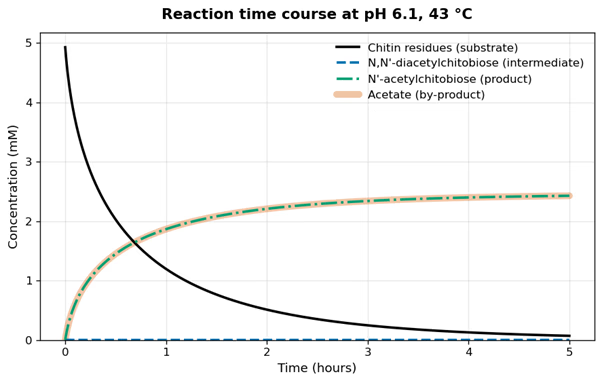
| The fusion protein can be treated as the combination of SmChiA and VcCDA, rather than its own unique entity. | This simplifies modelling by combining ODEs that would typically be specific to SmChiA and VcCDA. | Ignores fusion impact on enzyme functionality and intermediate channeling. |
| Polymer concentrations can be converted to monomer concentrations without significantly impacting the kinetics as a whole. | The concentration of a polymer’s binding sites for enzymatic action can never truly be known, but it will always be far smaller than the concentration of bound monomers making up that polymer. This assumption states that the artificial increase in reactive species, caused by treating monomers as the substrate, does not significantly impact the kinetics, primarily as a result of the kinetic parameters (such as turnover and Michaelis constant) correlating to activity on polymers and not monomers. | Causes a higher expected number of available reactive substrate species at any given time, potentially overestimating reaction rate. |
| N′-acetylchitotriose can be treated as the only product of PpChi. | This simplifies the PpChi model by selecting a single product rather than a range. | This has minimal impact on the project as a whole, as all of the potential monoacetylated products are desirable. |
| Acetylation of the substrate is considered entirely random. | This applies to the acetylation pattern of chitosan, thereby impacting the number of reactive species available as a substrate for PpChi. | Causes a higher expected number of available reactive substrate species at any given time, potentially overestimating reaction rate. |
| The double sigmoidal function [7] can be used to estimate the impact of environmental conditions on enzyme activity through direct multiplication with the turnover number. | This applies to the environmental impact of pH and temperature of the substrate on the kinetics as a whole. | A single equation may not be enough to accurately predict the impact of environmental effects on the kinetics. |
| Degradation of enzymes as a result of temperature conditions can be modelled using Bigelow’s laws [8]. | Enables the use of Bigelow’s model formulae to estimate thermal decay of active enzyme concentration [8]. | A single equation may not be enough to accurately predict the impact of temperature on enzyme decay. |
| The impact of enzyme impurity on kinetics is modelled using noncompetitive inhibition with chitin protein holding capacity rather than the inhibition constant. Impurities are treated as a single species of inhibitor, and chitin’s value is applied to all three enzymes. | Enables modification of the kinetic formulae to predict the impact of unit operation selection during the enzyme production stage of the bioprocess. | Lack of consistency amongst the different inhibition terms can be a source of inaccuracy. |
The primary formulae behind our model are based on the ODEs for noncompetitively-inhibited and dual-inhibited (noncompetitive & competitive) Michaelis-Menten kinetics [5] [6]. This has been done to simulate competitive inhibitors seen in literature as well as the inhibitory effect of impurities used for modelling purity. The standard Michaelis-Menten formula [5] (Equation 1), as well as the alternative formulae influenced by competitive (Equation 2), noncompetitive (Equation 3), and both (Equation 4) inhibitors [6] have been written out below.
Impurities neither compete with substrate nor exclusively bind to formed enzyme-substrate complexes, so noncompetitive inhibition was selected for modelling of enzyme purity [6]. Unfortunately, there is no single inhibition constant for a mixture of impurities. As such, the protein holding capacity () of chitin (0.032573g/g) [9] will be multiplied by the substrate concentration to establish a rate limiter term [10].
This produces alternative forms of Equations 3 and 4, being Equations 5 and 6, the two equations used for all kinetic formulae in this model.
The variables and constants within Equations 5 and 6 have been defined in Tables 2 and 3.
Table 2: List of variables within Equations 5 and 6.
| Parameter Symbol | Parameter Name | Unit |
|---|---|---|
| Product Concentration | mM | |
| Substrate Concentration | mM | |
| Reaction Time | s | |
| Competitive Inhibitor Concentration | mM | |
| Impurity/Debris Concentration | g/L |
Note that for the equations to be dimensionally valid, the value of S in the denominator of the noncompetitive inhibition term must be in g/L. This is solved later on through substrate derivation (see Equations 7, 13 and 20).
Table 3: List of constants within Equations 5 and 6.
| Parameter Symbol | Parameter Name | Unit | Description |
|---|---|---|---|
| Michaelis Constant (uninhibited) | mM | The value of where initial reaction rate is half of its maximum | |
| Inhibition Constant | mM | applied to rather than | |
| Total Active Enzyme Concentration | mM | The concentration of all enzyme in any state retaining enzymatic capability | |
| Turnover Number | 1/s | The rate that substrate units are converted to product | |
| Protein-Holding Capacity | g/g | The amount of protein that can bind to the surface of the substrate, reducing its reactivity in this context |
SmChiA enzyme performs hydrolysis of beta 1-4 glycosidic bonds in chitin () to generate N,N′-diacetylchitobiose molecules (). It works well on colloidal chitin due to the presence of the acetyl group at the -1 residue, enabling substrate-assisted catalysis. As chitin is an insoluble polymer, the reaction pathway is not the simple 2-step action needed for Michaelis-Menten kinetics to apply [11]:
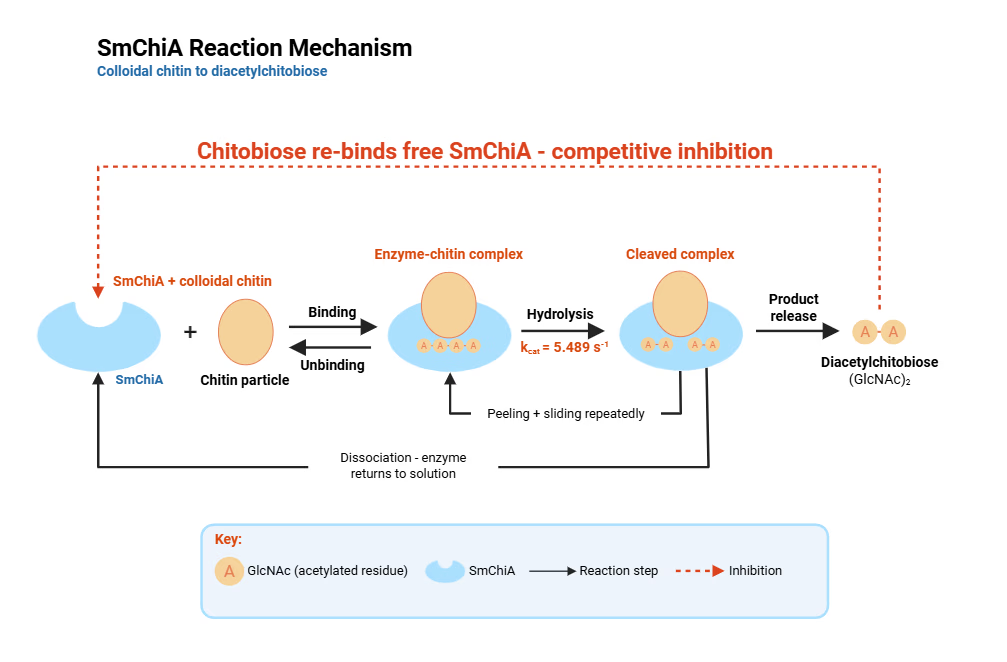
The reaction pathway of SmChiA involves a reversible binding step, followed by a unique irreversible step. The latter consists of cleavage of the beta 1-4 glycosidic bond between the 2nd and 3rd exposed residues to release chitobiose, followed by further unpeeling of chitin to release more residues. Only through eventual dissociation or complete degradation of chitin will the enzyme return to its free state. Additionally, chitobiose can bind to the free enzyme, acting as a competitive inhibitor.
To obtain a useable substrate concentration, the concentration of colloidal chitin () should be divided by the molecular weight of each N-acetylglucosamine residue (), not including the weight of water (due to the presence of the glycosidic bond).
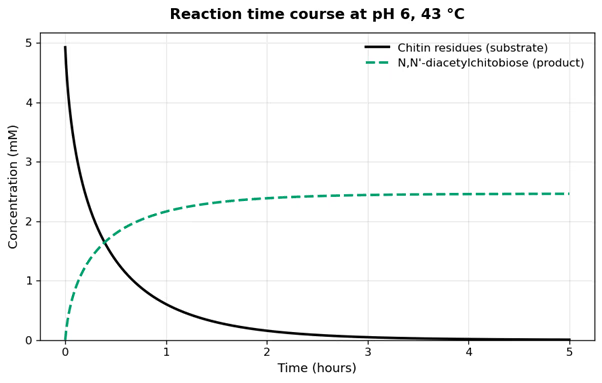
Now that standard Michaelis-Menten kinetics can be applied, it should be noted that chitobiose () is an inhibitor [4], so Equation 6 is used.
Something to note is that there is a molar ratio of 2:1 between residues () and diacetyl chitobiose (). Despite this, the rate is dependent on the amount of exposed residues which come in pairs regardless. For this reason, having a 2x coefficient in Equation 9 but not in Equation 8 does not disturb the mass balance in any way and is perfectly accurate. To confirm this, the fusion model will print the mass balance error, which is done on the basis of starting residue quantity.
VcCDA performs hydrolysis of acetamido bonds on the reducing end residue of N,N′-diacetylchitobiose () to generate N′-acetylchitobiose molecules () as well as acetate (). This reaction scheme is significantly simpler than SmChiA’s [2], simply being reversible complex formation followed by hydrolysis and release of both product and byproduct, returning the enzyme to its free state after each action:
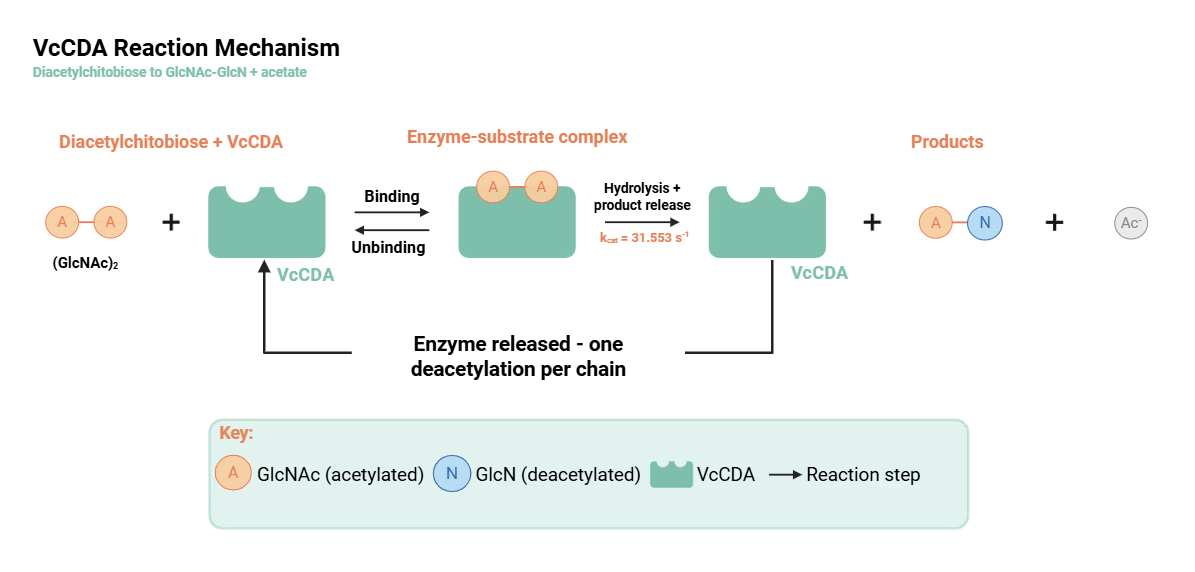
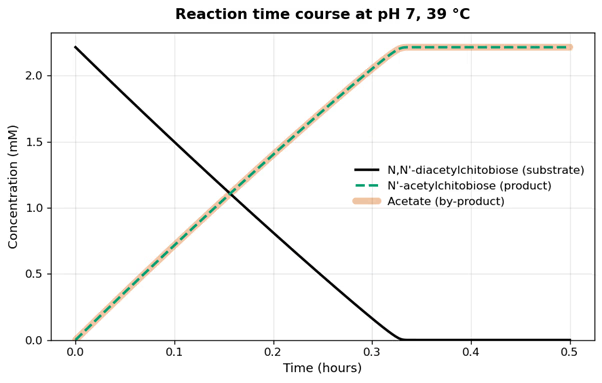
With little evidence for inhibition of VcCDA (see the Choice Sensitivity section for inclusion of the sole exception for a different deacetylase [12]), the kinetic formulae for VcCDA can be derived from Equation 5.
Note: Equation 10 has an term in its impurity inhibition term. This is an approximation generated from Assumption 11 for simplicity. As seen in the Results and Discussion section, this does not negatively impact the reliability of the model.
For simplicity, the mechanism of the fusion is simply the combination of SmChiA and VcCDA in tandem:
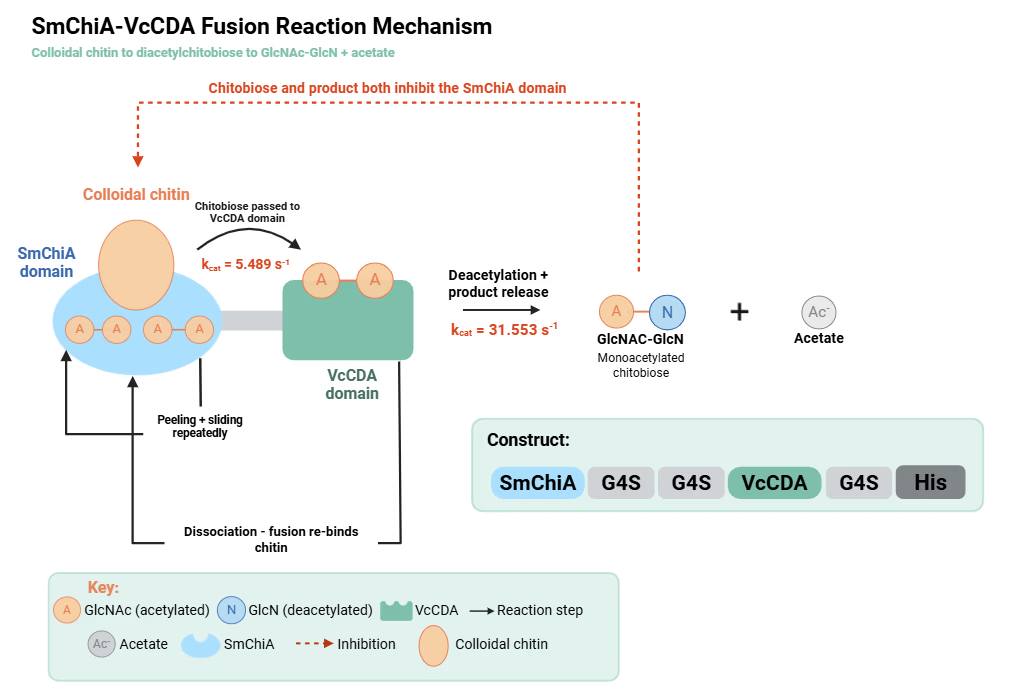
As such, the ODEs of SmChiA and VcCDA (Equations 7 through 12) are combined with just a couple modifications to create the model for the fusion enzyme:
Table 4: Summary of constant values for the fusion enzyme kinetic ODEs.
| Parameter Symbol | Parameter Name | Unit | Value | Source |
|---|---|---|---|---|
| Reference SmChiA Turnover Number | 1/s | 2.54 | [4] | |
| SmChiA Michaelis Constant | mM | 2.56* | [4] | |
| Chitobiose Inhibition Constant | mM | 0.159 | [4] | |
| Reference VcCDA Turnover Number | 1/s | 28.1 | [2] | |
| VcCDA Michaelis Constant | mM | 0.01 | [2] | |
| Protein-Holding Capacity | g/g | 0.032573 | [9] |
*Recalculated to match new substrate using Equation 13 (residues instead of polymer).
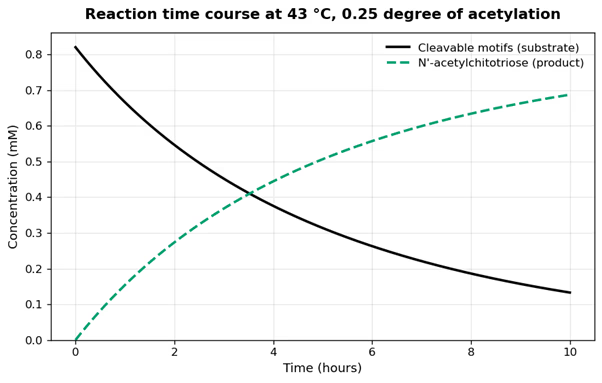
PpChi hydrolyses the same bond as SmChiA, though it does not possess decrystallisation capability, meaning that it heavily prefers chitosan, the deacetylated, and therefore soluble, form of chitin. Despite this, it produces longer chitooligosaccharide products [3], which are potentially better chelators than chitobiose [13].
Whilst the polymer is soluble, it still needs to be converted to usable units, being motifs () of GlcN-GlcN-GlcNAc, the bound form of the product (). The number of these motifs is dependent on the degree of acetylation (DA), which impacts the number of motifs per residue () and the average molecular weight of each residue ().
Due to the solubility of chitosan and the lack of a decrystallisation step, PpChi’s mechanism of action is closer to VcCDA’s than SmChiA’s, consisting of a reversible complex formation step followed by hydrolysis and release of product:
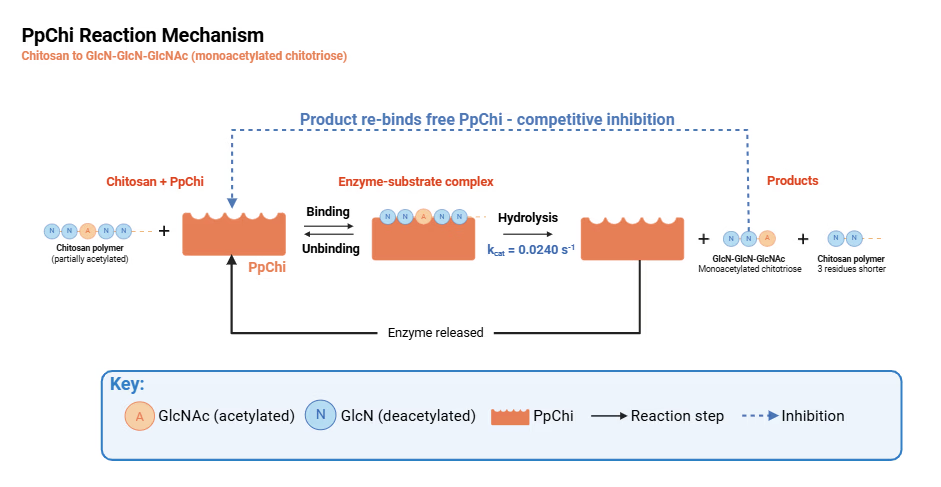
Acknowledging competitive product inhibition based on a similar enzymatic reaction [14], the kinetic formulae can be derived from Equation 6:
Table 5: Summary of constant values for PpChi’s enzyme kinetic ODEs.
| Parameter Symbol | Parameter Name | Unit | Value | Source |
|---|---|---|---|---|
| Reference PpChi Turnover Number | 1/s | 0.023 | [3] | |
| PpChi Michaelis Constant | mM | 0.0197* | [3] | |
| Chitotriose Inhibition Constant | mM | 0.015 | [14] | |
| Protein-Holding Capacity | g/g | 0.032573 | [9] |
* Recalculated to match new substrate using Equations 18-20 at reference DA (90%) (motifs instead of polymer).
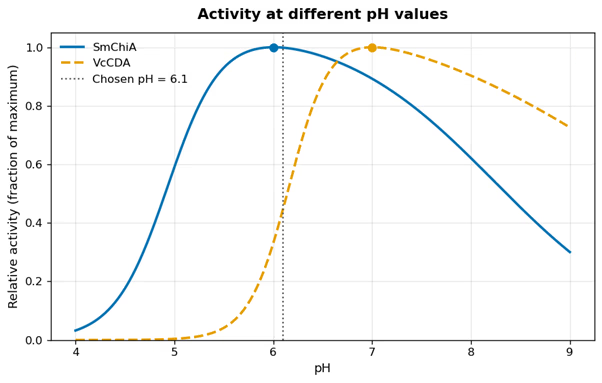
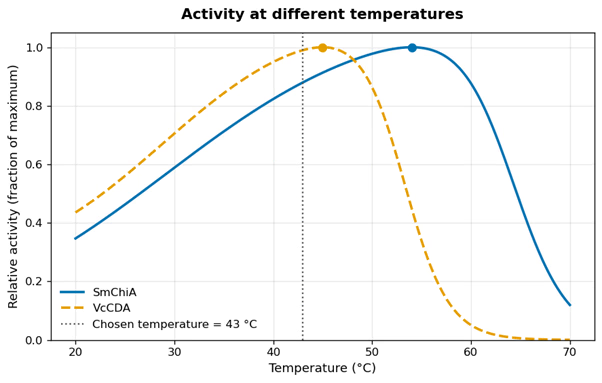
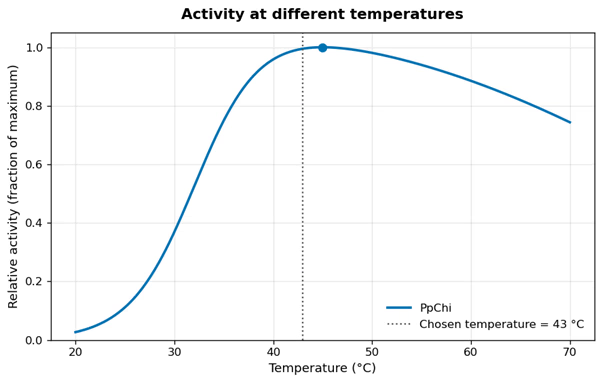
One of the primary considerations when using these enzymes is to find the optimal reaction conditions. That said, the data needed for precise determination is not always available, instead requiring interpolation through the use of double sigmoidal functions [7]. This is a combination of two sigmoidal (S-shaped curves) used to simulate an exponential increase in activity toward the peak without forming a single sharp peak but rather a soft plateau:
The double sigmoidal function is used to create the pH () and temperature () rate-modifier functions used in Equations 24 (fusion) and 25 (PpChi):
As the enzymes are all stable across a wide range of pHs [1] [2] [3], and PpChi is on its own with no other enzymes to compromise with, there is no reason not to use its literature pH optimum (pH 6) [3], hence why () is not present in Equation 25.
Rearranging Equations 24 and 25 enables derivation of (Appendix).
Through derivation (Appendix), Equation 23 can be converted to the form used in the model (Equation 26):
Table 6: Summary of constant values used in Equation 26.
| Function | Source | ||||||||
|---|---|---|---|---|---|---|---|---|---|
| 0.9250 | 0 | 1 | 0 | 3.6953 | 1.2563 | 4.94 | 8.24 | [1] | |
| 0.8803 | 0 | 1 | 0 | 0.0895 | 0.3631 | 29.19 | 64.19 | [1] | |
| 0.8741 | 0 | 1 | 0 | 4.8334 | 0.7685 | 6.17 | 9.72 | [2] | |
| 0.8880 | 0.19 | 1 | 0 | 0.1291 | 0.4459 | 28.80 | 53.20 | [2] | |
| 0.8856 | 0 | 1 | 0 | 0.3033 | 0.0633 | 32.18 | 80.38 | [3] |
Note the unusually-high value of for . This is likely caused by the literature source the value was derived from being unreliable, though unfortunately no other source was available to be used.
Figures 9–11
From the rearranged Equations 24 and 25:
Table 7: Maximum turnover number values used in Equations 24 and 25.
| Constant Name | Value | Unit |
|---|---|---|
| 5.489 | 1/s | |
| 31.553 | 1/s | |
| 0.0240 | 1/s |
During literature review, an issue with determining temperature optima arose – many enzyme assays do not test reaction rate for long enough for the impact of thermal degradation to become present. This means that these non-extremophilic enzymes all appear to have very high temperature optima. To make parameter optimisation more accurate for a multiple hour process such as chitin/chitosan hydrolysis, thermal degradation was modelled [8]:
For Equation 27, and therefore thermal degradation, to be modelled, the value of must be found (Appendix). To do this, the equation is rearranged:
Table 8: Components of Equation 28.
Note: the derivation for VcCDA uses multiple sources due to a lack of data.
Figures 12–14
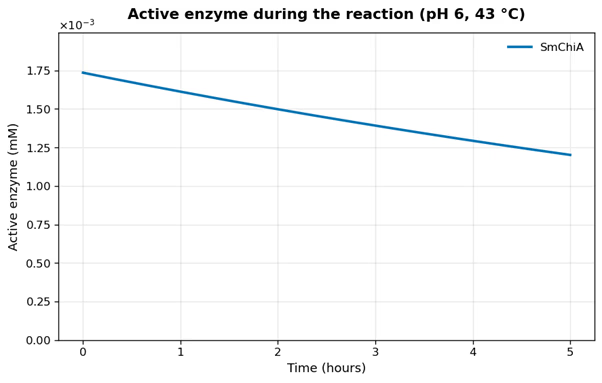
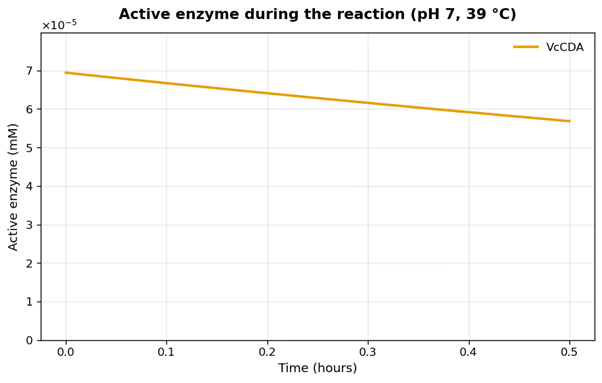
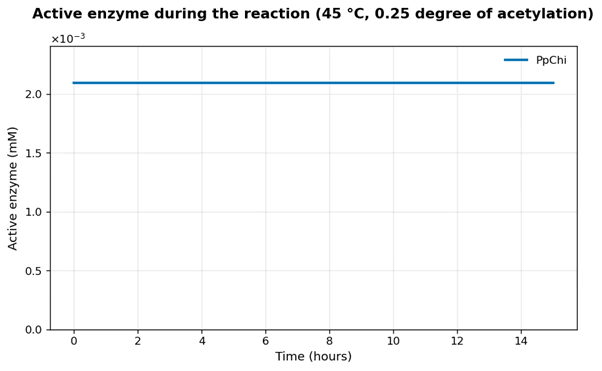
As seen above, PpChi is thermostable.