Loading...
Loading...

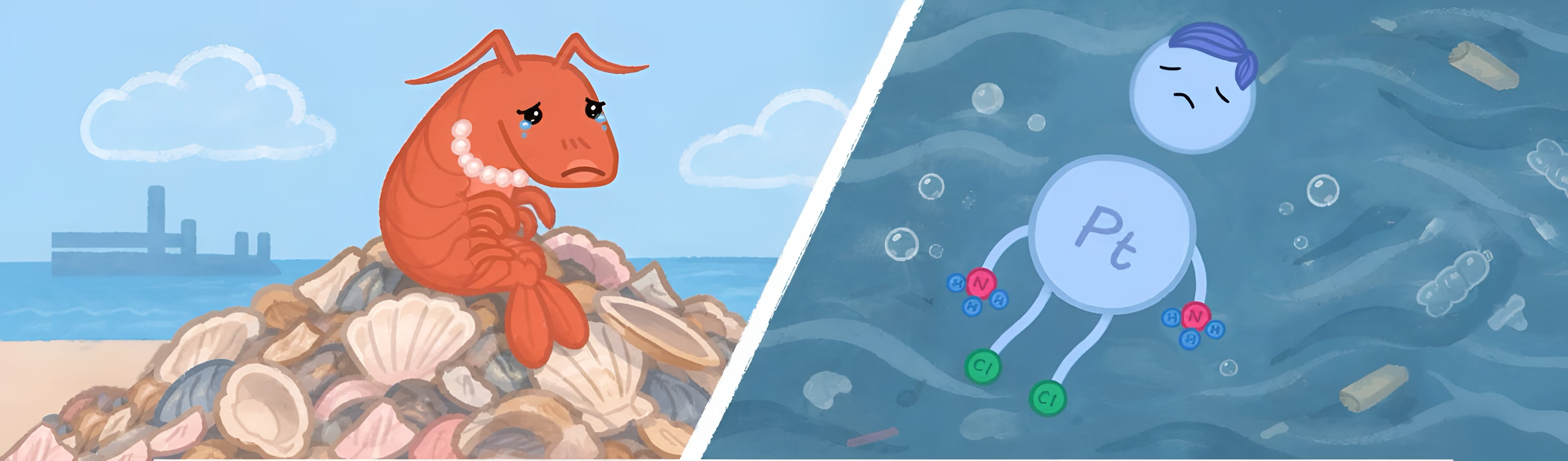
Toxic metals are polluting rivers and lakes worldwide. A meta-analysis of studies from 2010 to 2022 found average levels of lead, cadmium, chromium, mercury, nickel and more above World Health Organization drinking-water limits [1]. Unlike most pollutants, metals don’t break down: once in the water, they stay there unless they are captured.
One overlooked source of this metal pollution lies within cancer treatment. Over 403,000 people in the UK are diagnosed with cancer each year [2], and many are treated with cisplatin, a platinum-based chemotherapy. Most of that platinum leaves the body in urine and is flushed into sewers that were never built to remove it [3].
At the same time, a second waste problem is growing. The seafood industry discards up to 8 million tonnes of crab, shrimp and lobster shells every year [4]. Most of it is dumped at sea or sent to landfill [5], and in the UK disposal costs around £60 per tonne [4]. Yet these shells are rich in chitin, a valuable material that the seafood industry overlooks, treating it as waste.
Cisplatin has been used to treat cancer since 1978. Combined with other drugs, its cure rate is more than 90% for testicular cancers, and it is also used against bladder, breast, lung, ovarian, cervical and head and neck cancers [6]. Platinum-based drugs are prescribed for an estimated 10–20% of all cancer patients [6], and work by binding to DNA and stopping cells from dividing, which is what makes them harmful once they leave the body.
The treatment is not the problem; what happens to the drug afterwards is.
About 75% of an administered platinum drug leaves the body in urine, and most of it is gone fast: 43–48% of a cisplatin dose is excreted within the first four hours after treatment [3]. That urine goes straight down the toilet, whether the patient is on a ward or back at home.
Once flushed, urine containing cisplatin is handled exactly like ordinary household sewage. UK guidance bans pouring cytotoxic drugs down the drain, even rinsing out an empty bottle, but there is no requirement to treat patients’ urine before it enters the sewer [7]. The UK is not alone: most countries treat hospital wastewater like domestic sewage, sending it into the general sewer with no pre-treatment [8]. At no point along the way is there a step designed to remove platinum.
Platinum drugs harm aquatic life at concentrations as low as nanograms per litre, causing DNA strand breaks, reduced reproduction and loss of photosynthetic pigments [3]. Long-term, low-level exposure risks chronic genetic damage in animals and potentially humans [3].
Pilot activated sludge and membrane bioreactor systems have been reported to remove less than 63% of platinum drugs, and advanced methods such as ozonation suffer from high costs and energy demands [3]. Furthermore, these methods often break cisplatin down into another form without removing the platinum from wastewater. To fully solve this issue, the metal must be captured and removed.
In crabs, the shell can make up to 60% of the animal’s mass [5], so much of every catch never reaches a plate. Most of it is dumped at sea or sent to landfill, where leftover tissue rots, causing foul odours and visual pollution and altering the surrounding soil, water and marine ecosystems [5].
This also wastes a valuable resource. Chitin comprises 20–30% of shellfish shells [4], and chitin-based materials are already used in cosmetics, food preservation, wound healing and bio-based packaging [5]. But the conventional way of extracting chitin relies on concentrated acids and bases at high temperatures, followed by hazardous organic solvents [4], so even putting shells to use can create a pollution problem of its own.
Since most of the platinum leaves the body within hours of treatment [3], the patient’s urine is the place to catch it, so any solution has to go wherever patients go.
Chitosan, derived from the chitin in shellfish shells, captures platinum faster than biochar or wood ash [9], and is a low-cost resource.
That is why we built SHELLter: a closed-loop system that turns shellfish waste into a biosorbent that captures cisplatin from patients’ urine, tackling both problems at once.
Cisplatin is just our starting point. SHELLter is a platform technology that could be adapted to capture the many metals polluting our water bodies.
Drag to spin