


Loading...
Loading...


In order to showcase the potential of SHELLter as a large-scale platform technology, we designed parts to achieve high protein expression and purity. Beyond ensuring our project was a success, we expanded and improved upon existing iGEM deposits as well as creating new parts for future teams to build upon.
Beginning with extensive literature review, we identified the enzymes sequences we would use as the basis for our research: Serratia marcensens Chitinase A, Vibrio cholerae CDA and Paenibacillus pabuli Chitinase. Next, we looked into part characterisation, establishing what was missing from existing biobricks and how they could be improved upon. We decided to add solubility tags and test the role of codon-optimisation, with the hypothesis that this would allow us to better express and purify our enzymes. Our SmChiA and VcCDA biobricks bring new characterization and purification data to the registry, whilst PpChi and fusions of SmChiA and VcCDA are entirely new contributions.
Table 1: Source sequences and parts built upon in our project, including the reasoning for any additions.
| Enzyme | BBA code | Source | Codon Optimisation (in source sequence) | Challenges Identified | Optimisation | Optimisation rationale |
|---|---|---|---|---|---|---|
| SmChiA | BBa_K1913000 | iGEM registry: Wageningen_UR 2016 | Yes | Incomplete expression results and no purification data | Addition of a C-terminal His tag | Adding a solubility tag enables protein purification via IMAC, yielding both clearer SDS Page results and purified protein for activity assays. |
| SmChiA | AF085718 | Wu, 2009 | No | N/A | Addition of a C-terminal His tag | Variant made was the same as that of the biobrick-derived enzyme, allowing for comparison of expression and purification. |
| VcCDA | BBa_K2380044 | iGEM registry: TU_Darmstadt 2017 | Yes | Incomplete expression results and no purification data | Two variants made: one with a C-terminal His tag and one with a C-terminal Strep tag | Adding a solubility tag enables protein purification via IMAC, yielding both clearer SDS Page results and purified protein for activity assays. Variants with different solubility tags were made to test for the optimal tag for expression and purification. |
| VcCDA | NC_002505 | Li, 2007 | No | N/A | Two variants made: one with a C-terminal His tag and one with a C-terminal Strep tag | Variants made were the same as that of the biobrick-derived enzyme, allowing for comparison of expression and purification. |
| PpChi | BK122_02780 | Li, 2021 | Yes | N/A This enzyme was fully-characterized and well-documented in the source paper. | Addition of a C-terminal His tag | This enzyme can perform a one-step reaction to substitute the need for a chitinase and a deacetylase. It serves as a valuable new contribution to the registry. The solubility tag was added to allow for IMAC purification. |
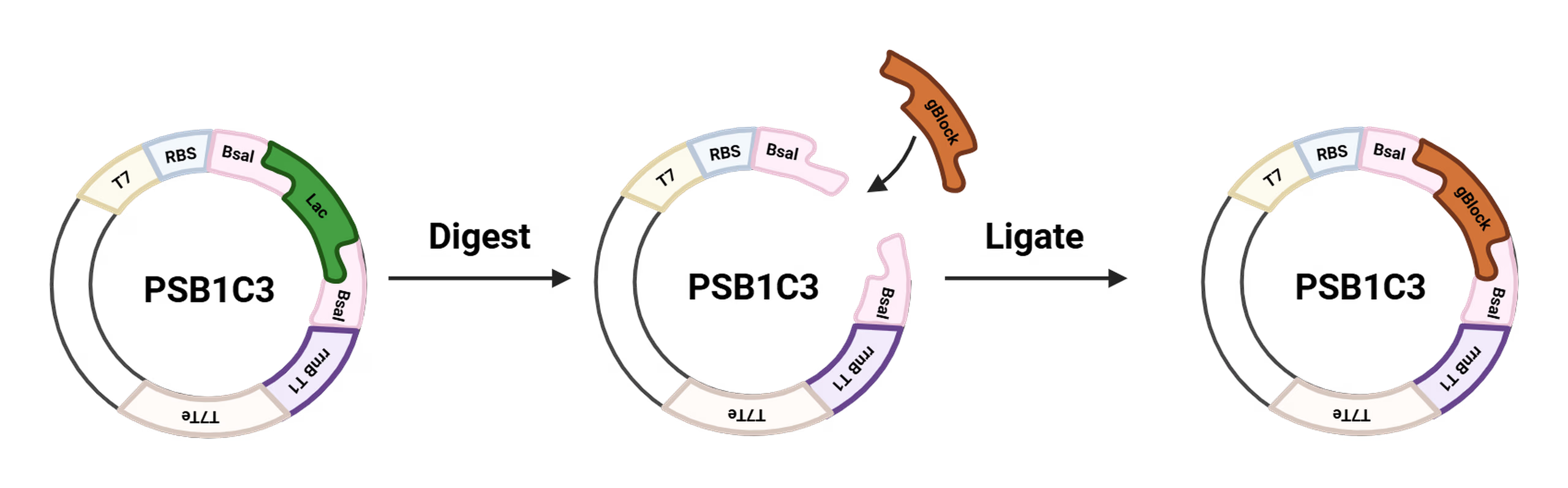
The vector used for Golden Gate cloning was a modified version of the pSB1C3 plasmid by the UCL 2018 iGEM team, in the registry as BBa_K2842666. The plasmid was modified by Cameron Cruickshanks (Department of Biochemical Engineering, UCL) to remove the two BsaI sites which flanked a cassette containing a lac promoter-RBS-lacZ-rrnb T1-T7Te which allowed for blue/white colony screening. A modified sequence containing T7 promoter-RBS-BsaI-lac promoter-RBS-lacZ-BsaI-rrnb T1-T7Te were inserted to replaced this region. Within the new sequence, BsaI sites were introduced to flank the lac promoter-RBS-lacZ. This enabled our gBlocks to replace the lacZ sequence via Golden Gate cloning using BsaI and the overhangs TACA and ACGG and inserting into the correct position downstream of the T7 promoter and the RBS and upstream of the two terminators. The presence of the lacZ allowed colony selection via blue/white screening. The advantage over the original plasmid is that we did not need to include the T7 promoter, RBS and Terminators in our gBlock designs, as would have been necessary if we had used the original vector BBa_K2842666. We thank UCL iGEM 2018 for the original construct and Cameron for the modification.
For individual enzyme contributions, we created multiple variants for each enzyme, allowing for comparison and evaluation of their expression and activity. SmChiA and VcCDA variations include Codon-optimised and non Codon-optimised sequences as well as the addition of a His tag in the C terminus (separated via G4S). VcCDA, has two additional variants that have a Strep tag (separated via G4S) in the C terminus.
All of the enzymes, unless specified otherwise, were ordered as IDT gblocks. Firstly, any forbidden sites such as BsaI and SapI were removed, when applicable, ensuring our cloning procedure complied with RCF[1000]. Secondly, BsaI sites were added at the 5’ and 3’ ends of the gene of interest (nucleotide sequence of enzymes). Lastly, gblocks were ordered, ready for Golden Gate cloning.
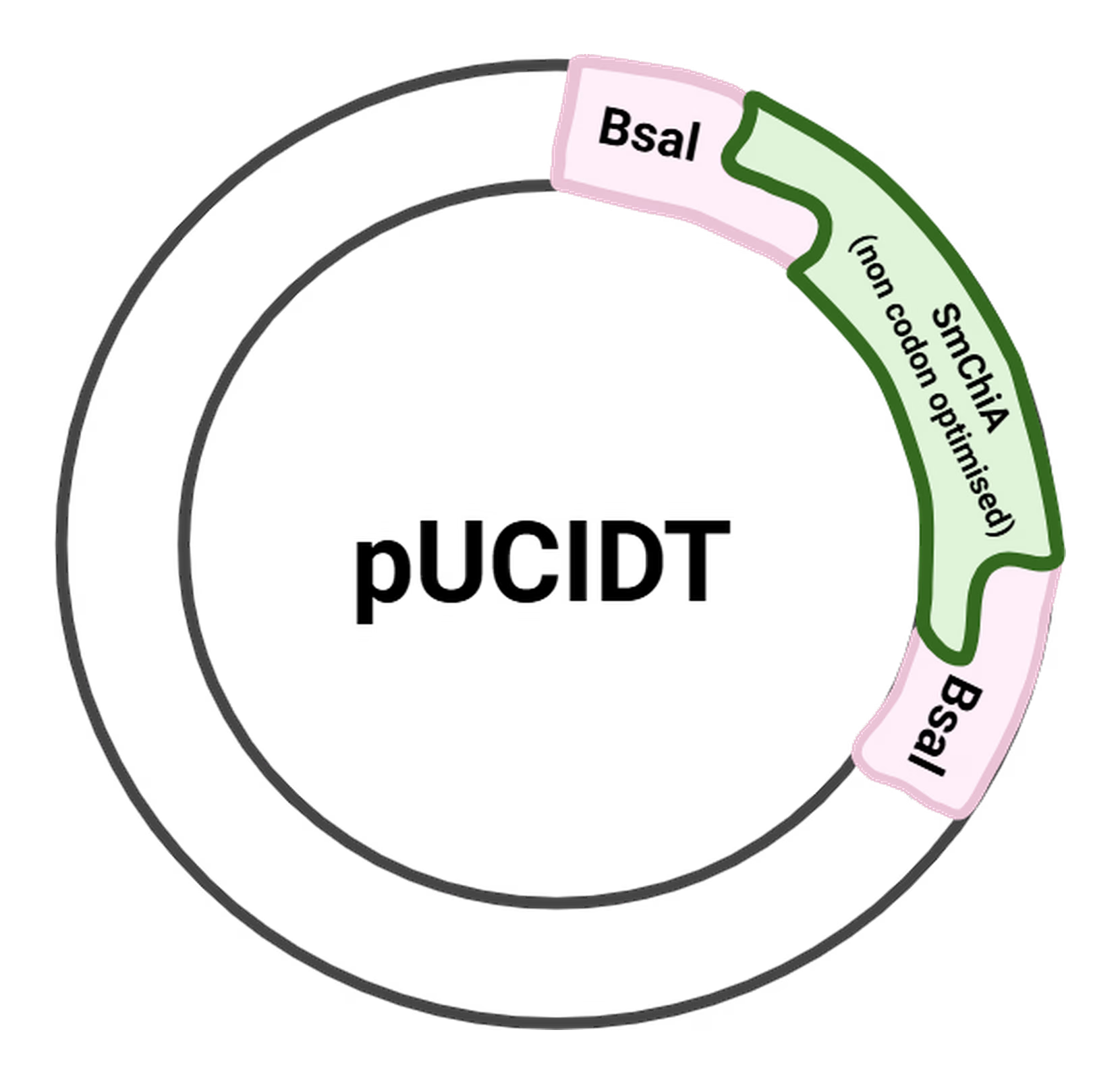
Three different literature sources were identified as candidates for the original sequence of SmChiA, including (Tu, 2010) and (Vaaje-Kolstad, 2013). However, our non Codon-optimised sequence for SmChiA was obtained from Wu, 2009. This is because the Wu, 2009 sequence, whilst very similar to Tu, 2009, was characterised in a way more aligned with our project focus, being action upon colloidal chitin to produce chitobiose. On the other hand, Tu, 2009 used SmChiA for solid chitin in live varroa destructor whilst Vaaje-Kolstad, 2013 serves primarily as a review article with significantly less data for ChiA compared to other variants (e.g. SmChiB). Nevertheless, IDT rejected the creation of this sequence in a gblock due to its structural complexity. Therefore, the “Genes in tubes” service was used with the pUCIDT vector to order the gene for this enzyme as seen in Figure 2.
Parts:

For the codon optimised sequence, there have been numerous efforts from previous iGEM teams to express ChiA, notably BBa_K1913000. Nevertheless, after translation, this biobrick was 98.6% identical to Wu, 2009 over an ungapped alignment and differed at eight positions. Five of the eight substitutions were conserved or semi-conserved (I226V, L235M, H263R, A351V, I385V); the remaining three (P139A, S156F and K433T) involved radical amino acid changes. In order to ensure the comparison of variants are solely from codon optimisation, we mitigated differences in enzyme behaviour Therefore, to mitigate the changes and to ensure the comparison of variants are solely from codon optimisation, we have corrected the eight amino acid substitutions in the biobrick sequence to the non-codon optimised sequence so that both constructs encode the same polypeptide SmChiA. At each position, codons were changed to the one that encodes for the original amino acid by using the Codon Frequency table for Escherichia coli.

The non-codon optimised sequence for VcCDA was obtained from Li, 2007.
Parts:


The codon optimised sequence for VcCDA was initially submitted as BBa_K2380044 (TU Darmstadt 2017). This initial submission had been previously improved upon by adding a His Tag in the C terminus: BBa_K2848002 (Stuttgart, 2018). Using the original BBa_K2380044 sequence, we added a His tag in the C terminus separated via G4S. The G4S flexible linker acts as a spacer to prevent the His tag from interfering with the functionality of the enzyme.
Parts:


For PpChi, as the discovery is novel and has been codon optimised in the published paper, we used the sequence from Li, 2021.
Parts:

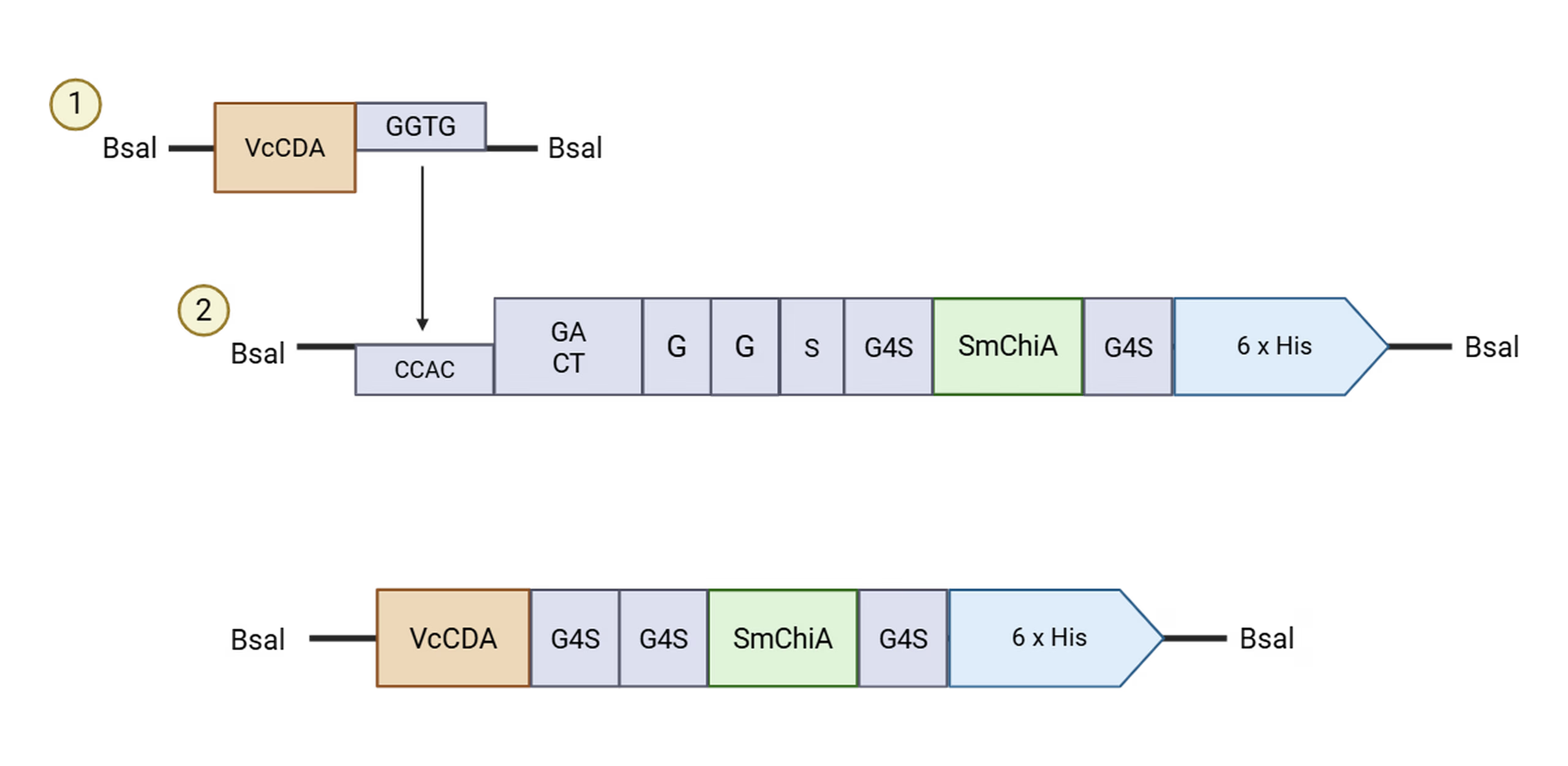
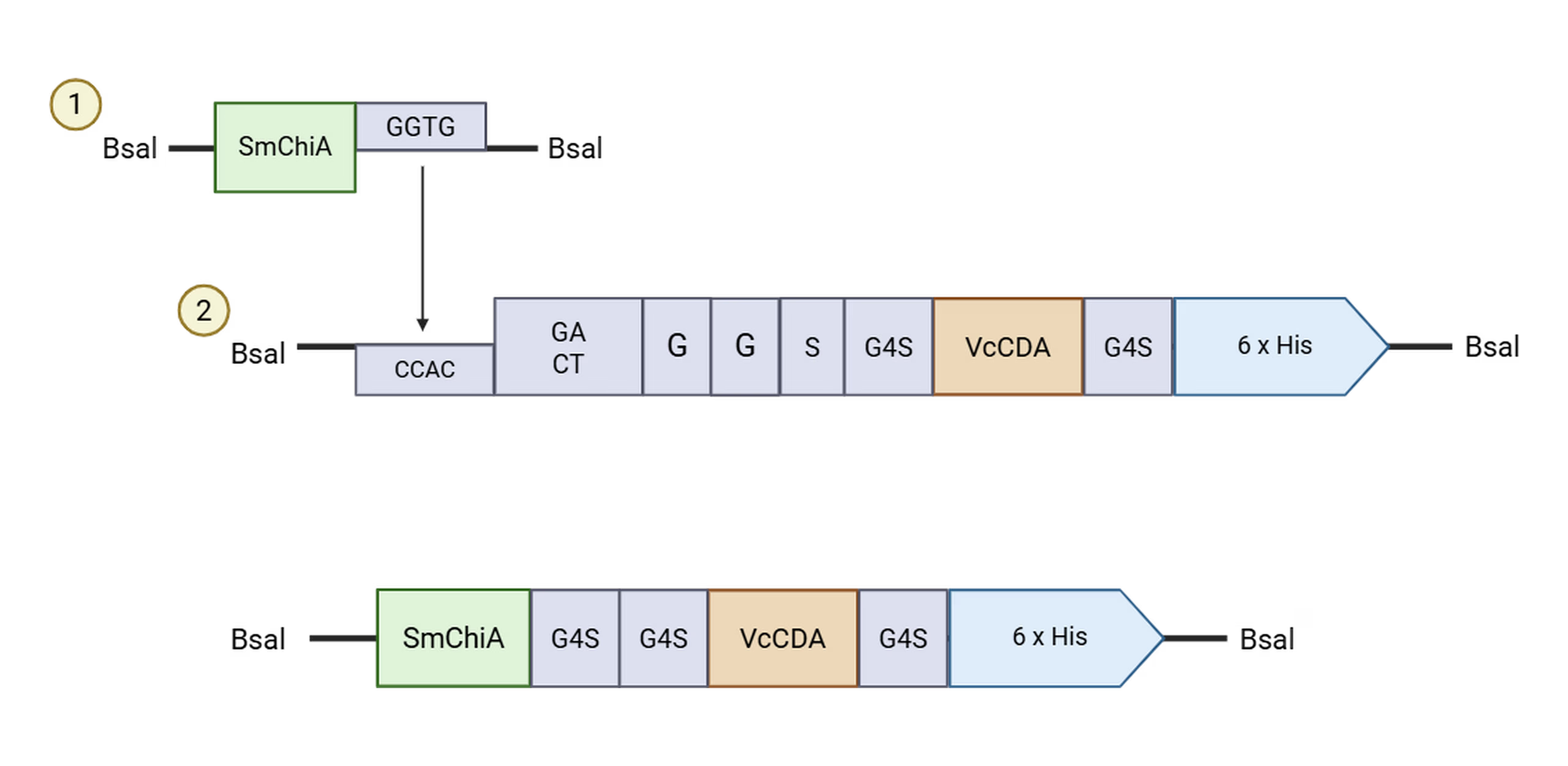
We created two fusion enzymes of VcCDA and SmChiA. These constructs consist of both enzymes, fused with a (G4S)2 linker, with a His tag added on the C terminus (separated via G4S). Only Codon-optimised variants were used, as non Codon-optimised sequences appeared too complex attempting to order them from gene synthesis services. Each fusion complex had the enzymes fused in an opposite order (SmChiA-VcCDA and VcCDA-SmChiA), designed to validate the conclusions drawn from docking simulation dry-lab results.
Following structure prediction using AlphaFold 3, we found that SmChiA’s active site lay close to its N-terminus, leading to concerns regarding conformational changes due to domain order and tag position. The aim of the docking simulation was to computationally assess whether the order of domains in the fusion enzyme would affect the binding affinity of each domain, and whether the function of one domain affected the other. We were able to determine that within the fusion each domain was still capable of binding and structurally responding to its own substrate. Furthermore, multiple tests, including dual-docking, additivity, and structure, agreed that the binding occurring at one site did not affect binding occurring at the other neither functionally nor structurally. However, what we did not expect was for the results to show that the largest effects were seen between tag position rather than domain order, as thermodynamic stability was seen to be better in the tag-last constructs.
In order to conserve time when ordering the gblocks, we shifted to using two separate fragments. Two gene fragments flanked by BsaI sites were used to perform Golden Gate reactions, using two inserts and the vector pSB1C3. The fusion enzyme was split in two; the first fragment contained the coding sequence for the first enzyme, followed by the overlapping region GGTG, followed by a BsaI site. The second fragment contained a BsaI site, overlapping region CCAC, followed by a (G4S)2 linker, and the second enzyme which was fused with a C-terminal His tag separated via G4S.
Parts:
All the parts created and used throughout the UCL iGEM 2026 project appear in the table below.
Table 2: All the parts created and used throughout the UCL iGEM 2026 project.
| Code | Name | Category | Type |
|---|---|---|---|
| BBa_26QZGVGT | VcCDA_Codon Optimised_His Tag | Basic | CDS |
| BBa_26UZ916X | VcCDA_Codon Optimised_Strep Tag | Basic | CDS |
| BBa_26HFM8MM | VcCDA_Non Codon Optimised_His Tag | Basic | CDS |
| BBa_26U3EZT0 | VcCDA_Non Codon Optimised_Strep Tag | Basic | CDS |
| BBa_26ST8NQ6 | SmChiA_Codon Optimised_His Tag | Basic | CDS |
| BBa_26ZLWPZS | SmChiA_Non Codon Optimised_His Tag | Basic | CDS |
| BBa_26YQ974E | PpChi_His Tag | Basic | CDS |
| BBa_264AJFMD | Fusion Enzyme_VcCDA-ChiA-His Tag | Basic | CDS |
| BBa_26JA8X8F | Fusion Enzyme_ChiA-VcCDA-His Tag | Basic | CDS |
| BBa_26XMC49J | T7-RBS-VcCDA (Codon optimised), His tag-rrnB T1-T7Te | Composite | Plasmid |
| BBa_265ULDC5 | T7-RBS-VcCDA (non Codon optimised), His tag-rrnB T1-T7Te | Composite | Plasmid |
| BBa_264FMC6Q | T7-VcCDA (non Codon optimised), Strep tag-rrnB T1-T7Te | Composite | Plasmid |
| BBa_26FXOFPE | T7-RBS-VcCDA (Codon optimised), Strep tag-rrnB T1-T7Te | Composite | Plasmid |
| BBa_2626I484 | T7-RBS-SmChiA (codon optimised), His tag-rrnB T1-T7Te | Composite | Plasmid |
| BBa_260EG9PN | T7-RBS-SmChiA (non codon optimised), His tag-rrnB T1-T7Te | Composite | Plasmid |
| BBa_26U8IQFO | T7-RBS-PpChi, His tag-rrnB T1-T7Te | Composite | Plasmid |
| BBa_26VVV8P4 | T7-RBS-VcCDA-SmChiA, His tag-rrnb T1-T7Te | Composite | Plasmid |
| BBa_26D66LW2 | T7-RBS-SmChiA-VcCDA, His tag-rrnb T1-T7Te | Composite | Plasmid |
| BBa_K5357000 | E. coli Ribosome Binding Site (RBS) | Basic | RBS |
| BBa_K5357001 | T7 Promoter | Basic | Promoter |
| BBa_K5357006 | T7Te Terminator | Basic | Terminator |
| BBa_B0010 | rrrnB T1 Terminator | Basic | Terminator |