
Sensing notebooks
The sensing notebooks cover both the computational design of aptamers and the experimental testing. Together, they show the progression from in silico design to experimental validation. Click on them to know more.
Sensing TFA using de novo in silico designed riboswitches. (Boudewijn)
Week 1-2 (11-22 May)
Aim: preparing experiments on paper
Protocols/Methods: -
Observations/results: -
Week 3 (25-29 May)
Aim: Amplify GFP drop-out cassette
Protocols/Methods: Q5 high fidelity PCR, gel electropherese and PCR cleanup.
Observations/results: The drop-out cassette was successfully amplified.
Week 4 (1-5 June)
Aim: Making glycerol stocks of E.coli with ordered plasmids, containing F12 fluoride riboswitches, and sequence sed plasmids.
Protocols/Methods: Plating cells. Making overnight culture. Making glycerol stocks. miniprep done for sequencing.
Observations/results: Successful glycerol stocks were made, and miniprepes where done.
Week 5 (8-12 June)
Aim: Clone drop-out cassette in the new plasmid. testing the fluoride riboswitches
Protocols/Methods: Digestion, pcr cleanup, ligation, making a NaF solution, cell preparation for plate reader and plate reader run
Observations/results: Failure to clone the drop-out cassette due to forgetting to transform the ligation mixture. Plate reader did not yield the expected results because of failure preparing the plate reader.
Week 6 (15-19 June)
Aim: Second attempt at cloning
Protocols/Methods: New GFP QPCR and DNA digestion.
Observations/results: GFP pcr was successful and DNA digestion was also successful.
Week 7 (22-26 June)
Aim: Second attempt at cloning of drop-out casette
Protocols/Methods: DNA ligation. heat shock, liquid cell culture, miniprep and making a glycerol stock.
Observations/results: Ligation occurred successfully. So did the transformation and the making of the glycerol stock.
Week 8 (29 June-3 July)
Aim: Second attempt at testing fluoride riboswitch, and cloning first batch riboswitches.
Protocols/Methods: Plate reader assay, Q5 PCR, Digestion of new riboswitches, and digestion of drop-out cassete containing plasmids.
Observations/results: The PCR and digestions were successful, gel PCR cleanup was less successful than regular PCR cleanup, for this reason only regular PCR cleanup persued afterwards. The plate reader assay didn’t produce the expected results –> the author of the paper was contacted.
Week 9 (6-10 July)
Aim: Toxicity assay, cloning first batch de novo riboswitches.
Protocols/Methods: Digestion, preparing PFOA solutions in water, plate reader assay, PCR cleanup.
Observations/results: PFOA toxicity assay did not show strong toxicity effect of PFOA, this might be due to the PFOA in water "sticking" to the glass bead. Next time PFOA solutions were prepared in methanol, which prevents sticking. The cleanup from the PCR mixture was more successful than the cleanup from the gel.
Week 10 (13-17 July)
Aim: Making negative control bacteria and PFOA toxicity assay.
Protocols/Methods: Digestion, gel electropherese, PCR cleanup, ligation, heat shock transformation, liquid cell culture, making, glycerol stocks, making PFOA solutions in methanol, plate reader assay.
Observations/results: Once again no growth inhibition with PFOA dissolved in methanol. Successful cloning and transformation with negative control plasmids.
Week 11 (20-24 July)
Aim: Second attempt getting fluoride riboswitches to work
Protocols/Methods: Overnight culture, plate reader assay.
Observations/results: Not the expected result in the plate reader assay, due to toxicity of high fluoride cultures.
Week 12 (27-31 July)
Aim: Ligate the new PFOA riboswitches
Protocols/Methods: Ligation, heat shock transformation.
Observations/results: Results varied regarding the cloning, a few plates gave good results, but a lot didn’t.
Week 13 (3-7 August)
Aim: Successfully clone more riboswitches
Protocols/Methods: Heat shock transformation.
Observations/results: Results varied regarding the cloning, a few plates gave good results, but a lot didn’t –> change to golden gate cloning strategy.
Week 14 (10-14 August)
Aim: Testing flow cytometer experimental setup and plate reader assay first PFOA riboswitches.
Protocols/Methods: Flow cytometer fluoride riboswitches and plate reader assay PFOA riboswitches.
Observations/results: Plate reader assay de novo PFOA riboswitches did not produce positive results, but flow cytometer experiment did produce expected results –> continuation that method. Also testing in vitro aptamers as potential alternatives in the future.
Week 15 (17-21 August)
Aim: Testing in vitro aptamers, testing de novo riboswitches in the flow cytometer.
Protocols/Methods: in vitro aptamer preparation, plate reader assay, flow cytometer assay.
Observations/results: Expected results from in vitro aptamers not shown –> method discontinued. No positive results from de novo riboswitches.
Week 16 (24-28 August)
Holiday
Week 17 (31 August-4 September)
Aim: Second attempt golden gate cloning riboswitches.
Protocols/Methods: Q5 protocol, golden gate cloning, heat shock transformation, colony pcr.
Observations/results: Successful second attempt of cloning of some of the first batch of riboswitches, done with colony pcr. Other riboswitch cloning not so successful
Week 18 (7-11 September)
Aim: Second attempt golden gate cloning first batch riboswitches, beginning cloning second batch of riboswitches.
Protocols/Methods: Q5 protocol, golden gate cloning, heat shock transformation, colony pcr, overnight liquid cell culture, miniprep.
Observations/results: More successful second attempt of cloning of some of the first batch of riboswitches, start cloning second batch of riboswitches.
Week 19 (14-18 September)
Aim: Clone second batch. test more riboswitches first batch.
Protocols/Methods: Q5 pcr, golden gate cloning, heat shock transformation, colony pcr, overnight liquid cell culture, miniprep, flow cytometer measurements.
Observations/results: Cloning second batch delayed due to redundant colonypcr experiment. One promising riboswitch came out of the first batch
Week 20 (21-25 September)
Aim: Clone second batch and characterization promising riboswitch.
Protocols/Methods: Golden gate cloning, heat shock transformation, overnight liquid cell culture, miniprep, flow-cytometer measurements.
Observations/results: Cloning second batch successful. Unfortunately promising riboswitch did not work.
Week 21 (28 September-2 October)
Aim: Measuring second batch of riboswitches.
Protocols/Methods: Overnight culture, flow-cytometer measurements.
Observations/results: One PFOA riboswitch shows promosing results.
Week 22 (5-9 October)
Out of the lab for wiki writing
Detecting the undetectable: a computational framework for aptamer-based TFA biosensing (Dirk de Laat)
Week 1 (11-15 May)
Aim: Start the thesis and get to know the MAWS aptamer-design software.
Protocols/Methods: Downloaded MAWS and explored how it works; the thesis GitLab repository was created.
Observations/results: no results yet.
Week 2 (18-22 May)
Aim: Test whether MAWS can generate aptamers for PFOA, starting with DNA aptamers of 25–35 nt.
Protocols/Methods: MAWS2023 in the AptaLoop Docker image.
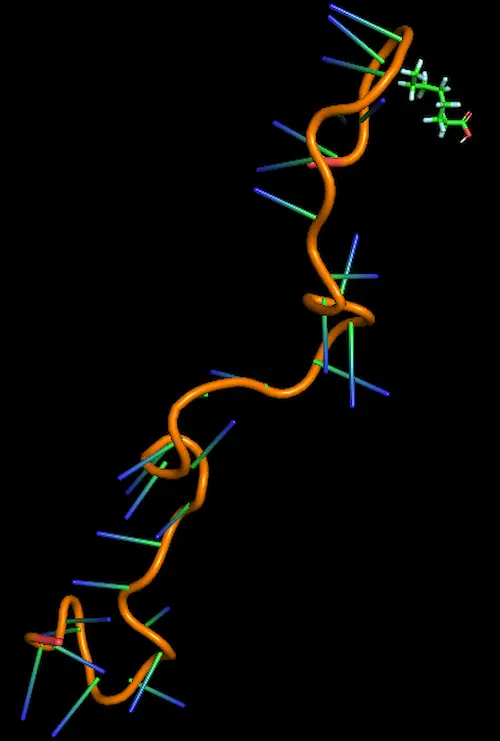
Observations/results: MAWS works but needs 20 h per aptamer even with reduced chunk sizes, and in the 30 nt aptamers most nucleotides are too far from PFOA to interact. Two aptamers of the same length (31 and 32 nt) differed, so MAWS is stochastic.
Week 3 (25-29 May)
Aim: Set up the docking and molecular dynamics part of the workflow.
Protocols/Methods: Investigated AutoDock Vina and GROMACS and decided not to run them from the AptaLoop Jupyter notebook; wrote and structured the instruction files for MAWS, docking, MD and the AptaLoop image.
Observations/results: No results.
Week 4 (1-5 June)
Aim: Test smaller RNA aptamers, validate them by docking, and plan how to integrate aptamers into riboswitches (plus preparation of the SynBioNL presentation on June 4th).
Protocols/Methods: MAWS for 8–13 nt RNA (-c1 200 -c2 200), RNAfold, AutoDock Vina and the Salis Lab riboswitch calculator.
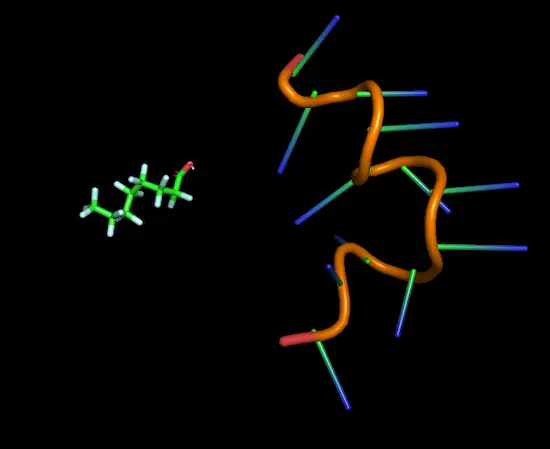
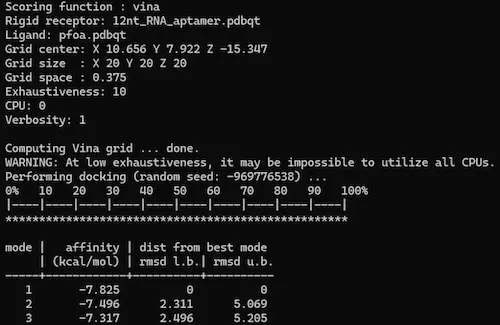
Observations/results: RNAfold predicts all 8–13 nt aptamers to be unstructured, so no binding pocket forms; Vina gave kcal/mol for the 12 nt aptamer (AptaLoop’s best: ), but this was judged to be noise. Take the best four aptamers (paper aptamer, best large DNA aptamer, two best small RNAs), integrate them in a riboswitch and send a selection to the lab partner.
Week 5 (8-12 June)
Aim: Look for conserved binding motifs by repeating MAWS many times, and explore a Latin hypercube / design-of-experiments approach for aptamer design.
Protocols/Methods: Started the MAWS run of 30 12 nt RNA for PFOA (-c1 200 -c2 200); wrote a first Latin hypercube generation script; tested the Salis Lab riboswitch calculator.
Observations/results: Filtering and ranking of the Latin hypercube aptamers was started but not finished.
Week 6 (15-19 June)
Aim: Decide whether the Latin hypercube approach is suitable and survey alternative tools (no daily registration this week; only a task list).
Protocols/Methods: Analysed the Latin hypercube; literature on AptaDiff, AutoDock Vina, the Salis Lab riboswitch calculator and 3D structure prediction tools.
Observations/results: Concluded that the Latin hypercube is probably not the right approach. No figures or result.
Week 7 (22-26 June)
Aim: Find conserved motifs among the 12 nt aptamers and the best aptamer length.
Protocols/Methods: RNAfold, WebLogo, MUSCLE alignment and STREME on the 30 aptamers of 12 nt; new MAWS run of 5 25, 30, 35 and 40 nt RNA (stopped after 2 per length because of the run time); a high-chunk run (-c1 5000 -c2 5000) started.
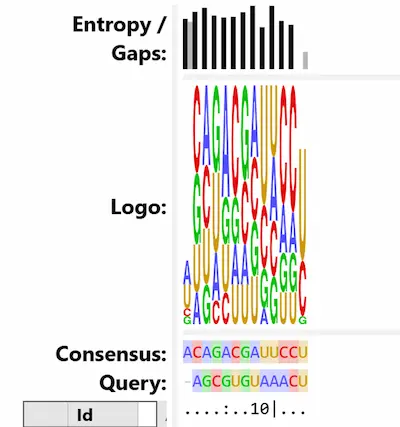
Observations/results: The 12 nt aptamers show no conserved motif (only a tendency to end in U or C) and 27 of 30 are unstructured; the 25–40 nt aptamers do fold (MFE to kcal/mol) but wander away from PFOA instead of forming a pocket. Converting the DNA aptamer for docking failed because AutoDock Vina would not run.
Week 8 (29 June-3 July)
Aim: Make MAWS build the aptamer around PFOA instead of away from it (penalty for moving away from the target, lower entropy, larger chunks, smaller box).
Protocols/Methods: Studied the MAWS scoring (penalties, RNAsubopt, entropy); high-chunk run (30 nt, -c1 5000 -c2 5000); run with a smaller bounding box (20 12 Å) and a run started on 2 July.
Observations/results: Neither more sampling nor the smaller box gave a binding pocket: the high-chunk aptamer is unstructured and wanders off, and in the 12 Å run only 3 nucleotides are close to PFOA. Also this week: SSB progress presentation (30 June).
Week 9 (6-10 July)
Aim: Understand the role of and entropy in the MAWS algorithm and try to reduce the aptamers’ drift away from PFOA.
Protocols/Methods: Studied the MAWS algorithm; runs with , ( and ) and ; set up the daily registration in git (6 July).
Observations/results: In all four runs most of the aptamer still lies far from PFOA; only the , high- aptamer folds into a stable hairpin (MFE kcal/mol).
Week 10 (13-17 July)
Aim: Document all results so far and decide on a strategy for the rest of the thesis.
Protocols/Methods: Made a result template and a data registry in git and wrote result descriptions for runs 01–07; looked into meaningful MAWS validation, using MAWS only to build binding pockets, and divalent ions such as Mg for stronger binding.
Observations/results: All main MAWS and RNAfold results are now in the git repository; the options for the thesis strategy were considered, and the resulting plan appears in the single-nucleotide run of week 12. Also arranged the Paris trip (Grand Jamboree) and a document with to-dos for after the vacation.
Week 11 (20-24 July)
Aim: Vacation
Protocols/Methods: -
Observations/results: -
Week 12 (27-31 July)
Aim: Use MAWS differently: place single nucleotides around PFOA to map where nucleotides like to sit, and score them by interaction energy instead of total energy.
Protocols/Methods: 50 MAWS runs of 1 nt (-nt 1 -c1 1000 -c2 200), then a modified MAWS (new get_interaction_energy, ) that also logs the energy of every sampled pose, run 50 with and analysed in R.
Observations/results: The original scoring uses total energy ( to kJ/mol, dominated by non-binding terms), whereas interaction energy gave to kJ/mol for the first test; the original box was too small to place nucleotides at the ends of PFOA. After filtering clashes and analysis artefacts (energies outside to kJ/mol), randomly placed nucleotides have a median interaction energy of 1 kJ/mol, consistent between runs and similar for the four bases, which serves as baseline for the selected poses. The idea to connect the best nucleotides in a graph (nodes = nucleotides, edges = distance/interaction energy) was thought of.
Week 13 (3-7 August)
Aim: Improve MAWS further (scoring, force field/solvent model) and complete the documentation of the earlier runs.
Protocols/Methods: Studied interaction-energy mechanisms and force fields/solvent models (OBC1, OBC2, GBn2; GBn2 gave errors), planned the combined set of MAWS improvements (interaction energy, Mg, saving all poses , larger box, fixed PFOA) and wrote a script to apply them inside the Docker container.
Observations/results: Tested and adjusted the improved MAWS (6 August); no new run results were recorded. Result descriptions of runs 01, 02, 08 and 09 were improved.
Week 14 (10-14 August)
Aim: Finalise the improved MAWS, including Mg as anchor next to the negatively charged PFOA.
Protocols/Methods: prepare_ligand.py (PFOA as anion with charge , rotated along x, Mg placed 2 Å from a carboxylate oxygen, relaxed) and patch_maws.py (interaction-energy scoring with Mg counted on the target side, PFOA/Mg frozen, 402828 Å box, logging of all and favourable poses, -s seed and -mg options).
Observations/results: After relaxation Mg sits 1.8 Å from the oxygen (experiment: 2.0–2.1 Å); a bug that counted Mg on the nucleotide side (all poses kJ/mol) was found and fixed, and the OBC1 solvent model was kept.
Week 15 (17-21 August)
Aim: Plan how to bring MAWS results into plug-and-play riboswitches, and start maps for PFOA (with/without Mg) and TFA.
Protocols/Methods: Wrote a day-by-day plan (graftamer S1 scaffold, staged sending of controls, PFOA and TFA constructs to wet lab); started a MAWS run for PFOA with and without Mg (18 August); studied how the current scripts work.
Observations/results: The first attempt to run MAWS on TFA did not work.
Week 16 (24-28 August)
Aim: Finalise MAWS (MAWS2026) for the production batch and start the PFOA and TFA runs.
Protocols/Methods: Analysed and finalised the MAWS scripts, reviewed the MAWS energy calculation, discussed MD and started MAWS for PFOA and TFA.
Observations/results: MAWS was changed, but no results yet.
Week 17 (31 August-4 September)
Aim: Swap the nucleotides favoured by the MAWS map into the pocket of a guanine riboswitch.
Protocols/Methods: Downloaded the guanine riboswitch crystal structure (1Y27.pdb is in the folder) and wrote the scripts build_map.py, match_pocket.py, design_riboswitch.py and graft_riboswitch.py.
Observations/results: The new pipeline was first run for TFA.
Week 18 (7-11 September)
Aim: Run the improved MAWS and send the improved riboswitches to the wet lab for vaildation.
Protocols/Methods: Scripts for the bounding box, placing the map at coordinates and finding swaps, AutoDock Vina of guanine into the modelled riboswitch backbone, run_full_pipeline.py with the stages pooled poses placed map swaps, and instructions for running MAWS with 5 seeds.
Observations/results: Docking guanine into the riboswitch backbone gave kcal/mol for the best mode (Preparing the backbone.md). Riboswitches were sent to the wet lab for validation.
Week 19 (14-18 September)
Aim: Improve the DISARM pipeline further, test if Autodock Vina is consistent
Protocols/Methods: A sequence was validated with AutoDock Vina (exhaustiveness 32, random seeds) 10 times to validate if it is consistent across seeds for aptamers.
Observations/results: The Vina affinities of the random example range from to kcal/mol, meaning the output is quite consistent.
Week 20 (21-25 September)
Aim: Improving the DISARM pipeline further, start a test to see if DISARM can identify the important nucleotides in the guanine riboswitch when given guanine as input.
Protocols/Methods: Updated helper scripts and a test set-up with guanine and a riboswitch structure.
Observations/results: No output or results.
Week 21 (28 September-2 October)
Aim: Analyse the guanine riboswitch run, wiki writing.
Protocols/Methods: Running DISARM on guanine and original riboswitch.
Observations/results: The guanine test did not give the correct results, but this is likely because the ligand is rotated in the pocket, so the results are dominated by other orientations.
Week 22 (5-9 October)
Aim: Wiki writing
Protocols/Methods: No protocols or methods.
Observations/results: No results.
Week 23 (12-16 October)
Aim: Wiki writing
Protocols/Methods: No protocols or methods.
Observations/results: No results.
Week 24 (19-23 October)
Aim: Wiki writing
Protocols/Methods: No protocols or methods.
Observations/results: No results.