Introduction
How to make the forever chemical, forever no more
Through hard work, we have developed all the components that are necessary for our system, but now they are only that: components. The individual components need to be assembled to synergise and become more than just the sum of their parts. By interviewing water remediation experts, we have identified gaps in the existing TFA remediation technologies that are necessary for TFA disposal. Interviewing researchers showed us scientific avenues to explore to fill the gaps in existing technologies. Finally, policy advisors and policymakers guided us through the regulations, so we can actually apply our system in real-world applications.
Where
We learned from Frank Schoonenberg, a process engineer at Vitens, that Vitens currently already implements reverse osmosis (RO), a technology that can filter TFA. However, the problem is that it only filters TFA, but doesn’t destroy it. RO ensures that the drinking water is clean, but they do not address the root cause. The resulting waste stream, called concentrate, is now discharged into the environment. Fortunately, the practice of dumping concentrate will become prohibited in the future. This leaves the water filtration companies with a huge problem however, as nobody is currently treating concentrate. For that reason, we designed Triton to filter concentrate and fill that need for water filtration companies.
Further concentration
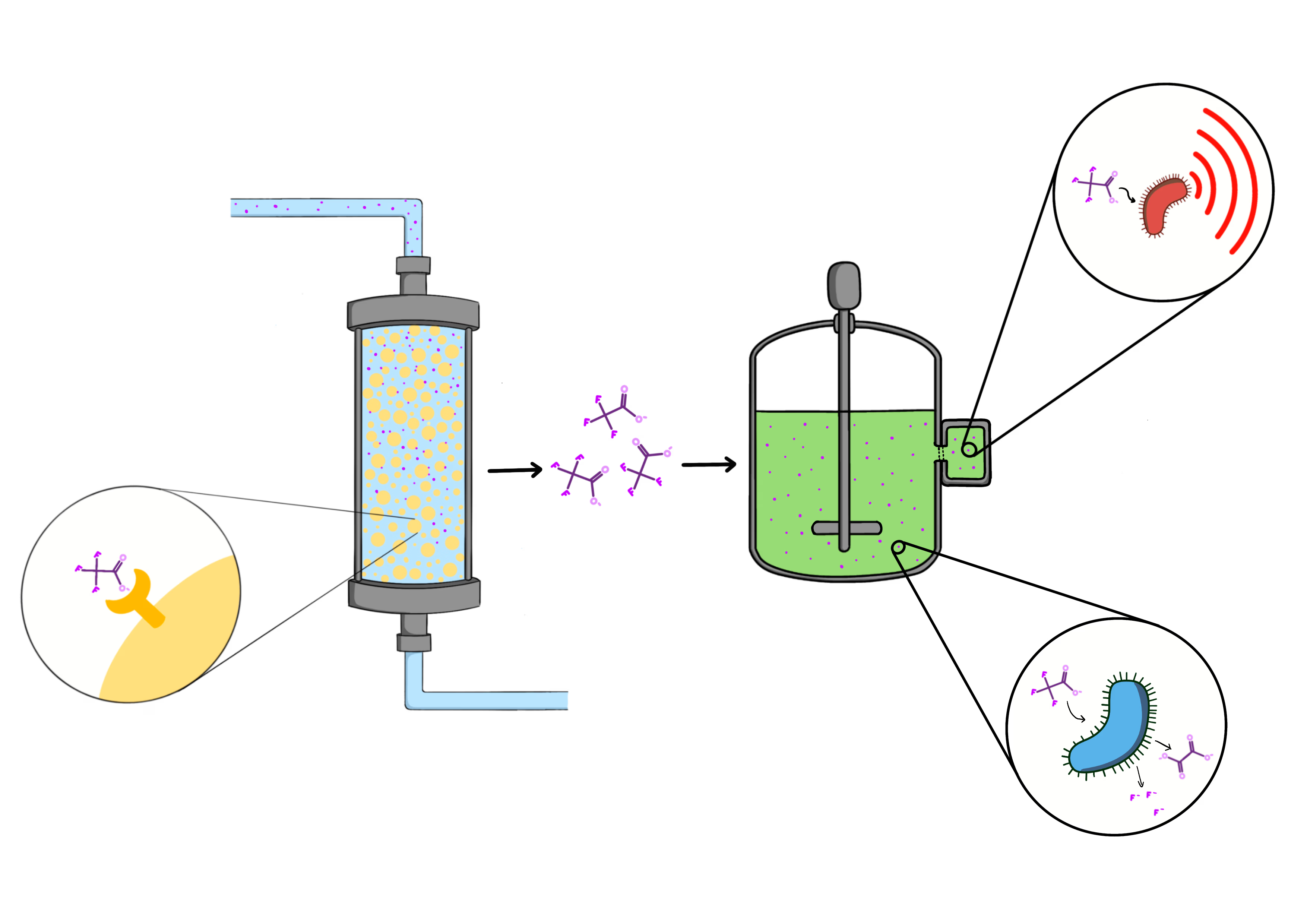
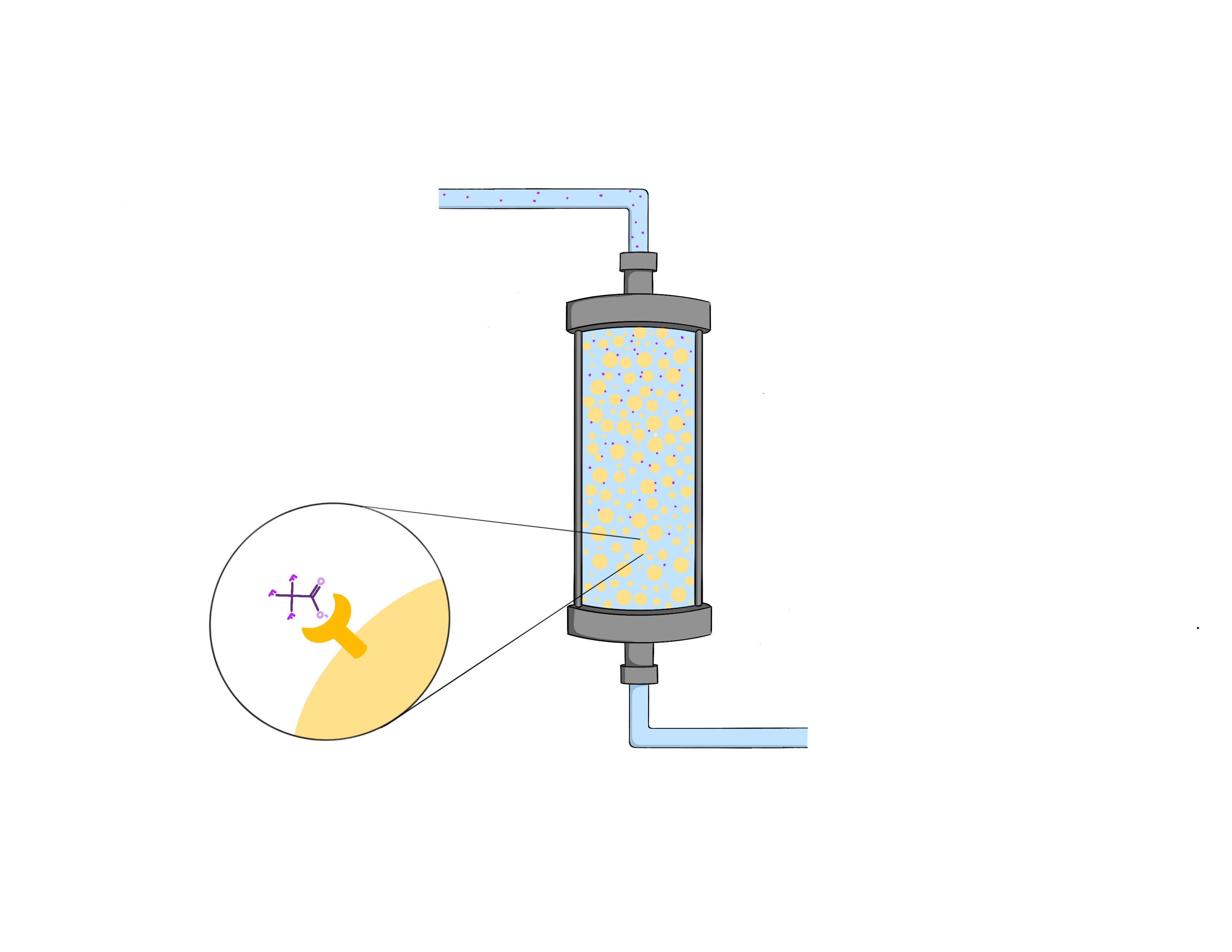
Our system starts at concentrate, where the TFA concentration has been increased by 5-10 times compared to environmental concentrations by RO. However, in interviews with Bert and Peyman, experts in development of novel water treatment techniques and in enzyme development respectively, that treating concentrate is not enough. They informed us that, for our degradation step down the line, the TFA concentration is not yet high enough. We need to concentrate it even further into the milligram per litre range. Thus, the first part of Triton is a further concentration step. The TFA is concentrated by having a specific binding protein attached to bacterial cellulose beads. This can be implemented as a granular filter. The proteins are attached to the bacterial cellulose with a cellulose binding domain that has a high affinity for bacterial cellulose. The concentrate flown through our filter and the TFA is bound tightly by the TFA-binding proteins. After the filtering, the TFA dissociated from the proteins by eluting them with a wash buffer. The TFA is now sufficiently concentrated for degradation. The beads with our now empty binding protein can be used again for another round of TFA concentration.
The degradation reactor
Now the most important part of Triton: solving the problem permanently. The TFA is now sufficiently concentrated and is flowed into our bioreactor that contains two core components: E. coli expressing our optimised TFA degradation enzyme and our biosensor. The TFA degradation enzyme is a dehalogenase that has been optimised through directed evolution to efficiently defluorinate TFA with only oxalate and fluoride as final products. The second component of the reactor is our biosensor. It works through our novel TFA riboswitch to continuously monitor the TFA concentration in the bioreactor. Our biosensor eliminates the need for TFA measurements using expensive analytical equipment. Combining the individual components into Triton, we have created the first sustainable technique to attack the root cause of the TFA problem and permanently eliminate the forever chemical known as TFA.
Following successful development and validation of the technology, implementation in drinking water treatment could be achieved within approximately 10 years. The key bottlenecks are expected to be permitting and certification procedures, infrastructure constraints such as grid congestion, and implementation timelines, rather than the construction work itself. If required, some of these processes could potentially be accelerated. The implementation time for the biosensor could be faster.
Biosafety
To be allowed to implement Triton in the real world, we have taken the necessary biosafety precautions to prevent the spread of genetically modified organisms (GMO) into the environment. There are three components to Triton with different strategies for biosafety. The bacterial cellulose beads with the TFA binding protein are produced by GMOs, but do not contain any living cells, so no extra safety measures are required. The biosensor will be implemented in the degradation reactor in its separate compartment. There will be a little stream of water into the biosensor, which will be flown into a collection vessel after it has been in contact with the cells of biosensor. The amount of water that has touched the biosensor will be low, so we can autoclave it. Finally, after our bioreactor is done running, its now TFA-free contents can be discharged into surface water. However, our E. coli expressing the TFA degrading enzyme cannot be discharged into the environment. To make sure there are now more viable cells in the discharge, we will do a UV sterilisation step to make sure there are no more viable cells in the effluent. Triton has now complied with all the safety measures that are required and we are ready for implementation in the real world.
Frank Schoonenberg
Process engineer at Vitens, the largest Dutch drinking water company
Following successful development and validation of the technology, implementation in drinking water treatment could be achieved within approximately 10 years. The key bottlenecks are expected to be permitting and certification procedures, infrastructure constraints such as grid congestion, and implementation timelines, rather than the construction work itself. If required, some of these processes could potentially be accelerated. The implementation time for the biosensor could be faster.
Why we reached out
We reached out to Frank to learn more about the logistics of drinking water companies and the techniques they use to treat water polluted with PFAS. We also wanted to know how Vitens prepares for upcoming regulations and what volumes Triton would need to handle to be implemented at scale.
Main takeaways
For PFAS, there are currently three technologies with a sufficient TRL: activated carbon, reverse osmosis (RO) and ion exchange resins. However, the resins are only at pilot scale and no ion exchange resins are certified for use in drinking water. Activated carbon does not work for TFA, so only RO and resins can be used. Both are scalable to drinking water volumes.
TFA is currently only removed as a side catch, as Vitens has split-stream RO installations. However, these were not designed with TFA in mind; removing TFA was an added benefit, not the goal of the installation.
A key limitation of RO is that part of the filtered water is discharged as concentrate, reducing the overall water recovery. Given the increasing pressure on drinking water resources in the Netherlands, this may be a significant disadvantage.
In the future, the concentrate, which is currently discharged into surface water, might also have to be treated. Treating RO concentrate could therefore be a very interesting application of Triton, as there are currently no high TRL TFA concentration solutions.
Vitens anticipates that TFA will be included in regulations in the future. The timeline is unknown, as it depends on politics. Vitens is currently writing an impact analysis on the effects of the new regulations proposed by RIVM.
The capacity of Vitens’ treatment plants is between around 1 and 27 million cubic metres of drinking water per year, depending on the size of the plant.
Reflection & integration
Frank gave us specific numbers regarding the scale-up of Triton, which we deemed to unrealistic for Triton. Fortunately, he pointed us to a viable alternative: RO concentrate. To help drinking water companies comply with upcoming regulations, we decided to focus on RO concentrate and rely on RO to develop Triton.