Introduction
From the beginning, iGEM evolves and grows around the principles of open science and synthetic biology standardization. That is why teams are expected to collaborate and build upon previous work, all contributing to growing the science community. Therefore, Triton was developed in this same spirit. With Triton, we address one of the most challenging emerging contaminants in water: trifluoroacetate (TFA). However, we are not just designing a single, closed solution around one molecule and one application. We developed Triton as a modular bio-treatment platform . Capturing, degradation, and sensing are treated as independent modules that can be improved individually and recombined into one integrated treatment system. By designing Triton this way, we not only contribute with a strategy for TFA, but for a modular framework for future teams to adapt to new contaminants, new biological parts and different treatments.
But, throughout the process, we did not only develop the final Triton system. We created biological parts, developed experimental assays, computational models, design workflows and protocols that can be reused beyond our project. By documenting all of these resources, we hope that future iGEM teams can build on what we have created.
Modular platform
Triton was designed around three functional modules: capturing, degradation and sensing.
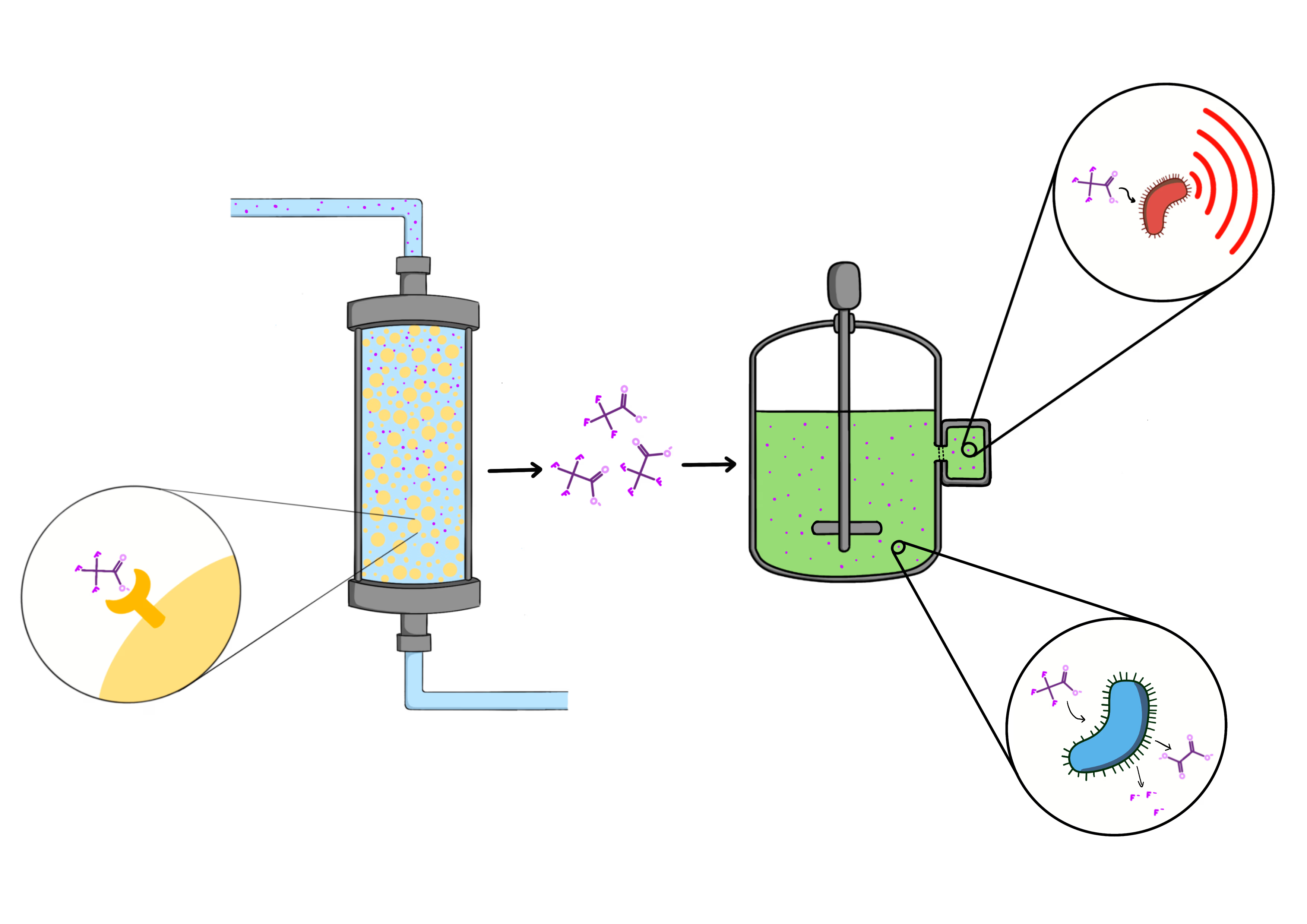
Instead of exploring these functions as one mechanism, we explored them as independent modules that can be optimised and integrated depending on the goal. This design allows future iGEM teams to build on individual parts of Triton without having to reproduce the entire system. A new sensing mechanism could replace our TFA sensor, or alternative enzymes or degradation methods could be introduced. We contribute a TFA treatment system, but most importantly, a design framework for building any other biological treatment system in which detection, degradation and monitoring can evolve individually. We are providing a design framework that shows how capturing, degradation and sensing can be combined into one biological water treatment system.
Defluorination framework
As team Triton, we faced the incredible challenge of breaking the carbon-fluorine bond: one of the strongest bonds in nature, which gets stronger with more fluorine bound to one carbon. To add to that, experimentally studying defluorination requires reliable and reproducible methods for determining whether fluoride is actually being released. To help future iGEM teams, we developed the Triton´s defluorination framework. This framework consists on three parts in order to obtain degradation enzymes: measurement of defluorination, generation of improved variants and selection of the variants that perform better.
A high-throughput platform for measurement of fluoride release
The first step to engineering defluorinating enzymes was to develop a way to determine if the cleavage of the carbon-fluorine bond had occurred. In our first cycle, we expressed candidate fluoroacetate dehalohenases (FaCDs) and implemented a workflow to evaluate defluorination by measuring the fluoride ions released after potential cleavage of the carbon-fluorine bond. We developed a protocol for high-throughput screening of defluorination. By reducing the time needed to develop and troubleshoot a defluorination assay, we hope future iGEM teams working on PFAS and other fluorinated compounds can use this workflow to screen defluorinating candidates. Future iGEM teams can reuse the standardised fluoride assay, calibration procedure, controls, sample preparation and analysis workflow, together with our step-by-step experimental video as a practical guide for performing the assay.
Generation of improved variants
After observing the activity of the first candidates, we developed a platform to hypermutate enzymes, generating larger libraries to be explored. We hope that future iGEM teams can reuse this platform and the expression architecture for future work. It is not restricted to the dehalogenases investigated in Triton, it can be adapted to any other enzyme.
Coupling defluorination to growth
Generating large mutant libraries of enzymes are useful if you can find a way to select for the desired activity. That is why, as team Triton, we pursued three selections in total: a toxicity-based selection on TFA; a glyoxylate-dependent auxotroph for evolution on DFA; and an oxalate-dependent auxotroph for TFA. These options together provide future iGEM teams with a strategy for growth-coupled selection of enzymes that act on fluorinated compounds that result in metabolites such as TFA. The strength of this platform relies on its specificity. Our auxotrophic strains were designed around the products of TFA and DFA defluorination. By coupling this conversion to growth, we are providing future iGEM teams with the tools to evolve, screen and select dehalogenases functioning on these difficult fluorinated substances. We, as team Triton are then providing with not only candidate enzymes, but a reusable selection framework to improve defluorinase activity towards TFA.
Registry contributions
All our biological parts are available through the iGEM registry so that future teams can directly reuse and improve them. We also built on parts developed by previous iGEM teams and extended some of these resources with new basic and composite parts. By documenting the parts we reused and the new parts we contributed, we aim to continue with this iGEM cycle of teams building on one another, rather than just starting from scratch.
The table below brings together all the biological parts used and developed in Triton, organised according to their role in the project.
Registry biological parts for degradation
| Registry name | Name | Type | Used in | Description | |
|---|---|---|---|---|---|
| BBa_26MHN5VI | Fluoroacetate dehalogenase 1y37 EC: 3.8.1.3 | Basic | E. coli | Coding sequence for fluoroacetate dehaloginase from Burkholderia sp. FA1 codon optimised for E. coli. It catalyses defluorination of fluoroacetate | |
| BBa_26GE2RMX | H1-NML | Basic | E. coli | Coding sequence encoding an engineered fluoroacetate dehalogenase (FAcD). It cleaves carbon–fluorine bonds in -fluorocarboxylic acids with an Asp–His–Asp catalytic triad | |
| BBa_26IXO2KM | 3’UTR 9 | Basic | E. coli | 3’UTR to aid in protein expression. Named UTR9 in the original paper. | |
| BBa_26DMM7WQ | Strong bidirectional terminator | Basic | E. coli | Strong bidirectional terminator to be used with the MutaT7 hyperevolution system. | |
| BBa_26AJJCH8 | Strong RBS for FAcD DAR3835 | Basic | E. coli | Strong RBS for DAR3835 (BBa_25Y573JG) synthetically generated via De Novo DNA by Salis Lab. | |
| BBa_26BC0YG2 | Plasmid for H1NML expression compatible with MutaT7 hypermutation | Composite | E. coli | High/medium copy plasmid for H1NML expression compatible with MutaT7 hypermutation. | |
| BBa_26MO0EH7 | pSEVA241 | Basic | E. coli | pSEVA241 plasmid with kanamycin resistance and pRO1600/ColE1 ori. | |
| BBa_26HSVTP2 | RBS for FAcD H1-NML | Basic | E. coli | Strong RBS for H1-ML synthetically generated via De Novo DNA by Salis Lab. | |
| BBa_26E79RY7 | NADPH oxidase | Basic | E. coli | Streptococcus pneumoniae NADPH oxidase | |
| BBa_26WOZ8ZO | Horseradish peroxidase | Basic | E. coli | Horse radish peroxidase optimised for functional expression in E. coli by the N255D mutation. | |
| BBa_261ADO3K | Plasmid for DAR3835 | Composite | E. coli | High/medium copy plasmid for DAR3835 expression compatible with MutaT7 hypermutation. | |
| BBa_263JH81Y | IPTG inducible OxdC | Composite | E. coli | OxdC in the Marionette plasmid pAJM.336, which drove expression upon IPTG induction. Converts oxalate to formate and CO2. | |
| BBa_26EIZBZQ | H1ML Fluoroacetate Dehalogenase | Basic | E. coli | H1ML is a fluoroacetate (MFA) dehalogenase optimised for the breakdown of difluoroacetate (DFA). It is the mutated version of H1 (Delftia acidovorans). We confirmed the activity on DFA and MFA. | |
| BBa_26RKJ6GR | DAR3835 base701deletion | Basic | E. coli | Sequence of fluoroacetate dehalogenase DAR3835. Contains a point deletion of base 701 (G) causing a frame shift. The enzyme was proven to be non-functional on fluoroacetate. | |
| BBa_26WOZ8ZO | Horse Radish Peroxidase N255D | Basic | E. coli | Horse radish peroxidase optimised for functional expression in E. coli by the N255D mutation. | |
| BBa_26C8L7RL | Oxalate decarboxylase | Basic | E. coli | CDS of oxalate decarboxylase derived from Bacillus subtilis. | |
| BBa_2601JBMN | FAcD 1Y37 P26T | Basic | E. coli | The CDS is a fluoroacetate dehalogenase (FAcD). One mutations is present compared to the original PDB 1Y37 registry: proline 26 changed into threonine. The enzyme is however functional and is able to defluorinate fluoroacetate and probably difluoroacetate. | |
| BBa_26HM9VFH | Cumate inducible A6RdhA+T7RdhA chimera reductive dehalogenase | Composite | E. coli | A6RdhA+T7RdhA chimera in the Marionette plasmid pAJM.657, which drove expression upon cumate induction. Predicted to degrade PFOA and other fluorinated molecules. | |
| BBa_26G1S745 | 5’UTR synthetically designed for H1ML expression | Basic | E. coli | 5’UTR synthetically designed for H1ML expression, optimised for the target translation initiation rate of 15000. | |
| BBa_26FGK5Y2 | 5’UTR synthetically designed for A6T7_chimera expression | Basic | E. coli | 5’UTR synthetically designed for A6T7_chimera expression, optimised for the target translation initiation rate of 15000 | |
| BBa_26BFLI3V | Cumate inducible 1Y37 for fluoroacetate to glycolate degradation | Composite | E. coli | 1Y37 in the Marionette plasmid pAJM.657, which drove expression upon cumate induction. Converts fluoroacetate to glycolate. | |
| BBa_26HFJQ31 | 5’UTR synthetically designed for 1Y37 expression | Basic | E. coli | 5’UTR synthetically designed for 1Y37 expression, optimised for the target translation initiation rate of 15000 | |
| BBa_26O7PVNP | Cumate inducible DAR3835 for fluoroacetate to glycolate degradation | Composite | E. coli | DAR3835 in the Marionette plasmid pAJM.657, which drove expression upon cumate induction. Converts fluoroacetate to glycolate, and potentially difluoroacetate to glyoxalate. | |
| BBa_26LLEBZB | Constitutively expressed dehH1 plasmid for P. Putida | Composite | E. coli | pMETA23 plasmid with constitutive expression of dehH1 for P. Putida |
Registry biological parts for sensing
| Registry name | Name | Type | Used in | Description | |
|---|---|---|---|---|---|
| BBa_26FF0OOX | AEB-F12 fluoride riboswitch | Basic | E. coli | Fluoride translational on-switch. | |
| BBa_26QWTA6K | Plasmid with PFOA riboswitch | Composite | E. coli | Plasmid containing transcriptional PFOA off switch with mRFP1 reporter protein | |
| BBa_268VH008 | sfGFP | Basic | E. coli | Easy green fluorescent protein to add as a reporter protein or drop-out cassette | |
| BBa_263QZLB2 | Negative control of the AEB-F12 fluoride plasmid | Composite | E. coli | Negative control of the AEB-F12 fluoride plasmid, no reporter protein | |
| BBa_26AQH0NF | PFOA off switch | Basic | E. coli | Transcriptional PFOA off riboswitch | |
| BBa_263MN2XT | Plasmid with fluoride traslational on switch | Composite | E. coli | Plasmid containing fluoride riboswitch and reporter protein. | |
| BBa_26W3MVJ7 | GFP-drop-out, mRFP1 reporter plasmid | Composite | E. coli | A simple plasmid with a drop-out cassette to add functions and a mRFP1 reporter protein. | |
| BBa_26Z9Y8DA | mRFP1 reporter protein | Basic | E. coli | mRFP1 an easy and functional reporter protein. | |
| BBa_26XQ3P22 | AEB-No-Rib-positive control mRFP1plasmid | Composite | E. coli | Positive control for the backbone plasmid. |
Registry biological parts for capturing
| Registry name | Name | Type | Used in | Description | Importance |
|---|---|---|---|---|---|
| BBa_269ADB50 | NeoR/KanR | Basic | E. coli | NeoR/KanR antibiotic resistance gene | Allows selection of cells that have successfully integrated the plasmid containing this gene, as it makes bacteria inmune to neomycin and kanamycin. |
| BBa_260LGK89 | 7xHis | Basic | E. coli | 7xHis for affinity chromatography purification. | This enabled purification of recombinant proteins. |
| BBa_25UN5QM4 | Maltose-binding protein (MBP) | Basic | E. coli | Maltose binding protein CDS as a fusion protein. | Used to increase the soluble recovery, as this strategy often gives increased expression levels and higher solubility of the target protein. |
| BBa_26VX2ZI9 | -Lactoglobulin (BLG) | Basic | E. coli | Bovine -Lactoglobulin CDS codon harmonised for expression in E. coli | Protein of interest analysed for binding of TFA |
| BBa_26BAFRJO | Binder 283 | Basic | E. coli | Binder 283, computationally designed protein codon optimised for expression in E. coli | Protein of interest analysed for binding of TFA |
| BBa_26LDQJJY | Boltzgen r1 | Basic | E. coli | Boltzgen r1, computationally designed protein codon optimised for expression in E. coli | Protein of interest analysed for binding of TFA |
| BBa_264Z4E2V | MBP-BLG fusion protein | Composite | E. coli | Gene encoding for MBP-BLG fusion protein fused to a 7xHis tag to be purified | This purified protein was further characterised for TFA binding. |
| BBa_26YMSOD8 | MBP-Binder 283 fusion protein | Composite | E. coli | Gene encoding for MBP-Binder 283 fusion protein fused to a 7xHis tag to be purified | This purified protein was further characterised for TFA binding. |
| BBa_26OAAOYE | MBP-Boltzgen r1 fusion protein | Composite | E. coli | Gene encoding for MBP-Boltzgen r1 fusion protein fused to a 7xHis tag to be purified | This purified protein was further characterised for TFA binding. |
| BBa_26UH0OF8 | pJS_BCD_HIS_MBP_BLG | Composite | E. coli | Plasmid with T7, BCD, NeoR/KanR, encoding for the gene of interest (MBP-BLG) | This plasmid was used to express -Lactoglobulin (BLG) and be analysed for TFA binding. |

Modelling
In Triton, computational modelling guided the design of our sensing and capturing systems before going into experimental testing. We developed a model to retarget existing riboswitches towards TFA by identifying promising mutations and another model to evolve and optimise TFA-binding proteins for capturing.
But our contribution is not limited to the specific candidates that we generated for Triton. We structured both models as reusable workflows that future iGEM teams can adapt to different objectives or molecular targets. By documenting how each model works, the inputs required, the outputs generated and how these outputs can guide experimental design, we are providing future iGEM teams with practical tools to go from computational design to experimentally testable candidates.
Therefore, Triton contributes with two computational tools: Discovering Interaction Sites for Aptamer Retargeting by Mutation (DISARM) and Protein In silico Guided Evolution and Optimization Network (PIGEON).
DISARM
To sense the amount of TFA present in the bioreactor, a riboswitch is used. However, adapting riboswitches to recognise a new target is a complicated process that normally requires extensive lab work, taking up both time and resources. Therefore, in silico alternatives are an attractive avenue of computation.
DISARM is a tool that does exactly that: the target ligand and an existing riboswitch are given as input. Based on the target ligand, it calculates favourable interaction conditions. It then identifies where the favourable positions line up with the existing riboswitch, and suggests mutations that would allow for incorporation of the favourable positions without disrupting the original riboswitch structure. DISARM outputs a table containing the mutated sequences, along with a rough prediction of how favourable the mutations are and how many mutations are made.
The list contains many rough estimates. It should therefore not be used as a list where the top riboswitch should work, but rather as a list of candidates that can be validated using high throughput wet lab validation. The tool allows for fast library generation of possible riboswitch candidates, reducing time and cost of riboswitch generation. Future iGEM teams can replace the ligand with another small molecule and use DISARM to generate candidate riboswitches for their own sensing applications.
PIGEON
Designing a protein that binds a difficult target is rarely a single decision. Even if rationally designed mutations have been made, a team is still left asking what to try next, and answering that question by hand quickly becomes impossible because there are 20 possible amino acid substitutions at every position of the protein. That is why we developed PIGEON, a pipeline that learns the relationship between a protein’s sequence and its predicted performance, and then proposes the mutations that improve it.
Unlike a conventional machine learning model, which only returns a score for an input it is given, PIGEON actively suggests where to go next. It needs only a starting protein family, a target, and an objective defining what a better sequence means to the user. Once those information are in place, PIGEON returns ranked variants together with the model it trained along the way. In our own project, fifty rounds of in silico evolution raised the Boltz-2 binding probability score of our best scaffold by over 33% relative to the wild type.
Nothing in this pipeline has to be specific to TFA or to binding at all. The objective is the only part that encodes what is being optimised for, which means future iGEM teams can replace it with solubility, thermostability, ligand interface predicted Template Modeling (ipTM) score, or any combination of these, and apply the same loop to a target of their own. We contribute not only a set of potentially improved TFA binders, but also a reusable framework for in silico protein evolution that any team working on computational protein design can adopt. We are aware that iGEM 2026 Lyon team is also developing TFA-binding proteins. Currently, we are exploring the possibility of optimising the TFA-binding capability and other metrics of their proteins by using PIGEON.