Why in silico riboswitch engineering?
With Triton, we are working towards effective degradation of TFA. When implementing Triton, a way to assess whether the degradation process is working effectively, in real time in a working bioreactor, is essential. Triton therefore should contain an effective sensor. For the sensor to be effective, it should be reliable, give a continuous readout, work within the bioreactor and be cost effective. Based on these constraints, a riboswitch biosensor was selected.
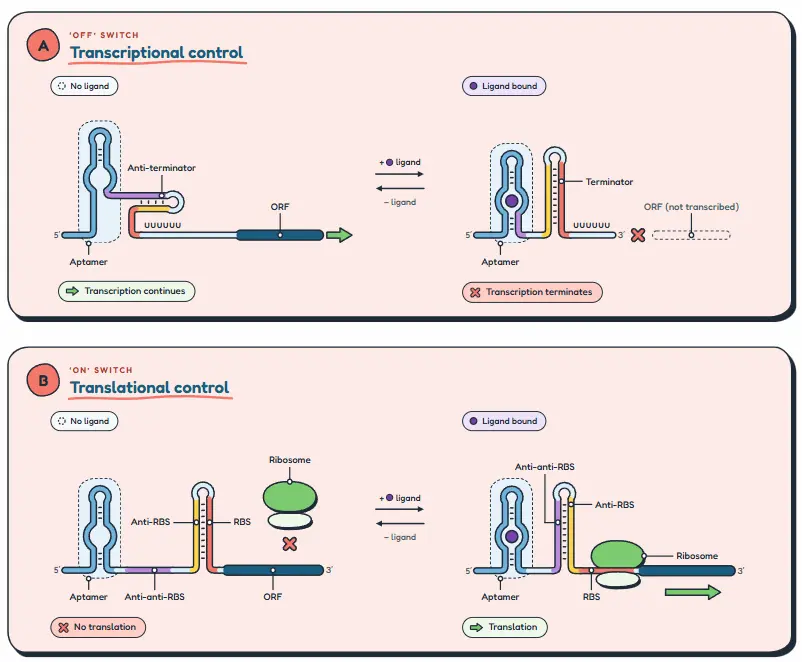
Riboswitches are genetic control elements that consist of an aptamer and an expression platform [1]. The expression platform can switch between an ON state, in which there is gene expression, and an OFF state, in which expression is blocked (Figure 1). After the riboswitch, almost any gene can be placed, allowing for great flexibility in its application. For the application in Triton, a red fluorescent protein (RFP) is placed after the riboswitch for an easy readout. The specific riboswitch chosen is a transcriptional OFF switch, meaning that RFP is normally produced, but when the ligand is present, transcription is blocked and RFP can no longer be produced. This should result in a measurable decrease in fluorescence when the ligand is present, which is the criterion for a successful riboswitch.
SELEX
The aptamer part of the riboswitch is what recognises the ligand. To develop an aptamer for a specific ligand, Systematic Evolution of Ligands by Exponential Enrichment (SELEX) is generally used.
In SELEX, the target is immobilised on a solid surface and exposed to a large random library of DNA or RNA sequences. Unbound sequences are washed away, bound ones are extracted and amplified by PCR. The sequences from the PCR are then again exposed to the target. This way, sequences are selected that have an increasingly higher binding affinity to the target [2]. After roughly 8–15 rounds, the pool contains mainly sequences with high affinity for the target, which can then be used as aptamers.
SELEX is common and well validated, but expensive, difficult and unable to screen many variants compared to the amount of possible aptamers [3]. For TFA, immobilisation is difficult because of the small size and lack of functional groups (other than the carboxylate group). Immobilization on a solid surface could additionally block parts of TFA that are important for aptamer binding. This increases the complexity of the SELEX experiment even further [4]. Because of the difficulties associated with SELEX, an in silico alternative for aptamer design is attractive.
MAWS
In silico aptamer design has a history in iGEM. iGEM Heidelberg 2015 created MAWS: Making Aptamers Without SELEX, a tool that was subsequently improved by iGEM Heidelberg 2017, iGEM NU Kazakhstan 2022, and finally by iGEM DTU Denmark 2023.
MAWS generates de novo aptamers, based on the structure of the target molecule. The algorithm works by first generating a bounding box around the target, and then places nucleotides in random positions and orientations within it, with the goal of evaluating many positions of nucleotides around the ligand, and identifying which ones are favourable and which ones are not. To determine if the position is favourable, the total potential energy of the nucleotides and ligands atoms is calculated using AMBER [5]. A relatively high potential energy means that the atoms are less comfortably arranged, and the arrangement is less likely. The reverse is also true: a relatively low potential energy means that atoms are comfortably arranged, making that arrangement more likely to be reached. The amount of positions evaluated per nucleotide is set by the user.
For each of the four nucleotides, MAWS now has a list of positions, together with the potential energy of the system. Next, the Boltzmann distribution is calculated: percentages are assigned that describe how often a conformation will be reached, based on the potential energy. The Boltzmann distribution assigns lower potential energies a disproportionately high percentage, making positions that are better than the rest stand out. The percentages of all the conformations tested for one specific nucleotide add up to 100%. If all states are equally likely, every state will have the same Boltzmann probability, and the distribution will be flat.
Next, MAWS calculates the entropy: a score describing how flat the distribution is. If the distribution is completely flat, the score is 0. If there is 1 position that stands out, the score is highly negative. MAWS keeps the nucleotide with the lowest score, given that this the nucleotide that showed the clearest preference for one particular arrangement. If you want details about the specific formulas used, see iGEM Heidelberg 2015 or iGEM DTU Denmark 2023 for a more in depth explanation.
The best scoring nucleotide is fixed in place, and the sampling is repeated for the positions adjacent to it. This algorithm of fixing the nucleotides, finding the best adjacent nucleotide position, adding the best adjacent nucleotide to the chain and fixing the complex again is run until the chain length specified by the user is reached. When finished, MAWS returns the sequence and nucleotide positions of the aptamer. However, the structure is not necessarily realistic, given that the structure is only based on the interaction with the ligand and not on actual folding calculations. DTU Denmark addressed this by adding modules for 2D and 3D structure prediction, which predicts the most stable structure for the generated aptamer, but loses the structure generated by MAWS and ignores the ligand in the folding.
Using MAWS, we were unable to get an aptamer for TFA or PFOA. Because of this, we decided to fundamentally change the approach and create a new tool: DISARM - Detecting Interaction Sites for Aptamer Retargeting by Mutation.
DISARM
DISARM identifies which nucleotide positions interact favourably with the ligand, and recommends potential beneficial mutations (called "swaps" in the programme) in an existing aptamer to increase the chance it will recognise the new ligand without disrupting its secondary structure (Figure 2).
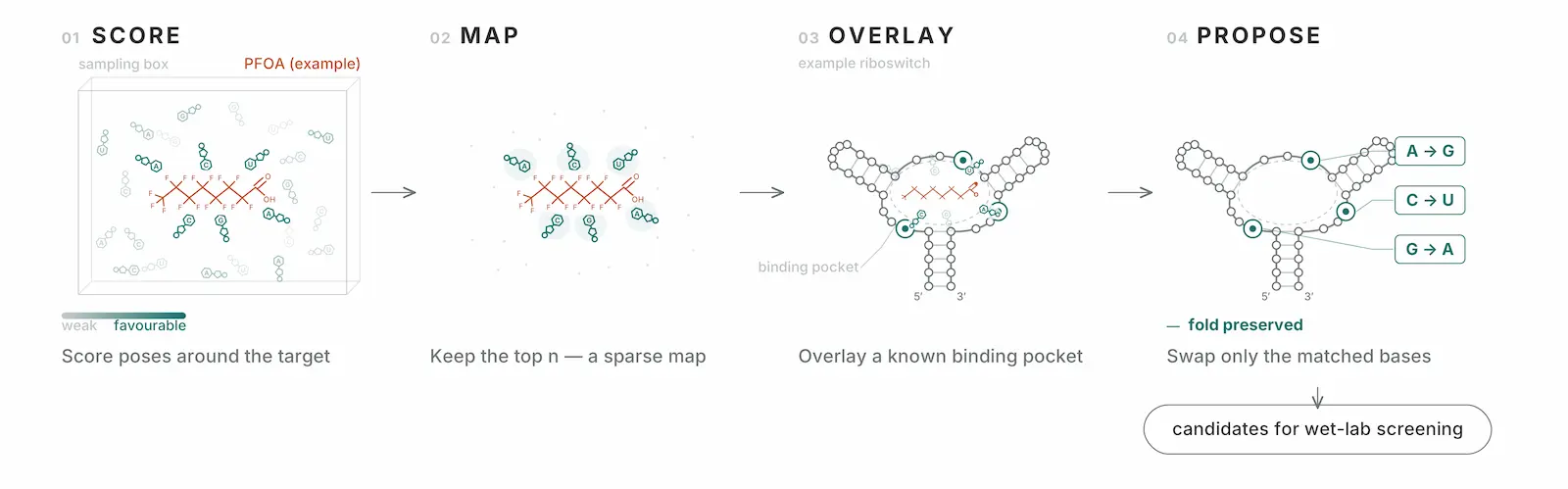
To identify which nucleotide positions interact favourably with the ligand, DISARM uses AMBER to calculate the potential energy, the same way MAWS does. However, instead of using the total potential energy, it subtracts the potential energy of the nucleotide alone and the ligand alone. This means that the energy left is the interaction energy between the nucleotide and the ligand. The idea is that this allows the favourable contact points to be found, instead of positions where the nucleotide happens to be in a comfortable position.
Next, DISARM saves the top 5% of nucleotide positions, meaning the lowest interaction energy. This means the Boltzmann distribution and entropy calculation are completely dropped, and instead a map of favourable nucleotide positions around the ligand is constructed. This map is now overlaid onto a riboswitch or aptamer template supplied by the user (in .pdb format). The nucleotides of the map and the existing aptamer are compared, and based on where they attach to the backbone of the DNA/RNA and the orientation of the nucleotides, swaps are selected to generate candidate riboswitches. The map of the nucleotide positions is then rotated into 50 different orientations and for every orientation, swaps are made. The rationale here is that the original orientation of the ligand is not necessarily the one that is most optimal for the template, so many orientations are tried.
After swapping the nucleotides, a secondary structure prediction is generated using RNAfold [6] and compared to the original one. DISARM then ranks the candidates based on the structure. If the structure is unchanged compared to the original one, the riboswitch is recommended. If there are less than 50 possible riboswitches that keep the structure intact, the list will be filled as much as possible with riboswitches that have swaps but had a different secondary structure prediction. This yields a list of candidate riboswitches, together with the total interaction energy and number of swaps.
Next to the folding prediction, the candidates are ranked based on the total interaction energy of the swaps. This means that two swaps with both -6 kJ/mol will rank higher than one swap of a nucleotide with an interaction energy of -10 kJ/mol. However, the total interaction energy and the number of swaps are both recorded, so the user can decide in the end which riboswitch to test in the lab.
The algorithm also allows for same base swaps. This means that if a template already has favourable interactions with the ligand, this will still be picked up and the algorithm can still recommend a riboswitch with conserved important nucleotides, or even a riboswitch that has only had same base swaps, and is therefore identical to the original one.
Finally, a seed is added to DISARM. When placing the nucleotides around the ligand, randomness is involved. However, MAWS did not have an option to set a seed, and it also did not record a seed. With DISARM, a seed can be set, and if no seed is provided, the seed is saved for reproducibility.
Results
Running DISARM on PFOA and TFA gives a table with 50 candidate riboswitches, An overview of what the output looks like is shown in Table 1.
Click here to see the Table
| Rank | Orientation | Swaps (n) | Substitutions | Total energy |
|---|---|---|---|---|
| PFOA | ||||
| 1 | 46 | 3 | A73G, C53C, G72C | |
| 2 | 14 | 3 | C70A, C53U, A73U | |
| 3 | 39 | 2 | C54G, C71G | |
| 4 | 38 | 3 | C54C, G72C, A52C | |
| 5 | 1 | 3 | G72G, C53U, C74U | |
| TFA | ||||
| 1 | 31 | 2 | A52G, A73G | |
| 2 | 32 | 2 | C71G, A73G | |
| 3 | 28 | 3 | A52G, C54U, A73C | |
| 4 | 33 | 3 | C54C, C71C, G55G | |
| 5 | 9 | 3 | G72C, G55C, A52G | |
The wet lab validation showed that one PFOA riboswitch met the success criterion: when the ligand is present, there is a measurable decrease in fluorescence.
Discussion & Conclusion
The one successful result confirms the rationale of DISARM holds: making swaps to retarget the aptamer can yield a functional riboswitch that exhibits switching behaviour, although more testing is required to validate how many candidates would meet the success criterion. This avoids the problems that arise when generating a de novo aptamer without the necessary folding information. It also simplifies the workflow, avoiding the additional step of using the Salislab riboswitch calculator [7] to generate an expression platform.
Scoring interaction energy instead of the total potential energy allows DISARM to evaluate the nucleotide-ligand interaction more directly, and the addition of a seed makes the results reproducible.
DISARM currently only scores based on affinity to the ligand, not specificity. This means that although a riboswitch might be found, it likely also recognises similar molecules. Future improvements might want to address this by also calculating the interaction energy when given possible off-targets as input, and calculating a combined score that rewards affinity for the target ligand while punishing affinity for the off-target. Another possibility would be to incorporate at least one nucleotide in the riboswitch that would not be a problem for the target ligand, but that inhibits binding of the off-target ligand.
The scope of DISARM is limited to small molecules. Generating a map of single nucleotides and incorporating them in an existing structure works for a small ligand, because the number of possible swaps in one aptamer is limited. Increasing the ligand size means increasing the number of swaps, and therefore increasing the chance that the structure or switching behaviour is disrupted, making the riboswitch non-functional.
In conclusion, DISARM is a novel computational tool that allows the user to retarget an existing aptamer or riboswitch to a new, small molecule target. The tool has shown promising results in the wet lab, although broader validation is required. The tool does not offer a complete replacement for wet lab validation, but it can reduce the need for SELEX in some cases, or guide the selection of a better starting library for it. DISARM will not hand you one working riboswitch, but it can guide you to test a few dozen rather than a few billion.