


Loading...
Loading...

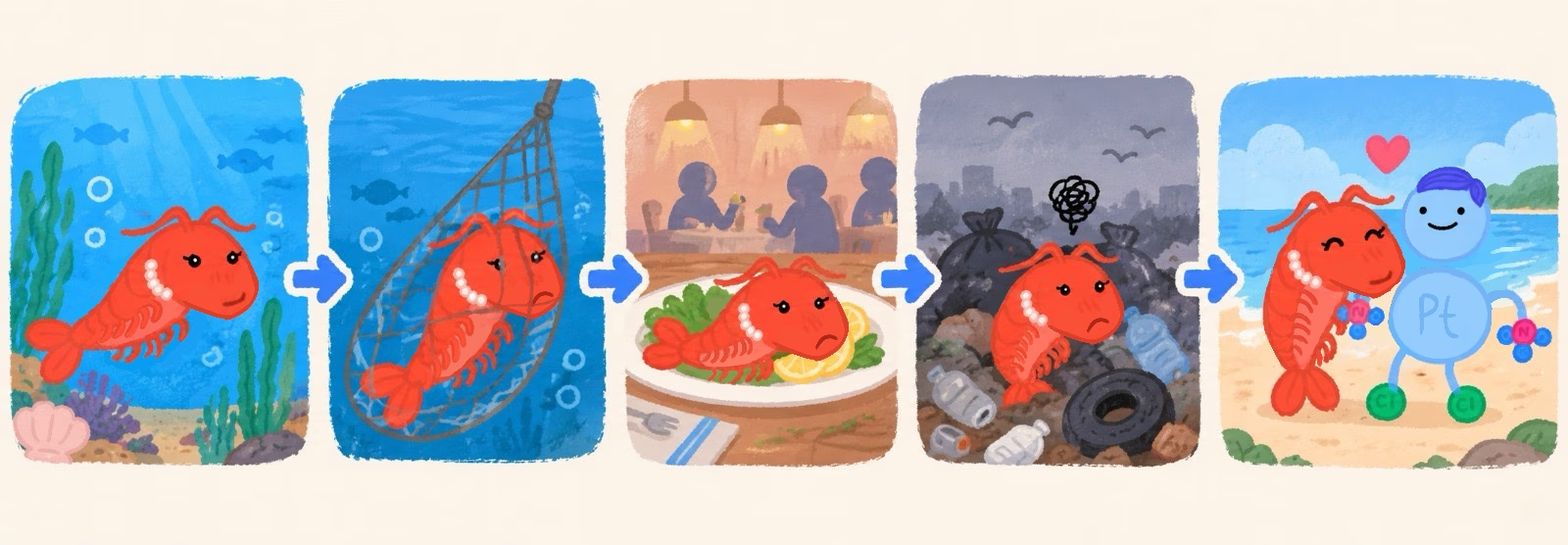
One SHELLter course is predicted to emit…
19.76 kg CO2 eq
approximately equivalent to…
Common foods
NHS practices
Note: These are not accurate equivalence data points. All of these values come from papers that run LCAs using different impact assessment methods and databases, and they are given only for contextual perspective.
Treating one’s patient urine costs roughly what one of their own chemotherapy cycles costs: a five-cycle course on the same partial boundary is about 100 kg CO2 eq, so SHELLter adds around only a fifth to the treatment it cleans up.
Cisplatin is a highly potent cytotoxic drug widely used for chemotherapy treatment [1], and roughly half of each administration dose leaves the patient in urine within days of treatment [2]. In the UK that urine goes straight to the sewer: hospital effluent is not treated for cytotoxics, and the municipal works it reaches was never designed to remove platinum complexes, removing them only incidentally [3]. Platinum has consequently been measured in the wastewater of major UK hospitals and predicted in the surface waters that receive it [3].
SHELLter intercepts the drug at the point of care instead, using a chelating ligand made from chitin recovered from shellfish processing waste using an engineered CDA-ChiA fusion enzyme. The intervention is therefore a genuine trade as it prevents an emission that currently occurs unchecked. Our process does so by building, shipping and incinerating a device, alongside running a fermentation and a chemical extraction to make the ligand that device depends on.
The aim of our project was to quantify the environmental cost of producing and using the SHELLter monoacetylchitosan (MAC) ligand to remove platinum-based cytotoxic drugs from wastewater.
Our objectives for the LCA are as follows:
This study is built in 2 halves that must agree. A component mass balance tracks every stream in every unit operation, and an openLCA model reproduces that arithmetic independently.
Cisplatin is the chemotherapy drug (MW 300.05), platinum is the element within it (MW 195.08). One mg of cisplatin contains 0.650 mg of platinum, and ecotoxicity factors are per kg of element, so both bases are tracked and every figure states which.
MAC ligand is the chelator made from chitin by our fusion enzyme and is made up of a mixture of monoacetylchitobiose (MACB) and monoacetylchitotriose (MACT) depending on degree of polymerisation. One treatment course is one patient, five cycles, five cartridges used per cycle (fifteen total) and 60 kg of urine carrying 0.336 g of drug. The baseline is the urine being discharged remains untreated – the status quo, since UK hospital effluent is not treated for cytotoxics at all [3]. A characterisation factor expresses how much of a kg of substance contributes to a category [4]; without one it contributes nothing.
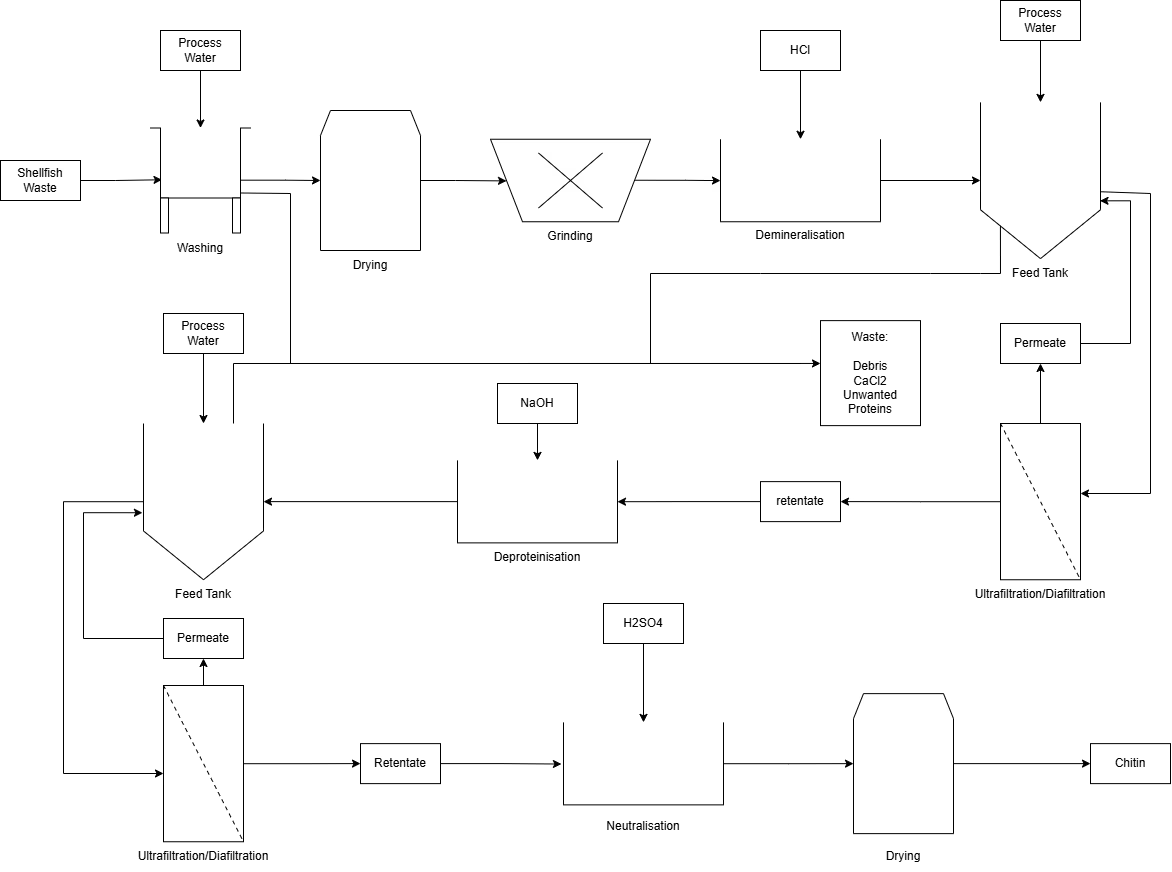
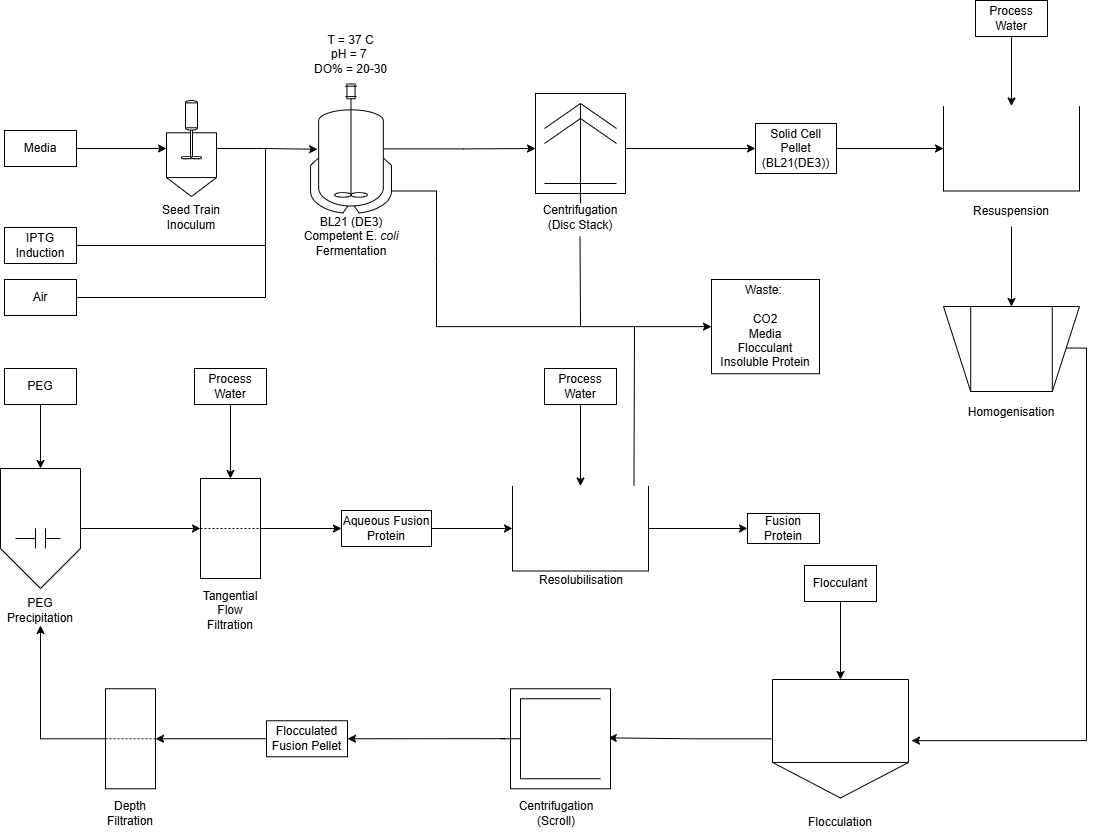
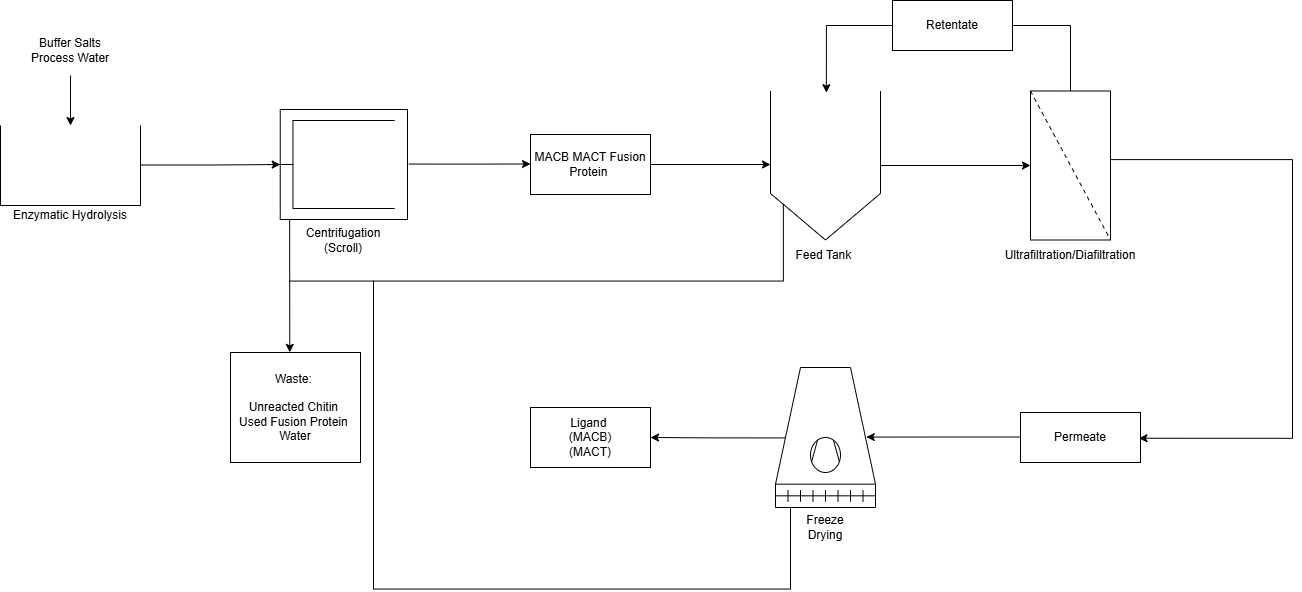
We designed a process which includes the creation of our ligand, alongside the creation and use of it in our proposed hardware, with 4 steps – Steps A, B, C and D:
Steps A to C run on 100 kg of wet shellfish waste, yielding 3.97 kg of chitin and 3.46 kg of MAC ligand, amounting to roughly 2,300 courses at 1.5 g each. Step D runs on one course, drawing 0.043 kg of shell. The ratio is why the biological chain is immaterial – spread over 2,300 courses, the burden from steps A to C nearly vanishes.
| Assumption | Value | Basis and status |
|---|---|---|
| Shell composition, dry basis | 20% chitin, 35% mineral, 40% protein | North Atlantic shrimp [5] |
| Chitin converted to ligand | 90 % | A reaction target, not a measured conversion. Step A scales inversely with it. |
| Mixture of MACT:MACB | 1:1 | Conversion of chitin to each MAC variant is unpredictable so we assumed its equal. |
| Clinical dosing | 75 mg/m3, 1.79 m2 BSA, 5 cycles, 50% excreted on day 1 | FDA label and published mean BSA [6][7][8]. |
| Ligand capacity and operating fraction | 240mg Pt/g at 70% | Capacity from molecular weights assuming 50:50 MACB:TACT |
| Urine volume and density | 2.4 L/day over 5 days per cycle; 1.00 kg/L | Adult upper bound plus a 20 % safety margin [9] |
| Frame service life | 1 course | Initial hardware design |
| Urine retained after pressing | 5% of urine passed | Initial hardware design |
Table 1. Assumptions carried by the model; with the value used, its source, and whether it is a measurement, a literature figure or a design target.
Three caveats bound what the results can support. First, the dominant burden is modelled on a generic hazardous-waste incineration dataset, whereas cytotoxic incinerations runs on hotter, with longer residence and heavier flue-gas cleaning [10]; the largest figure in this study is therefore likely to be conservative rather than inflated. Second, several foreground materials are carried on proxies - ethylene oxide for PEG, containerboard for moulded pulp, generic inorganic chemical for medium and buffer salts, and cellulose fibre for the regenerated cellulose sponge. Third, energy demands are engineering estimates rather than measurements [11]; they are immaterial at the per-course functional unit but would need measuring before any per-batch claim is made.
| Indicator | Baseline | SHELLter | Change |
|---|---|---|---|
| Platinum to surface water | 218.21 mg | 23.85 mg | −89.1 % |
| Platinum diverted to incineration | — | 194.36 mg | — |
| Global warming | 0 | 19.76 kg CO₂ eq | + |
| Terrestrial ecotoxicity | 0 | 23.97 kg 1,4-DCB | + |
| Human non-carcinogenic toxicity | 0 | 10.07 kg 1,4-DCB | + |
| Fossil resource scarcity | 0 | 3.17 kg oil eq | + |
| Human carcinogenic toxicity | 0 | 2.20 kg 1,4-DCB | + |
| Freshwater ecotoxicity | 0 | 0.564 kg 1,4-DCB | + |
Table 2. Results per functional unit; management of urine from one cisplatin treatment course. The baseline is untreated discharge. A plus sign marks a burden the baseline does not carry at all, so no percentage change can be stated.
We expected capture to appear as reduced aquatic ecotoxicity, and it does not: all 1,968 inventory flows are tested against all eighteen categories, and platinum to surface water contributes to none. No characterisation factor for it exists in ReCiPe 2016, EF 3.1 or IPCC, so a conventional assessment scores our benefit zero and our costs in full – a limitation of the method, not a result of SHELLter.
As a result, we aimed to use this LCA model to assess the environmental cost of using our ligand to remove cytotoxic drugs such as cisplatin from wastewater.
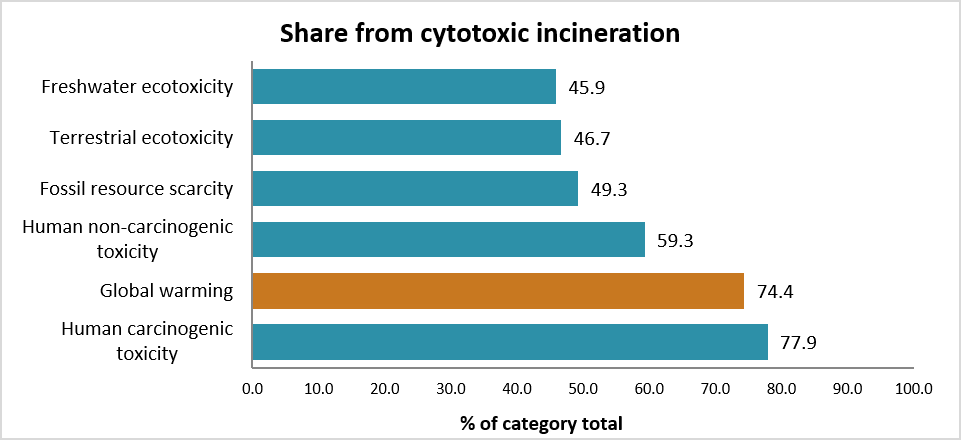
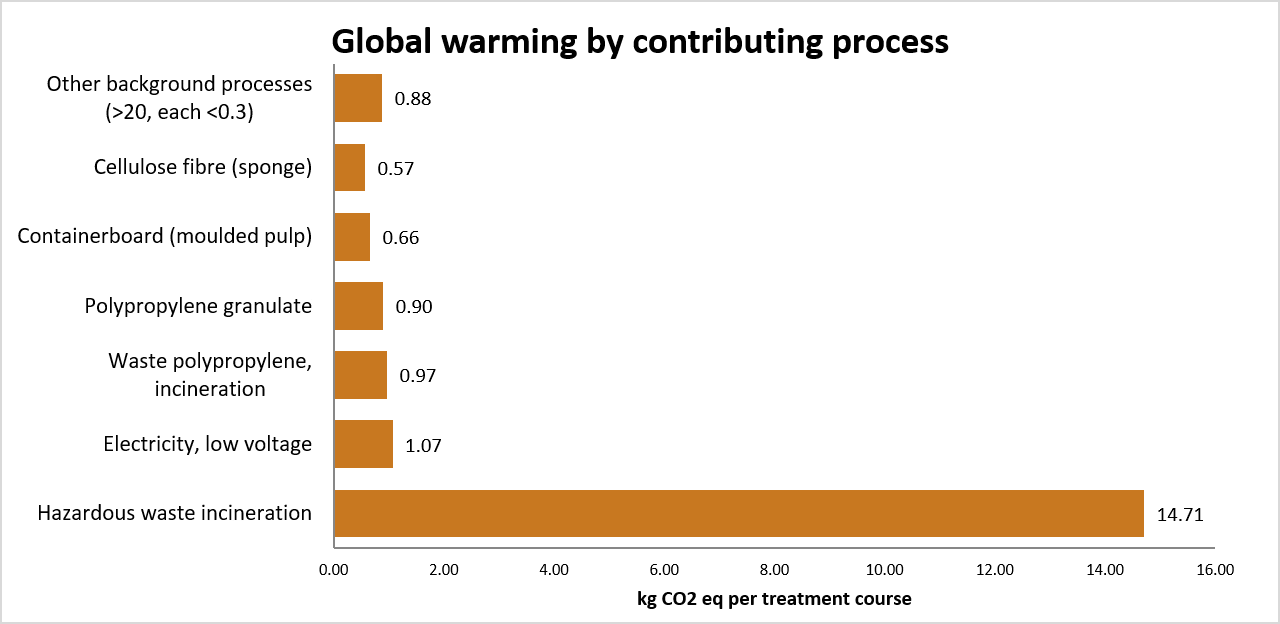
Cytotoxic incineration of the spent cartridge is the largest contributor to every major category: the fifteen cartridges (5.98 kg) supply 14.7 of the 19.76 kg CO2 eq (See Figures 4 and 5 above). The interpretation may be misleading. The cartridge is plant material, and LCA counts burning plant carbon as zero. The emissions come from running the incinerator – the fuel that keeps it hot, the reagents that clean its flue gas, the stabilisation and landfill of its ash. Half of what we send there is urine the lever did not press out, so we are paying to incinerate water. By contrast, no unit process in steps A to C reaches the top eight in any category.
| Scenario | Platinum diverted per kg CO2 eq | vs as designed |
|---|---|---|
| SHELLter as designed | 9.84 mg | — |
| Frame reused 5× | 10.86 mg | +10 % |
| Sponge halved | 11.05 mg | +12 % |
| Pressed harder (2 % retention) | 12.56 mg | +28 % |
| Pressed harder and sponge halved | 14.63 mg | +49 % |
Table 3. Sensitivity of the platinum-to-carbon trade-off to four design changes; each compared against the as-designed case.
One kilogram of CO2 equivalent is able to remove 9.84 mg of platinum out of surface water, or 102 kg CO2 eq per gram of platinum. A sensitivity analysis revealed that break-even has a maximum, not a threshold (See Table 3 above): burden per course is dependent on the bill of materials and the retained urine, while capture scales with concentration only until the ligand saturates. Capacity across fifteen cartridges is 387.6 mg of cisplatin against 335.6 mg excreted from a patient in one treatment course, but half of each cycle’s drug arrives on day one through one cartridge that fills to 100 % while the rest run at 65 %.
The environmental case for SHELLter does not rest where we assumed. We expected biology to dominate and were optimising accordingly; instead, once a batch serves thousands of patients, the production chain divides to very minimal, and three quarters of the burden is incinerating a single-use cartridge that is half water.
Our benefit is also invisible to the method we must use. Any project capturing a trace pharmaceutical meets the same wall: the burden is characterised, the benefit is not, and a naive reading makes the intervention look harmful rather than beneficial. Two methods of improvement – derive a characterisation factor for Pt(II) species or establish that such technologies report an inventory indicator alongside a risk assessment.
One design change would alter the shape of the whole study. The model assumes a single use ligand and no platinum recovery, which can be aspects we consider in prospects of our project. If the ligand could be stripped and reconditioned – acid elution, platinum recovered, ligand returned to service – the burden per course would fall by most of the 74 % that end-of-life contributes, and the recovered platinum would become a co-product to the clean wastewater rather than a hazardous waste.
We can use our process and potentially apply it to capturing heavy metal pollution from industrial mining. The model currently assumes a single-use ligand and no platinum recovery, and these are the two assumptions most worth challenging. Acid elution would strip the chelated cisplatin, returning the ligand to service and potentially converting platinum from a hazardous waste into a recoverable co-product. In this case, regeneration would not only benefit us with producing the ligand: at 0.1 g per cartridge its production chain is already immaterial, so regenerating it saves almost nothing. The prize is that a stripped cartridge may no longer be cytotoxic waste, and end-of-life incineration carries 74 % of the global warming burden.
The LCA ran alongside the design rather than justifying it afterwards. Three conversations changed what we measured, how we report it, and what we now recommend (see Human Practices).
Sara Lightowlers, oncology registrar and research fellow at the Green Cancer Care Network, explained that NHS England’s decarbonisation mandate models carbon across the system as a whole, with cost often standing in as a proxy for emissions to simplify complex decisions. Her warning was that this oversimplifies sustainability, which is multi-faceted and has no single correct solution. This conversation was a great motivation for creating this LCA to honestly communicate trade-offs with our process but also looking at the bigger picture and the implications of doing nothing at all.
Laurence Lovat, Professor of Gastroenterology and Biophotonics at UCL, told us that financially constrained trusts need clear metrics in three things: the problem, the cost, and the feasibility. The Background therefore opens on platinum reaching surface water rather than on our device, and every impact is reported per treatment course, so that downstream environmental damage can be attached to a unit of care and monetised in our Techno-economic Model.
Sharon Pfleger, Consultant in Pharmaceutical Public Health and co-founder of the NHS One Health Breakthrough Partnership, described the gap between academic evidence on pharmaceutical pollution and real-world practice. She argues that metrics which do not save money rarely get acted on, emphasising the need for projects like ours to generate data on metrics that an LCA can for it.