The gene was designed on Benchling and ordered as an IDT gBlock and then cloned into the pSB1C3 vector via Golden Gate cloning using BsaI. The plasmid was then transformed into chemically Competent E. coli DH5alpha cells using heat shock, and cultured on LB agar. The LB agar contained chloramphenicol, IPTG and Xgal. As pSB1C3 is chloramphenicol resistant, the presence of chloramphenicol ensured only transformed cells were present on the plate.
Blue white screening was used to identify colonies that were successfully transformed with the assembled plasmid. During Golden Gate assembly, BsaI cut out the lacZ cassette which was replaced with the coding sequence. This means that the colonies carrying the correct construct appear white on Xgal plates. Colonies without the successful transformation would retain the lacZ fragment, appearing blue. White colonies were picked, cultured overnight and a miniprep was performed to isolate the plasmids.
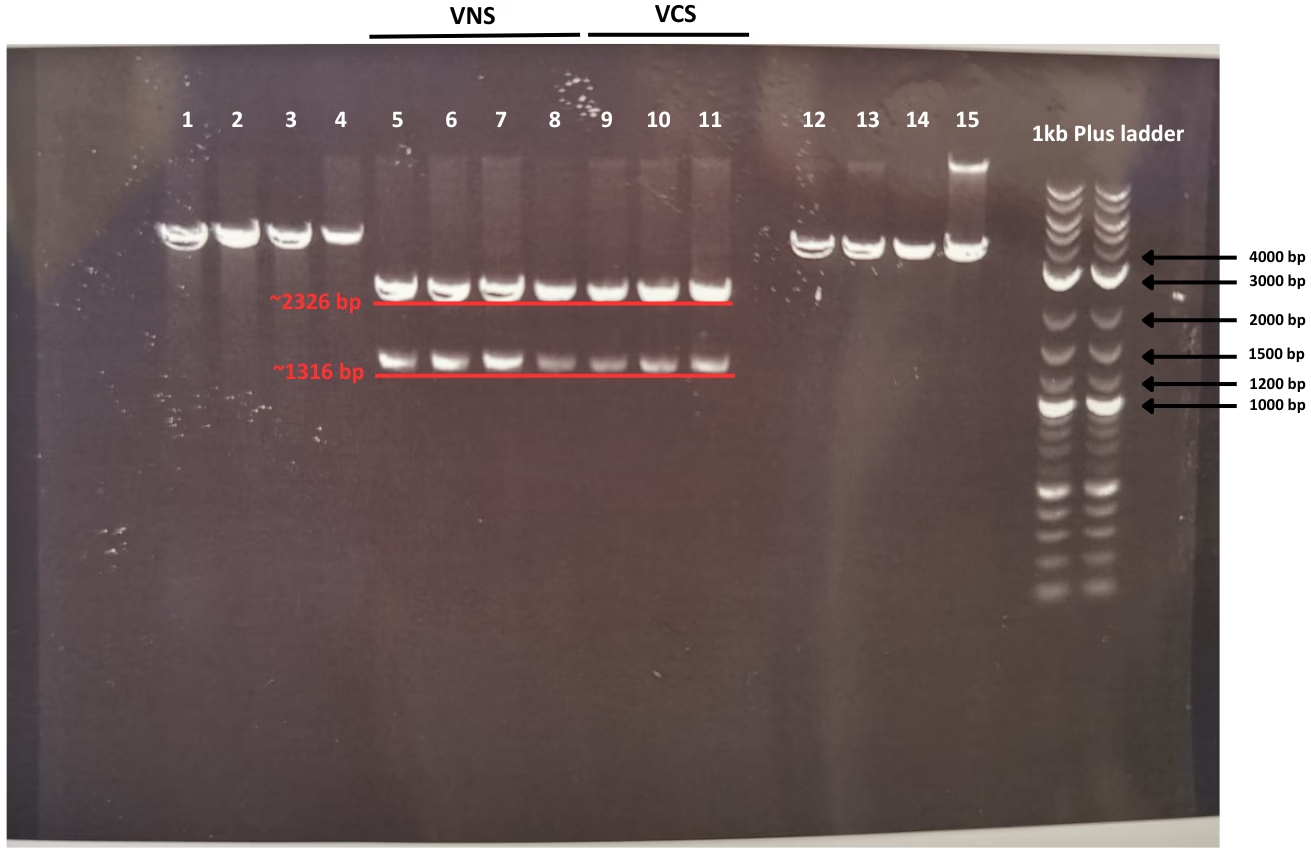
After miniprep, nanodrop was read to understand the A260/280 ratio and gauge plasmid concentration. Then, we performed a restriction digest of the purified plasmid using SacI and NdeI, creating linearised fragments of 1316bp and 2316bp, matching the expected band sizes for the VcCDA gene insert and backbone. The results were visualised using gel electrophoresis as seen in Figure 1.
Figure 1: Gel electrophoresis of the restriction digest for VcCDA expressed in DH5α E. coli. For VcCDA, two strains were run correctly: VcCDA (codon optimised, Strep tag) and VcCDA (non codon optimised, Strep tag). Four colonies of each strain were digested using two restriction enzymes, SpeI and EcoRI. Lanes 5–8: VcCDA (non codon optimised, Strep tag); lanes 9–11: VcCDA (codon optimised, Strep tag).
Once the gel verified that plasmids harboured DNA of the expected size, samples with the highest DNA concentration were sent for sequencing at FullCircle labs. Sequencing results showed perfect matches in the CDS region, indicating suitability for use in expression studies.
Correctly verified plasmids were transformed into competent BL21*(DE3) E. coli cells and plated on LB agar containing chloramphenicol only. A single colony was grown in a 10 mL LB starter culture containing chloramphenicol. The culture was incubated overnight at 37 degrees Celsius, 180rpm. Post overnight, the culture was inoculated into 200 mL total volume LB culture with a starting OD600 of 0.1. Once the culture reached an OD600 of 0.6, protein expression was induced via addition of 100 µL of 1M IPTG. The culture was incubated overnight (16-18 hours) at 20 degrees Celsius, 180rpm.
The cells were harvested by centrifugation at 2500rpm for 30 minutes at 4 degrees celsius, lower than the recommended 6000rpm for 10minutes as VcCDA is shear sensitive.
The pellet was weighed and resuspended in a lysis buffer composed of 20mM sodium phosphate, 0.5M NaCl, and 30mM imidazole, and lysed on ice using a sonicator. A sample of the lysate was taken. The mixture was then centrifuged again under the same conditions and the cell pellet and supernatant were collected.
Characterisation
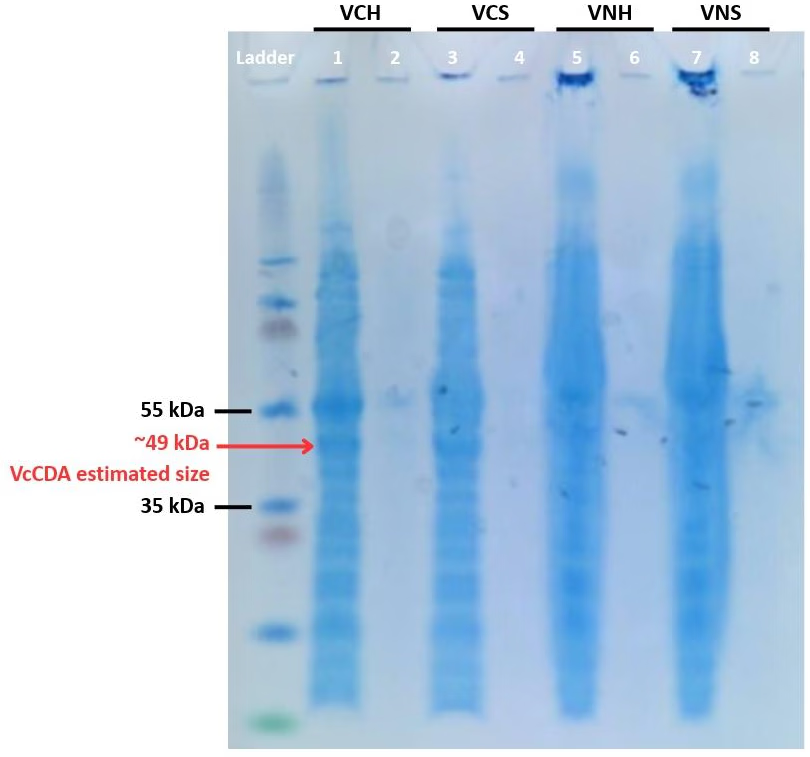
A sample of resuspended cell pellet and supernatant prior to sonication were analysed using SDS-PAGE to see initial protein expression levels. As expected, the background levels of BL21*(DE3) E. coli host cell protein were very high, making it impossible to discern target protein bands, shown in Figure 2.
Figure 2: SDS-PAGE expression study of four VcCDA variants expressed in BL21*(DE3). Variants VCH, VCS, VNH and VNS are VcCDA (codon optimised, His tag), VcCDA (codon optimised, Strep tag), VcCDA (non codon optimised, His tag) and VcCDA (non codon optimised, Strep tag) respectively. Cell pellet and media were collected for each variant post-induction with IPTG. Samples for each strain appear as follows: (1) cell pellet, (2) media.
Due to time constraints and the cost of a Strep tag column, this variant wasn’t further analysed.
Validation
Within the available time for wet-lab data collection, we prioritised conducting and validating the pNPA assay for at least one construct of the VcCDA enzyme. Hence, kinetic characterisation of the VNH construct was not completed, as enzyme characterisation was performed with the VCH construct. For future work, the assay, standard curve, and data analysis conducted for the VCH can be utilised to continue characterisation of the VNS construct.
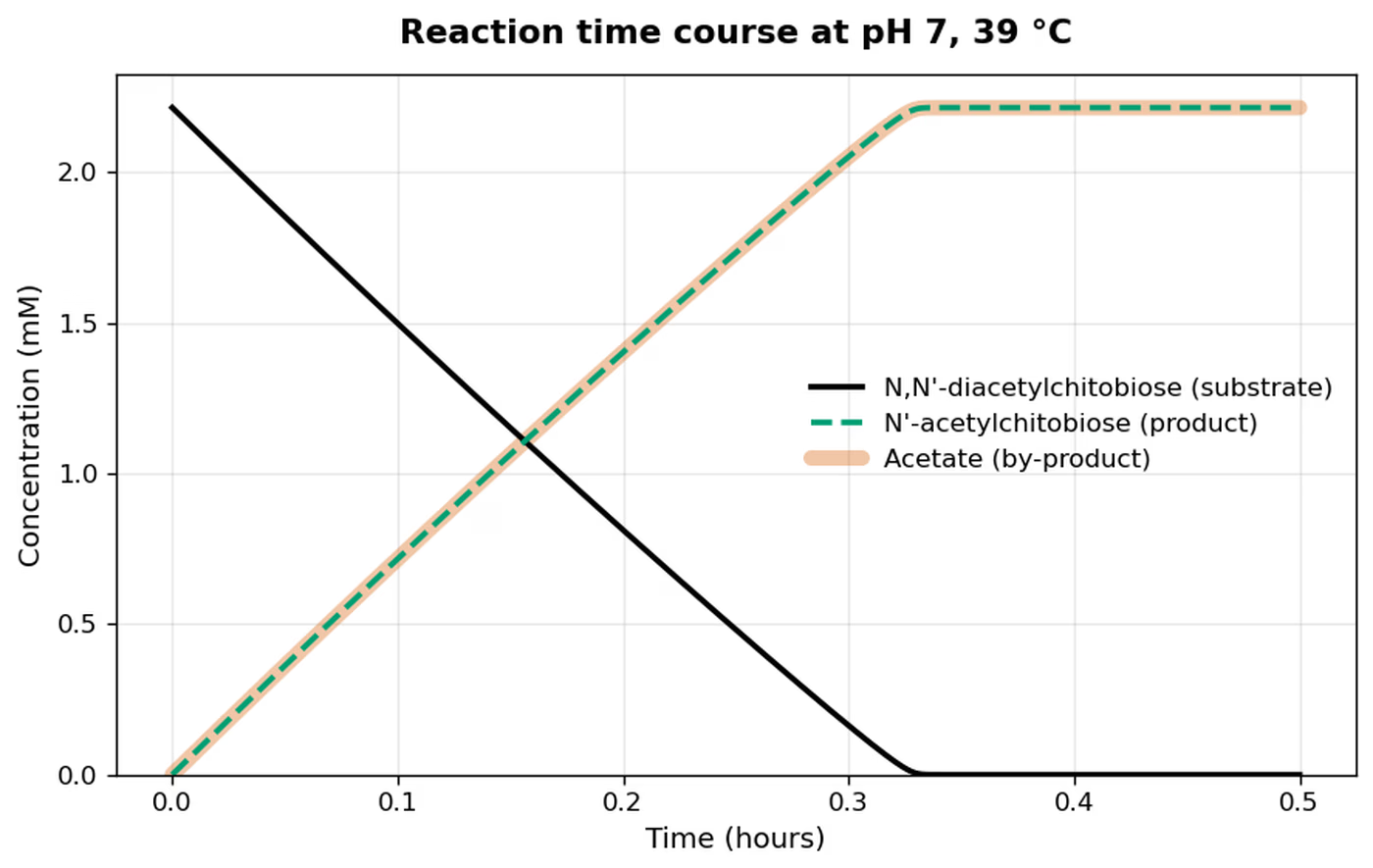
A mechanistically-derived kinetic model was created for VcCDA as a whole (applies to VCH, VNH, VCS, and VNS). This model serves the purpose of being a component of the fusion kinetic model, determining the optimum conditions of VcCDA, and determining its enzymatic capability (e.g. product produced in a certain amount of time with a certain amount of enzyme). The data produced was used to define the assay conditions, as well as to inform on the life cycle assessment and techno-economic models, both of which were used to validate the feasibility of the project and, in the latter case, make comparisons between different enzymatic routes. The model was made by applying traditional Michaelis-Menten kinetics [1], double sigmoidal estimations of thermal and pH optima, and Bigelow degradation kinetics [2], all using literature-sourced values.
For VcCDA in particular, the kinetic model found that the optimum conditions were 39°C and pH 7.0 for an industrial scale run (5 hours). This was deemed close enough to the recommended conditions of the pNPA assay - 37°C and pH7.4 (Sergi and Antoni, 2018). Additionally, by using this model in combination with the SmChiA kinetic model and applying the results to the techno-economic analysis, it was shown that a bioprocess system involving two separate enzymatic unit operations (SmChiA then VcCDA) was not as optimal as a single-pot system, fusion system, or PpChi-based system.
Figure 3: Kinetic model’s reaction time course for VcCDA using literature data. The values derived from the rest of the model to create this graph are a turnover number of 31.553/s and a Michaelis constant of 0.01 mM.
Discussion
Dry lab results, originating from the implementation of kinetic model data into the techno-economic model, suggests that the use of the isolated enzyme (when not in a one-pot enzymatic reaction system) is not financially viable, providing support for the other systems (single-pot, fusion, PpChi).
Ultimately, VNS was not used due to VNH successfully being purified. As such, no further wet lab data was generated.
References
Johnson, K. A., & Goody, R. S. (2011). The original Michaelis constant: Translation of the 1913 Michaelis–Menten paper. Biochemistry, 50(39), 8264–8269. https://doi.org/10.1021/bi201284u
Bigelow, W. D. (1921). The logarithmic nature of thermal death time curves. The Journal of Infectious Diseases, 29(5), 528–536. https://doi.org/10.1093/infdis/29.5.528