

































Finding a plastic-degrading enzyme in a database of millions takes more than a good model. You have to search the database quickly, keep track of what is known about each sequence, and buy enough DNA to test the best candidates without spending the whole budget on synthesis. We built a tool for each of those jobs, and we built them so other teams can use them for their own enzymes.
LOBSTER designs a small set of DNA fragments that assemble into many natural enzyme variants at once, so a lab can test a whole family for much less than the cost of ordering each gene. Sharded DIAMOND search lets anyone paste in an unknown protein and, within a minute, see its closest relatives across all of PETadex, with nothing to install. The sequence record card gathers everything we know about one enzyme on a single page: its structure, origin, relatives and lab results.
Each tool comes with a small demo that runs on this page using real data. All of the code, data and models are open, and the last section of this page says where to find them.
LOBSTER
To maximize our Wet Lab activity validation efficiency, we developed the LOBSTER (Library Optimization for Bioprospecting Sequences Through Economical Recombination) algorithm. Rather than naively purchasing full-length DNA sequences for each PETase core, LOBSTER splits the full-length sequence into sections called fragment positions. LOBSTER then designs fragments at these positions to be combinatorially assembled using Golden Gate assembly and degenerate codons. Overall, LOBSTER seeks to maximize the number of PETadex natural PETase cores which are generated in the resulting full-length library, which we define as coverage, under library size and nucleotide constraints. By running LOBSTER on 90pid clusters, we can experimentally validate them for a fraction of the nucleotide cost (~45%), greatly expanding our full validation space.
LOBSTER operates by isolating the PETase cores, identifying and selecting Golden Gate cut sites, then greedily adding cores to the solution using additional fragments and degenerate codons. Using this approach, the LOBSTER output designs reduce the purchased nucleotides by 55% to cover the LCC and IsPETase 90pid clusters. This expands our PETase activity validation search space across more clusters. Additional details on LOBSTER's implementation can be found on its own page.
Output
As literature controls, we ran LOBSTER on two 90pid clusters, one containing IsPETase and the other containing LCC. Below is an interactive example of LOBSTER's output designs for the IsPETase and LCC clusters. Hovering over the different fragment positions shows the nucleotide sequences of each oligo at that position. Additionally, Golden Gate information including the overhangs between fragment positions and adapter sequences are displayed.
Savings
The following figures show the nucleotide savings of LOBSTER's output designs for the IsPETase and LCC clusters.
Sharded DIAMOND search
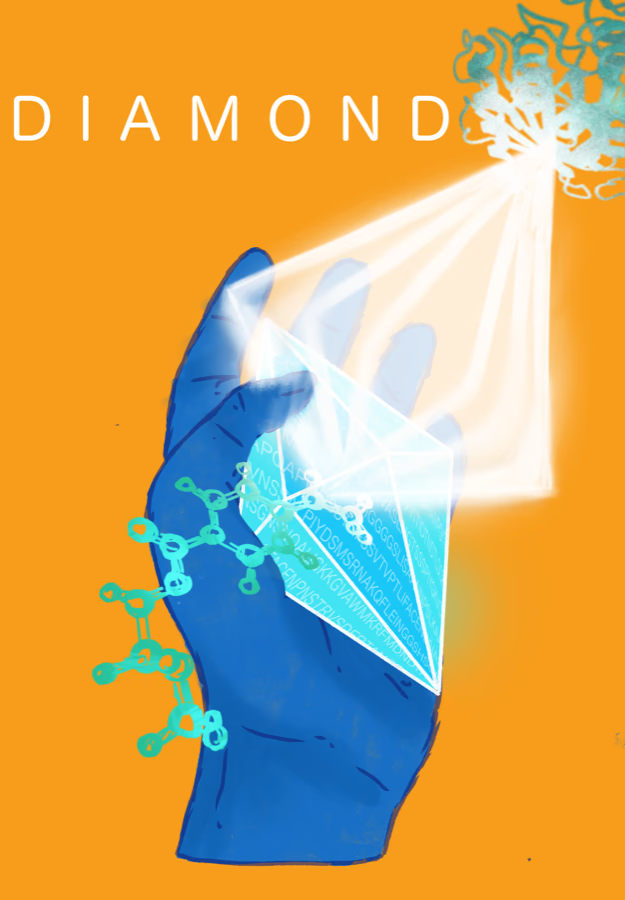
Paste a protein. Search every enzyme in PETadex.
- 300M+
- proteins searched per query
- 32
- shards searched in parallel
- < 1 min
- from paste to results
Researchers often come to our database and ask a simple question.
I have this novel enzyme here that I know nothing about. Can you tell me what it is?
We can tell what it is by looking at the enzymes that are similar to it, found with a DIAMOND search [1] over the entirety of the PETadex corpus. We've built this into a lightweight tool in the web-browser, no installs and less than a minute runtime.
Nothing runs between searches, so the tool costs almost nothing while it waits for a query. When one arrives, a coordinator starts one worker per shard, and a final step merges their hits.
Below is what comes back. Each of these ten searches was really run on the live tool, and the replay shows the shards finishing and merging the way the real pipeline does, sped up from about 45 seconds to two.
What is this enzyme? Ask its neighbours.
Pick an enzyme to replay a real search of it against every protein in PETadex.
MHETase is the one to try for a contrast: it is IsPETase's partner enzyme [2] but has a different fold, and the search finds only 134 relatives, the closest about 34% identical, where every PETase here fills the 500-hit cap. SRR10663367 is the question we opened with — a sequence from Logan [3] that nobody had identified, whose closest neighbours turn out to be Nonomuraea PET hydrolases at 71% identity.
MethodsHow the database is split, why the merged ranking is exact, how results are versioned and cached, and how we measured all of this.Sequence record card
From our vast dataset of millions of putative plastic-degrading enzymes, it is important to not lose track of the minute details of each sequence. To explore these details, we've given each ORF (sequence) in PETadex its own page, documenting everything that we've annotated for these enzymes.
We've annotated everything from the structures of these enzymes, down to their catalytic mechanisms and which residues in the sequence are specifically responsible. In addition, we've included metadata features, such as where each of these sequences comes from, its homologous neighbours and how they fall within our hierarchical clustering. We've even included how we ordered these sequences with the LOBSTER algorithm and even the readout we got from our Wet Lab validation of these enzymes!
Check out the demo below to see how this looks on two reference enzymes, and see petadex.net for the full pages.
One enzyme, every layer.
One record, layer by layer. Pick an enzyme, then step down the left.
ColabFoldv1.5.5, 290 residues, mean 91 pLDDT · CF0000000001_02_01. Picked out in the fold: the catalytic triad, serine 160, aspartate 206, histidine 237, where a PET chain is cut.
Availability and licensing
The source code for LOBSTER and the Sharded DIAMOND search lives at https://gitlab.igem.org/2026/software/toronto/petabite . Both tools are released under the MIT License.
Installation
Each tool installs separately. Open its folder and follow its README, for example PETadex Sequence Search → Installation.
git clone https://gitlab.igem.org/2026/software/toronto/petabite.git
cd petabite/<tool-folder>
Usage
See each tool's README for usage examples and expected output, for example PETadex Sequence Search → Usage.
Data and large files
This repository holds source code only. Datasets are deposited on Zenodo and linked from each tool's README:
| Tool | Dataset | Record |
|---|---|---|
| PETadex Sequence Search | PETadex catalytic ORF corpus v1.1, sharded search database (23.8 GB) | doi:10.5281/zenodo.23457986 |