

Accessibility
Text size
The goal of our Proof of Concept (PoC) phase is to test our engineered genetic circuit step by step at every level of the DBTL cycle from genomic integration to dynamic, ratiometric fluorescent readout.
Beyond testing ICHNOS itself, our PoC was designed to characterize the system adequately for future researchers to reuse and repurpose it: a modular sensing module that can be swapped for any stress-specific promoter, paired with a universal, linearizing reporting module.
After constructing the linear DNA fragments, our first priority was to bring the cassettes into the yeast genome at the HO locus in each of the three strains. Host cells were transformed following the Lithium Acetate (LiAc) protocol, and the fragments are joined by the cell's native homologous recombination machinery through their overlaps and the HO flanks. Cells that received no DNA served as the negative control. All three strains grew on histidine-free medium and the control did not. Since the HIS3 gene is carried on Fragment 1, this shows that Fragment 1 was taken up and maintained. We also designed a colony PCR across the left junction to test the position of the cassette. Its first attempt gave no band, most likely because the cells were not lysed well enough, and a repeat with a stronger lysis step is planned. For now we describe the strains as selected and consistent with correct integration.
To support engineering success, we used the laboratory yeast strain CEN.PK2-1C, which is auxotrophic for four markers (his3, leu2, ura3 and trp1). We used the his3 deficiency as a selection tool: only cells that took up the HIS3 gene on our DNA cassette could grow on histidine-free medium. Auxotrophy is a selection method and not a containment measure, and the strains are handled and disposed of as genetically modified organisms (see Safety and Security).
By the end of this stage, all three strains had been selected on histidine-free medium and showed the expected dependence on the growth medium, consistent with uptake of the HIS3 marker.
Both sensing modules share a common design principle: each is built on a well-characterized, endogenous or synthetic stress-responsive promoter, rather than a de novo part whose specificity we would need to establish ourselves. Beyond specificity, we also evaluated the activation timing of each promoter. It was important to utilize genes that were activated early-on the cell's stress response rather than genes that signal an apoptotic pathway.
Oxidative stress module: the synthetic promoter pSynO4_alt1, chosen for its early-onset activation kinetics under oxidative stress, downstream of the Yap1 transcription factor pathway.[1]
ER-homeostasis module: the native promoter pKAR2, part of the Unfolded Protein Response (UPR), activated via Ire1/Hac1 signaling and also induced by heat shock. [2]
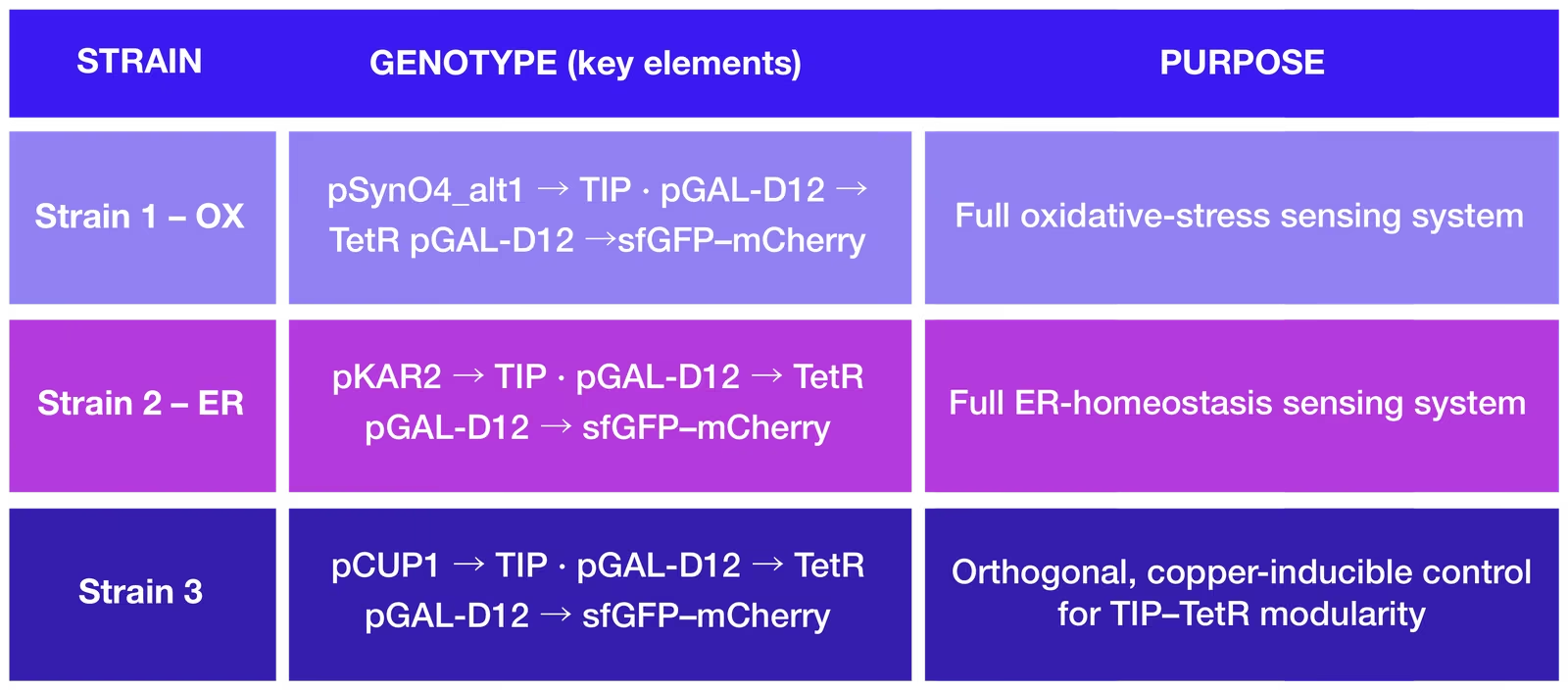
Since our engineering goal was not to re-establish the specificity of these promoters already extensively documented, we instead drew on the literature to define our operating parameters and used our PoC assays to characterize the system-level dynamics that ICHNOS adds on top of these well-known switches.
Every dose-response run included a 0 µM culture of the same day, taken through the same galactose step as the stressed cultures, and unmodified CEN.PK2-1C was exposed to the same stressors as an autofluorescence background. The 0 µM culture is our readout of basal expression (leakiness) and the reference for every dose.
Drawback
Variations in cellular growth rate and fluorophore maturation under stress are expected and show up as fluctuations in the measured signal.
Our response
Strain 3 (pCUP1) was designed as a stress-independent control for the downstream circuit, so that a change seen in all three strains can be separated from one seen only with the stress-specific promoters. [3]
Our central design hypothesis is that the TetR negative-feedback loop linearizes the relationship between input stress and fluorescent output and delays premature saturation compared with an open-loop design. TIP binds TetR and relieves its repression at pGAL1-D12. Because TetR also represses its own transcription, the pool of TetR available for de-repression is replenished, which should buffer the response and give a more linear dose curve than a circuit in which the promoter drives the reporter directly. [4], [5], [6]
Strain 1 (oxidative stress) and Strain 2 (ER stress) were each exposed to a ladder of their stressor (hydrogen peroxide from 0 to 600 µM, DTT from 0 to 2000 µM) and imaged in brightfield, the sfGFP channel and the mCherry channel at several times after dosing. In the first analysis the red signal rose with the hydrogen peroxide dose on 7 October, and no response to DTT was detected up to 2000 µM. The next round extends both ladders and adds a time course to test the linearization.
Drawbacks
While the architecture is designed to handle near-saturation dynamics, the circuit encounters biological limits under extreme stress intensities. Hyper-physiological stress levels arrest cellular responses and activate native apoptotic pathways, overpowering the synthetic circuit.
Our response
However, this limitation is aligned with the intended scope of ICHNOS that the platform is engineered as a real-time monitoring and characterization tool for healthy or moderately stressed cell populations in research settings, rather than a diagnostic marker for cell death. Beyond the biological survival threshold, cellular signal processing becomes irrelevant.
Strain 3-Cu carries the same downstream circuit behind a copper-inducible promoter, an input that is separate from oxidative and ER stress, and it was run alongside Strains 1 and 2. It was exposed to copper sulfate (10, 25, 50 and 100 µM, with a no-copper control) and imaged in brightfield, sfGFP and mCherry from dosing up to 4 hours, and the unmodified strain was imaged under the same doses. These images are held for analysis once the model has a copper input module, and they will serve as a sensor-independent test of TIP, TetR and the reporter.
The design keeps the sensing promoter swappable: any future stress- or condition-specific promoter could in principle be substituted upstream of TIP without redesigning the reporting circuit, which supports the feasibility of a universal plug-and-play assembly.
Drawbacks
An inherent limitation of using a copper-inducible promoter pCUP1 as an orthogonal control is that high levels of copper ions (Cu2+) can generate reactive oxygen species (ROS) via Fenton-like reactions, potentially confounding oxidative stress pathways.
Our response
Although copper above some concentrations can cause oxidative stress, yeast cells have copper-specific compartments that reduce this effect [7], and we used low micromolar doses (10 to 100 µM) taken from published characterizations of the CUP1 promoter, well below toxic concentrations.
Ending with the most important part of the system's architecture, the fluorescent output, is the interface between the genetic cassette and protein-to-protein interaction with the computational toolkit. Tandem Timers are based on the different maturation times of different fluorescent proteins, meaning a fast-maturing sfGFP is fused with a slow-maturing mCherry. Both are measured through separate fluorescence channels and their ratio is used as a time predictor. In our experiments both channels were recorded at several times after dosing [8]. The red-to-green ratio becomes a clock once the timer is calibrated optically (for example with mother and bud cells) and tested with strains that carry sfGFP and mCherry separately and with a pulse-and-release experiment, and the images already collected can be re-read with that calibration. A first RT-qPCR for GB1 (as a proxy for TIP), TetR and sfGFP was attempted, and a repeat with more RNA is planned.
Together, dose-response imaging and the decoding toolkit are built to characterize a stress event as recent, ongoing, or past rather than as an ON/OFF switch.
Drawbacks
The maturation time of mCherry is inherently sensitive to physiological factors such as intracellular pH, local oxygen concentrations, and temperature. Extreme stress states that perturb cellular homeostasis may alter protein folding dynamics, introducing minor noise into the predicted time estimates. Continuous or long-term fluorescent tracking can induce photobleaching, which affects sfGFP and mCherry unequally. Regarding the sensing accuracy and characterization ability, a greater load of imaging data may be required to ensure robust time estimation.
Our response
Fine-tuning excitation/emission parameters and keeping exposure times minimal are required to prevent artificial shifts in the ratiometric index.
Lastly, we included some extra controls:
Through this work we built three strains that share one reporting module and differ only in the sensing promoter, selected them on histidine-free medium, imaged dose-response runs for all three and found a first dose-ordered signal under hydrogen peroxide. The design keeps the sensing promoter swappable without redesigning the reporting circuit, and this modularity is the core of what we hope future teams can reuse. See our Engineering page for more information on our experimental workflow, and our Applications page for how ICHNOS's plug-and-play design could extend beyond stress-sensing.