

Abstract
Halogenated compounds are essential parts of pharmaceuticals and fine chemicals, accounting for up to 30% of approved drugs.1 Enzymatic halogenation offers a promising alternative to classical chemical halogenation, but its industrial application is limited by enzyme stability and recovery. Vanadium chloroperoxidase from Curvularia inaequalis (CiVCPO) is a haloperoxidase which catalyzes the oxidation of chloride using hydrogen peroxide to hypochlorous acid, a reactive intermediate that halogenates nucleophilic acceptors to form chlorinated products.2 Vanadate acts as a cofactor in the active center without changing its oxidation state, so no cofactor regeneration is required.3 The enzyme is thermostable (melting temperature ≈ 90 °C),4 is not inactivated by 500 mM H2O2 and remains fully stable over 25,000 turnovers.5 Existing immobilization strategies, including covalent attachment to hydroxyapatite6 and to aldehyde-functionalized methacrylate resins,7 have resulted in poor recovered activity or limited reusability. Therefore, we asked whether vanadium chloroperoxidases can instead be enclosed in encapsulins, protecting the enzymes while preserving their activity and allowing their recovery. With the ENCORE toolKIT we co-expressed CiVCPO carrying a C-terminal targeting peptide together with the encapsulin monomer of Myxococcus xanthus8,9 or Quasibacillus thermotolerans,10 which self-assembles into encapsulins in Saccharomyces cerevisiae.11 The constructs were assembled by Golden Gate cloning12 using the ENCORE toolKIT and verified by Sanger sequencing. Neither the expected protein bands on SDS-PAGE nor halogenating activity in a phenol red assay could be detected. The same expression failure was observed across all toolKIT modules, which places the limitation in the shared expression system rather than in the CiVCPO constructs. The encapsulated enzyme itself therefore remains uncharacterized.
Introduction
Halogenation is one of the most widely used activation strategies in industrial organic synthesis, both to introduce halogen substituents into the final product and as an intermediate step in multi-step syntheses.13 Chemical halogenation typically requires a higher energy input, e.g. elevated temperatures, and generates hazardous waste due to the use of reagents such as N-bromosuccinimide/acid/methanol or Ag+/Br2, resulting in a higher environmental impact.14,15 Enzymatic halogenation is a sustainable alternative, proceeding under milder conditions.16
Vanadium-dependent chloroperoxidases tolerate harsh conditions, including high concentrations of H2O2, a broad pH and temperature range and a variety of solvents.4,5,16 These enzymes catalyze the H2O2-dependent oxidation of halide ions to hypohalous acids.2 The vanadate in the active center does not change its oxidation state, which accounts for the stability against H2O2 and hypohalous acids.3,16 Because the vanadate is neither consumed nor redox-cycled during turnover, no cofactor regeneration is required. Flavin-dependent halogenases, by contrast, depend on NAD(P)H, a partner reductase and a sacrificial co-substrate to reduce their cofactor, whereas the vanadium chloroperoxidase from Curvularia inaequalis (C. inaequalis, CiVCPO) needs only hydrogen peroxide and a halide salt. Removing the auxiliary enzyme and the stoichiometric reductant lowers both the cost and the waste burden of the process. The highly reactive hypohalous acid halogenates a broad range of substrates. CiVCPO has been shown to halogenate phenols,14 carbon acids, indoles and activated aromatics.15,16
Despite its robustness, the enzyme has not been widely adopted in industry because efficient immobilization strategies that enable the catalyst to be reused are scarce. There are only two papers investigating the immobilization of CiVCPO.6,7 Covalent attachment to hydroxyapatite proceeds with high immobilization yield, but the recovered activity, the specific activity of the bound enzyme relative to the free enzyme, does not exceed 17% while the same support performs well for two unrelated enzymes in the same study. Attachment proceeds through the enzyme’s surface lysines, and the activity lost during binding is attributed to conformational strain and restricted access to the buried, vanadate-bearing active site.6
Encapsulins offer a promising alternative. The nanocompartment is co-expressed with the enzyme and self-assembles, so that CiVCPO is enclosed in the encapsulin without any chemical modification, which should preserve its activity.11 The result is a defined reaction space, protected from proteases,11 which also offers the possibility to host multi-enzyme cascades.9 This also separates the two requirements that conventional immobilization has to meet at once. The shell preserves the enzyme, while its exterior can be functionalized with peptide tags or conjugation handles, so that recovery is engineered on the compartment and the surface lysines and the buried active site of CiVCPO are left untouched.
We applied the ENCORE toolKIT to encapsulate CiVCPO in Saccharomyces cerevisiae (S. cerevisiae).11 We chose a pore-engineered encapsulin from Myxococcus xanthus (M. xanthus, Enc-Mxpe)8,9 and an encapsulin from Quasibacillus thermotolerans (Q. thermotolerans, Enc-Qt)10 because we expected them to provide a sufficiently large lumen and sufficiently wide pores. CiVCPO is natively secreted, so the signal peptide was removed during construct design. Enc-Qt is additionally thermostable,10 which can be used for purification since CiVCPO is thermostable as well.4 The Golden Gate assembly strategy is described on the toolKIT page.
Two questions had to be answered before the nanoreactor could be evaluated: whether both components are expressed in S. cerevisiae, and whether CiVCPO retains halogenating activity once it is enclosed. We addressed the first by SDS-PAGE of cell lysates and the second by a phenol red assay on the same lysates.
Results
Design and Assembly of the Module
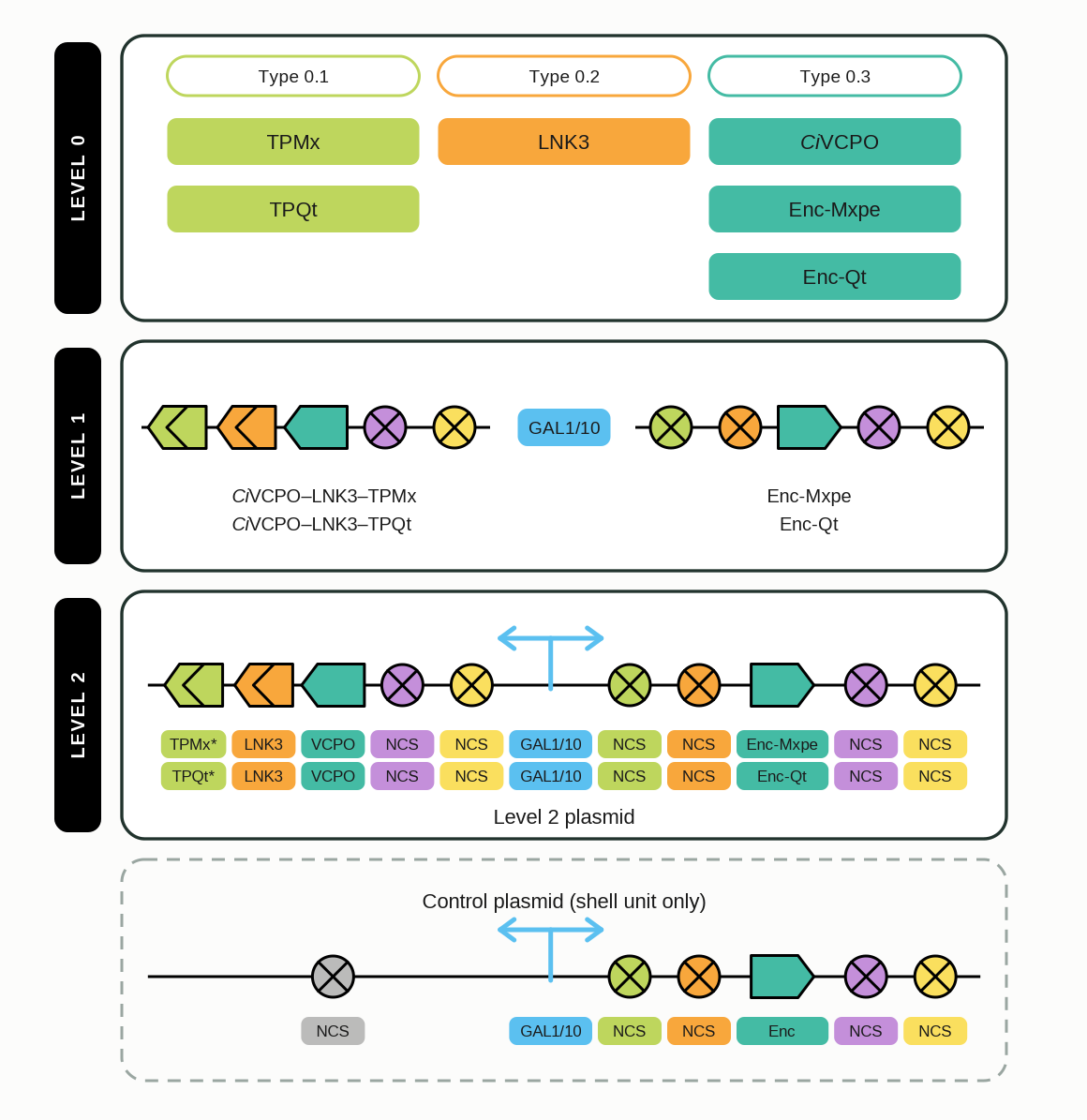
The module consists of two transcriptional units on one Level 2 plasmid: the Enc-Qt or Enc-Mxpe encapsulin monomer and the CiVCPO with C-terminal targeting peptides (TPQt or TPMx), both joined through (GSSS)3 linkers. The control strain carries only the shell unit. The Level 0 constructs were assembled by Golden Gate cloning.12 Assembly of the Level 1 constructs failed and they were ordered from GenScript for time reasons, in a pESC-URA plasmid with the GAL1/10 promoter.
Transformation
The Level 2 construct was transformed into S. cerevisiae strain MH272-3fα according to the transformation protocol. Transformation was verified by yeast colony PCR.Each of the four strains was cultivated with and without galactose induction giving the eight samples analyzed below.
Expression
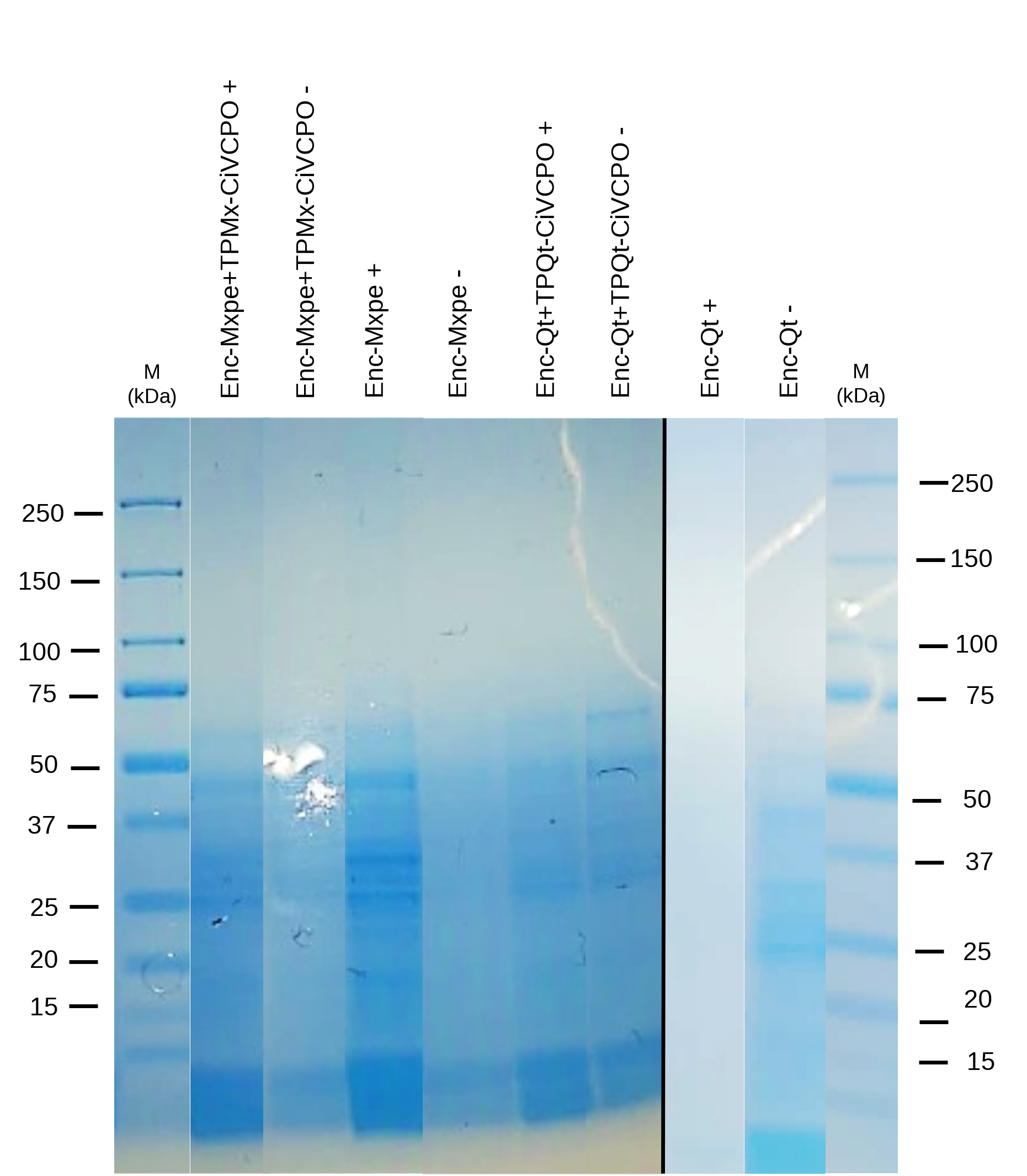
Expression could not be verified. Lysates of all samples were analyzed by SDS-PAGE (Figure 2). The expected bands on the SDS gel were not detected. The band pattern of induced samples was indistinguishable from non-induced controls. The marker was resolved over the range from 250 to 15 kDa. The expected sizes are about 67 kDa for the CiVCPO and 32 kDa for the encapsulin monomers. The samples were not purified.
Phenol Red Assay
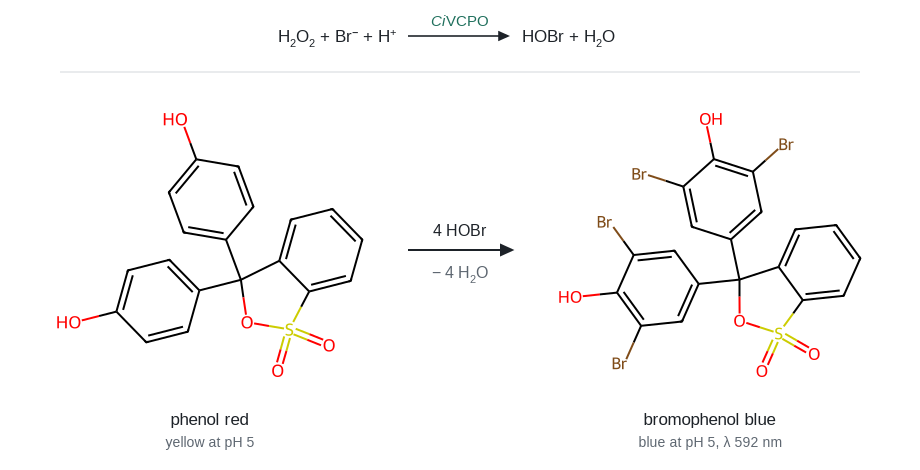
Halogenating activity was followed by the bromination of phenol red to bromophenol blue (Figure 3).¹⁷ CiVCPO oxidizes bromide with H₂O₂ to hypobromous acid, which then brominates phenol red non-enzymatically at the four positions ortho to the phenolic hydroxyl groups. At pH 5 the substrate is yellow and the product blue, so turnover is followed as an increase in absorbance at 592 nm. Because the enzyme releases free HOBr instead of halogenating a bound substrate, the readout reports hypohalite generation rather than substrate recognition, and HOBr is small enough to leave the compartment, so the assay does not require phenol red to reach the encapsulated enzyme
Cell lysates Enc-Mxpe + TPMx-CiVCPO induced, Enc-Mxpe + TPMx-CiVCPO not induced, Enc-Mxpe induced, Enc-Mxpe not induced, Enc-Qt + TPQt-CiVCPO induced, Enc-Qt + TPQt-CiVCPO not induced, Enc-Qt induced, Enc-Qt not induced were assayed for bromination activity using phenol red.17 No formation of bromophenol blue was detected in any sample. The absorbance at 592 nm did not change over 30 min. A positive control using free CiVCPO was not available.
The remaining steps of the design could not be evaluated within the project timeframe.
Discussion
For an extensive analysis of the limitations see Discussion toolKIT.
Neither the expected bands on SDS-PAGE nor halogenating activity in the phenol red assay could be detected. The same expression failure was observed across the other toolKIT modules, including the fluorescent proof-of-concept cargo, which remained undetectable by microscopy, plate-reader kinetics and SDS-PAGE in two different strains. The common element is the Level 2 destination vector: domestication of pESC-HIS removed four BbsI sites, two of them in the GAL1/10 upstream activating sequence, one in the HIS3 marker and one in the 2µ origin, so induction, selection and copy number are all potentially affected. None of the four can be assigned a definite effect and none can be excluded, but together they remain the most concrete explanation available for a construct that is correct in its assembled sequence yet fails to express. Because the CiVCPO constructs are carried on the same backbone, they are subject to the same limitation. Mistargeting the cargo to the secretory pathway, the failure mode specific to a natively secreted enzyme, can be excluded, since the construct encodes the mature protein without its signal peptide.
The assay result therefore follows from the absence of detectable enzyme and carries no independent information. No statement can be made about encapsulation efficiency or about the activity of the encapsulated enzyme. Two qualifications apply. First, Coomassie-stained SDS-PAGE of crude lysate detects a heterologous protein only above roughly 1% of total cell protein, so the data establish that expression was insufficient, not that it was absent. Immunodetection is required before expression can be excluded. Second, in the absence of a positive control with free CiVCPO, the sensitivity of the assay under our lysate conditions was not independently confirmed.
What the module did deliver is a complete construct set for two encapsulin scaffolds and a characterization workflow that is ready to run once expression is restored.
Outlook
Once the expression system is restored, several questions specific to this module remain open. The first step is to establish whether the two components are produced at all. Coomassie-stained gels of crude lysate cannot settle this, so expression should be probed by immunodetection. Once expression is confirmed, compartment formation and cargo loading have to be shown rather than assumed. Native PAGE and negative-stain transmission electron microscopy (TEM) would establish that compartments assemble, and densitometry of the shell and cargo bands after purification would give a first estimate of the encapsulation efficiency, on which the present data allows no statement at all.
After the qualitative phenol red assay and purification, the monochlorodimedone (MCD) assay18 should be used to quantify the activity of the encapsulated enzyme relative to the free enzyme, free recombinant enzyme and to published support-bound systems. Resistance to proteases should be measured in the same series. We assumed that ortho-vanadate can be supplied after lysis. There is, however, no evidence that vanadate diffuses efficiently through the pores of assembled encapsulins, and supplementation during cultivation may therefore be required. Comparing both regimes would settle whether the holoenzyme has to be formed before encapsulation. Furthermore, the hypohalous acid intermediate is highly reactive and may react with the proteins of the encapsulin shell. The stability of the compartment under turnover conditions should therefore be tested, for example by analyzing compartments after extended reaction by native PAGE and TEM.
Whether heat treatment is a viable purification step has to be established experimentally. Thermostability is documented for the free enzyme and for the isolated shell, but encapsulation may stabilize the cargo, or the loaded compartment may aggregate or release its cargo at a temperature at which both components are stable on their own. Incubating purified compartments across a temperature series and following analysis by native PAGE and TEM and residual activity by the MCD assay would define the usable window.
Finally, the property that motivated encapsulation has to be demonstrated. Capture through a tag displayed on the shell exterior would be compared over consecutive reaction cycles, with activity measured against the free and immobilized enzyme. Assuming that a functional system is established, the nanoreactor can then be extended, for instance by co-encapsulating a second enzyme through its own targeting peptide to build a catalytic cascade within a defined reaction space.9
References
- Ali, S.; Tian, X.; Meccia, S. A.; Zhou, J. Highlights on U.S. FDA-approved halogen-containing drugs in 2024. Eur. J. Med. Chem. 2025, 287, 117380. https://doi.org/10.1016/j.ejmech.2025.117380
- van Schijndel, J. W. P. M.; Vollenbroek, E. G. M.; Wever, R. The chloroperoxidase from the fungus Curvularia inaequalis; a novel vanadium enzyme. Biochim. Biophys. Acta 1993, 1161 (2–3), 249–256. https://doi.org/10.1016/0167-4838(93)90221-C
- Messerschmidt, A.; Wever, R. X-ray structure of a vanadium-containing enzyme: chloroperoxidase from the fungus Curvularia inaequalis. Proc. Natl. Acad. Sci. USA 1996, 93 (1), 392–396. https://doi.org/10.1073/pnas.93.1.392
- van Schijndel, J. W. P. M.; Barnett, P.; Roelse, J.; Vollenbroek, E. G. M.; Wever, R. The stability and steady-state kinetics of vanadium chloroperoxidase from the fungus Curvularia inaequalis. Eur. J. Biochem. 1994, 225 (1), 151–157. https://doi.org/10.1111/j.1432-1033.1994.00151.x
- Renirie, R.; Pierlot, C.; Aubry, J.-M.; Hartog, A. F.; Schoemaker, H. E.; Alsters, P. L.; Wever, R. Vanadium chloroperoxidase as a catalyst for hydrogen peroxide disproportionation to singlet oxygen in mildly acidic aqueous environment. Adv. Synth. Catal. 2003, 345 (6–7), 849–858. https://doi.org/10.1002/adsc.200303008
- Gelati, L.; Gervasini, A.; Speranza, G.; Paradisi, F. Covalent immobilization of different enzymes on hydroxyapatite, an alternative green support. ACS Omega 2025, 10 (36), 41899–41905. https://doi.org/10.1021/acsomega.5c06430
- Broumidis, E.; Paradisi, F. Engineering a dual-functionalized PolyHIPE resin for photobiocatalytic flow chemistry. Angew. Chem. Int. Ed. 2024, 63 (21), e202401912. https://doi.org/10.1002/anie.202401912
- McHugh, C. A.; Fontana, J.; Nemecek, D.; Cheng, N.; Aksyuk, A. A.; Heymann, J. B.; Winkler, D. C.; Lam, A. S.; Wall, J. S.; Steven, A. C.; Hoiczyk, E. A virus capsid-like nanocompartment that stores iron and protects bacteria from oxidative stress. EMBO J. 2014, 33 (17), 1896–1911. https://doi.org/10.15252/embj.201488566
- Kwon, S.; Andreas, M. P.; Giessen, T. W. Pore engineering as a general strategy to improve protein-based enzyme nanoreactor performance. ACS Nano 2024, 18 (38), 25740–25753. https://doi.org/10.1021/acsnano.4c08186
- Giessen, T. W.; Orlando, B. J.; Verdegaal, A. A.; Chambers, M. G.; Gardener, J.; Bell, D. C.; Birrane, G.; Liao, M.; Silver, P. A. Large protein organelles form a new iron sequestration system with high storage capacity. eLife 2019, 8, e46070. https://doi.org/10.7554/eLife.46070
- Lau, Y. H.; Giessen, T. W.; Altenburg, W. J.; Silver, P. A. Prokaryotic nanocompartments form synthetic organelles in a eukaryote. Nat. Commun. 2018, 9, 1311. https://doi.org/10.1038/s41467-018-03768-x
- Engler, C.; Kandzia, R.; Marillonnet, S. A one pot, one step, precision cloning method with high throughput capability. PLoS ONE 2008, 3 (11), e3647. https://doi.org/10.1371/journal.pone.0003647
- Lin, R.; Amrute, A. P.; Pérez-Ramírez, J. Halogen-mediated conversion of hydrocarbons to commodities. Chem. Rev. 2017, 117 (5), 4182–4247. https://doi.org/10.1021/acs.chemrev.6b00551
- Fernández-Fueyo, E.; van Wingerden, M.; Renirie, R.; Wever, R.; Ni, Y.; Holtmann, D.; Hollmann, F. Chemoenzymatic halogenation of phenols by using the haloperoxidase from Curvularia inaequalis. ChemCatChem 2015, 7 (24), 4035–4038. https://doi.org/10.1002/cctc.201500862
- Dong, J. J.; Fernández-Fueyo, E.; Li, J.; Guo, Z.; Renirie, R.; Wever, R.; Hollmann, F. Halofunctionalization of alkenes by vanadium chloroperoxidase from Curvularia inaequalis. Chem. Commun. 2017, 53 (46), 6207–6210. https://doi.org/10.1039/C7CC03368K
- Wever, R.; Renirie, R.; Hollmann, F. Vanadium chloroperoxidases as versatile biocatalysts. In Vanadium Catalysis; Sutradhar, M., Pombeiro, A. J. L., da Silva, J. A. L., Eds.; RSC Catalysis Series; Royal Society of Chemistry: Cambridge, 2020; Ch. 24, pp 548–563. https://doi.org/10.1039/9781839160882-00548
- de Boer, E.; Plat, H.; Tromp, M. G. M.; Wever, R.; Franssen, M. C. R.; van der Plas, H. C.; Meijer, E. M.; Schoemaker, H. E. Vanadium containing bromoperoxidase: an example of an oxidoreductase with high operational stability in aqueous and organic media. Biotechnol. Bioeng. 1987, 30 (5), 607–610. https://doi.org/10.1002/bit.260300504
- Hager, L. P.; Morris, D. R.; Brown, F. S.; Eberwein, H. Chloroperoxidase II. Utilization of halogen anions. J. Biol. Chem. 1966, 241 (8), 1769–1777. https://doi.org/10.1016/S0021-9258(18)55451-X