
A game about yeast, protein cages, and the question of what you could actually do with them
- 3 to 6 players
- age 12 and up
- about 45 minutes
- no background needed
Rulebook · Version 4 · iGEM Team KIT 2026 · Project ENCORE
Version 1 · Just the game. Pure mechanics. No background needed, no biology.
What this is about
You grow colonies on a board, harvest building blocks in twenty colors and letters, and write those blocks onto your score pad in the order your mission cards demand. A full chain scores points, but only if you can deliver it at the right edge of the board.
That is the whole game. The first player to reach 12 points wins.
This version explains the mechanics and nothing else. If you want to know why the rules are the way they are, switch to one of the other two versions at the top.
The goal
12 points. Reach them during your own turn and you win immediately.
Most of your points come from completed missions. On top of that there are bonuses for one long connected colony and for pushing somebody off the board entirely. Sloppily built chains and missions you started but never finished drag you back down at the end.
3 to 6 players · age 12 and up · about 45 minutes
What you need
For one game, up to 6 players.
| Count | Material | File |
|---|---|---|
| 2 | d20, twenty sided dice | |
| 1 | Game board, printed at A1. The ring is printed with it, so cut the ring out as one piece and the six areas keep their order. | Game_Board.pdf |
| 6 × 15 | Yeast cells in the player colors, or any other playing pieces | YeastCell.stl |
| 6 × 5 | Budding Yeast cells, or any other playing pieces | BuddingYeast.stl |
| 56 | Mission cards | Mission_Cards.pdf |
| 54 | Event cards | Event_Cards.pdf |
| 6 | Score pads, one per player | Score_Pad.pdf |
| 1 each | A pen |
Everything runs on the score pad
There are no wooden pieces in this game. Your building blocks exist only as marks on your own score pad, and so does everything you do with them.
- You receive a block by filling in one circle in its row.
- You spend a block by crossing that circle out.
- You build a block into a mission by crossing out the circle and writing its letter into the next free cell of that mission's row.
- The bank never runs out. What is limited is you. The length of a row is the most you can hold of that kind at one time, 15 for the common ones, 10 for the medium ones, 8 for the rare ones.
Pads lie open on the table like everything else. A trade, a payout, or a setback is simply two people correcting their pads at the same moment.
Supply · fill in what you receive, cross out what you spend
Mission · the letters you actually built in
A word on wording. The twenty kinds are always called building blocks in this rulebook, never dice. The only things you ever roll are the two d20. That sounds pedantic and it saves one question at the table every single time.
The two d20
Twenty faces, all equally likely. In this game there are no good and bad numbers, only good and bad neighborhoods. Where you stand decides everything. Which number is printed there decides nothing.
Both dice are rolled at the same time. The fields carry the numbers 2 to 19, while the faces 1 and 20 trigger events instead. That way every one of the twenty faces does something and none of them is used twice.
The amino acid building blocks
Twenty kinds in four colors. These four colors are the most important code in the game. Learn them and nothing else, and you can still read every mission card.
| Color | Group | Amino acids | Fields |
|---|---|---|---|
| Orange | nonpolar (fat loving) | G A V L I P F M W | 17 |
| Light blue | polar, uncharged | S T C Y N Q | 10 |
| Lime green | positively charged | K R H | 5 |
| Purple | negatively charged | D E | 5 |
The board
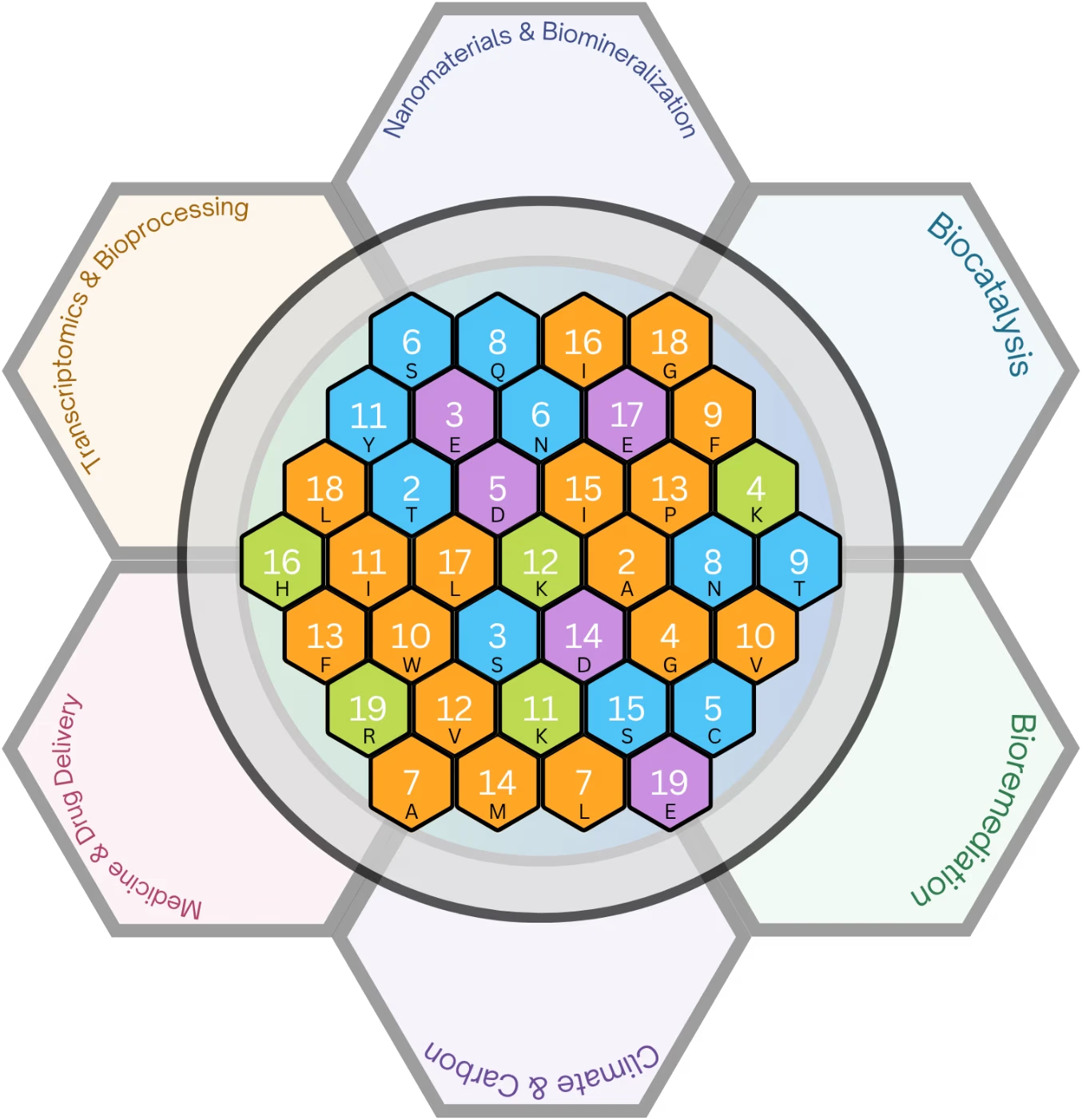
Inside, the petri dish
37 hexagonal fields, laid out as one big hexagon. Every field carries one amino acid, shown as a color and a letter, and one number.
The distribution is unfair on purpose.
| Occurrence | Amino acids | What it means |
|---|---|---|
| 3 fields | L, S, K, I, E | common, you can get them almost always |
| 2 fields | N, T, D, V, A, G, F | medium |
| 1 field | R, P, Q, Y, H, M, C, W | rare, and if you do not stand there you have to trade |
The numbers 2 to 19 are spread almost evenly. One number appears three times, every other number twice. On your board that number is the 11.
No two neighboring fields carry the same amino acid or the same number, and the fields of one amino acid always carry different numbers. So a single number can never hand you a whole kind.
Outside, the ring
Around the dish lies the ring, and it is one single piece. Cut it out as a whole and the six segments keep their order for the whole game. Each segment carries the name of its application area and its color, and that color is the one your mission cards use.
A segment covers one side of the big hexagon and borders the seven rim corners along that side. Those seven are its delivery corners. If you are unsure whether a corner belongs to a segment, look outwards along the edge. The corners in front of the segment are the ones that count.
The ring never comes apart, it only turns. An earthquake rotates the whole ring, the order of the six areas stays exactly as it was, and suddenly your finished cargo sits at the wrong exit.
Corners, not fields
Your yeast cells stand on the corners of the hexagons, not on the fields themselves. The board has 96 corners and 42 of them lie on the rim. Those are the delivery corners.
A corner only ever belongs to one cell. A cell on an inner corner touches three fields and harvests from all three.
The mission cards
A mission is an assignment. It tells you three things.
- What for, meaning why any of this is worth doing
- What, meaning what is to be built, the cargo
- With what, meaning the chain of building blocks you need
Every card carries its category at the top in the category color. That color tells you at which ring segment you have to deliver.
Every card also carries a code at the top, something like #C52EA4. Write that code onto your score pad and you always know which column belongs to which mission, even with three cards in front of you.
The slots, letter or ring
The chain consists of slots, which you fill from left to right. There are two kinds.
| Slot | Meaning |
|---|---|
| Letter in a solid frame, for example C | exactly this amino acid and no other |
| ◯ Ring in a dashed frame, colored | any amino acid of that color group |
A tier 1 card consists of group slots only and reads something like nonpolar · nonpolar · polar · negative · nonpolar. Five building blocks, and almost every harvest is useful.
The three tiers
| Tier | Slots | Composition | Points | Cards |
|---|---|---|---|---|
| 1, easy | 5 | group slots only | 3 | 4 per mission |
| 2, medium | 7 | at most 2 fixed, no rare one | 5 | 3 per mission |
| 3, hard | 9 | at least 3 fixed, 2 of them rare | 8 | 2 per mission |
19 missions, 56 cards. The easy ones turn up more often than the hard ones.
Setup
- Lay out the board and drop the ring around it. The ring is one piece, so the only thing you choose is how far it is turned.
- Shuffle the mission cards into three face down piles, one per tier.
- Shuffle the event cards into one pile.
- Each player takes 15 yeast cells of one color, 5 Budding Yeasts of the same color, a score pad, and a pen.
- The youngest player starts.
The first two colonies
Going round the table, each player puts one yeast cell on a free corner of their choice. Then you go back in reverse order and each player places a second one. So whoever placed last places twice in a row, which evens out the advantage of starting.
After that every player receives the opening payout, 1 building block from every field one of their two colonies stands on. Fill in the circles on your pad. With two inner corners that comes to six building blocks.
Finally every player draws two missions, one from tier 1 and one of their own choosing. Put them face up in front of you.
Everything lies open
There are no screens in this game. Mission cards and score pads lie on the table where everybody can see them. You are meant to see who is after what, who is waiting for what, and who is about to finish. That is the basis for trading and for displacing.
If you would rather keep a little tension, agree before the start that pads stay face down between turns. Everything in the rules still works, you just have to ask instead of look.
A turn in three phases
Play goes round clockwise. Every turn has the same three phases, always in this order.
Both d20 at once. Every field with one of the two numbers pays everybody standing on it.
Move, extend, jump, upgrade. As much as you can pay for.
Write blocks into your missions, trade, play cards, deliver.
Phase 1, roll and payout
The active player rolls both d20 at the same time. Both numbers pay out, each on its own.
For each number rolled, every field with that number gives 1 building block of its kind to every player who has at least one colony on one of its corners. Each field pays each player only once, even if that player stands on two or three of its corners.
- A Budding Yeast on that field collects 2 instead of 1.
- If both d20 show the same number, that number pays out twice.
- If a d20 shows 1 or 20, it pays nothing. An event card is drawn instead. If both show it, two cards are drawn.
- If a row on your pad is already full, that block is lost. Nobody can hold more of one kind than the row allows.
The payout goes to everybody, not just to the active player. Even when you have nothing to do, watch the numbers.
The one exception to "each field only once" is the event card Yeast Lawn. Play it and for that one payout you collect with every colony separately.
Phase 2, growth phase
This is where you move and multiply your colonies. It has a chapter of its own just below.
Phase 3, build phase
This is where the actual work happens. In any order and as often as you like:
- Write blocks into your mission rows, from left to right
- Trade, with the bank and with everybody at the table
- Play opportunity cards, the ones you have been saving
- Deliver finished missions and draw a replacement straight away
Growing and moving
In your growth phase you can do four things. Each of them costs building blocks of your own choice, which you cross off your pad.
| Price | Action |
|---|---|
| 1 building block per hop | Move, one of your colonies slides along a hexagon edge onto a free neighboring corner |
| 2 building blocks | Extend, a new colony on a free corner that touches one of your own colonies |
| 3 building blocks | Jump, a new colony on any other free corner of a field you already stand on |
| 4 building blocks | Budding Yeast, 1 building block from each of the four color groups, upgrades one of your colonies |
Everything combines
This is the most important rule in this chapter, and it was missing at the first playtest.
In one growth phase you may carry out as many of these actions as you can pay for, in any order, with as many colonies as you like.
When you move, every single hop costs 1 building block. Shifting a colony around three corners therefore costs 3 building blocks, not 1. Every hop has to land on a free corner, and you cannot pass through an occupied one.
And here is the decisive part. A colony you have just moved or just placed counts as yours immediately. You may build on from it, move it again in the same turn, or upgrade it to a Budding Yeast right away.
An example. You hold 6 building blocks and want to reach a tryptophan field two corners away.
- 2 building blocks, move the colony twice, and it now stands on the tryptophan field.
- 2 building blocks, extend from there with a new colony, so that you hold both fields.
- 2 building blocks left over, which you keep for the build phase.
Lost every colony? Anyone with no cell at all left on the board places one colony for free on any free corner in their next growth phase. There is more on this in the chapter on displacing.
The Budding Yeast, your expansion
A Budding Yeast is a colony that has grown into something bigger. It is the one upgrade in this game, and it is the thing to aim for in the long run. Other building games let you turn a small settlement into a larger one. Here the small colony becomes a budding mother cell, and it does so for 4 building blocks, one from each of the four color groups.
What it changes:
- The upgraded colony harvests double, 2 building blocks instead of 1 from every field that pays out.
- It stays one colony. For the pure culture bonus and for displacement it counts completely normally.
- With the Yeast Lawn card it counts double as well.
- If it gets displaced, the upgrade is gone and only a plain colony comes back to you.
Each player has 5 of them, so this is not something you spread around. Put your Budding Yeast where a lot comes in, which means on an inner corner between three fields you actually need, or on the one rim corner you deliver at over and over.
Displacing
Occupied corners are not taken forever. Pay enough and you grow over somebody else's colony.
When and how
You only displace during your own growth phase. You put a new colony on a corner where a foreign cell already stands and pay the normal placing price plus 2 building blocks.
| Where | Cost |
|---|---|
| grow over a neighboring corner (extend) | 2 + 2 = 4 building blocks |
| grow over a distant corner of the same field (jump) | 3 + 2 = 5 building blocks |
You cannot displace by moving. The cheap relocation only works onto free corners.
The limits
- Not in the first round. Let everybody arrive first.
- At most once per turn.
- Each corner at most once per round. Put a marker on it and clear the markers at the end of the round, otherwise you will push the same corner back and forth until sunrise.
- A Budding Yeast may be displaced like any other colony.
The defense
Anyone holding a Biofilm card may play it the moment somebody tries to displace one of their colonies. The displacement then does not happen, and the attacking player does not get their building blocks back. There are two of these cards in the deck.
What the displaced player gets
- The figure goes back to its owner. Built chains, missions, and cards in hand stay completely untouched.
- As compensation that player fills in 1 building block of their choice on their pad. Whatever is left of the overgrown cell, you take it with you.
Coming back in
Anyone who still has colonies on the board after a displacement simply grows on as normal.
Anyone with no colony left at all is not out of the game. In their next own growth phase the following applies.
- You place one colony for free on any free corner of the board. You do not need a connection to anything.
- After that you may grow on completely normally in the same phase, if you can pay.
- With this free colony you may not displace.
So you lose one turn of pace, but no position you cannot win back, and your built chains were never in danger.
Trading
Trading is not merely allowed in this game, it is the way out of almost every dead end. This is not a silent game.
With the bank
The bank is always open and never runs out. The rarer the thing you want, the more you have to give up for it. You cross out identical building blocks and fill in any one of your choice.
| You want | You give | Example |
|---|---|---|
| a common amino acid, 3 fields, L, S, K, I, E | 2 identical | 2 valine for 1 leucine |
| a medium amino acid, 2 fields, N, T, D, V, A, G, F | 3 identical | 3 serine for 1 threonine |
| a rare amino acid, 1 field, R, P, Q, Y, H, M, C, W | 4 identical | 4 alanine for 1 tryptophan |
The rate is printed on your score pad next to every amino acid. You may trade as often as you like, and trading breaks every blockage. Anyone who waits for the rare field to finally come up loses rounds, and nobody gives those back.
With each other
In your own build phase you may negotiate and trade with everybody at the table. Any building blocks for any building blocks, any quantity, uneven deals included. If both sides agree, it stands.
- Only building blocks are traded. One of you crosses out, the other fills in, at the same moment. Mission cards, event cards, colonies, and points stay where they are.
- Deals are only closed in your own turn. Making offers and talking about them loudly is allowed for anybody at any time.
- Gifts are allowed. Promises for later are not enforceable.
Because everything lies open, everybody can see what the others are waiting for. Use that. A tryptophan that is only gathering dust on your side is worth a favor on somebody else's.
Building the cargo
Pick one of your open missions, write its code at the head of a free mission row on your pad, and build the chain into that row.
You build strictly from left to right. Slot 1 first, then slot 2, then slot 3. You may not skip ahead. For every slot you cross out one filled circle in the matching row above and write that letter into the next cell of the mission row. The card tells you what fits, the pad records what you actually used.
A letter once written stays written. You do not erase it, you do not swap it, and you do not shift it. The one exception is the event card Sequencing Error.
The circles you have filled but not yet spent are your supply, and they are a target. Setback cards aim at exactly those.
When a mission counts as started
This is worth real money at the end of the game, so remember it.
A mission counts as started the moment you write the first letter into slot 1 on your pad. Not when you draw the card. Not when you collect matching blocks for it. Only the first letter actually written counts.
- A mission that is started but not finished costs you its full point value at the end of the game, so −3, −5, or −8.
- A mission you never started costs nothing. It goes back into the box without comment.
So having a card in front of you is free. Starting it is the decision. Write the first letter only when you mean it.
Point mutation, the elegant way out
Stuck because one amino acid will not come? Then build in a different one and write the mutation down.
| You place | Cost at the end of the game |
|---|---|
| another amino acid of the same color group | −1 point |
| an amino acid of a different color group | −2 points |
The mission still counts as completed and still scores its full points. You only subtract the mutation in the final count. Write it on the score pad straight away, because afterward nobody remembers.
In a group slot a mutation within the group is not a mutation at all. Every amino acid of that color fits there anyway.
Delivering and drawing again
A mission is completed when two things are true.
- The chain is complete, every slot filled.
- You stand at the right exit, meaning one of your colonies stands on a rim corner of the ring segment whose color the mission carries.
Then you put the card face up in front of you, check the Done circle on that mission row, and note the points. The colony stays where it is and can deliver the next mission of the same category straight away.
Delivering happens in your build phase, as often per turn as you like.
When you draw a new mission card
You should always have two missions in front of you. There are four ways to get a new card.
| When | What |
|---|---|
| Right after delivering | Draw a new card immediately. Any pile you like. |
| Once per round, voluntarily | In your build phase you may discard one mission you have not started and immediately draw a new one from the same pile. Missions you have started are yours to finish. |
| Event card New Strain | One extra card, any pile you like. |
| Event card A New Paper Came Out | Discard one unfinished mission and draw a new one of the same tier. |
At most three open missions at a time. You may never have more than that in front of you, not even through card effects.
When the ring turns
An earthquake turns the whole ring by one, two, or three segments, clockwise or counterclockwise. The six areas keep their order, they only move around the dish together. Delivered missions stay scored and built chains stay untouched. Only your way out suddenly leads somewhere else.
Anyone standing widely spread along the rim has little to fear from a quake. Anyone who bet everything on one exit is standing in the wrong place afterward.
Event cards
54 cards. You draw one whenever a d20 shows a 1 or a 20, which is about 0.2 times per roll phase and so around eleven cards per game.
Every event card carries two blocks of text. The one headed In the game is the rule, and that is all you need. The block headed In the lab tells you what the card means in a real laboratory. It is nice to read and it changes nothing, so skip it freely.
| Kind | Cards | When |
|---|---|---|
| Earthquake | 9 | immediately |
| Opportunity | 23 | may be kept |
| Setback | 18 | immediately |
| Defense (Biofilm) | 2 | may be kept |
| Special event (Cell Fusion) | 2 | immediately |
Opportunities and the Biofilm card may be saved and played later, normally in your own build phase. Biofilm also works outside your turn, when somebody tries to displace you, and Yeast Lawn is played right after a roll. At most three cards in hand. Draw a fourth and you have to play or discard one at once.
Setbacks, earthquakes, and Cell Fusion take effect immediately and go to the discard pile afterward. Bad luck cannot be saved up.
Four cards worth knowing:
Yeast Lawn (5 copies) suspends the rule that a field pays each player only once, for one single payout. With three of your colonies on one field you collect three times. Keep it, wait for the right roll, play it once.
Coffee (4 copies) gives you 1 building block of your choice and can be saved. Small, but often exactly the one block everything hangs on.
Cell Fusion (2 copies) makes two players swap all their colonies on the board. Missions, building blocks, and cards in hand stay with you.
Biofilm (2 copies) fends off one displacement.
Points
What scores
| Points | What for |
|---|---|
| 3 | completed mission, tier 1, easy |
| 5 | completed mission, tier 2, medium |
| 8 | completed mission, tier 3, hard |
| 3 | pure culture |
| 2 | displacement, 4 points at most in total |
Pure culture. This bonus is held by whoever owns the longest unbroken path of their own colonies, and that path needs at least 5 of them. Two colonies count as connected when they sit on the same hexagon edge, meaning one hop apart. What is counted is the longest path without a branch. The bonus moves as soon as somebody else clearly has more. On a tie it stays with whoever already held it.
Displacement. 2 points for taking the last yeast cell of one color off the board, at most once per affected color, and only if that player had at least 3 colonies on the board at some point in the game. 4 points from displacement at most in total. This is not a strategy, only an opportunity.
What costs
| Points | What for |
|---|---|
| −1 / −2 | per point mutation, same group or different group |
| −3 / −5 / −8 | per mission you started but had not completed at the end |
| −3 | only in the variant for experienced players, if you call the end and do not win |
Missions you never started cost nothing.
The end of the game
The normal case, 12 points
If somebody reaches 12 points during their own turn, the game ends immediately and that player wins. Minus points for mutations and for started missions are part of that count, so 12 means 12 after subtraction.
On a tie the win goes to whoever can show the hardest completed mission. If that is equal too, it goes to whoever wrote down fewer mutations.
The variant for experienced players, calling the end
Once you know the game, play with this rule. It makes the second half considerably more exciting, but it does require everybody to keep count.
Anyone who believes at the end of their turn that they have the most points calls the end of the game. Everybody else takes exactly one more complete turn, then you count up. The threshold of 12 points does not apply in this variant. Whoever is ahead at the end simply wins.
This is a bet. Call the end and turn out not to be ahead and you lose 3 points, which in a close game can cost you second place as well. Count before you call. The other players' chains lie open, but the mutations they have written down do not.
Everything at a glance
| Goal | 12 points |
| You roll | 2 × d20, both numbers count |
| Fields carry | 2 to 19, one number three times, all others twice |
| 1 or 20 | event card, no payout |
| One field gives | 1 building block per player, 2 with a Budding Yeast, once per field |
| Move | 1 building block per hop, as often as you like, combinable |
| Extend | 2 building blocks · Jump 3 building blocks |
| Budding Yeast | 1 building block from each color group |
| Displace | placing price + 2, once per turn, not in round 1, never by moving |
| Bank | 2 for 1 common · 3 for 1 medium · 4 for 1 rare |
| Trading with each other | allowed and encouraged, in your build phase |
| You build | strictly from left to right, built in means fixed |
| Mission started | as soon as the first building block sits in slot 1 |
| Point mutation | −1 same group, −2 different group |
| Missions | 2 open, 3 at most · draw again right after delivering |
| Cards in hand | 3 at most |
| Building blocks | only on your pad, fill a circle to receive, cross it out to spend |
The Yeast We Can Do · after the iGEM project ENCORE · Team KIT 2026
Version 2 · With the biology. The same rules, plus what they mean inside a cell.
Welcome to your petri dish
You are a yeast strain. More precisely, each of you is a strain of Saccharomyces cerevisiae, baker's yeast, the same organism that has been raising bread and fermenting beer for ten thousand years. Today it is also one of the most important factories in synthetic biology.
Inside you floats something nature never planned. An encapsulin, a protein shell about the size of a virus, which folds itself into a perfect sphere. There is room inside. That is exactly what our iGEM project ENCORE is about, and it is exactly what this game is about. What do you put in there?
What you put inside is called cargo, and cargo has to be built. There are only twenty kinds of building block, they lie unevenly spread across the dish, and you get them only where your colonies grow. A finished compartment is also no use at all as long as it stays in the dish. You have to work your way out to the edge, out of the lab and into the world.
Whoever manages that first wins.
And if you know nothing about biology? Then you play anyway, we promise. A protein is a string of beads. There are 20 kinds of bead, some lie around everywhere, some you find in one single place. You collect beads and thread them in the order you are given. That is the whole game.
The goal
12 points. Reach them during your own turn and you win immediately.
Most of your points come from completed missions. On top of that there are bonuses for one long connected colony and for pushing somebody off the board entirely. Sloppily built chains and missions you started but never finished drag you back down at the end.
3 to 6 players · age 12 and up · about 45 minutes
What you need
For one game, up to 6 players.
| Count | Material | File |
|---|---|---|
| 2 | d20, twenty sided dice | |
| 1 | Game board, printed at A1. The ring is printed with it, so cut the ring out as one piece and the six areas keep their order. | Game_Board.pdf |
| 6 × 15 | Yeast cells in the player colors, or any other playing pieces | YeastCell.stl |
| 6 × 5 | Budding Yeast cells, or any other playing pieces | BuddingYeast.stl |
| 56 | Mission cards | Mission_Cards.pdf |
| 54 | Event cards | Event_Cards.pdf |
| 6 | Score pads, one per player | Score_Pad.pdf |
| 1 each | A pen |
Everything runs on the score pad
There are no wooden pieces in this game. Your building blocks exist only as marks on your own score pad, and so does everything you do with them.
- You receive a block by filling in one circle in its row.
- You spend a block by crossing that circle out.
- You build a block into a mission by crossing out the circle and writing its letter into the next free cell of that mission's row.
- The bank never runs out. What is limited is you. The length of a row is the most you can hold of that kind at one time, 15 for the common ones, 10 for the medium ones, 8 for the rare ones.
Pads lie open on the table like everything else. A trade, a payout, or a setback is simply two people correcting their pads at the same moment.
Supply · fill in what you receive, cross out what you spend
Mission · the letters you actually built in
A word on wording. The twenty kinds are always called building blocks in this rulebook, never dice. The only things you ever roll are the two d20. That sounds pedantic and it saves one question at the table every single time.
The two d20
A d20 is an icosahedron, twenty equilateral triangles, the most complex of the five platonic solids. We roll it not out of nostalgia but because it does exactly what this game needs. All twenty faces are equally likely. There are no good and bad numbers, only good and bad neighborhoods. Where you stand decides everything. Which number is printed there decides nothing.
And there is one more reason we like it. Many virus capsids, and our encapsulin too, are built as icosahedra. Nature picks the same shape because it encloses as much space as possible with as few identical building blocks as possible. So you are quite literally rolling the object this whole game revolves around.
Both dice are rolled at the same time. The fields carry the numbers 2 to 19, while the faces 1 and 20 trigger events instead. That way every one of the twenty faces does something and none of them is used twice.
The amino acid building blocks
Twenty kinds, colored by their chemical property. These four colors are the most important code in the game. Learn them and nothing else, and you can still read every mission card.
| Color | Group | Amino acids | Fields |
|---|---|---|---|
| Orange | nonpolar (fat loving) | G A V L I P F M W | 17 |
| Light blue | polar, uncharged | S T C Y N Q | 10 |
| Lime green | positively charged | K R H | 5 |
| Purple | negatively charged | D E | 5 |
In the lab. These four groups are not an invention of ours. Whether an amino acid likes water or avoids it, whether it carries a charge or not, that is what decides whether it ends up in the water repelling core of a protein or on its surface, and whether it can grip a metal ion or cannot. Proteins fold according to exactly this code.
The board
Inside, the petri dish
37 hexagonal fields, laid out as one big hexagon. Every field carries one amino acid, shown as a color and a letter, and one number.
The distribution is unfair on purpose.
| Occurrence | Amino acids | What it means |
|---|---|---|
| 3 fields | L, S, K, I, E | common, you can get them almost always |
| 2 fields | N, T, D, V, A, G, F | medium |
| 1 field | R, P, Q, Y, H, M, C, W | rare, and if you do not stand there you have to trade |
In the lab. This is copied from life as well. In real proteomes leucine, serine, and lysine are everywhere, while tryptophan and cysteine are the most expensive and rarest building blocks a cell has. A cell only puts them where it really matters. A cell is stingy with tryptophan. So are you.
The numbers 2 to 19 are spread almost evenly. One number appears three times, every other number twice. On your board that number is the 11.
No two neighboring fields carry the same amino acid or the same number, and the fields of one amino acid always carry different numbers. So a single number can never hand you a whole kind.
Outside, the ring
Around the dish lies the ring, and it is one single piece. Cut it out as a whole and the six segments keep their order for the whole game. Each segment carries the name of its application area and its color, and that color is the one your mission cards use.
A segment covers one side of the big hexagon and borders the seven rim corners along that side. Those seven are its delivery corners. If you are unsure whether a corner belongs to a segment, look outwards along the edge. The corners in front of the segment are the ones that count.
The ring never comes apart, it only turns. An earthquake rotates the whole ring, the order of the six areas stays exactly as it was, and suddenly your finished cargo sits at the wrong exit.
Corners, not fields
Your yeast cells stand on the corners of the hexagons, not on the fields themselves. The board has 96 corners and 42 of them lie on the rim. Those are the delivery corners.
A corner only ever belongs to one cell. A cell on an inner corner touches three fields and harvests from all three.
The mission cards
A mission is an assignment. It tells you three things.
- What for, meaning why any of this is worth doing
- What, meaning what is to be built, the cargo
- With what, meaning the chain of building blocks you need
Every card carries its category at the top in the category color. That color tells you at which ring segment you have to deliver.
Every card also carries a code at the top, something like #C52EA4. Write that code onto your score pad and you always know which column belongs to which mission, even with three cards in front of you.
The slots, letter or ring
The chain consists of slots, which you fill from left to right. There are two kinds.
| Slot | Meaning |
|---|---|
| Letter in a solid frame, for example C | exactly this amino acid and no other |
| ◯ Ring in a dashed frame, colored | any amino acid of that color group |
A tier 1 card consists of group slots only and reads something like nonpolar · nonpolar · polar · negative · nonpolar. Five building blocks, and almost every harvest is useful.
In the lab. That is not a simplification, it is the more honest picture. In the vast majority of positions in a protein what counts is the property and not the specific building block. The core has to be fat loving and the surface charged, and the folding does not care which leucine or isoleucine sits there. Only in a few places does it have to be one exact amino acid. The letters on the hard cards are exactly those places. The cysteine that holds the cofactor of nitrogenase. The histidine that grips the heme iron.
The three tiers
| Tier | Slots | Composition | Points | Cards |
|---|---|---|---|---|
| 1, easy | 5 | group slots only | 3 | 4 per mission |
| 2, medium | 7 | at most 2 fixed, no rare one | 5 | 3 per mission |
| 3, hard | 9 | at least 3 fixed, 2 of them rare | 8 | 2 per mission |
19 missions, 56 cards. The easy ones turn up more often than the hard ones.
The six categories
Bioremediation, breaking down what was left behind. Pesticides, oil, forever chemicals. Biocatalysis, chemistry without chemistry. Splitting plastic, cracking lignin, oxidizing selectively. Climate & Carbon, capturing CO2 and fixing nitrogen. Medicine & Drug Delivery, bringing active substances where they belong. Transcriptomics & Bioprocessing, letting cells read, improving yeast, storing data. Nanomaterials & Biomineralization, growing crystals no furnace can manage.
Setup
- Lay out the board and drop the ring around it. The ring is one piece, so the only thing you choose is how far it is turned.
- Shuffle the mission cards into three face down piles, one per tier.
- Shuffle the event cards into one pile.
- Each player takes 15 yeast cells of one color, 5 Budding Yeasts of the same color, a score pad, and a pen.
- The youngest player starts.
The first two colonies
Going round the table, each player puts one yeast cell on a free corner of their choice. Then you go back in reverse order and each player places a second one. So whoever placed last places twice in a row, which evens out the advantage of starting.
After that every player receives the opening payout, 1 building block from every field one of their two colonies stands on. Fill in the circles on your pad. With two inner corners that comes to six building blocks.
Finally every player draws two missions, one from tier 1 and one of their own choosing. Put them face up in front of you.
Everything lies open
There are no screens in this game. Mission cards and score pads lie on the table where everybody can see them. You are meant to see who is after what, who is waiting for what, and who is about to finish. That is the basis for trading and for displacing.
If you would rather keep a little tension, agree before the start that pads stay face down between turns. Everything in the rules still works, you just have to ask instead of look.
In the lab. You place before you know what you need. Every project starts exactly like that. The strain is chosen, the medium is ready, and only afterward does it turn out which enzyme is actually needed. Spreading wide is what helps, not guessing right.
A turn in three phases
Play goes round clockwise. Every turn has the same three phases, always in this order.
Both d20 at once. Every field with one of the two numbers pays everybody standing on it.
Move, extend, jump, upgrade. As much as you can pay for.
Write blocks into your missions, trade, play cards, deliver.
Phase 1, roll and payout
The active player rolls both d20 at the same time. Both numbers pay out, each on its own.
For each number rolled, every field with that number gives 1 building block of its kind to every player who has at least one colony on one of its corners. Each field pays each player only once, even if that player stands on two or three of its corners.
- A Budding Yeast on that field collects 2 instead of 1.
- If both d20 show the same number, that number pays out twice.
- If a d20 shows 1 or 20, it pays nothing. An event card is drawn instead. If both show it, two cards are drawn.
- If a row on your pad is already full, that block is lost. Nobody can hold more of one kind than the row allows.
The payout goes to everybody, not just to the active player. Even when you have nothing to do, watch the numbers.
The one exception to "each field only once" is the event card Yeast Lawn. Play it and for that one payout you collect with every colony separately.
Phase 2, growth phase
This is where you move and multiply your colonies. It has a chapter of its own just below.
Phase 3, build phase
This is where the actual work happens. In any order and as often as you like:
- Write blocks into your mission rows, from left to right
- Trade, with the bank and with everybody at the table
- Play opportunity cards, the ones you have been saving
- Deliver finished missions and draw a replacement straight away
Growing and moving
In your growth phase you can do four things. Each of them costs building blocks of your own choice, which you cross off your pad.
| Price | Action |
|---|---|
| 1 building block per hop | Move, one of your colonies slides along a hexagon edge onto a free neighboring corner |
| 2 building blocks | Extend, a new colony on a free corner that touches one of your own colonies |
| 3 building blocks | Jump, a new colony on any other free corner of a field you already stand on |
| 4 building blocks | Budding Yeast, 1 building block from each of the four color groups, upgrades one of your colonies |
Everything combines
This is the most important rule in this chapter, and it was missing at the first playtest.
In one growth phase you may carry out as many of these actions as you can pay for, in any order, with as many colonies as you like.
When you move, every single hop costs 1 building block. Shifting a colony around three corners therefore costs 3 building blocks, not 1. Every hop has to land on a free corner, and you cannot pass through an occupied one.
And here is the decisive part. A colony you have just moved or just placed counts as yours immediately. You may build on from it, move it again in the same turn, or upgrade it to a Budding Yeast right away.
An example. You hold 6 building blocks and want to reach a tryptophan field two corners away.
- 2 building blocks, move the colony twice, and it now stands on the tryptophan field.
- 2 building blocks, extend from there with a new colony, so that you hold both fields.
- 2 building blocks left over, which you keep for the build phase.
Lost every colony? Anyone with no cell at all left on the board places one colony for free on any free corner in their next growth phase. There is more on this in the chapter on displacing.
In the lab. A yeast cell that wants to divide needs material, and it is exactly the same material it builds proteins from. Every block you put into growth is a block missing from your cargo. Every real cell makes that decision in every moment of its life.
In the lab. Moving is called filamentous growth in the game, and it is precisely what yeast does when nutrients run out. Instead of dividing into round cells it forms long threads of cells, stays attached, and travels away from the spot, looking for better ground. The name for it is pseudohyphal growth, and it is one of the oldest hunger responses the cell knows. That every hop is paid for separately fits that picture. Every thread of cells costs material.
The Budding Yeast, your expansion
A Budding Yeast is a colony that has grown into something bigger. It is the one upgrade in this game, and it is the thing to aim for in the long run. Other building games let you turn a small settlement into a larger one. Here the small colony becomes a budding mother cell, and it does so for 4 building blocks, one from each of the four color groups.
What it changes:
- The upgraded colony harvests double, 2 building blocks instead of 1 from every field that pays out.
- It stays one colony. For the pure culture bonus and for displacement it counts completely normally.
- With the Yeast Lawn card it counts double as well.
- If it gets displaced, the upgrade is gone and only a plain colony comes back to you.
Each player has 5 of them, so this is not something you spread around. Put your Budding Yeast where a lot comes in, which means on an inner corner between three fields you actually need, or on the one rim corner you deliver at over and over.
In the lab. Budding is the way baker's yeast reproduces. The mother cell pushes out a bud, which grows, pinches itself off, and becomes a mother cell in its turn. A single cell manages around twenty buds in its life and carries the scar of every one of them visibly on its surface. A cell that buds is a cell doing well, which is why a Budding Yeast harvests twice as much.
Displacing
Occupied corners are not taken forever. Pay enough and you grow over somebody else's colony.
When and how
You only displace during your own growth phase. You put a new colony on a corner where a foreign cell already stands and pay the normal placing price plus 2 building blocks.
| Where | Cost |
|---|---|
| grow over a neighboring corner (extend) | 2 + 2 = 4 building blocks |
| grow over a distant corner of the same field (jump) | 3 + 2 = 5 building blocks |
You cannot displace by moving. The cheap relocation only works onto free corners.
The limits
- Not in the first round. Let everybody arrive first.
- At most once per turn.
- Each corner at most once per round. Put a marker on it and clear the markers at the end of the round, otherwise you will push the same corner back and forth until sunrise.
- A Budding Yeast may be displaced like any other colony.
The defense
Anyone holding a Biofilm card may play it the moment somebody tries to displace one of their colonies. The displacement then does not happen, and the attacking player does not get their building blocks back. There are two of these cards in the deck.
What the displaced player gets
- The figure goes back to its owner. Built chains, missions, and cards in hand stay completely untouched.
- As compensation that player fills in 1 building block of their choice on their pad. Whatever is left of the overgrown cell, you take it with you.
Coming back in
Anyone who still has colonies on the board after a displacement simply grows on as normal.
Anyone with no colony left at all is not out of the game. In their next own growth phase the following applies.
- You place one colony for free on any free corner of the board. You do not need a connection to anything.
- After that you may grow on completely normally in the same phase, if you can pay.
- With this free colony you may not displace.
So you lose one turn of pace, but no position you cannot win back, and your built chains were never in danger.
In the lab. This is what happens on every agar plate left standing too long. Cultures compete for the same nutrients, and whatever grows faster grows over the rest. Contamination is not an accident, it is competition. That one surviving cell is enough to found a whole culture again is just as true, though.
Trading
Trading is not merely allowed in this game, it is the way out of almost every dead end. This is not a silent game.
With the bank
The bank is always open and never runs out. The rarer the thing you want, the more you have to give up for it. You cross out identical building blocks and fill in any one of your choice.
| You want | You give | Example |
|---|---|---|
| a common amino acid, 3 fields, L, S, K, I, E | 2 identical | 2 valine for 1 leucine |
| a medium amino acid, 2 fields, N, T, D, V, A, G, F | 3 identical | 3 serine for 1 threonine |
| a rare amino acid, 1 field, R, P, Q, Y, H, M, C, W | 4 identical | 4 alanine for 1 tryptophan |
The rate is printed on your score pad next to every amino acid. You may trade as often as you like, and trading breaks every blockage. Anyone who waits for the rare field to finally come up loses rounds, and nobody gives those back.
With each other
In your own build phase you may negotiate and trade with everybody at the table. Any building blocks for any building blocks, any quantity, uneven deals included. If both sides agree, it stands.
- Only building blocks are traded. One of you crosses out, the other fills in, at the same moment. Mission cards, event cards, colonies, and points stay where they are.
- Deals are only closed in your own turn. Making offers and talking about them loudly is allowed for anybody at any time.
- Gifts are allowed. Promises for later are not enforceable.
Because everything lies open, everybody can see what the others are waiting for. Use that. A tryptophan that is only gathering dust on your side is worth a favor on somebody else's.
In the lab. Cells do exactly this. Whatever is there in excess gets rebuilt through metabolism into whatever is missing. The rebuilding costs energy and is never free of loss, which is why you get one for two, and why a tryptophan costs you properly. Tryptophan is the most expensive amino acid a cell can make.
Building the cargo
Pick one of your open missions, write its code at the head of a free mission row on your pad, and build the chain into that row.
You build strictly from left to right. Slot 1 first, then slot 2, then slot 3. You may not skip ahead. For every slot you cross out one filled circle in the matching row above and write that letter into the next cell of the mission row. The card tells you what fits, the pad records what you actually used.
A letter once written stays written. You do not erase it, you do not swap it, and you do not shift it. The one exception is the event card Sequencing Error.
The circles you have filled but not yet spent are your supply, and they are a target. Setback cards aim at exactly those.
In the lab. Ribosomes build proteins from the N terminus to the C terminus, one block at a time, without jumping back. There is no correction and no touching up. Whatever has been linked stays linked, and the chain only grows at one end.
When a mission counts as started
This is worth real money at the end of the game, so remember it.
A mission counts as started the moment you write the first letter into slot 1 on your pad. Not when you draw the card. Not when you collect matching blocks for it. Only the first letter actually written counts.
- A mission that is started but not finished costs you its full point value at the end of the game, so −3, −5, or −8.
- A mission you never started costs nothing. It goes back into the box without comment.
So having a card in front of you is free. Starting it is the decision. Write the first letter only when you mean it.
Point mutation, the elegant way out
Stuck because one amino acid will not come? Then build in a different one and write the mutation down.
| You place | Cost at the end of the game |
|---|---|
| another amino acid of the same color group | −1 point |
| an amino acid of a different color group | −2 points |
The mission still counts as completed and still scores its full points. You only subtract the mutation in the final count. Write it on the score pad straight away, because afterward nobody remembers.
In a group slot a mutation within the group is not a mutation at all. Every amino acid of that color fits there anyway.
In the lab. A conservative substitution, leucine for isoleucine, usually changes almost nothing. The protein folds, it works, perhaps a little more slowly. A substitution that is not conservative, leucine for aspartate, fat loving for negatively charged, can tear the whole core open. That is exactly why one costs 1 point and the other 2.
Delivering and drawing again
A mission is completed when two things are true.
- The chain is complete, every slot filled.
- You stand at the right exit, meaning one of your colonies stands on a rim corner of the ring segment whose color the mission carries.
Then you put the card face up in front of you, check the Done circle on that mission row, and note the points. The colony stays where it is and can deliver the next mission of the same category straight away.
Delivering happens in your build phase, as often per turn as you like.
When you draw a new mission card
You should always have two missions in front of you. There are four ways to get a new card.
| When | What |
|---|---|
| Right after delivering | Draw a new card immediately. Any pile you like. |
| Once per round, voluntarily | In your build phase you may discard one mission you have not started and immediately draw a new one from the same pile. Missions you have started are yours to finish. |
| Event card New Strain | One extra card, any pile you like. |
| Event card A New Paper Came Out | Discard one unfinished mission and draw a new one of the same tier. |
At most three open missions at a time. You may never have more than that in front of you, not even through card effects.
In the lab. A compartment that stays inside the cell has helped nobody. Neither has a project that stays in the lab. Between "works in the flask" and "works where it is needed" lies the actual work, and that is why the rim of this board is so far away.
When the ring turns
An earthquake turns the whole ring by one, two, or three segments, clockwise or counterclockwise. The six areas keep their order, they only move around the dish together. Delivered missions stay scored and built chains stay untouched. Only your way out suddenly leads somewhere else.
Anyone standing widely spread along the rim has little to fear from a quake. Anyone who bet everything on one exit is standing in the wrong place afterward.
Event cards
54 cards. You draw one whenever a d20 shows a 1 or a 20, which is about 0.2 times per roll phase and so around eleven cards per game.
| Kind | Cards | When |
|---|---|---|
| Earthquake | 9 | immediately |
| Opportunity | 23 | may be kept |
| Setback | 18 | immediately |
| Defense (Biofilm) | 2 | may be kept |
| Special event (Cell Fusion) | 2 | immediately |
Opportunities and the Biofilm card may be saved and played later, normally in your own build phase. Biofilm also works outside your turn, when somebody tries to displace you, and Yeast Lawn is played right after a roll. At most three cards in hand. Draw a fourth and you have to play or discard one at once.
Setbacks, earthquakes, and Cell Fusion take effect immediately and go to the discard pile afterward. Bad luck cannot be saved up.
Four cards worth knowing:
Yeast Lawn (5 copies) suspends the rule that a field pays each player only once, for one single payout. With three of your colonies on one field you collect three times. Keep it, wait for the right roll, play it once.
Coffee (4 copies) gives you 1 building block of your choice and can be saved. Small, but often exactly the one block everything hangs on.
Cell Fusion (2 copies) makes two players swap all their colonies on the board. Missions, building blocks, and cards in hand stay with you.
Biofilm (2 copies) fends off one displacement.
In the lab. The discard pile is an honest balance sheet, 23 opportunities and 18 setbacks. In the lab something goes well about as often as something goes wrong. It is only that the setbacks are easier to remember.
Points
What scores
| Points | What for |
|---|---|
| 3 | completed mission, tier 1, easy |
| 5 | completed mission, tier 2, medium |
| 8 | completed mission, tier 3, hard |
| 3 | pure culture |
| 2 | displacement, 4 points at most in total |
Pure culture. This bonus is held by whoever owns the longest unbroken path of their own colonies, and that path needs at least 5 of them. Two colonies count as connected when they sit on the same hexagon edge, meaning one hop apart. What is counted is the longest path without a branch. The bonus moves as soon as somebody else clearly has more. On a tie it stays with whoever already held it.
In the lab. A pure culture is the state you want and rarely get, one single colony, cleanly grown, nothing foreign in between. Whoever has one has worked well, and will probably lose it next turn.
Displacement. 2 points for taking the last yeast cell of one color off the board, at most once per affected color, and only if that player had at least 3 colonies on the board at some point in the game. 4 points from displacement at most in total. This is not a strategy, only an opportunity.
What costs
| Points | What for |
|---|---|
| −1 / −2 | per point mutation, same group or different group |
| −3 / −5 / −8 | per mission you started but had not completed at the end |
| −3 | only in the variant for experienced players, if you call the end and do not win |
Missions you never started cost nothing.
The end of the game
The normal case, 12 points
If somebody reaches 12 points during their own turn, the game ends immediately and that player wins. Minus points for mutations and for started missions are part of that count, so 12 means 12 after subtraction.
On a tie the win goes to whoever can show the hardest completed mission. If that is equal too, it goes to whoever wrote down fewer mutations.
The variant for experienced players, calling the end
Once you know the game, play with this rule. It makes the second half considerably more exciting, but it does require everybody to keep count.
Anyone who believes at the end of their turn that they have the most points calls the end of the game. Everybody else takes exactly one more complete turn, then you count up. The threshold of 12 points does not apply in this variant. Whoever is ahead at the end simply wins.
This is a bet. Call the end and turn out not to be ahead and you lose 3 points, which in a close game can cost you second place as well. Count before you call. The other players' chains lie open, but the mutations they have written down do not.
In the lab. This is the moment a team decides that the data are enough and the paper goes out. Sometimes the timing is exactly right. Sometimes somebody turns up three weeks later with the better dataset.
Everything at a glance
| Goal | 12 points |
| You roll | 2 × d20, both numbers count |
| Fields carry | 2 to 19, one number three times, all others twice |
| 1 or 20 | event card, no payout |
| One field gives | 1 building block per player, 2 with a Budding Yeast, once per field |
| Move | 1 building block per hop, as often as you like, combinable |
| Extend | 2 building blocks · Jump 3 building blocks |
| Budding Yeast | 1 building block from each color group |
| Displace | placing price + 2, once per turn, not in round 1, never by moving |
| Bank | 2 for 1 common · 3 for 1 medium · 4 for 1 rare |
| Trading with each other | allowed and encouraged, in your build phase |
| You build | strictly from left to right, built in means fixed |
| Mission started | as soon as the first building block sits in slot 1 |
| Point mutation | −1 same group, −2 different group |
| Missions | 2 open, 3 at most · draw again right after delivering |
| Cards in hand | 3 at most |
| Building blocks | only on your pad, fill a circle to receive, cross it out to spend |
Appendix A, the field distribution
37 fields, 20 amino acids, numbers 2 to 19.
The rules the board was built by:
- No two neighboring fields carry the same amino acid.
- No two neighboring fields carry the same number.
- The fields of one amino acid always carry different numbers.
- Amino acids with only one field do not sit in the innermost ring, so that the rare kinds stay reachable.
How often each number appears. The 11 appears three times, every other number from 2 to 19 exactly twice. That makes 3 + 17 × 2 = 37 fields.
Group distribution. 17 nonpolar, 10 polar uncharged, 5 positively charged, 5 negatively charged. The charged groups are scarce, which is why a charged group slot counts double in the difficulty formula.
Appendix B, all 19 missions
A = exactly this amino acid · ◯ = any one of that color group · colors: nonpolar polar positive negative
Bioremediation
| Legacy PesticidesOrganophosphate Hydrolase | #C52EA4 | ◯◯◯◯◯ | Tier 1 | 3 pts | 4× |
| Oil Spill on the CoastNaphthalene Dioxygenase | #L43YR2 | C◯◯◯◯◯◯ | Tier 2 | 5 pts | 3× |
| Forever ChemicalsFluoroacetate Dehalogenase | #U93VD7 | DHR◯W◯◯◯◯ | Tier 3 | 8 pts | 2× |
Biocatalysis
| Plastic DegradationPETase | #P93HR8 | ◯◯◯◯◯ | Tier 1 | 3 pts | 4× |
| Lignin DegradationPeroxidase | #H82ZX5 | H◯◯◯◯◯◯ | Tier 2 | 5 pts | 3× |
| Selective OxidationUnspecific Peroxygenase (UPO) | #V65PU7 | C◯R◯H◯◯◯◯ | Tier 3 | 8 pts | 2× |
| Halogenation without Chlorine ChemistryVanadium Chloroperoxidase (VCPO) | #C82CH2 | H◯R◯W◯◯◯◯ | Tier 3 | 8 pts | 2× |
Climate & Carbon
| CO2 from Flue GasCarbonic Anhydrase | #Q83VT8 | ◯◯◯◯◯ | Tier 1 | 3 pts | 4× |
| CO2 CaptureRubisco | #E88YM4 | K◯M◯◯◯◯ | Tier 2 | 5 pts | 3× |
| The Biological Haber BoschNitrogenase | #D58NQ7 | CCH◯R◯◯◯◯ | Tier 3 | 8 pts | 2× |
Medicine & Drug Delivery
| Fight CancerBinding Pocket for Doxorubicin | #Z52YA7 | ◯◯◯◯◯ | Tier 1 | 3 pts | 4× |
| Gene Silencing DeliverysiRNA Binding Protein | #V58CF4 | K◯R◯◯◯◯ | Tier 2 | 5 pts | 3× |
| An Alternative to AntibioticsAntimicrobial Peptide (AMP) | #R99BE2 | ◯RW◯W◯◯◯◯ | Tier 3 | 8 pts | 2× |
Transcriptomics & Bioprocessing
| Time MachinePab1p, Poly(A) Binding Protein | #F57VV5 | ◯◯◯◯◯ | Tier 1 | 3 pts | 4× |
| Better Baker's YeastdCas9, CRISPR Interference | #X59SF5 | D◯H◯◯◯◯ | Tier 2 | 5 pts | 3× |
| The Bigger ArchivePab1p with an INT Domain for Vaults | #A23ER7 | WY◯R◯H◯◯◯ | Tier 3 | 8 pts | 2× |
Nanomaterials & Biomineralization
| The Iron CoreEncapsulin Associated Ferritin | #M52QZ4 | ◯◯◯◯◯ | Tier 1 | 3 pts | 4× |
| Glass at Room TemperatureSilicatein | #A82WS3 | S◯H◯◯◯◯ | Tier 2 | 5 pts | 3× |
| Magnetite Made to MeasureMms6, Magnetosome Protein | #B24SM3 | ◯◯◯◯HCR◯◯ | Tier 3 | 8 pts | 2× |
The Yeast We Can Do · after the iGEM project ENCORE · Team KIT 2026
Version 3 · The whole project. Everything from version 2, plus ENCORE in detail.
Welcome to your petri dish
You are a yeast strain. More precisely, each of you is a strain of S. cerevisiae, baker's yeast, the same organism that has been raising bread and fermenting beer for ten thousand years. Today it is also one of the most important factories in synthetic biology.
Inside you floats something nature never planned. An encapsulin, a protein shell about the size of a virus, which folds itself into a perfect sphere. There is room inside. That is exactly what our iGEM project ENCORE is about, and it is exactly what this game is about. What do you put in there?
What you put inside is called cargo, and cargo has to be built. There are only twenty kinds of building block, they lie unevenly spread across the dish, and you get them only where your colonies grow. A finished compartment is also no use at all as long as it stays in the dish. You have to work your way out to the edge, out of the lab and into the world.
Whoever manages that first wins.
And if you know nothing about biology? Then you play anyway, we promise. A protein is a string of beads. There are 20 kinds of bead, some lie around everywhere, some you find in one single place. You collect beads and thread them in the order you are given. That is the whole game.
In the project. ENCORE stands for Engineered Nanocompartments for Capture, Optimization and Reactor Engineering. Encapsulins come from bacteria and consist of one single type of protein, which assembles into a hollow sphere out of 60 or 180 copies. We grow them in yeast and load them with cargo on purpose, and that is the platform. What anyone does with it afterward is an open question, and that openness is what the game tries to show.
The goal
12 points. Reach them during your own turn and you win immediately.
Most of your points come from completed missions. On top of that there are bonuses for one long connected colony and for pushing somebody off the board entirely. Sloppily built chains and missions you started but never finished drag you back down at the end.
3 to 6 players · age 12 and up · about 45 minutes
What you need
For one game, up to 6 players.
| Count | Material | File |
|---|---|---|
| 2 | d20, twenty sided dice | |
| 1 | Game board, printed at A1. The ring is printed with it, so cut the ring out as one piece and the six areas keep their order. | Game_Board.pdf |
| 6 × 15 | Yeast cells in the player colors, or any other playing pieces | YeastCell.stl |
| 6 × 5 | Budding Yeast cells, or any other playing pieces | BuddingYeast.stl |
| 56 | Mission cards | Mission_Cards.pdf |
| 54 | Event cards | Event_Cards.pdf |
| 6 | Score pads, one per player | Score_Pad.pdf |
| 1 each | A pen |
Everything runs on the score pad
There are no wooden pieces in this game. Your building blocks exist only as marks on your own score pad, and so does everything you do with them.
- You receive a block by filling in one circle in its row.
- You spend a block by crossing that circle out.
- You build a block into a mission by crossing out the circle and writing its letter into the next free cell of that mission's row.
- The bank never runs out. What is limited is you. The length of a row is the most you can hold of that kind at one time, 15 for the common ones, 10 for the medium ones, 8 for the rare ones.
Pads lie open on the table like everything else. A trade, a payout, or a setback is simply two people correcting their pads at the same moment.
Supply · fill in what you receive, cross out what you spend
Mission · the letters you actually built in
A word on wording. The twenty kinds are always called building blocks in this rulebook, never dice. The only things you ever roll are the two d20. That sounds pedantic and it saves one question at the table every single time.
The two d20
A d20 is an icosahedron, twenty equilateral triangles, the most complex of the five platonic solids. We roll it not out of nostalgia but because it does exactly what this game needs. All twenty faces are equally likely. There are no good and bad numbers, only good and bad neighborhoods. Where you stand decides everything. Which number is printed there decides nothing.
And there is one more reason we like it. Many virus capsids, and our encapsulin too, are built as icosahedra. Nature picks the same shape because it encloses as much space as possible with as few identical building blocks as possible. So you are quite literally rolling the object this whole game revolves around.
Both dice are rolled at the same time. The fields carry the numbers 2 to 19, while the faces 1 and 20 trigger events instead. That way every one of the twenty faces does something and none of them is used twice.
The amino acid building blocks
Twenty kinds, colored by their chemical property. These four colors are the most important code in the game. Learn them and nothing else, and you can still read every mission card.
| Color | Group | Amino acids | Fields |
|---|---|---|---|
| Orange | nonpolar (fat loving) | G A V L I P F M W | 17 |
| Light blue | polar, uncharged | S T C Y N Q | 10 |
| Lime green | positively charged | K R H | 5 |
| Purple | negatively charged | D E | 5 |
In the lab. These four groups are not an invention of ours. Whether an amino acid likes water or avoids it, whether it carries a charge or not, that is what decides whether it ends up in the water repelling core of a protein or on its surface, and whether it can grip a metal ion or cannot. Proteins fold according to exactly this code.
The board
Inside, the petri dish
37 hexagonal fields, laid out as one big hexagon. Every field carries one amino acid, shown as a color and a letter, and one number.
The distribution is unfair on purpose.
| Occurrence | Amino acids | What it means |
|---|---|---|
| 3 fields | L, S, K, I, E | common, you can get them almost always |
| 2 fields | N, T, D, V, A, G, F | medium |
| 1 field | R, P, Q, Y, H, M, C, W | rare, and if you do not stand there you have to trade |
In the lab. This is copied from life as well. In real proteomes leucine, serine, and lysine are everywhere, while tryptophan and cysteine are the most expensive and rarest building blocks a cell has. A cell only puts them where it really matters. A cell is stingy with tryptophan. So are you.
The numbers 2 to 19 are spread almost evenly. One number appears three times, every other number twice. On your board that number is the 11.
No two neighboring fields carry the same amino acid or the same number, and the fields of one amino acid always carry different numbers. So a single number can never hand you a whole kind.
Outside, the ring
Around the dish lies the ring, and it is one single piece. Cut it out as a whole and the six segments keep their order for the whole game. Each segment carries the name of its application area and its color, and that color is the one your mission cards use.
A segment covers one side of the big hexagon and borders the seven rim corners along that side. Those seven are its delivery corners. If you are unsure whether a corner belongs to a segment, look outwards along the edge. The corners in front of the segment are the ones that count.
The ring never comes apart, it only turns. An earthquake rotates the whole ring, the order of the six areas stays exactly as it was, and suddenly your finished cargo sits at the wrong exit.
Corners, not fields
Your yeast cells stand on the corners of the hexagons, not on the fields themselves. The board has 96 corners and 42 of them lie on the rim. Those are the delivery corners.
A corner only ever belongs to one cell. A cell on an inner corner touches three fields and harvests from all three.
The mission cards
A mission is an assignment. It tells you three things.
- What for, meaning why any of this is worth doing
- What, meaning what is to be built, the cargo
- With what, meaning the chain of building blocks you need
Every card carries its category at the top in the category color. That color tells you at which ring segment you have to deliver.
Every card also carries a code at the top, something like #C52EA4. Write that code onto your score pad and you always know which column belongs to which mission, even with three cards in front of you.
The slots, letter or ring
The chain consists of slots, which you fill from left to right. There are two kinds.
| Slot | Meaning |
|---|---|
| Letter in a solid frame, for example C | exactly this amino acid and no other |
| ◯ Ring in a dashed frame, colored | any amino acid of that color group |
A tier 1 card consists of group slots only and reads something like nonpolar · nonpolar · polar · negative · nonpolar. Five building blocks, and almost every harvest is useful.
In the lab. That is not a simplification, it is the more honest picture. In the vast majority of positions in a protein what counts is the property and not the specific building block. The core has to be fat loving and the surface charged, and the folding does not care which leucine or isoleucine sits there. Only in a few places does it have to be one exact amino acid. The letters on the hard cards are exactly those places. The cysteine that holds the cofactor of nitrogenase. The histidine that grips the heme iron.
The three tiers
| Tier | Slots | Composition | Points | Cards |
|---|---|---|---|---|
| 1, easy | 5 | group slots only | 3 | 4 per mission |
| 2, medium | 7 | at most 2 fixed, no rare one | 5 | 3 per mission |
| 3, hard | 9 | at least 3 fixed, 2 of them rare | 8 | 2 per mission |
19 missions, 56 cards. The easy ones turn up more often than the hard ones.
The six categories
Bioremediation, breaking down what was left behind. Pesticides, oil, forever chemicals. Biocatalysis, chemistry without chemistry. Splitting plastic, cracking lignin, oxidizing selectively. Climate & Carbon, capturing CO2 and fixing nitrogen. Medicine & Drug Delivery, bringing active substances where they belong. Transcriptomics & Bioprocessing, letting cells read, improving yeast, storing data. Nanomaterials & Biomineralization, growing crystals no furnace can manage.
In the project. These six fields are not decoration. They are the application areas we actually researched for ENCORE. Every one of them holds a real enzyme and a real open question. "Forever Chemicals" for example is the most honest card in the deck. Only in the last few years has anybody found bacteria that can partly defluorinate PFAS at all, and an industrial solution is a long way off. Anyone playing that mission is playing open research.
Setup
- Lay out the board and drop the ring around it. The ring is one piece, so the only thing you choose is how far it is turned.
- Shuffle the mission cards into three face down piles, one per tier.
- Shuffle the event cards into one pile.
- Each player takes 15 yeast cells of one color, 5 Budding Yeasts of the same color, a score pad, and a pen.
- The youngest player starts.
The first two colonies
Going round the table, each player puts one yeast cell on a free corner of their choice. Then you go back in reverse order and each player places a second one. So whoever placed last places twice in a row, which evens out the advantage of starting.
After that every player receives the opening payout, 1 building block from every field one of their two colonies stands on. Fill in the circles on your pad. With two inner corners that comes to six building blocks.
Finally every player draws two missions, one from tier 1 and one of their own choosing. Put them face up in front of you.
Everything lies open
There are no screens in this game. Mission cards and score pads lie on the table where everybody can see them. You are meant to see who is after what, who is waiting for what, and who is about to finish. That is the basis for trading and for displacing.
If you would rather keep a little tension, agree before the start that pads stay face down between turns. Everything in the rules still works, you just have to ask instead of look.
In the lab. You place before you know what you need. Every project starts exactly like that. The strain is chosen, the medium is ready, and only afterward does it turn out which enzyme is actually needed. Spreading wide is what helps, not guessing right.
A turn in three phases
Play goes round clockwise. Every turn has the same three phases, always in this order.
Both d20 at once. Every field with one of the two numbers pays everybody standing on it.
Move, extend, jump, upgrade. As much as you can pay for.
Write blocks into your missions, trade, play cards, deliver.
Phase 1, roll and payout
The active player rolls both d20 at the same time. Both numbers pay out, each on its own.
For each number rolled, every field with that number gives 1 building block of its kind to every player who has at least one colony on one of its corners. Each field pays each player only once, even if that player stands on two or three of its corners.
- A Budding Yeast on that field collects 2 instead of 1.
- If both d20 show the same number, that number pays out twice.
- If a d20 shows 1 or 20, it pays nothing. An event card is drawn instead. If both show it, two cards are drawn.
- If a row on your pad is already full, that block is lost. Nobody can hold more of one kind than the row allows.
The payout goes to everybody, not just to the active player. Even when you have nothing to do, watch the numbers.
The one exception to "each field only once" is the event card Yeast Lawn. Play it and for that one payout you collect with every colony separately.
Phase 2, growth phase
This is where you move and multiply your colonies. It has a chapter of its own just below.
Phase 3, build phase
This is where the actual work happens. In any order and as often as you like:
- Write blocks into your mission rows, from left to right
- Trade, with the bank and with everybody at the table
- Play opportunity cards, the ones you have been saving
- Deliver finished missions and draw a replacement straight away
Growing and moving
In your growth phase you can do four things. Each of them costs building blocks of your own choice, which you cross off your pad.
| Price | Action |
|---|---|
| 1 building block per hop | Move, one of your colonies slides along a hexagon edge onto a free neighboring corner |
| 2 building blocks | Extend, a new colony on a free corner that touches one of your own colonies |
| 3 building blocks | Jump, a new colony on any other free corner of a field you already stand on |
| 4 building blocks | Budding Yeast, 1 building block from each of the four color groups, upgrades one of your colonies |
Everything combines
This is the most important rule in this chapter, and it was missing at the first playtest.
In one growth phase you may carry out as many of these actions as you can pay for, in any order, with as many colonies as you like.
When you move, every single hop costs 1 building block. Shifting a colony around three corners therefore costs 3 building blocks, not 1. Every hop has to land on a free corner, and you cannot pass through an occupied one.
And here is the decisive part. A colony you have just moved or just placed counts as yours immediately. You may build on from it, move it again in the same turn, or upgrade it to a Budding Yeast right away.
An example. You hold 6 building blocks and want to reach a tryptophan field two corners away.
- 2 building blocks, move the colony twice, and it now stands on the tryptophan field.
- 2 building blocks, extend from there with a new colony, so that you hold both fields.
- 2 building blocks left over, which you keep for the build phase.
Lost every colony? Anyone with no cell at all left on the board places one colony for free on any free corner in their next growth phase. There is more on this in the chapter on displacing.
In the lab. A yeast cell that wants to divide needs material, and it is exactly the same material it builds proteins from. Every block you put into growth is a block missing from your cargo. Every real cell makes that decision in every moment of its life.
In the lab. Moving is called filamentous growth in the game, and it is precisely what yeast does when nutrients run out. Instead of dividing into round cells it forms long threads of cells, stays attached, and travels away from the spot, looking for better ground. The name for it is pseudohyphal growth, and it is one of the oldest hunger responses the cell knows. That every hop is paid for separately fits that picture. Every thread of cells costs material.
The Budding Yeast, your expansion
A Budding Yeast is a colony that has grown into something bigger. It is the one upgrade in this game, and it is the thing to aim for in the long run. Other building games let you turn a small settlement into a larger one. Here the small colony becomes a budding mother cell, and it does so for 4 building blocks, one from each of the four color groups.
What it changes:
- The upgraded colony harvests double, 2 building blocks instead of 1 from every field that pays out.
- It stays one colony. For the pure culture bonus and for displacement it counts completely normally.
- With the Yeast Lawn card it counts double as well.
- If it gets displaced, the upgrade is gone and only a plain colony comes back to you.
Each player has 5 of them, so this is not something you spread around. Put your Budding Yeast where a lot comes in, which means on an inner corner between three fields you actually need, or on the one rim corner you deliver at over and over.
In the lab. Budding is the way baker's yeast reproduces. The mother cell pushes out a bud, which grows, pinches itself off, and becomes a mother cell in its turn. A single cell manages around twenty buds in its life and carries the scar of every one of them visibly on its surface. A cell that buds is a cell doing well, which is why a Budding Yeast harvests twice as much.
In the project. The upgrade has a second meaning for us. A yeast cell that buds is a cell in good condition, and that is exactly the state in which it produces encapsulins in useful amounts. In the lab we do not measure how many cells there are but how much shell per cell. The expensive part of the process is never the cell, it is getting the cell into the state where it builds what we want.
Displacing
Occupied corners are not taken forever. Pay enough and you grow over somebody else's colony.
When and how
You only displace during your own growth phase. You put a new colony on a corner where a foreign cell already stands and pay the normal placing price plus 2 building blocks.
| Where | Cost |
|---|---|
| grow over a neighboring corner (extend) | 2 + 2 = 4 building blocks |
| grow over a distant corner of the same field (jump) | 3 + 2 = 5 building blocks |
You cannot displace by moving. The cheap relocation only works onto free corners.
The limits
- Not in the first round. Let everybody arrive first.
- At most once per turn.
- Each corner at most once per round. Put a marker on it and clear the markers at the end of the round, otherwise you will push the same corner back and forth until sunrise.
- A Budding Yeast may be displaced like any other colony.
The defense
Anyone holding a Biofilm card may play it the moment somebody tries to displace one of their colonies. The displacement then does not happen, and the attacking player does not get their building blocks back. There are two of these cards in the deck.
What the displaced player gets
- The figure goes back to its owner. Built chains, missions, and cards in hand stay completely untouched.
- As compensation that player fills in 1 building block of their choice on their pad. Whatever is left of the overgrown cell, you take it with you.
Coming back in
Anyone who still has colonies on the board after a displacement simply grows on as normal.
Anyone with no colony left at all is not out of the game. In their next own growth phase the following applies.
- You place one colony for free on any free corner of the board. You do not need a connection to anything.
- After that you may grow on completely normally in the same phase, if you can pay.
- With this free colony you may not displace.
So you lose one turn of pace, but no position you cannot win back, and your built chains were never in danger.
In the lab. This is what happens on every agar plate left standing too long. Cultures compete for the same nutrients, and whatever grows faster grows over the rest. Contamination is not an accident, it is competition. That one surviving cell is enough to found a whole culture again is just as true, though.
Trading
Trading is not merely allowed in this game, it is the way out of almost every dead end. This is not a silent game.
With the bank
The bank is always open and never runs out. The rarer the thing you want, the more you have to give up for it. You cross out identical building blocks and fill in any one of your choice.
| You want | You give | Example |
|---|---|---|
| a common amino acid, 3 fields, L, S, K, I, E | 2 identical | 2 valine for 1 leucine |
| a medium amino acid, 2 fields, N, T, D, V, A, G, F | 3 identical | 3 serine for 1 threonine |
| a rare amino acid, 1 field, R, P, Q, Y, H, M, C, W | 4 identical | 4 alanine for 1 tryptophan |
The rate is printed on your score pad next to every amino acid. You may trade as often as you like, and trading breaks every blockage. Anyone who waits for the rare field to finally come up loses rounds, and nobody gives those back.
With each other
In your own build phase you may negotiate and trade with everybody at the table. Any building blocks for any building blocks, any quantity, uneven deals included. If both sides agree, it stands.
- Only building blocks are traded. One of you crosses out, the other fills in, at the same moment. Mission cards, event cards, colonies, and points stay where they are.
- Deals are only closed in your own turn. Making offers and talking about them loudly is allowed for anybody at any time.
- Gifts are allowed. Promises for later are not enforceable.
Because everything lies open, everybody can see what the others are waiting for. Use that. A tryptophan that is only gathering dust on your side is worth a favor on somebody else's.
In the lab. Cells do exactly this. Whatever is there in excess gets rebuilt through metabolism into whatever is missing. The rebuilding costs energy and is never free of loss, which is why you get one for two, and why a tryptophan costs you properly. Tryptophan is the most expensive amino acid a cell can make.
Building the cargo
Pick one of your open missions, write its code at the head of a free mission row on your pad, and build the chain into that row.
You build strictly from left to right. Slot 1 first, then slot 2, then slot 3. You may not skip ahead. For every slot you cross out one filled circle in the matching row above and write that letter into the next cell of the mission row. The card tells you what fits, the pad records what you actually used.
A letter once written stays written. You do not erase it, you do not swap it, and you do not shift it. The one exception is the event card Sequencing Error.
The circles you have filled but not yet spent are your supply, and they are a target. Setback cards aim at exactly those.
In the lab. Ribosomes build proteins from the N terminus to the C terminus, one block at a time, without jumping back. There is no correction and no touching up. Whatever has been linked stays linked, and the chain only grows at one end.
When a mission counts as started
This is worth real money at the end of the game, so remember it.
A mission counts as started the moment you write the first letter into slot 1 on your pad. Not when you draw the card. Not when you collect matching blocks for it. Only the first letter actually written counts.
- A mission that is started but not finished costs you its full point value at the end of the game, so −3, −5, or −8.
- A mission you never started costs nothing. It goes back into the box without comment.
So having a card in front of you is free. Starting it is the decision. Write the first letter only when you mean it.
Point mutation, the elegant way out
Stuck because one amino acid will not come? Then build in a different one and write the mutation down.
| You place | Cost at the end of the game |
|---|---|
| another amino acid of the same color group | −1 point |
| an amino acid of a different color group | −2 points |
The mission still counts as completed and still scores its full points. You only subtract the mutation in the final count. Write it on the score pad straight away, because afterward nobody remembers.
In a group slot a mutation within the group is not a mutation at all. Every amino acid of that color fits there anyway.
In the lab. A conservative substitution, leucine for isoleucine, usually changes almost nothing. The protein folds, it works, perhaps a little more slowly. A substitution that is not conservative, leucine for aspartate, fat loving for negatively charged, can tear the whole core open. That is exactly why one costs 1 point and the other 2.
Delivering and drawing again
A mission is completed when two things are true.
- The chain is complete, every slot filled.
- You stand at the right exit, meaning one of your colonies stands on a rim corner of the ring segment whose color the mission carries.
Then you put the card face up in front of you, check the Done circle on that mission row, and note the points. The colony stays where it is and can deliver the next mission of the same category straight away.
Delivering happens in your build phase, as often per turn as you like.
When you draw a new mission card
You should always have two missions in front of you. There are four ways to get a new card.
| When | What |
|---|---|
| Right after delivering | Draw a new card immediately. Any pile you like. |
| Once per round, voluntarily | In your build phase you may discard one mission you have not started and immediately draw a new one from the same pile. Missions you have started are yours to finish. |
| Event card New Strain | One extra card, any pile you like. |
| Event card A New Paper Came Out | Discard one unfinished mission and draw a new one of the same tier. |
At most three open missions at a time. You may never have more than that in front of you, not even through card effects.
In the lab. A compartment that stays inside the cell has helped nobody. Neither has a project that stays in the lab. Between "works in the flask" and "works where it is needed" lies the actual work, and that is why the rim of this board is so far away.
When the ring turns
An earthquake turns the whole ring by one, two, or three segments, clockwise or counterclockwise. The six areas keep their order, they only move around the dish together. Delivered missions stay scored and built chains stay untouched. Only your way out suddenly leads somewhere else.
Anyone standing widely spread along the rim has little to fear from a quake. Anyone who bet everything on one exit is standing in the wrong place afterward.
In the project. The turning ring is the mechanic we argued about longest. It shows that funding lines, urgencies, and whole fields of application shift faster than a project matures. The platform stays the same, a shell that carries cargo. Where that cargo is supposed to go is decided by the world outside, and the world decides it again and again. That is exactly why we are building a platform and not one single product.
Event cards
54 cards. You draw one whenever a d20 shows a 1 or a 20, which is about 0.2 times per roll phase and so around eleven cards per game.
| Kind | Cards | When |
|---|---|---|
| Earthquake | 9 | immediately |
| Opportunity | 23 | may be kept |
| Setback | 18 | immediately |
| Defense (Biofilm) | 2 | may be kept |
| Special event (Cell Fusion) | 2 | immediately |
Opportunities and the Biofilm card may be saved and played later, normally in your own build phase. Biofilm also works outside your turn, when somebody tries to displace you, and Yeast Lawn is played right after a roll. At most three cards in hand. Draw a fourth and you have to play or discard one at once.
Setbacks, earthquakes, and Cell Fusion take effect immediately and go to the discard pile afterward. Bad luck cannot be saved up.
Four cards worth knowing:
Yeast Lawn (5 copies) suspends the rule that a field pays each player only once, for one single payout. With three of your colonies on one field you collect three times. Keep it, wait for the right roll, play it once.
Coffee (4 copies) gives you 1 building block of your choice and can be saved. Small, but often exactly the one block everything hangs on.
Cell Fusion (2 copies) makes two players swap all their colonies on the board. Missions, building blocks, and cards in hand stay with you.
Biofilm (2 copies) fends off one displacement.
In the lab. The discard pile is an honest balance sheet, 23 opportunities and 18 setbacks. In the lab something goes well about as often as something goes wrong. It is only that the setbacks are easier to remember.
Points
What scores
| Points | What for |
|---|---|
| 3 | completed mission, tier 1, easy |
| 5 | completed mission, tier 2, medium |
| 8 | completed mission, tier 3, hard |
| 3 | pure culture |
| 2 | displacement, 4 points at most in total |
Pure culture. This bonus is held by whoever owns the longest unbroken path of their own colonies, and that path needs at least 5 of them. Two colonies count as connected when they sit on the same hexagon edge, meaning one hop apart. What is counted is the longest path without a branch. The bonus moves as soon as somebody else clearly has more. On a tie it stays with whoever already held it.
In the lab. A pure culture is the state you want and rarely get, one single colony, cleanly grown, nothing foreign in between. Whoever has one has worked well, and will probably lose it next turn.
Displacement. 2 points for taking the last yeast cell of one color off the board, at most once per affected color, and only if that player had at least 3 colonies on the board at some point in the game. 4 points from displacement at most in total. This is not a strategy, only an opportunity.
What costs
| Points | What for |
|---|---|
| −1 / −2 | per point mutation, same group or different group |
| −3 / −5 / −8 | per mission you started but had not completed at the end |
| −3 | only in the variant for experienced players, if you call the end and do not win |
Missions you never started cost nothing.
The end of the game
The normal case, 12 points
If somebody reaches 12 points during their own turn, the game ends immediately and that player wins. Minus points for mutations and for started missions are part of that count, so 12 means 12 after subtraction.
On a tie the win goes to whoever can show the hardest completed mission. If that is equal too, it goes to whoever wrote down fewer mutations.
The variant for experienced players, calling the end
Once you know the game, play with this rule. It makes the second half considerably more exciting, but it does require everybody to keep count.
Anyone who believes at the end of their turn that they have the most points calls the end of the game. Everybody else takes exactly one more complete turn, then you count up. The threshold of 12 points does not apply in this variant. Whoever is ahead at the end simply wins.
This is a bet. Call the end and turn out not to be ahead and you lose 3 points, which in a close game can cost you second place as well. Count before you call. The other players' chains lie open, but the mutations they have written down do not.
In the lab. This is the moment a team decides that the data are enough and the paper goes out. Sometimes the timing is exactly right. Sometimes somebody turns up three weeks later with the better dataset.
Everything at a glance
| Goal | 12 points |
| You roll | 2 × d20, both numbers count |
| Fields carry | 2 to 19, one number three times, all others twice |
| 1 or 20 | event card, no payout |
| One field gives | 1 building block per player, 2 with a Budding Yeast, once per field |
| Move | 1 building block per hop, as often as you like, combinable |
| Extend | 2 building blocks · Jump 3 building blocks |
| Budding Yeast | 1 building block from each color group |
| Displace | placing price + 2, once per turn, not in round 1, never by moving |
| Bank | 2 for 1 common · 3 for 1 medium · 4 for 1 rare |
| Trading with each other | allowed and encouraged, in your build phase |
| You build | strictly from left to right, built in means fixed |
| Mission started | as soon as the first building block sits in slot 1 |
| Point mutation | −1 same group, −2 different group |
| Missions | 2 open, 3 at most · draw again right after delivering |
| Cards in hand | 3 at most |
| Building blocks | only on your pad, fill a circle to receive, cross it out to spend |
Appendix A, the field distribution
37 fields, 20 amino acids, numbers 2 to 19.
The rules the board was built by:
- No two neighboring fields carry the same amino acid.
- No two neighboring fields carry the same number.
- The fields of one amino acid always carry different numbers.
- Amino acids with only one field do not sit in the innermost ring, so that the rare kinds stay reachable.
How often each number appears. The 11 appears three times, every other number from 2 to 19 exactly twice. That makes 3 + 17 × 2 = 37 fields.
Group distribution. 17 nonpolar, 10 polar uncharged, 5 positively charged, 5 negatively charged. The charged groups are scarce, which is why a charged group slot counts double in the difficulty formula.
Appendix B, all 19 missions
A = exactly this amino acid · ◯ = any one of that color group · colors: nonpolar polar positive negative
Bioremediation
| Legacy PesticidesOrganophosphate Hydrolase | #C52EA4 | ◯◯◯◯◯ | Tier 1 | 3 pts | 4× |
| Oil Spill on the CoastNaphthalene Dioxygenase | #L43YR2 | C◯◯◯◯◯◯ | Tier 2 | 5 pts | 3× |
| Forever ChemicalsFluoroacetate Dehalogenase | #U93VD7 | DHR◯W◯◯◯◯ | Tier 3 | 8 pts | 2× |
Biocatalysis
| Plastic DegradationPETase | #P93HR8 | ◯◯◯◯◯ | Tier 1 | 3 pts | 4× |
| Lignin DegradationPeroxidase | #H82ZX5 | H◯◯◯◯◯◯ | Tier 2 | 5 pts | 3× |
| Selective OxidationUnspecific Peroxygenase (UPO) | #V65PU7 | C◯R◯H◯◯◯◯ | Tier 3 | 8 pts | 2× |
| Halogenation without Chlorine ChemistryVanadium Chloroperoxidase (VCPO) | #C82CH2 | H◯R◯W◯◯◯◯ | Tier 3 | 8 pts | 2× |
Climate & Carbon
| CO2 from Flue GasCarbonic Anhydrase | #Q83VT8 | ◯◯◯◯◯ | Tier 1 | 3 pts | 4× |
| CO2 CaptureRubisco | #E88YM4 | K◯M◯◯◯◯ | Tier 2 | 5 pts | 3× |
| The Biological Haber BoschNitrogenase | #D58NQ7 | CCH◯R◯◯◯◯ | Tier 3 | 8 pts | 2× |
Medicine & Drug Delivery
| Fight CancerBinding Pocket for Doxorubicin | #Z52YA7 | ◯◯◯◯◯ | Tier 1 | 3 pts | 4× |
| Gene Silencing DeliverysiRNA Binding Protein | #V58CF4 | K◯R◯◯◯◯ | Tier 2 | 5 pts | 3× |
| An Alternative to AntibioticsAntimicrobial Peptide (AMP) | #R99BE2 | ◯RW◯W◯◯◯◯ | Tier 3 | 8 pts | 2× |
Transcriptomics & Bioprocessing
| Time MachinePab1p, Poly(A) Binding Protein | #F57VV5 | ◯◯◯◯◯ | Tier 1 | 3 pts | 4× |
| Better Baker's YeastdCas9, CRISPR Interference | #X59SF5 | D◯H◯◯◯◯ | Tier 2 | 5 pts | 3× |
| The Bigger ArchivePab1p with an INT Domain for Vaults | #A23ER7 | WY◯R◯H◯◯◯ | Tier 3 | 8 pts | 2× |
Nanomaterials & Biomineralization
| The Iron CoreEncapsulin Associated Ferritin | #M52QZ4 | ◯◯◯◯◯ | Tier 1 | 3 pts | 4× |
| Glass at Room TemperatureSilicatein | #A82WS3 | S◯H◯◯◯◯ | Tier 2 | 5 pts | 3× |
| Magnetite Made to MeasureMms6, Magnetosome Protein | #B24SM3 | ◯◯◯◯HCR◯◯ | Tier 3 | 8 pts | 2× |
Building your own missions
You want to invent a mission of your own? The difficulty is worked out like this.
| Kind of slot | Value | Why |
|---|---|---|
| group nonpolar or polar uncharged | 1 | 17 and 10 of 37 fields deliver it |
| group positively or negatively charged | 2 | only 5 fields each |
| a specific common amino acid, 3 fields | 3 | L, S, K, I, E |
| a specific medium amino acid, 2 fields | 4 | N, T, D, V, A, G, F |
| a specific rare amino acid, 1 field | 6 | R, P, Q, Y, H, M, C, W |
Add the values of all slots to get the raw value. Then the following applies.
| Tier | Slots | Raw value | Points |
|---|---|---|---|
| 1 | 5 | 5 to 9 | 3 |
| 2 | 7 | 13 to 18 | 5 |
| 3 | 9 | 24 to 32 | 8 |
At most two identical rare amino acids per mission, otherwise the row on the pad does not stretch far enough.
The Yeast We Can Do · after the iGEM project ENCORE · Team KIT 2026