A global challenge: increasing drought and water scarcity
Water is one of the planet's most essential natural resources, yet it is becoming increasingly scarce. Climate change is altering precipitation patterns, increasing temperatures, and intensifying the frequency, duration, and severity of droughts across many regions of the world. As a result, freshwater availability is declining while global demand continues to grow due to population growth, urbanization, and agricultural expansion1, 2.
Today, nearly half of the world's population experiences severe water scarcity for at least part of the year, making water security one of the defining challenges of the 21st century3.
Agriculture is particularly vulnerable to this crisis. Around 70% of global freshwater withdrawals are used for agriculture, making crop production heavily dependent on reliable water supplies2. Prolonged droughts reduce soil moisture, limit plant growth, decrease crop yields, and threaten food security and rural livelihoods. According to the Food and Agriculture Organization (FAO), agriculture absorbs up to 80% of the direct impacts of drought, highlighting the urgent need for innovative strategies that improve crop resilience while reducing water consumption4.
Without effective adaptation, climate-driven drought is expected to affect an increasing number of people and ecosystems worldwide. The United Nations Convention to Combat Desertification (UNCCD) estimates that drought affected at least 1.5 billion people between 2000 and 2017 and warns that, by 2050, drought could impact more than three-quarters of the global population5. Developing sustainable agricultural technologies that enable crops to maintain productivity under water-limited conditions is therefore essential for ensuring future food security and protecting natural resources.
This challenge motivates the development of Vinesys, a synthetic biology approach designed to enhance plant resilience to water stress. By helping crops better tolerate drought Vinesys aims to contribute to a more sustainable and climate-resilient agricultural future.
How full is it, really?
Spin the Earth and pick a reservoir. The info box fills with water to its level and shifts colour: red when critically low, green when healthy. It starts on the Catalan system that anchors our project13.
When the vineyard stops being only a vineyard
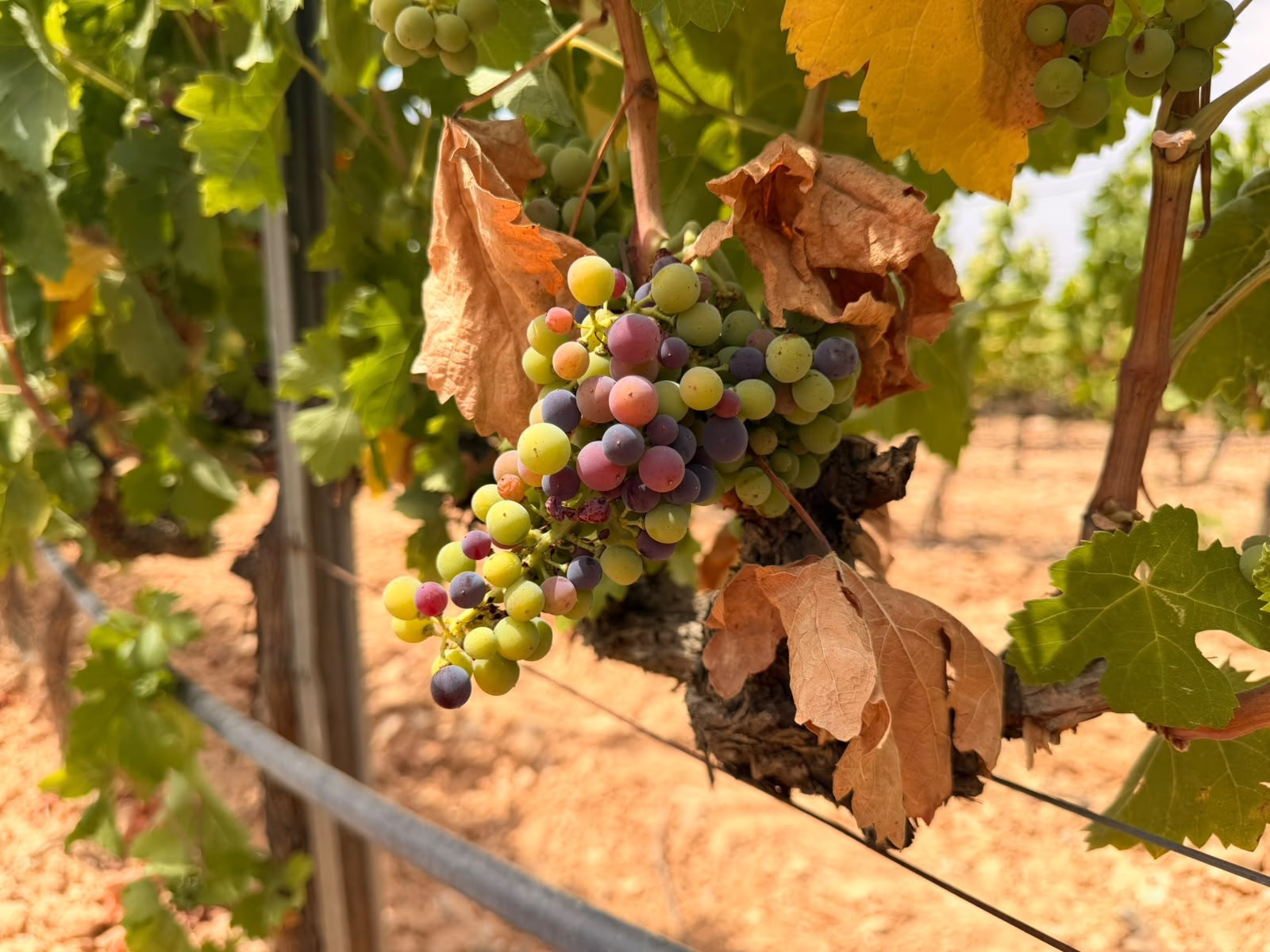
Drought does not hit a vine in a single season. A vine that goes through a dry summer closes its stomata, produces smaller berries and, above all, cannot store the reserves it needs to sprout the next spring. That is why the damage accumulates. During the 2023 drought, the DO Montsant warned that the real problem would come the following year, because the plant had not been able to prepare. In September 2024 Unió de Pagesos estimated that the drought could cut the Catalan harvest by up to 40%, and the grapes weighed in by then were down 68% in the DOQ Priorat and 46% in the DO Penedès on the previous year. In the Penedès the loss was not only grapes but plants: in April 2024 the union expected the drought to carry off between 15 and 20% of the region’s vines, with growers facing the prospect of pulling up fields not yet ten years old. Grape prices did rise, as wineries were forced to pay more, but Unió de Pagesos judged the increase still too small to make the harvest pay6.
What made us look at the problem differently is what these vineyards do for everyone else. Catalonia’s landscape used to be a patchwork of crops and forest, and that mosaic has been disappearing. Around 40% of the territory is now forest, a share that keeps growing as farming and herding are abandoned. Firefighters are clear about the consequences: Marc Castellnou, head of the Bombers’ forest action groups (GRAF), ties today’s fast, intense fires to a landscape that, over the last twenty years, has stopped being the agricultural-forest mosaic it used to be. After one such fire he credited the last farms still working vines, olives and almonds with doing the most to stop it growing: a green, tilled vineyard between two patches of forest slows the fire and gives firefighters a place to work. This is not theoretical. When the Priorat fire of 2024 reached La Figuera, the old Grenache vines of the El Guixar estate acted as a firebreak and kept it from reaching the village, at the cost of about a fifth of the plot7.
This service has no price. The Vins de Foc (Fire Wine) project, a European project led by the CTFC, describes vineyards as one of the most effective natural firebreaks there is, and the scientists and firefighters behind it are asking for that role to be recognised in money, through tax incentives for the farmers who keep those vineyards in production7. When drought kills a vine on a terrace in the Priorat, the region loses a harvest, a livelihood and a piece of its fire defence at the same time. For us, this is why helping vines survive dry years matters beyond wine.
And the market gives growers no room to absorb any of this. Global wine consumption fell in 2024 to its lowest level since 1961, down 3.3% on the year to 214 million hectolitres, while export prices stayed historically high at an average of €3.60 a litre8. Spanish wine is unusually exposed to this, because much of it is sold abroad in bulk and at a low price per litre, and Catalonia’s exports lean heavily on a single category, sparkling wine and above all Cava9, 10. A grower who loses most of a harvest is therefore selling into a shrinking market, and into the part of it that earns the least per litre.
This is what closes the trap, because the one response available to an individual grower is to spend more water. Irrigation is how a vineyard buys itself a harvest in a dry year, and it is the response the economics push towards even though water is the scarce resource to begin with. In Catalonia that option barely exists: only around 7% of the Catalan vineyard is irrigated, against roughly 41% in Spain as a whole (2021 figures)11, and on the terraced slopes of the Priorat the infrastructure is neither available nor desirable. Where irrigation is possible, it competes with urban supply for the same water: in March 2024 the reservoirs of the Catalan internal basins fell to 14.3% of capacity, their lowest on record12. The sector is asked to keep producing with less water, without the margin to invest in doing so, which is why we looked for a way to make the water that already falls go further in the soil, rather than a way to bring more of it to the vine.
Our mission
We want to keep Mediterranean vineyards viable as droughts intensify1, by engineering Bacillus subtilis to work at the vine's roots2 into an input growers add to what they already do3.
- A crop tied to Catalonia's landscape, culture and economy, kept viable without an ever-growing reliance on irrigation.
- It overexpresses γ-PGA, a water-retaining biopolymer, and ACC deaminase, which degrades the stress hormone precursor ACC. At the rhizosphere, not in the vine's genome.
- A microbial inoculant applied alongside existing practice, reducing irrigation needs.
References
- Intergovernmental Panel on Climate Change. Climate Change 2022: Impacts, Adaptation and Vulnerability. Cambridge: Cambridge University Press; 2022. Available from: https://www.ipcc.ch/report/ar6/wg2/
- Food and Agriculture Organization of the United Nations. Water scarcity. Rome: FAO; [cited 2026 Jul 30]. Available from: https://www.fao.org/land-water/water/water-scarcity/en
- United Nations. Water – At the center of the climate crisis. New York: United Nations; [cited 2026 Jul 30]. Available from: https://www.un.org/en/climatechange/science/climate-issues/water
- Food and Agriculture Organization of the United Nations. Drought. Rome: FAO; [cited 2026 Jul 30]. Available from: https://www.fao.org/land-water/water/drought/en
- United Nations Convention to Combat Desertification. Drought in numbers 2022 – Overview. Bonn: UNCCD; 2022 [cited 2026 Jul 30]. Available from: https://www.unccd.int/land-and-life/drought/overview
- Unió de Pagesos de Catalunya. Preveuen que la verema enguany es reduirà més d’un 40% per la sequera [press release]. 2024 Sep 10 [cited 2026 Oct 20]. Available from: https://uniopagesos.cat/comunicat-de-premsa/preveuen-que-la-verema-es-reduira-mes-dun-40-per-la-sequera/. On the 15–20% of Penedès vineyards expected to be lost: LesVegueries. Pagesos i vinicultors constaten una «mortaldat important» a les vinyes del Penedès tot i les últimes pluges. 2024 Apr 17 [cited 2026 Oct 20]. Available from: https://lesvegueries.cat/penedes/alt-penedes/pagesos-i-vinicultors-constaten-una-mortaldat-important-a-les-vinyes-del-penedes-tot-i-les-ultimes-pluges. On the DO Montsant warning: Agència Catalana de Notícies. La sequera avança la verema i redueix la collita fins un 30% a les vinyes del Camp de Tarragona i les Terres de l’Ebre. EbreDigital.cat; 2023 Aug 25 [cited 2026 Oct 19]. Available from: https://ebredigital.cat/2023/08/25/269024/
- Ripoll Ferrer M. El foc crema per segon cop les vinyes d’un celler del Montsant. Arrels; 2024 Aug 1 [cited 2026 Oct 20]. Available from: https://arrels.info/noticia/el-foc-crema-per-segon-cop-les-vinyes-dun-celler-del-montsant/. On Marc Castellnou and the agricultural-forest mosaic: 3CatInfo. El cap dels GRAF: «Prevenir incendis és invertir en el territori. És un tema de tots». 2019 Jun 30 [cited 2026 Oct 20]. Available from: https://www.3cat.cat/3catinfo/el-cap-dels-graf-prevenir-incendis-es-invertir-en-el-territori-es-un-tema-de-tots/noticia/2932032/. On vineyards as firebreaks: Centre de Ciència i Tecnologia Forestal de Catalunya (CTFC). Presentació del projecte Vins de Foc. Blog del CTFC; 2023 Nov 10 [cited 2026 Oct 20]. Available from: https://blog.ctfc.cat/ca/presentacio-del-projecte-vins-de-foc/. On Catalonia’s forest cover: Creus i Badia L. «Més que treure bosc, l’hem d’endreçar»: què diuen els experts en gestió forestal. 3CatInfo; 2025 Aug 29 [cited 2026 Oct 19]. Available from: https://www.3cat.cat/3catinfo/mes-que-treure-bosc-lhem-dendrecar-que-diuen-els-experts-en-gestio-forestal/noticia/3367557/
- International Organisation of Vine and Wine (OIV). State of the world vine and wine sector in 2024 [press release, PDF]. Dijon: OIV; 2025 Apr 15 [cited 2026 Oct 20]. Available from: https://www.oiv.int/sites/default/files/2025-04/EN_OIV_Press_release_State_of_the_World_Vine_and_Wine_Sector_in_2024.pdf
- Vinetur. Spanish wine exports fall below 1.9 billion liters for first time since 2013. Vinetur; 2026 Feb 25 [cited 2026 Oct 19]. Available from: https://www.vinetur.com/en/2026022596756/spanish-wine-exports-fall-below-19-billion-liters-for-first-time-since-2013.html
- Generalitat de Catalunya, Ministry for European Union and Foreign Action. Catalan agri-food sector reaches a historic new milestone in international trade with over €15.7 billion in exports in 2024. 2025 Feb 19 [cited 2026 Oct 20]. Available from: https://exteriors.gencat.cat/en/actualitat/250306_agri_food_exports
- Castellà i Martín A. La vitivinicultura amb DO al Principat: situació actual i futura [presentation, PDF]. Barcelona: Institut d’Estudis Catalans; 2023 Nov 9. Irrigated vineyard: 7.1% in Catalonia, 41.1% in Spain (data: Observatori de la Vinya, el Vi i el Cava, 2021). Available from: Castellà i Martín, 2023 (PDF). On Spain in 2024 (40.8% of the vineyard irrigated): Vinetur. Mínimo histórico del viñedo español. 2025 Jul 10 [cited 2026 Oct 20]. Available from: https://www.vinetur.com/es/2025071089603/minimo-historico-del-vinedo-espanol.html
- Bosch i Grané P. Com estan els embassaments i què falta per fer: un any del moment més crític de la sequera. 3CatInfo; 2025 Mar 10 [cited 2026 Oct 20]. Reservoirs of the Catalan internal basins at their historic minimum, 14.3% of capacity, on 8 March 2024. Available from: https://www.3cat.cat/3catinfo/un-any-del-moment-mes-critic-de-la-sequera-que-falta-per-fer-i-com-estan-els-embassaments-ara/noticia/3337896/
- Reservoir levels shown on the globe above. Illustrative snapshots: values are approximate and from various dates (2018–2026); several drought-hit reservoirs shown at their recent lows. Live, satellite-measured levels: NASA Global Water Monitor · US reservoirs: Bureau of Reclamation · Spain: embalses.net and the Agència Catalana de l’Aigua · Italy: Autorità di bacino del Distretto idrografico della Sicilia · Greece: EYDAP.
Reservoir globe. Globe made by the team with Claude Code.