Executive Summary
Vinesys started from a water problem and a hypothesis about who would pay to solve it. This page documents how we tested that hypothesis against the Catalan wine sector, and what we had to change about our own assumptions once the sector answered.
- Who it is for
- Viticulturists, DO wineries and cooperatives
- Where we are
- Proof of concept: contained laboratory work, no environmental release
- Value today
- Knowledge, education and visibility, not product sales
- How it is funded
- Sponsorship and in-kind support now; public and institutional grants next
Stakeholders & Outreach
Who experiences this problem? We began from a deliberately simple question: who would have a concrete reason to want this technology to exist? Two groups came out of that exercise.
Wineries and viticulturists
They carry the production loss directly and want their vines to withstand dry seasons.
Public and private institutions
Their interest is not in any single product but in agriculture becoming less water-dependent.
Rather than treat that as settled, we went and asked them. Our outreach combined winery visits with interviews at institutional level, so that the same hypotheses could be tested against people with very different backgrounds.
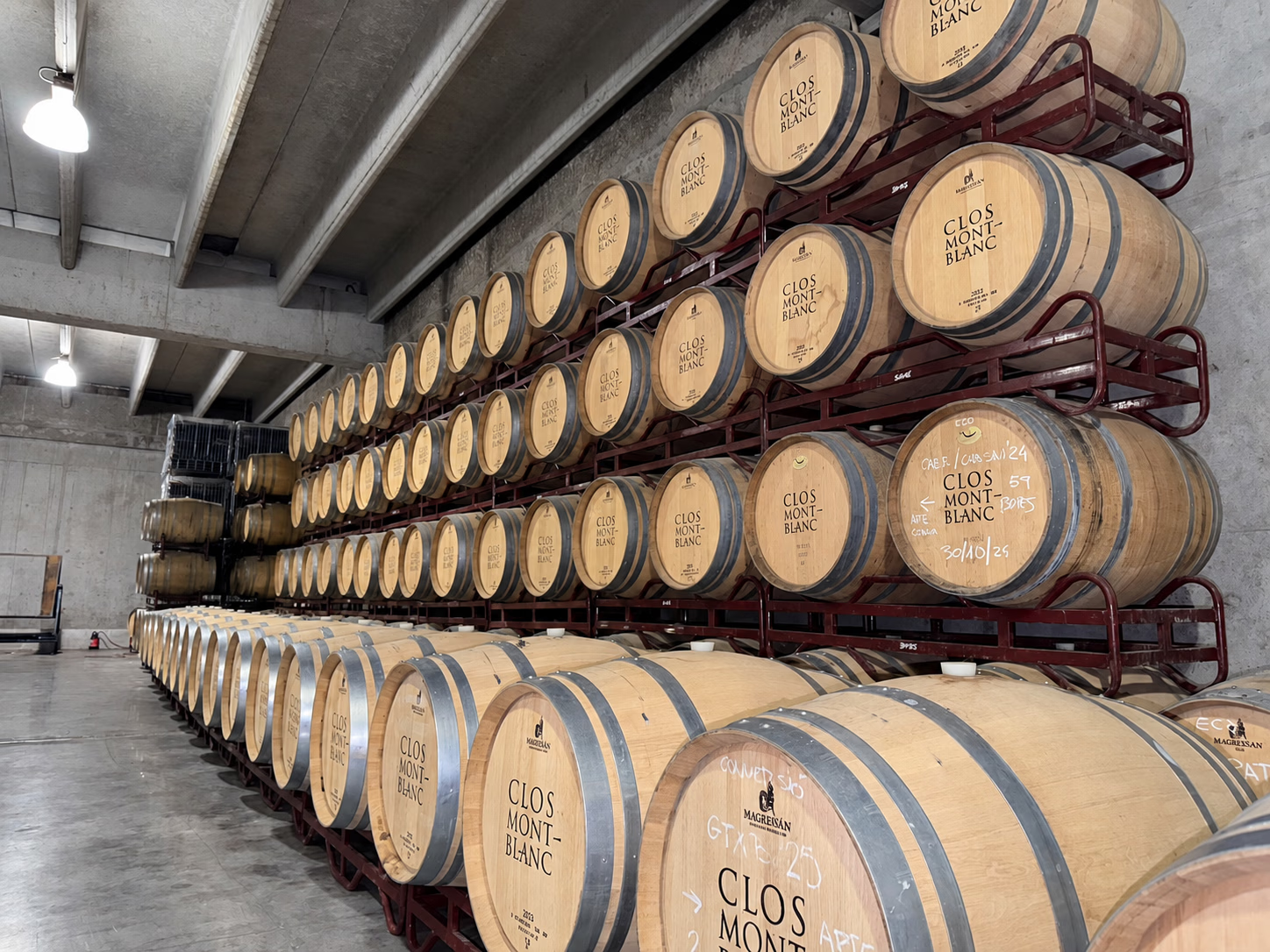
Celler Clos Montblanc
WineryDO Conca de Barberà. We visited the winery and discussed its vineyard needs and how it manages soil and water during dry seasons. Outcome: a first-hand view of the drought's impact.
Sumarroca · Vallformosa
WineriesDO Penedès. We interviewed both wineries about how a new input would fit into their current practice and reach the vine. Vallformosa told us that acting directly at root level could mean lower adoption friction than other solutions.
Ajuntament de Barcelona
Public institutionWe met with the Departament de Ciència i Innovació, who connected us with dissemination contacts and offered us a talk at Centre Cívic Guinardó.
IRTA
Research bodyIRTA reviewed our approach against its own soil-and-water research and introduced us to several leading Catalan wineries. Outcome: technical validation and contacts.
Mapping the System
Outreach
Since June 2026, the funding & business development team, together with Human Practices, has run outreach on three parallel tracks: research and institutional credibility, winery and company sponsorship, and wet-lab material sponsorship.
Institutions & Research Bodies
We are keeping this list short on purpose: only organisations we have already met with are included, and we will expand it as further meetings are confirmed.
IRTA (Institut de Recerca i Tecnologia Agroalimentàries)
IRTA (the Institute of Agrifood Research and Technology) is the Government of Catalonia's public research institute for agriculture and food. Our conversation with IRTA was more technical, centred on a soil-and-water research initiative in the Penedès that they are involved in. It was useful mainly for validating the real-world potential of our approach, since IRTA has worked on comparable strategies before. They also gave us direct contacts at several of the main wineries in Catalonia.
What came of it · technical validationINNOVI, the Catalan wine cluster
INNOVI is the Catalan wine cluster (Clúster Vitivinícola Català), a non-profit association of wineries, growers, suppliers, universities and institutions across the wine value chain that promotes innovation projects in the sector. We met with their technical office, who explained that INNOVI, as a non-profit, is financed by its associate wineries and institutions. They committed to sharing Vinesys with their network. We also noticed they had run a workshop titled "L'edició gènica a la vinya: eines, aplicacions i reptes per a la cultura mediterrània", which lines up closely with our own work, and asked to be notified of similar upcoming events. They agreed.
What came of it · network accessDepartament de Ciència i Innovació, Ajuntament de Barcelona
The Departament de Ciència i Innovació is Barcelona City Council's department for science and innovation. This conversation was oriented toward outreach and education rather than funding or validation. It gave us several contacts for dissemination activities, including the chance to give a talk at Centre Cívic Guinardó.
What came of it · education & outreachWineries & Other Companies
Wineries Reached
- Familia Torres
- Raventós Codorníu
- Freixenet / Henkell Freixenet
- Bodegues Sumarroca
- Masia Vallformosa
- Bodega Jaume Serra
Foundations & Utilities
- Fundació La Caixa A major foundation with grant lines for social, environmental and youth-research projects, a natural funding fit for a university-led sustainability initiative. We collaborated in different ways, such as the filming of our promotional video and la Nit de la Recerca.
- Fundació Damm The philanthropic arm of a Catalan beverage company with a track record of supporting agri-food sustainability and young talent rooted in the local territory. We applied for funding; the request was not accepted. It did give us useful feedback on how to plan our business plan, and more contacts in the industry.
- Aigües de Barcelona Manages water supply for the Barcelona metropolitan area, giving it a direct institutional stake in water-efficiency innovation. We applied for funding; the request was not accepted.
How we chose who to contact
While researching the sector, we came across a joint soil-and-water-management research initiative active in the Penedès. We are not part of that project; we simply saw which wineries and institutions were already involved in it, and reasoned that they were likely to already care about the exact soil-drought challenge Vinesys addresses. That observation, together with our own research into water-related foundations and utilities, shaped who we reached out to.
Wet-Lab Material Sponsors
In parallel, the wet-lab team identified the specific consumables and reagents needed to advance the project, and we ran a separate, lower-stakes outreach track aimed directly at suppliers.
Material Suppliers
- Thermo Fisher Scientific Official wet-lab sponsor
- Labbox Official wet-lab sponsor
- Eppendorf Ibérica
- Merck Group España / Sigma-Aldrich
- Promega Biotech Ibérica
- Pidiscat
What We Learned
Personal introductions outperform generic inboxes: wherever we reached a named individual, through a direct introduction or a contact identified through our own network, the conversation moved forward. Wherever we relied on a general information address, replies were slower, less specific, or did not arrive at all.
Institutional and sector timing matters: grant-submission periods, holidays and harvest season all affect how quickly organisations can respond. We now plan our outreach as a sustained, multi-month effort rather than expecting a fast turnaround.
Customer Validation
What do wineries, institutions and researchers need? Rather than assuming which benefits would matter to a winery, we treated our outreach conversations as a validation exercise.
How we ran it
- Each hypothesis was stated before the meeting, not after, so that a conversation could disconfirm it.
- We counted a hypothesis as confirmed only when it was raised positively by the other party rather than agreed to after we had proposed it.
- We deliberately kept "open" as an outcome instead of reading a single favourable comment as proof.
Three hypotheses confirmed, one still open
| Value proposition | Status | What we heard |
|---|---|---|
| Drought resilience without replanting or changing existing practice | Confirmed as a selling point | Framed consistently as a root-level input applied alongside current viticulture. It came up positively in every winery-adjacent conversation, and it is the one proposition no one needed convincing of. |
| Scientific credibility and R&D partnership visibility | Confirmed, but as a different value than expected | We expected this to be a secondary benefit alongside the product. For certified-organic estates it is now the primary value on offer (education, dissemination and sponsorship), because the modified organism itself is structurally excluded from organic certification. |
| Alignment with sustainability and ESG water-stewardship narratives | Confirmed | Directly echoed by Fundació La Caixa, whose own mandates already centre on water and sustainability. The alignment required no argument from us, which is itself the finding. |
| Low adoption friction, compatible with conventional farming | Open question | At Vallformosa we were told, to our surprise, that the approach could carry lower friction than other solutions, and that acting directly at root level was valued very positively. One favourable conversation is not a validated claim, so we have kept this open rather than promote it. |
Business Model
How could Vinesys create and capture that value? Creating value and capturing it are two different questions, and our outreach suggests that the answer to each depends on which stakeholder segment is being asked.
Creating Value
A product
Technically, Vinesys creates value through a single mechanism: a B. subtilis strain combining γ-PGA water retention with ACC deaminase-driven ethylene reduction, deployed in the rhizosphere alongside existing viticultural practice rather than in place of it.
A regulatory pathway first
In practice, that is not where the value sits today. The project is at an early stage, and field application of a modified microorganism would require its own regulatory pathway.
Why
The 2026 EU reform that eased the rules for certain gene-edited plants applies to plants and their products, not to microorganisms,8 so a modified B. subtilis released to soil would remain within the deliberate-release framework for GMOs.11 Combined with the organic exclusion described under Customer Validation, this means commercialisation is not a realistic near-term outcome even on a longer horizon.
Knowledge
The value Vinesys creates now is therefore the knowledge generated: characterising how rhizosphere water retention behaves under real soil and climate conditions, and testing our hypotheses against the technical experience of working wineries, together with the education and awareness work built around it.
Capturing Value
Vinesys does not capture value through product sales, because the product is at lab-validation stage. Value is captured instead through two parallel mechanisms.
Sponsorship and in-kind support
Financial and material contributions from wineries, foundations and suppliers, captured in exchange for visibility. This is the mechanism that monetises the value identified for certified-organic estates, who cannot use the input but can use the association.
Public and institutional funding
Grants and university funding, captured by positioning Vinesys inside an existing policy priority, water scarcity and agri-food resilience, rather than asking institutions to create a new one. The reservoir and restriction figures in The Problem are not background here; they are the reason the priority already exists.
Both mechanisms share one property worth making explicit: neither requires the product to reach the market.
Why that is deliberate
That is a deliberate consequence of the validation work. Had we designed the model around product sales, the regulatory position would have left us with no viable route at all; by building it around the value each segment told us it could actually use, the project remains fundable and useful at its current stage.
The Whole Model on One Canvas
Value creation and value capture are two of the nine blocks of a business model, and they only hold up if the other seven hold with them: who the partners are, what the project must do well, what it runs on, how it reaches each segment, how it works with them, and what all of it costs.
Vinesys business model canvas Nine blocks across two time horizons. Open it to read the model, or to filter it by horizon. Open canvasClose canvas
Vinesys business model canvas
Customer segments
Who is it for?- Sponsors: wineries, including certified-organic estates, plus foundations and suppliers
- Institutional funders: the university, public bodies and grant programmes with water and agri-food mandates
- Research and sector bodies that want field knowledge on vine water use
- Students and the public, as beneficiaries of outreach
- Conventional viticulturists, DO wineries and cooperatives in water-stressed areas such as Costers del Segre
- Other drought-exposed crops, including cereals
Value propositions
What do we offer each segment?- Scientific credibility and visible R&D partnership, the primary value for organic estates validated
- Fit with ESG and water-stewardship goals validated
- Knowledge of how rhizosphere water retention behaves in real soils and climates
- Science education and awareness of responsible water use
- Drought resilience without replanting or changing practice validated
- A rhizosphere water trap and a compliance shield for irrigation restrictions
- Less defoliation, with berry acidity and aromas protected
- Low adoption friction through existing drip fertigation open
Channels
How do we reach them?- Winery visits and structured interviews
- iGEM Grand Jamboree, Paris, 12–16 November 2026
- Wiki, social media, and talks in schools and universities
- UPF and PRBB networks for grants and sponsors
- Cooperatives, DO technical services and agri-input distributors open
- Applied through drip lines growers already run
Customer relationships
How do we work with them?- Co-creation: wineries test our hypotheses and shape the experimental design
- Sponsor packages with visibility, dissemination rights and early access to results
- Reporting to funders against existing water-scarcity priorities
- Joint field trials and agronomic support for early-adopter estates open
Revenue streams
How is value captured?- Short term: sponsorship and in-kind support from wineries, foundations and suppliers
- Medium term: public grants and university funding tied to water and agri-food resilience
- Product sales per hectare per season; price sensitivity has not been tested open
- Licensing the strain or platform to an agri-biotech company open
Key activities
What must we do well?- Contained proof-of-concept work on B. subtilis expressing γ-PGA and ACC deaminase
- Computational modelling of both mechanisms
- Customer validation, with hypotheses written before each interview
- Outreach, fundraising and sponsor relations
- Field characterisation, a deliberate-release dossier, and scale-up of production
Key resources
What do we rely on?- The dual-mechanism strain design (γ-PGA plus acdS)
- PRBB laboratory and biosafety framework
- A 16-person student team across lab, modelling, human practices, business and communication, with senior researchers
- Validation evidence and contacts across the Catalan wine sector
- An ownership model for the strain, since iGEM parts are shared openly open
Key partners
Who helps us deliver?- UPF and PRBB, host institutions, with supervision by PI Javier Santos Moreno
- Wineries: Clos Montblanc (DO Conca de Barberà), Sumarroca and Vallformosa (Penedès)
- IRTA for applied research
- Ajuntament de Barcelona and Fundació La Caixa, whose mandates centre on water and sustainability
- iGEM Foundation: competition, safety framework and community
- Vallformosa, for testing under the most demanding low-rainfall conditions open
- An inoculant manufacturer to produce, register and distribute open
Cost structure
What does it cost?- Lab consumables, reagents and DNA synthesis
- iGEM team registration and travel to the Jamboree in Paris
- Outreach materials, events and the website
- Lab space and supervision largely in kind; the student team is unpaid open
- Regulatory approval for release, multi-season field trials, and manufacturing (the dominant cost and the main barrier)
The project today A future product validatedraised positively in outreach (Table 1) openassumption still to be tested
Competitive Landscape
Vinesys sits inside the broader agricultural biostimulants industry, with an initial commercial focus on Catalan and Spanish viticulture.
The Competitive Landscape
What else can a grower already buy, and where does it fall short? Vinegrowers facing drought are not waiting for us. They already have several tools, and some of them work well. Vinesys does not try to replace them. The question we set out to answer is narrower and more useful: where do the current solutions stop, and is there a gap that a living, root-associated system could fill on top of them?
Comparison
Setting the categories against the two things our design actually does, holding water in the soil and lowering the plant's stress response, shows that no existing option does both.
Drip and deficit irrigation
- Retains soil water
- No
- Reduces plant stress
- No
- Self-renewing in field
- Not applicable
- No persistent residue
- Yes
- Main limitation
- Depends on water being available in the first place.
Drought-tolerant rootstocks
- Retains soil water
- No
- Reduces plant stress
- Yes, genetic
- Self-renewing in field
- Yes
- No persistent residue
- Yes
- Main limitation
- Requires replanting the vineyard; very slow to deploy.
Synthetic hydrogels (polyacrylates)
- Retains soil water
- Yes
- Reduces plant stress
- No
- Self-renewing in field
- No
- No persistent residue
- No
- Main limitation
- Persistent polymer, inside the scope of the EU microplastics restriction.
Non-microbial biostimulants
- Retains soil water
- No
- Reduces plant stress
- Partly
- Self-renewing in field
- No
- No persistent residue
- Yes
- Main limitation
- Short-lived; has to be reapplied through the season.
Natural PGPR and mycorrhizae
- Retains soil water
- Partly
- Reduces plant stress
- Partly
- Self-renewing in field
- Yes
- No persistent residue
- Yes
- Main limitation
- Traits are inherited strain by strain, not designed or combined.
Vinesys, engineered B. subtilis Our approach
- Retains soil water
- Yes, via γ-PGA
- Reduces plant stress
- Yes, via ACC deaminase
- Self-renewing in field
- In principle
- No persistent residue
- Yes
- Main limitation
- GMO regulation, and field persistence still unproven.
What Makes Vinesys Different
Two complementary mechanisms in one organism
Most solutions act either on the soil, by keeping water there, or on the plant, by helping it cope. Vinesys acts on both at once: γ-PGA holds moisture around the roots, and ACC deaminase lowers stress ethylene so the roots can keep growing towards that water.
Production where it is needed
Hydrogels and biostimulants are applied from outside and gradually lost. A rhizosphere-colonising B. subtilis would, in principle, produce γ-PGA at the root surface itself, reducing the need for repeated application.
A biodegradable alternative to synthetic hydrogels
γ-PGA is a naturally produced, biodegradable polymer. As EU policy restricts persistent synthetic microparticles in agriculture, a biological water-retention mechanism sits on the right side of where the rules are heading.
Complementary, not a substitute
Vinesys is designed to sit on top of drip irrigation and good agronomy. It does not ask growers to abandon tools they already trust, which is the same low-friction argument that came back positively from Vallformosa in Customer Validation.
A platform, not a single product
The chassis and the genetic design could in principle be adapted to other drought-exposed crops, cereals among them, which widens the potential market well beyond viticulture.
References
- FAO. 2025 AQUASTAT Water Data Snapshot. Reported via UN-Water, 2026. Agriculture accounts for around 72% of global freshwater withdrawals; renewable freshwater per capita down 7% in a decade. unwater.org/news/fao-2025-aquastat-water-data
- 3Cat Info. Reserves in the Catalan internal basins reached their historic minimum of 14.3% of capacity on 8 March 2024. 2025. 3cat.cat · Agència Catalana de l'Aigua, real-time reservoir data: aca.gencat.cat
- Generalitat de Catalunya. Entry into the emergency scenario of the Special Drought Plan for the Ter-Llobregat system: 80% reduction in agricultural irrigation, with survival irrigation of woody crops authorised only under conditions. Government press release, 2024. govern.cat
- OIV. Statistical Brief: Wine, Table Grapes and Dried Grapes in 2024. Spain holds the world's largest vineyard area at approximately 930,000 ha. oiv.int
- ACCIÓ and Prodeca, Generalitat de Catalunya. The Catalan agri-food sector generates €57,981 million, equivalent to 18.3% of Catalan GDP, and employs 177,383 people. 2026. govern.cat
- Unió de Pagesos, reported in El Punt Avui. The 2023 Catalan grape harvest fell about 40% on average, with declines of 85% in Costers del Segre, 73% in Pla de Bages, 68% in Priorat, 53% in Montsant, 48.5% in Terra Alta, 46% in Penedès and 41.4% in Empordà. 2023. elpuntavui.cat
- Gambetta GA, Herrera JC, Dayer S, Feng Q, Hochberg U, Castellarin SD. The physiology of drought stress in grapevine: towards an integrative definition of drought tolerance. Journal of Experimental Botany. 2020;71(16):4658–4676. doi.org/10.1093/jxb/eraa245
- Regulation (EU) 2026/1388 on plants obtained by certain new genomic techniques and their products, adopted 17 June 2026, applicable from 17 July 2028. NGT plants are not permitted in organic production. eur-lex.europa.eu · European Commission overview
- Opadokun M, et al. Effect of γ-polyglutamic acid produced by drought-tolerant Bacillus subtilis FSO3 on soil moisture retention. Journal of Basic Microbiology. 2025. doi.org/10.1002/jobm.70047
- Gupta S, Pandey S, et al. Bacterial ACC deaminase: insights into enzymology, biochemistry, genetics, and potential role in amelioration of environmental stress in crop plants. Frontiers in Microbiology. 2023;14:1132770. doi.org/10.3389/fmicb.2023.1132770
- Directive 2001/18/EC on the deliberate release into the environment of genetically modified organisms. eur-lex.europa.eu