
Abstract
Viticulture in Catalonia is being reshaped by a water problem that is no longer occasional. Between 2021 and 2024 the region went through its most severe drought on record, and in the two wine denominations we have worked with most closely, DOQ Priorat and DO Penedès, growers describe the same pattern: shorter cycles, earlier harvests, vines that struggle to recover between seasons, and young plantings that fail to establish.
Vinesys approaches the problem from the soil rather than from the plant. We are engineering a Bacillus subtilis chassis, applied to the rhizosphere through the irrigation system or by manual application, that combines two complementary functions. The first is the overproduction of gamma-polyglutamic acid (γ-PGA), a highly hygroscopic natural biopolymer that retains water in the immediate root environment and improves soil structure. The second is the expression of ACC deaminase, an enzyme that degrades the immediate precursor of ethylene and therefore attenuates the stress-ethylene signal that halts root elongation when a vine perceives drought. The vine, the grape and the wine are not genetically modified at any point. All of the engineering is confined to a soil bacterium, which is also confined to the vineyard by two biocontainment circuits that sense resveratrol, a compound secreted by grapevine roots, as a positional signal.
γ-PGA holds the water
A hygroscopic biopolymer B. subtilis already makes, overproduced under a stress-responsive promoter: it keeps water in the pore space around the root and binds soil particles into aggregates.
Read the module Module 2ACC deaminase keeps the root growing
Heterologous acdS cleaves ACC, the immediate precursor of ethylene, lowering the stress-ethylene peak that would otherwise halt root elongation during drought.
Read the module ActivationTwo independent drought checks
An osmolarity sensor acting on transcription, and a salt-dependent intein acting on the protein itself, so a transcribed construct still yields nothing functional until intracellular K+ has genuinely risen.
Read the design ContainmentConfined to the vine's rhizosphere
TtgR reads resveratrol secreted by grapevine roots as a positional signal: with the signal, the lethal circuit stays repressed; without it, the cell is eliminated.
Read the strategyChassis: why Bacillus subtilis
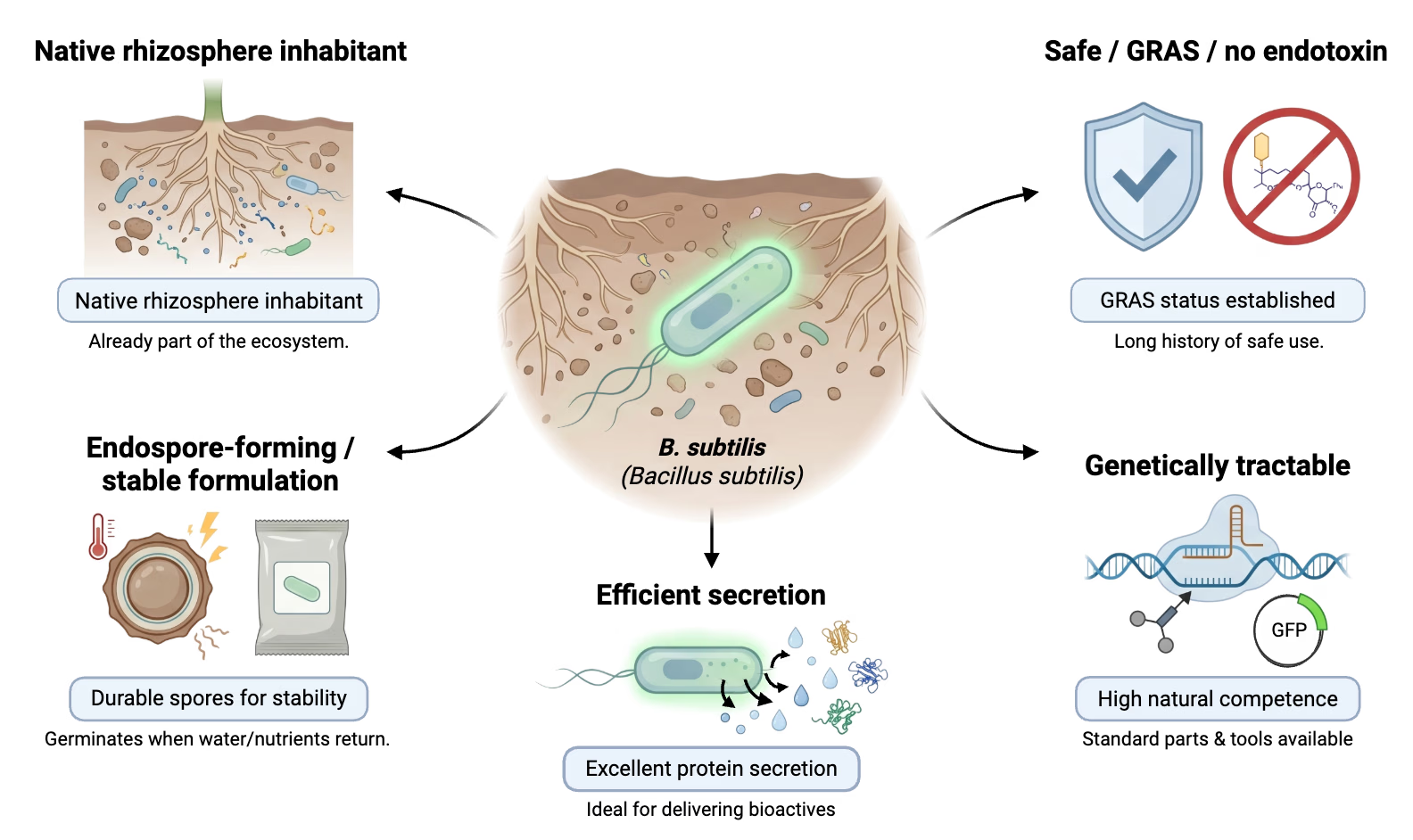
We did not choose B. subtilis because it was convenient in the lab, because it is not. We chose it because it is naturally part of the solution.
B. subtilis is a native inhabitant of the rhizosphere and is one of the most abundant plant-growth-promoting bacteria found in agricultural soils, including Mediterranean soils with low organic matter and high mineral content such as the llicorella of Priorat. Several commercial biofertilizers and biocontrol products based on this species are already authorised and in use in European agriculture, which means growers and technical advisors are familiar with it and the agronomic baseline is established. From a regulatory and public-acceptance perspective this matters: we are not introducing a foreign organism into the vineyard, we are modifying one that is already there.
The species also carries a set of properties that are difficult to find together in one organism. It is Gram-positive and therefore lacks lipopolysaccharide endotoxin, it has GRAS (Generally Recognised As Safe) status and a long history of safe industrial use, and its genetics are exceptionally well characterised with a large collection of standardised parts available. It is naturally competent, so transformation does not require electroporation or conjugation and genomic integration is straightforward with a slight push, which is a practical advantage for a student team working within an iGEM timeline. Moreover, it secretes proteins and polymers efficiently into the extracellular medium, which is exactly what both of our modules require.
Under nutrient limitation, B. subtilis forms endospores that survive heat, UV radiation and prolonged desiccation, and germinate as soon as water and nutrients return, which is what allows the species to be formulated and stored as a stable product. A spore is metabolically dormant and therefore produces neither γ-PGA nor ACC deaminase, so the agronomic function of the system depends on maintaining an active vegetative population in the rhizosphere during the season. Our application strategy is built around exactly that. Fertigation delivers water and nutrients together, which is the germination signal itself, and the frequency of the irrigation calendar through the spring and summer months keeps the population cycling back into the vegetative state rather than settling into prolonged dormancy. Both the productive modules and the resveratrol-dependent biocontainment circuit are therefore transcriptionally active.
Module 1: gamma-polyglutamic acid (γ-PGA)
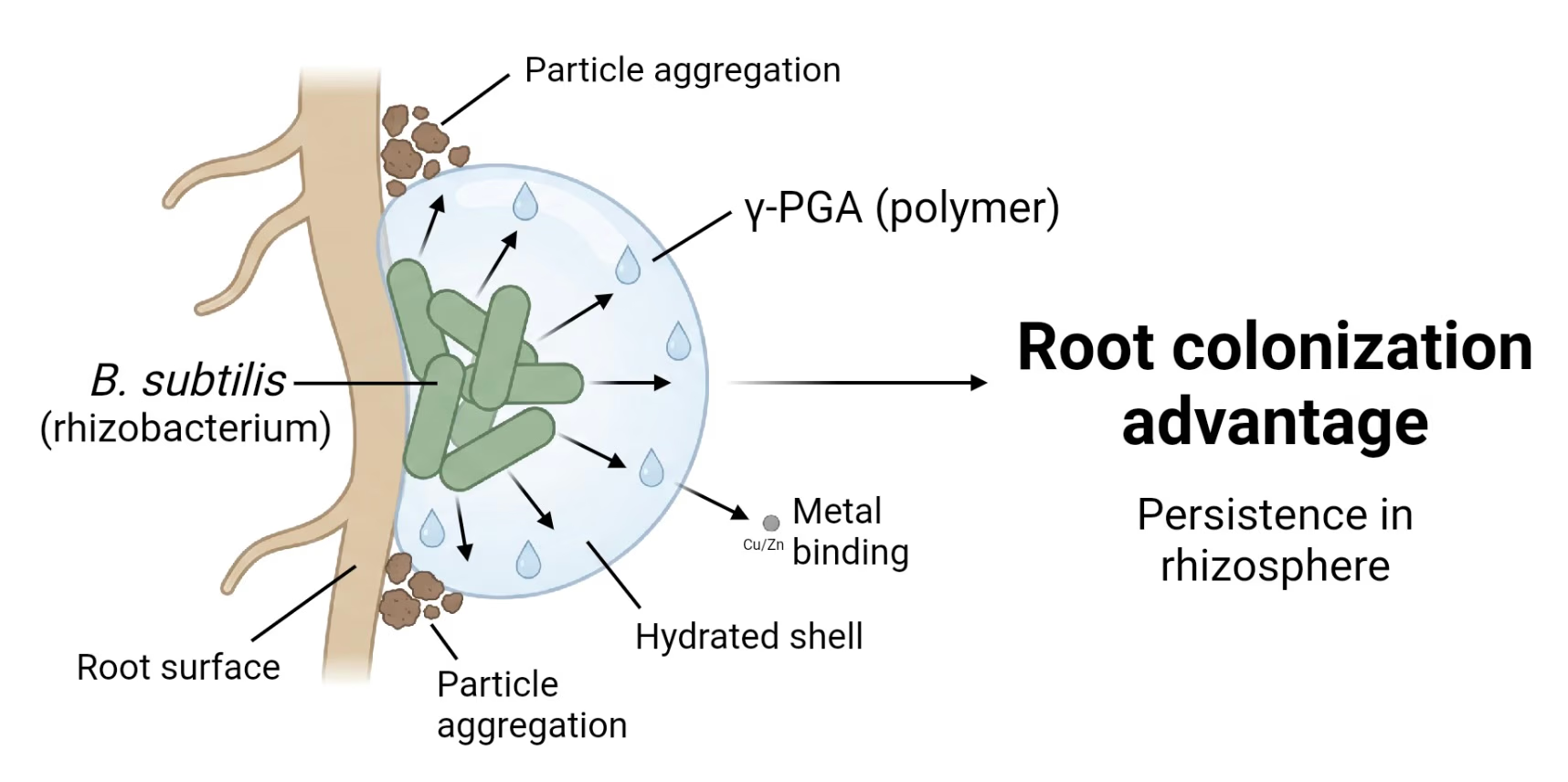
In the rhizosphere, γ-PGA does three things at once that are beneficial to our solution and that give our bacteria a root colonisation advantage.
It forms a hydrated shell around the root surface. γ-PGA absorbs a multiple of its own weight in water and holds it as a hydrogel in the pore space immediately surrounding the root. Our claim is local rather than agronomic: what a bacterially produced hydrogel can plausibly do at the root surface is buffer it against desiccation between irrigation or rainfall events, maintaining hydration in the thin zone where water uptake actually happens, and interpose an anionic, metal-binding layer between the root and the soil solution, limiting the entry of toxic cations. That shell is protective before it is nutritional.
It improves soil structure. γ-PGA acts as a binding agent between soil particles, promoting aggregate formation. Insofar as a bacterial producer does raise plant-available water, we believe this is the route: better aggregation means the little water that arrives is retained rather than lost to runoff and deep percolation. In the shallow, stony and poorly aggregated soils typical of Priorat, this effect may matter even more than any direct water-holding by the polymer itself.
It gives our chassis a competitive advantage in the rhizosphere, which is the function we consider most important. The rhizosphere is a crowded and contested environment, and an inoculant that cannot hold its position there does nothing regardless of what it encodes. γ-PGA is one of the major polymeric substances secreted by B. subtilis and has a demonstrated role in biofilm robustness and root colonisation1. In a biocontrol strain, γ-PGA yield was tied to motility, to wheat root colonisation and to biocontrol efficacy against Fusarium graminearum, which reached 62.14% for the parent isolate2: the polymer is not only structural, it is part of how the bacterium holds ground against competitors. In a vineyard soil the advantage is sharper still, because γ-PGA is natively a protection mechanism against copper and zinc excess3, and vineyard soils are a textbook case of copper accumulation from decades of copper-based fungicides. In that specific environment the polymer is a selective advantage that most of the surrounding community does not have.
Module 2: ACC deaminase
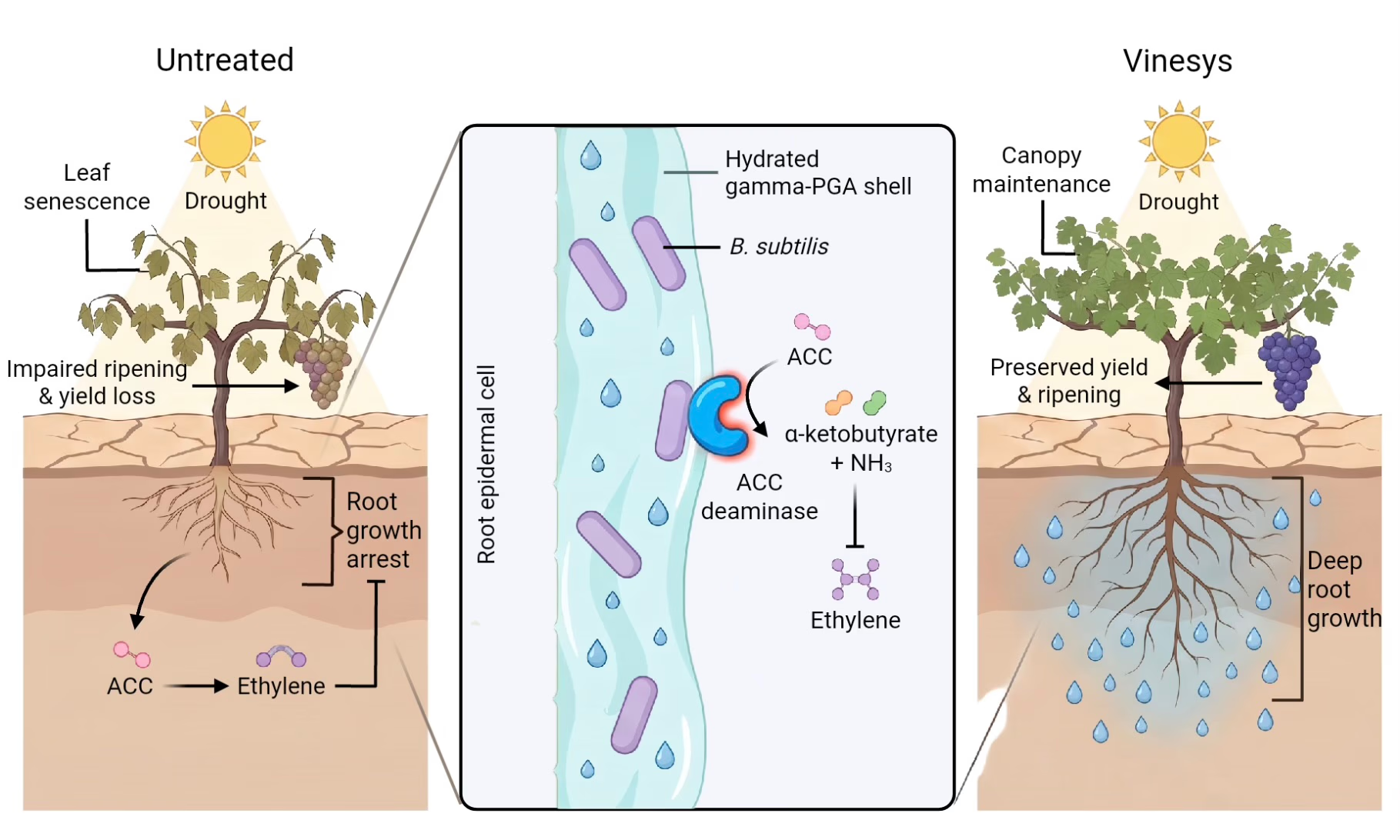
The second module addresses the plant's own response rather than the physical availability of water. When a vine perceives drought, it accumulates 1-aminocyclopropane-1-carboxylate (ACC), the immediate precursor of ethylene, and the resulting rise in ethylene inhibits root elongation, accelerates leaf senescence and contributes, along with abscisic acid, to closing the stomata and reducing transpiration.
That response keeps the vine alive through a dry August, so the aim is not to suppress it but to set it at the right level. Closed stomata also stop the CO2 uptake photosynthesis depends on, and prolonged ethylene signalling arrests the root growth that would eventually reach deeper water, so a response that is protective over days becomes costly over weeks. The two failure modes are not symmetrical: a vine that never experiences moderate deficit in spring builds excessive canopy over a shallow root system and arrives in July with a transpirational demand its roots cannot sustain, while a vine held under severe stress too long shuts down, loses yield and fails to ripen. The useful interval between the two is narrow and shifts with phenological stage. Vinesys is designed to widen that interval, not to move the vine out of it.
ACC deaminase, encoded by acdS, cleaves ACC into alpha-ketobutyrate and ammonia before it can be converted into ethylene4. Rhizosphere bacteria carrying this enzyme act as a sink for the plant's ACC, lowering the ethylene peak and allowing roots to keep growing under conditions where they would otherwise stop. The bacteria gain nitrogen and carbon from the reaction, so the function is not altruistic and should be metabolically stable.
This module is the one that depends on the other two parts of the design. The enzyme is only a sink where the bacteria actually are, so its effect scales with colonisation density at the root surface: without γ-PGA holding the chassis on the root, ACC deaminase is expressed into empty soil and does nothing. And because its substrate is a signalling molecule rather than a waste product, an enzyme that degraded ACC continuously would be interfering with vine hormone signalling at times when the vine has no water deficit to answer, and when that signal is serving other functions entirely. γ-PGA puts the enzyme where it matters; the osmolarity promoter and the salt-dependent intein confine it to when it matters, holding activity inside the margin the vine can use.
Most B. subtilis strains do not carry a functional acdS, so this module is heterologous. We are evaluating well-characterised sequences from known ACC-deaminase-producing rhizobacteria, with codon optimisation for B. subtilis and genomic integration rather than plasmid maintenance, to avoid antibiotic selection in a field-oriented design.
Two-factor authentication for drought
Both of our modules do work that must not be done constitutively. ACC is the immediate precursor of ethylene, a key hormone regulating a variety of processes, so a bacterium degrading it continuously in the rhizosphere intervenes in vine signalling whether or not the soil is dry. γ-PGA is subtler: it helps our chassis colonise the root and persist there, which is what makes the ACC deaminase module deliverable at all, but its benefit is not monotonic in production level. It is built from glutamate, the same precursor the cell needs for osmoprotective proline, so an excess of the hydrogel would come at the cost of that osmoprotection.
Conditional production is the design response. We gate the system twice through two physically different mechanisms: an osmolarity sensor acting on transcription, and a salt-dependent intein acting on the protein itself. Both read the same physical variable, so this is not a second opinion; what it buys is a sharper threshold, because promoter leakiness and spurious splicing are uncorrelated failure modes. Our intein derives from the MCM2 intein of Halorhabdus utahensis, which splices only above a salt threshold higher than our chassis reaches under drought. Rather than screen a library, our dry lab re-engineered that threshold computationally: a four-mutation variant is predicted to be most active at the salt concentration B. subtilis reaches under osmotic stress, awaiting wet lab validation.
Why conditional production, and not more production
ACC deaminase is not a harmless enzyme to leave on. ACC is the immediate precursor of ethylene, and the vine uses that hormone for far more than its drought response, so continuous degradation in the rhizosphere is an intervention in plant signalling regardless of soil water status.
γ-PGA is not simply a cost. It is one of the major polymeric substances secreted by B. subtilis, it contributes to biofilm robustness, and it has a demonstrated role in root colonisation1. Its loss is not cosmetic: in a biocontrol strain, γ-PGA yield was tied to motility, to wheat root colonisation and to biocontrol efficacy against Fusarium graminearum2. The standard failure of Bacillus inoculants is not activity in culture but persistence in the field, so the module that keeps our chassis on the root is the one that makes the ACC deaminase module deliverable at all.
But two independent lines of evidence show the benefit is not monotonic in production level.
γ-PGA is a polymer of glutamate, and glutamate is the precursor from which B. subtilis builds proline de novo as its compatible solute under osmotic stress, through the ProJ-ProA-ProH route induced on osmotic upshift. The proline pool rises from roughly 16 mM to 500-700 mM after a moderate salt upshift5, so this is a major demand on the same precursor, arising in exactly the conditions where Module 1 is meant to operate.
Extracellular γ-PGA has also been shown to drive localised biofilm dispersion: the hydrogel swells, generates osmotic pressure and ejects motile cells from the biofilm interior, with overproducing biofilms showing markedly more cell-void regions than the wild type6. Too little polymer and the chassis does not colonise; too much and it disperses the community it just built.
Conditional production, restricted to genuine deficit, answers both. It is not only an argument about metabolic economy; it is what keeps colonisation on the useful side of the curve.
The intein, and why this one
Inteins excise themselves from a precursor and ligate their flanking exteins through a native peptide bond, needing no cofactor and no energy. Ours derives from the MCM2 intein of the halophilic archaeon Halorhabdus utahensis7, one of a family of halo-obligate inteins that stay inactive at low salinity and splice only above a salt threshold specific to each intein8.
Inserted inside our protein of interest, it means a fully transcribed and translated construct still yields nothing functional unless intracellular K+ has genuinely risen, the signature of osmotic stress our wet lab confirmed in B. subtilis under drought.
Inteins have been used for purification, semisynthesis and biosensing9, and their salt dependence has been engineered in both directions before, both added to a non-halophilic intein10 and lowered in a halophilic one11. Using one as a physiologically calibrated second authentication factor is, to our knowledge, new.
Re-engineering the salt threshold
The native intein requires salt above what B. subtilis reaches under drought. Rather than screen a library experimentally, our dry lab asked whether the salt dependence could itself be engineered, reasoning, as earlier work on the Halobacterium salinarum PolII intein did, that the surface acidic residues typical of halophilic proteins are what must be electrostatically screened before the protein reaches its active conformation.
That precedent is explicit: replacing nine negatively charged surface residues with those found in non-halophilic homologues allowed splicing at 0.5 M NaCl instead of the native 1.5 M, an effect later narrowed to two residues11. Our contribution is to do this computationally and against a physiological target concentration rather than by assay.
Candidate residues were selected by combining two independent lines of evidence: an evolutionary comparison against inteins with known thresholds above and below our own, and a structural filter for solvent exposure, model confidence and distance from the catalytic machinery. Survivors were checked for stability with FoldX, then tested in molecular dynamics, tracking how often the catalytic residues reach an attack-ready geometry across a range of salt concentrations.
The wild type is consistently most active at its own native threshold, which validates the method against a known answer, and the four-mutation variant is most active instead at the concentration our chassis reaches under drought. Potassium coordination drops markedly at every mutated position and not at an uncharged control, supporting the electrostatic premise directly. A larger seven-mutation variant did not reproduce the shift, and all of this remains computational prediction awaiting wet lab validation.
Application
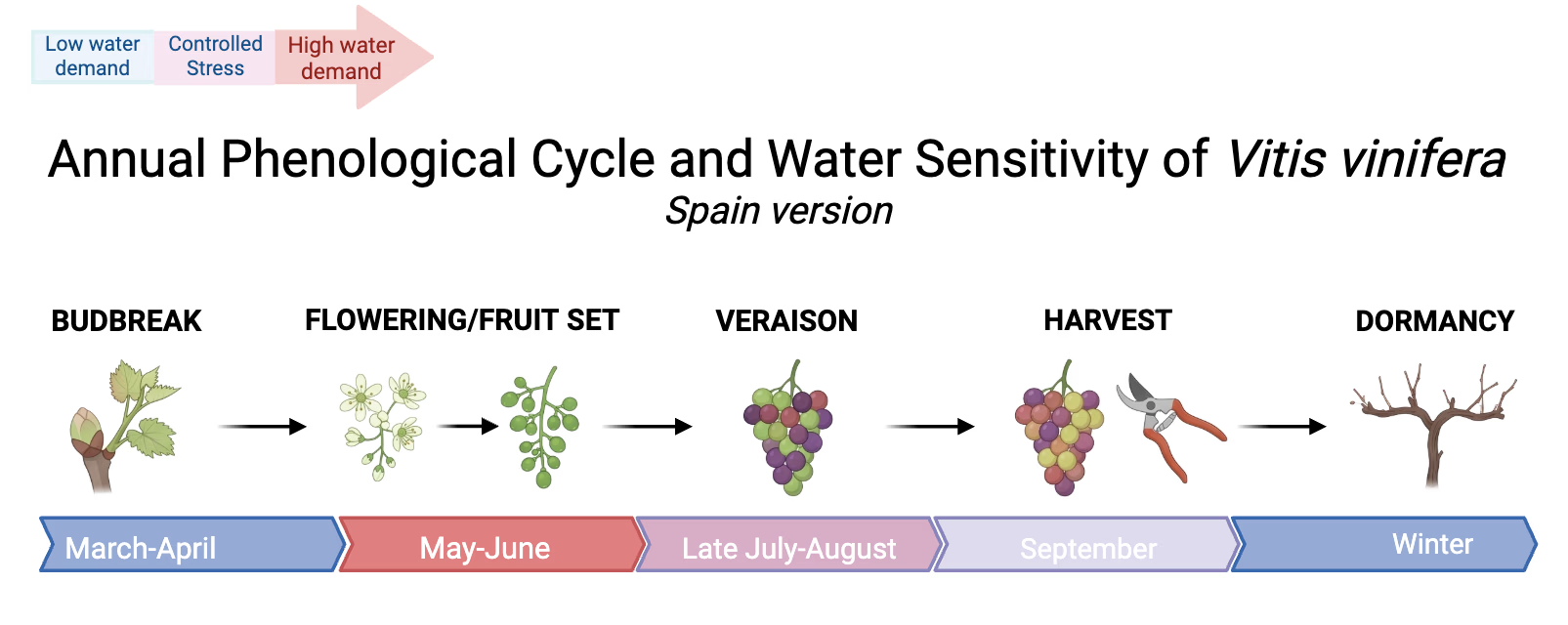
As the diagram shows in Figure 4, moderate water stress is not something the vineyard necessarily needs to avoid. Within the right window it reduces berry size, raises the skin-to-pulp ratio and is part of what gives Priorat wines their concentration, and growers manage it deliberately. What damages the crop is severe stress, and in particular severe stress during flowering and fruit set, where the loss is irreversible.
Our application strategy follows from that distinction. We propose applying the product at budbreak, between March and April, for three reasons. The soil still holds the water accumulated over the winter, so the rhizosphere is wet enough for the bacterium to establish itself. The vine's own demand is still low at that stage, so there is no competition for water during colonisation. And colonisation takes several weeks, which means an application at budbreak gives the population time to settle before the critical flowering and fruit set window in May and June.
From there the bacterium remains in the rhizosphere through the spring, kept in its vegetative state by the irrigation calendar where irrigation exists. The relevant period is the summer, when rainfall is minimal and when water restrictions during a drought emergency may suspend irrigation altogether. Even where irrigation continues, the γ-PGA retained around the roots extends the time water remains available after each rainfall or irrigation event, which allows the intervals between waterings to be longer and the total volume applied over the season to be lower. Meanwhile ACC deaminase keeps the root system growing instead of shutting down.
The aim is to prevent the vine from crossing from the moderate deficit that improves the wine into the severe deficit that costs the harvest, and to reduce the volume of irrigation needed to stay on the right side of that line.
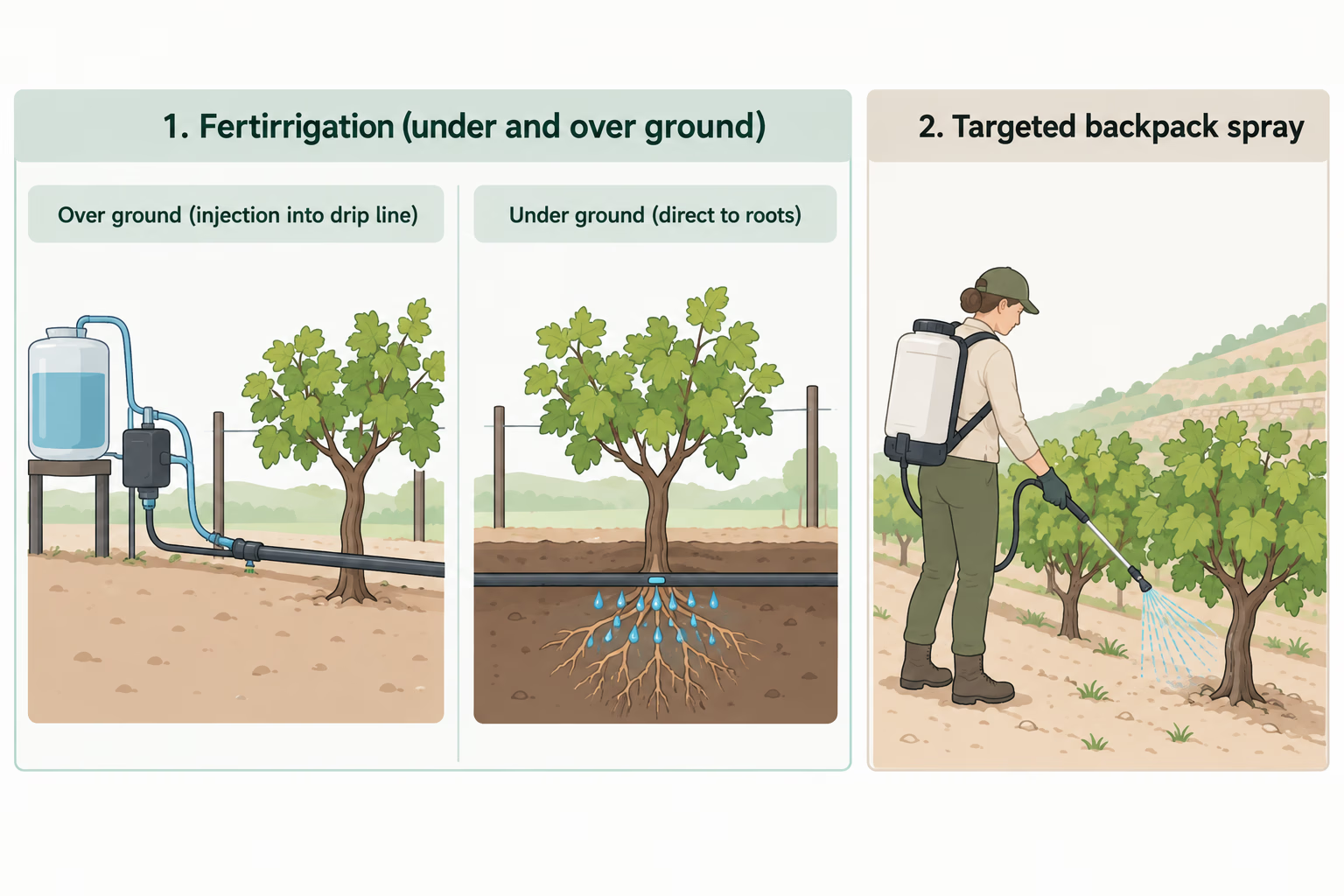
The first route of application uses the drip systems already installed in many vineyards, a number that keeps growing as drought pushes producers who once farmed exclusively in “secano” towards irrigation. The bacterial preparation, most likely in spore form for stability, is injected into the drip line in the same way as a liquid fertiliser, which delivers it directly to soil and ends up reaching the wetted bulb where the active roots are concentrated. It requires no new equipment or additional passes through the vineyard. Ideally, our product would benefit most of the underground fertirrigation, where the water (thus our bacterium) is delivered directly to the roots. This system is less incorporated because its substantial initial cost, but has enough benefits to be adapted by some growers. The second route addresses the plots that have no irrigation at all, which in Priorat is a substantial fraction of the surface, and consists of a backpack unit applied at the base of each vine during the normal spring treatments. It is more labour-intensive and less precise, but it is compatible with the steep terraces where machinery cannot operate, and it keeps the technology accessible to small producers rather than only to estates with modern infrastructure.
| Route | How it reaches the roots | Where it fits |
|---|---|---|
| Fertigation, over ground | Injected into the drip line like a liquid fertiliser, reaching the wetted bulb where the active roots are concentrated. | The drip systems already installed in many vineyards. No new equipment and no additional passes. |
| Fertigation, under ground | Water, and with it the bacterium, is delivered directly to the roots. | Where it exists: a substantial initial cost keeps it rare, but it is the system our product would benefit from most. |
| Backpack spray | Applied at the base of each vine during the normal spring treatments. | Plots with no irrigation at all, a substantial fraction of the surface in Priorat, including steep terraces where machinery cannot operate. |
Biocontainment
A genetically modified bacterium intended for open soil has to be restricted to the place where it is supposed to work, and the restriction has to be biological rather than procedural.
Our strategy exploits a signal that is specific to the environment we are targeting. Grapevine roots secrete resveratrol, a stilbene phytoalexin, into the surrounding soil, and the concentration falls with distance from the root. We use this gradient as a positional signal, detected by TtgR, a transcriptional repressor from Pseudomonas putida DOT-T1E that binds resveratrol and related phenolics and releases its operator when bound. In the presence of resveratrol, that is, in the rhizosphere of a vine, the lethal circuit is repressed and the bacterium functions normally. Outside that zone, in the absence of the signal, the circuit is derepressed and the cell is eliminated.
We are developing two architectures for the lethal module. The first is a toxin-antitoxin system in which the toxin is expressed on escape, and the second is a CRISPR-Cas9 self-targeting kill switch that introduces irreparable double-strand breaks in the bacterium's own genome. We will characterise both and introduce both, as a safeguard if random mutations damage one.
| Architecture | What happens outside the rhizosphere |
|---|---|
| Toxin-antitoxin | The toxin is expressed on escape. |
| CRISPR-Cas9 self-targeting | Irreparable double-strand breaks are introduced in the bacterium's own genome. |
Future steps
Experiments and protocols
Everything below is a plan, not a result. None of these assays have been run, and no data from them appears anywhere on this wiki. The plan took its current shape over months of conversations with researchers working on soil microbiology, plant stress physiology and viticulture, and it is organised chronologically: each phase only makes sense once the previous one has worked.
-
Promoter characterisation
Determine whether POpuA-P1 or PgsiB responds more strongly to osmotic stress, with mRFP1 as reporter and P43 as control. Everything else depends on this.
-
Each effector on its own
Confirm expression and translation, then test ACC deaminase by growth on ACC as sole nitrogen source and γ-PGA by methylene blue assay. How ACC deaminase reaches its substrate outside the cell is still an open question we would want to look into here.
-
The intein on its own
Validate splicing in E. coli using sfGFP and a K+ gradient, then tune the activation threshold down into the range B. subtilis actually reaches under stress.
-
The intein inside the effectors
Confirm excision by molecular-weight shift, and repeat the functional assays to check the proteins still work after splicing.
-
The complete system
Assemble everything into one plasmid and use growth curves to see whether the construct imposes a real metabolic burden, and where it comes from.
-
Arabidopsis thaliana
Confirm the bacterium colonises a real rhizosphere, then measure what it does for a plant under controlled drought: morphology, photosynthetic efficiency, and stress markers.
-
Genome integration
Integrate the plasmids into the bacterial genome to ensure that the information will last through cellular divisions.
-
Vitis vinifera
The same questions on grapevine and Penedès soil, adding soil structure and water retention on one side and leaf water potential and stomatal conductance on the other.
Deployment in working vineyards remains the goal, but European regulation on the release of genetically modified organisms places it well beyond the horizon of the project as it stands.
Regulatory barriers
We are following the Biotech Act II proposal, expected during the second half of 2026 and covering agricultural and industrial biotechnology, because it is the realistic legislative vehicle through which engineered microorganisms for agricultural use could be addressed in the European framework. Part of our Human Practices work has consisted precisely in mapping this landscape with regulators and researchers rather than treating it as a formality to resolve later.
Organic certification barriers
Catalan wine is organised into Denominacions d'Origen (DO), the regional quality designations recognised under the EU protected designation of origin system. Each DO is governed by a Consell Regulador and defined by a plec de condicions, the binding specification that sets the production area, permitted varieties, yields and practices a wine must meet to carry the name. Those specifications are what make Vinesys admissible in one denomination and not another, because EU Regulation 2018/848 excludes GMOs from organic production on the basis of how an organism is obtained rather than how it performs, and DO Penedès completed its transition to one hundred per cent certified organic production with the 2025 harvest14, 15. Vinesys is therefore incompatible with DO Penedès as currently conceived, and no redesign resolves it, so we document this as a design constraint rather than minimise it.
DOQ Priorat is our target context, but the market narrows what the rules allow. Its plec de condicions does not require organic certification, so a non-organic authorised input remains admissible. Organic production is nonetheless close to the default expectation of Catalan viticulture, with organic vineyard area in Catalonia reported at around 52% of the total against roughly 16% for Spain as a whole16. That expectation extends to growers outside any denomination, who still lose commercial standing by giving up certification, so the addressable surface is smaller than the appellation itself and the limiting factor shifts from regulation to demand.
The barrier is regional rather than inherent to the product. In most wine-producing countries outside the EU, organic certification is one market segment among several and microbial inoculants are assessed mainly on efficacy and environmental safety, so the same inoculant would meet a different reception elsewhere. That asymmetry is what makes this a policy question rather than a technical limit, and the question we want to put to the sector is whether a technology that reduces water demand without modifying the plant should be judged only by its process or also by its environmental outcome, since the current framework answers in one direction and the drought is asking in the other.
References
- Yu Y, Yan F, Chen Y, Jin C, Guo J-H, Chai Y. Poly-γ-glutamic acids contribute to biofilm formation and plant root colonization in selected environmental isolates of Bacillus subtilis. Front Microbiol. 2016;7:1811. doi:10.3389/fmicb.2016.01811. Available from: https://pubmed.ncbi.nlm.nih.gov/27891125/
- Wang L, Wang N, Mi D, Luo Y, Guo J. Poly-γ-glutamic acid productivity of Bacillus subtilis BsE1 has positive function in motility and biocontrol against Fusarium graminearum. J Microbiol. 2017;55(7):554–560. doi:10.1007/s12275-017-6589-y. Available from: https://pubmed.ncbi.nlm.nih.gov/28664519/
- Deol R, Louis A, Glazer HL, Hosseinion W, Bagley A, Chandrangsu P. Poly-gamma-glutamic acid secretion protects Bacillus subtilis from zinc and copper intoxication. Microbiol Spectr. 2022;10(2):e01329-21. doi:10.1128/spectrum.01329-21. Available from: https://doi.org/10.1128/spectrum.01329-21
- Saleem M, Arshad M, Hussain S, Bhatti AS. Perspective of plant growth promoting rhizobacteria (PGPR) containing ACC deaminase in stress agriculture. J Ind Microbiol Biotechnol. 2007;34(10):635–648. doi:10.1007/s10295-007-0240-6. Available from: https://pubmed.ncbi.nlm.nih.gov/17665234/
- Brill J, Hoffmann T, Bleisteiner M, Bremer E. Osmotically controlled synthesis of the compatible solute proline is critical for cellular defense of Bacillus subtilis against high osmolarity. J Bacteriol. 2011;193(19):5335–5346. doi:10.1128/JB.05490-11. Available from: https://pmc.ncbi.nlm.nih.gov/articles/PMC3187420/
- Chou TKT, Dau-Martinez A, Vicens-Figueres J, Gouttumukkala A, Galera-Laporta L, Garcia-Ojalvo J, Süel GM. Self-generated hydrogel ejects bacterial cells for localized biofilm dispersion. Nat Microbiol. 2026;11(9):2423–2435. doi:10.1038/s41564-026-02413-4. Available from: https://doi.org/10.1038/s41564-026-02413-4
- Ciragan A, Aranko AS, Tascón I, Iwaï H. Salt-inducible protein splicing in cis and in trans by inteins from extremely halophilic archaea as a novel protein-engineering tool. J Mol Biol. 2016;428(23):4573–4588. doi:10.1016/j.jmb.2016.10.006. Available from: https://pubmed.ncbi.nlm.nih.gov/27720988/
- Yalala VR, Lynch AK, Mills KV. Conditional alternative protein splicing promoted by inteins from Haloquadratum walsbyi. Biochemistry. 2022;61(4):294–302. Available from: https://pmc.ncbi.nlm.nih.gov/articles/PMC8847336/
- Aranko AS, Iwaï H. The inducible intein-mediated self-cleaving tag (IIST) system: a novel purification and amidation system for peptides and proteins. Molecules. 2021;26(19):5948. doi:10.3390/molecules26195948. Available from: https://doi.org/10.3390/molecules26195948
- Engineered halophilic DnaE intein [structure]. RCSB Protein Data Bank, entry 7QIL; 2022. Available from: https://www.rcsb.org/structure/7QIL
- Haigbea MK. The influence of surface residues on the structure and activity of a salt-dependent halophilic enzyme [undergraduate honors thesis]. College of the Holy Cross, Honors Program, thesis 78; 2023. Abstract available; the thesis itself is not public at the repository.
- Directive 2001/18/EC of the European Parliament and of the Council of 12 March 2001 on the deliberate release into the environment of genetically modified organisms. Available from: https://eur-lex.europa.eu/eli/dir/2001/18/oj/eng
- Council Directive 2009/41/EC of 6 May 2009 on the contained use of genetically modified micro-organisms. Available from: https://eur-lex.europa.eu/eli/dir/2009/41/oj/eng
- Regulation (EU) 2018/848 of the European Parliament and of the Council of 30 May 2018 on organic production and labelling of organic products. OJ L 150, 14.6.2018. Available from: https://eur-lex.europa.eu/eli/reg/2018/848/oj/eng
- Consell Regulador de la DO Penedès. Plec de condicions; transition to 100% organic production, 2025 harvest. Available from: https://dopenedes.cat/en/dopenedes/
- Castellà A. La vitivinicultura amb DO al Principat: situació actual i futura. Barcelona: Institut d’Estudis Catalans; 2023 Nov 9 (data from the Observatori de la Vinya, el Vi i el Cava). Available from: https://publicacions.iec.cat/