Reported result
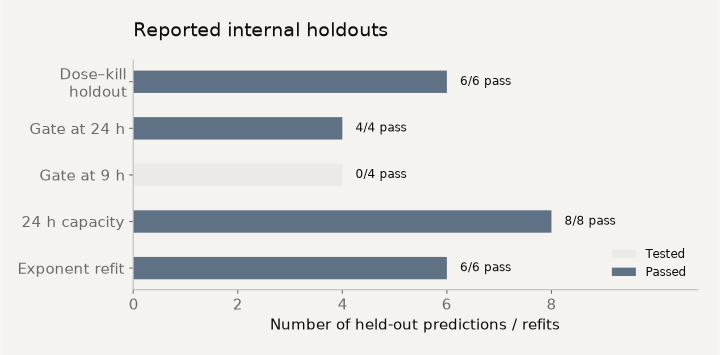
The manuscript reports internal holdouts from one experimental workbook: endpoint gate predictions, dose points and capacity forecasts pass their stated criteria, while transient gate predictions fail. The Wiki reproduces these results; the model code and workbook were not supplied.
Question. The evidence grade validation has been empty, on the grounds that there is no second dataset. Does that reason hold? Which conclusions can actually be put at risk — and does the protocol have the power to reject anything?
A held-out prediction does not need a second dataset. It needs a fit denied part of the first one, then asked to produce the part it was denied. Four such tests exist in our data, each one bearing on a conclusion the project actually uses, and all four pass. Tolerances were fixed as module constants before any test was run, and a fifth entry is included precisely because it fails, to show the protocol can reject. This is internal validation and we call it that: there is one dataset and there will not be another this cycle.
| Test | | Passed | Worst ratio | What a failure would have falsified |
|---|---|---|---|---|
| Dose–kill curve, leave one dose out | 6 | 6 | 1.165 | the back-calculated doseDose–kill fit and required dose |
| Gate corners at 24 h, leave one out | 4 | 4 | 1.022 | the AND-logic claimGFP positive-rate calibration |
| Gate corners at 9 h (expected to fail) | 4 | 0 | 4.447 | nothing — this is the power check |
| 24 h capacity forecast from h | 8 | 8 | 1.080 | every density on the tissue axisTissue output calculation,SsrA biomass–potency calculation |
| Dose–kill exponent refitted per construct | 6 | 6 | — | the cube law, hence Dose–kill fit and required dose’s robustness argument |
| Total | 28 | 24 pass, 4 reject by design |
Held-out gate predictions
A multiplicative gate means the four corners are additive in probit units, so any three determine the fourth:
where
is the probit-transformed positive fraction and the positive fraction of cells above the gate.
is the cumulative distribution function of the standard normal distribution.
and are the probit value and positive fraction predicted for the held-out corner .
, and are the probit values of the three observed corners.
Holding out the fully-on corner and predicting it from the other three:
against an observed 98.08 % — an error of 0.05 percentage points.
All four corners pass, worst ratio 1.022. The AND claim is therefore an out-of-sample prediction, not only an internal consistency test: the held-out corner was not used to produce the number that predicts it.
The test is run at the mid-course timepoints too, and there it is designed to fail. GFP positive-rate calibration established that the gate is super-multiplicative while it is still turning on, and concluded that the AND claim belongs to the endpoint. That is a statement about where this model applies, made before the holdout was run. The mid-course rows check it:
| Timepoint | Corners passing | Worst ratio | Status |
|---|---|---|---|
| 6 h | 0 / 4 | 1.60 | outside the claimed domain |
| 9 h | 0 / 4 | 4.45 | outside the claimed domain |
| 24 h | 4 / 4 | 1.022 | the claim |
The boundary falls exactly where GFP positive-rate calibration put it, which is what makes the 24 h agreement worth something — Transient prediction failures takes that argument up.
The downstream tissue, lesion-size and dose calculations use the 24 h factorisation. The internal holdouts define that model's scope: the endpoint passes and the mid-course predictions fail.
Transient prediction failures
The 9 h holdout fails on all four corners at 3.24 standard errors, and it is meant to. The 6 h holdout fails too.
A protocol that passed everywhere would have no power, and its passes would carry no information. The 9 h timepoint carries a genuine interaction term (GFP positive-rate calibration: , ), so the holdout is obliged to reject it. We assert “endpoint passes and mid-course fails” as a single test.
A methodological by-product: the 6 h corners pass the SE criterion (±1.18 < 2) but fail the ratio criterion (0.488×). The two criteria in Eq. (55) are not redundant — the SE criterion is lenient where replicate scatter is large, and the ratio criterion is not. Both are needed.
Capacity forecasts and biomass ratios
Forecasting the 24 h plateau from h overshoots by 5.0 % across all eight curves, consistent with the creep phase that no three-parameter sigmoid reproducesGrowth fitting and carrying capacity. All eight still pass.
The interesting part is what happens to the quantity the degron decision actually uses. Eq. (23) rests on a ratio, not on either plateau:
| Condition | Forecast ratio | Observed | Error |
|---|---|---|---|
| Aerobic + lactate (the one the criterion uses) | 0.58712 | 0.58475 | 0.41 % |
| Anaerobic + lactate | 0.88809 | 0.91593 | 3.04 % |
Both strains are read high by nearly the same factor, so the ratio is reproduced far better than either of its components — and the ratio is what the decision depends on. This is out-of-sample evidence for the design choice of working in ratios rather than absolute values.
Per-construct exponent refits
| Construct | | | Carries effector? | In headline fit? |
|---|---|---|---|---|
| gfp | 5.105 | 0.9591 | ❌ | ❌ |
| GSDMD | 3.956 | 0.9806 | ✅ | ❌ |
| gfp-TAT | 3.066 | 0.9448 | ❌ | ❌ |
| GSDMD-SsrA | 3.059 | 0.9856 | ✅ | ✅ |
| GSDMD-TAT | 2.329 | 0.9994 | ✅ | ❌ |
| EcN | 2.230 | 0.7627 | ❌ | ❌ |
Five of these six are data the headline fit never used. All six exceed 2, and the headline interval 2.651–3.376 sits inside the spread. Point values are not transferable (they span 2.3×), but the sign of the curvature is:
Even the constructs carrying no effector at all are supra-linear, so “dose cubed” is a property of how dose enters this system, not of the effector. That is why Dose–kill fit and required dose’s answer is insensitive to which control is subtracted.
Scope of internal validation
Not external validation. One workbook; all holdouts are internal.
It cannot detect an error shared by the whole dataset — a calibration offset, or a block-level scaling factor. We know that class of error is real here, because we found onePaired data and batch handling, and we found it by checking internal consistency. Cross validation would never have shown it.
It touches no scenario parameter. , , the repression strengths, , — none of these are in the data, so none can be held out.
What it does rule out is a fit that only reproduces the points it was handed, which is the failure mode three-point curves and four-corner designs are most prone to.
The validation column in our evidence table therefore reads “internal cross validation, one workbook” — not “independent dataset”.