The Challenge: Killing Cancer Cells Without Losing Control
Colorectal cancer (CRC) remains a major global health challenge, with approximately 1.93 million new cases and 904,000 deaths worldwide each year [1]. Although chemotherapy, targeted therapies and immunotherapy have expanded treatment options, effective tumor-cell elimination can still be limited by insufficient selectivity, toxicity to healthy tissues and treatment-related inflammatory effects. These limitations share a common underlying tension: the trade-off between potency and control. Increasing the potency of a therapeutic agent does not necessarily make it safer or more effective [2]; dose escalation is often constrained by off-target toxicity, and systemic activity can trigger unwanted inflammatory effects. The more fundamental question is therefore how to restrict a therapeutic’s activity to the intended biological context.
Our project addresses three connected challenges: promoting selective tumor-cell killing, exploring whether anti-tumor immune stimulation can be beneficial, and reducing the risk of unwanted tissue damage or excessive inflammation. These goals cannot be considered independently. A highly cytotoxic molecule may damage normal cells if its production or action is insufficiently controlled, while inflammatory cell death may carry both therapeutic potential and safety implications [3]. Each of these goals can be pursued only in balance with the other two. Safety is therefore not an add-on to potency; it is a design constraint on when, where and how the effector is produced.
We therefore asked a central engineering question: can a living therapeutic system integrate multiple tumor-associated signals to regulate when a potent membrane-disrupting effector is expressed, while preserving a route toward more selective tumor-cell killing? This question frames our design philosophy: rather than relying on a single tumor marker or constitutive effector expression, we aim to build a multi-input regulatory circuit that favors activation only where relevant conditions coincide.
Our Inspiration: Engineering Bacteria for Cancer Therapy
Solid tumors can develop microenvironments that differ from surrounding healthy tissues. Hypoxia and altered metabolism, including elevated lactate, are common features of many tumors. Certain bacteria can also persist or accumulate in tumor-associated environments [4]. Together, these observations suggested that bacteria could be engineered as programmable platforms for localized therapeutic delivery.
Among the bacterial chassis explored in this field, Escherichia coli Nissle 1917 (EcN) has been particularly instructive. Previous work has examined its potential as a platform for regulatory circuits and therapeutic expression modules [5]. This literature suggested that EcN could offer a practical chassis for tumor-localized expression, while also making clear that colonization alone does not guarantee tumor-specific targeting or safety after genetic modification [6].
The colorectal environment makes this distinction especially important. Hypoxia can occur in non-tumor intestinal settings, lactate is not exclusive to cancer [7], and bacterial population density alone is not a direct indicator of tumor location. Instead of treating any one characteristic as a definitive tumor marker, we were inspired to combine complementary signals into a coordinated expression system — a shift that moved us from inspiration to circuit design.
This idea drew further architectural inspiration from bacterial quorum-sensing systems such as the LuxI/LuxR pair. In their native form, these systems use a diffusible acyl-homoserine lactone (AHL) as a shared signaling intermediate: one enzyme produces the signal, a second receptor responds to it, and gene expression emerges only when the two are co-expressed and the signal accumulates. We recognized in this architecture a blueprint for a multi-input logic gate: two independent environmental sensors could feed into a shared activator, so that effector expression requires the coincidence of conditions rather than the presence of any one signal.
Our Solution: FLAME
FLAME (Functional Layered Anti-tumor Microbial Executor) is our proposed EcN-based living therapeutic platform. Its central feature is a genetic circuit that links multi-input environmental sensing to the expression of GSDMD-N, the pore-forming N-terminal fragment of gasdermin D.
Following this logic, the regulatory circuit brings together three connected features: a hypoxia-responsive FNR promoter controls the expression of LuxI; a lactate-responsive lldPRD promoter controls the expression of LuxR; and the LuxI-generated signaling molecule AHL cooperates with LuxR to activate pLux, which controls the expression of GSDMD-N. AHL accumulation also depends on the local bacterial population and signaling environment. Consequently, the system is designed to favor expression when relevant conditions coincide, rather than when a single signal is present.
Downstream of this circuit, GSDMD-N provides a potential mechanism for membrane disruption and tumor-cell killing. We also explored different effector tags to examine how delivery and protein stability might influence activity. In particular, the project compared the parent GSDMD-N design, a TAT-fused alternative intended to improve cellular entry, and a SsrA-tagged design associated with regulated protein persistence.
In 4 h co-cultures, GSDMD-N-TAT showed the strongest CT26 cytotoxicity among the tested constructs. At 10 OD, both untagged and TAT constructs also caused more L929 cytotoxicity than GSDMD-N-SsrA. This indicates a potency–toxicity trade-off under the tested in vitro conditions, not demonstrated tumor-specific targeting. PI positivity indicates membrane damage but does not establish pyroptosis. See Wet Lab Results.
FLAME: overall mechanism
Environmental cues, GSDMD-N expression and proposed downstream action.
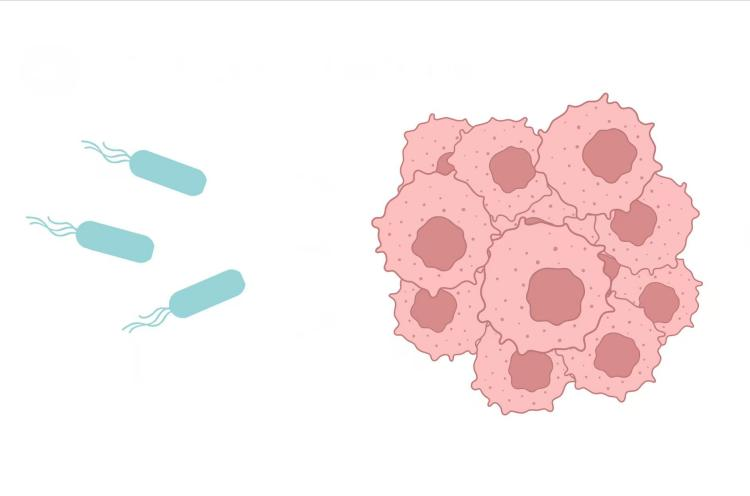
Engineered bacteria approach the tumor-cell cluster.
Read mechanism steps
- Bacteria approach. Engineered bacteria approach the tumor-cell cluster.
- Bacteria in the cluster. Bacteria are shown within the tumor-cell cluster.
- Lactate. The surrounding lactate signal is introduced.
- Low oxygen. The diagram adds the low-oxygen cue.
- AHL accumulation. Additional bacteria and the AHL accumulation cue appear.
- Inside a bacterium. The inset enlarges a bacterium and its genetic material.
- GSDMD-N expression. Red GSDMD-N proteins appear inside the bacterium.
- Bacterial membrane detail. The view enlarges the bacterium and membrane-associated structures.
- Extracellular GSDMD-N. GSDMD-N is shown outside the bacterium in the proposed design.
- Target membrane detail. The inset switches to a target membrane approached by GSDMD-N.
- Membrane association. The red N-terminal domains associate with the membrane.
- Pore assembly. The membrane-bound domains assemble into the pore shown in the source diagram.
- Membrane permeabilization. Particles pass through the assembled pore.
- Potential immune involvement. The source diagram introduces dendritic cells, T cells and macrophages.
- Proposed downstream outcome. The final design schematic shows a fragmented tumor-cell cluster with bacteria and immune cells.
Source keyframes 15
Therapeutic Goals and Future Potential
FLAME is built around the relationship between conditional expression, tumor-cell targeting and biological control. The first objective is to reduce unnecessary effector production outside environments enriched in the relevant signals. The second is to investigate whether the membrane characteristics of tumor cells, including increased outer-leaflet phosphatidylserine (PS) exposure in some cancers, can contribute to preferential susceptibility to extracellular GSDMD-N. This PS-associated selectivity is a design hypothesis, not a demonstrated targeting mechanism.
A further motivation is the potential immunological consequence of gasdermin-mediated membrane damage. GSDMD-N is associated with pyroptotic cell death, which can release intracellular signals and potentially influence local immune responses. However, the present project does not establish that the observed cancer-cell killing is specifically pyroptosis, nor does it demonstrate anti-tumor immune activation or protection against cytokine storm. These remain important questions for future work.
Our proof-of-concept work therefore focuses on tractable milestones: constructing the regulatory system, characterizing its response to environmental conditions, and comparing the cytotoxic effects of different GSDMD-N configurations. Together, these steps establish a foundation for evaluating FLAME as a controllable bacterial therapeutic platform rather than a completed or clinically validated treatment.
Human Practices: Connecting FLAME with People and Context
Throughout FLAME, our Human Practices work has connected research on an engineered bacterial approach to colorectal cancer with the people it may one day affect. Through clinical discussion, community visits, education, and public engagement, we explored both the needs our project aims to address and the questions people ask about unfamiliar technologies.
In Integrated Human Practices, we spoke with a clinician, visited older patients with colon cancer, and collected students’ perspectives through questionnaires. These encounters brought treatment needs, safety concerns, evidence expectations, and everyday circumstances into our team discussions. They helped us reconsider how we evaluate and explain FLAME, including its controllability, effects on non-tumor cells, and the distinction between preliminary findings and therapeutic potential.
In Education, we developed activities for different ages and levels of scientific knowledge:
- For primary-school children, storytelling and building blocks introduced biological functions and encouraged students to construct and explain their own models.
- For secondary-school students, cancer and synthetic biology talks, campus and laboratory visits, and classroom questions connected scientific concepts with research. Reflecting on limited interaction during our first high-school session, we placed greater emphasis on participation and reasoning in later activities.
- For university students, a freshman idea wall and the BIO FUTURE exhibition invited creative proposals, exploration of applications, and discussion of the conditions under which technologies might be accepted.
- For older community members, health conversations, practical support, and blood-pressure measurements with community doctors reminded us to respect people’s immediate concerns and willingness to engage.

Together, these experiences taught us to listen more carefully, adapt how we communicate, and keep our research connected to the people and circumstances it seeks to serve. Explore the full Integrated Human Practices record and Education activities.
Modelling: What the Numbers Changed in the Design
The architecture described above is designed for preferential activation rather than tumour-exclusive expression. That design choice raises a question the architecture alone cannot answer: at which anatomical sites, and under which conditions, does preferential become sufficient? We therefore built a quantitative model of the circuit and of the environments it would meet, calibrated on the 391 measurements this cycle's wet lab produced. Four of its results changed the design rather than illustrating it.
Signal integration behaves multiplicatively at the endpoint, but not before it. The interaction between the hypoxia-associated and lactate-associated arms is zero within error at 24 h, and the factorised description predicts a held-out input combination to within 2.2 %. At 6 and 9 h the same prediction is wrong by up to 4.4-fold. We therefore treat the circuit as a product of its two inputs only at the endpoint, and do not quote mid-course on/off ratios anywhere in this project.
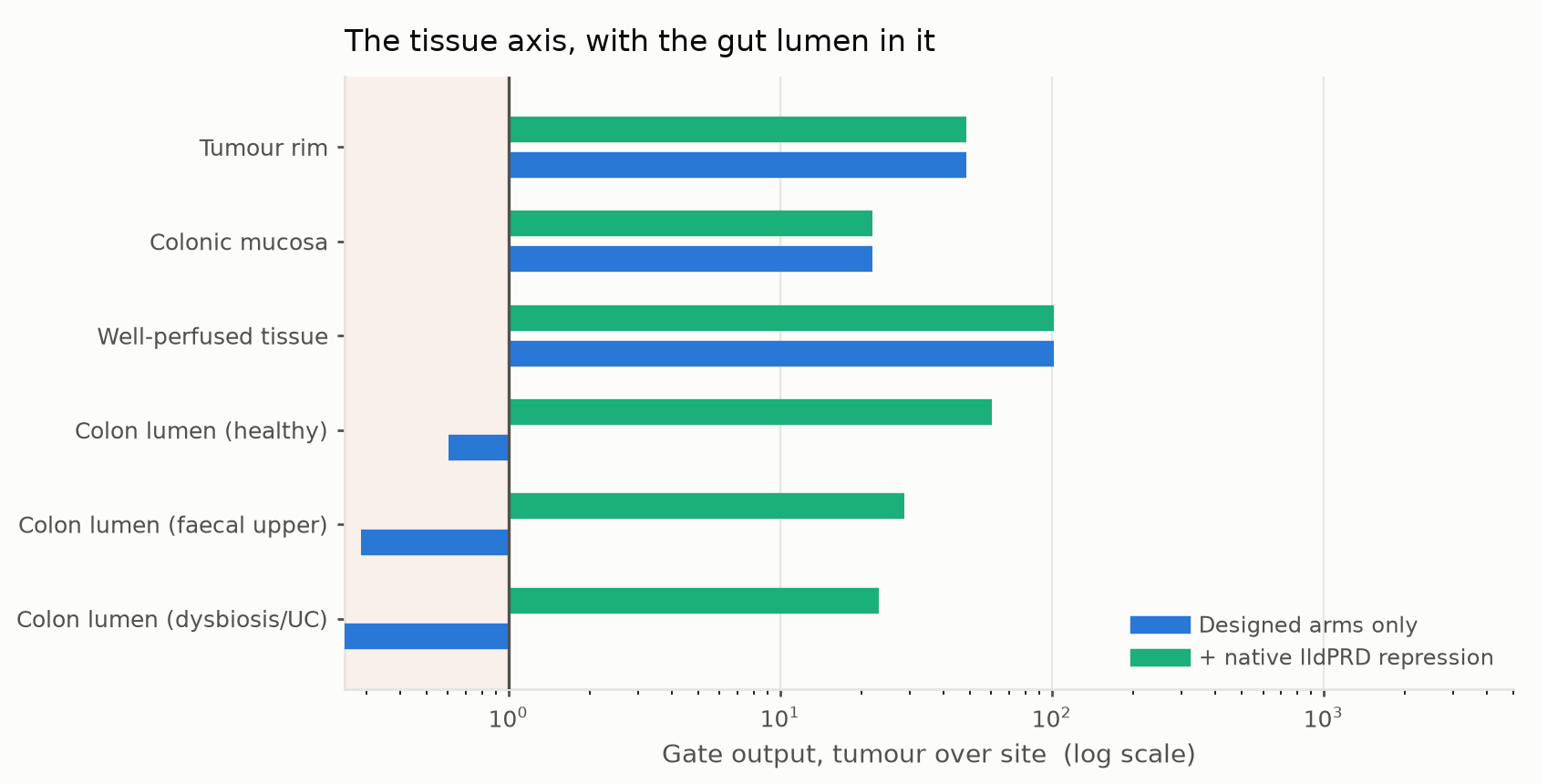
The tightest safety margin is at the colonic mucosa, not in the tissue next to a tumour. Comparing gate output across tissue sites (Fig. 2), the mucosa sits 21.85-fold below the tumour, closer than any other site on the axis. The gut lumen stays off, but only because the native lldPRD promoter is additionally repressed by glucose and by anoxia [7]; on the engineered inputs alone, every luminal site we examined falls below the tumour-equivalent level (Fig. 2).
That result argues against an apparently obvious improvement. Replacing the native lactate promoter with a de-repressed, higher-dynamic-range variant would raise reporter output, but it collapses luminal discrimination from 87–228-fold to 0.87–2.28-fold. We kept the native, lower-performing promoter deliberately, and record this as a design decision taken on quantitative grounds.
There is a lesion size below which the hypoxia-associated arm cannot contribute at all: approximately 178 µm in radius. This follows from oxygen diffusion geometry and contains no fitted parameters, and it falls inside the 160–200 µm range measured histologically by Thomlinson and Gray [8], which makes it the one quantity here that an independent measurement corroborates.
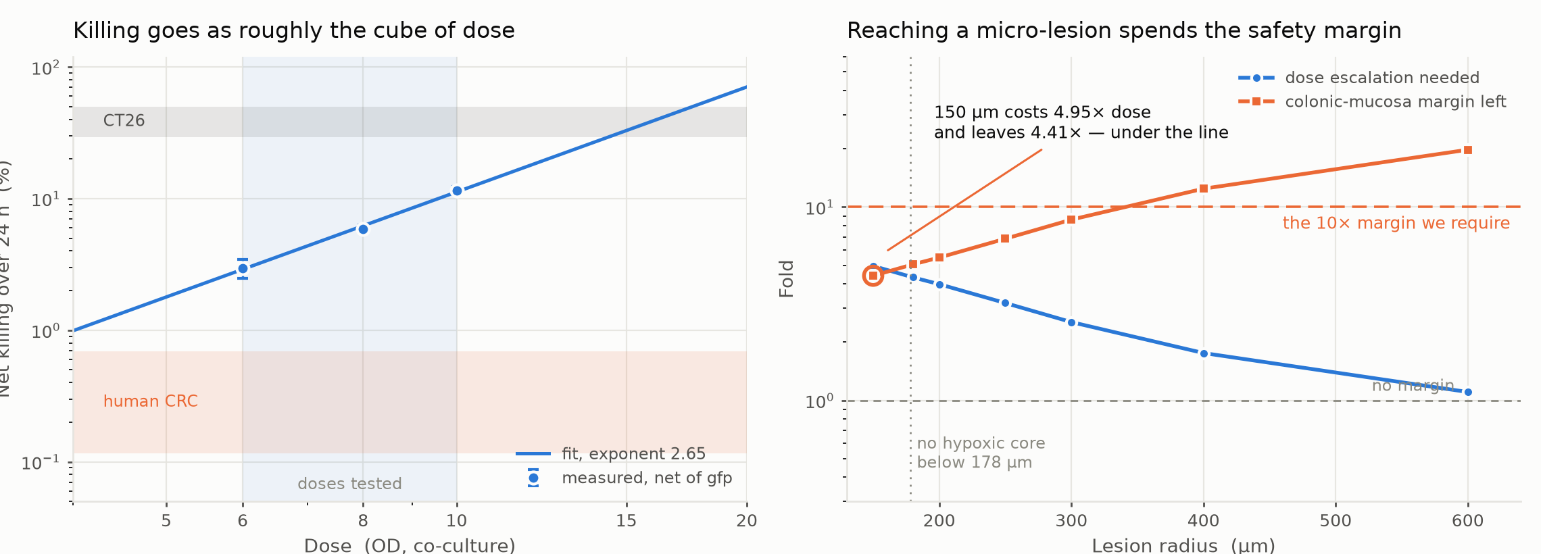
The same framework was used to ask what dose a therapeutic effect would require. Net killing in co-culture scales as roughly the cube of dose, with a fitted exponent of 2.65 (Fig. 3). On that relation, the effect size reported for the human indication is reached below the lowest dose we tested, while the CT26 benchmark requires 1.3–1.8 times the highest. The binding constraint is not potency but what escalation costs: reaching a 150 µm micro-lesion would require 4.95 times the dose and would leave only 4.41-fold of the mucosal margin, below the 10-fold we set as a working requirement. Micrometastatic disease is therefore not a dose problem, and would need to be addressed by another route.
These analyses are computational and are calibrated on in vitro data; they include no animal work, and several inputs are stated as intervals or declared assumptions rather than measurements. The equations, parameter provenance, worked substitutions and out-of-sample tests are given on the Model page, where each assumption is marked at the point it is used.
References
[1] Bray F, Laversanne M, Sung H, et al. Global cancer statistics 2022: GLOBOCAN estimates of incidence and mortality worldwide for 36 cancers in 185 countries. CA: A Cancer Journal for Clinicians, 2024, 74(3): 229–263. DOI: 10.3322/caac.21834. View source ↗
[2] Xie H, Deng X, Li Q. The role of pyroptosis in colorectal cancer: from mechanisms to therapeutic opportunities. Cancer Management and Research, 2025, 17: 3115–3128. DOI: 10.2147/CMAR.S572874. View source ↗
[3] Xiao C, Oyang L, Jiang X, et al. Targeting cell death: a promising approach for colorectal cancer therapy. Cancer Cell International, 2026, 26(1): 199. DOI: 10.1186/s12935-026-04261-y. View source ↗
[4] Hadid MA, Shaikhli NHA, Suhail OK, Hameed ST, Challoob MA. Synthetic biology of oncolytic bacteria: comparative microbial chassis and precise killing strategies. Toxicology Reports, 2026, 17: 102292. DOI: 10.1016/j.toxrep.2026.102292. View source ↗
[5] Wang C, Luo L, Wang J. Construction of probiotic Escherichia coli Nissle 1917 as a next-generation expression platform and its application in therapeutic protein production. Journal of Biological Engineering, 2026, 20: 18. DOI: 10.1186/s13036-025-00608-7. View source ↗
[6] Radford GA, et al. Towards understanding tumour colonisation by probiotic bacterium Escherichia coli Nissle 1917. Cancers, 2024, 16(17): 2971. DOI: 10.3390/cancers16172971. View source ↗
[7] Zúñiga A, Camacho M, Chang H-J, Fristot E, Mayonove P, Hani E-H, Bonnet J. An engineered lactate-responding promoter system operating in glucose-rich and anaerobic environments. ACS Synthetic Biology, 2021, 10(12): 3527–3536. DOI: 10.1021/acssynbio.1c00456. View source ↗
[8] Thomlinson RH, Gray LH. The histological structure of some human lung cancers and the possible implications for radiotherapy. British Journal of Cancer, 1955, 9(4): 539–549. DOI: 10.1038/bjc.1955.55. View source ↗