Book learning is no substitute for hands-on experience.
As we develop an experimental platform for colorectal cancer treatment, one question guides FLAME: how can the functions we hope to engineer address concerns that matter to people?
We sought direction in the disease context and relevant research, then brought the project into conversations with a clinician, students and people in the community. These experiences shaped our research questions, evidence requirements and communication. This page records what we asked, what we heard, what we changed and what remains unresolved.
LIMITATIONFLAME is an in vitro proof of concept. Tumor-specific localization, in vivo activation, anti-tumor immunity and systemic safety have not been established; no animal efficacy study is presented.Our approach
Connect — Listen — Reflect — Integrate — Return. Human Practices is a repeated cycle rather than a one-way path from interview to publicity. Each activity asks why we engaged, what we heard, how the team responded and what evidence can be checked.
Social needs and project origins
Challenges that persist despite treatment advances
The World Health Organization estimates that approximately 1.9 million new colorectal cancer cases and more than 900,000 deaths occurred worldwide in 2022 ((WHO, 2026)). Treatment choices depend on disease stage, lesion distribution, molecular characteristics and overall health. Surgery and systemic treatments are important options, while recurrence, metastasis and the burden of ongoing treatment remain challenges ((National Cancer Institute, 2026)).
Immunotherapy also depends on tumor biology. Checkpoint therapies can benefit people with MSI-H or dMMR colorectal cancer ((U.S. Food and Drug Administration, 2025); (Le et al., 2015)), while many MSS or pMMR tumors respond less well to checkpoint inhibitor monotherapy. We therefore focus on specific settings of limited immune responsiveness rather than treating all colorectal cancers as the same.
As a US regulatory example, the FDA's 2025 approval of nivolumab with ipilimumab applies to a specific MSI-H or dMMR colorectal-cancer population; this example does not describe approval status in China ((U.S. Food and Drug Administration, 2025)).
Turning disease challenges into research questions
This context led us to ask whether a delivery strategy associated with the intestinal environment could produce an effect under suitable conditions, while enabling further investigation of the relationship between tumor-cell death and immune responses. A proposed treatment ultimately concerns real people: clinicians need appropriate evidence, patients have treatment experiences and priorities, and the public needs enough information to understand an unfamiliar technology.
Research inspiration and scope
Learning from microbial delivery and cell-death research
Published work has reported enrichment of Escherichia coli Nissle 1917 in human colorectal tumor tissue and therapeutic potential of specific engineered strains in mice ((Gurbatri et al., 2024)). These findings drew our attention to microbes as possible local delivery platforms, while reminding us that bacterial presence, payload activity and eventual benefit require separate evidence. Research on gasdermins also encouraged us to explore links between cell death and antitumor immunity ((Wang et al., 2020)), but the chassis, constructs and operating conditions used by FLAME still require evidence from our own studies.
Our technical approach and research scope
FLAME uses EcN as its chassis and combines hypoxia sensing, lactate sensing and quorum sensing to explore control of GSDMD-N expression and delivery. We aim to make effector activity more likely under suitable conditions and investigate its effects on tumor cells. The site of action, activation conditions, payload release, cellular effects and safety are all research questions.
We therefore took three questions beyond the laboratory: which treatment needs could this approach address; which risks and evidence deserve priority in our explanations; and is the information we consider valuable also what people want to know?
Stakeholders and engagement
Understanding a proposed treatment requires perspectives beyond those of its researchers. Clinical discussion helps us review scope and evidence; community visits help us understand everyday circumstances; and school and campus activities reveal information needs and conditions for acceptance. These inputs complement one another and are not interchangeable.
- Completed engagement
- Ongoing
- Next phase — planned, not yet held
Arrows point towards FLAME to show how engagement informs project discussions. The map does not imply that every stakeholder group has been covered or that each input has already changed the project. Solid lines indicate completed activities, orange lines ongoing work, and dashed lines planned engagement.
People affected by colorectal cancer
People living with colorectal cancer and their families. Their circumstances, priorities, information needs and willingness to engage must be understood directly and respectfully.
Clinical and community care
Clinicians, community nurses and endoscopy services. Treatment context, patient pathways, evidence needs, safety and follow-up.
Research, translation and governance
Researchers, biosafety and regulatory professionals, ethics reviewers, and potential manufacturing and quality-control partners.
Students and the wider public
Students and teachers of different ages, campus visitors and the public. Their questions can help us improve explanations and understand conditions people consider important for using new technologies.
This is a living map. We update the status of each connection as activities progress and record which project discussions each stakeholder group influences.
Engagements
The source manuscript documents 7 completed activities, presented from the clinical discussion through the high-school visit, primary-school workshop, community visits, freshman activity, middle-school lesson and BIO FUTURE exhibition. A separate community-nursing and patient-follow-up discussion remains ongoing; its findings are pending review and are not counted among the completed activities.
Connecting the research proposal with clinical questions
Why we connected
We wanted to understand which challenges in colorectal cancer treatment merit further research and what evidence a new approach would need before it could move closer to practical use.
What we heard
We discussed limitations in advanced, recurrent and metastatic disease, differences in responses to immunotherapy, and how tumor-cell death might relate to an immune response. The conversation also raised the possible role and safety of engineered bacteria, patient acceptance, and the evidence required for clinical translation. These questions helped us ask which treatment need FLAME might address and under what conditions.
Reflection
A promising mechanism is not yet a testable research objective. We need to specify where the system is intended to act, how its regulation and cellular effects will be evaluated, what controls are needed, and which conclusions require additional evidence.
Team reflection and response
- Evaluate circuit responses separately from effector activity and cellular effects.
- Include non-tumor cells in comparisons and interpret those results as preliminary safety information, not evidence of overall safety.
- Distinguish evidence for membrane damage, a specific cell-death mechanism, and functional antitumor immunity.
- Describe FLAME as an early research platform; oral delivery and possible clinical use remain unvalidated.
Evidence
The discussion informed the team's evaluation questions and evidence boundaries. The interview record, confirmed participant details and any quotations or photographs for publication still require review and permission.
High-school questionnaires on risk and evidence
Why we connected
We wanted to understand what young participants needed to know before forming a view about a proposed oral therapy using genetically modified bacteria, and which risks or evidence they considered important.
What we heard
Before the lecture, 26 of 38 responses (68.4%) said they needed more information before deciding whether to accept the proposed therapy. On a separate risk question, 21 responses identified unpredictable bacterial behavior and 13 identified spread to normal tissues causing infection. The pre-lecture charts also record students' views of treatment burden, including pain, uncertainty and financial pressure. After the lecture, 19 responses prioritized a comparison with conventional chemotherapy, while 11 prioritized real patients' views or cases. Written comments also asked about clinical data, actual effects, costs and responses in the human body.
Methodological boundary. Each multiple-choice item summarized here had 38 responses. The pre- and post-lecture questionnaires asked different questions, and only aggregate results were retained. They describe this group’s information needs and concerns; they cannot show individual learning gains or clinical acceptance, and they do not represent patients’ own treatment priorities.
Reflection
The responses showed us that explaining an intended mechanism is not enough. Readers also need to see the evidence behind a proposal, what remains unknown and how far it has been evaluated. We also recognized that questionnaires left too little room for students to explain their reasoning or ask questions during the session.
Team reflection and response
- Separate published findings, FLAME's own preliminary observations, design hypotheses and future validation needs in our explanations.
- State that oral delivery alone does not establish lower treatment burden or better efficacy, and that sensing design cannot substitute for safety evidence.
- Use more hands-on activities, open questions and independent comments in later engagement, while retaining the questionnaire findings as group-level feedback.
Evidence
Aggregate pre- and post-lecture questionnaire summaries are shown in Figures 3 and 4. The original item wording and source sheets are identified in the project record. Individual responses and identifiable participant images are not published here.
“I Am a Little Synthetic Biologist” for primary-school students
Why we connected
We wanted children to approach synthetic biology through something they could build and explain, while giving them room to express their own ideas about how different functions might work together.
What we heard
Pupils combined building blocks representing roles such as target recognition, information processing, action, repair and signaling. They created designs and presented their work, making their choices visible and giving us an opportunity to discuss the models with them.
Reflection
Questionnaires alone cannot explain how participants think. A hands-on activity can create opportunities for participants to make choices, explain a model and raise questions in their own words.
Team reflection and response
- Use building blocks and student explanations as participatory formats alongside questionnaires.
- Develop age-appropriate explanations around observable examples and one concept at a time.
Evidence
The activity format is described on the Education page. Anonymized student work, teacher feedback and any photographs require appropriate permissions before publication.
Summer community visits and listening to patients
Why we connected
We wanted to connect the project with people's everyday circumstances and consider whether a new treatment approach was a subject they wished to discuss during a community visit.
What we heard
We offered practical help, shared information about healthy living, and worked with community doctors to measure blood pressure. When we introduced new treatment approaches, the older participants showed limited interest. This observation describes those conversations; it does not establish why participants responded that way, and limited interest should not be interpreted as refusal of treatment.
Reflection
A technology's novelty to researchers does not make it the subject someone most wants to discuss. Language, relevance to current concerns and the opportunity to speak may all shape an encounter, so we should not attribute the response to age, understanding or treatment experience on the basis of this visit alone.
Team reflection and response
- Treat practical support, health services and patient listening as meaningful engagement in their own right.
- Begin future conversations by understanding what participants want to discuss and whether they wish to hear more about research.
- Continue asking clearer questions about patients' concerns and information needs before drawing conclusions about acceptability.
Boundaries and protection
- Do not generalize a small number of conversations to all patients or families.
- Respect each person's choice about whether and how much to participate.
- Do not publish identifying details or quotations without appropriate permission.
Evidence
The visit and the team's reflection are documented in the activity account. Further work is needed to understand patient concerns and information needs through clearer questions and continued listening.
Freshman welcome activity: letting students set the question
Why we connected
We invited students to begin with an everyday problem they cared about and consider what new ability they might give an organism through synthetic biology.
What we heard
The manuscript records examples such as making plants glow and using engineered bacteria to address environmental pollution. These are examples from the collected notes, not coded or ranked themes; the original responses still need to be organized while preserving their meanings.
Reflection
An open question can reveal more than a list of proposed applications: it can point to the everyday needs behind participants' ideas.
Team reflection and response
- Provide an open-ended way for participants to choose the problem and application they want to discuss.
- Organize the original notes while preserving participants' meanings, then use the themes to guide future lessons and exhibitions.
Evidence
Sticky-note responses were collected. Their analysis and any resulting revisions to educational materials remain to be documented.
Middle-school talk with questions throughout the lesson
Why we connected
Building on our reflection that talks need room for students to express their reasoning, we used questions throughout a lesson on cancer, treatment and FLAME's research approach.
What we heard
Students took part in questions and discussion. Short questions offered a quick way to join in, while open prompts invited different ideas and explanations. The lesson asked students to consider why a proposed research idea would need more evidence than protein release alone.
Reflection
Participation is not only a raised hand or a quick answer. The reasons behind a response can help us understand how students are thinking.
Team reflection and response
- Add open questions and opportunities to explain “why” within the lesson, building on the limits we recognized in the high-school questionnaire format.
- Record students' explanations as well as participation when evaluating future classroom activities.
Evidence
The lesson format and participation activities are described on the Education page. Specific question-and-answer records and any resulting material revisions remain to be organized.
BIO FUTURE exhibition: participation across different backgrounds
Why we connected
We wanted visitors with different starting knowledge to find an entry point and to have opportunities to express their own views about synthetic biology and conditions for using new technologies.
What we heard
Four stations introduced synthetic biology; applications in medicine, food and the environment with their risks; conditions for acceptance; and open feedback. For the engineered-bacteria scenario, team prompts included site of action, controllability, clearance and safety assessment. These were questions posed by the team; visitor comments have not yet been organized as findings.
Reflection
People with similar ages or campus settings can have very different prior knowledge. Offering different levels of detail and choices about how to participate can make an exhibition more accessible.
Team reflection and response
- Organize the exhibition around multiple entry points, from basic concepts to applications and conditions for acceptance.
- Treat the boards' safety and acceptance examples as prompts, not as evidence of what visitors themselves believe.
- Organize actual visitor comments before using them to revise future materials.
Evidence
The four exhibition boards and their prompts are documented. Actual visitor feedback, recurring questions and any changes made in response remain to be organized separately.
Understanding endoscopy and community follow-up pathways
Why we connected
Community nursing and endoscopy services connect screening, preparation, health education, post-procedure instructions and follow-up. We are learning how these care pathways work and which practical concerns should inform our research questions and communication.
What we heard
The activity and patient follow-up records are still being reviewed. We have not yet drawn conclusions from them.
Reflection
Our understanding of patient pathways and community monitoring remains incomplete. We will distinguish direct observations from questions that still need discussion.
Team reflection and response
Nothing yet — the engagement is still in progress. Conclusions must not be entered in advance.
Boundaries and protection
- Do not diagnose, recommend medication, provide treatment, recruit trial participants or collect unnecessary clinical information.
- Do not interrupt care or create pressure to participate.
- Do not publish patient names, faces, contact details, record numbers, addresses or test results without explicit, revocable written permission.
- Anonymize and confirm any quotation with the participant.
- Report critical views alongside supportive ones and avoid overgeneralization.
Evidence
Pending review of anonymized notes and image permissions, verified insights, any changes to experiments or risk communication, and how revised materials are returned to the nurse or participants.
Feedback in research and communication
Engagement clarified that evaluating FLAME involves operating conditions, effector selection, mechanistic evidence, safety and communication. The matrix below links each input to the question it challenged, the response we made or plan to make, and its current evidence status.
| Stakeholder input | What it challenged | Integration into the project | Status |
|---|---|---|---|
| Clinical questions about treatment needs, safety, acceptance and evidence for translation | A promising design mechanism does not by itself identify a clinical need or establish efficacy, safety or immune benefit | Evaluate regulation and cellular effects separately; include non-tumor cell comparisons; distinguish membrane damage, cell-death mechanisms and immune function | OngoingCurrent experimental comparisons and the evidence boundaries stated across the project pages |
| High-school questionnaire responses about risk, information needs and evidence priorities | Mechanistic explanation alone does not answer questions about clinical evidence, effects, costs or risks | Separate published research, preliminary FLAME observations, design hypotheses and unresolved validation; do not imply oral delivery is more effective or less burdensome | ConductedPre-lecture Questions 1 and 3 and post-lecture Question 4; each summarized item has n = 38 and is analyzed separately |
| Limited interest in new treatment approaches during summer community visits | A research topic that is novel to the team may not be relevant to what a person wants to discuss at that moment | Begin future conversations with everyday concerns, practical support and participants' willingness to engage; continue listening before drawing conclusions about patient needs | OngoingCommunity visit account; further patient-focused conversations and clearer questions are needed |
| Pupils' building-block designs and explanations | Questionnaires alone do not show how participants reason about an idea | Use hands-on models and participant explanations as complementary forms of engagement | ConductedActivity description and student work, subject to appropriate permissions |
| Open questions and feedback opportunities in later school and campus activities | A single lecture format or level of detail does not suit everyone; team prompts are not visitor feedback | Add questions and open discussion within lessons; provide multiple entry points at BIO FUTURE; organize actual comments before revising materials | OngoingLesson plans, four exhibition boards and feedback records still to be organized |
| Community nursing and patient follow-up pathways | The team's understanding of routine care and patient monitoring remains incomplete | Pending — review verified insights before deciding whether they require changes to research questions, risk communication or follow-up assumptions | OngoingAnonymized discussion and follow-up records, with permissions reviewed before publication |
| Biosafety, regulatory, ethics and manufacturing stakeholders | Future feasibility cannot be inferred from in-vitro research alone | Plan discussions on engineered-organism control, environmental release, quality control, approval pathways and manufacturing | Next phaseThese discussions have not yet been documented |
Safety and feasibility
Evaluating the engineered construct throughout development
Choosing a probiotic chassis with a history of research and use does not replace evaluation of the engineered construct. Issues include expression outside intended sites, persistence and clearance, infection and inflammation, genetic stability and environmental spread. Current in-vitro comparisons provide preliminary information on some questions; further investigation under appropriate research conditions remains necessary.
Considering use and evidence quality
The proposed oral route connects administration with the intestinal setting, but delivery efficiency, tumor-associated distribution, effector release and individual variation remain to be tested. Technical novelty alone cannot establish feasibility, and how FLAME might complement existing treatments remains a question for further discussion. Questions about cost, clinical evidence and everyday priorities also shape what future feasibility work should examine; they do not establish affordability or patient preferences.
Priorities for the next stage
We will verify the clinical discussion record, improve our understanding of patients' current concerns, organize first-year student ideas and exhibition comments, and continue examining regulation, delivery, selectivity, mechanisms and immune effects. Completed work, current choices and further validation will remain clearly distinguished.
Education and public engagement
The Education work extended our Human Practices cycle across age groups and settings. We adapted the starting point, learning goal and form of participation to the people in front of us, then used what we observed to change the next activity.
The summary below brings the manuscript's activities into the HP record. It keeps planned examples separate from participant responses and makes the limits of the questionnaire result explicit.
Education across ages
Make room for people to build, ask, choose and explain.
In learning we discover what we lack; in teaching we discover where we struggle.
"If synthetic biology could give an organism a new ability, what problem would you want it to help humanity solve?"
We placed this question on the display board for our freshman welcome activity. Participants did not need to have studied genetic engineering or arrive with a complete research proposal. They could begin with something they cared about in everyday life and write an idea on a sticky note. For FLAME, this question also captures why we undertake science education: to help more people approach synthetic biology and consider how it relates to their lives.
Read the full Education account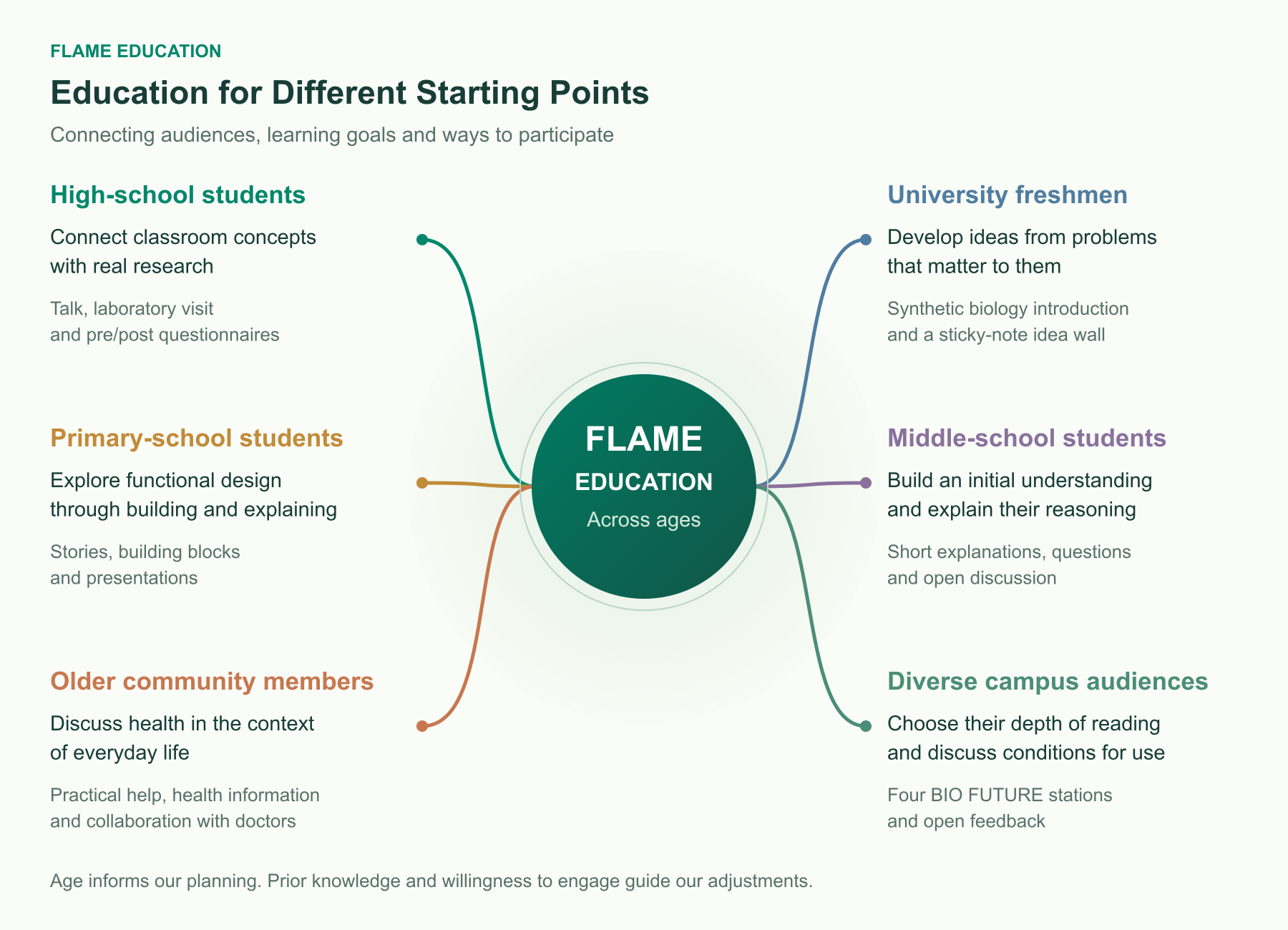
Evidence from the high-school activity
The questions mattered as much as the headline result.
The activity record keeps initial concerns, later openness and remaining uncertainty together. That helped us decide what the next educational activity should make visible.
Starting point
26/38 (68.4%) said they needed more information before deciding about an oral engineered-bacteria therapy.
This records an information need, not rejection of the approach.
Concerns to explain
21/38 selected unpredictable bacterial behaviour as a leading risk, and 13/38 selected spread to normal tissues causing infection.
These are students' perceptions, not patients' own accounts.
What changed next
Later sessions moved beyond answer collection: children built and explained models, middle-school students reasoned through questions, and BIO FUTURE offered different depths of participation.
The activity design changed in response to what the first format could not show.
What we tried and learned
Six activities, one evolving method
Education across ages begins with the question, "Who are we speaking with this time?" Age can help us plan, but people of the same age may have different prior knowledge, interests and ways of expressing themselves. In our lessons and exhibitions, we therefore considered participants' learning stages, existing understanding and willingness to engage.
High-school Campus Visit: Talks and Questionnaires
Our first activity aimed to connect disease knowledge, project ideas and the laboratory, introducing students to the practical work behind a research concept.
Reflection. Looking back at this first activity, we had devoted considerable attention to the lecture content, questionnaires and visit arrangements, while giving less attention to participation during the talk itself. Students mainly expressed their views through the questionnaires. We had included too few opportunities for them to ask questions, discuss ideas or explain their understanding as the lecture progressed.
Open activity recordPrimary-school Workshop: Participation at the Center
After the first activity, we reconsidered students' role in the classroom. In the primary-school workshop, participation became central: children would build models and explain their ideas about functional design.
Reflection. Compared with the first activity's emphasis on a lecture and questionnaires, building blocks gave children more opportunities to choose and express themselves. Their active participation encouraged us to shift attention from how much content we had delivered to what children could do and explain with that content.
Open activity recordSummer Community Visits: Rethinking How to Begin
Building and presenting in the primary-school classroom showed us that active participation could take many forms. During our summer community visits, the audience and circumstances changed. With older patients, respecting their willingness to engage mattered more than reusing an energetic classroom format.
Reflection. When we introduced new treatment approaches, the older participants showed limited interest. Compared with the enthusiastic classroom response, their quieter reaction made us realize that a format that engages one audience does not automatically suit another. We had brought new research concepts, but whether people wanted to listen and saw a connection with their own lives also shaped whether the conversation could continue.
Open activity recordFreshman Welcome: Letting Participants Set the Question
Back on campus, we engaged with students beginning their university studies in pharmacy. We continued to make room for participants' own expression, inviting them to identify problems in everyday life that they would like to approach through biology.
Reflection. Sticky notes made it easier for freshmen to begin expressing themselves and allowed different ideas to be seen together. We came to understand that an open question offers more than a collection of suggestions. Those ideas can also reveal the everyday needs that participants hope science will address.
Open activity recordMiddle-school Talk: Questions Throughout the Lesson
In the later middle-school talk, we translated our early reflections on classroom participation into the lesson itself. Short questions helped students enter the subject, while open questions encouraged them to explain their reasoning.
Reflection. This talk addressed the lack of interaction in our first high-school activity. By placing questions within the explanations, we enabled students to make judgments as they listened. We also recognized that the value of interaction depends on the questions themselves. Quick answers and raised hands can show enthusiasm; the reasons behind an answer help us understand how students are thinking.
Open activity recordBIO FUTURE: Participation for Different Backgrounds
Our activities with particular audiences gradually showed us that participation needed to accommodate differences in prior knowledge as well as age. BIO FUTURE became a further attempt: people with different starting points could choose their depth of reading and find a place to express themselves within the same exhibition.
Reflection. Earlier activities taught us the importance of adapting to age. The campus exhibition took this further: even among people at a similar life stage, familiarity with synthetic biology can differ greatly. The four stations therefore offered entry points through basic concepts, applications and open feedback, rather than expecting the same learning task from every visitor.
Open activity recordWhat changed in our practice
Participation became part of the lesson.
From the talk and questionnaires in our first high-school activity to the primary-school building blocks, community health conversations, freshman sticky notes, middle-school questions and BIO FUTURE exhibition, FLAME continued to adapt its educational approach. Children used models to express functions, secondary-school students tried to explain their reasoning, and university students proposed ideas and discussed technology in society. Community conversations reminded us that science education also needs to remain close to everyday life and respect willingness to engage. Our commitment to education across ages took shape through these practical choices.
We also reconsidered what education asks of us. A complete explanation is only one concern. Where participants begin, whether they can express their own ideas and what still puzzles them are equally important. Greater openness in the high-school questionnaires coexisted with unresolved concerns. Enthusiasm during the primary-school presentations created opportunities for expression. Limited interest in the community led us to reconsider our communication goals. These experiences helped us learn both how to organize knowledge and how to listen.
Evidence boundary. The 94.7% figure describes self-reported attitude change after the talk. The pre- and post-talk questions differed and were not matched at the individual level, so it is not a measure of knowledge gain or clinical acceptance.
What these encounters changed
Clinical discussion sharpened the questions we use to evaluate regulation, cellular effects and evidence. Student responses led us to explain risks, comparisons and uncertainty more directly, then add opportunities to build, ask, explain and choose. Community visits reminded us to begin with people's priorities and willingness to discuss research. These are changes to our research questions and engagement practice, not evidence that FLAME is effective or ready for clinical use.
We thank the physician, community health staff, people living with colorectal cancer, teachers, students and campus visitors who took part in these conversations and activities.
Values and unresolved questions
FLAME currently prioritises five values.
- Safety
- Evaluate the engineered construct, including expression outside intended conditions, bacterial persistence and clearance, infection and inflammation, genetic stability and environmental spread. A probiotic chassis does not remove the need for this assessment.
- Evidence quality
- Distinguish published findings, our own observations and hypotheses. Match each conclusion to the evidence available and state what further validation it requires.
- Informed choice
- Explain intended use, uncertainty and potential risks in language healthcare professionals, patients and the public can assess; respect each person's decision about whether to participate or learn more.
- Respect
- Protect privacy, avoid pressure and do not treat patients' experiences as promotional material. Seek appropriate permission before sharing quotations, photographs or other identifying information.
- Accessibility
- Consider cost, health literacy, practical care pathways and barriers that may affect different groups if future implementation is discussed.
What remains unresolved
- Can the system deliver and release GSDMD-N locally and controllably?
- What evidence would establish the relevant cell-death mechanism and any functional immune effect?
- How should inflammation, effects on normal tissues, colonization, clearance, genetic stability and environmental spread be evaluated?
- Could differences in patients' gut environments affect system performance?
- What do patients and clinicians need to know to assess the proposed approach, and how might routine care pathways support any future administration and monitoring?
- What further evidence is needed to assess accessibility, cost and practical feasibility?
Publishing these questions defines the direction of our next experiments and stakeholder engagement. FLAME remains an early research platform, not an approved medicine or a source of medical advice.
Evidence status on this page
Every substantive statement on this page carries an evidence level. We publish what is validated, what is still running, what is a design hypothesis, and what we have not shown.
References
- Engineering tumor-colonizing E. coli Nissle 1917 for detection and treatment of colorectal neoplasia. Nature Communications (2024) doi:10.1038/s41467-024-44776-4
- PD-1 Blockade in Tumors with Mismatch-Repair Deficiency. New England Journal of Medicine (2015) doi:10.1056/NEJMoa1500596
- Colon Cancer Treatment (PDQ®), Health Professional Version. (2026) https://www.cancer.gov/types/colorectal/hp/colon-treatment-pdq
- Nivolumab with ipilimumab for unresectable or metastatic MSI-H or dMMR colorectal cancer. (2025) https://www.fda.gov/drugs/resources-information-approved-drugs/fda-approves-nivolumab-ipilimumab-unresectable-or-metastatic-msi-h-or-dmmr-colorectal-cancer
- A bioorthogonal system reveals antitumour immune function of pyroptosis. Nature (2020) doi:10.1038/s41586-020-2079-1
- Colorectal cancer. (2026) https://www.who.int/news-room/fact-sheets/detail/colorectal-cancer