Introduction: Every Age Can Begin with a Question
In learning we discover what we lack; in teaching we discover where we struggle.
"If synthetic biology could give an organism a new ability, what problem would you want it to help humanity solve?"
We placed this question on the display board for our freshman welcome activity. Participants did not need to have studied genetic engineering or arrive with a complete research proposal. They could begin with something they cared about in everyday life and write an idea on a sticky note. For FLAME, this question also captures why we undertake science education: to help more people approach synthetic biology and consider how it relates to their lives.
In our research, we explore ways to give engineered probiotics new functions for colorectal cancer treatment. Beyond the laboratory, we face another question: how can we explain why this research matters to people with very different knowledge and experiences? For primary-school children, bacteria may be characters they are only beginning to understand. For secondary-school students, cancer and its treatments are subjects to explore step by step. For university freshmen, biology can become a way to formulate questions of their own. In the community, a patient's everyday circumstances and willingness to talk shape how a conversation should begin.
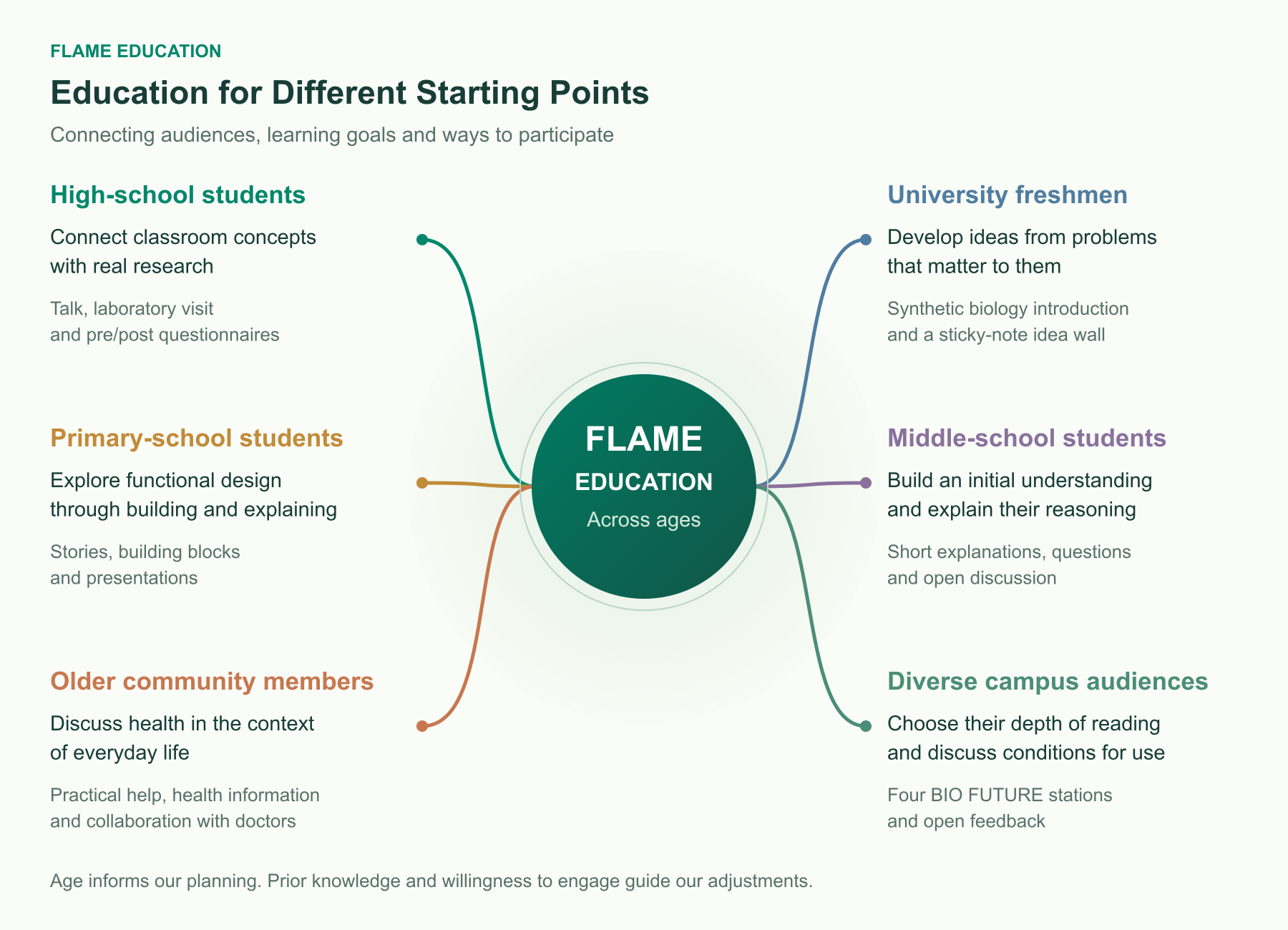
These differences led us to place participants at the starting point of our educational work. We wanted children to explore functional design by combining building blocks, secondary-school students to encounter disease and research through questions and visits, and university students to propose ideas and discuss the conditions for using a technology. For older adults, communication needed to remain close to everyday health concerns. The same scientific subject called for different ways in.
FLAME therefore adopted education across age groups as a direction for our practice, connecting activities in primary schools, middle schools, high schools, universities and older-adult communities. We hoped participants would understand, but also have opportunities to build, ask, choose and express themselves. Education took shape through these concrete opportunities: science could begin with a question in a classroom or an act of care in everyday life.
How We Plan: Participation for Different Starting Points
Education across ages begins with the question, "Who are we speaking with this time?" Age can help us plan, but people of the same age may have different prior knowledge, interests and ways of expressing themselves. In our lessons and exhibitions, we therefore considered participants' learning stages, existing understanding and willingness to engage.
Looking back at our activities, we can describe this approach through four connected questions: Where do participants begin? What next step do we hope the activity will support? Which format helps them express themselves? What materials can help us understand the activity's contribution? These questions connect talks, building blocks, questionnaires and exhibitions, while providing a basis for further adjustments.
Planning Goals Around the Audience
For primary-school children, we introduced the idea of combining functions by turning "design a useful organism" into something they could build and explain. For middle-school students, we focused on an initial understanding of cancer and treatment, using short questions and open discussion to encourage explanations. For high-school students, we connected disease knowledge and research ideas with a real laboratory environment so they could see how research is conducted.
At university, participants could exercise more choice. The freshman sticky-note activity invited ideas based on everyday needs. BIO FUTURE allowed students with different backgrounds to explore concepts, applications and social conditions according to their interests. With older patients in the community, we attended to current health concerns and respected the pace and willingness of each person, grounding communication in everyday care.
 View full size
Making Room for Participants Beyond Listening
Each activity offered a different form of participation. Building blocks allowed children to choose and combine components. Questions gave middle-school students a chance to explain their reasoning. Laboratory visits provided high-school students with concrete things to observe. Sticky notes and exhibition feedback allowed university students to decide what questions to raise. We wanted these elements to support the activity's goals and give participants opportunities to contribute while learning.
BIO FUTURE also extended adaptation from differences between age groups to differences within one event. Visitors new to synthetic biology could begin with basic concepts. Those with relevant knowledge could explore applications and discuss conditions for acceptance. The depth of participation could vary while opportunities to express a view remained available to everyone.
Using Records to Understand and Improve Communication
In the high-school activity, pre- and post-talk questionnaires recorded attitudes and concerns. In the primary-school classroom, models and children's explanations offered ways to understand their thinking about functional relationships. At the welcome activity and exhibition, sticky notes and open feedback created space for participants' own questions. These materials serve different purposes and need to be interpreted in relation to each activity's goals.
We therefore attended both to participation and to questions that remained. Concerns about clinical evidence in the questionnaires, feedback spaces in the exhibition and quieter responses in the community all prompted us to reconsider whether our explanations were clear and relevant. Organizing feedback, retaining explanations of models and recording our responses will be important to developing this educational practice further.
Activities and Reflections: Adjusting Through Experience
Our educational activities began with a high-school campus visit, followed by a primary-school classroom, community visits and a university welcome event. We then held a middle-school talk and the BIO FUTURE exhibition. The following sections follow this sequence and describe what we tried, observed and reconsidered. Questions left by one activity became starting points for rethinking participation in later ones.
High-school Campus Visit: Talks and Questionnaires
Our first activity aimed to connect disease knowledge, project ideas and the laboratory, introducing students to the practical work behind a research concept.
Bringing High-school Students onto Campus
On May 22, we invited high-school students to our university for a talk about cancer and treatment, alongside an introduction to our iGEM project. We began by exploring their existing views. Before the talk, we distributed and collected a questionnaire about how they viewed new therapies, what concerned them and how they understood the circumstances of patients undergoing treatment.
The talk connected disease, treatment approaches and a student research project. We wanted students to see how an idea involving engineered bacteria could develop into testable research questions. Campus and laboratory visits extended this theme: we introduced equipment and explained how experiments are carried out, linking the concepts in the talk to a research setting.
The equipment and working environment gave research a concrete form. By hearing about instruments and experimental procedures, students could relate the steps shown in the presentation to a real setting and gain a clearer picture of how an idea enters experimental work.
After the talk, we distributed a second questionnaire to collect feedback on attitudes and concerns. We also invited students to write messages for people with colon cancer. This brought the activity back to the people whom treatment research seeks to help and gave students a way to express their care.
What the Questionnaires Told Us
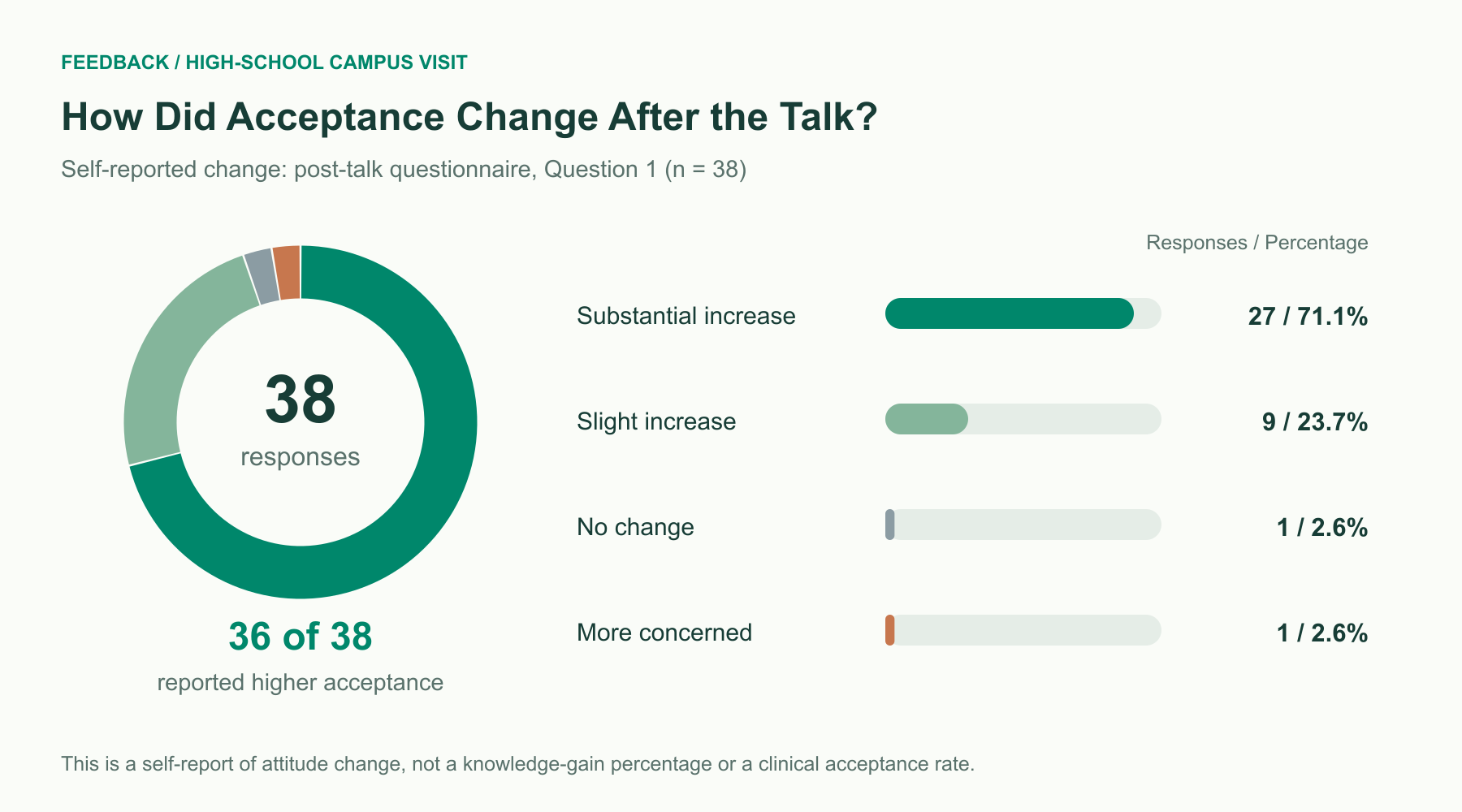
Before the talk, 26 responses indicated that more information was needed before deciding whether to accept an oral therapy using genetically modified bacteria. This showed that the need for further explanation was itself valuable feedback. The first post-talk question then asked whether acceptance had changed after learning about the safety design presented in the lecture.
 View full size
This item received 38 responses. Of these, 36 reported a substantial or slight increase in acceptance, giving a combined proportion of 94.7%. Individual percentages are rounded to one decimal place. Source: the team's aggregated post-talk questionnaire results.
This finding records participants' reports of their own attitude changes. The two questionnaires were not identical knowledge tests, and the available files contain no paired individual-level data. The 94.7% therefore cannot be interpreted as a percentage gain in knowledge or as a clinical acceptance rate. Written feedback continued to raise questions about clinical evidence, practical effectiveness, cost and effects on the body. Greater openness and continuing uncertainty could coexist.
Reflection and Adjustment: Participation During the Talk
Looking back at this first activity, we had devoted considerable attention to the lecture content, questionnaires and visit arrangements, while giving less attention to participation during the talk itself. Students mainly expressed their views through the questionnaires. We had included too few opportunities for them to ask questions, discuss ideas or explain their understanding as the lecture progressed.
The questionnaires revealed attitudes and concerns, but collecting responses after the talk did not tell us enough about how students were thinking while they listened. We needed to make room for expression throughout the explanation, rather than relying on a questionnaire at the end.
With this reflection in mind, we placed building and presenting at the center of the subsequent primary-school activity. In the later middle-school talk, we integrated short questions and open discussion into the explanations. These different approaches addressed the same need: to hear students' ideas while an activity was taking place.
Primary-school Workshop: Participation at the Center
After the first activity, we reconsidered students' role in the classroom. In the primary-school workshop, participation became central: children would build models and explain their ideas about functional design.
I Am a Young Synthetic Biologist
At Wujiang School Affiliated to Soochow University, we designed a session for primary-school children entitled "I Am a Young Synthetic Biologist." We began with an accessible story: the gut was a kingdom with different residents, and bacteria could have different relationships with the human body. "Are all bacteria harmful?" opened the discussion before we introduced probiotics and their connections with daily life.
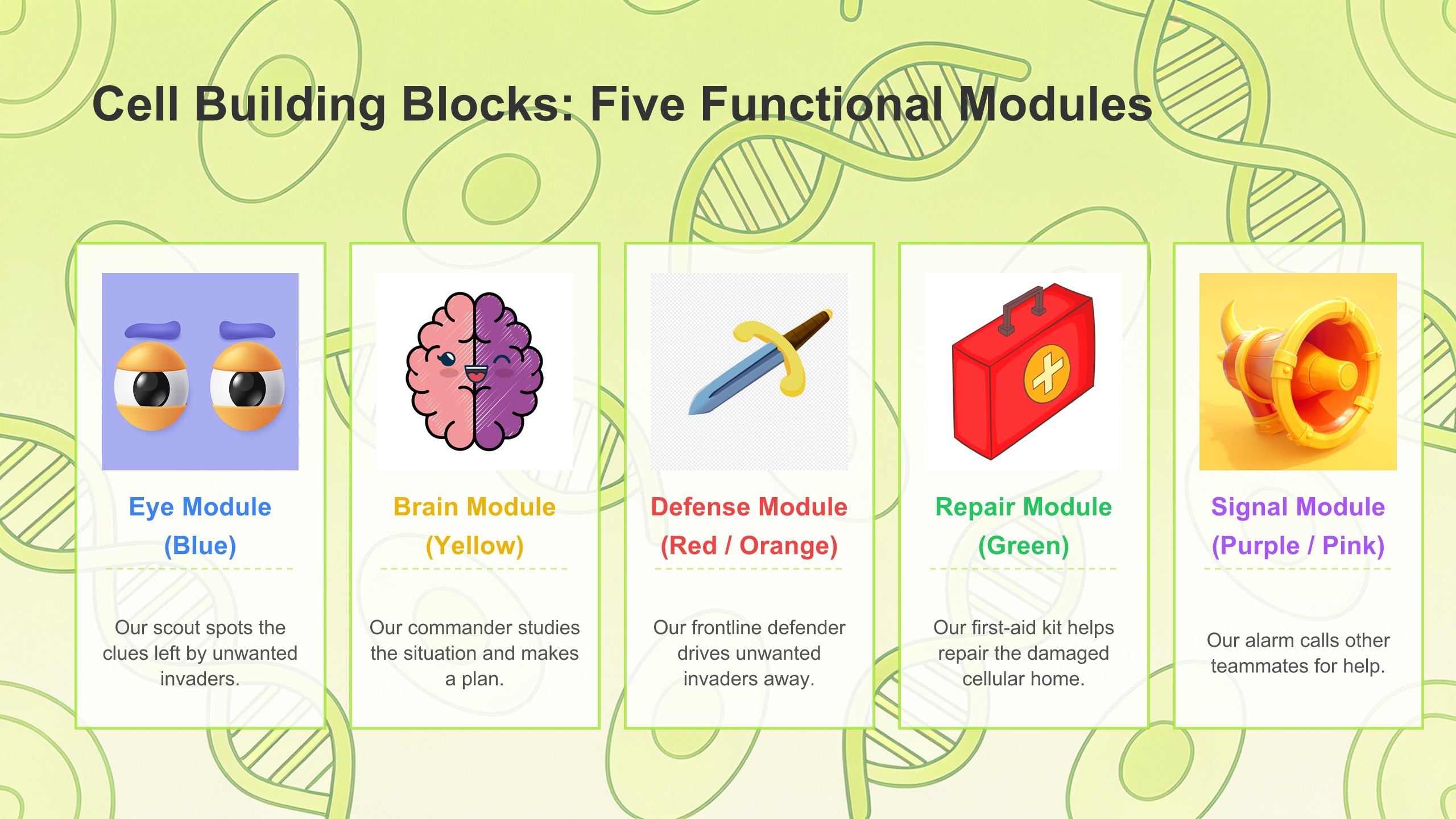
We used building blocks to explain how functions can be combined. Different colors represented roles that children could choose and discuss: eyes for recognition, a brain for decision-making, a defense component for action against a target, a first-aid kit for repair and a loudspeaker for signaling. These were teaching analogies to show how different parts could work together on a task.
 View full size
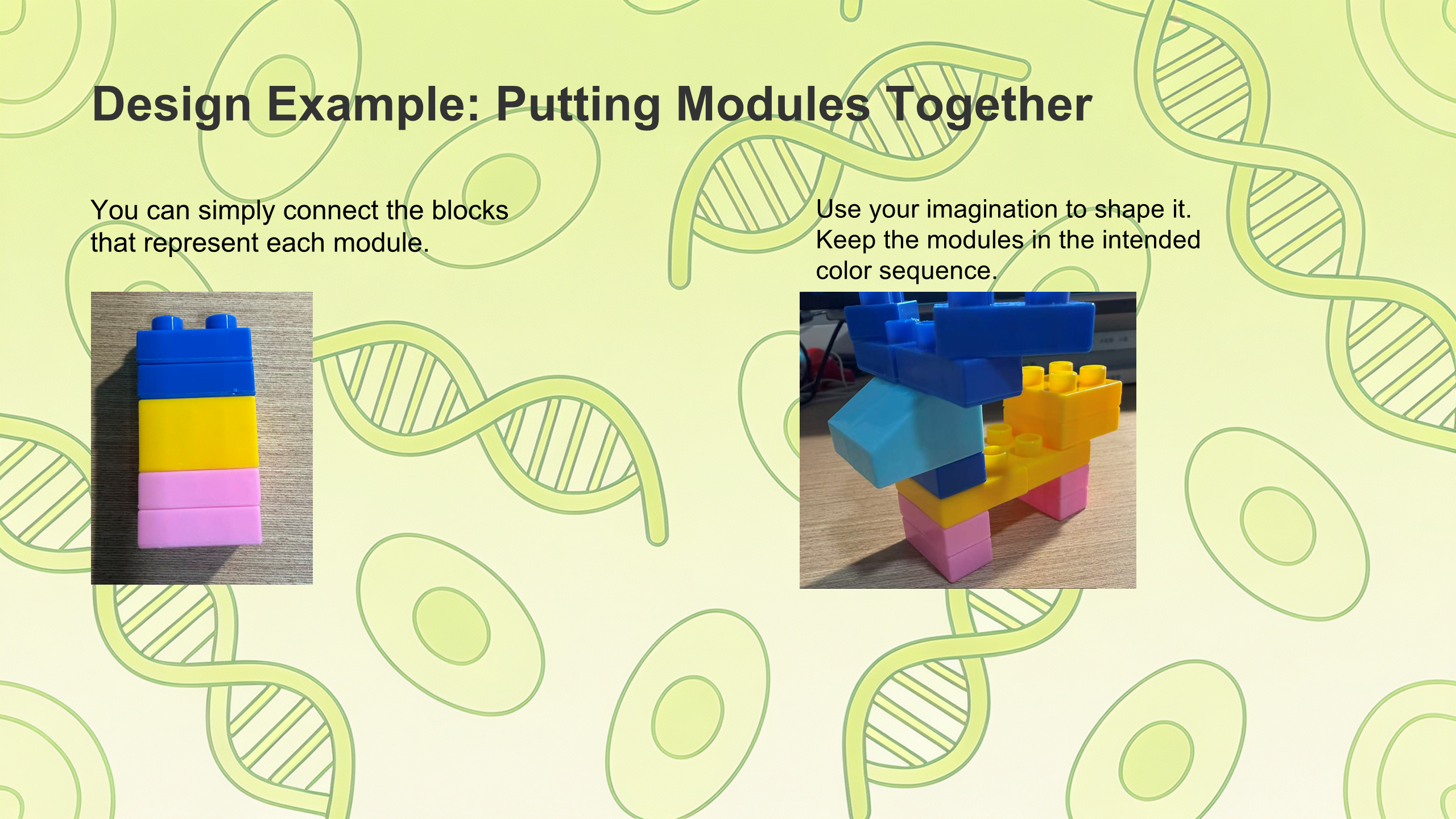
In our demonstration, we connected the process of finding a target, making a decision and sending a signal with the corresponding modules. Students then combined the blocks to create their own models. They could use their imagination when choosing a shape, while explaining how the functions fitted together: What problem would the model help solve? Why did they choose these parts? How would the parts cooperate?
 View full size
Finally, students presented their models and explained their ideas. We observed enthusiastic participation and a willingness to describe design choices. The models and explanations offered more specific ways to observe understanding than attendance alone. They also reminded us to retain children's explanations of how modules relate, rather than recording only the finished shapes.
The activity focused on an initial understanding of functional combinations. Building blocks provided concrete roles through which children could discuss abstract relationships. Synthetic biology became an approach they could begin exploring through building and explaining.
Reflection and Adjustment: Listening to the Reasoning Behind a Model
Compared with the first activity's emphasis on a lecture and questionnaires, building blocks gave children more opportunities to choose and express themselves. Their active participation encouraged us to shift attention from how much content we had delivered to what children could do and explain with that content.
A lively building session still needs clear learning goals. A wide variety of shapes does not, by itself, show that children understand the relationships between modules. Explaining why they combined parts in a particular way was therefore an important step. We hope to retain more of this reasoning in future records, documenting both what children made and how they understood it.
Summer Community Visits: Rethinking How to Begin
Building and presenting in the primary-school classroom showed us that active participation could take many forms. During our summer community visits, the audience and circumstances changed. With older patients, respecting their willingness to engage mattered more than reusing an energetic classroom format.
We spoke with older people with colon cancer, offered practical help, shared information about healthy living and worked with community doctors to measure blood pressure. This setting differed from a school classroom. Communication needed to relate to patients' current lives and the subjects they were willing to discuss.
Reflection and Adjustment: What the Other Person Wants to Discuss
When we introduced new treatment approaches, the older participants showed limited interest. Compared with the enthusiastic classroom response, their quieter reaction made us realize that a format that engages one audience does not automatically suit another. We had brought new research concepts, but whether people wanted to listen and saw a connection with their own lives also shaped whether the conversation could continue.
This experience prompted us to revisit our goals. Health information, practical support and patient listening were worthwhile contributions in their own right. A slower pace, more listening and language closer to everyday experience are directions to explore in future visits. We also avoided attributing the limited interest we observed directly to age or lack of knowledge.
The visits brought us back to a basic principle: adaptation includes respecting how much someone wishes to participate. Health information and everyday care can provide a meaningful beginning. Patient needs and their implications for the project are discussed further on our Human Practices page.
Freshman Welcome: Letting Participants Set the Question
Back on campus, we engaged with students beginning their university studies in pharmacy. We continued to make room for participants' own expression, inviting them to identify problems in everyday life that they would like to approach through biology.
If You Could Redesign an Organism
The welcome activity was intended for incoming pharmacy students. As they began their subject, we wanted them to have an opportunity to express what mattered to them. Our display board therefore asked, "If synthetic biology could give an organism a new ability, what problem would you want it to help humanity solve?"
The poster stated, "No biology knowledge required. Be creative!" Taking part was straightforward: collect a sticky note, write an idea and place it on the board. During the activity, we introduced synthetic biology and iGEM, using students' contributions as openings for further conversation.
We collected many ideas on the same display board. Sticky notes created a record that could be revisited and allowed one person's idea to be seen by others. Participants could raise serious social questions or begin with everyday frustrations and humorous possibilities.
We were interested in which organism a student would choose, what function they would give it and which problem they hoped to address. Whether an idea was already feasible could become a topic for a later discussion. The notes provided material for organizing participants' concerns and planning further conversations.
Reflection and Adjustment: Keeping the Questions Behind the Ideas
Sticky notes made it easier for freshmen to begin expressing themselves and allowed different ideas to be seen together. We came to understand that an open question offers more than a collection of suggestions. Those ideas can also reveal the everyday needs that participants hope science will address.
In organizing the notes, we hope to identify themes while preserving participants' meanings and continue asking why a problem matters and what conditions a proposed solution would require. This next step needs to draw on the actual notes so that participants' contributions can inform future lessons and exhibitions.
Middle-school Talk: Questions Throughout the Lesson
In the later middle-school talk, we translated our early reflections on classroom participation into the lesson itself. Short questions helped students enter the subject, while open questions encouraged them to explain their reasoning.
Cancer, Treatment and Targeted Action
At Wujiang Middle School Affiliated to Soochow University, we held a talk about cancer and its treatment. We wanted students to develop an initial understanding and an interest in learning more. We therefore used short explanations and placed questions between them.
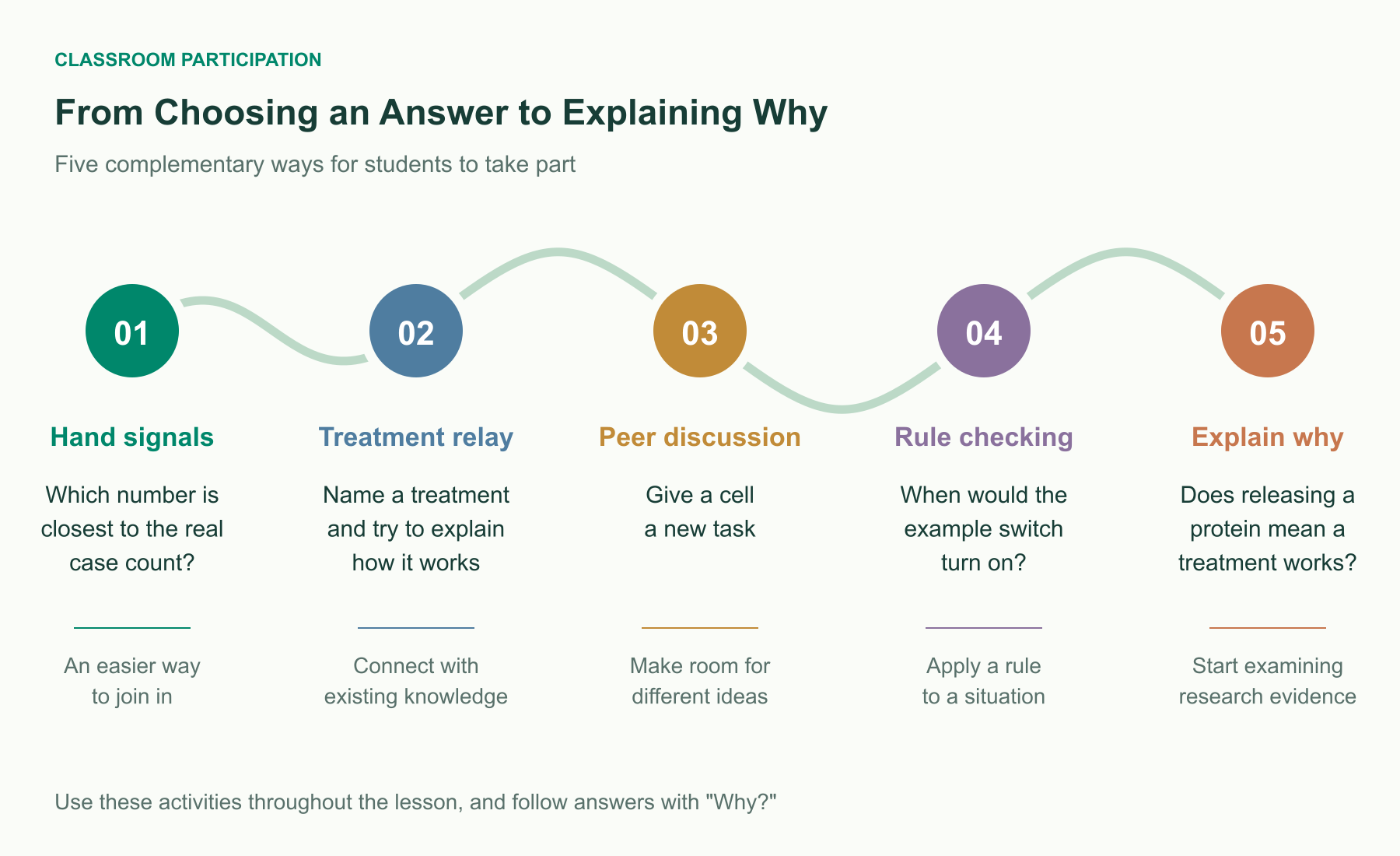
The presentation began with a multiple-choice question about case numbers before introducing uncontrolled cell growth. A treatment relay then asked, "Which cancer treatments have you heard of?" Students could begin with familiar terms, name an approach and try to explain what it does. We added brief explanations of surgery, radiotherapy, chemotherapy, targeted therapy and immunotherapy, showing that different treatments have different conditions of use.
When introducing iGEM and FLAME, we focused on where an action should occur and what conditions should trigger it. The presentation explained quorum sensing through an analogy involving the number of neighboring cells and accumulating signals. Hand signals let students judge whether example conditions had been met. Understanding a rule and then trying to apply it offered an accessible way into an unfamiliar concept.
Combining Basic Questions with Open Discussion
Some questions had answers that could be checked, while others welcomed different ideas. "If you could give a cell a new task, what would you ask it to do?" invited students to propose uses. "Does releasing a protein mean a treatment works?" encouraged them to consider what else a research idea would require. Asking students to include "because" kept attention on the reasons behind their answers.
 View full size
Students actively joined the questions and discussions. Short questions helped more students participate quickly, while open questions left space for different ideas.
Reflection and Adjustment: Interaction in Support of Understanding
This talk addressed the lack of interaction in our first high-school activity. By placing questions within the explanations, we enabled students to make judgments as they listened. We also recognized that the value of interaction depends on the questions themselves. Quick answers and raised hands can show enthusiasm; the reasons behind an answer help us understand how students are thinking.
We therefore retained a further question: "Why?" Basic questions helped students begin answering, open questions allowed them to organize their ideas, and explanations connected their judgments with the subject. Future classroom records should pay attention to these explanations as well as the atmosphere in the room.
BIO FUTURE: Participation for Different Backgrounds
Our activities with particular audiences gradually showed us that participation needed to accommodate differences in prior knowledge as well as age. BIO FUTURE became a further attempt: people with different starting points could choose their depth of reading and find a place to express themselves within the same exhibition.
Four Stations at BIO FUTURE
We held the BIO FUTURE science exhibition on campus for students who had studied biology, those familiar with relevant research and those encountering synthetic biology for the first time. Four display boards offered different levels of detail and incorporated opportunities to answer questions while reading.
Station 1 asked, "What is synthetic biology?" An analogy of combining functional parts introduced the basic approach. Visitors could indicate whether they had encountered the field in class, in news coverage, on social media or had never heard of it. This provided an accessible first interaction and a way to record visitors' starting points.
Station 2 broadened the discussion to engineered microbial medicines, cell-cultivated food, plastic-degrading microbes and bioluminescent plants. Each example paired what it could do with what needed consideration. Visitors could explore potential applications while considering control, labeling, spread and ecological effects.
Station 3 asked, "Under what conditions could we accept it?" Across scenarios involving human treatment, environmental applications and food or crops, spaces for feedback invited visitors to complete, "I could accept it if..." The question allowed conditional judgments and helped people explain different positions.
Station 4 invited visitors to help shape the exhibition by answering, "What would you like to learn more about?" and "What is missing from the exhibition?" The end of the reading experience became a place to raise the next question. These prompts opened a continuing conversation about how the content could be improved.
Different Depths and Choices for Participation
The four stations did not require everyone to complete the same learning task at the same pace. Newcomers could begin with concepts and applications. Visitors with prior knowledge could continue into technical conditions and social judgments. Through this arrangement, we wanted people with different levels of subject knowledge to have something meaningful to contribute.
The scenarios and examples helped visitors enter the discussion, while open feedback invited them to explain their own judgments. We hope to organize recurring questions, unclear wording and requests for additional content so that a later exhibition can respond to what participants have raised.
Reflection and Adjustment: Keeping Participation Open
Earlier activities taught us the importance of adapting to age. The campus exhibition took this further: even among people at a similar life stage, familiarity with synthetic biology can differ greatly. The four stations therefore offered entry points through basic concepts, applications and open feedback, rather than expecting the same learning task from every visitor.
For future exhibitions, we also want a clearer connection between receiving feedback and responding to it. Which wording is difficult? What would visitors like us to add? Does a revision make the subject easier to understand? Recording these details will help the feedback space contribute to continued improvement.
Conclusion: Leaving Room for Further Exploration
From the talk and questionnaires in our first high-school activity to the primary-school building blocks, community health conversations, freshman sticky notes, middle-school questions and BIO FUTURE exhibition, FLAME continued to adapt its educational approach. Children used models to express functions, secondary-school students tried to explain their reasoning, and university students proposed ideas and discussed technology in society. Community conversations reminded us that science education also needs to remain close to everyday life and respect willingness to engage. Our commitment to education across ages took shape through these practical choices.
We also reconsidered what education asks of us. A complete explanation is only one concern. Where participants begin, whether they can express their own ideas and what still puzzles them are equally important. Greater openness in the high-school questionnaires coexisted with unresolved concerns. Enthusiasm during the primary-school presentations created opportunities for expression. Limited interest in the community led us to reconsider our communication goals. These experiences helped us learn both how to organize knowledge and how to listen.
We have developed primary- and middle-school presentations, aggregated questionnaire results, a freshman welcome poster and four exhibition boards. Next, we hope to develop these into more usable educational resources, specifying audiences, goals and instructions for participation. We also want to retain genuine models, anonymous feedback and records of subsequent adjustments so that future teams can use and improve the materials in their own settings.
A talk may end before every question has been answered. An exhibition can lead to the next discussion. We hope to leave opportunities that encourage people to keep approaching science: a child explaining a model, a student questioning a research idea or a visitor describing the conditions under which they would accept a technology. FLAME's educational work will continue to develop through these questions and responses.
Source Materials
Activity descriptions and observations draw on the team's accounts. Plans, teaching examples and actual participant feedback are distinguished in this document.
Questionnaires: the statistical figure was redrawn from the original aggregated counts. Sector sizes and bar lengths represent response counts. The pre-talk workbook, Lecture Pre-Questionnaire, uses Sheet1 A1:E15; the post-talk workbook, Lecture Post-Questionnaire, uses Sheet1 A1:F11. The five pre-talk items and four post-talk items each total 38 responses. For post-talk Question 1, 36/38 rounds to 94.7%; summing separately rounded category percentages may give a slightly different result.
Primary-school presentation: I Am a Young Synthetic Biologist, 11 slides. The module and building-example figures use translated copies of slides 6 and 8, retaining the original layouts. Slides 6-9 cover modules and tasks; slide 11 covers presentations and review. The cover date alone does not establish the event date.
Middle-school presentation: FLAME iGEM Science Outreach Talk, 20 actual slides. Slides 5, 11, 14, 15, 18 and 19 contain questions and discussion activities. The 35-minute description in the original filename does not establish the event's actual duration.
Campus activities: the freshman idea-wall poster and the four BIO FUTURE boards. Examples printed on a poster or board are not participant-submitted responses.
Opening quotation: Xue Ji (On Learning), Book of Rites, translated into English for this document. The passage and its attribution can be consulted in Shanghai Normal University's introduction to the educational ideas of Xue Ji.
Structural reference: XJTLU-Science-China 2025 Education. Its progression from educational motivation and planning through activities to a conclusion informed the organization. Activity accounts and feedback here come from FLAME's own materials.