


Overview
As a team involved in scientific studies, we prioritize safety in experimental and ethical situations. In adherence to this, we ensured safety orientation among team members and conformed to ethical considerations during integrated human practice and educational activities.
Lab Safety
All students received obligatory safety orientation on proper lab equipment use and Personal Protective Equipment (PPE) application prior to the beginning of our wet lab experimental sessions.[1]
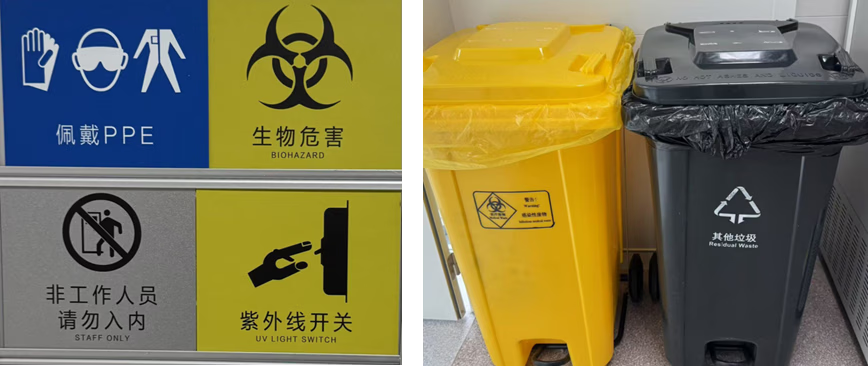
Specifically, this includes the operation of lab machines such as pipettes, storage of bacteria, chemical solutions, and basic garments. Lab coats and gloves are required at all times during activities in the lab but strictly prohibited in areas outside the lab in order to avoid contamination, considering the substances used in experiments. Specifically, this also includes heat-resistant or acid-resistant gloves, goggles, and medical protective masks when working with hot or acidic materials. Food and drinks, as well as unrelated materials, are prohibited in the lab, and hands must be washed before every experiment or cleaned with alcohol before using the clean bench to avoid infection by bacteria and other samples. After each experiment, members must clean the workplace, maintain proper chemical storage, and ensure disposals are made after being disinfected and sterilized into biohazard waste bins.[1]
In addition to operative restrictions, foundational knowledge of handling emergencies is also provided as part of the orientation. This includes knowing the locations of emergency exits, eyewash stations, fire extinguishers, and first-aid kits in case any accidents occur. Report such cases, including spills or injuries, immediately to a supervisor or advisor after taking basic self-protection steps. [1]
Equipment, Instrument, and Reagent Safety
Prior to experimentation, comprehensive safety training was conducted for all equipment, instruments, and reagents. For specialized equipment (e.g., autoclaves, high-speed centrifuges), operation was restricted to certified personnel who performed pre-use safety checks and usage logging. Laboratories housing such equipment required faculty or staff supervision, prohibiting student solo access.
Instrument training emphasized risk mitigation: thermal gloves were mandated for heating devices (water baths, PCR machines, microwaves) and cryogenic exposure (-80°C freezers, dry ice); centrifuges required strict load balancing and lid sealing; and shaking incubators displayed "Caution: Pinch Point" warnings. All electrical circuits were configured compliantly, isolated from water/fire hazards.
Reagent selection prioritized low-toxicity/non-toxic alternatives, with PPE inspections (lab coats, gloves, masks) pre-experiment. During agarose/SDS-PAGE gel preparation, novel low-toxicity nucleic acid dyes/coagulants were used, supplemented by training for future dye-handling scenarios. Commercial low-irritant stains and deionized water were employed for SDS-PAGE staining/destaining within fume hoods to prevent inhalation exposure. Microbial experiments were confined to biosafety cabinets with gloved handling. Although other reagents posed minimal hazards, glove usage was universally enforced during reagent contact.[1]
Bio-safety
Bacteria Experiments: Sterilize hands with 75% alcohol. All the experiments dealing with cells for our project deal with E. coli cells. If we had to transfer solutions, grow them on agar plates, etc., we would all perform these steps inside the clean bench. This prevents the cells from being exposed to less sterile environments, but also allows for regulated disposal and operation of all our cell experiments. [2]
Toxic Chemical Experiments: Wear PPE, extra gloves, and masks. Chemicals like gelred, SDS, as well as some other buffers used in our experiments, are toxic. Hence, for these experiments, we were required to wear extra gloves and masks.
High Temperature Experiments: Check the machinery before use: Microwave, PCR machine, Water Bath Pot.
Centrifuge: Must balance evenly and close the lid.
Waste Disposal: All our experiment waste goes into specified biohazard trash bags (which are professionally processed). [3]
Ethical Considerations In Human Practices
For ethical considerations in human practices, we included consent that confirmed the participant’s agreement to recording, note-taking, and further citation in future wiki creation, emphasizing that these would only be applied in our project before addressing any questions to protect their privacy. In addition, a brief outline of interview questions and introduction of our project was sent to interviewees at least one day before the interview. [4]
All participants voluntarily filled out the survey forms, which are kept anonymous. [6]
Ethical Considerations In Education
To enhance the public’s knowledge and understanding of synthetic biology, we conducted small-scale lab operation sessions among children, adolescents, and community members. To ensure their safety, these sessions were restricted to the operation of non-erosive or non-harmful substances, in addition to providing PPE and informing lab safety rules. Children participating in the activity at TianLin are treated with care and protection and provided with permission from guardians before the activity. [5,6]
References
- National Research Council. (2011). Prudent practices in the laboratory: Handling and management of chemical hazards (Updated ed.). The National Academies Press. https://doi.org/10.17226/12654
- Centers for Disease Control and Prevention, & National Institutes of Health. (2020). Biosafety in microbiological and biomedical laboratories (6th ed.). U.S. Department of Health and Human Services. https://www.cdc.gov/labs/pdf/SF__19_308133-A_BMBL_6th_Ed-BOOK-WEB.pdf
- Regulation on the management of medical waste (2011 Revision). (State Council of the People's Republic of China Order No. 380). http://www.gov.cn/gongbao/content/2011/content_1860802.htm
- World Medical Association. (2024). WMA Declaration of Helsinki: Ethical principles for medical research involving human participants. https://www.wma.net/policies-post/wma-declaration-of-helsinki/
- Law of the People's Republic of China on the protection of minors (2024 Amendment). (1991). https://www.spp.gov.cn/spp/fl/202010/t20201018_482257.shtml
- Personal Information Protection Law of the People's Republic of China. (2021). National Laws and Regulations Database. https://flk.npc.gov.cn/detail?id=ff8081817b6472a3017b656cc2040044