


Small Parts.
A different
starch.
Three enzymes work together.
People help shape what comes next.
We engineered an AM–GT–PUL toolkit and compared enzyme treatments to increase resistant starch in corn starch. Our award case connects a coordinated Part Collection with Human Practices that helps with shaping project decisions and a feasible route to market.

 Hydrolyze
 Rearrange chains
 Debranch
A coordinated enzyme sequence for starch modification.
Conceptual three-enzyme workflow.
The complete formula
for our award case.
From reusable Parts to a functioning enzyme system, our pathway links laboratory work with learning and responsible development.
Bronze
Fundamental criteriaCompetition Deliverables
Required deliverables and participation are recorded through the team's competition submissions and judging session.
Competition submissions
Project Attributions
Student work, external advice, resources and institutional support are extensively documented in the standardized Attributions Form.
Standardized Attributions Form
Contribution
Our Contribution page shares three basic coding sequences and three composite expression constructs, with characterization, protocols and troubleshooting records. Colony PCR, sequencing, SDS-PAGE and activity assays connect construction to enzyme function. We also nominate BBa_26W8LISZ, pET28a-PUL, the composite pullulanase expression construct for b.
Silver
Engineering and contextEngineering Success
Our Engineering page traces three enzyme-focused design–build–test–learn cycles, followed by a combined-system evaluation. AM expression optimization, GT activity testing and TLC troubleshooting, and PUL purification and reducing-sugar assays informed the consecutive enzyme-treatment workflow.
In addition, we nominate BBa_26R7U1GF, pET28a-AM, the α-amylase expression construct used in this work.
Human Practices
A 605-response survey, user interviews and nutrition, engineering, manufacturing and compliance perspectives shaped our requirements, experimental assessment and intended delivery route.
Gold
Three selected awardsBest Part Collection
General Biological Engineering. Three basic CDS Parts and three composite pET28a constructs connect complementary enzyme functions with comparable characterization and a tested starch-modification workflow.
Best Integrated Human Practices
Specialization. Stakeholder input changes how we assess the ingredient, select its delivery route and communicate evidence.
Best Entrepreneurship
Specialization. A B2B ingredient strategy connects customer needs, scale-up planning and financial risk.
Low expression.
A revised build–test cycle.
Initial AM purification yielded a faint target band. We adjusted induction to 1.0 mM IPTG, 16 °C and more than 20 hours, obtaining a clearer band near 72 kDa and enough material for subsequent assays. This expression iteration fed into the combined enzyme workflow.
Follow AM's two iterations ↗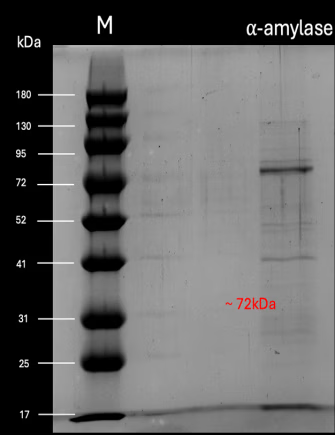
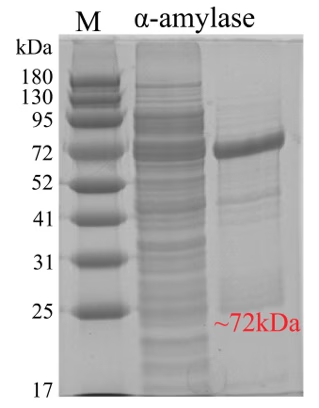
Protein-expression evidence from the team's Engineering record.
Build each module.
Learn how to combine them.
AM · expression and activity
We constructed pET28a-AM and verified it by colony PCR and sequencing. The induction revision shown above improved the target band near 72 kDa. TLC and the GOD-POD glucose readout then supported comparison of reaction conditions.
GT · separation and soluble yield
We used the same expression backbone for pET28a-GT and observed a band near 98 kDa. Initial TLC tailing and poor separation led to adjustments in solvent composition, development time, substrate concentration and enzyme amount. A glucose-consumption assay supported condition screening; low soluble yield remained a target for further improvement.
PUL · purification and reducing sugars
We verified pET28a-PUL, observed a band near 94 kDa and assessed activity with TLC and DNS. A maltose-calibrated DNS curve showed R² > 0.99. Weak elution bands prompted review of dilution and recovery during nickel-affinity purification.

Six Parts.
One coordinated toolkit.
Our Multi-enzyme resistant starch modification system pairs three enzyme coding sequences with three expression constructs. Each contributes a distinct function to the same substrate-processing task.
Hydrolysis → chain rearrangement → debranching
AM hydrolyzes starch chains, GT redistributes glucan segments, and PUL removes α-1,6 branch points. The enzymes are produced separately, purified and applied by consecutive incubation, linking each reusable module to the performance of the combined system.
Open up the starch chains.
AM from Bacillus amyloliquefaciens cleaves internal α-1,4 glycosidic bonds, generating shorter glucan fragments. It provides the hydrolysis step before subsequent chain rearrangement and debranching.
Colony PCR and sequencing support construction; SDS-PAGE shows the target band near 72 kDa. Induction optimization improved recovery. TLC and the GOD-POD assay track carbohydrate products and glucose-associated activity across the reported test matrix.
α-Amylase (AM) · 1,989 bp
pET28a-AM · 6,410 bp
Redistribute the glucan chains.
GT from Bacteroides finegoldii transfers α-1,4-linked glucan segments between suitable donor and acceptor molecules. This rearrangement complements AM hydrolysis and PUL debranching.
Colony PCR and sequencing support construction; SDS-PAGE shows a band near 98 kDa. We revised TLC conditions after tailing and poor separation. GOD-POD measurements track glucose consumption as an assay readout; low soluble yield remains a documented limitation.
4-α-Glucanotransferase (GT) · 2,691 bp
pET28a-GT · 7,112 bp
Remove the branch points.
PUL from Neobacillus ginsengisoli hydrolyzes α-1,6 glycosidic linkages. Its debranching function complements the other two modules in the starch-modification sequence.
Colony PCR and sequencing support construction; SDS-PAGE shows a band near 94 kDa. TLC and a maltose-calibrated DNS assay support activity assessment. The record also documents weak elution bands, possible dilution and low soluble recovery as troubleshooting priorities.
Pullulanase (PUL) · 2,577 bp
pET28a-PUL · 6,998 bp
Common pET28a / T7 expression context; separate BL21(DE3) production strains.
His-tag affinity purification and enzyme-specific activity assays.
Single, selected dual and triple treatments; gelatinized and non-gelatinized starch.
Functional workflow schematic. Each enzyme is produced in its own expression strain, purified and then used in the treatment sequence.
Compare the reported working conditions.
Temperature, concentration and time screens provided working conditions for the subsequent starch-treatment experiments. The best-performing points are listed as follows within the tested matrix.
| Enzyme | Activity readout | Temperature | Reported concentration | Reaction time |
|---|---|---|---|---|
| AM | GOD-POD · glucose production | 42 °C | 2 mg/mL | 120 min |
| GT | GOD-POD · glucose consumption | 37 °C | 0.5 mg/mL | 30 min |
| PUL | DNS · reducing sugars, calibrated with maltose | 42 °C | 2 mg/mL | 30 min |
Reaction conditions are reported as screened. TLC provides qualitative product profiles; GOD-POD and DNS provide the colorimetric readouts used for condition comparison.

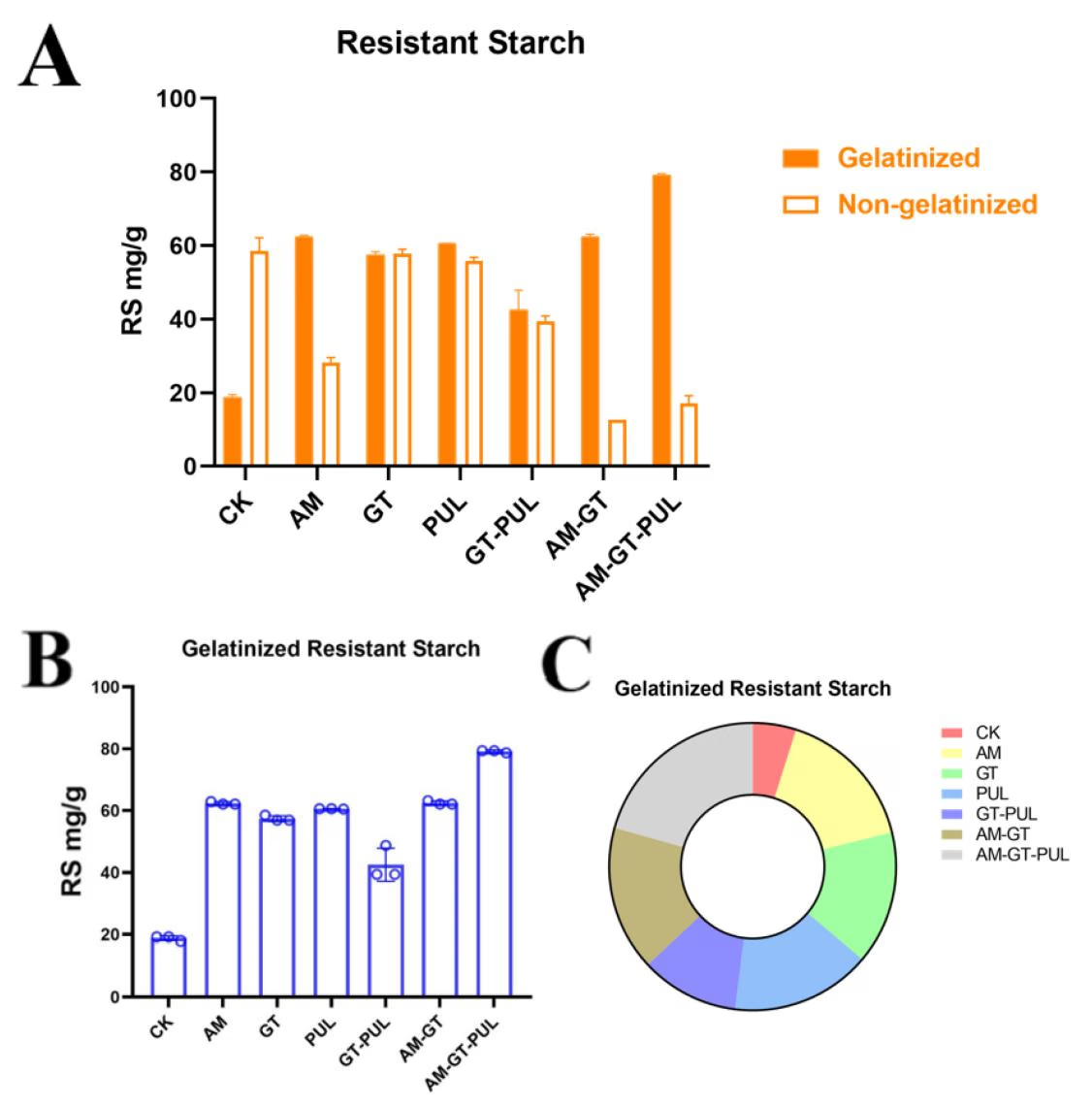
Coherence: complementary functions.
The six entries form three coding-sequence / expression-construct pairs. Hydrolysis, glucan rearrangement and debranching address different parts of a shared starch-modification process.
Inspect the system and membership ↗Construction: a common production strategy.
Colony PCR and sequencing verify the constructs; BL21(DE3) expression, His-tag nickel-affinity purification and SDS-PAGE connect the coding sequences to protein preparations. Shared pET28a expression elements, affinity tags and selection context belong to the composite constructs, providing a consistent starting point for reuse.
Construction and Part records ↗Function: compare the components and the ensemble.
TLC, GOD-POD and DNS support individual-enzyme assessment. The RS assay compares single, selected dual and triple treatments across two starch-processing states. SEM adds observations of surface roughening, pores and changes in granule morphology after treatment.
Functional characterization ↗Reuse: start with a module or adapt the workflow.
Future iGEM teams can select a coding sequence, reproduce the expression route or compare enzyme combinations. Protocols and failure logs cover TLC separation, nickel-affinity binding and elution volumes, and low soluble yields. These records help others reproduce the work and plan improvements.
Usage and documentation ↗From individual Parts to a tested system. When used in synergy by consecutive incubation, our sample produced the highest resistant starch content among all tested groups. The measurements support selection of the gelatinized AM–GT–PUL treatment within this comparison. Subsequent application work will assess food processing, digestion-related performance and formulation.
Let the real world
change our recipe.
Four connected stages turn user needs and specialist knowledge into requirements, experimental assessment and a defined development direction.
Clarify the problem.
What would make a staple-food ingredient worth using?
Our survey recorded 605 valid responses. Safety, credible evidence, taste and price emerged as recurring considerations. In the taste-barrier question, 39.34% selected coarse texture or unpleasant taste.
Understand the users.
Which needs are shared, and which are personal?
Nutritionist Tang Xiaoya encouraged attention to health conditions, routines and goals. Interviews with people living with diabetes, weight-loss users and fitness-oriented users exposed differences in affordability, taste and convenience.
Test the practical questions.
How should laboratory work reflect everyday preparation?
Clinical-nutrition input from Dr. Huang Limin linked food preparation with structural and digestion-related assessment. Enzyme-engineering consultations with Dr. Qin Zhen and Dr. Mei Jianfeng added expression, cost and delivery-route questions.
Define responsible use.
How could the ingredient reach food production responsibly?
Food-law and compliance advice from Dr. Bao Huihui focused on classification, safety evidence and communication. The Prowell manufacturing visit clarified the role of formulation, quality control and downstream production.
Supply the enzymes,
or supply the modified starch?
Dr. Qin and Dr. Mei recommended different B2B deliverables. We compared the work each route placed on our team and on downstream manufacturers, then selected a direction that matched our experimental focus.
Supply the enzyme preparation.
This would reduce the team's starch-processing burden, while downstream users would need the capability to carry out starch conversion themselves.
Retained as an alternativeSupply the converted ingredient.
This requires more upstream processing, but fits our starch-modification work and lets manufacturers concentrate on formulation and food production.
Selected current B2B directionA manufacturer may buy it.
A person will eat the food.
The Prowell visit helped us understand how ingredient supply connects with formulation, quality control and production. Our B2B choice retains the original user priorities: credible evidence, everyday practicality, taste and affordability.
The record distinguishes completed assessment from the next development steps, keeping stakeholder input connected to decisions throughout the project.
Review the full integration record ↗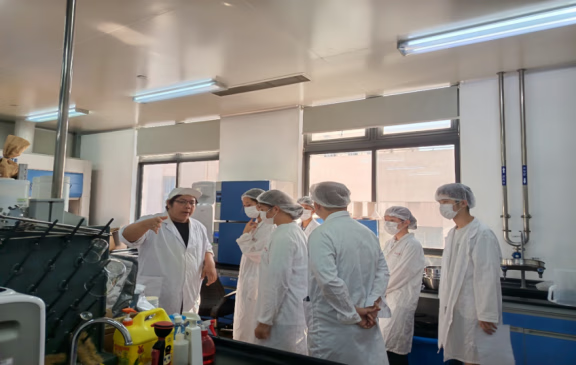
| Stakeholder knowledge | Project response | Evidence route |
|---|---|---|
| User needs + clinical nutrition | SEM assessment of gelatinized starch connects preparation-related questions with completed laboratory characterization; digestion and food-application testing form the next assessment steps. | Preparation → assessment ↗ |
| Enzyme-engineering perspectives | AM expression iteration, structural analysis and production-cost evaluation inform the current enzyme route. Further GT engineering and scale-up options remain distinct development tasks. | Engineering and process decisions ↗ |
| Users + compliance + manufacturing | Prioritize ingredient supply and supported product characteristics; plan QR-linked information and numerical sensory evaluation while evaluating future application requirements. | Communication and implementation ↗ |
Our integration principle: identify who can inform a decision, explain the trade-off, record the action and use the resulting evidence to decide what to retain or revise.
Build the ingredient.
Commercialize our idea.
Informed by our Human Practices, our commercialization plan starts with resistant-starch ingredients for food manufacturers.
Start with manufacturers.
Consumer and expert input shaped a B2B offer for familiar staple foods.
Customers and opportunity ↗Supply the modified starch.
Ingredient sales, application support and planned CDMO production connect our process to downstream formulation.
Business model ↗- 01Laboratory proof
- 02Food application testing
- 03Safety & regulatory review
- 04Pilot customer trials
- 05Repeat supply
| Business priority | Our approach | Evidence route |
|---|---|---|
| Feasibility & scale | Compare pilot yields, processing stability and partner quotations before supply commitments. | Development plan ↗ |
| Economics & protection | Cost scenarios and sensitivity analysis guide pricing; patent review and process know-how inform IP strategy. | Financial plan ↗IP strategy ↗ |
| Impact & responsibility | Assess affordability, waste and energy use; validate final-food claims and control production residues. | Long-term impacts ↗ |
Follow the evidence.
Direct routes to the nominated records and the Wiki documentation behind our award cases.
| Criterion / award | What to inspect | Direct route |
|---|---|---|
| Bronze · Contribution | Reusable Parts, characterization, experimental learning and nominated pET28a-PUL. | Contribution ↗BBa_26W8LISZ ↗ |
| Silver · Engineering Success | Three enzyme-focused DBTL cycles, induction and TLC troubleshooting, activity screens, system comparisons and nominated pET28a-AM. | Engineering ↗BBa_26R7U1GF ↗ |
| Silver · Human Practices | Stakeholder rationale, user requirements, responsibility and decision-making. | Human Practices ↗ |
| Gold · Best Part Collection | Six-member toolkit, construction, enzyme working conditions, RS comparisons, troubleshooting and reuse. | Collection Registry ↗ |
| Gold · Best Integrated Human Practices | Four-stage engagement, competing recommendations and documented project changes. | Integration and reflection ↗ |
| Gold · Best Entrepreneurship | Customers, business model, milestones, economics and impact. | Entrepreneurship ↗ |
For Part Collection review: every verification link within the collection award case leads to the nominated Registry collection.