Integrated Human Practices
Engineering With Impact In Mind
Integrated Human Practices is where Metlock steps beyond the bench, and where we must ask ourselves whether our technology can function synergistically within its intended environments. Metlock is concerned not only with scientific viability but also with whether our approach addresses real environmental needs, industrial workflows, and responsible development and implementation.
Human Practices Milestones
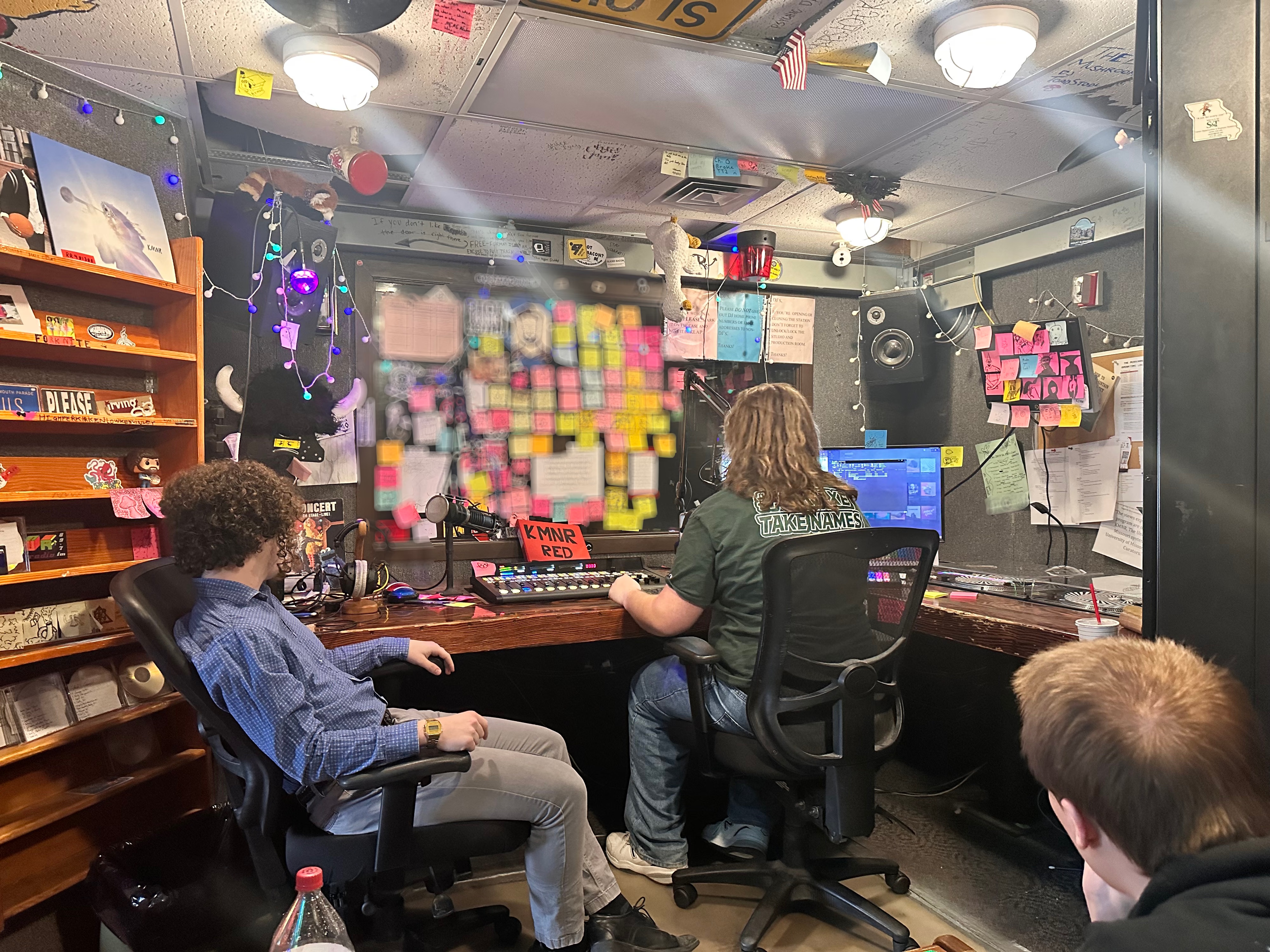
- Feb 7KMNR 89.7 FM Interview
- Apr 8–10Academy Of Chemical And Biochemical Engineers Banquet
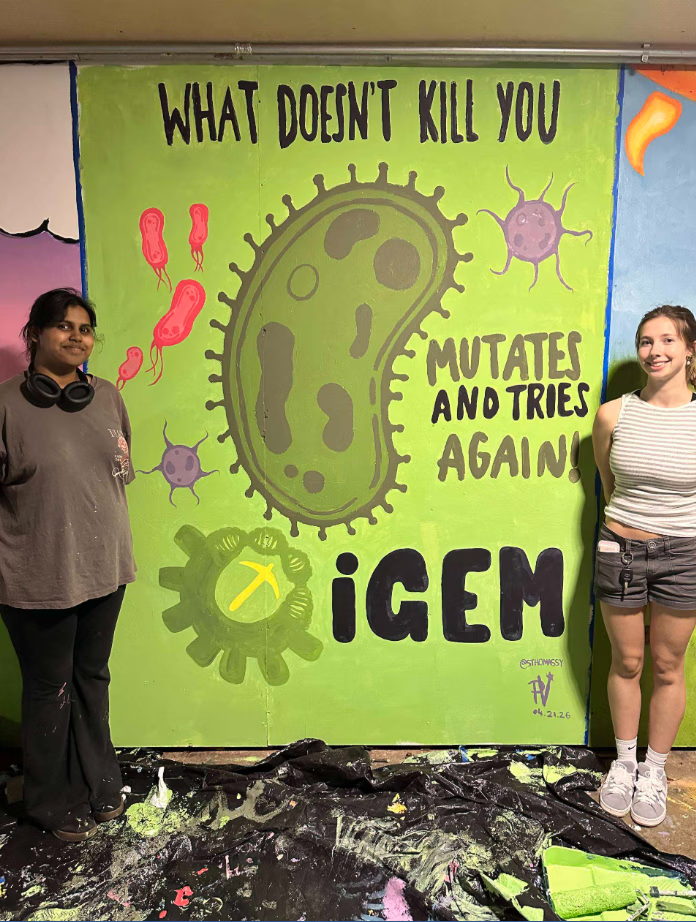
- Apr 21–23TJunnel Mural Painting
- Aug 19iGEM TIP Begins
- Sep 16Missouri DNR Interview
- Sep 25MilliporeSigma Consultation
- Sep 29Doe Run Interview
- Sep 29–30Video Feedback At The Summit
- Oct 1–2UM System Model Organism Symposium
The Problem & Our Human-Centered Approach
Where Metlock Could Help
To develop Metlock for use outside the lab, we need to understand where zinc recovery is needed, who would operate the system and how it could affect nearby communities. Cost, maintenance, environmental risks and existing treatment options all matter when choosing an application.
Conversations with people in mining, environmental oversight, protein engineering and science communication have helped us narrow potential uses, revise our protein designs and plan further tests. Here, we explain what we heard, what we changed and what we still need to investigate.
Community / Industry / Environmental Context
Situating Metlock In The Real World
Growing demand for critical metals has increased the need for efficient recovery, while conventional extraction and waste management fail to effectively handle the environmental, social, and industrial challenges associated with this demand. Mining operations must balance recovery efficiency and economic feasibility with environmental protection and the concerns of communities affected by mining activities. Metal-rich waste streams therefore provide a valuable case study for examining how synthetic biology could complement existing processes while addressing these interconnected challenges.
For Metlock, this means considering where biological zinc capture and uptake could realistically fit within current systems. Potential applications include dilute zinc streams, industrial polishing steps, and other contaminated environments where conventional approaches may have limitations. The feasibility of these applications depends not only on biological performance and compatibility with existing infrastructure, but also on whether they address the practical needs of mining operators and surrounding communities. Understanding these contexts helps us evaluate not only whether Metlock can work biologically, but also whether it could address a meaningful need outside the laboratory.
Stakeholder Mapping & Feedback
Who Shapes The Direction Of Metlock?
Metlock is part of a network of relevant external stakeholders with diverse interests, responsibilities, and perspectives. Each group brings different questions about feasibility, safety, communication, and practical value. Our team sought perspectives on treatment infrastructure, environmental oversight, protein engineering, and scientific communication. These conversations helped us identify practical constraints that would be difficult to understand from laboratory work alone.
| Person or group | Perspective | Question raised for Metlock |
|---|---|---|
| Bill Zeaman Missouri Department of Natural Resources |
Mining waste and environmental oversight | How should regional conditions, community interests, and applicable requirements shape a potential use case? |
| Gen Sutton Doe Run |
Mining and treatment operations | Where is there an unmet treatment need, and what operating conditions would a biological system face? |
| MilliporeSigma Representative | Protein design and validation | How should the fusion construct be revised, and what evidence would establish expression and localization? |
| Rice University Participant World Of Synbio Summit |
Communication and responsible implementation | Can an outside audience understand the intended use, affected stakeholders, and environmental questions? |
| KMNR 89.7 FM | Public science communication | How can we explain genetic engineering, iGEM, and our intended community impact beyond a specialist setting? |
We still need to hear directly from residents near contaminated waterways, workers at potential sites and downstream water users. Their priorities may differ from those of the professionals we consulted.
How Feedback Shapes Design
Turning Outside Input Into Design Decisions.
Stakeholder input informs Metlock’s engineering process by helping refine target applications, establish performance goals, identify safety expectations, and determine the evidence needed to demonstrate practical value beyond the laboratory. By integrating feedback into design and testing decisions, we can identify real-world constraints, prioritize necessary improvements, and evaluate what must be addressed before implementation.
- External Input
- Interpretation Of Feedback
- Decision Making
- Implementation & Evaluation
- Reassessment & Follow-Up
MoDNR
Our conversation with Bill Zeaman, Chief of the Industrial and Metallic Minerals Mining Unit within the Missouri Department of Natural Resources (MoDNR), broadened our understanding of the environmental, economic, and community context in which Metlock might be considered. The discussion highlighted surface-water runoff as a concern because it can transport mining-related contaminants into nearby water systems. The Tri-State Mining District, spanning southwest Missouri, southeast Kansas, and northeast Oklahoma, emerged as a potential context for further investigation. We also learned about regional funding constraints and the economic importance of mining to local communities, emphasizing that environmental remediation must be considered alongside the livelihoods that depend on the industry.
These insights expanded our evaluation of Metlock beyond scientific feasibility. A potential recovery technology must be assessed not only by its ability to capture target metals, but also by its compatibility with existing operations, its environmental risks, and its implications for the people who live and work nearby. This means considering who would benefit from implementation, who would be responsible for operating and maintaining the system, and whether it could complement existing mining activities rather than undermine local livelihoods. Community and economic considerations therefore became part of our assessment of potential applications and implementation requirements.
Our next steps are to investigate the technical, environmental, and regulatory requirements associated with a defined use case and seek direct perspectives from affected communities. The conversation helped identify the questions that must be addressed before implementation can be responsibly evaluated. By incorporating these regional considerations into our ongoing assessment, we aim to develop a recovery platform that responds to practical industrial needs while accounting for environmental protection and community priorities.
- Our Original Assumption
- Limited understanding of the Tri-State Mining District’s environmental conditions, economic context, and potential relevance to Metlock.
- Stakeholder Insight
- Surface-water runoff presents an environmental concern in the region, while mining remains important to local livelihoods. Any potential application of Metlock must account for both environmental protection and community needs.
- Our Planned Response
- Investigate the technical, environmental, and regulatory requirements associated with a potential use case in the Tri-State Mining District. Evaluate Metlock’s proposed benefits alongside scientific feasibility, environmental impacts, operational demands, and implications for local communities before considering implementation.
Doe Run
Our conversation with Gen Sutton at Doe Run challenged the assumption that a biological zinc-treatment system would be valuable wherever zinc-containing water occurs. The discussion emphasized that existing treatment methods can work well. The more useful question was where treatment infrastructure is absent or difficult to provide, while water discharge continues.
This changed how we defined the proposed application. We narrowed our investigation toward mining sites with limited treatment infrastructure and refined our target-user considerations to prioritize operations where conventional treatment options may be unavailable or impractical. Cost, energy demand, maintenance, portability, labor, and ease of handling became practical criteria for evaluating the concept.
Sutton also drew attention to differences between optimized laboratory conditions and operating environments. We discussed seasonal temperature changes, water chemistry, pH regulation, and flow rates. These considerations led us to explore the concept of a self-contained bioreactor with controlled operating conditions, potentially incorporating temperature and pH monitoring and regulation. Such controls could improve consistency, but they could also increase energy consumption, equipment costs, and maintenance demands at the very sites where infrastructure is limited. This trade-off became an important consideration in evaluating the feasibility of our proposed design.
Next, we plan to evaluate the vessel concept against specific waste streams and the requirements of potential operators. Alongside uptake, that evaluation must cover recovery of a useful metal product, treatment capacity, and management of the remaining biomass and water.
- Our Original Assumption
- Metlock could be scaled across wastewater management applications without adapting its use case or accounting for industrial operating conditions.
- Stakeholder Insight
- Doe Run’s feedback highlighted the need to focus on mining sites with limited treatment infrastructure and account for environmental variability, including seasonal temperature changes and pH differences.
- Our Response
- Narrow our target-user mapping to mining operations that could benefit from an alternative treatment approach and explore a self-contained bioreactor with monitoring and control systems to manage operating conditions.
MilliporeSigma
During our consultation with a MilliporeSigma representative, we discussed challenges in developing Module 3’s zinc-binding fusion protein. Early computational modeling raised questions about the arrangement of individual components and presented computational difficulties. Although predicted structures could help identify potential design issues, they could not establish how the fusion protein would behave or function within cells. This highlighted the need to evaluate both construct design and the methods used to validate its performance.
The representative recommended moving outer membrane protein A (OmpA) to the N-terminus and the FLAG tag to the C-terminus. In response, we revised the proposed sequence and examined individual components alongside the larger construct. Following the consultation, we revisited the sequence with AlphaFold and continued work on the linkers. The second model showed a more extended arrangement with clearer separation between major regions; the comparison remained qualitative. This iteration demonstrated how stakeholder feedback informed our design process while highlighting the limitations of computational predictions.
The consultation also broadened our approach to experimental validation. The representative recommended examining individual components before assembling the fusion, varying linker lengths, and evaluating alternative expression vectors and host strains. These suggestions emphasized that expression strength, protein localization, and construct performance must be considered when assessing the design. We also discussed the possibility of misleading detection signals if tagged proteins were incorrectly localized or released through cell lysis.
GFP visualization and Western blotting were suggested as potential additions or alternatives to our planned detection strategy. We intend to evaluate these methods in a future phase of Metlock, considering which questions each assay can answer and whether the resulting measurements can distinguish protein expression from correct localization and function. Through this consultation, we refined our protein-design approach and identified further validation steps needed to assess the construct beyond its predicted structure.
- Our Original Assumption
- Our selected experimental parameters would be sufficient to establish an effective and reliable assay.
- Stakeholder Insight
- Expression strength, protein localization, and assay reliability depend on optimizing construct components and validating assay performance through systematic troubleshooting.
- Our Planned Response
- In a future phase of Metlock, we will evaluate alternatives to the construct components and assess GFP visualization and Western blotting as potential improvements to our detection strategy.
Move OmpA to the N-terminus and FLAG to the C-terminus.
Swipe across to see the full component order.
Initial proposal
- Ag43 Surface-display scaffold
- SmtA Zinc-binding domain
- FLAG Detection tag
- OmpA Targeting component
Revised proposal
- OmpA Targeting component
- Ag43 Surface-display scaffold
- SmtA Zinc-binding domain
- FLAG Detection tag
Module 3 engineering cycles · Protein modeling and Ag43 figures
Rice University
At the World of Synbio Summit, a Rice University participant reviewed Metlock’s project video and provided feedback on its communication and broader implications. They responded positively to the video’s prose, graphics, and presentation, but noted that the intended implementation and industrial impact were less clear. This highlighted an important distinction: explaining the biological mechanism behind our design does not necessarily communicate where the technology could be used or why it matters.
The participant recommended simplifying technical language for general audiences and narrowing our problem statement to focus on one central issue. In response, we plan to refine the video’s main message and test future revisions with viewers outside our research team. This feedback also reinforced the need to communicate Metlock’s intended application and limitations alongside its underlying science, allowing audiences to better understand both the problem being addressed and the role our proposed technology could play.
The discussion also broadened our consideration of implementation responsibilities. Questions about who would be affected by Metlock, whether we had consulted those communities, and how environmental release could affect aquatic life prompted further consideration of biosafety and metal management. The participant raised the possibility of incorporating a genetic kill switch, improving recovery of metal-bearing cells, and examining whether metals could be released back into the environment. They also encouraged us to compare Metlock with existing treatment approaches and critically evaluate why genetic engineering would be appropriate for a particular application.
These suggestions informed our priorities for further investigation, including stakeholder engagement, environmental risk assessment, containment, metal recovery, and comparison with alternative technologies. By incorporating this feedback into both our communication strategy and implementation planning, we aim to ensure that Metlock’s proposed benefits are clearly explained and assessed alongside its environmental responsibilities and practical alternatives.
- Assumption
- Explaining the biological mechanism behind our design does not necessarily communicate where the technology could be used or why it matters.
- Insight
- The participant recommended simplifying technical language for general audiences and narrowing our problem statement to focus on one central issue.
- Response
- In response, we plan to refine the video’s main message and test future revisions with viewers outside our research team.
KMNR 89.7 FM: Science Communication As A Human Practices Stakeholder
On February 7, 2026, Tristan Crawford, Julian Foat, Addison Imhof, and Paula Veeramasu participated in an interview with KMNR 89.7 FM, the student-run radio station serving Missouri S&T and the wider Rolla community. The discussion covered the challenges of genetic engineering, the iGEM competition, and the potential community impact of Metlock.
The interview provided an opportunity to explain Metlock beyond a specialist scientific audience, connecting our research with the local community in which our team studies and works. Discussing both the challenges of genetic engineering and the motivation behind our project reinforced the importance of communicating not only how a biological system is designed, but also what problem it is intended to address and what evidence is needed to establish its practical value.
This distinction is important to our Human Practices approach. A proposed environmental technology must be evaluated not only by its biological performance, but also by the needs of the people who might use or be affected by it. Potential environmental benefits should therefore be presented as goals to investigate rather than established outcomes. Public communication provides an opportunity to explain these goals, clarify uncertainties, and make the purpose of our research accessible to people outside the laboratory.
We recognize, however, that sharing our research with the community is only one part of meaningful engagement. Communication becomes more fully integrated into Human Practices when community perspectives can challenge our assumptions and inform project decisions. Building on this outreach experience, we aim to create opportunities for more reciprocal engagement, in which people can raise concerns, identify priorities, and help us evaluate Metlock’s proposed applications and broader implications.
- Assumption
- A proposed environmental technology must be evaluated not only by its biological performance, but also by the needs of the people who might use or be affected by it.
- Insight
- This interaction reinforced the importance of communicating our goals and limitations clearly.
- Response
- Building on this outreach experience, we aim to create opportunities for more reciprocal engagement, in which people can raise concerns, identify priorities, and help us evaluate Metlock’s proposed applications and broader implications.
The Central Challenge And Our Response
The Role Of iGEM TIP
Throughout our stakeholder engagement, two questions recurred: where could Metlock provide practical value within biomining operations, and what would responsible implementation require? To investigate these questions alongside our laboratory research, we established iGEM TIP on August 19 within Missouri S&T’s Team Innovation Projects program.
iGEM TIP evaluates potential users, competing technologies, technical integration, intellectual property, and regulatory considerations. By examining these factors alongside stakeholder feedback, the team works to identify how industrial needs, environmental protection, and biosafety considerations should shape Metlock’s proposed implementation. This process has moved our approach beyond its original concept toward a more informed evaluation of potential applications and the requirements that must be met before responsible deployment can be considered.
Zinc Research And Future Target Metals
Based in Rolla, Missouri, our team used iGEM TIP to investigate regional mining opportunities and identify critical minerals with potential industrial value. This research led us to select germanium and gallium as candidate metals for future application research, given their importance to electronics, communications, energy, and defense technologies.
As a result, Metlock’s industrial direction has evolved while our current zinc-focused research remains the basis of our intended proof of concept. We plan to use this work as a starting point for investigating whether our biological system can be adapted for germanium or gallium recovery. However, zinc recovery does not establish effectiveness for either metal; adaptation would require further evaluation of the biological design, relevant waste streams, recovery performance, and practical value. This evolving strategy demonstrates how iGEM TIP integrates regional industry research with scientific feasibility to guide Metlock’s potential applications.
A Proposed Modular Bioreactor
Through market research, competitor analysis, and stakeholder engagement, iGEM TIP is investigating how Metlock’s biological system could be translated into a practical industrial process. In response to operating variability and containment concerns, we are exploring a small modular bioreactor as a potential implementation concept for zinc first, with later germanium and gallium research.
A self-contained vessel could allow biological material and operating conditions to be managed more carefully. Potential features include sensors, programmable logic controllers, and chemical dosing loops, although these remain conceptual rather than validated components. Our research is evaluating the requirements for integrating such a system into existing industrial processes, including recovery performance, throughput, temperature and chemical control, energy use, maintenance, scalability, and cost.
These considerations help establish the criteria against which the proposed reactor must be assessed. Its final configuration, suitability for targeted waste streams, and industrial feasibility remain unvalidated. By considering these requirements alongside biological development, iGEM TIP aims to ensure that Metlock’s implementation strategy reflects both stakeholder needs and the practical constraints of responsible deployment.
Responsible Development & Environmental Safety
iGEM TIP’s proposed application involves engineered bacteria and accumulated metals, so responsibility extends beyond measuring uptake. We plan to trace the biological material through operation and after treatment, examine how metals would be recovered, and assess possible escape or re-release of either during handling or disposal. The concerns raised during the summit helped make these questions part of the implementation discussion.
To evaluate containment for the proposed vessel, we plan to assess physical reliability, the handling of biomass and residual streams, and the consequences of failures. A biological safeguard such as a kill switch would also require its own design and validation before it could support a safety claim.
We plan to compare the environmental effects of biological capture with an existing or realistic alternative, including the energy, materials, labor, waste, and recovery steps needed to operate the full process. Doe Run's feedback was important here: a system that performs in the laboratory may still offer little value at a site with effective treatment, or may impose demands that a site without infrastructure cannot meet.
Community participation is another part of that evaluation. We have discussed potential community interests with professionals and brought the project into a local radio conversation. Our next step is direct dialogue with people connected to candidate applications, including those who could be affected by changes to water management or local work. Their priorities should help define the evaluation questions and the conditions under which an application would be acceptable.
Scientific Exchange And University Engagement
Integrating New Perspectives Into Scientific Discovery.
Through scientific exchange and campus engagement, we shared Metlock’s research, learned from the expertise of the broader Missouri S&T community, and connected our scientific work with perspectives beyond the laboratory. Through academic discussions and campus involvement, we sought to strengthen our scientific approach, build connections, and communicate the purpose and potential implications of our project. These interactions complemented our broader Human Practices efforts by situating Metlock within the research community and the university environment in which it was developed.
Academy Of Chemical And Biochemical Engineers Banquet
During the April 8–10, 2026 Academy of Chemical and Biochemical Engineers banquet at Missouri S&T, our team presented Metlock and discussed the project with alumni, academy members, and students involved in ChemE Cube and ChemE Car. Questions about applications beyond the laboratory drew our attention to the technical and operational challenges of scaling the proposed biological recovery system.
One takeaway we recorded was the difficulty and value of modeling gene expression. This reinforced a modeling question: how will predictions be compared with measurements and used to guide design? The banquet also gave us practice explaining the project to people with related experience but different technical priorities.
UM System Model Organism Symposium
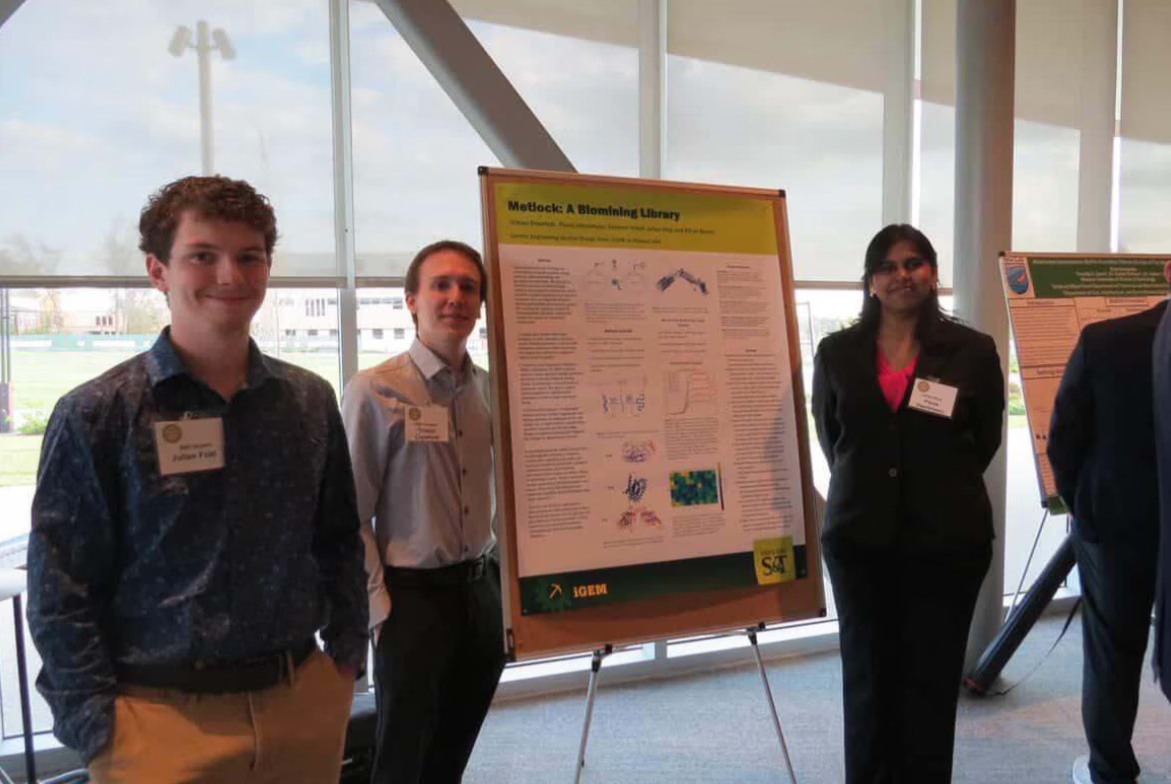
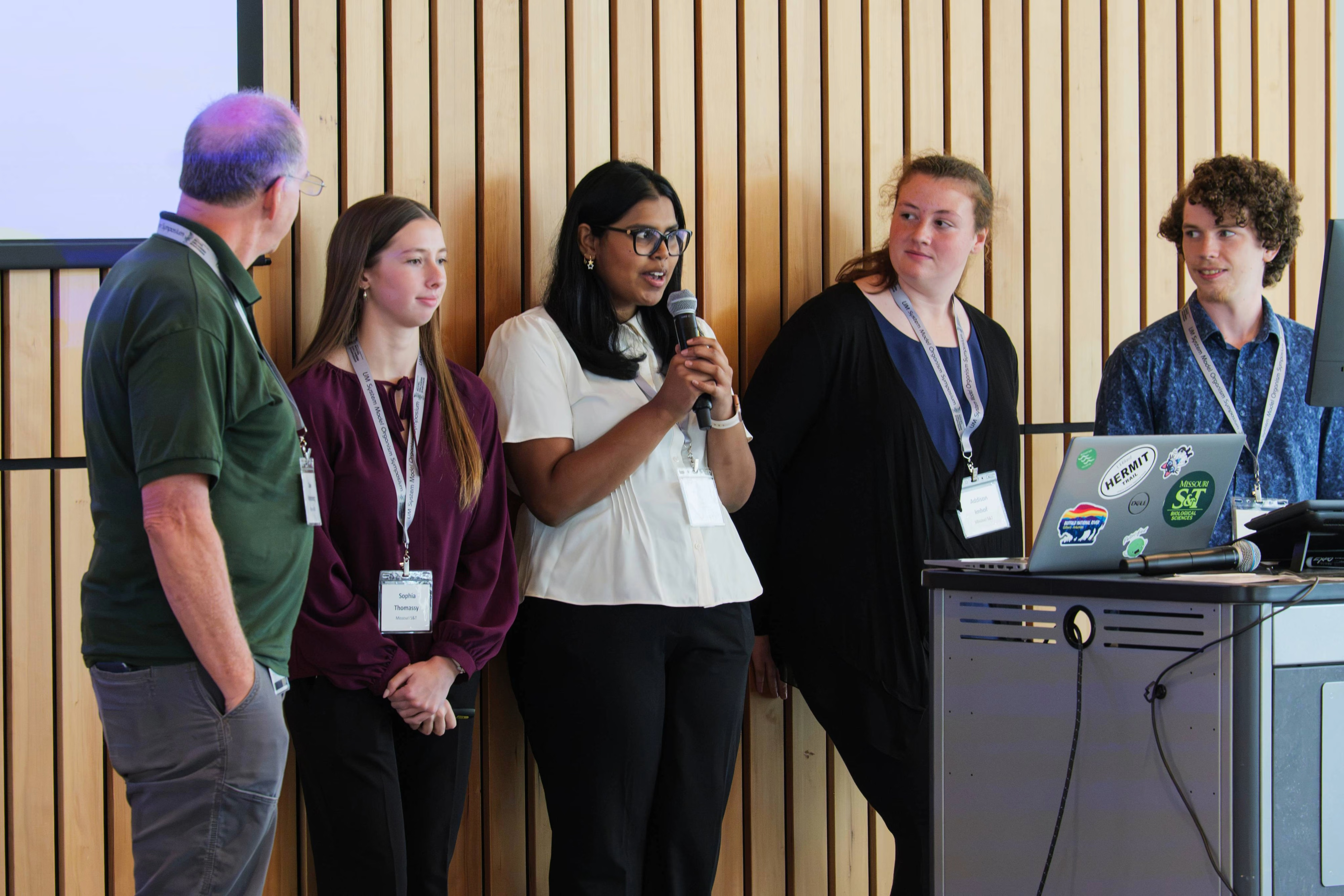
We also participated in the UM System Model Organism Symposium on October 1–2, 2026. The event gave us an opportunity to present our research to researchers working with different genetic and experimental systems and to learn about related work across the University of Missouri System. This exchange forms part of our effort to expose Metlock to perspectives beyond the immediate team and to build relationships that could support further discussion.
The TJunnel Mural And Campus Visibility
Our campus engagement also included an art installation in the TJunnel, a frequented space at Missouri S&T. Working through a Residential Hall Association contest, the team submitted a design, received approval, and painted the space. We started painting on April 21 and finished on April 23.
The mural was intended to make iGEM and the team more visible in everyday campus life and to invite interest in getting involved. Alongside the KMNR interview, it illustrates how we used familiar local spaces and media to introduce the people and purpose behind Metlock.