ENGAGEMENT / INCLUSIVITY
Header logo
Dry lab
Engagement
Human Practices submenu
Human Practices
Inclusivity
Throughout our project, we considered our choices carefully to make our work inclusive to people of diverse backgrounds. At reGELerate, we believe that everyone willing should have equal access to knowledge and feel included whenever they attend a scientific event.
The two prime examples of our steps towards project inclusivity are our Project Promotion Video and the UK/EU Mini Jamboree.
Traversing language barriers to diversify knowledge accessibility
English dominates scientific communication, yet non-native English speakers with low English proficiency need 91% more time than native speakers to read a scientific paper in English (Amano et al., 2023). Language barriers are an important limiting factor in grasping knowledge. Recognising the significance of this issue, we wanted to enhance our project’s accessibility by adding a wide range of subtitles to our Project Promotion Video.
26
languages in the subtitles of our Project Promotion Video
24
people, including reGELerate members, wrote the subtitles
17
contributors were completely new to our project, aged from their teens to their fifties
We began with the largest language groups and, for each language, asked a speaker close to our project’s network or connected to our team.
Read more
We set out to gather as many languages as possible, starting with the largest language groups. For each language, we made sure to approach speakers close to our project’s network or connected to our team members in some way. As a result, we got 24 people, including reGELerate members, to write subtitles in 26 languages: Arabic, Bengali, Cantonese, Czech, Dutch, English, French, German, Hindi, Hungarian, Italian, Korean, Lithuanian, Malay, Mandarin, Persian, Polish, Portuguese, Romanian, Russian, Spanish, Tamil, Turkish, Urdu, Ukrainian and Welsh.
New people, new languages
The subtitles brought 17 people new to our project on board, from teenagers to people in their fifties, and were a way to show how much we value their languages and cultures.
Read more
Not only did we make reGELerate more accessible, but we also involved 17 people, aged from their teens all the way to their fifties, who were completely new to our project. We hope this initiative made these people, including our very own iGEM teammates, appreciate how much we value their individual cultures and languages. This was evident in our interaction with our PI, Dr Manka, who kindly contributed the Polish subtitles to our video.
“Thank you for including my mother tongue.”
Dr Manka, our PI, after contributing the Polish subtitles
Separating Cantonese and Mandarin
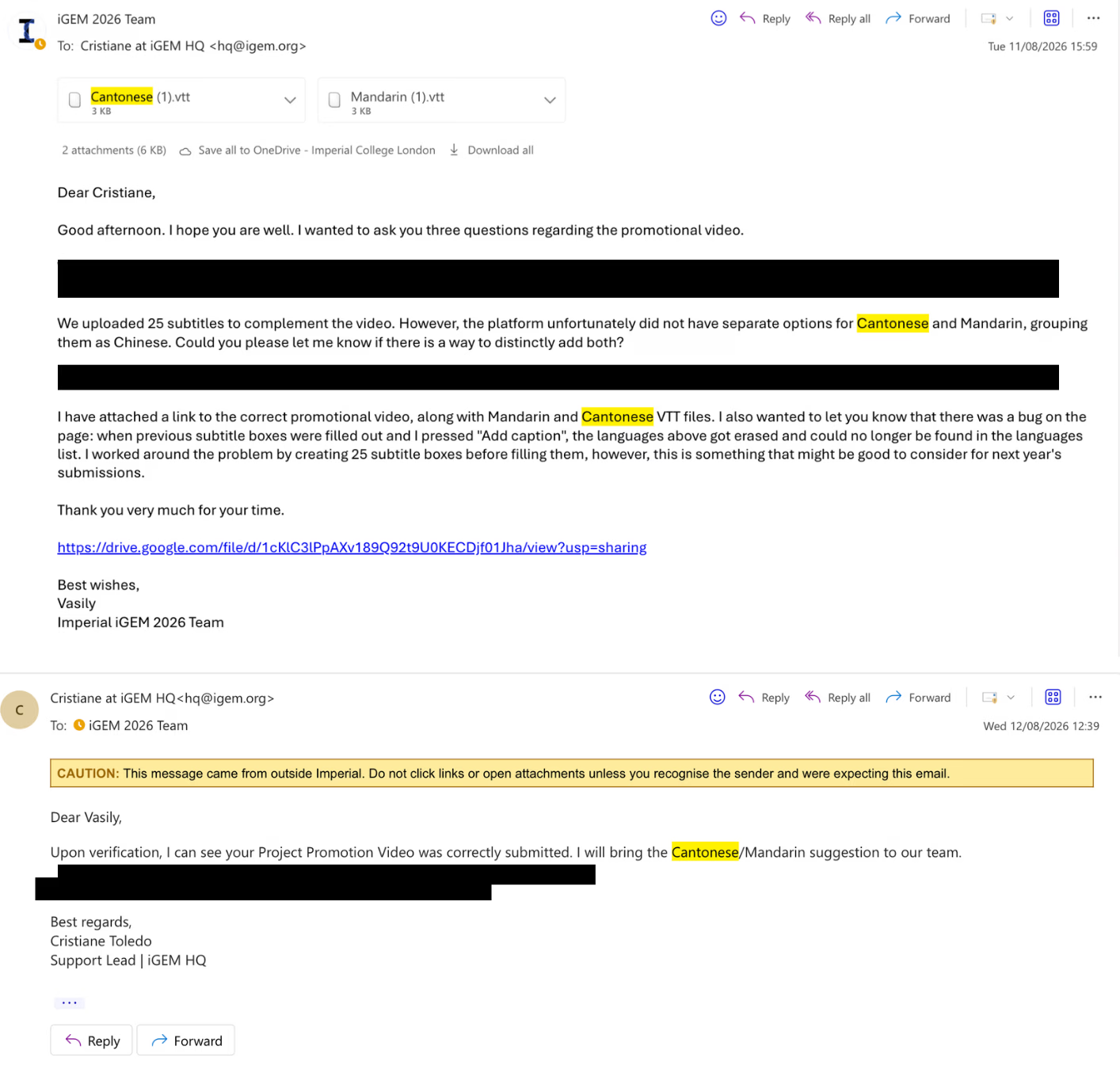
iGEM’s subtitle upload grouped Cantonese and Mandarin together as Chinese. We asked iGEM HQ to list them separately and reported a bug in the upload, and their Support Lead offered to take our suggestion forward.
Read more
Something interesting we discovered is that the subtitle upload options for iGEM’s Project Promotion Video did not list Cantonese and Mandarin separately, grouping them as Chinese. The platform also did not let us create two uploads for the Chinese subtitles. Recognising the importance of representing both Mandarin- and Cantonese-speaking populations, and feeling a close connection with both groups represented in our team, we reached out to iGEM HQ and asked them to make both languages separately available.
Alongside the subtitle suggestion, we shared information about a bug in the subtitle upload, to help iGEM teams uploading their videos next year. We received a positive response from Cristiane Toledo, a Support Lead at iGEM HQ, who kindly offered to bring our suggestion to the iGEM leadership team.
Mandarin subtitles with Fudan iGEM
We carried this consideration of multilingual diversity into our educational and informational resources through our collaboration with Fudan iGEM, asking their team to create accurate Mandarin subtitles for our educational videos on equipment use. You can read more about this initiative on our Collaborations page.
Where our subtitle languages are spoken
Each green country or territory has at least one of our 26 subtitle languages as an official, national or working language. Hover over a country, or tap it on a phone, to see which languages are spoken there, or pick a language to see where it is spoken.
Taking steps towards an inclusive intercultural conference
In August, we organised a UK/EU Mini Jamboree, attended by 90 people. We wanted to diversify the perspectives represented at our event and prioritised inviting European teams as much as we did UK teams. The result was pleasing: the largest international attendance of any UK iGEM meetup we are aware of, with 6 international teams from France, Germany and Spain.
90
people attended our UK/EU Mini Jamboree in August
6
international teams, from France, Germany and Spain
Free
to attend, so the event was open to people of varied financial backgrounds
Bringing in new perspectives
We also invited Cambridge iDEC and Eton College’s high school iGEM team, so undergraduate, high school and non-iGEM teams from four countries could learn from one another on equal footing.
Read more
We also invited Cambridge iDEC, offering them an opportunity to learn more about iGEM and share their related work. At the end of the event, Cambridge iDEC thanked us for the invitation and expressed strong interest in the human practices component of iGEM, which iDEC currently lacks. We also invited Eton College, a high school iGEM team, to offer them the same experience that undergraduate teams receive.
By bringing together undergraduate, high school and non-iGEM teams from four countries, we created a space where participants at every stage of their scientific journey could learn from one another on equal footing. For Eton College, this meant taking inspiration from university teams and engaging in meaningful conversation, while for Cambridge iDEC, it opened a door to iGEM’s human practices approach that could shape their future work.
Travel and cost
With multiple experienced travellers on our team, we used their guidance to support certain teams, helping them choose the safest areas to stay close to the event venue and find travel routes with optimal costs. Naturally, we made the event itself free, to maximise participation, which was already limited by transport fees, and to make it accessible to people of varied financial backgrounds.
Representation
Careful planning went into the event to establish an inclusive environment. We actively sought gender diversity across our speakers, judges and panel.
Making everyone feel welcome
Making everyone feel welcome was another priority of ours. For this, we did four things.
1. Personalised lanyards
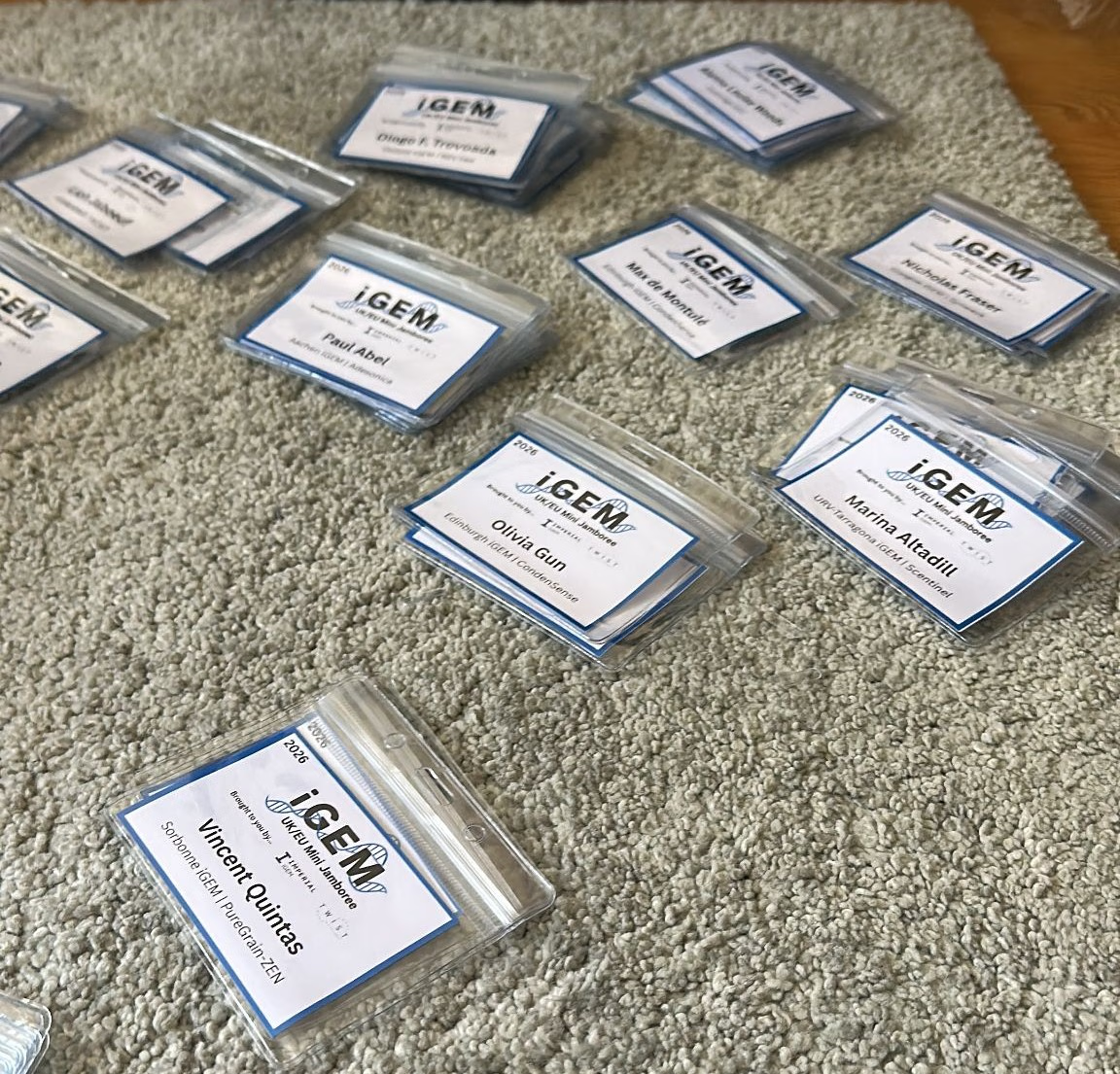
Every attendee got a lanyard with their name and affiliation to keep, to help everyone feel equally welcome and make it easier to start a conversation with another team.
Read more
We designed and created personalised lanyards for all attendees, showing each person’s name and affiliation. They were given out at the start of the day and were theirs to keep as mementos. We wanted each participant to feel welcome and equally important. We also felt that lanyards with names and affiliations would lower social barriers, making it easier for teams to approach each other and talk, and encouraging exciting idea exchange, discussion and new relationships.
2. An hour-long breakfast
We started the conference with an hour-long breakfast session, easing attendees into an information-heavy day that included a stressful pitching session. We hoped this would help participants open up by building new connections and feel more comfortable stepping outside their own team’s group.
3. Posters for the breaks
We created a feedback poster, a questionnaire poster and a poster where teams showed where they came from by sticking a pin into a map. These posters engaged participants during breaks and gave shier participants a chance to take a break from social interaction. The map activity celebrated diversity and representation.
Food for every diet
For dietary requirements, we placed orders that included halal, vegan and gluten-free options for both breakfast and lunch. Unfortunately, due to an issue with catering communication, a vegan option was unavailable at lunch. We extend a sincere apology to all the attendees affected by this issue.
Joining online
A live Teams stream let iGEMers who could not travel follow the day. When AV issues cut the visuals, we matched the slides to the audio and published the whole event on YouTube.
Read more
We made the Jamboree available online through a live Teams stream for all interested iGEMers who could not attend for reasons such as cost, schedule clashes or distance. At one point during the event, we had AV issues, which left parts of the day without visuals. To solve this and keep the event accessible to everyone interested, we aligned the slides from the presentations with an audio track and published the entire event on our YouTube channel.
A picnic and a campus tour
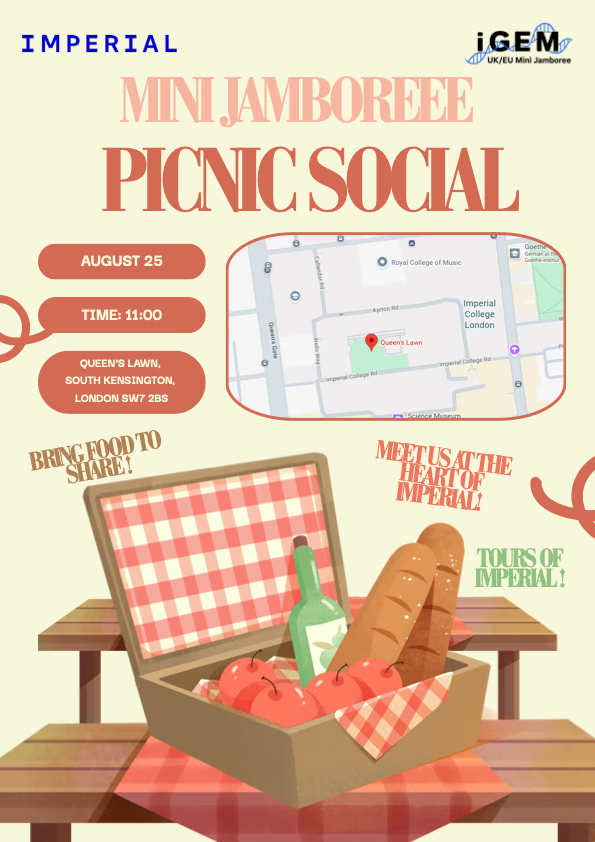
To welcome our guests, especially teams from outside London, we hosted a picnic at Imperial’s South Kensington campus and gave the teams a tour of the campus.
Read more
Finally, as hosts, we strongly felt that we should connect further with our guests, particularly teams from outside London, and make them feel welcome in our city. For this reason, we organised a friendly picnic at Imperial’s primary South Kensington campus. Multiple teams brought snacks and refreshments, and we had meaningful discussions about our work and our lives beyond it, sharing and connecting over our iGEM experiences.
Our team also arranged a tour of Imperial’s campus for the teams, showing them our facilities and telling them more about the university, particularly for those interested in pursuing postgraduate study at Imperial or joining one of its research powerhouses.
Surveying for issues around the iGEM Competition
In the questionnaire we distributed during the UK/EU Mini Jamboree, every free-text answer on improving iGEM concerned cost: lower registration fees, transparency about competition costs, and a better sponsorship framework for fairer competition. We had already kept our event free and advised visiting teams on affordable travel, but these responses show that the barrier sits at the level of the competition itself.
We fully recognise how tall a barrier iGEM’s costs are, and this was one of the reasons we created our Fundraising Guide, designed to help new iGEM teams handle all the costs and truly enjoy the iGEM experience to the fullest.
Making our wiki more accessible
To assist all our viewers with colour blindness, we created an accessible colour mode for our wiki, which can be toggled on and off at the top right corner of the wiki page, with the switch appearing as a circle with a light and a dark half. This feature is currently in its beta version and may not be functional for all of the wiki’s elements. We apologise for any inconvenience to the colourblind users wishing to use this feature.
References
- [1]Amano, T. et al. (2023) ‘The manifold costs of being a non-native English speaker in science’, PLOS Biology, 21(7), e3002184. Available at: https://doi.org/10.1371/journal.pbio.3002184 (Accessed: 13 October 2026).View source ↗