Why Think About Implementation at This Stage?
Developing a therapeutic concept is not only about demonstrating that it works in a laboratory. A molecule can successfully degrade its target in vitro and still fail to become a viable treatment because it cannot reach the tumor, cannot be manufactured consistently, is unstable during storage, causes unacceptable toxicity, or cannot be administered effectively.
For this reason, implementation has been an integral part of AETh3R from the beginning, since we are designing a potential therapeutic system that must eventually address the entire path from molecular design to patient treatment. Early consideration of implementation allows us to identify potential translational barriers before investing in a prototype that may be difficult or impossible to develop further.
What Problems Does Our Product Address?
Non-Small Cell Lung Cancer (NSCLC) treatment has advanced considerably through targeted therapies and immunotherapies, yet treatment resistance and disease progression remain important clinical challenges. These clinical barriers we have identified have consistently driven our project design to ensure optimal translatability: (see our DESCRIPTION page)
AETh3R explores targeted protein degradation as an alternative therapeutic modality with potential to address key resistance mechanisms “disarming” conventional inhibitors.
Combination treatment targeting KRAS and MDM2 is a direct response to clinical insight and expert feedback highlighting combinatorial therapies as a necessary response to cancer adaptability and polyclonality, a core issue in NSCLC.
Our targeted lipid nanoparticle delivery system addresses one of the central translational challenges of peptide-based intracellular therapeutics: selectively sequestering the active molecule to its site of action, whilst sparing healthy tissues.
Key Implementation Milestones
Thinking about implementation early allows us to define what evidence would actually be needed for AEThER to progress beyond proof-of-concept. We therefore envision AETh3R continuously developing through the following implementation stages, each one generating crucial information that feeds back into the core design on the therapeutic and guiding its future iterative evolution:
-
1. Therapeutic design
Selection and optimization of the peptide PROTAC, target and E3 ligase-recruitment strategy.
-
2. Delivery optimization
Development of an LNP capable of efficiently encapsulating, protecting and delivering the peptide.
-
3. In vitro proof-of-concept
Demonstration of cellular uptake, target engagement, target degradation and downstream antitumor effects.
-
4. Formulation optimization
Optimization of potency, stability, reproducibility and other relevant physicochemical properties.
-
5. Preclinical development
Evaluation of pharmacokinetics, biodistribution, pharmacodynamics, efficacy and toxicity in appropriate models.
-
6. Manufacturing development
Establishment of scalable and reproducible production under appropriate pharmaceutical quality standards.
-
7. Clinical development
Progression through Phase I, II and III clinical trials to establish safety, dosing and efficacy.
-
8. Continued evaluation
Long-term monitoring of safety, efficacy, resistance and opportunities for further formulation improvement.
Safety, Ethics & Responsible Implementation
In our research project on NSCLC, we are developing a therapeutic concept that combines targeted protein degradation with nanoparticle-based delivery. While our approach aims to address important limitations of existing cancer therapies, we recognize that developing a new therapeutic strategy also introduces important questions regarding patient safety, biosafety, ethics, environmental responsibility, and regulatory compliance. For this reason, responsible implementation has been a fundamental consideration of our project from the beginning, rather than a requirement to be addressed only once our prototype is complete.
We believe that scientific progress must be accompanied by integrity, transparency and accountability. Throughout the development of AEThER, we have therefore considered not only whether our proposed therapeutic could work, but also the conditions under which it could be developed and eventually used responsibly. This has guided our decisions regarding experimental design, laboratory safety, the selection of appropriate models, potential risks associated with our delivery system, and the evidence that would be required before any future transition towards clinical development.
For our team, safety and ethics are therefore not separate from scientific progress, but part of what defines successful research. AEThER should only move forward when the evidence, safety considerations, and ethical framework are strong enough to justify the next step.
From the Lab to the Patient
Defining Our Target Market
Global incidence, molecular prevalence and the addressable market for AETh3R.
Read more →Who Are the End Users?
The three operational tiers of our commercial ecosystem, from B2B partners to patients.
Read more →Defining Our Target Market
Lung cancer is the most commonly diagnosed cancer worldwide, accounting for 12.4% of all global cancer cases with nearly 2.5 million new cases and over 1.8 million deaths reported in 2022 [1]. NSCLC constitutes the vast majority of these cases, representing 80% to 85% of all diagnoses. As the primary driver of global cancer morbidity and mortality, lung cancer was responsible for nearly one in five (19.1%) cancer deaths worldwide [2], with its annual mortality exceeding that of colon, breast and prostate cancers combined.
Moreover, lung cancer shows striking geographic variation in its gender gap. Male-to-female ratios range from roughly 1:1 in Northern America and Northern Europe to as high as 5:1 in Northern Africa and Eastern Europe, largely tracking historical regional tobacco use [1].
The disease predominantly impacts older adults, with a median age at diagnosis of roughly 70 years [3]. Patient prognosis remains sharply dependent on the stage at detection. Only 22% of cases are identified while localised; conversely, over half (53%) are diagnosed after distant metastasis, where 5-year survival drops below 10% [4]. Even among patients undergoing surgical resection, 5-year recurrence rates escalate from ~29% in stage IA to nearly 60% in stage IIB, with relapses predominantly occurring as distant metastases [5].
NSCLC mortality has dropped significantly over recent years due to declines in smoking rates alongside major therapeutic advances. Yet it remains exceptionally difficult to treat in advanced, recurrent or metastatic stages, due to its biological complexity. This is compounded by treatment toxicity, late-stage diagnosis, comorbidities and high costs. Consequently, we identified an urgent unmet need for novel, highly selective therapeutic modalities that can overcome resistance mechanisms, improve survival and minimise systemic toxicity and treatment burden, while delivering cost-effective production and scalable manufacturing feasibility.
The global NSCLC market represents a massive commercial and clinical opportunity. With NSCLC representing ~85% of all cases [6], global incidence stands at roughly 2 million new patients per year [7], defining the Total Addressable Market (TAM). Financially, the NSCLC therapeutics market across the seven major markets (US, EU4, UK, Japan) was valued at approximately USD 33 billion in 2025 and is projected to reach USD 67 billion by 2036 [8], with broader estimates for all global lung cancer therapeutics spanning USD 46.7 billion in 2026 to USD 141.2 billion by 2036 [9].
Refining this landscape to a molecularly defined Serviceable Available Market (SAM), KRAS mutations occur in 25–35% of newly diagnosed NSCLC cases overall [10], reaching 37.2% to 40% in large adenocarcinoma cohorts [11][12]. Additionally, MDM2 amplification is observed in 3.5% to 7% of tumours in large NGS pan-cancer datasets [13][14] and up to 21% in surgical cohorts [15]. Applying these molecular prevalence rates to the total annual incidence yields a SAM of approximately 500,000 to 700,000 patients per year globally [7][11][10][15][14].
AETh3R's Serviceable Obtainable Market (SOM) focuses on advanced, resistant or refractory NSCLC patients unserved by current standard-of-care options. Currently FDA-approved KRAS inhibitors exclusively target the G12C mutation [16], which accounts for only ~40% of KRAS mutations in NSCLC [11]. This leaves ~60% of KRAS-mutated patients, specifically those harbouring G12D/V and other non-G12C variants, without an approved targeted therapy [16]. Moreover, even among G12C-treated patients, response rates remain limited due to intrinsic and acquired resistance mechanisms [17]. By targeting non-G12C KRAS variants and MDM2-altered tumours in the advanced setting, AETh3R's realistic launch SOM captures a global population in the low hundreds of thousands of patients annually, unlocking a multi-billion-dollar commercial opportunity within the targeted NSCLC landscape.
Who Are the End Users?
Our final product is a novel, dual-targeting therapeutic platform comprising de novo peptide-PROTACs (p-PROTACs) that simultaneously target two critical oncogenic drivers in NSCLC: mutant KRAS and MDM2. The target user base and commercial ecosystem for AETh3R span three distinct operational tiers.
- At the primary tier, our direct business-to-business (B2B) customers are biopharmaceutical and biotechnology companies specialising in oncology and targeted protein degradation (TPD). Because early-stage drug discovery is increasingly outsourced or out-licensed to bypass small-molecule limitations and degrade previously "undruggable" targets such as mutant KRAS and MDM2, these partners will in-license the p-PROTAC candidates for downstream optimisation, preclinical validation, clinical trials and regulatory filings.
- At the secondary tier, Contract Development and Manufacturing Organisations (CDMOs) and commercial-stage pharmaceutical partners license the intellectual property (IP), production rights and know-how from AETh3R to scale manufacturing and distribute the therapeutic through specialised healthcare supply chains.
- Finally, at the clinical tier, once the therapy receives regulatory approval and hospital integration, the direct clinical users are specialised oncology care teams, including medical oncologists, molecular pathologists and clinical pharmacists. The end users are patients with NSCLC who will be administered the treatment following medical recommendation. It is important to note that our target patient population was discussed with Pfizer stakeholders, whose industry perspectives reaffirmed the relevance of the patient population and unmet clinical needs identified for AETh3R (see our Human Practices page).
From Production to Patient
Manufacturing & Production Conditions
The final AETh3R product would combine a peptide PROTAC with an LNP delivery system. Its production would therefore involve several interconnected stages, all of which would need to follow appropriate Good Manufacturing Practice (GMP) standards. The peptide component would require controlled synthesis, purification, and structural characterization. The LNP formulation would require controlled manufacturing of parameters such as lipid composition, peptide-to-lipid ratio, particle size, polydispersity, surface charge, peptide loading, and encapsulation efficiency, with a reproducible scale-up method such as microfluidic mixing. [18]
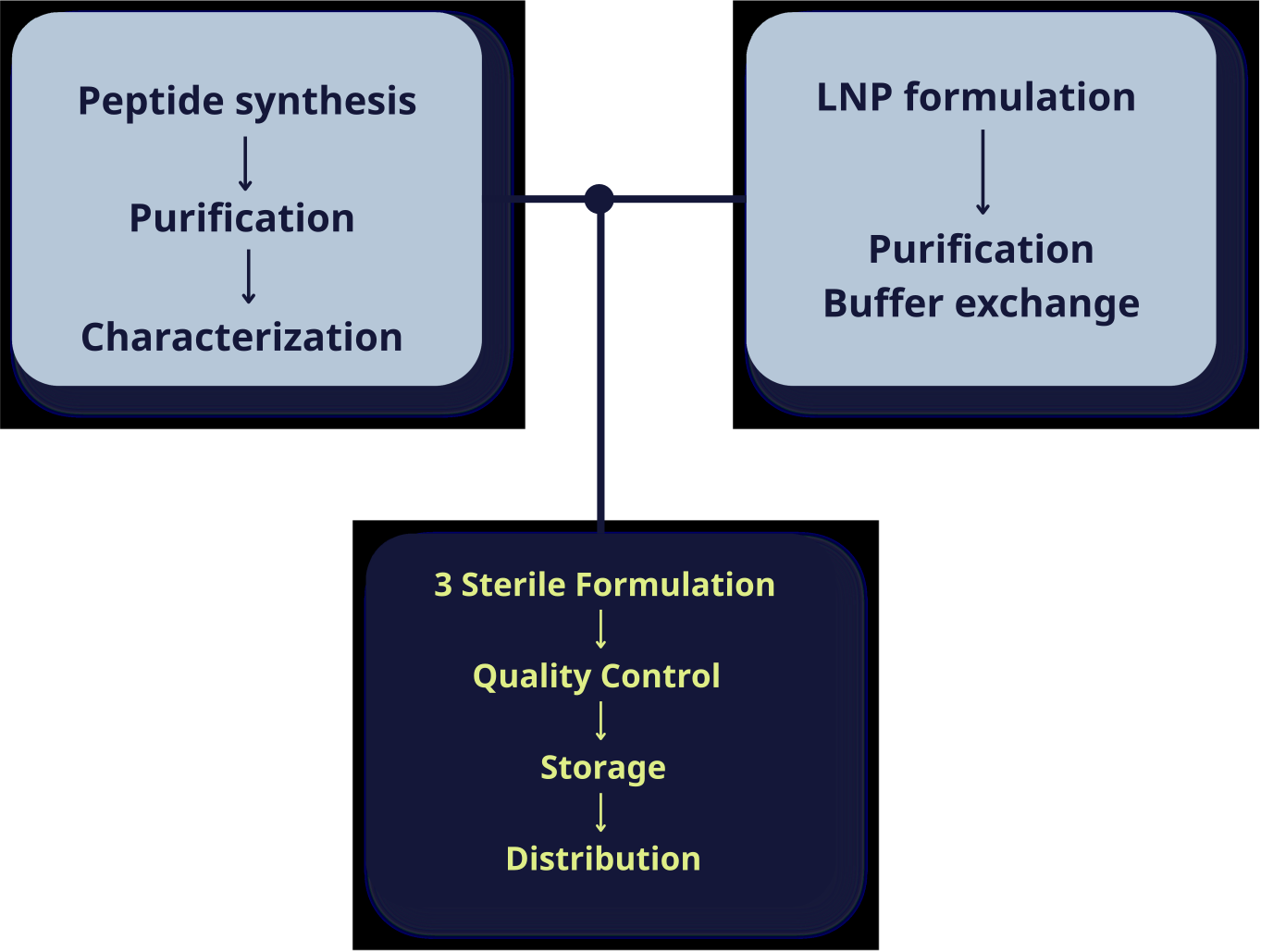
However, a formulation that performs successfully at laboratory scale cannot automatically be transferred to pharmaceutical-scale production. Scale-up would therefore require the manufacturing process to maintain the physicochemical and biological characteristics of the formulation while increasing production volume. Process parameters would need to be optimized, controlled, and validated before clinical manufacturing.
Batch-to-batch consistency would be essential to ensure that patients receive a product with predictable characteristics. For that reason, the final product would need predefined critical quality attributes (CQAs) such as particle size and size distribution, polydispersity, surface charge, peptide loading and encapsulation efficiency, peptide integrity, lipid composition, purity, aggregation, sterility, endotoxin levels, potency, and target degradation activity.
Delivery & Maintenance
The final storage conditions would be established experimentally through comprehensive stability studies assessing peptide and LNP integrity, aggregation, temperature sensitivity, freeze–thaw stability, and robustness during transportation. Based on the storage requirements of currently available LNP-based therapeutics, maintaining a cold chain would likely be necessary, and available data on Moderna’s SM-102-based LNPs point towards a storage temperature of 4°C. [19] However, the appropriate storage temperature and shelf life cannot be defined at this stage and would only be established following sufficient stability data to demonstrate product integrity and performance under the proposed conditions.
Dose Optimization & Administration
The therapeutic dose cannot be determined directly from an in vitro concentration. Instead, dose selection would progress from cellular experiments to animal studies and finally to human clinical trials. The objective would be to identify a dose that produces sufficient target degradation and therapeutic activity while remaining within an acceptable safety margin. Repeated dosing will be required, with pharmacokinetics and pharmacodynamic activity informing the time intervals between subsequent administrations, and the appropriate dosing schedule depending on in vivo data and the individual response of patients to the drug.
The administration route would be selected according to the pharmacokinetic, biodistribution, and safety characteristics of the final formulation. Intravenous administration could provide controlled systemic exposure and is a robust potential route for an initial formulation. Pulmonary administration could also be investigated in some cases, however this route introduces additional challenges, including cough reflexes, mucus barriers, lung clearance, particle deposition, and dose reproducibility, not to mention a strong dependence on tumor localization within the lung or peripheral tissue metastases, which is why we and the stakeholders we consulted have opted against it. [20]
Risks, Limitations & Safety Profile
Comparative Safety and Risk Model
In the absence of clinical data, evaluating worst-case safety scenarios is vital for guiding Investigational New Drug (IND)-enabling preclinical studies and establishing safety margins. Due to the fact that our dual p-PROTAC therapeutic approach combines MDM2 and KRAS degradation with a targeted lipid nanoparticle (LNP) delivery system with Integrin avβ6 targeting, its safety profile reflects overlapping biological mechanisms.
To construct a comprehensive risk model, we analyzed clinical safety data across adjacent classes: clinical-stage MDM2 antagonists, FDA-approved KRAS inhibitors, the first FDA-approved PROTAC, LNP-formulated therapeutics, a clinical-stage KRAS G12D PROTAC, and a first-in-class, humanized anti-αvβ6 IgG1 monoclonal antibody.
Table 1 outlines the treatment-related adverse events (TRAEs) and underlying mechanisms of these benchmark therapeutic classes alongside the specific engineering features built into our system to mitigate these risks.
| Drug class / agent | Adverse effects | AETh3R mitigation |
|---|---|---|
| Clinical-stage MDM2 inhibitors (brigimadlin, milademetan) [5][21][22][23][24] |
Gastrointestinal (all-grade): high-frequency nausea, vomiting, fatigue, decreased appetite, diarrhoea, dysgeusia. Haematological (grade 3/4): thrombocytopenia, neutropenia and anaemia. |
Targeted delivery: Fab′ functionalisation and DOTAP-mediated lung targeting aim to promote preferential LNP delivery to NSCLC tumour tissues, which may reduce exposure in non-cancerous tissues such as bone marrow and intestinal epithelium. Catalytic degradation: rapid catalytic target degradation followed by clearance may allow effective depletion at lower or less frequent dosing, potentially narrowing the window of systemic p53 activation in normal progenitor cells. |
| FDA-approved KRAS inhibitors (sotorasib, adagrasib) [25][26][27][28][29][30] |
Gastrointestinal (all-grade): diarrhoea, nausea, vomiting, decreased appetite. Systemic, renal & pulmonary: fatigue, musculoskeletal pain, blood creatinine increases, and interstitial lung disease (ILD)/pneumonitis, which is uncommon but can be fatal. Hepatotoxicity: affects 25–37% of patients, ALT/AST elevations. Total burden: overall TRAEs in about 70% of patients on sotorasib and 94–97% on adagrasib; grade 3 or higher events in about 33% on sotorasib and about 45–47% on adagrasib. |
Targeted delivery: Fab′-functionalised LNPs incorporating DOTAP-mediated lung targeting are designed to promote preferential delivery to NSCLC tumour tissues, with the aim of limiting exposure in healthy tissues, particularly the liver. Preclinical in vivo evidence of reduced hepatic uptake and enhanced delivery to target tissue with antibody-guided LNPs supports the rationale for this strategy. Catalytic degradation: rapid catalytic target degradation followed by clearance may allow effective depletion at lower or less frequent dosing, potentially reducing systemic exposure and overall treatment burden. |
| First FDA-approved PROTAC (vepdegestrant; oral tablet) [31][32] |
Low-grade systemic: primarily grade 1/2 fatigue, nausea, constipation and musculoskeletal pain. Asymptomatic grade 3/4: infrequent grade ≥3 ALT/AST elevations (<5%) and grade 3 QT interval prolongation. |
p-PROTAC selectivity: peptide-based protein–protein interaction (PPI) recognition may improve target selectivity and reduce off-target binding and associated systemic toxicities. Targeted delivery: encapsulation of p-PROTACs in Fab′-functionalised, DOTAP-containing lung-targeted LNPs aims to improve cellular delivery, protect against serum degradation, and enhance accumulation in NSCLC tissue while reducing systemic exposure. |
| FDA-approved LNP therapeutics (patisiran/Onpattro, intravenous infusion; Pfizer–BioNTech and Moderna COVID-19 mRNA vaccines, intramuscular injection) [33][34][35] |
Infusion-related reactions (IRRs): flushing, back pain, nausea, abdominal pain, dyspnoea and headache (Onpattro); acute localised (injection-site pain/swelling) and systemic reactogenicity (fever, fatigue, myalgia, headache) for the COVID-19 mRNA vaccines. Immunogenicity: Onpattro — low-level anti-drug antibodies targeting the surface lipid component (PEG2000-C-DMG) detected in 3.6% of patients, with low, transient titres and no observed impact on clinical efficacy, safety or pharmacokinetics. mRNA vaccines — low-to-moderate induction of anti-PEG IgM/IgG antibodies following repeat booster doses. |
Targeted delivery: Fab′ functionalisation and DOTAP-mediated lung targeting are intended to favour the concentration of LNPs in target tumour tissue, which may reduce systemic macrophage uptake, peak blood concentrations, complement activation and cytokine-driven IRRs. LNP optimisation: lipid formulation optimisation aims to balance particle stability and circulation while minimising accelerated blood clearance (ABC), complement activation-related pseudoallergy (CARPA) and anti-PEG immune responses. Catalytic efficiency: the catalytic mechanism of p-PROTACs is expected to lower the required lipid dose and frequency, which should limit total lipid accumulation and the risk of anti-PEG antibody generation across repeated cycles. |
| KRAS G12D PROTAC in clinical development for NSCLC (setidegrasib; intravenous infusion) [36][37] |
Results from Phase I study: infusion-related reactions (mainly urticaria, pruritus, rash), nausea, increased alanine aminotransferase levels. | Targeted delivery and LNP optimisation: encapsulation of p-PROTACs in LNPs with optimised lipid formulation, Fab′ functionalisation and DOTAP-mediated lung targeting aim to improve cellular delivery and protect against serum degradation. Intended effects also include enhancing accumulation in NSCLC tissue while reducing nonspecific macrophage uptake and systemic exposure, and limiting complement-mediated and cytokine-driven IRRs. p-PROTAC selectivity: peptide-based protein–protein interaction (PPI) recognition is expected to improve target selectivity and reduce off-target binding and associated systemic toxicities. |
| BG00011 (payload-free, humanised, function-blocking anti-αvβ6 antibody in clinical development) [38][39][40][41] |
Results from Phase IIa study: Pulmonary: deteriorated respiratory status, most frequently cough, dyspnoea and hypoxia (overlapping with disease symptoms under treatment, and not separable from them with confidence). Cutaneous reaction: rash. Immunogenicity: anti-drug antibody formation, immune complex deposition and hypersensitivity on re-exposure (properties of an administered humanised immunoglobulin, independent of any payload by definition). |
Non-blocking targeting module: the attributable adverse effects come from an antibody chosen to occupy the pocket and suppress TGF-β1 activation. Our antibody is designed to bind outside the ligand-binding pocket and is therefore not expected to reproduce BG00011's pharmacological action. Minimal targeting-module exposure: the module is a monovalent fragment without an Fc domain, present only in the quantity required to decorate a particle surface. BG00011, by contrast, was given repeatedly at doses intended to saturate the receptor pool in tissue. |
Table 1: Comparative safety and risk model for AETh3R.
Integrated Worst-Case Scenario Analysis
In a hypothetical worst-case safety scenario, AETh3R could exhibit overlapping toxicities associated with its therapeutic components and LNP delivery platform. Pharmacological disruption of the MDM2–p53 pathway has been associated with hematological and gastrointestinal toxicities in clinical studies of MDM2 inhibitors, supporting concern that p53 pathway activation in healthy proliferative tissues could limit tolerability. However, the safety profile of MDM2 degradation may differ from that of MDM2 inhibition and would require direct evaluation. Similarly, systemic KRAS depletion could potentially disrupt normal cellular functions, although hepatic, renal, and pulmonary injury should be regarded as unconfirmed risks rather than established consequences of KRAS degradation. Furthermore, because targeted protein degraders eliminate target proteins rather than merely inhibiting specific functional sites, AETh3R may produce biological effects that differ from those of conventional inhibitors, highlighting the need to assess degradation selectivity and unintended target loss. The LNP delivery platform may introduce additional risks, including infusion-related reactions (IRRs), complement activation, inflammatory responses, and anti-PEG immune responses. Finally, the αvβ6-targeting antibody fragment could contribute to respiratory or cutaneous reactions and immunogenicity. However, unlike BG00011, the fragment is designed to mediate LNP targeting without blocking αvβ6 function; whether this non-blocking design translates into a distinct safety profile remains to be established.
The combination of these potential liabilities could create a cumulative toxicity burden if AETh3R reaches healthy tissues at exposures sufficient to cause substantial target degradation. Nevertheless, additive or synergistic toxicity across tissues has not been established for AETh3R and should be treated as a hypothesis for preclinical investigation. These possibilities establish the principal safety parameters that must be controlled during dose escalation: where the therapeutic accumulates, how much target degradation occurs, and how long that activity persists.
However, AETh3R is specifically engineered to shift this toxicity landscape away from the broad systemic exposure characteristic of conventional therapies.
Antibody-guided LNP targeting
Antibody-guided LNP targeting is introduced to preferentially direct the therapeutic payload toward NSCLC tissue, with the aim of reducing non-specific exposure of healthy organs and thereby decreasing the probability that MDM2 or KRAS degradation will occur at clinically relevant levels outside the tumor. This spatial restriction directly addresses a central limitation of conventional systemic therapy: the inability to sufficiently distinguish tumor tissue from healthy tissue during drug distribution. This spatial restriction is particularly important for MDM2, where systemic p53 activation can damage healthy bone marrow and intestinal epithelium, and for KRAS, where systemic pathway inhibition can interfere with normal tissue homeostasis.
Selective & catalytic mechanism of p-PROTAC-mediated degradation
The catalytic mechanism of p-PROTAC-mediated degradation provides a second layer of control. Unlike conventional inhibitors that require sustained systemic concentrations to maintain target suppression, p-PROTACs can repeatedly engage their targets and achieve substantial protein depletion without requiring continuous high concentrations of therapeutic molecules. Crucially, achieving robust protein knockdown at lower doses lowers the risk of off-target toxicity, expanding the therapeutic index while lessening the overall systemic burden tied to persistent target occupancy. Following clearance of the active therapeutic, newly synthesized target protein can restore protein abundance over time, providing an additional opportunity to manage toxicity through dose, treatment interval and treatment interruption. Furthermore, peptide-based PPI recognition may enable engagement of broader interaction surfaces and improve target-binding selectivity, potentially limiting unintended protein interactions and off-target degradation. [42]
Optimized LNP dynamics
AETh3R's LNP architecture incorporates lung tropism via optimized formulation dynamics, with the addition of cationic SORT (Specific ORgan Targeting) molecule DOTAP. Informed by established formulation principles and lipid compositions used in FDA-approved LNP therapeutics, AETh3R's formulation will be iteratively optimized during experimental development, with lipid molar ratios adjusted to investigate their effects on biodistribution, organ tropism, particle stability, and tolerability. Combined with the aforementioned antibody-guided tumor targeting, this design is intended to reduce systemic inflammatory and immunogenic liabilities associated with conventional LNP administration, including complement activation and anti-PEG responses. This dual organ- and cell-level spatial restriction provides an additional layer of control over the tolerability of the delivery platform, particularly during repeated administration. [43]
Consequently, the central safety advantage of AETh3R lies not in eliminating individual toxicities, but in controlling where, how much and for how long therapeutic activity occurs. By preferentially concentrating a transient, catalytic degradation event within target NSCLC tissue, reducing the requirement for sustained systemic exposure, and optimizing the tolerability of the delivery vehicle, AETh3R is designed to widen the separation between antitumor activity and healthy-tissue toxicity. This creates a therapeutic framework in which dose, treatment interval and targeting efficiency can be strategically optimized to maximize tumor KRAS and MDM2 depletion while limiting systemic toxicity, resulting in a safety profile that is expected to differ meaningfully from conventional systemic MDM2 or KRAS inhibition.
Finally, it is essential to note that the proposed AETh3R mitigation strategies discussed in this section are hypothetical and based on the project’s design and theoretical mechanism of action. AETh3R has not yet been experimentally validated, and no experimental safety data are available to confirm the proposed benefits. Consequently, it remains untested whether this therapeutic approach will cause the adverse effects outlined above or introduce previously unanticipated adverse effects. Additionally, certain side effects observed with benchmark drug classes may arise from chemical motifs, excipients, or off-target profiles specific to individual agents that are absent from our formulation. On the other hand, first-in-human clinical evaluation of AETh3R may reveal novel adverse effects not captured by this preliminary comparative model. Nevertheless, this theoretical assessment provides a structured benchmark for guiding IND-enabling toxicology studies, informing safe clinical starting-dose selection, and supporting participant safety during early-phase development. Finally, it should be highlighted that our safety evaluation was further informed by our discussions with Dr. Protopapadakis, who stressed the importance of systematically assessing potential risks and validating proposed mitigation strategies before any future clinical application (see our Human Practices page).
Residual Safety Risks & AETh3R Vulnerabilities
Despite the proposed mitigation strategies, AETh3R retains residual safety risks associated with its antibody-targeting mechanism, LNP delivery platform and p-PROTAC-mediated degradation. As AETh3R has not yet been experimentally validated, the following risks remain hypothetical and require systematic preclinical evaluation.
Targeting Limitations and LNP-Related Risks
AETh3R's antibody-guided targeting is designed to preferentially direct LNPs toward target-expressing NSCLC tissue. However, this strategy does not guarantee tumor-exclusive distribution. Integrin αvβ6 may also be expressed at low levels in certain non-malignant tissues. Binding to these tissues could promote unintended LNP uptake and intracellular delivery of the p-PROTAC, potentially resulting in MDM2 and KRAS degradation outside the tumor and exposing healthy cells to unintended on-target toxicity.
A key safety consideration in our proposed LNP formulation is DOTAP, a permanently cationic lipid whose positive surface charge may contribute to cytotoxicity and unintended interactions with biological components during systemic circulation. Importantly, this same cationic character is also central to the formulation’s intended tissue-targeting properties, highlighting a critical trade-off between delivery efficiency and safety. Consequently, the formulation’s safety profile will depend not only on DOTAP’s intrinsic effects but also on the extent to which the LNPs preferentially accumulate in the intended tissue while limiting off-target exposure. Evaluating biodistribution, targeting specificity, and dose-dependent toxicity will therefore be essential to determine whether the potential therapeutic benefits of this delivery strategy can be achieved without unacceptable systemic toxicity.
Moreover, while AETh3R is engineered to avoid non-specific clearance, systemic circulation inevitably exposes a fraction of the formulation to physiological clearance mechanisms. The liver’s fenestrated vasculature drives dominant uptake via mononuclear phagocyte system (MPS) Kupffer cells. Upon systemic contact, LNPs rapidly adsorb plasma proteins to form a protein corona, marking them for phagocytic clearance regardless of targeting motifs.
This residual exposure poses safety considerations, as hepatic LNP accumulation can cause transient transaminase elevations and inflammatory responses, while repeat dosing increases anti-PEG immune recognition. These risks do not negate the targeting strategy, but rather, they define the residual systemic exposure that the design must control. [44]
Modality-Specific Vulnerabilities
Despite the development of engineered solutions aimed at mitigating adverse effects, the p-PROTAC modality retains intrinsic safety vulnerabilities and residual toxicological risks inherent to its mechanism and structure.
On a biological level, although PROTACs are designed for selective target degradation, cross-reactivity or promiscuous binding can induce the degradation of unintended off-target proteins, resulting in tissue-specific toxicity, differential organ responses, or other adverse reactions that compromise their safety profile.
Because the ubiquitin–proteasome system (UPS) has a finite processing capacity, excessive activation or saturation of the proteasome with abundant substrates can overwhelm cellular degradation pathways, triggering cytotoxic cellular stress, activating compensatory pathways, and ultimately compromising cell viability.
Systemic administration also poses safety challenges: potential immunogenicity, particularly with peptidic moieties, can trigger adverse immune reactions, accelerate clearance from circulation, and diminish exposure at target sites.
Co-administration with other medications introduces the risk of drug–drug interactions, which can unpredictably alter the metabolism, clearance and safety profiles of both the PROTAC and co-administered compounds.
Protein degradation can also affect functions beyond a target's canonical catalytic activity. Whereas a conventional inhibitor may block a specific functional site while leaving the protein scaffold intact, complete removal of KRAS or MDM2 may disrupt protein–protein interactions or structural functions within multiprotein complexes. This creates the possibility of broader signalling perturbations that would not necessarily be predicted from inhibitor-based toxicity profiles.
The simultaneous and rapid depletion of MDM2 and KRAS creates dual-targeting liabilities: while synergistically amplifying apoptosis and cell-cycle arrest in tumour cells, this co-degradation can trigger excessive overall cytotoxicity and injure normal proliferating tissues if target engagement is not strictly tumour-selective. Because MDM2 and KRAS represent broadly important survival and regulatory pathways, their concurrent degradation risks overlapping on-target toxicities that cannot be independently dose-adjusted, creating a narrow therapeutic window. During dose escalation, these mechanisms heighten the risk that accelerated tumour clearance translates into localised tissue injury, systemic tolerability limits and unpredictable organ-specific toxicities in human translation [45][46][47].
Importantly, these residual vulnerabilities are precisely the risks that the AETh3R safety strategy is designed to characterise and control through exposure optimisation, target-specificity assessment and tissue-level monitoring.
Contraindications & Patient Exclusion Criteria
To ensure patient safety and maintain a favourable risk–benefit profile, AETh3R requires strict selection boundaries. Because its dual-degradation mechanism targets proteins with essential functions, systemic exposure and target depletion in healthy tissue carry significant toxicological risks, so eligibility criteria must account for the roles of MDM2, KRAS and integrin αvβ6 in normal tissues.
MDM2 acts as the primary negative regulator of p53, and without it unchecked p53 activity causes widespread cellular toxicity and lethality in embryonic and postnatal stages [48]. KRAS is essential for mid-gestation development. Its loss in nonclinical models causes lethality through defects in placenta, heart, fetal liver haematopoiesis and neural survival, while germline dysregulation in humans causes RASopathies with severe cardiac, craniofacial and growth malformations [49][50]. Integrin αvβ6 supports cell–matrix interactions, tissue remodelling and TGF-β1 activation, and is expressed in selected embryonic epithelia, including developing lung, kidney and skin, and in fetal membranes [51][52][53].
The Road Ahead
Developing AEThER into a potential therapeutic would require much more than demonstrating that our peptide PROTAC can degrade its target in a laboratory setting. Our current work represents the beginning of a longer development pathway in which each stage would provide the evidence needed to determine whether the therapy is suitable for further investigation. We therefore envision a gradual progression from in vitro validation to preclinical evaluation, and eventually to clinical development, with safety, efficacy and feasibility assessed throughout the process.
Preclinical Development
In Vitro Studies
A staged route from molecular validation to formulation, intracellular delivery and biological activity.
Read more →In Vivo Studies
Biodistribution, pharmacokinetics, efficacy and toxicity in appropriate animal models.
Read more →In Vitro Studies
Our first experimental priority will be to establish whether our therapeutic concept can achieve the intended effect at the cellular level. First, we will characterise and validate the peptide PROTAC itself, assessing its ability to interact with the selected target and promote its degradation. We will evaluate target engagement and degradation through appropriate protein-level assays, while also examining the stability and specificity of the construct. These experiments will allow us to determine whether our molecular design produces the mechanism of action we intend, by using a less complicated delivery approach such as Lipofectamine 2000 encapsulation.
A crucial step will be to investigate how the peptide interacts with both early liposomal delivery constructs and our mature LNP formulation, following appropriate LNP characterisation and preformulation studies. Since peptide cargoes differ fundamentally from the nucleic acids for which many LNP systems have been developed, efficient association with the nanoparticle cannot simply be assumed. Based on our discussions with Dr. Tsourkas, we will therefore investigate whether the peptide requires the incorporation of a polyanionic (poly-glutamate or poly-aspartate) tail to facilitate electrostatic complexation with the LNP and improve its encapsulation and delivery. We will compare the relevant peptide designs and characterise parameters such as encapsulation efficiency, particle size, polydispersity, surface charge and peptide stability. This step will help us determine whether the peptide itself can be efficiently incorporated into the formulation or whether an additional structural modification is required.
Then, we will evaluate the cellular delivery of the complete PROTAC–LNP system, investigating whether the formulation can be taken up by relevant NSCLC cells and whether the peptide is successfully released intracellularly. Appropriate fluorescence-based uptake studies and microscopy or flow-cytometry analyses could be used to distinguish nanoparticle association from effective cellular internalisation, with the split-GFP strategy employed by Dr. Tsourkas and colleagues being a good candidate assay for confirming endosomal escape and cytoplasmic localisation. Importantly, we will also assess the effects of the LNP formulation alone and appropriate control formulations, allowing us to distinguish the biological activity of the peptide PROTAC from potential effects caused by the delivery system itself.
Next experiments will determine whether successful intracellular delivery translates into the intended therapeutic response. We will measure degradation of the selected target and subsequently investigate downstream effects on NSCLC cell viability, proliferation and apoptosis. Dose-response and time-course experiments will allow us to characterise how the response changes with exposure, while appropriate negative and positive controls will help establish whether the observed effects are target-dependent. We will also compare relevant cancerous and non-target cell models where possible, providing an initial assessment of selectivity and potential off-target toxicity.
Through this staged approach, we aim to move from molecular validation, to formulation, to intracellular delivery, and finally to biological activity. Each stage will provide information for the next: insufficient degradation could require redesign of the PROTAC, poor peptide–LNP association could motivate the introduction of a polyanionic tail, inadequate cellular uptake could require reformulation of the LNP, and nonspecific toxicity could indicate the need to modify either the therapeutic construct or its delivery system. In this way, our in vitro experiments will not only demonstrate whether AETh3R works, but will help us understand which components of the system need to be optimised before progressing towards in vivo evaluation [42].
In Vivo Studies
If AETh3R demonstrates sufficient activity and selectivity in vitro, the next stage would be to determine whether these properties can be maintained within a living organism. Appropriate animal models would be selected to investigate how the formulation behaves in vivo and whether it can reach the tissues relevant to NSCLC. Our approach was complemented by discussions with Dr. Papagianni, whose feedback helped us consider the bioethical requirements, safety metrics and regulatory standards that should guide future in vivo studies (see our Human Practices page).
Initial studies would focus on biodistribution and pharmacokinetics, allowing us to determine where the LNP travels, how long the therapeutic remains available, and whether the intended target tissues can be reached. Pharmacodynamic studies would then examine whether delivery results in the expected target degradation in vivo.
These studies would be accompanied by assessments of therapeutic efficacy and toxicity. We would investigate whether the treatment can produce measurable antitumour effects while maintaining an acceptable safety profile, including evaluation of potential systemic toxicity, immune responses and effects on non-target tissues. Any animal studies would only be undertaken following the appropriate ethical and regulatory approvals and in accordance with the principles of the 3Rs.
The results of these studies would help determine whether AETh3R has sufficient evidence to justify progression towards clinical development. They could also reveal limitations that require us to return to earlier stages of the project, for example by modifying the PROTAC structure, reformulating the LNP or reconsidering the delivery strategy.
Clinical Development
If AETh3R demonstrates acceptable safety and pharmacodynamic activity in preclinical models, its clinical development will be informed by the clinical development pathway used for Vepdegestrant, the first FDA-approved heterobifunctional protein degrader. More specifically, we plan to employ a combined Phase 1/2 dose-escalation and expansion study, followed by a randomized Phase 3 trial against standard of care [54] [55] [57]. Because AETh3R combines two new investigational agents, the program will be designed to show that each agent contributes to the combination’s effect, and FDA will be consulted early on the combination strategy and trial design [56] [58]. Our proposed clinical development pathway was further informed by discussions with Dr. Zairi, whose input helped us consider the regulatory requirements and practical challenges involved in progressing from preclinical evidence to clinical evaluation (See Human Practices Page).
Phase 1/2: Dose Escalation and Expansion
The first-in-human study will be an open-label trial in patients with advanced KRAS-mutant, TP53 wild-type solid tumors whose tumors are αvβ6-positive, using analytically validated biomarker assays [54] [59].
In Part A, the antibody-LNP MDM2 pPROTAC and the antibody-LNP KRAS pPROTAC will be tested separately to identify dose-limiting toxicities and recommended Phase 2 doses [54] [56]. Because MDM2-targeting agents commonly cause low platelet and neutrophil counts, hematologic toxicity will be monitored closely [60]. In Part B, the two agents will be given together, starting from doses cleared in Part A, to find a tolerable combination dose [54] [56]. Infusions will use premedication and step-up dosing to reduce infusion reactions to the lipid carrier, and an independent committee will oversee safety [59] [61].
Paired tumor biopsies before and after treatment will assess target degradation, p53 pathway restoration and MAPK pathway suppression. Blood samples will assess pharmacokinetics and anti-drug antibodies against the peptide cargo and the targeting antibody [54].
Expansion cohorts in NSCLC will then randomize patients between the MDM2 agent alone, the KRAS agent alone, the combination, and standard of care, with objective response rate as the primary endpoint [57] [58]. This design is intended to show whether each agent contributes to the combination’s effect [56] [58].
Phase 3: Confirmatory Efficacy
Phase 3 will be a randomized, open-label trial comparing the combination with standard-of-care treatment in patients with KRAS-mutant, TP53 wild-type, αvβ6-positive NSCLC who have progressed after platinum chemotherapy and a checkpoint inhibitor [62]. Progression-free survival assessed by blinded independent central review will be a primary endpoint [55] [63], with overall survival included in the testing hierarchy, as FDA regards it as the gold standard in NSCLC [63].
Continued Evaluation & Patient-Centered Long-Term Tracking
After potential regulatory approval, long-term safety monitoring and real-world efficacy tracking will be important to ensure that therapeutic benefits translate into a manageable patient experience. Phase IV post-marketing surveillance and non-interventional studies will monitor rare or delayed toxicities in a broader patient population, including potential LNP-related immunogenicity, anti-drug antibody development, and rare organ toxicities, addressing concerns regarding unexpected side effects [64]. Concurrently, real-world evidence (RWE) gathered from electronic health records, claims databases, and registries, alongside integrated Patient-Reported Outcome Measures (PROMs), will help bridge the gap between controlled clinical trials and everyday clinical practice [65] [66]. These complementary approaches may support evaluation of overall survival, treatment durability, safety, and health-related quality of life across diverse patient populations [64] [65].
Finally, to investigate long-term efficacy and potential drug resistance, longitudinal circulating tumor DNA (ctDNA) analysis and tumor biopsies, where clinically feasible, may be used to identify emerging resistance mechanisms [67]. These investigations will examine potential changes in E3 ligases or target proteins and their binding sites, alterations in LNP uptake or intracellular delivery, and changes in ubiquitin–proteasome system (UPS) activity that could reduce target degradation [67] [68]. Because these mechanisms have not yet been established for AETh3R, they will be treated as hypotheses for investigation. Findings from resistance profiling and post-marketing safety surveillance could inform the design of second-generation constructs and guide further optimization of LNP composition, drug stability, and targeted delivery. Any resulting modifications would require appropriate preclinical evaluation and subsequent clinical testing. Through this iterative development strategy, AETh3R could be refined to address emerging resistance, improve tolerability, and potentially reduce treatment burden while maintaining a focus on patient safety and quality of life.

References
Bibliography
- Bray, F., Laversanne, M., Sung, H., Ferlay, J., Siegel, R. L., Soerjomataram, I., & Jemal, A. (2024). Global cancer statistics 2022: GLOBOCAN estimates of incidence and mortality worldwide for 36 cancers in 185 countries. CA: A Cancer Journal for Clinicians, 74(3), 229–263. https://doi.org/10.3322/caac.21834
- Sung, H., Filho, A. M., Laversanne, M., Ferlay, J., Siegel, R. L., Soerjomataram, I., Jemal, A., & Bray, F. (2026, July 8). Global cancer statistics 2024: GLOBOCAN estimates of incidence and mortality worldwide for 34 cancers in 186 countries. International Agency for Research on Cancer. https://www.iarc.who.int/news-events/global-cancer-statistics-2024-globocan-estimates-of-incidence-and-mortality-worldwide-for-34-cancers-in-186-countries/
- American Cancer Society. (2023, January 12). Lung cancer statistics | how common is lung cancer? American Cancer Society. Www.Cancer.Org. https://www.cancer.org/cancer/types/lung-cancer/about/key-statistics.html
- National Cancer Institute. (2024). Cancer of the lung and bronchus - cancer stat facts. National Cancer Institute. https://seer.cancer.gov/statfacts/html/lungb.html
- LoRusso, P., Yamamoto, N., Patel, M. R., Laurie, S. A., Bauer, T. M., Geng, J., Davenport, T., Teufel, M., Li, J., Lahmar, M., & Gounder, M. M. (2023). The MDM2-p53 antagonist brigimadlin (Bi 907828) in patients with advanced or metastatic solid tumors: Results of a phase IA, first-in-human, dose-escalation study. Cancer Discovery, 13(8), 1802–1813. PubMed Central. https://doi.org/10.1158/2159-8290.CD-23-0153
- The Business Research Company. (2026, September 10). The targeted protein degradation oncology (PROTAC) market is projected to grow to $4.15 billion By 2030 fueled. openPR. openPR.Com. https://www.openpr.com/news/4627653/the-targeted-protein-degradation-oncology-protac-market
- Zhou, Y.-J., Zheng, W., Zeng, Q.-H., Ye, Y., Wang, C., Fang, C., Liu, C.-J., Niu, L., & Wu, L.-M. (2021). Targeted exome sequencing identifies mutational landscape in a cohort of 1500 Chinese patients with non-small cell lung carcinoma (NSCLC). Human Genomics, 15(1), 21. PubMed Central. https://doi.org/10.1186/s40246-021-00320-9
- Targeted protein degradation market size and share analysis report. (2023). Insightaceanalytic.Com. https://www.insightaceanalytic.com/report/targeted-protein-degradation-market/2530
- LLP, D. B. R. (2026, September 2). Non-small cell lung cancer market expected to reach USD 67 billion By 2036 - DelveInsight. openPR. openPR.Com. https://www.openpr.com/news/4619863/non-small-cell-lung-cancer-market-expected-to-reach-usd-67
- Lim, T. K. H., Skoulidis, F., Kerr, K. M., Ahn, M.-J., Kapp, J. R., Soares, F. A., & Yatabe, Y. (2023). KRAS G12C in advanced NSCLC: Prevalence, co-mutations, and testing. Lung Cancer, 184, 107293. https://doi.org/10.1016/j.lungcan.2023.107293
- Climent, C., Soriano, S., Lopez, N., Giner, J., Blazquez, M. C., Carrera, R., Sierra, M., Cobo, P., Fragio, M., Busquets, M., Cano, O. C. I., Carrasco, A., Seguí, M. Á., & Vila, L. (2025). Molecular characterisation of KRAS mutations in non-small cell lung cancer across all stages. Ecancermedicalscience, 19, 1914. PubMed Central. https://doi.org/10.3332/ecancer.2025.1914
- Dworakowska, D., Jassem, E., Jassem, J., Peters, B., Dziadziuszko, R., Zylicz, M., Jakóbkiewicz-Banecka, J., Kobierska-Gulida, G., Szymanowska, A., Skokowski, J., Roessner, A., & Schneider-Stock, R. (2004). MDM2 gene amplification: A new independent factor of adverse prognosis in non-small cell lung cancer (NSCLC). Lung Cancer (Amsterdam, Netherlands), 43(3), 285–295. PubMed. https://doi.org/10.1016/j.lungcan.2003.09.010
- Consulting, P. M. R. (2024, November 28). Targeted protein degradation market size worth USD 3531.80 Million By 2034. Polaris Market Research & Consulting, Inc. Polaris. https://www.polarismarketresearch.com/press-releases/targeted-protein-degradation-market
- Shreyas Shirsat. (2026, July 16). Targeted protein degradation market size, industry demand, 2026-2034. Polaris. https://www.polarismarketresearch.com/industry-analysis/targeted-protein-degradation-market
- Kato, S., Ross, J. S., Gay, L., Dayyani, F., Roszik, J., Subbiah, V., & Kurzrock, R. (2018). Analysis ofMDM2Amplification: Next-generation sequencing of patients with diverse malignancies. JCO Precision Oncology, (2), 1–14. https://doi.org/10.1200/po.17.00235
- Reita, D., Pabst, L., Pencreach, E., Guérin, E., Dano, L., Rimelen, V., Voegeli, A.-C., Vallat, L., Mascaux, C., & Beau-Faller, M. (2022). Direct targeting KRAS mutation in non-small cell lung cancer: Focus on resistance. Cancers, 14(5), 1321. https://doi.org/10.3390/cancers14051321
- Rosas, D., Barad, P., Wright, J., & Raez, L. (2026). KRAS G12C-Targeted therapy in non-small cell lung cancer: From resistant salvage to potential first-line backbone. International Journal of Molecular Sciences, 27(14), 6455. PubMed Central. https://doi.org/10.3390/ijms27146455
- Dechbumroong, P., Hu, R., Keaswejjareansuk, W., Namdee, K., & Liang, X. J. (2024). Recent advanced lipid-based nanomedicines for overcoming cancer resistance. Cancer drug resistance (Alhambra, Calif.), 7, 24. https://doi.org/10.20517/cdr.2024.19
- Suzuki, Y., & Ishihara, H. (2021). Difference in the lipid nanoparticle technology employed in three approved siRNA (Patisiran) and mRNA (COVID-19 vaccine) drugs. Drug Metabolism and Pharmacokinetics, 41, 100424.
- Plaunt, A. J., Nguyen, T. L., Corboz, M. R., Malinin, V. S., & Cipolla, D. C. (2022). Strategies to Overcome Biological Barriers Associated with Pulmonary Drug Delivery. Pharmaceutics, 14(2), 302. https://doi.org/10.3390/pharmaceutics14020302
- Yamamoto, N., Tolcher, A., Hafez, N., Lugowska, I., Ramlau, R., Macarulla, T., Geng, J., Li, J., Teufel, M., Märten, A., & LoRusso, P. (2024). Efficacy and safety of the MDM2-p53 antagonist brigimadlin (Bi 907828) in patients with advanced biliary tract cancer: A case series. OncoTargets and Therapy, 17, 267–280. PubMed. https://doi.org/10.2147/OTT.S440979
- Russano, F., Sturlese, M., Dall’Olmo, L., Callegarin, F., Brugnolo, D., Del Fiore, P., Patti, V., Purpura, A., Moro, S., Rastrelli, M., & Mocellin, S. (2025). MDM2 in tumor biology and cancer therapy: A review of current clinical trials. International Journal of Molecular Sciences, 27(1), 99. https://doi.org/10.3390/ijms27010099
- Yoo, C., Lamarca, A., Choi, H. J., Vogel, A., Pishvaian, M. J., Goyal, L., Ueno, M., Märten, A., Teufel, M., Geng, L., & Morizane, C. (2024). Brightline-2: A phase IIa/IIb trial of Brigimadlin (Bi 907828) in advanced biliary tract cancer, pancreatic ductal adenocarcinoma or other solid tumors. Future Oncology, 20(16), 1069–1077. https://doi.org/10.2217/fon-2023-0963
- Dumbrava, E. E., Stinchcombe, T. E., Gounder, M., Cote, G. M., Hanna, G. J., Sumrall, B., Wise-Draper, T. M., Kanaan, M., Duffy, S., Sumey, C., Cobb, P., Forbes, A., Beckmann, A. G., Schadt, E. E., Ku, N., Tirunagaru, V. G., Singh, K., Pei, X., Xu, F., … Chen, C. T. (2025). Milademetan in advanced solid tumors with MDM2 amplification and wild-type TP53: Preclinical and phase II clinical trial results. Clinical Cancer Research, 31(20), 4255–4264. https://doi.org/10.1158/1078-0432.ccr-25-0762
- U.S. Food and Drug Administration. (2025). Prescribing information. https://www.accessdata.fda.gov/drugsatfda_docs/label/2025/214665Orig1s009correctedlbl.pdf
- Desai, A., & Dimou, A. (2023). Toxicity from sotorasib after immune checkpoint inhibitors: A note of caution and reflections of future advancements in the field. Journal of Thoracic Oncology, 18(10), 1265–1267. https://doi.org/10.1016/j.jtho.2023.07.013
- Chour, A., & Duruisseaux, M. (2023). Response to commentary on “brief report: Severe sotorasib-related hepatotoxicity and non-liver adverse events associated with sequential Anti-PD(L)1 and sotorasib therapy in KRASG12C-Mutant lung cancer.” Journal of Thoracic Oncology, 18(10), e114–e115. https://doi.org/10.1016/j.jtho.2023.07.021
- Chen, J., Liu, X., Wang, R., Li, J., Xu, Z., Yang, B., He, Q., Yang, X., Hao, Y., & Luo, P. (2026). Sotorasib induces intestinal epithelial injury through suppression of the cAMP/PKA/CREB signaling axis. Biochemical Pharmacology, 251, 118078. https://doi.org/10.1016/j.bcp.2026.118078
- U.S. Food and Drug Administration. (2024). KRAZATI (adagrasib) tablets, for oral use: Prescribing information. https://www.accessdata.fda.gov/drugsatfda_docs/label/2024/216340s005lbl.pdf
- Parhiz, H., Shuvaev, V. V., Pardi, N., Khoshnejad, M., Kiseleva, R. Y., Brenner, J. S., Uhler, T., Tuyishime, S., Mui, B. L., Tam, Y. K., Madden, T. D, Hope, M. J., Weissman, D., & Muzykantov, V. R. (2018). PECAM-1 directed re-targeting of exogenous mRNA providing two orders of magnitude enhancement of vascular delivery and expression in lungs independent of apolipoprotein e-mediated uptake. Journal of Controlled Release : Official Journal of the Controlled Release Society, 291, 106–115. PubMed Central. https://doi.org/10.1016/j.jconrel.2018.10.015
- U.S. Food and Drug Administration. (2026). VEPPANU (vepdegestrant) tablets, for oral use: Prescribing information. https://www.accessdata.fda.gov/drugsatfda_docs/label/2026/219835Orig1s000lbl.pdf
- U.S. Food and Drug Administration. (2026). Multidiscipline review: VEPPANU (vepdegestrant). https://www.accessdata.fda.gov/drugsatfda_docs/nda/2026/219835Orig1s000MultidisciplineR.pdf
- European Commission. (2020). Onpattro (patisiran): Summary of product characteristics. https://ec.europa.eu/health/documents/community-register/2020/20200309147562/anx_147562_en.pdf
- U.S. Food and Drug Administration. (2018). ONPATTRO (patisiran) lipid complex injection, for intravenous use: Prescribing information. https://www.accessdata.fda.gov/drugsatfda_docs/label/2018/210922s000lbl.pdf
- European Medicines Agency. (n.d.). Onpattro (patisiran): EPAR—Risk management plan summary. https://www.ema.europa.eu/en/documents/rmp-summary/onpattro-epar-risk-management-plan-summary_en.pdf
- Paz-Ares, L., Spira, A., Hollebecque, A., Cassier, P., Fountzilas, C., Jung, M., Kim, S.-W., Morgensztern, D., Nishina, T., Lovly, C. M., Lorusso, P. M., Italiano, A., You, B., Macarulla Mercade, T., Hayashi, H., Gill, S., Lee, H.-J., Kadam, S., Shetty, A., & Goldman, J. W. (2026). 1O efficacy and safety of setidegrasib in patients (PTS) with advanced NSCLC with Kras g12d mutation. ESMO Open, 11, 106308. https://doi.org/10.1016/j.esmoop.2026.106308
- Fithian, T. (2026, May 26). Investigational KRAS G12D agents demonstrate promising antitumor activity in non-small cell lung cancer. IASLC Lung Cancer News. https://www.ilcn.org/investigational-kras-g12d-agents-demonstrate-promising-antitumor-activity-in-non-small-cell-lung-cancer/
- Raghu, G., Mouded, M., Prasse, A., Stebbins, C., Zhao, G., Song, G., Arefayene, M., Violette, S. M., Gallagher, D., & Gibson, K. F. (2022). Randomized phase IIa clinical study of an Anti-αvβ6 monoclonal antibody in idiopathic pulmonary fibrosis. American Journal of Respiratory and Critical Care Medicine, 206(9), 1166–1168. https://doi.org/10.1164/rccm.202205-0868LE
- Weinreb, P. H., Simon, K. J., Rayhorn, P., Yang, W. J., Leone, D. R., Dolinski, B. M., Pearse, B. R., Yokota, Y., Kawakatsu, H., Atakilit, A., Sheppard, D., & Violette, S. M. (2004). Function-blocking integrin αvβ6 monoclonal antibodies. Journal of Biological Chemistry, 279(17), 17875–17887. https://doi.org/10.1074/jbc.m312103200
- Breuss, J. M., Gallo, J., DeLisser, H. M., Klimanskaya, I. V., Folkesson, H. G., Pittet, J. F., Nishimura, S. L., Aldape, K., Landers, D. V., Carpenter, W., Gillett, N., Sheppard, D., Matthay, M. A., Albelda, S. M., Kramer, R. H., & Pytela, R. (1995). Expression of the β6 integrin subunit in development, neoplasia and tissue repair suggests a role in epithelial remodeling. J Cell Sci, 108(6), 2241–2251. https://doi.org/10.1242/jcs.108.6.2241
- Munger, J. S., Huang, X., Kawakatsu, H., Griffiths, M. J. D., Dalton, S. L., Wu, J., Pittet, J.-F., Kaminski, N., Garat, C., Matthay, M. A., Rifkin, D. B., & Sheppard, D. (1999). A mechanism for regulating pulmonary inflammation and fibrosis: The integrin αvβ6 binds and activates latent TGF β1. Cell, 96(3), 319–328. https://doi.org/10.1016/s0092-8674(00)80545-0
- Chan, A., Haley, R. M., Najar, M. A., Gonzalez-Martinez, D., Bugaj, L. J., Burslem, G. M., Mitchell, M. J., & Tsourkas, A. (2024). Lipid-mediated intracellular delivery of recombinant bioPROTACs for the rapid degradation of undruggable proteins. Nature Communications, 15(1). https://doi.org/10.1038/s41467-024-50235-x
- Żak, M. M., & Zangi, L. (2021). Lipid Nanoparticles for Organ-Specific mRNA Therapeutic Delivery. Pharmaceutics, 13(10), 1675. https://doi.org/10.3390/pharmaceutics13101675
- Gustafson, H. H., Holt-Casper, D., Grainger, D. W., & Ghandehari, H. (2015). Nanoparticle uptake: The phagocyte problem. Nano Today, 10(4), 487–510. https://doi.org/10.1016/j.nantod.2015.06.006
- Mukesh Nandave, & Jain, P. (2024). PROTAC-Mediated protein degradation: A paradigm shift in cancer therapeutics. Springer Nature. https://books.google.com/books?id=zj8eEQAAQBAJ
- Yang, Y., Mou, Y., Wan, L. X., Zhu, S., Wang, G., Gao, H., & Liu, B. (2024). Rethinking therapeutic strategies of dual‐target drugs: An update on pharmacological small‐molecule compounds in cancer. Medicinal Research Reviews, 44(6), 2600–2623. https://doi.org/10.1002/med.22057
- Xie, H., Liu, J., Alem Glison, D. M., & Fleming, J. B. (2021). The clinical advances of proteolysis targeting chimeras in oncology. Exploration of Targeted Anti-Tumor Therapy, 511–521. https://doi.org/10.37349/etat.2021.00061
- Moyer, S. M., Larsson, C. A., & Lozano, G. (2017). Mdm proteins: Critical regulators of embryogenesis and homoeostasis. Journal of Molecular Cell Biology, 9(1), 16–25. https://doi.org/10.1093/jmcb/mjx004
- Minati, M. A., Sulic, S., Al-Masaoudi, M., et al. (2025). KRAS4B is required for placental development. Cellular and Molecular Life Sciences, 82(1), Article 308. https://doi.org/10.1007/s00018-025-05846-y
- Tidyman, W. E., & Rauen, K. A. (2009). The RASopathies: Developmental syndromes of Ras/MAPK pathway dysregulation. Current Opinion in Genetics & Development, 19(3), 230–236. https://doi.org/10.1016/j.gde.2009.04.001
- Bandyopadhyay, A., & Raghavan, S. (2009). Defining the role of integrin αvβ6 in cancer. Current Drug Targets, 10(7), 645–652. https://doi.org/10.2174/138945009788680374
- Ahmed, N. (2004). Expression and localization of V 6 integrin in extraplacental fetal membranes: Possible role in human parturition. Molecular Human Reproduction, 10(3), 173–179. https://doi.org/10.1093/molehr/gah025
- Koivisto, L., Bi, J., Häkkinen, L., & Larjava, H. (2018). Integrin αvβ6: Structure, function and role in health and disease. The International Journal of Biochemistry & Cell Biology, 99, 186–196. https://doi.org/10.1016/j.biocel.2018.04.013
- Pfizer Oncology. (2019). A phase 1/2, open label, dose escalation, and cohort expansion clinical trial to evaluate the safety, tolerability, and pharmacokinetics of ARV-471 alone and in combination with palbociclib (IBRANCE®) in patients with estrogen receptor positive/human epidermal growth factor receptor 2 negative (ER+/HER2-) locally advanced or metastatic breast cancer, who have received prior hormonal therapy and chemotherapy in the locally advanced/metastatic setting (NCT04072952) [Clinical trial record]. https://www.pfizeroncologydevelopment.com/clinical_trial/NCT04072952
- Hamilton, E. P., Ma, C., De Laurentiis, M., Iwata, H., Hurvitz, S. A., Wander, S. A., Danso, M., Lu, D. R., Perkins Smith, J., Liu, Y., Tran, L., Anderson, S., & Campone, M. (2024b). VERITAC-2: A phase III study of vepdegestrant, a protac er degrader, versus fulvestrant in ER+/HER2- advanced breast cancer. Future Oncology, 20(32), 2447–2455. https://doi.org/10.1080/14796694.2024.2377530
- U.S. Food and Drug Administration. (2013). Codevelopment of two or more new investigational drugs for use in combination: Guidance for industry. https://www.fda.gov/media/80100/download
- U.S. Food and Drug Administration. (2022). Expansion cohorts: Use in first-in-human clinical trials to expedite development of oncology drugs and biologics: Guidance for industry. https://www.fda.gov/regulatory-information/search-fda-guidance-documents/expansion-cohorts-use-first-human-clinical-trials-expedite-development-oncology-drugs-and-biologics
- Office. (2025). Determining the contribution of the individual drugs’ effects. U.S. Food and Drug Administration. https://www.fda.gov/regulatory-information/search-fda-guidance-documents/development-cancer-drugs-use-novel-combination-determining-contribution-individual-drugs-effects
- Research, C. D. E. (2022, March 2). Master protocols: Efficient clinical trial design strategies to expedite development of oncology drugs and biologics guidance for industry. U.S. Food and Drug Administration. https://www.fda.gov/regulatory-information/search-fda-guidance-documents/master-protocols-efficient-clinical-trial-design-strategies-expedite-development-oncology-drugs-and
- Gluck, W. L., Gounder, M. M., Frank, R., Eskens, F., Blay, J. Y., Cassier, P. A., Soria, J.-C., Chawla, S., de Weger, V., Wagner, A. J., Siegel, D., De Vos, F., Rasmussen, E., & Henary, H. A. (2020). Phase 1 study of the MDM2 inhibitor AMG 232 in patients with advanced p53 wild-type solid tumors or multiple myeloma. Investigational New Drugs, 38(3), 831–843. https://doi.org/10.1007/s10637-019-00840-1
- Bavli, Y., Winkler, I., Chen, B. M., Roffler, S., Cohen, R., Szebeni, J., & Barenholz, Y. (2019). Doxebo (doxorubicin-free doxil-like liposomes) is safe to use as a pre-treatment to prevent infusion reactions to PEGylated nanodrugs. Journal of Controlled Release, 306, 138–148. https://doi.org/10.1016/j.jconrel.2019.06.007
- de Langen, A. J., Johnson, M. L., Mazieres, J., Dingemans, A.-M. C., Mountzios, G., Pless, M., Wolf, J., Schuler, M., Lena, H., Skoulidis, F., Yoneshima, Y., Kim, S.-W., Linardou, H., Novello, S., van der Wekken, A. J., Chen, Y., Peters, S., Felip, E., Solomon, B. J., … Paz-Ares, L. (2023). Sotorasib versus docetaxel for previously treated non-small-cell lung cancer with KRASG12C mutation: A randomised, open-label, phase 3 trial. The Lancet, 401(10378). https://doi.org/10.1016/s0140-6736(23)00221-0
- Research, C. D. E. (2020, May 7). Clinical trial endpoints for the approval of non-small cell lung cancer drugs and biologics. U.S. Food and Drug Administration. https://www.fda.gov/regulatory-information/search-fda-guidance-documents/clinical-trial-endpoints-approval-non-small-cell-lung-cancer-drugs-and-biologics
- Suvarna, V. (2010). Phase IV of drug development. Perspectives in Clinical Research, 1(2), 57–60. https://pmc.ncbi.nlm.nih.gov/articles/PMC3148611/
- FDA. (2019). Real-world evidence. U.S. Food and Drug Administration. https://www.fda.gov/science-research/science-and-research-special-topics/real-world-evidence
- Commissioner, O. (2021, June 17). Core patient-reported outcomes in cancer clinical trials. U.S. Food and Drug Administration. https://www.fda.gov/regulatory-information/search-fda-guidance-documents/core-patient-reported-outcomes-cancer-clinical-trials
- Li, Y., Liu, Z., Yuan, B., Zhang, T., Zhu, X., Zhou, L., Zhang, W., & Yu, G. (2026). Liquid biopsy in cancer drug resistance: Real-time monitoring, mechanistic insights, and translational applications. Frontiers in Immunology, 17. https://doi.org/10.3389/fimmu.2026.1795789
- Kim, H., Park, J., & Kim, J.-M. (2022). Targeted protein degradation to overcome resistance in cancer therapies: PROTAC and N-degron pathway. Biomedicines, 10(9), 2100. https://doi.org/10.3390/biomedicines10092100