2.48million
New lung cancer cases worldwide in 2022 [92]
Lung cancer deaths worldwide in 2022 [92]
Approximately the share of lung cancer cases that are NSCLC [93]
Lung cancer was the most frequently diagnosed cancer worldwide in 2022, with approximately 2.48 million new cases and 1.8 million deaths [92]. NSCLC accounts for roughly 85% of all lung cancer cases [93]. In the US specifically, the SEER program estimated 234,580 new cases of lung and bronchus cancer for 2024, with overall lung cancer incidence at 56.3 per 100,000 population between 2015–2019 [93].
Age distribution: NSCLC is predominantly a disease of older adults - nearly 70% of people diagnosed are older than 65, and fewer than 3% of all cases occur in people under 45 [94]. In a large real-world cohort, the mean age at diagnosis for early-stage (Stage IB–IIIA) NSCLC was 70.9 ± 8.6 years [101].
Stage distribution at diagnosis: The majority of NSCLC patients present with locally advanced or metastatic disease. In a UK/SEER-based analysis, 79% of patients presented with local or distant metastatic spread (Stages III and IV) at diagnosis [98]. In France, lung cancer is diagnosed at the metastatic stage (Stage IV) in 40–50% of cases and at the locally advanced stage (Stage III) in about 20% of cases [99]. Only about 23–25% of NSCLC patients are diagnosed early enough (Stage I–IIIA) to be candidates for potentially curative surgery [101][102].
Survival rates: Overall 5-year survival for NSCLC is reported at around 21–28% across different analyses and time periods [95][97][103], but this varies drastically by stage at diagnosis. Using SEER's localized/regional/distant staging framework, 5-year relative survival is approximately 65% for localized disease, 37% for regional spread, and just 9% for distant/metastatic disease [96]. Using the more granular AJCC Stage I–IV system, one large Korean cohort reported 5-year relative survival of 82% at Stage I, 59% at Stage II, 16% at Stage III, and 10% at Stage IV [94], broadly consistent with other cohorts reporting operable (early-stage) NSCLC 5-year survival around 50%, dropping to 25%, 12%, and 5% for Stages IIIB, IIIC, and IV respectively [98].
→ Key takeaway for the infographic: NSCLC is common, predominantly diagnosed late (≥75-79% at Stage III/IV), and survival drops off steeply with stage, reinforcing the need for therapies that work in the advanced/metastatic setting, which is exactly where most patients are when diagnosed.
| Treatment Class | Resistance/Relapse Finding | Source |
|---|---|---|
| Chemotherapy (neoadjuvant, early-stage) | Recurrence reported in 68% of patients after pathologically-verified complete resection following neoadjuvant chemotherapy, with 19% recurring at both locoregional and distant sites | [103] |
| Chemotherapy (later lines, advanced disease) | Response rate and disease control rate decrease significantly with each subsequent line of chemotherapy, indicating progressive development of drug resistance. | [103] |
| Immunotherapy (PD-1/PD-L1 blockade) | A significant proportion of patients, approximately 70–85%, show either primary resistance or develop acquired resistance following initial benefit | [105] |
| Immunotherapy (acquired resistance specifically) | In a cohort of 1,201 NSCLC patients, acquired resistance occurred in >60% of initial responders to checkpoint blockade | [106] |
| Immunotherapy (acquired resistance, timing) | Most patients exhibiting acquired resistance progress within the first 6 months (20%) or within the first year of treatment (35%) | [104] |
| Immunotherapy (large retrospective cohort) | Acquired resistance observed in 61% of cases, with 52% of those progressing within 1 year | [105] |
| Targeted therapy (general) | Despite initial high response rates, nearly all patients ultimately relapse during treatment with current first-line options (chemo, immunotherapy, or combinations) in NSCLC without a targetable driver mutation | [193] |
| Treatment Class | Toxicity/Limitation | Source |
|---|---|---|
| Chemotherapy | Associated with significantly higher rates of Grade ≥3 adverse events than immunotherapy alone (e.g., 53% vs. 40% in a head-to-head comparison), driven mainly by bone marrow suppression | [107] |
| Immunotherapy (single-agent PD-1/PD-L1) | Immune-related adverse events (irAEs) occur in 10–80% of treated patients depending on definition and agent; any-grade irAEs occur in ~40% of patients, with grade ≥3 events in about 20% | [107][109] |
| Immunotherapy (combination ICI, e.g., nivolumab + ipilimumab) | Grade 3-4 irAEs reported in 26% (CheckMate 067) to 32.8% (CheckMate 227) of patients; fatal toxicity incidence of 8.3% overall and 3.3% for grade 3-4 events with dual checkpoint blockade, vs. 3-7% with single-agent PD-1 blockade | [107][108] |
| Chemo-immunotherapy combinations | Significantly higher risk of grade ≥3 treatment-related adverse events, treatment discontinuation, and treatment-related death compared to chemotherapy alone (60.4% vs. 56.3% grade ≥3 AEs in one meta-analysis) | [110] |
| Limited molecular eligibility | Targeted therapies are mutation-specific: EGFR mutations are detected in only ~10% of NSCLC cases, ALK rearrangements in 3–5%, and ROS1 rearrangements in just 1–2%, meaning the majority of patients are not eligible for any single targeted agent | [99] |
| Early treatment discontinuation | Immune-related adverse events lead to early treatment discontinuation in ~18% of NSCLC patients | [200] |
KRAS: KRAS is the most frequently mutated oncogene in NSCLC, found in roughly 25–35% of newly diagnosed cases [113], with an even higher prevalence (up to 37–40%) within the adenocarcinoma subtype specifically [113]. KRAS has historically been considered "undruggable" due to its small, smooth, and shallow protein surface, which lacks the deep binding pocket that conventional small-molecule inhibitors require [111][112]. When mutated (commonly at codon 12), KRAS becomes locked in its active, GTP-bound state, driving constitutive downstream signaling through the MAPK and PI3K pathways that promotes uncontrolled cell proliferation and survival [111].
MDM2: MDM2 is a key negative regulator of the tumor suppressor p53: it binds p53 and targets it for ubiquitination and proteasomal degradation, effectively silencing p53's ability to trigger cell-cycle arrest or apoptosis in response to DNA damage or oncogenic stress [115]. MDM2 amplification rates in NSCLC vary considerably by cohort and detection method, ranging from about 3.5–7% in large NGS-based pan-cancer datasets up to 21% in some older, surgically-resected patient cohorts [114]. Because amplified or overactive MDM2 effectively neutralizes p53 even when the TP53 gene itself is not mutated, MDM2 represents an independent oncogenic driver and an attractive target for restoring apoptotic capacity in tumor cells [115].
→ Why both matter together: KRAS mutation drives proliferation, while MDM2 overactivity suppresses the cell's natural "self-destruct" mechanism. Together, they represent two complementary and mutually reinforcing drivers of tumor survival in a meaningful subset of NSCLC, which is the scientific rationale for AETh3R's dual-target degradation approach.
Non-small cell lung cancer (NSCLC) accounts for roughly 85% of all lung cancer cases and remains one of the deadliest cancers worldwide, with approximately 2.48 million new lung cancer cases and 1.8 million deaths recorded globally in 2022. The disease is most often diagnosed late: up to 79% of patients present with locally advanced or metastatic disease at diagnosis, by which point 5-year survival falls to as low as 5–16%, compared to over 80% for disease caught at Stage I. Even where effective treatments exist, their benefit is frequently short-lived. The majority of immunotherapy responders develop resistance within a year, chemotherapy resistance emerges rapidly across successive treatment lines, and currently approved KRAS-targeted drugs work only for the G12C mutation, leaving the majority of KRAS-mutated patients, and virtually all MDM2-altered patients, without a matching targeted option. Existing treatments also carry substantial costs for patients: combination immunotherapy regimens cause severe (grade 3-4) adverse events in a quarter to a third of patients, and chemotherapy's toxicity profile remains a major driver of treatment discontinuation and reduced quality of life.
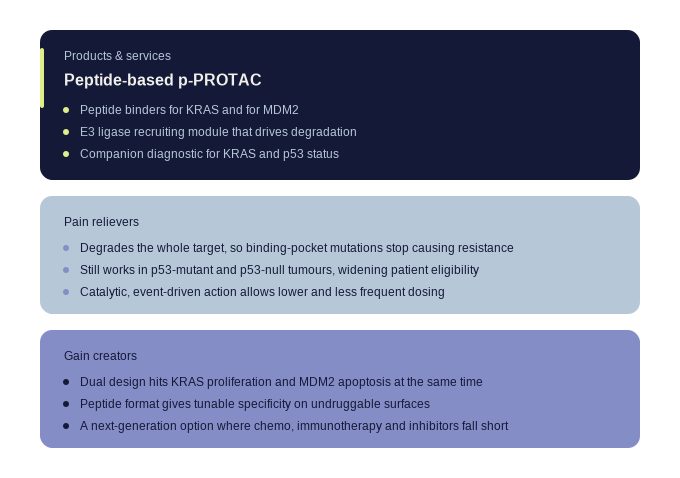
This gap reflects a deeper biological limitation: most current drugs work by inhibiting a protein's activity rather than removing the protein itself, leaving KRAS, one of the most common and historically "undruggable" oncogenic drivers, largely untouched by anything but a single mutation-specific inhibitor class, and leaving MDM2's p53-suppressing activity, present in a meaningful subset of NSCLC, without any approved targeted therapy at all. Targeted protein degradation, and specifically a dual-target, peptide-based PROTAC (p-PROTAC) approach capable of simultaneously eliminating both KRAS and MDM2, offers a scientifically distinct strategy: one that could reach patients left behind by current mutation-specific drugs, while addressing two complementary drivers of tumor survival in a single therapeutic mechanism.
| Segment | Description |
|---|---|
| KRAS-mutated NSCLC | ~25–35% of NSCLC patients [113] |
| — of which, non-G12C | ~60% of KRAS-mutated (no approved targeted drug) [41][43] |
| MDM2-amplified NSCLC | ~3.5–21% depending on cohort [114] |
| Dual/overlap population | Patients with both alterations - smaller, high-need niche |
| Resistant/relapsed on current therapy | Most KRAS-G12C and immunotherapy patients within 1–2 yrs [15][104][105] |
| Stakeholder | Role |
|---|---|
| Medical/thoracic oncologists | Prescribers, trial investigators |
| Comprehensive cancer centers & hospitals | Treatment delivery, formulary decisions |
| Pharma (oncology BD/licensing) | Partnership, acquisition, co-development |
| Biotech (PROTAC/peptide space) | Competitors or CDMO/tech partners |
| CROs/peptide CDMOs | Preclinical & manufacturing outsourcing |
| Academic/research institutions | Early discovery, grants, publications |
| Payers/HTA bodies | Reimbursement gatekeeping |
| Factor | EU | US | Global South (LMIC) |
|---|---|---|---|
| Regulatory approval | Centralized via EMA - no approval gap within EU/EEA [142] | FDA, generally fastest to market | Often delayed, follows EMA/FDA |
| Molecular diagnostics | Uneven: CEE lags Western Europe; NGS reimbursement not automatic in most OECD countries [134][140] | Broad NGS access but costly/insurance-dependent | Largely histology-only; NGS rare due to cost/infrastructure [133][139] |
| Targeted therapy uptake | 7–10x variation across countries; Poland/UK treat ~half the ESMO-recommended population [135] | High uptake where insured | Severely limited; CSMBS-type schemes cover only select drugs [133] |
| Cost barrier | Moderate, HTA-negotiated | High out-of-pocket even if approved | Major: affordability is the primary bottleneck [139] |
| Clinical trial access | Concentrated in Western Europe [137] | High trial density | Minimal representation [136] |
AETh3R's core innovation is a peptide-based targeted protein degrader (p-PROTAC) that simultaneously addresses two of the most significant drivers of non-small cell lung cancer (NSCLC): KRAS and MDM2. Rather than inhibiting these proteins' activity, AETh3R hijacks the cell's own ubiquitin-proteasome system to physically eliminate them. A bifunctional peptide binds the protein of interest at one end and an E3 ubiquitin ligase at the other, forming a ternary complex that tags the target for degradation and destroys it via the proteasome. Because this relies on large peptide-surface interactions rather than a small molecule fitting into a defined pocket, AETh3R can act on KRAS, long considered "undruggable" due to its shallow, high-affinity binding surface. By degrading both a proliferation driver (KRAS) and a suppressor of apoptosis (MDM2) at once, AETh3R offers a dual-mechanism therapy that both halts tumor growth and actively triggers cancer cell death.
| Factor | Conventional Inhibition | Targeted Protein Degradation (PROTAC/p-PROTAC) |
|---|---|---|
| Mechanism | Binds active site to block protein function; protein remains present in the cell | Recruits E3 ligase to ubiquitinate and destroy the target protein entirely |
| Duration of effect | Reversible; effect lasts only while drug occupies the binding site | Often more sustained - protein must be resynthesized before signaling resumes |
| Dosing implications | Requires continuous target occupancy, often high/frequent dosing | Event-driven, catalytic mechanism - one PROTAC molecule can degrade multiple target copies, enabling lower doses |
| Resistance profile | Vulnerable to compensatory target upregulation and binding-site mutations | Less susceptible to resistance from target overexpression or point mutations, since the whole protein is removed |
| Druggability requirements | Requires a deep, well-defined binding pocket | Works via large interaction surfaces - feasible for "undruggable" flat/shallow targets like KRAS |
| Selectivity | Generally protein-family selective (can hit off-target paralogs) | Can be tuned for isoform/mutation selectivity via peptide-target interface design |
| Effect on mutant/null targets | Often ineffective if the drug-binding pocket is mutated or absent | Can remain effective even against loss-of-function or structurally altered targets (e.g., p53-null cells respond to MDM2 degradation) |
| Toxicity considerations | Off-target binding and sustained high dosing can drive toxicity (e.g., hematologic toxicity from MDM2 inhibitors) | Lower doses and catalytic activity can reduce off-target exposure, though ternary complex formation adds a new toxicity variable to manage |
| Dimension | Chemotherapy | Immunotherapy (e.g., anti-PD-1/PD-L1) | Targeted Small-Molecule Inhibitors (e.g., sotorasib, MDM2 inhibitors) | AETh3R (p-PROTAC) |
|---|---|---|---|---|
| Mechanism | Non-specific cytotoxic damage to rapidly dividing cells | Reactivates immune recognition of tumor cells | Blocks activity of a specific oncoprotein | Degrades KRAS and MDM2 proteins entirely via the ubiquitin-proteasome system |
| Molecular specificity | Low - affects healthy dividing cells too | Moderate - depends on tumor immunogenicity/PD-L1 status | High - but limited to specific mutations (e.g., G12C only) | High - dual-target, peptide-tunable specificity |
| Resistance considerations | Common; tumors adapt to cytotoxic stress | Can develop via immune evasion mechanisms | Frequent, especially with non-G12C KRAS mutations and MDM2 upregulation | Designed to reduce resistance by removing rather than inhibiting the target, even under p53 mutation |
| Toxicity/administration | High systemic toxicity, IV administration | Immune-related adverse events, IV administration | Oral dosing common; hematologic toxicity for MDM2 inhibitors | Peptide-based; toxicity profile still under characterization, potential for lower off-target burden |
| Coverage of patient population | Broad, mutation-agnostic | Limited to immunogenic/PD-L1-high tumors | Narrow (mutation-specific, e.g., G12C only) | Broader within KRAS/MDM2-altered NSCLC, not limited to a single point mutation |
| Developmental maturity | Standard of care, decades of use | Standard of care in eligible patients | Approved (sotorasib, adagrasib) or in trials (MDM2 PROTACs) | Preclinical/early-stage |
Customer Segment: Oncologists, NSCLC patients, and hospital/pharma decision-makers
| Class | Mechanism | Efficacy | Key AEs | Route | Limitation |
|---|---|---|---|---|---|
| Chemotherapy | Cytotoxic, non-specific | Modest PFS, broad use | Myelosuppression, Grade ≥3 in ~53% | IV | Toxic, resistance common [103] |
| ICIs (PD-1/PD-L1) | Immune reactivation | ORR ~50% first-line combos | irAEs 10–80%, Grade ≥3 ~20% | IV | Only ~50% PD-L1+ benefit durably [107][109] |
| Targeted (EGFR/ALK/ROS1) | Kinase inhibition | High ORR if eligible | Rash, diarrhea, hepatotoxicity | Oral | Only 10-15% of NSCLC eligible [99] |
| KRAS G12C inhibitors | Covalent OFF-state inhibition | PFS 5.5-5.6mo vs 3.8-4.5mo docetaxel | GI, hepatic, Grade 3 16-27% [157] | Oral | G12C only; on/off-target resistance [161] |
| Compound | Company | Target | Stage | Resistance mechanism |
|---|---|---|---|---|
| Sotorasib (Lumakras) | Amgen | G12C | Approved (NSCLC) [154] | On-target (Y96D etc.) + off-target bypass [155] |
| Adagrasib (Krazati) | Mirati/BMS | G12C | Approved (NSCLC, CRC) [154] | Similar resistance spectrum [161] |
| Divarasib (GDC-6036) | Roche/Genentech | G12C | Phase 3 | More potent/selective; resistance data emerging [155][161] |
| Olomorasib | Eli Lilly | G12C | Phase 3 (+ pembrolizumab) [158] | — |
| RMC-6236 (Daraxonrasib) | Revolution Medicines | Pan-RAS (G12/multi) | Phase 3 (PDAC), Phase 2 NSCLC [154][159] | Broader coverage; resistance unclear |
| RMC-9805 (Zolondorasib) | Revolution Medicines | G12D selective | Phase 1 (52% ORR) [161] | — |
| MRTX1133 | Mirati/BMS | G12D | Phase 1/2 [157] | — |
| ASP3082 (Setidegrasib) | Astellas | G12D, PROTAC degrader | Phase 1 (36% ORR, NEJM) [161] | Direct degrader-modality comparator |
| Compound | Company | Modality | Stage | Notes |
|---|---|---|---|---|
| Navtemadlin (KRT-232/AMG232) | Kartos/Amgen | Small-molecule inhibitor | Phase 3 (MF); Phase 1-2 solid tumors | BOREAS primary endpoint not met [162] |
| Idasanutlin (RG7388) | Roche | Small-molecule inhibitor | Phase 3 | OS endpoint not met (MIRROS) [162] |
| Siremadlin (HDM201) | Novartis | Small-molecule inhibitor | Phase 1b/2 | — |
| Brigimadlin (BI 907828) | Boehringer Ingelheim | Small-molecule inhibitor | Phase 3 (sarcoma); Phase 2 NSCLC/bile duct | Most advanced in NSCLC indication [163][166] |
| APG-115 (Alrizomadlin) | Ascentage Pharma | Small-molecule inhibitor | Phase 2 | — |
| KT-253 | Kymera | Heterobifunctional PROTAC degrader | Phase 1 (pharmacodynamic PoC) [162] | Only clinical-stage MDM2 PROTAC - closest direct mechanism competitor |
| Modality | Representative players | Stage |
|---|---|---|
| Small-molecule PROTAC | Arvinas (approved: vepdegestrant), Kymera, C4 Therapeutics | Approved → Phase 1-3 [146] |
| Molecular glue degraders | Monte Rosa, Novartis collab | Phase 1-2 [148][149] |
| Peptide-based PROTAC (p-PROTAC) | Academic-stage, few commercial players | Preclinical, AETH3R's space [27] |
| Pan-RAS small-molecule (non-degrader) | Revolution Medicines | Phase 2-3 |
| Axis | AETh3R | Closest competitors |
|---|---|---|
| Targets | KRAS + MDM2 simultaneously | ASP3082 (KRAS G12D only); KT-253 (MDM2 only) - no one does both |
| Modality | Peptide-based PROTAC | Small-molecule PROTACs (Arvinas/Kymera) target smaller pockets |
| Mutation coverage | Potentially non-G12C + MDM2-altered | Sotorasib/adagrasib limited to G12C |
| Stage | Preclinical | Competitors mostly Phase 1-3, AETh3R is earlier but differentiated by dual-target design |
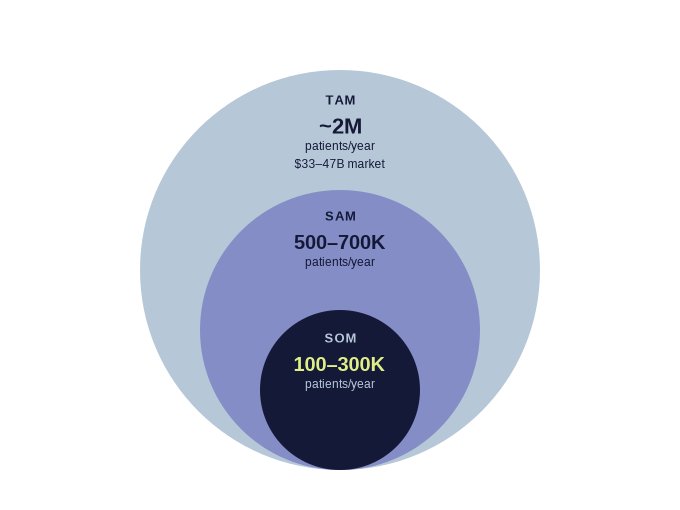
Lung cancer was the most frequently diagnosed cancer worldwide in 2022, with approximately 2.48 million new cases and 1.8 million deaths [39]. NSCLC accounts for about 85% of all lung cancer cases [49], which puts global NSCLC incidence at roughly 2 million new cases per year [38]. On the commercial side, the NSCLC therapeutics market size across the 7 major markets (US, EU4, UK, Japan) was approximately USD 33 billion in 2025, projected to reach approximately USD 67 billion by 2036 [50]. A broader estimate covering all lung cancer types puts the global therapeutics market at USD 46.7 billion in 2026, growing to USD 141.2 billion by 2036 [52].
KRAS mutations occur in roughly 25–35% of newly diagnosed NSCLC [42], with a higher share specifically within the adenocarcinoma subtype. Up to 37.2% in one large cohort of 17,095 NSCLC samples [41], and up to 40% depending on demographic factors [44]. MDM2 amplification rates in NSCLC vary considerably by cohort and detection method: an older PCR-based study found it in 21% of surgically treated patients [46], while large NGS-based pan-cancer datasets put it closer to 3.5% [48] to 7% [47] of tumors overall.
Currently approved KRAS drugs (sotorasib, adagrasib) only cover the G12C mutation [43], which represents about 40% of all KRAS mutations in NSCLC [41]. That means roughly 60% of KRAS-mutated patients (the G12D/V and other non-G12C variants) have no approved targeted therapy [43]. Even among G12C patients who do have access to a drug, the vast majority do not respond well, mainly due to intrinsic or acquired resistance through cellular, molecular, and genetic mechanisms [15].
The SAM estimate applies the KRAS-mutation percentages and MDM2-amplification estimates to the global NSCLC incidence [38][42][46][48]. The SOM focuses on non-G12C KRAS-mutated and/or MDM2-altered advanced NSCLC resistant or refractory to current standard of care [15][43], using approximately 60% of the KRAS-mutated SAM slice [41][43].
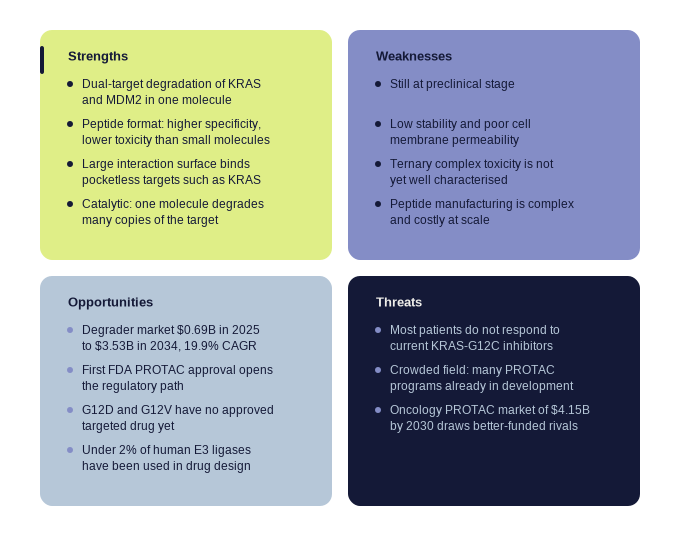
The global targeted protein degradation market was valued at USD 687.90 million in 2025, projected to reach USD 3,531.80 million by 2034 at a CAGR of 19.9% [33]. The PROTAC-specific oncology segment alone is projected to grow from $1.3 billion in 2025 to $4.15 billion by 2030, a CAGR of 26.0% [35].
A major regulatory milestone occurred in May 2026, when Arvinas received FDA approval for vepdegestrant (VEPPANU), the first-ever approved use of a PROTAC drug [33]. Later that same month, Arvinas and Pfizer entered an agreement granting Rigel exclusive global development, manufacturing, and commercialization rights for the drug [33]. This approval is seen as establishing "an important commercial and regulatory benchmark for targeted protein degradation," supporting continued investment across clinical development and commercialization [34].
Within the broader TPD market, the PROTAC segment held the largest revenue share, about 47.56% in 2025, ahead of molecular glues and other modalities [54]. Growth going forward is expected to be driven by "first-product commercial validation, late-stage clinical pipeline maturation across oncology and immunology, and increasing large-pharma investment through licensing and co-development agreements" [34]. Named major players across different market reports include Arvinas, Pfizer/Rigel, Kintor Pharmaceuticals, Monte Rosa Therapeutics, Ranok Therapeutics, Zentalis Pharmaceuticals, Kangpu Biopharmaceuticals, Medivir, Sanofi, and Eisai [56].
Global NSCLC therapeutics market estimates vary by scope: one report puts it at USD 24.1 billion in 2025, growing to USD 63.5 billion by 2033 (CAGR 12.9%) [93], while another estimates USD 33 billion across the 7 major markets in 2025 alone [50].
Major players: AstraZeneca, Merck & Co., F. Hoffmann-La Roche, Bristol-Myers Squibb, Pfizer, Amgen, Novartis, Johnson & Johnson, Eli Lilly, Takeda, Boehringer Ingelheim, and AbbVie are consistently named as dominant companies across market reports [90][91][93].
Commercial trend: Competition is described as "driven by product innovation, regulatory approvals, precision medicine strategies, and the development of therapies targeting EGFR, ALK, ROS1, MET, RET, HER2, KRAS, and other molecular alterations" [93] - a trend that supports the commercial rationale for a dual-target, molecularly-defined approach like AETh3R.
Healthcare expenditure: Total medical costs for lung cancer overall range from about 0.00248% to 0.1326% of GDP and 0.038% to 0.836% of total health expenditure across countries studied [95]. In low- and lower-middle-income countries, direct per-patient costs ranged from USD 2,541 (Nepal) to USD 10,180 (Bolivia) [95]. In a 5-year Ontario cohort, the total cost of care for an all-stage NSCLC population reached $1.9 billion, averaging $76,816 per patient higher for stage III/IV disease [99].
Cost variation by country: Mean direct costs for advanced NSCLC ranged from about US$5,647 (Brazil) to US$158,908 (US) over 12–24 months, generally higher in the US, Korea, and Germany [104].
Hospitalization & resource use: Across a systematic review of 43 studies, hospitalization rates in advanced NSCLC ranged from 13.0% to 98.2% of patients, with lower healthcare resource use generally associated with immunotherapy compared to chemotherapy [96]. Brain/CNS metastases were identified as the major clinical factor driving higher healthcare resource utilization [97].
Productivity loss: In an Argentine cohort, NSCLC patients reported an average 59% decrease in their ability to perform regular daily activities [98]. Among those still working, total productivity loss (absenteeism + presenteeism combined) reached 72.2% [98]. Indirect costs frequently exceed direct medical costs: in Turkey, indirect costs accounted for 68.6% of the total economic burden [100], and in Canada they were estimated at 1.3 times the direct cost of NSCLC [100].
Financial toxicity & quality of life: In France, Germany, and Italy, mean total out-of-pocket expenses were reported at €5,691 for patients and €4,125 for caregivers, with 31% of patients paying direct out-of-pocket costs for treatment [95][97], underscoring that the societal burden of NSCLC extends well beyond direct treatment costs, and reinforcing the unmet need for more durable, less toxic therapies like AETh3R.
| Block | Content |
|---|---|
| Key Partners | PROTAC/TPD biotechs (Arvinas, Kymera, Monte Rosa, C4 Therapeutics, Nurix) [146][150]; peptide CDMOs (Eurogentec, Bachem-type firms); academic labs (AUTh, DTU); CROs for preclinical/tox studies; regulatory consultants (EMA/FDA); oncology centers for trial access; investors (EIC, VC biotech funds) |
| Key Activities | Peptide/p-PROTAC design & synthesis, ternary-complex/degradation assays, preclinical pharmacology, IP filing, grant/investor relations |
| Key Resources | p-PROTAC platform/IP, peptide synthesis know-how, lab access (AUTh/DTU), scientific team, early data package |
| Value Proposition | Dual-target (KRAS+MDM2) degrader reaching non-G12C/MDM2-altered NSCLC patients with no approved targeted option |
| Customer Relationships | Scientific partnerships, licensing negotiations, KOL engagement, conference presence (e.g. ACT) |
| Channels | Publications, conferences, direct BD outreach to pharma, grant bodies |
| Customer Segments | Pharma/biotech licensing partners; eventually oncologists/hospitals once clinical |
| Cost Structure | Peptide synthesis & GMP scale-up, preclinical/IND-enabling studies, personnel, IP/regulatory costs |
| Revenue Streams | Licensing/milestone deals (precedent: Arvinas–Novartis $150M upfront + $ milestones [152]; Monte Rosa–Novartis $150M upfront, up to $2.1B milestones [149]), eventual drug sales or royalties |
Peptide/binder synthesis: Standard custom peptide synthesis pricing ranges from about $2 to $26+ per amino acid residue, depending on purity, quantity, and modifications, with minimum orders typically starting at $100–$125 [67]. Prices as low as $2–3.50 per residue are advertised by several CROs for standard research-grade peptides [65][66], though costs rise sharply for longer sequences, unnatural amino acids, cyclization, or stapling. All features AETh3R's p-PROTAC would likely need given its dual-target design [68]. Buying in bulk (e.g., a full 1000 mg/1 g batch) can drop the effective cost to just a few cents per milligram compared to small research-scale orders [67].
Broader preclinical R&D budget: Independent-drug-development-organization data indicate preclinical/discovery costs ranging from EUR 0.1–22.6 million depending on program complexity, with Phase I costs of EUR 1.5–9.9 million [69]. A separate simulation-based estimate put IND-enabling preclinical studies (for a small molecule) at around USD 1.2 million over 10 months, including about USD 40,000 in manufacturing costs [69], though this figure would likely be higher for a peptide-based PROTAC given the added complexity of ternary-complex assays, proteomics, and pharmacokinetic characterization discussed in earlier sections.
→ Recommended budget scope for the spreadsheet: peptide/binder library synthesis and screening, PROTAC linker chemistry and conjugation, cell-based degradation and ternary-complex assays, proteomics (to check off-target degradation), in vivo pharmacology/PK-PD studies, and IND/CTA-enabling toxicology, realistically in the low-to-mid single-digit millions (EUR/USD) range for a program at AETh3R's stage [69].
Peptide manufacturing at GMP scale is meaningfully more complex and costly than small-molecule production. Leading peptide CDMOs report per-batch production capacities in the 20–25 kg range and annual capacities exceeding 1,000 kg for established players [75], but capital expenditure for a dedicated kilogram-scale GMP lab can exceed $50 million for smaller CDMOs, which stretches break-even timelines [76]. The regulatory burden is proportionally heavier for peptides than for small molecules, since confirming that a multi-residue chain is correct at every position requires sophisticated analytical methods including mass spectrometry, HPLC, and amino acid analysis [76]. Industry guidance also stresses that sponsors should align CDMO capacity to actual clinical-scale needs. Most peptide therapeutics require only small commercial volumes, so overpaying for large generic capacity is a common pitfall [77]. For a p-PROTAC specifically, additional complexity comes from linker/conjugation chemistry, which requires the CDMO to manage the target-binding peptide, the E3-ligase-recruiting warhead, and the connecting linker as one integrated synthesis and purification process [77].
→ Key cost drivers to model: synthesis route selection (solid-phase vs. hybrid vs. recombinant) [68], purification and QC scale-up, stapling/cyclization chemistry for stability, and the step-up from milligram research batches to multi-kilogram GMP batches for clinical supply [76].
Published estimates of clinical trial costs vary widely by methodology, but oncology consistently ranks among the most expensive therapeutic areas. One widely cited analysis estimated the average cost of clinical trials for an FDA-approved new drug at $339.3 million overall (2013 dollars), broken down as Phase 1 ≈ $25.3 million (7.5%), Phase 2 ≈ $58.6 million (17.3%), and Phase 3 ≈ $255.4 million (75.3%) [70]. A separate, more conservative analysis of 138 pivotal trials found a median trial cost of $19 million (interquartile range $12.2–$33.1 million), with oncology trials specifically often exceeding $45 million [71][73]. Government-model estimates for a simplified oncology case put Phase 1 at roughly $30 million and Phase 2 at roughly $45 million [71].
For oncology-specific full development-and-approval costs (through Phase 4), one analysis found a median of $149.6 million [73], while other therapeutic-area-specific estimates for cancer drugs range from $648 million (median R&D cost per approved cancer drug) up to figures as high as $1.7 billion when failures across the whole pipeline are included [72][74]. Preclinical expenditure is typically estimated at around 43% of total capitalized development costs in these broader models [74].
→ Recommended cost ranges for AETh3R's forecast table: IND/CTA-enabling package ≈ low single-digit millions (aligned with [69]); Phase I ≈ $20–30 million; Phase II ≈ $45–60 million [70][71], with the caveat that peptide/PROTAC-specific trials may carry added costs for pharmacodynamic biomarker assays (target degradation confirmation) not captured in these general oncology estimates.
Cancer drug pricing has risen sharply over the past decade and varies substantially by country. In a study of 65 cancer drugs approved 2009–2019, the median monthly treatment cost at launch was $11,755 in the US, compared with $8,305 in Germany, $6,955 in Switzerland, and $7,355 in England, roughly 1.45x higher in the US than the European comparators [87]. Median launch prices have also risen over time: the lowest median monthly cost in 2018–2019 was $14,580 in the US versus just $5,790 in 2009–2010 [87]. More broadly, a cross-sectional study of 224 cancer drug approvals (2015–2020) found a median annual cost of $196,000, with no significant difference in price between first-in-class, next-in-class, or subsequent approvals of an already-approved mechanism, suggesting pricing is not fully explained by therapeutic novelty alone [88].
Post-launch price dynamics differ sharply between the US and Europe. In the US, prices for cancer drugs continued rising after launch, a median of +6.07% at 2 years and +15.31% at 4 years post-launch, while in Germany and Switzerland, prices generally decreased over time or stayed within inflation, e.g., −21.01% in Germany and −1.48% in Switzerland at 2 years post-launch [89]. This reflects that European countries directly negotiate drug prices at launch and over time through health technology assessment (HTA) processes, unlike the US where manufacturers set prices with fewer restrictions [89].
Recent US policy shifts are relevant to AETh3R's long-term access planning: Medicare has begun directly negotiating prices for select high-cost drugs, with the first five negotiated cancer drugs achieving an average 47% discount, substantially more than the under-10% average rebate typical for non-negotiated cancer drugs and a $2,000/year out-of-pocket cap for Medicare Part D beneficiaries started in 2025 [90].
→ Implications for AETh3R's access strategy: As a novel, dual-target biologic modality entering a crowded and increasingly price-scrutinized oncology market, an early access framework should anticipate HTA-driven price negotiation in Europe, the growing role of US payer/Medicare negotiation for high-cost oncology drugs, and the general finding that price is not strongly tied to mechanistic novelty [88] That demonstrates the clinical benefit (e.g., in the non-G12C KRAS-mutated niche identified in Section E) will likely matter more for reimbursement success than the novelty of the degradation mechanism itself.
| Item | Range | Source |
|---|---|---|
| Peptide synthesis (research-scale) | ~$2–26/residue; lower costs for bulk orders | [65][67] |
| Preclinical/IND-enabling budget | €0.1–22.6M (broad range); small IND package ~$1.2M | [69] |
| GMP peptide manufacturing CapEx | >$50M for a dedicated kg-scale laboratory | [76] |
| Phase I cost | ~$20–30M | [70][71] |
| Phase II cost | ~$45–60M | [70][71] |
| Total oncology R&D cost per approved drug | $149.6M (median) to $1.7B (broader models) | [72][73][74] |
| EIC Accelerator | Up to €2.5M in grants + €1–15M in equity | [78][79][80] |
| ERC Proof of Concept | €150,000 / 18 months | [85][86] |
| Horizon Europe Cluster 1 Health | Varies; consortium-based; deadline 16 April 2026 | [83][84] |
| Average monthly oncology drug cost (US) | $11,755 vs. $8,305 (Germany) | [87] |
| Average annual cost | $196,000, independent of novelty in mechanism of action | [88] |
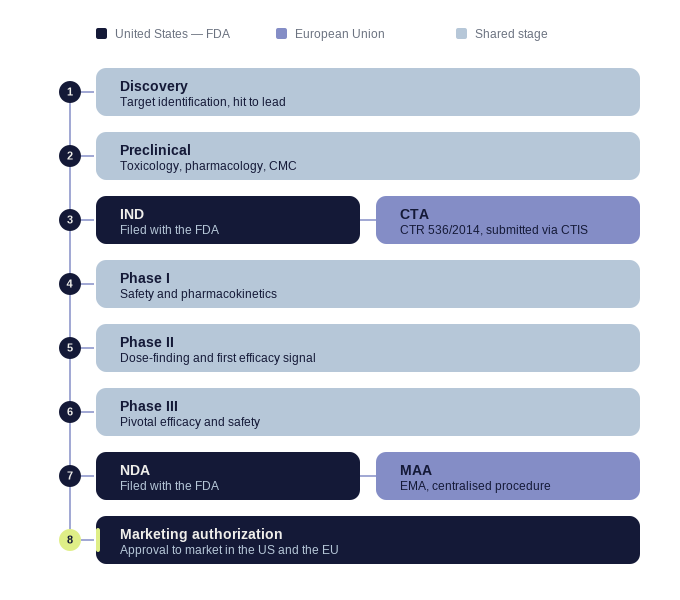
AETh3R, as a peptide-based degrader, falls into a gray zone but with clear precedent: FDA classifies peptides ≤40 amino acids as drugs filed via NDA through CDER (small-molecule-like pathway); >40 aa typically requires a BLA (biologic) [179]. Since there's no dedicated ICH guidance for peptides - ICH M3(R2) explicitly excludes them, and industry instead blends M3(R2) (small molecule) with ICH S6(R1) (biologics) principles for nonclinical safety assessment [171] - AETh3R will likely need a hybrid nonclinical package justified case-by-case with FDA/EMA, positioning itself as a synthetic peptide therapeutic (NDA/CDER route) unless its final length or conjugation pushes it toward biologic classification [174][179].
| Target | Notable prior art / IP | Assignee | Status |
|---|---|---|---|
| MDM2 (small-molecule PROTAC) | MD-224, MD-265, KT-253 (clinical) | Various (academic + Kymera) | Patented, KT-253 in Phase 1 [187] |
| MDM2 (peptide-based) | Peptide-MDM2 binders with Kd ~12.2nM, conjugated to AR-V7/VHL | Academic groups | Published/preclinical [181] |
| MDM2 (homo-PROTACs, glue-type) | GAA-PROTACs, Nutlin-3 homo-PROTACs, Ori-Ori | Multiple CN academic groups | Preclinical, actively patented [183] |
| MDM2 generally | "PROTAC MDM2 Degrader-2", 100 associated patents | Shaoxing University | Pending [186] |
| KRAS (small-molecule PROTAC) | VHL-recruiting pan-mutant degrader (13/17 mutants + WT) | Academic | Preclinical [185] |
| KRAS G12D (PROTAC, clinical) | ASP3082 | Astellas | Phase 1, actively patented [182][187] |
| KRAS G12D (preclinical PROTACs) | RP03707, ZJK-807, compound 8o | Multiple academic/CN groups | Preclinical, dense recent filings (2024-2025) [182] |
A 2025 Chinese patent from the National Center for Nanoscience and Technology describes peptide-based PROTAC condensates simultaneously targeting HER2, EGFR, and RAS via supramolecular self-assembly, a multi-target single-entity architecture conceptually close to AETh3R's dual-KRAS/MDM2 approach, though targeting a different protein combination [184]. This is the most directly relevant prior art found and should be reviewed closely by a patent attorney.
| Element | Risk | Notes |
|---|---|---|
| Peptide binder (KRAS) | Medium | Dense recent CN filings on KRAS peptide/small-molecule binders [182][185] |
| Peptide binder (MDM2) | Medium-High | Established peptide-MDM2 binders already published with defined Kd [181] |
| E3 recruiter (VHL/CRBN) | Low-Medium | Standard, widely-licensed warheads, not novel per se, freedom depends on specific conjugation |
| Linker/conjugation chemistry | Medium | Active filing area (stapling, condensate self-assembly) [184] |
| Dual KRAS+MDM2 construct (overall) | Low-Medium, potential whitespace | No identified patent specifically combining KRAS+MDM2 in one bifunctional/multi-target peptide construct |
→ Overall: general peptide-PROTAC and individual-target space is crowded (especially CN filings), but the specific KRAS+MDM2 dual-degradation construct appears to be unclaimed, likely AETh3R's strongest protectable angle, pending professional FTO/attorney review.
| Stage | Duration (est.) | Depends on | Type |
|---|---|---|---|
| Binder validation (KRAS + MDM2 peptides) | 6–9 mo | — (start) | Tech |
| IP filing (provisional) | parallel, month 3-6 | Initial binder data | Commercial |
| PROTAC/p-PROTAC synthesis & linker optimization | 6–12 mo | Binder validation | Tech |
| In-vitro degradation assays (ternary complex, DC50) | 3–6 mo | Synthesized constructs | Tech |
| Mechanism validation (ubiquitination, proteasome dependency) | 3–4 mo | In-vitro degradation | Tech |
| Selectivity/proteomics (off-target screen) | 4–6 mo | Mechanism validation | Tech |
| Seed funding / EIC-type grant | parallel, month 6-18 | Early in-vitro data package | Commercial |
| ADME/PK studies | 4–6 mo | Lead construct selected | Tech |
| In-vivo validation (xenograft efficacy) | 6–9 mo | PK data + selectivity | Tech |
| Preclinical partnership outreach | parallel, month 18-30 | In-vivo proof-of-concept | Commercial |
| IND/CTA-enabling tox package | 9–12 mo | In-vivo validation | Tech |
| Regulatory interaction (pre-IND/CTA meeting) | 2–3 mo | Tox package near-complete | Commercial |
| IND/CTA filing → Phase I | 12–18 mo post-filing | Regulatory clearance | Tech/Commercial |
| Licensing/co-development outreach | parallel, from Phase I data | Phase I safety signal | Commercial |
→ Total preclinical-to-IND timeline: roughly 3–4 years, consistent with typical peptide/biologic-class programs [69][171].
| Stage Gate | Go Criterion | No-Go Signal |
|---|---|---|
| After binder validation | Kd in low-nM range for both targets | No measurable binding to either target |
| After in-vitro degradation | DC50 in sub-µM range, Dmax >50% | Degradation plateau below threshold, or ternary complex doesn't form |
| After selectivity screen | Clean/limited off-target degradation profile | Significant off-target hits on proteomics |
| After in-vivo validation | Tumor growth inhibition in xenograft at tolerable dose | No efficacy or unacceptable toxicity signal |
| After IND-enabling tox | Clean tox profile, defined therapeutic window | DLT at sub-therapeutic doses |
| After Phase I | Acceptable safety + evidence of target engagement (PD biomarker) | Unmanageable toxicity or no PD signal |
| Risk | Description | Source |
|---|---|---|
| Target engagement | KRAS has a small, smooth, shallow surface with no defined binding pocket, making it hard to design an effective peptide binder [12] | [12] |
| Degradation efficiency | Even if the ternary complex forms, transfer of ubiquitin from the E2 enzyme to the target protein via an isopeptide bond may not be efficient enough [8] | [8] |
| Peptide stability | Clinical progress of PROTACs is often limited by poor proteolytic stability, due to their peptide nature and large molecular weight [31] | [31] |
| Cell permeability | A known fix exists: double-stapled peptides showed better permeability than their linear counterparts, with confirmed in vivo antitumor effects [29] | [29] |
| E3 ligase recruitment | Limited expression of specific E3 ligases in certain tissues could block degradation | [2] |
| Off-target degradation | Risk of unintentionally degrading proteins with similar structural motifs | [6] |
| Resistance | Possible development of resistance, similar to what's seen with KRAS inhibitors due to compensatory mechanisms [15] | [15] |
| Risk | Description | Source |
|---|---|---|
| Manufacturing cost | Peptide synthesis at industrial scale is costlier than small-molecule production | [7] |
| IP overlap | Many active PROTAC programs already exist in preclinical/clinical stages; a freedom-to-operate analysis is needed [10] | [10] |
| Competitive crowding | The PROTAC segment held the largest revenue share (47.56%) of the TPD market in 2025 [54] | [54] |
| Regulatory pathway | There's no separate regulatory process specifically for protein degraders; authorities apply conventional small-molecule guidelines, such as the FDA's API GMP guidelines [51] | [51] |
Alternative binders: Keep backup peptide sequences ready in case the lead candidate shows weak target binding.
Stapling/linker optimization: Stapled peptide-based PROTACs (SP-PROTACs) showed improved cellular uptake and proteolytic stability, while maintaining effective target degradation [30].
Delivery systems: Combining with an appropriate drug delivery system could improve cell penetration [32].
Biomarkers: Stratify patients by KRAS/MDM2 expression or p53 status.
Dosing strategy: Intermittent high-dose administration (instead of continuous low-dose) has shown reduced hematologic toxicity while maintaining efficacy in similar MDM2-targeting drugs - worth exploring for AETh3R as well [21].
| Factor | Considerations | Source |
|---|---|---|
| Economic | The oncology PROTAC market grew at roughly 26% within a single year (2025–2026) [52] | [52] |
| Technological | Less than 2% of E3 ligases in the human genome have been used so far. A significant technological headroom [9] | [9] |
| Legal | Dense existing patent landscape around PROTAC technology [10] | [10] |
| Political/Regulatory | In May 2026, the FDA approved the first-ever PROTAC drug (vepdegestrant) , a milestone for the regulatory pathway of this drug class [33] | [33] |
| SDG | Relevance |
|---|---|
| SDG 3 (Good Health & Well-being) | Direct: novel therapy for underserved NSCLC subpopulation (non-G12C KRAS, MDM2-altered) |
| SDG 9 (Industry, Innovation, Infrastructure) | Advances peptide-PROTAC platform technology; contributes to TPD innovation ecosystem |
| SDG 10 (Reduced Inequalities) | Potential relevance if accessibility strategy (below) addresses LMIC/Global South access gaps |
Molecular testing and targeted therapy access remains highly uneven: HICs use comprehensive molecular profiling while MICs/LICs often rely on histology alone with limited molecular testing [133]; EU shows 7-10x variation in targeted therapy uptake between countries [135]; global disparities in NGS access are driven by affordability, technical capacity, and infrastructure [139].
Peptide synthesis (SPPS) is one of the most waste-intensive pharma modalities, median baseline Process Mass Intensity ~13,000 kg material per kg API, with 80-90% of waste from solvent washes/purification (DMF, DCM, NMP) [196][198]. Mitigation options directly applicable to AETh3R:
| Cancer | KRAS mutation rate | MDM2 relevance |
|---|---|---|
| Pancreatic (PDAC) | 73–97% (highest of any cancer) [212][213][217] | — |
| Colorectal (CRC) | 30–44% | KRAS amplification co-occurs with mutation in >50% of CRC cases [210] |
| Uterine/endometrial | ~21% | — |
| Biliary tract/cholangiocarcinoma | ~14.6% | Brigimadlin in Phase II/III for MDM2-amplified biliary tract cancer [170] |
| Liposarcoma (well-diff./dediff.) | Low | MDM2 amplification is the defining driver (~90%+ of cases), Brigimadlin's lead indication (Brightline-1, Phase III) [163] |
| Gastric | ~8.6% | KRAS amplification ~3.5% [210] |
→ Pancreatic cancer stands out as the strongest secondary indication (highest KRAS burden, G12D-dominant - matches AETh3R's degrader modality strength); liposarcoma is the strongest MDM2-only indication if a single-target variant is pursued.
Peptide-PROTAC architecture (binder–linker–E3 recruiter) is modular by design, future expansion could swap binders to target other "undruggable" oncoproteins (e.g., MYC, STAT3) while reusing the same E3-recruitment and linker chemistry validated in AETh3R's KRAS/MDM2 program.
Builds directly on Sections D and F shortlists (Arvinas, Kymera, Monte Rosa, Astellas as KRAS-degrader comparator; academic labs; peptide CDMOs). Outreach sequence: academic/grant partners first (seed stage) → CDMO/tech partners (scale-up) → pharma licensing (post-POC data).
| Route | Pros | Cons |
|---|---|---|
| Licensing (early, post-POC) | Fast capital, lower risk | Lower long-term value capture |
| Co-development | Shared cost/risk, retains upside | Requires strong negotiating position |
| Research partnership (non-exclusive) | Keeps optionality, builds credibility | Slower path to value |
| Spin-out/startup | Full control, highest potential upside | Highest capital/regulatory burden |
References from all sections, with the original numbering from the supplied document.
Custom Peptide Synthesis Price. AAPPTEC. https://www.peptide.com/custom-peptide-synthesis-price/
