
The parts collection
The design combines ten interchangeable sensing composites, one shared reporting module (BBa_26E11Z80, GCaMP6f–Orco), and supporting basic and reused parts (EMCV IRES, mCherry). Explore the architecture on Design and its expression evidence.
- Sensing 10 composites Swap only the OR CDS / specificity module.
- Reporting 1 shared module GCaMP6f–(GGGGS)3–DmOrco stays fixed.
- Support Basics + 2 reused OR CDS parts, Orco, GCaMP6f, linker, IRES, mCherry.
mCherry is a QC / expression marker beside the channel, not the AeroSense measurement (Design · mCherry).
Explore the sensor
Follow the DNA architecture, protein products and proposed sensing mechanism.
Choose a tuning receptor
Selecting a receptor changes only the OR coding sequence; the reporter cassette stays fixed.
Without JavaScript, open each composite in the catalogue: Or7a, Or22a, Or35a, Or42a, Or59b, Or67a, Or85b, Or98a, Or19a, Or67b.
Sensing composite in view
Or7a-IRES-mCherry
Only the OR CDS changes. Shared reporting module: GCaMP6f–Orco (BBa_26E11Z80). Schematic topology does not change with receptor identity.
DNA
Two constructs
Select a block to trace its expression pathway. CMV and BGH poly(A) are shared pcDNA3.1(+) backbone features; the catalogue identifies the registered AeroSense parts.
Translation products
Translation products
From transcript to protein
Module A
Two separate translation products from one bicistronic transcript.
IRES is an RNA translation element; not a protein product.
Module B
One fusion protein.
GCaMP6f — (GGGGS)3 — Orco is one fused polypeptide. Domains/features of one fusion protein.
Cell / mechanism
Cell / mechanism
Schematic topology
OR and Orco form an odor-gated ion channel. GCaMP6f, joined to Orco by a flexible linker, reports changes in intracellular Ca²⁺. mCherry is a separate expression marker.
Select a protein to highlight its translation product. The diagram represents the designed topology; structural and functional evidence is documented separately.
Plasmid and sensing composite
Further reading: [1] · [2] · [3] · [4] · [5]Roberts et al., 2021 — full entry in References. · [6]Zboray et al., 2023 — full entry in References.
Catalogue
The catalogue contains 27 records: 25 new parts (14 basic and 11 composite) plus 2 reused parts. Each Registry link opens the part’s sequence, annotations and documentation.
Jump to a Registry ID
BBa_26ZAGFK0BBa_26WOX4B1BBa_26LLF3LMBBa_26Q1Q094BBa_26Y7CI2HBBa_265G8CE1BBa_26K1TU11BBa_26TZLBMJBBa_2629NIWHBBa_26E11Z80BBa_26VGDFA1BBa_26AIIWHVBBa_26HJ1RUTBBa_26UHN7NTBBa_26OJ8HGOBBa_26XXP4K7BBa_26DVVZIABBa_26DG1NPKBBa_26HTXB02BBa_26LWIKBQBBa_26QHYP02BBa_262WP16PBBa_26E21OEQBBa_26ACVV3RBBa_K5490030BBa_K4177005
Assembly standard
Each button shows parts recorded as compatible with that Registry standard. RFC 10 and RFC 1000 are independent; they are not inferred from each other. Press again to clear.
Panel status
No parts match this search or filter.
Composite parts
Ten sensing cassettes share one architecture; only the OR CDS changes. One reporting fusion serves every line. RFC 10 and RFC 1000 compatibility are listed separately for each part.
| Registry ID | Module | Length | Protein / architecture summary | RFC 10 | RFC 1000 | Map | Registry |
|---|---|---|---|---|---|---|---|
| Modular sensing family Ten cassette variants. Only the OR CDS changes. | |||||||
| Sensing family · Or7a New Composite | 2,546 bp | Or7a 413 aa · Kozak → OR CDS → STOP → EMCV IRES → mCherry → STOP | Incompatible | Incompatible | Or7a map | View on Registry ↗ | |
| Sensing family · Or22a New Composite | 2,498 bp | Or22a 397 aa · Kozak → OR CDS → STOP → EMCV IRES → mCherry → STOP | Incompatible | Incompatible | Or22a map | View on Registry ↗ | |
| Sensing family · Or35a New Composite | 2,534 bp | Or35a 409 aa · Kozak → OR CDS → STOP → EMCV IRES → mCherry → STOP | Incompatible | Incompatible | Or35a map | View on Registry ↗ | |
| Sensing family · Or42a New Composite | 2,525 bp | Or42a 406 aa · Kozak → OR CDS → STOP → EMCV IRES → mCherry → STOP | Incompatible | Compatible | Or42a map | View on Registry ↗ | |
| Sensing family · Or59b New Composite | 2,501 bp | Or59b 398 aa · Kozak → OR CDS → STOP → EMCV IRES → mCherry → STOP | Incompatible | Compatible | Or59b map | View on Registry ↗ | |
| Sensing family · Or67a New Composite | 2,528 bp | Or67a 407 aa · Kozak → OR CDS → STOP → EMCV IRES → mCherry → STOP | Incompatible | Incompatible | Or67a map | View on Registry ↗ | |
| Sensing family · Or85b New Composite | 2,477 bp | Or85b 390 aa · Kozak → OR CDS → STOP → EMCV IRES → mCherry → STOP | Incompatible | Compatible | Or85b map | View on Registry ↗ | |
| Sensing family · Or98a New Composite | 2,498 bp | Or98a 397 aa · Kozak → OR CDS → STOP → EMCV IRES → mCherry → STOP | Incompatible | Compatible | Or98a map | View on Registry ↗ | |
| Sensing family · Or19a New Composite | 2,468 bp | Or19a 387 aa · Kozak → OR CDS → STOP → EMCV IRES → mCherry → STOP | Incompatible | Incompatible | Or19a map | View on Registry ↗ | |
| Sensing family · Or67b New Composite | 2,570 bp | Or67b 421 aa · Kozak → OR CDS → STOP → EMCV IRES → mCherry → STOP | Unknown | Unknown | Or67b design | View on Registry ↗ | |
| Shared reporting module One fusion protein. Common to every AeroSense line. | |||||||
| Shared reporting module New Composite | 2,862 bp | 951 aa fusion · Kozak → RSET → GCaMP6f → (GGGGS)3 → DmOrco → STOP | Incompatible | Incompatible BsaI inherited from DmOrco | Reporting map | View on Registry ↗ | |
Basic parts
Fourteen new basic parts comprise ten tuning-receptor CDSs and four shared fusion components. Or67b CDS (BBa_26ACVV3R) is used in the published composite BBa_269VSDDR.
| Registry ID | Part | Type | Length | RFC 10 | RFC 1000 | Role | Used in |
|---|---|---|---|---|---|---|---|
| Final-panel OR CDSs Ten tuning receptors. Human codon-optimised. | |||||||
| Or7a CDS New Basic | CDS | 1,242 bp | Incompatible | Incompatible | Input / specificity | Or7a-IRES-mCherry (BBa_26ZAGFK0) | |
| Or22a CDS New Basic | CDS | 1,194 bp | Incompatible | Incompatible | Input / specificity | Or22a-IRES-mCherry (BBa_26WOX4B1) | |
| Or35a CDS New Basic | CDS | 1,230 bp | Incompatible | Incompatible | Input / specificity | Or35a-IRES-mCherry (BBa_26LLF3LM) | |
| Or42a CDS New Basic | CDS | 1,221 bp | Incompatible | Compatible | Input / specificity | Or42a-IRES-mCherry (BBa_26Q1Q094) | |
| Or59b CDS New Basic | CDS | 1,197 bp | Compatible | Compatible | Input / specificity | Or59b-IRES-mCherry (BBa_26Y7CI2H) | |
| Or67a CDS New Basic | CDS | 1,224 bp | Incompatible | Incompatible | Input / specificity | Or67a-IRES-mCherry (BBa_265G8CE1) | |
| Or85b CDS New Basic | CDS | 1,173 bp | Incompatible | Compatible | Input / specificity | Or85b-IRES-mCherry (BBa_26K1TU11) | |
| Or98a CDS New Basic | CDS | 1,194 bp | Compatible | Compatible | Input / specificity | Or98a-IRES-mCherry (BBa_26TZLBMJ) | |
| Or19a CDS New Basic | CDS | 1,164 bp | Compatible | Incompatible | Input / specificity | Or19a-IRES-mCherry (BBa_2629NIWH) | |
| Or67b CDS New Basic | CDS | 1,266 bp | Incompatible | Incompatible | Input / specificity | Or67b-IRES-mCherry (BBa_269VSDDR) | |
| Shared channel and reporter pieces DmOrco, GCaMP6f, RSET leader, and the (GGGGS)3 linker. | |||||||
| DmOrco CDS New Basic | CDS | 1,461 bp | Incompatible | Incompatible | Transduction | GCaMP6f-(GGGGS)₃-DmOrco (BBa_26E11Z80) | |
| GCaMP6f New Basic | CDS region | 1,245 bp | Incompatible | Compatible | Output / readout | GCaMP6f-(GGGGS)₃-DmOrco (BBa_26E11Z80) | |
| RSET leader New Basic | CDS region | 105 bp | Compatible | Compatible | N-terminal leader | GCaMP6f-(GGGGS)₃-DmOrco (BBa_26E11Z80) | |
| (GGGGS)3 linker New Basic | CDS region | 45 bp | Compatible | Compatible | Peptide linker | GCaMP6f-(GGGGS)₃-DmOrco (BBa_26E11Z80) | |
Reused Registry parts
We searched the Registry before creating new parts and reused byte-identical existing entries rather than duplicating them.
| Registry ID | Part | Length | RFC 10 | RFC 1000 | Role | Used in | Registry |
|---|---|---|---|---|---|---|---|
| EMCV IRES Reused | 587 bp | Compatible | Compatible | Cap-independent re-initiation | All ten sensing modules: Or7a, Or22a, Or35a, Or42a, Or59b, Or67a, Or85b, Or98a, Or19a, Or67b | View on Registry ↗ | |
| mCherry Reused | 711 bp | Incompatible | Compatible | Expression marker — not the measurement | All ten sensing modules: Or7a, Or22a, Or35a, Or42a, Or59b, Or67a, Or85b, Or98a, Or19a, Or67b | View on Registry ↗ |
Plasmid atlas
Construct maps show the full experimental plasmid context; registered composites are the inserts. The Or67b panel is an insert design schematic. Neither format establishes receptor function.
Sensing modules (10 OR–IRES–mCherry)
Nine pcDNA3.1(+) construct maps and one Or67b insert design schematic document the ten modules.
 Open full map
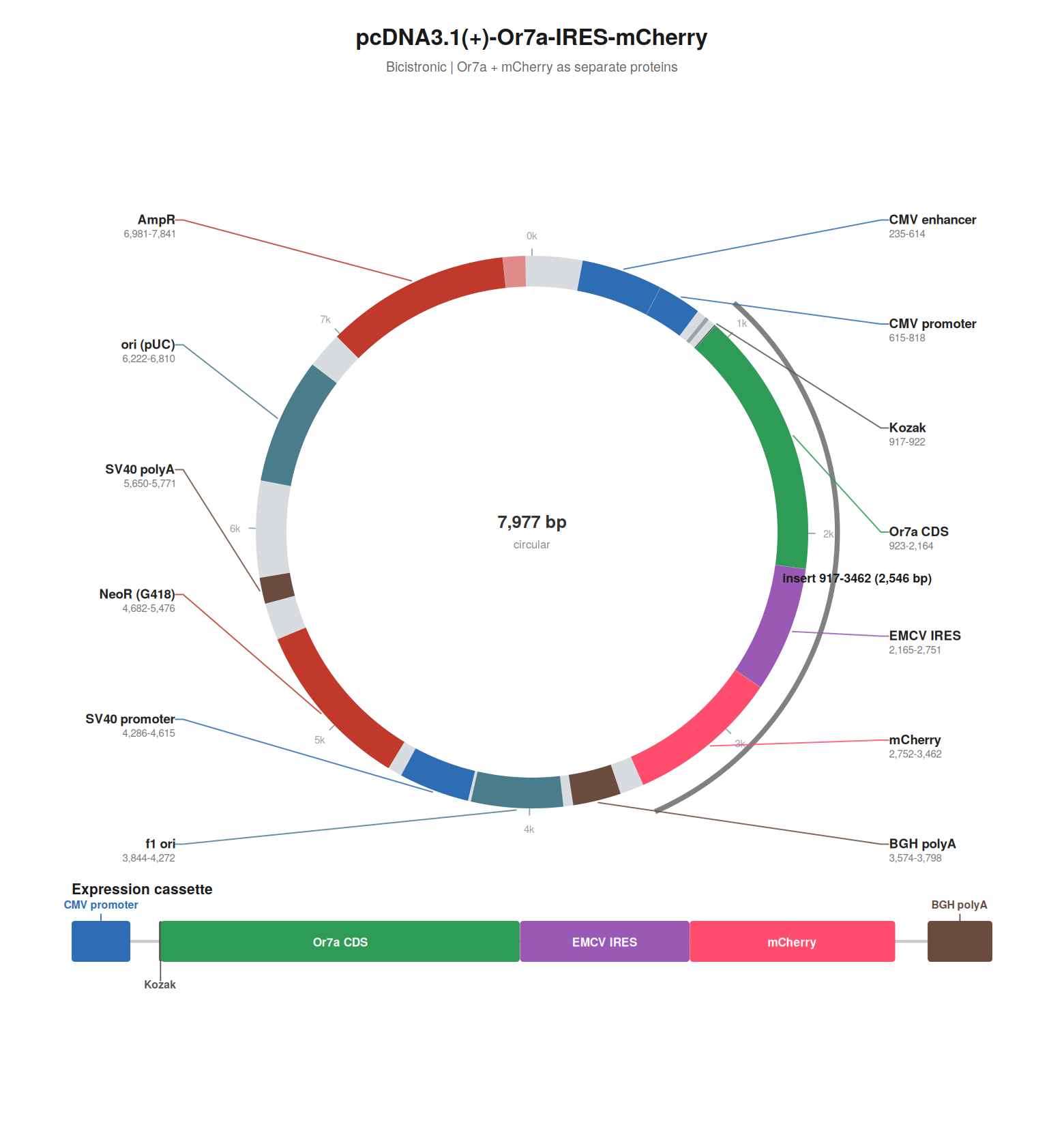
BBa_26ZAGFK0
The pcDNA3.1(+) map shows the Or7a coding sequence followed by EMCV IRES and mCherry, with the expression cassette and backbone annotations below and around the circle. IRES separates receptor and marker translation; related measurements are reported in Results.
 Open full map
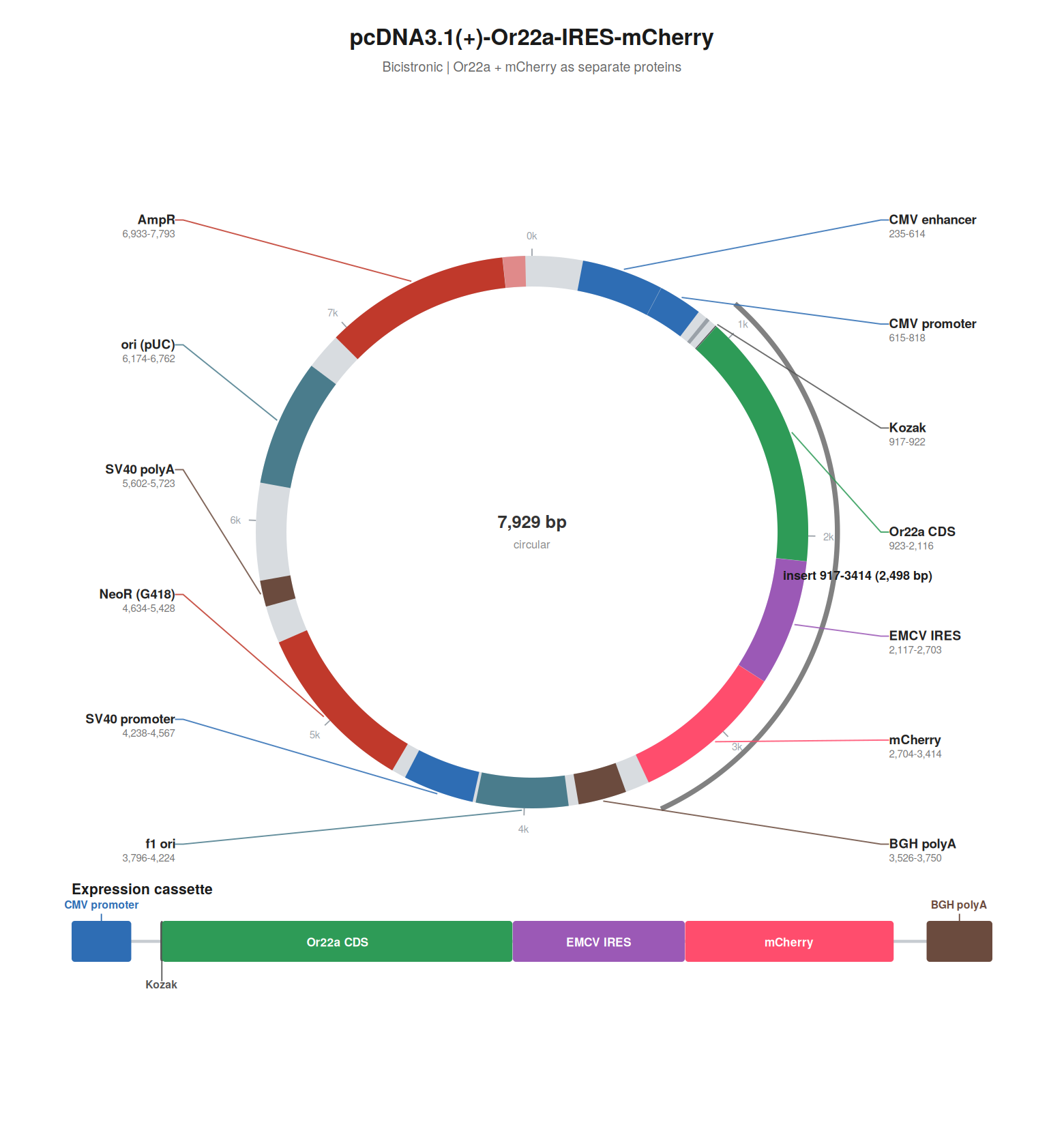
BBa_26WOX4B1
The pcDNA3.1(+) map shows the Or22a coding sequence followed by EMCV IRES and mCherry, with the expression cassette and backbone annotations below and around the circle. IRES separates receptor and marker translation; related measurements are reported in Results.
 Open full map
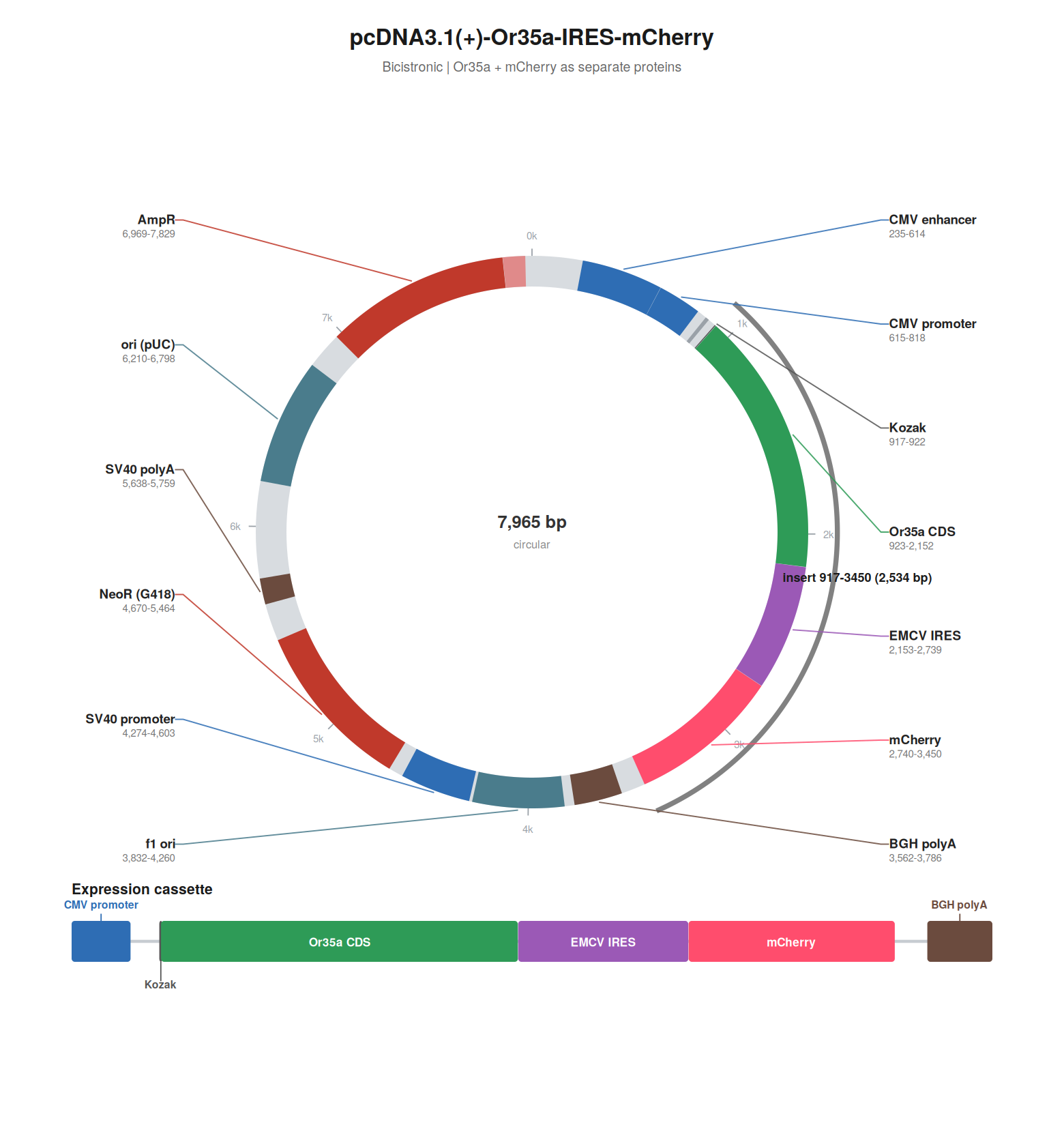
BBa_26LLF3LM
The pcDNA3.1(+) map shows the Or35a coding sequence followed by EMCV IRES and mCherry, with the expression cassette and backbone annotations below and around the circle. IRES separates receptor and marker translation; related measurements are reported in Results.
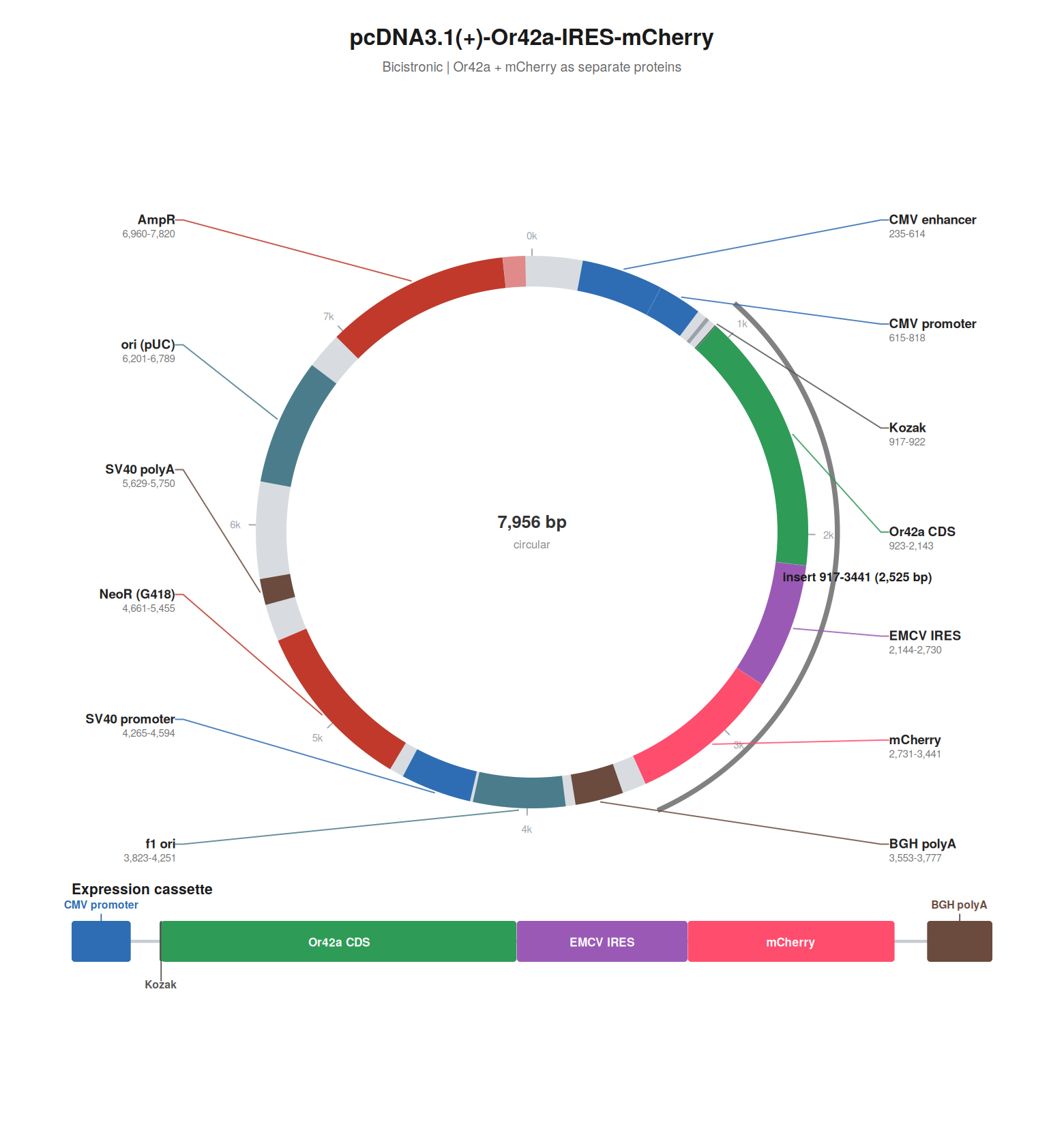 Open full map
BBa_26Q1Q094 · RFC 1000 compatible
The pcDNA3.1(+) map shows the Or42a coding sequence followed by EMCV IRES and mCherry, with the expression cassette and backbone annotations below and around the circle. IRES separates receptor and marker translation; related measurements are reported in Results.
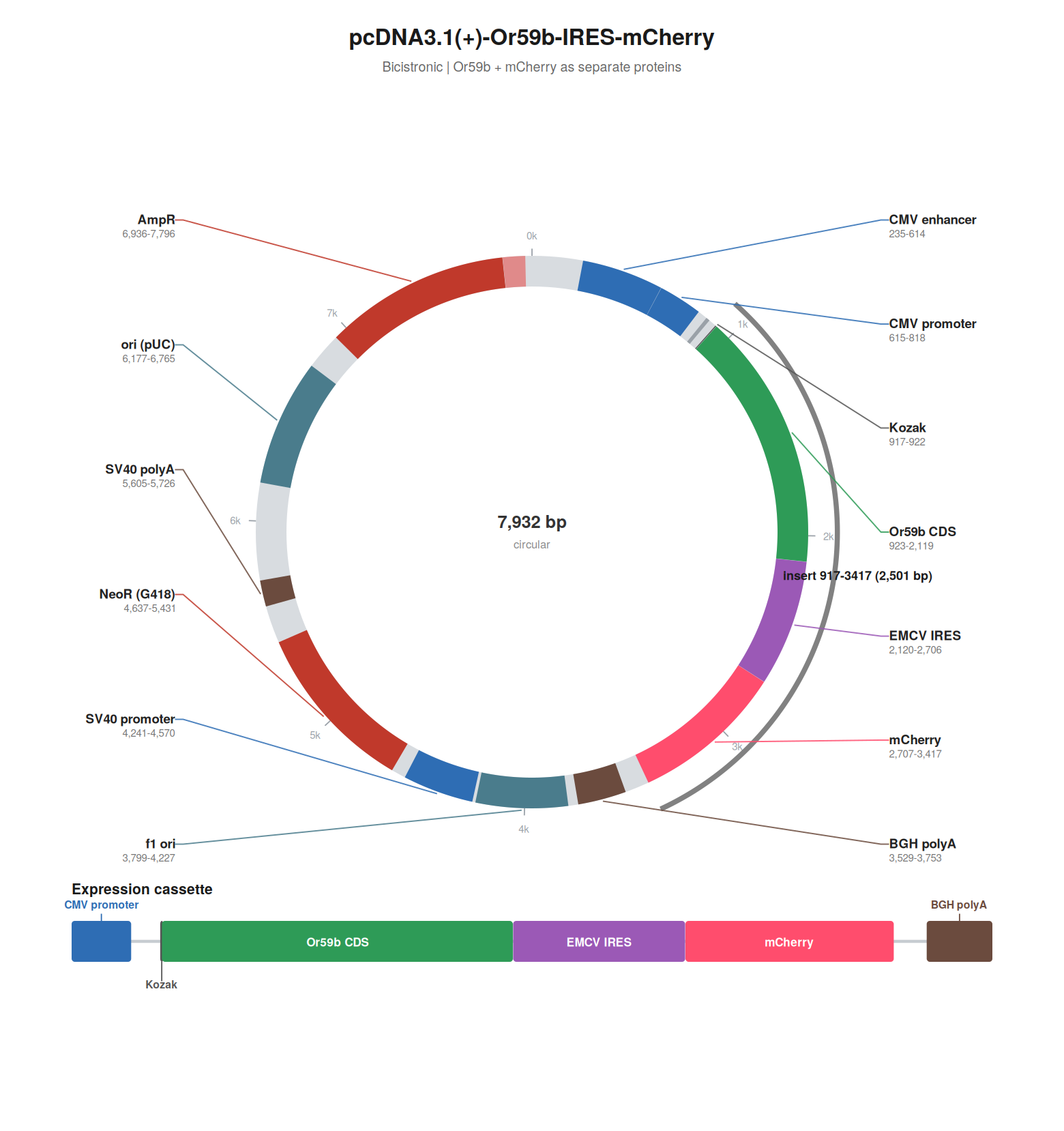 Open full map
BBa_26Y7CI2H · RFC 1000 compatible
The pcDNA3.1(+) map shows the Or59b coding sequence followed by EMCV IRES and mCherry, with the expression cassette and backbone annotations below and around the circle. IRES separates receptor and marker translation; related measurements are reported in Results.
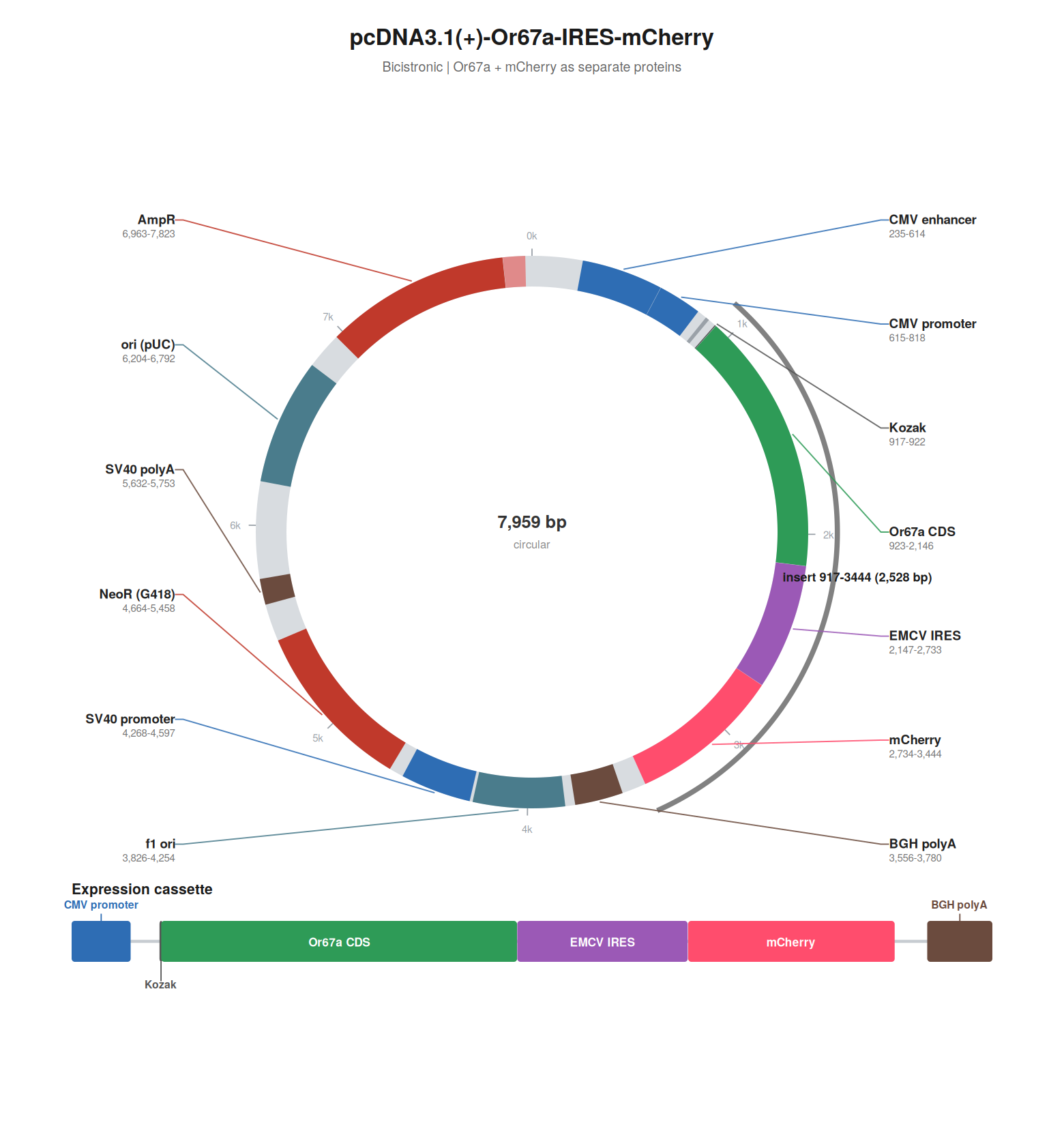 Open full map
BBa_265G8CE1
The pcDNA3.1(+) map shows the Or67a coding sequence followed by EMCV IRES and mCherry, with the expression cassette and backbone annotations below and around the circle. IRES separates receptor and marker translation; related measurements are reported in Results.
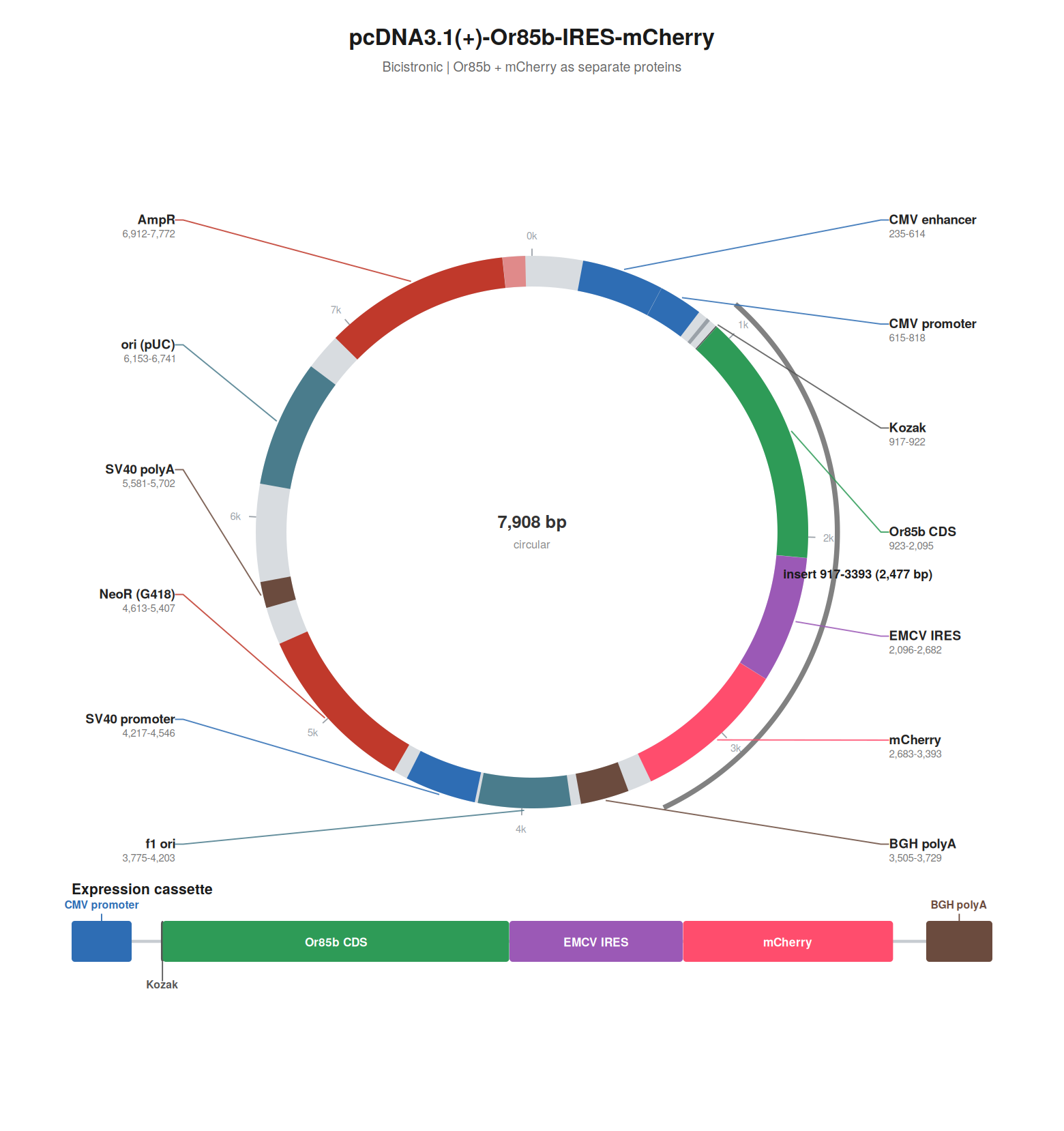 Open full map
BBa_26K1TU11 · RFC 1000 compatible
The pcDNA3.1(+) map shows the Or85b coding sequence followed by EMCV IRES and mCherry, with the expression cassette and backbone annotations below and around the circle. IRES separates receptor and marker translation; related measurements are reported in Results.
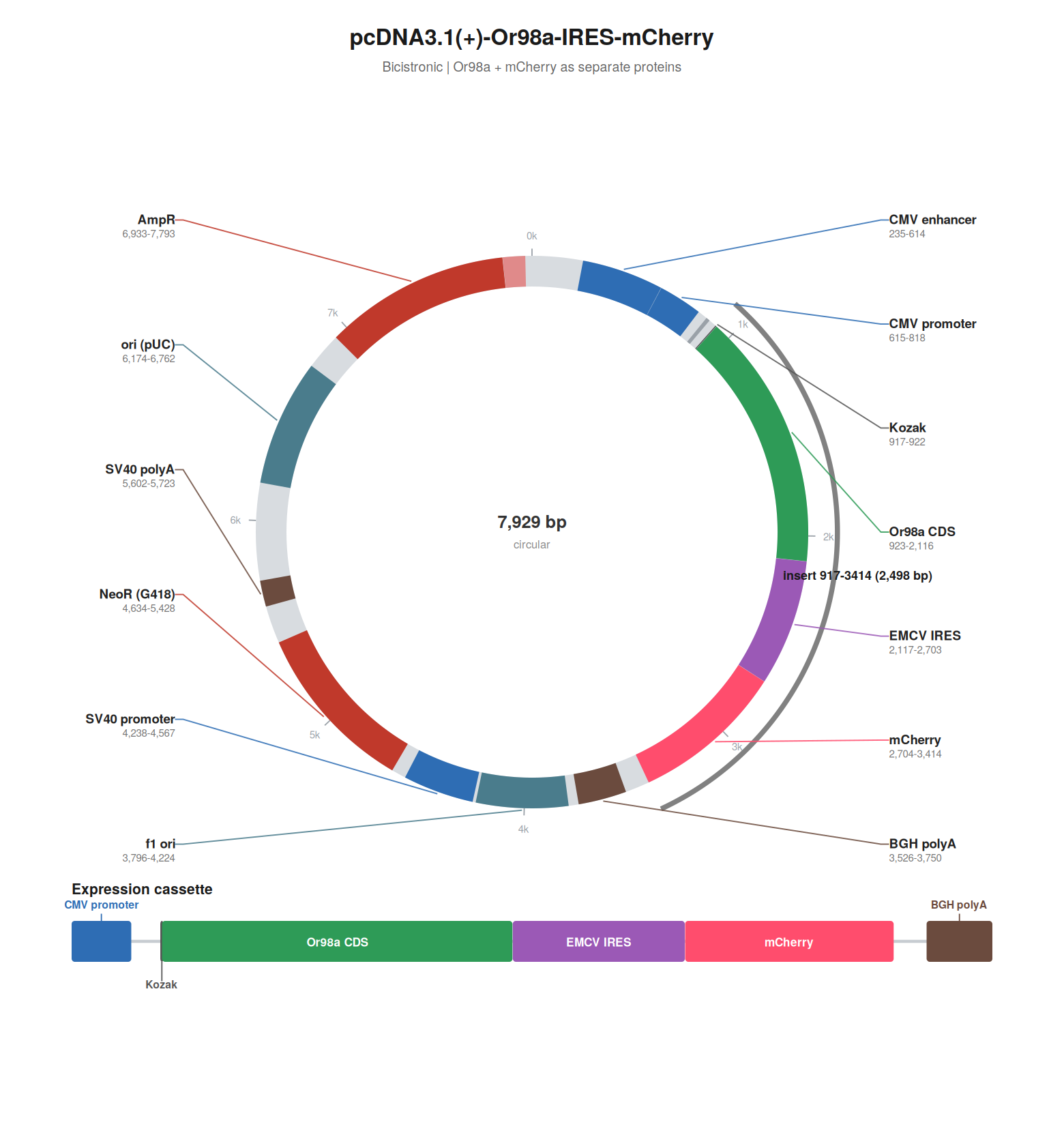 Open full map
BBa_26TZLBMJ · RFC 1000 compatible
The pcDNA3.1(+) map shows the Or98a coding sequence followed by EMCV IRES and mCherry, with the expression cassette and backbone annotations below and around the circle. IRES separates receptor and marker translation; related measurements are reported in Results.
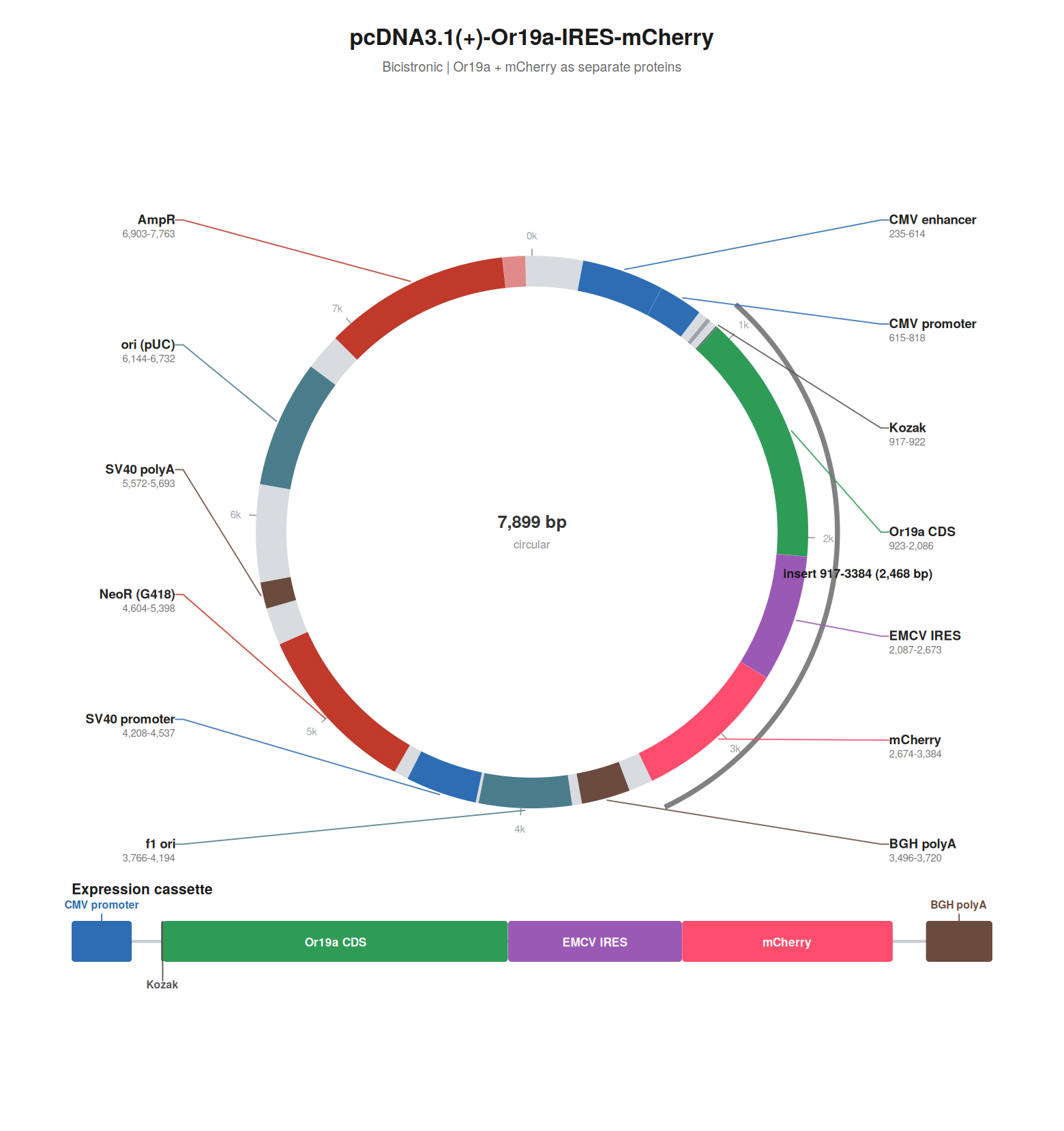 Open full map
BBa_2629NIWH
The pcDNA3.1(+) map shows the Or19a coding sequence followed by EMCV IRES and mCherry, with the expression cassette and backbone annotations below and around the circle. IRES separates receptor and marker translation; related measurements are reported in Results.
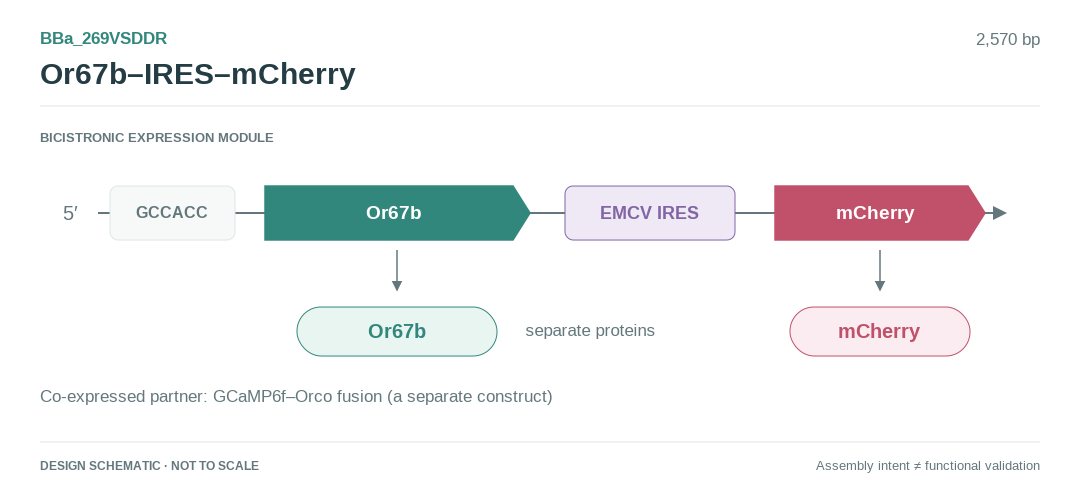 Open full schematic
BBa_269VSDDR
Or67b CDS is followed by EMCV IRES and mCherry in the registered insert. This schematic is not to scale and does not show a complete plasmid backbone or demonstrate receptor function.
Reporting module
One fusion plasmid used with every sensing line.
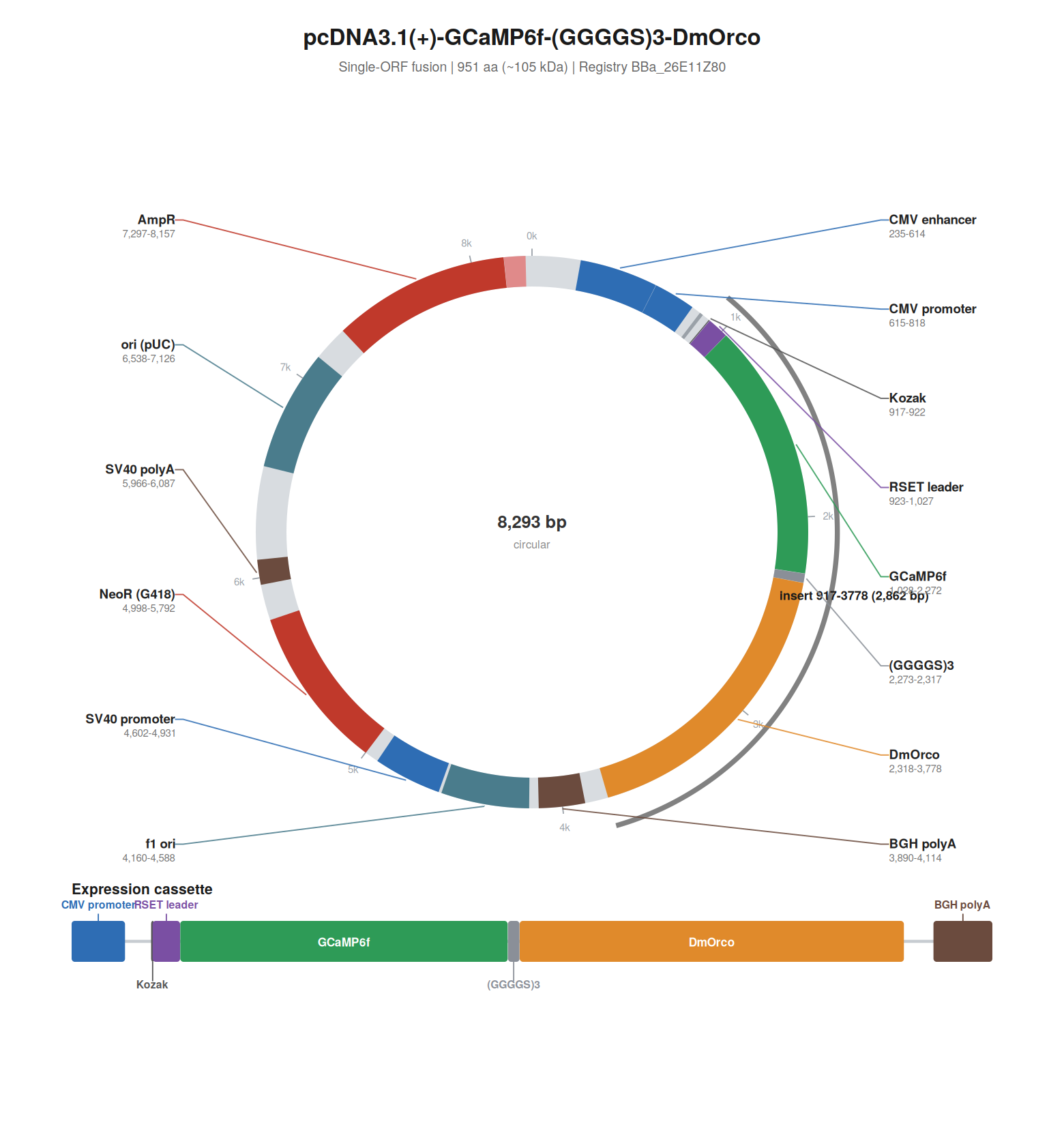 Open full map
BBa_26E11Z80 · Shared reporting module
The pcDNA3.1(+) map places GCaMP6f and DmOrco in one reading frame joined by the flexible (GGGGS)₃ linker. This shared reporting construct is paired with the sensing plasmids; the map documents the design rather than a measured calcium or odor response.
First-generation / legacy
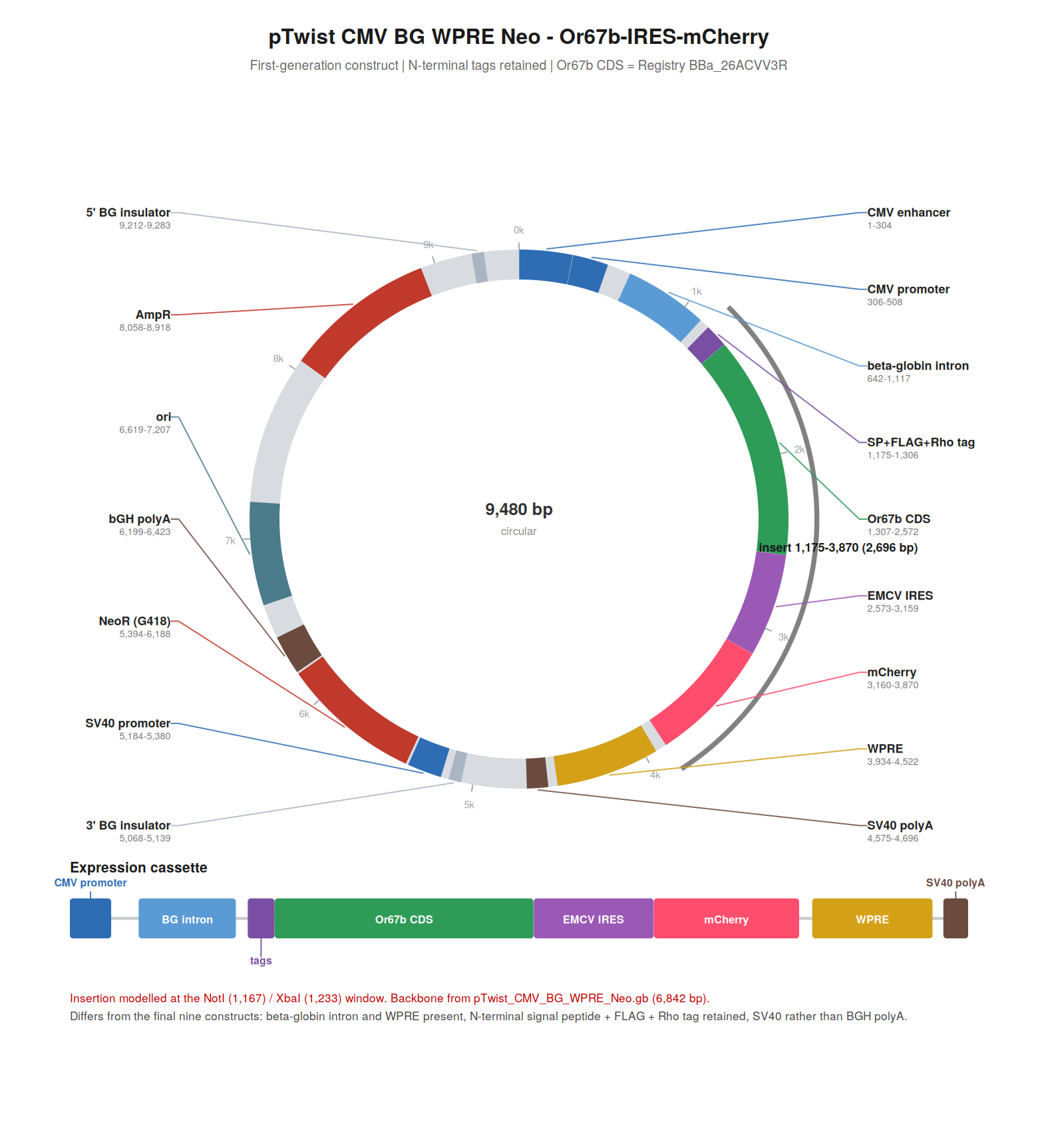
The current collection includes Or67b CDS (BBa_26ACVV3R) and composite BBa_269VSDDR. This earlier pTwist image remains a historical construct record; it does not verify the published composite sequence.
 Open full map
BBa_26ACVV3R · Historical pTwist construct map
First-generation Or67b–IRES–mCherry design in the pTwist backbone, retaining the N-terminal tags and the backbone features shown. The Registry identifier on this historical record refers to the Or67b basic part. The separately published composite is BBa_269VSDDR; its design schematic is available in the catalogue.
Data availability
Research archive: Zenodo · DOI: 10.5281/zenodo.23469212. Public release pending.
The 25-part documentation connects design, construction records, microscopy and the two exploratory odor tests. Original RFU exports and microscopy TIFFs: Research archive availability.
Collection methods and evidence · All 25 part documents
Test 1 well summary (CSV) · Test 1 control contrasts (CSV) · Microscopy object counts (CSV)