
Abstract
Engineering changed the mammalian expression backbone, reporter architecture, fluorescence reader and decoder evaluation. Sequence review led to pcDNA3.1(+); a weak IRES reporter prompted a GCaMP6f–Orco fusion. Circuit review removed a redundant processor and improved weak-signal protection, while optical and gas models guided the enclosure. Decoder comparisons improved PN encoding and located the learned readout bottleneck. Six receptor-design iterations tested prediction, mutation ranking and molecular access in a separate mosquito reference complex.
Engineering approach
Each cycle links a design question, artifact, evidence and revision, distinguishing sequence reviews, qualitative observations, computations and measurements.
The experimental host is HEK293. Assay procedures are documented in Experiments and image-level evidence in Results. Detailed physical models, decoder methods and receptor-engineering analyses are kept on Model; build files and component choices are on Hardware.
Further reading: [1]
Four technical streams. Evidence before closure.
Engineering at a glance
Every redesign starts with a question the previous design could not answer.
Improve the reporter
Backbone checks and a weak IRES reporter led to a mammalian expression system and a GCaMP6f–Orco fusion construct.
Backbone → Reporter → Fusion Explore the decisionsRefine the reader
Board review and physical models shaped the reader; bench tests identified the next gain check.
Design → Integration → Bench testing Explore the decisionsAudit the decoder
Quantile coding improved input resolution; layerwise probes identified the readout loss; a receptor-data comparison set the next measurement target.
Benchmark → Diagnose → Re-evaluate Explore the decisionsTest receptor candidates
Response prediction, mutation audits and membrane simulations exposed the gap between a plausible design and measured function.
Predict → Audit → Investigate accessExplore the decisions ↗Supporting iteration archive
The supporting archive records outreach, business and wiki-design decisions.
Define the first use
Mentor and industry feedback refined the first market, institutional buyer, sampling targets and field-trial plan.
Use case → Buyer → Workflow Explore the decisionsBuild the learning pathway
A 300-response survey shaped games and a five-module curriculum; live audiences guided the next revisions.
Question → Play → Reason Explore the decisionsHelp readers find answers
Page reviews and informal reader feedback shaped distinct routes for definitions, search and contextual questions.
Find → Understand → Question Explore the decisionsRecords
Engineering cycles
Each cycle records Design → Build → Test → Learn → Redesign.
Technical workstream
Wet Lab
3 cycles · cloning backbone → weak IRES reporter → fusion
Current artifact: synthesized GCaMP6f–Orco fusion and fixed-field images
Experimental host: all team wet-lab experiments use HEK293.
Evidence status REVIEW-SUPPORTED
Before testing receptor function, can the delivered DNA support mammalian expression?
Sequence review; vector redesign completed
Construct backbone — before / after
Showing Before · cloning backbone
High-copy cloning backbone
Propagates in bacteria. Cannot support the intended mammalian transcription.
pcDNA3.1(+)
CMV promoter + BGH polyadenylation + NeoR (G418). All ten constructs consolidated here.
Transferable lesson
Verify that every host-required expression element exists before ordering / synthesis — not after delivery. Written up for other teams on Contribution.
Design
We initially treated the supplied high-copy cloning plasmid as a HEK293 expression vector.
Sequence review checked whether the backbone supplied the host’s required regulatory elements.
Build
The synthesized DNA arrived in a cloning backbone that could be amplified in E. coli; it did not establish a mammalian expression system.
The complete plasmid sequence and annotation were the review artifacts.
Test
Test evidence: Construct / expression-context review; primary record incomplete.
The backbone contained a ColE1 origin, β-lactamase resistance and sequencing adapters, but no mammalian promoter or polyadenylation signal.
Learn
We considered overlap-extension PCR of a linear CMV–insert–poly(A) cassette, then chose a mammalian vector.
A common vector provided the panel with a shared expression and selection context.
Redesign
We consolidated all ten constructs onto pcDNA3.1(+), supplying a CMV promoter, BGH polyadenylation signal and NeoR cassette for G418 selection.
Cycle 2 records the bicistronic reporter response. Construct details: Design.
Evidence status DATA
Which part of the Orco–calcium–reporter chain could explain the weak green response?
Qualitative observation; mechanism remains a hypothesis
Intended signal path
- 1Orcoreceptor / channel
- 2Ca²⁺influx / microdomain
- 3GCaMPsensor
- 4Fluorescenceoptical report
VUAA1 challenges the combined Orco–calcium–reporter pathway.
Observation
Real but weak fluorescence response to VUAA1
Initial hypothesis
Poor Orco expression
Re-examination
GCaMP6 sits downstream of the IRES; Orco is the upstream, cap-dependent cistron
Revised hypothesis
Reporter abundance and/or distance from the Ca²⁺ microdomain may be limiting signal amplitude
Design
The bicistronic cassette placed Orco upstream of an IRES and GCaMP downstream: CMV → Orco → STOP → IRES → GCaMP → STOP. Separate proteins preserved the bicistronic arrangement used in the visibly fluorescent OR–IRES–mCherry modules.
We tested whether downstream GCaMP provided enough signal for a transient calcium response.
Build
We synthesized Orco–IRES–GCaMP and transfected HEK293. Orco and cytosolic GCaMP remained separate proteins, with GCaMP translated downstream of the IRES.
Test
Test evidence: Preliminary reporter observation; quantitative comparison not archived.
We challenged the pathway with VUAA1, an Orco agonist [2]. The green-fluorescence increase was visible on close inspection but too weak for reliable quantification.
This observation did not resolve receptor abundance, localization, reporter abundance, calcium handling or imaging limitations.
Learn
The map placed Orco in the cap-dependent upstream position and GCaMP downstream of the IRES, suggesting a reporter-expression bottleneck [3]. GCaMP fluorescence also depends on calcium state [4]; a dim resting image cannot by itself establish failed expression.
Reporter proximity to the channel was a second hypothesis. Neither abundance nor localization was measured independently.
Redesign
We chose a single-ORF GCaMP6f–linker–Orco fusion to address translation stoichiometry and channel proximity together. A 2A design would still produce separate proteins.
Because several features changed together, any fusion comparison concerns the whole redesign.
Evidence status PROTOTYPE
Can a pore-proximal GCaMP6f fusion provide a quantifiable response without disrupting Orco function?
Synthesized construct; fixed-field expression record
Reporter architecture — before / after
Showing Old · IRES
Two cistrons; sensor translation IRES-dependent; sensor free in cytosol.
Single ORF; 1:1 stoichiometry; sensor tethered near the channel mouth.
The fusion comparison is not a strict single-variable experiment because IRES → fusion, GCaMP6 → GCaMP6f, the RSET leader and linker changed together. It does not isolate one causal variable.
Why this change
Remove the IRES reporter bottleneck and tether the sensor near the pore. Full ORF rationale: Design · Module 2.
Orientation constraint: GCaMP on Orco’s cytosolic N-terminus. Topology lecture: Design · topology.
Acceptance criteria vs observed result
Success criterion
- VUAA1-evoked ΔF/F₀ large enough to quantify on the plate reader, clearly separated from vehicle
- Response abolished in Ca²⁺-free buffer (extracellular Ca²⁺ influx, not sensor artefact)
Observed result
No comparison supplied — no direct IRES-versus-fusion functional comparison.
Design
We placed GCaMP6f at the Orco N terminus through a flexible (GGGGS)₃ linker to coordinate translation and place the reporter near the channel. Cytosolic N-terminal placement follows insect OR/Orco topology [5] [6].
Fusion effects on folding, localization and channel function remain unresolved.
Build
The historical pre-synthesis review checked reading frame, internal stops, Kozak context, domain order, orientation and cloning junctions. That version recorded 2,856 bp / 951 amino acids with no internal stop and Kozak sequence GCCACCATGG. Synonymous codons diversified the three repeated 15-bp linker units while retaining the peptide sequence.
The final 8,293-bp pcDNA3.1(+) plasmid was synthesised, the vendor sequence matched the intended construct, and the part was recorded as BBa_26E11Z80.
Test
Test evidence: Construct review and fixed-field microscopy.
The available microscopy record now covers 25 fields across 12 conditions before G418 selection. The analysis on Results quantifies reporter-positive fractions among eligible segmented DAPI objects; dense regions limit the denominator, and the fields are not independent biological replicates.
These fixed images document fluorescence detectability, not a live calcium-response comparison.
Learn
Sequence correctness, detectable fluorescence and dynamic sensor function are separate outcomes. Dim resting GCaMP6f and crowded nuclei limit simple cell-fraction estimates.
Redesign
The diagnostic scheme separates reporter competence with ionomycin from Orco-linked response with VUAA1.
The completed redesign is the synthesized fusion cassette and its control scheme.
BBa_26E11Z80: GCaMP6f–Orco fusion Registry record. The dated documentation review is recorded in Notebook.
Engineering summary
What we built. What changed.
Work. We checked the mammalian expression backbone, investigated the weak IRES reporter, and redesigned the sensing construct as a GCaMP6f–Orco fusion.
Outcome. All constructs use pcDNA3.1(+); BBa_26E11Z80 was synthesized. The ionomycin × VUAA1 scheme distinguishes reporter and channel responses.
Construct compatibility decision
Internal BsaI/SapI/PstI sites were retained so the Registry sequence matches the synthesized material. View the compatibility tables →
Further reading: [7]
Dry Lab
Dry Lab · Hardware
6 cycles · electronics, integration, simulation, documentation and bench testing
A lower-gain retest redirects the board diagnosis
Evidence status REVIEW-SUPPORTED
Would the first circuit preserve a weak photodiode signal through to digitization?
Electrical design audit and professional review
Conceptual pivot
“Amplify the fluorescence as much as possible”
“Preserve measurement integrity throughout the entire analog and optical chain.”
Hardware V1 → V2 (measurement integrity)
Showing Before · V1
Gain-first V1
- 100 MΩ TIA emphasis for maximum amplification
- Longer high-impedance PD/TIA routing risk
- Shared analog/digital supply priorities
- Stopped before fab after DRC/ERC + review
Integrity-first V2
- Shorter PD–LMP7721 path + guarded region
- ADS8866 symbol rebuilt; 3-wire CS + damping
- Separate 3V3_ANA / 3V3_DIG rails
- Improved decoupling and return-current management
Design
V1 combined LED excitation, a sample, photodiode, LMP7721 TIA, ADS8866 ADC and ESP32. The four-layer board included 100 MΩ feedback, four LED channels, power regulation and a Raspberry Pi interface.
The review examined whether layout, supplies and the ADC interface preserved the signal at this gain.
Build
V1 included a schematic, PCB layout, BOM, footprints, 3D models and DRC/ERC reports. The board was not fabricated.
The team prepared the design; iST Group reviewed the high-impedance detector region and mixed-signal interfaces.
Test
Test evidence: Archived computational DRC / ERC audit.
The V1 archive recorded 73 DRC violations, four unconnected items, seven ERC errors and 11 ERC warnings, covering clearance, solder mask, incomplete nets, guards, power rules and symbol/footprint consistency. V1 was not fabrication-ready.
Professional review covered LMP7721 pins and guarding, photodiode pads, TIA placement, ADS8866/reference decoupling, SAR input behavior, ESP32 EN/BOOT and critical capacitors.
Learn
At 100 MΩ, leakage from long traces, poor guarding, humidity or flux residue can rival photocurrent. More ADC resolution cannot recover a corrupted analog signal.
The ADC symbol also required correction against its datasheet. The design objective shifted from gain alone to control of optical and electrical interference.
Redesign
V2 shortens the photodiode–LMP7721 high-impedance path and adds guarding around the detector/TIA feedback region. The ADC symbol was rebuilt from the ADS8866 pinout; the design uses the intended three-wire CS arrangement with DIN high and damping on SCLK/CONVST. Analog and digital 3.3 V supplies, decoupling and return-current paths were separated or reorganized.
Cycle 2 then reviewed the need for a second processor.
Evidence status REVIEW-SUPPORTED
Which tasks truly require an additional computer inside the reader?
Architecture review; portable operation unvalidated
Evidence type: architecture review mapping required functions to available silicon, not fabricated-board validation.
Architecture before / after
Showing Before · V1
ESP32 + Raspberry Pi
- ESP32: LED timing, ADC acquisition, low-level processing
- Raspberry Pi: higher-level control, networking, computation
- Power concept depended on the Raspberry Pi 5 V supply
- Reader framed as a PCB attached to another computer
ESP32 standalone + external server
- Raspberry Pi removed — no unique measurement role remained
- ESP32 retains acquisition, DLIA-class processing, and wireless links
- NeuroAI / heavier analysis → external server
- Power: rechargeable single-cell battery · USB-C charging · power-path management · 5 V boost
- Reader framed as an independent sensing instrument
Design
V1 assigned acquisition and signal processing to ESP32, with Raspberry Pi for control, networking and heavier computation.
We mapped excitation, ADC acquisition, demodulation, user interaction and data export to the available processors.
Build
The V1 package documented both processors and their space, power and interface requirements.
ESP32 GPIO, serial and wireless interfaces covered reader control, acquisition and a local UI. Heavy NeuroAI analysis remained external.
Test
Test evidence: Architecture design review.
The function review found no unique measurement task for Raspberry Pi. ESP32 specifications supported acquisition, control and the proposed digital lock-in design.
This was an architecture review, not an assembled-system benchmark.
Learn
Removing the second processor reduced board area, connectors, supply demands, enclosure height and software boundaries.
Redesign
V2 retained ESP32 and removed Raspberry Pi. Its power design uses USB-C, single-cell charging/power-path management, a battery and a 5 V boost path.
The correspondence made the power requirements concrete: USB-C charging and power-path management, a single cell, a 5 V boost rail and an ESP32 programming interface. A follow-up review moved the ON/OFF function into the boost enable logic.
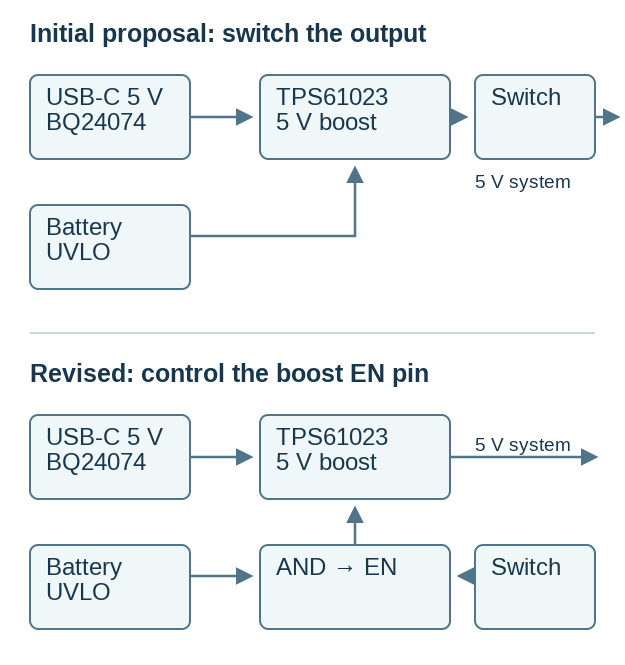
The simplified board set the enclosure constraints. Component and power details: Hardware.
Evidence status DESIGN
What must be fixed and documented before a physical fluorescence result can be trusted?
V2 layout, software and integration documents supplied
Design
Integration joined the PCB to repeatable LED/sample/photodiode geometry, filtering, an opaque enclosure, power and programming access.
The build record specifies the PCB, optical path and operating configuration together.
Build
The September record documents a revised V2 placement/layout of approximately 100 × 90 mm, completed with professional support. The detector/TIA revision shortened the sensitive node while preserving optical geometry.
The later package adds enclosure CAD, eight operating prints, a component inventory, firmware builds, a local phone UI and English assembly/operation manuals.
Development budget archive
The historical workbook recorded a development-device budget of USD 2,511.36 (NTD 79,873.79), including PCB design/setup and a custom-filter allowance. This archive preserves the procurement assumptions used during integration.
The selected build uses one LEE 101 layer. This budget retains the NTD 12,000 custom-filter allowance and Edmund 67-016 price reference; it does not price the selected film.
| Category | USD | Basis / boundary |
|---|---|---|
| Required printing | 35.07 | Three print batches; source resin and machine-time formulas |
| Required purchases at used quantity | 412.94 | 13 required purchase lines at used quantity, including the custom-filter allowance |
| Required budget excluding PCB | 448.00 | Required printing + used purchase quantities |
| PCB allocation from this quote | 2,063.35 | Two-board development quote divided by two; design and setup included |
| Required device budget | 2,511.36 | Device development budget; excluded costs remain below |
| Required purchases in whole packs | 512.51 | Whole-pack cash outlay for purchases only, before printing and PCB |
| Developer equipment budget | 1,214.03 | 10 shared development / gas / measurement lines; may be borrowed |
| Future allowance | 235.81 | PDMS, valve development and environmental sensing; excluded |
The workbook uses fixed USD inputs. Its retained 31.805 NTD/USD conversion snapshot records the historical quotation basis and is retained with that budget. The source quotation was NTD 131,250 for two boards. Shipping, extra taxes, unlisted labor, reprints, cell-culture consumables and replacement of existing facilities remain excluded. Priced PCB materials (USD 61.44) are not added again to the PCBA quote; one PCB material-price row remains unresolved.
Test
Test evidence: Validation protocol in the integration archive.
The supplied protocol specifies electrical/mechanical preflight and cell-free fluorescence standards: Hardware. It covers dark signal, excitation leakage, calibration and channel recovery.
Learn
The integration archive records CAD and software. Later assembly and board diagnostics are documented in Cycle 6.
Redesign
V2 is the documented physical design revision.
Validation ladder
Archived validation specification; all steps are SPECIFIED; optical checks are specified in the standard-solution protocol.
Step 1 · Electrical bring-up · SPECIFICATION
Step 1 — Electrical bring-up. Protocol scope: supply rails, references, ESP32 boot and ADC communication.
Step 2 — Dark noise and drift. Protocol scope: baseline noise and temporal drift in darkness.
Step 3 — Excitation leakage. Protocol scope: excitation light reaching the detector through filtering and baffling.
Step 4 — Standard fluorescence calibration. Protocol scope: non-biological fluorescence standards.
Step 5 — FDM recovery. Protocol scope: recovery of frequency-division-multiplexed LED channels.
Step 6 — Channel crosstalk. Protocol scope: interference under multi-LED drive.
Step 7 — DLIA SNR improvement. Protocol scope: digital lock-in versus broadband signal-to-noise.
Step 8 — Biological fluorescence. Protocol scope: engineered-cell GCaMP signals.
Step 9 — Battery / system stability. Protocol scope: portable power-path behavior under load.
Step 10 — User workflow. Protocol scope: the complete operator workflow.
How should a compact shared cartridge guide light and sample gas before it is fabricated?
Optical and gas computations completed
Design
The enclosure brief required a compact footprint, real connector access, a fan below the PCB, black-sleeved flat wells, fewer printed parts and a clear assembly sequence. The resulting nominal envelope is 108 × 108 × 66 mm, with LED-based well positions and a removable seal-loading plate.
We modeled collection geometry, cross-well transfer and gas redirection within the shared enclosure.
Build
The package contains editable CAD and individual STLs for eight operating prints, including an integrated fan cradle and gas deflector. The optical model represents clear flat-bottom wells, the off-center detector proxy, filter/seal and opaque carrier. The gas model represents the common plenum and alternative perforated or directional features.
Before the current enclosure, the archive retained a larger integrated body, a removable service tray and a hinged lid. Reviewing the actual meshes makes the mechanical iteration visible without treating the historical dimensions as the current specification.
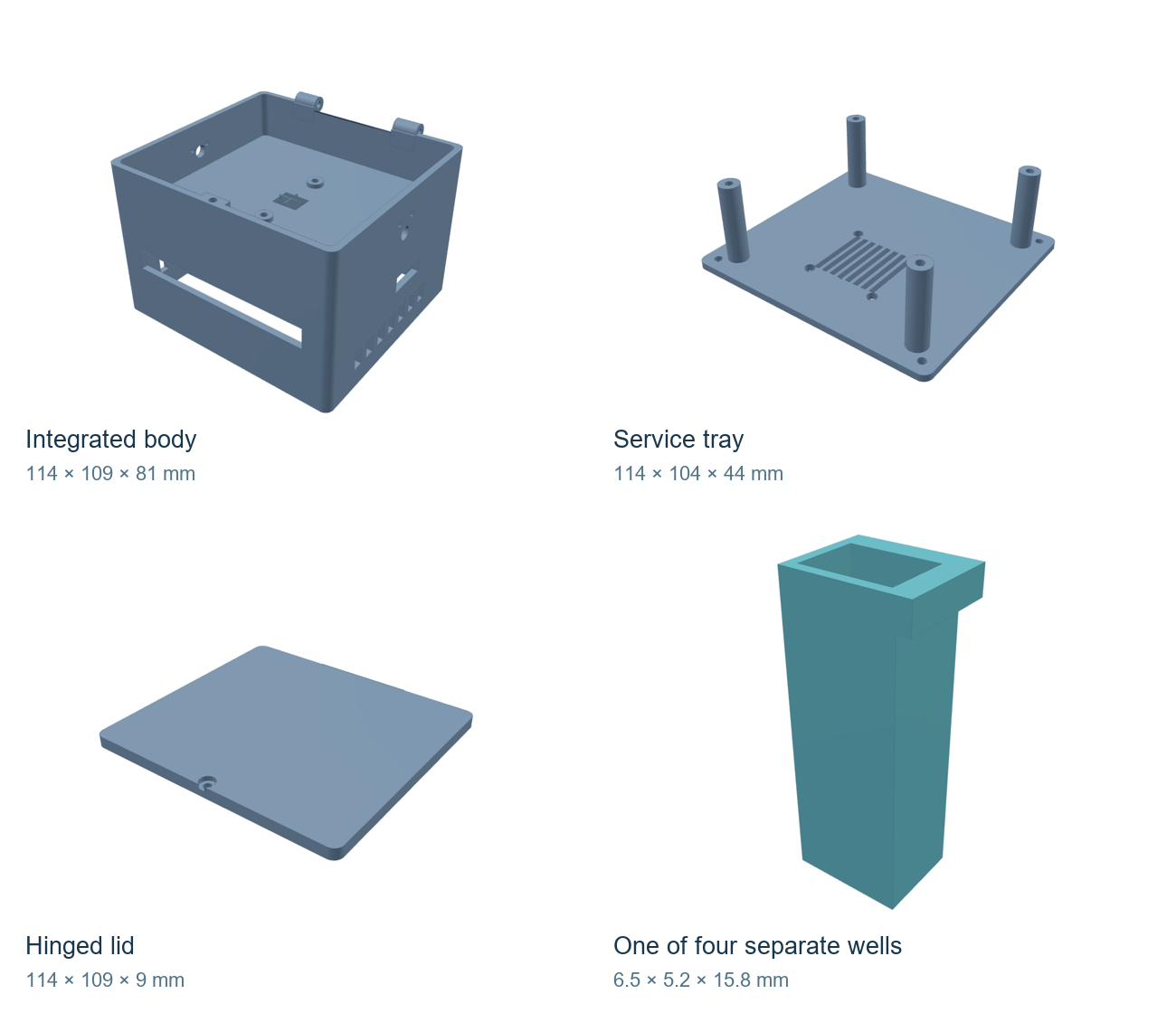
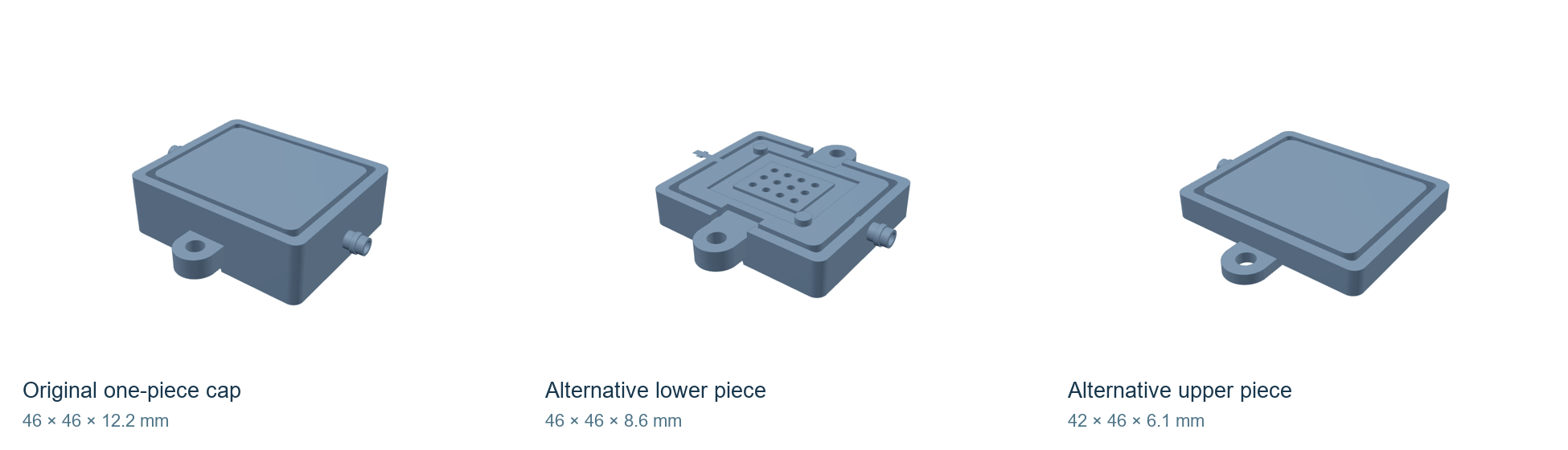
Parameter sweeps, outputs and manuals accompany the build sources. Simulations used 100 µL; the 80 µL operating proposal was a historical iteration. Hardware records the final confirmed parameters.
Test
Test evidence: Conditional computational comparison.
Under its stated assumptions, the ideal D3 optical case predicts 0.593 ± 0.035 nW. Intended-well fractions of 88.6–90.9% indicate cross-well optical transfer even with frequency-separated excitation.
For the selected gas geometry, shelf_w8_e0p2 reduces the downward momentum proxy by 36.1% on the finest 0.20 mm grid. The fixed-STL Q3 candidate gives a worst gas t90 of 50.00 s, compared with 50.98 s in the selected-grid check. These predictions describe gas equilibration, not cell-plane exposure.
Subsequent spectral comparison. The synthetic detector-current model predicts that one LEE 101 layer retains 70.43% of green-proxy current and 2.987% of LED current; two layers retain 51.27% and 0.410%. The filter comparison documents the spectrum and current model.
Learn
Flat well floors still produced nonuniform excitation, and the detector active area was off-center. Cross-well transfer limits direct assignment of recovered signals to samples.
The gas comparison favored controlled redirection at low Reynolds number. Membrane and liquid transport add delays beyond the modeled plenum response.
Redesign
The models informed a fixed optical layout, an opaque carrier/filter arrangement and the selected shelf geometry. The 3 mL/min candidate applies to the modeled geometry and flow assumptions.
Cycle 5 documents the manuals and evaluation specification. Hardware presents the result figures and their design consequences.
The selected design uses one LEE 101 layer. The Edmund #29-190 comparison uses a constructed OD4 curve. See the updated filter design decision.
Can a person who did not design the reader assemble it and identify a valid measurement?
One assembly-feedback record; Developer Manual R6
Design
The manual-evaluation specification covers parts, enclosure assembly, seals, well replacement and demo/live measurement states.
Build
The package contains labeled build documents, illustrated bilingual assembly/operation manuals, a local interface and a feedback form.
Test
Test evidence: one completed, anonymized assembly-feedback record and annotated earlier manual.
This qualitative assembly review did not measure completion time or a post-revision success rate.
Learn
The feedback identified unclear PCB fasteners, enclosure screw length, fan clearance and the photodiode/well orientation.
Redesign
Developer Manual R6 specifies M2.5 PCB fasteners, M3 × 36 mm enclosure screws, the fan-clearance check and photodiode/well orientation. A follow-up assembly test has not been completed.
Why did changing the illumination leave both the analog voltage and ADC code unchanged?
Lower-gain retest reported; input-node fault unresolved
Design
Weak fluorescence requires gain, but the photodiode also receives blue excitation and ambient light.
Build
The circuit uses a VEMD5060X01 photodiode and an LMP7721 transimpedance amplifier (TIA). The feedback resistor, R27, is 100 MΩ. Within the linear operating range, an input current of 1 nA produces an output change of approximately 0.1 V.
Test
After installing the firmware, we compared three illumination conditions and separately measured the ADC input node with a multimeter.
| Illumination condition | ADC code | Multimeter voltage (V) |
|---|---|---|
| LEDs off | 32767 | ≈ 3.15 |
| All LEDs on; photodiode covered | 32767 | ≈ 3.15 |
| One LED on; photodiode exposed | 32767 | ≈ 3.15 |
We did not observe the expected response to changes in illumination. The fixed digital code alone did not prove saturation. The measured analog voltage was also inconsistent with the digital reading under the intended 2.5 V ADC reference.
Learn
We shared the circuit information and test results with iST, our PCB manufacturing partner. Their assessment was that excessive TIA gain could cause the output to saturate near its upper limit. They proposed changing R27 and testing different resistance values.
iST subsequently reported replacing the TIA feedback resistance from 100 MΩ to 10 kΩ without eliminating output saturation. They then observed that the inverting input was shorted to ground and were still investigating the cause.
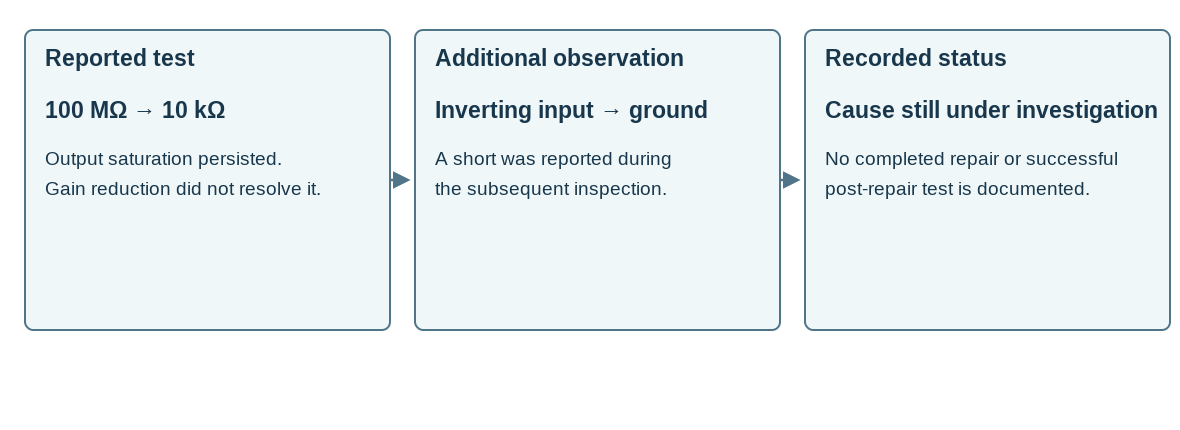
The gain explanation remains unconfirmed because photodiode current was not measured. iST confirmed that pre-delivery checks covered power supplies, not ADC function or the complete photodiode path.
Redesign
The follow-up changed the next step from gain selection to locating the reported input-to-ground short. After resolving that connection, the same dark, covered-detector and illuminated-detector checks should be repeated.
We will compare digital readings with measured analog voltage, check ADC input margin and repeatable light dependence, then compare a blank with a fluorescent standard.
The supplied record does not document a completed repair or a successful post-repair optical test.
Engineering summary
What we built. What changed.
Work. The student team specified the sensing requirements, selected the core components, and prepared the initial schematic, BOM and PCB layout. iST Group supplied professional schematic/layout review and manufacturing-preparation support.
Outcome. The review informed photodiode/TIA routing, separate analog/digital supplies and the verification specification. Follow-up board tests and iST assessment →
Further reading: [9]
Dry Lab
Dry Lab · Odor decoding
3 cycles · quantile coding → layerwise diagnosis → receptor-data transfer
Current state: computational comparisons identify the readout and data-collection priorities.
Cycle 1 Put PN resolution where the data are
Can the network learn gas identity without losing it during encoding?
Computational comparison
Design
We hypothesized that fixed sparse expansion followed by a learned readout could classify gas-response patterns, but first needed to check whether the PN representation retained the input information.
Build
We standardized the 128 UCI-270 features, fitted PCA on training data and converted each component to a PN-bin code. We compared equal-width and training-quantile bin edges.
Test
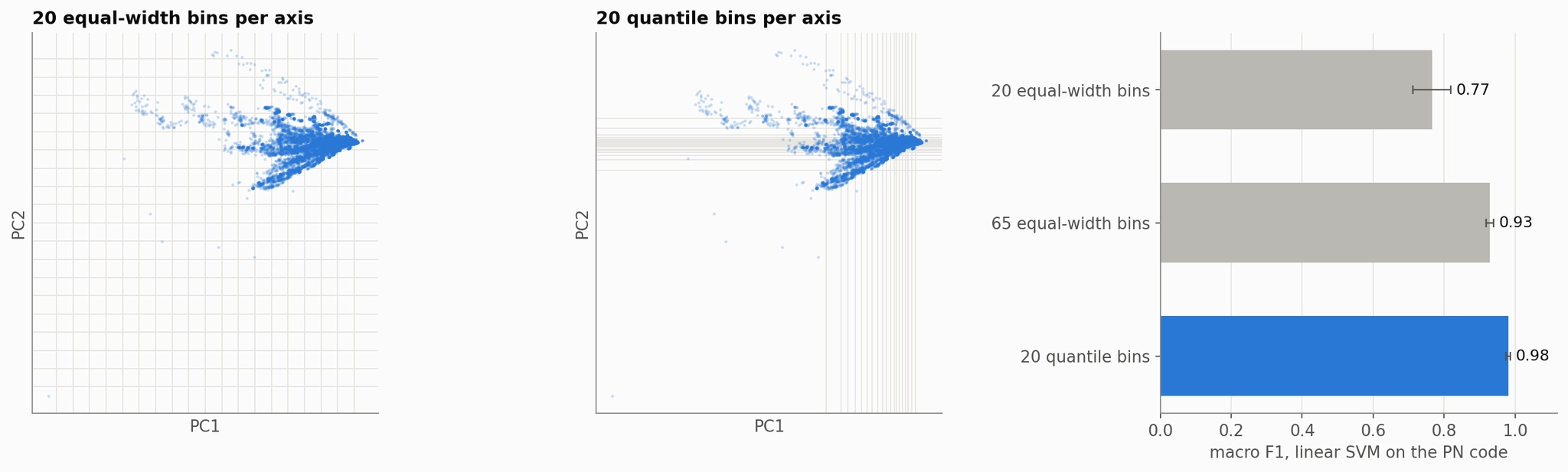
On the second principal component, three of twenty equal-width bins contained 90% of the training measurements and eight bins were empty. A linear SVM on the PN code scored macro-F1 0.77 with twenty equal-width bins, 0.93 with sixty-five equal-width bins and 0.98 with twenty quantile bins. This PN-code comparison uses five-fold cross-validation over 13,910 measurements; it is separate from the SNN learning-curve split.
Learn
Uniform coverage of a wide numerical range wastes PN resolution on sparse tails. The encoding should follow sample density.
Improve
We adopted quantile bins and exposed connection probability, APL inhibition, threshold adaptation, learning rate, weight cap and MBON inhibition as configurable settings. The reported SNN run peaks at 0.83, falls to 0.53 at cycle 400 and ends at 0.79; tuning did not remove training instability. See the full learning curve.
Cycle 2 Locate the loss before redesigning the network
After parameter tuning, which representation limits the final decision?
Computational comparison
Design
We compared access to class information at every stage instead of diagnosing the model from its final score alone.
Build
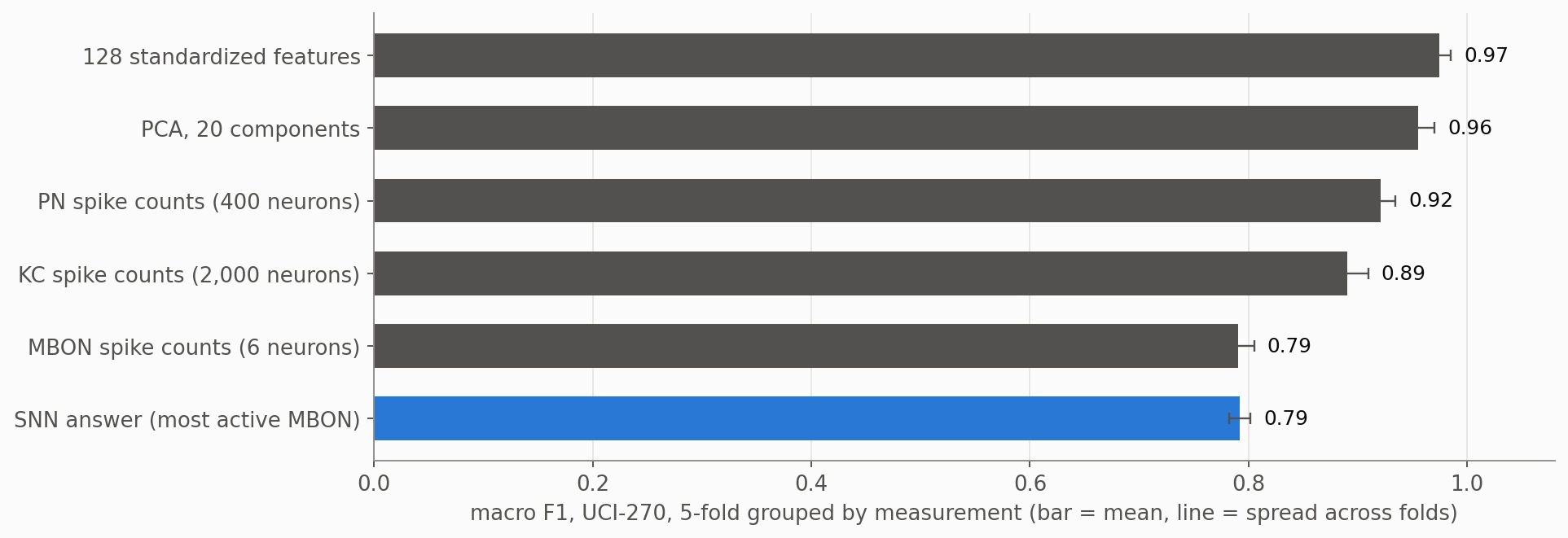
For the 800-cycle UCI run, we reconstructed standardized features, PCA values and PN/KC/MBON spike counts for the recorded test presentations. Each representation received a linear-SVM probe. Repeated presentations of one measurement stayed in the same cross-validation fold.
Test
The shared five-fold comparison contains 1,799 presentations from 1,322 measurements. Macro-F1 progresses from 0.97 (features) to 0.96 (PCA), 0.92 (PN), 0.89 (KC) and 0.79 (MBON). The network’s most-active-MBON answer also scores 0.79.
Learn
The largest adjacent loss is at the KC→MBON readout. The KC representation supports a stronger linear classifier than the trained network uses.
Improve
We made layerwise probes part of the comparison protocol and identified the learned readout as the next redesign target. A future readout change should be evaluated on fixed folds and independent runs; this cycle does not claim that such a redesign has already succeeded.
Cycle 3 Match coding resolution to receptor-data scale
Can the pipeline classify chemical families from the receptors used by AeroSense?
Computational comparison
Design
We moved from repeated metal-oxide gas measurements to published DoOR responses for the ten fly receptors in our cell-line panel. This changes the prediction task to chemical-family classification of distinct odorants.
Build
We retained 91 odorants measured on at least eight receptors, imputed missing values within training folds, and compared the SNN with logistic-regression readouts on the same five stratified odorant folds.
Test
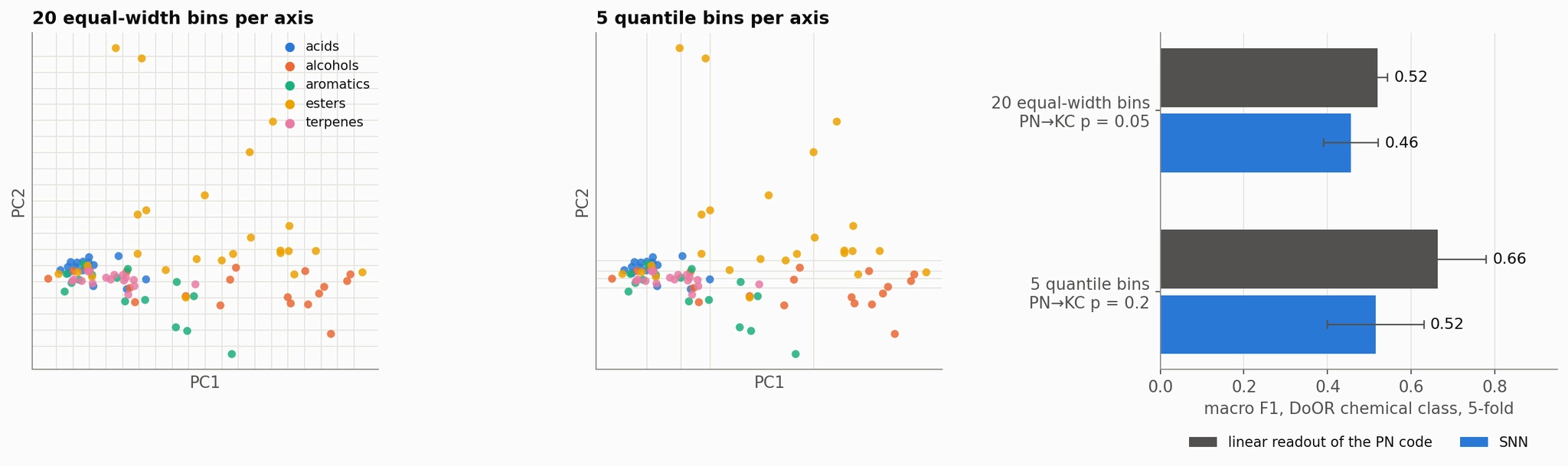
With twenty equal-width bins, the SNN scores 0.46 and a linear PN-code readout 0.52, compared with 0.69 from raw receptor values. Sixteen bins on the second component contain at most two odorants, while one contains 40. Five quantile bins increase the linear PN-code score to 0.66; the associated SNN configuration reaches 0.52.
Learn
Fine bins fragment the small dataset. The SNN comparison also changes PN→KC probability from 0.05 to 0.2 and training duration from 200 to 100 cycles, so it does not isolate binning as the sole cause of improvement. The separate Test1 cell comparison does not yet establish agreement with DoOR.
Improve
We adopted the coarser quantile configuration as the candidate and set a wet-lab target of three to five independent wells per odorant–receptor condition. Replicated cell acquisition and a prespecified transfer test remain future work; DoOR consensus values are not substituted for cell measurements.
What changed
We changed the PN code to follow training-data density, added measurement-grouped layerwise probes, and adapted the code to a small receptor dataset. The new evidence supports a specific next step—readout comparison and replicated biological input—not a completed cell-based odor classifier. Methods, uncertainty and source availability.
Earlier preprocessing and precision-audit cycles
This earlier record is retained for its data-cleaning, seed and clock-audit evidence. Its scores and fixed-seed candidates do not describe the newer UCI/DoOR configurations above.
Dry Lab
Dry Lab · Odor decoding
2 cycles · multi-seed discipline → gated OFAT candidate
Current state: baseline retained; clock error corrected
Evidence status DATA
Are the apparent performance and sensor-importance patterns robust to data cleaning and random seed?
Recorded seed comparison and preprocessing audit
- 1Data cleaning105 contaminated Batch2 files isolated
- 2Multi-seed checkseeds 100 / 102 / 104
- 3Sensor contradictionSVM vs SNN / ANOVA-F
- 4Root causeno StandardScaler on SNN PCA
- 5Redesignmulti-seed rule + queued scaler
Team-reported runs; primary plot unavailable (Evidence note E-D1)
Single-seed (misleading)
~0.90
Appeared strong at one seed — treated as luck, not a claim.
Honest 3-seed mean
~0.85
Average across the three recorded seeds.
pca_dim=5 more stable across seeds than pca_dim=3
(best-per-seed std 0.042 vs 0.080); pca_dim=8 saturated at the same level as 5.
Cleaning barely shifted PCA (top-3 variance 88.0%→88.7%).
Primary multi-seed plot: Evidence note E-D1 (not archived — text-reported only).
Sensor-importance contradiction Evidence note E-D2
Standardized SVM
Dropping S6 improved F1 by +0.041.
SNN (unstandardized PCA→bin)
Barely changed when S6 dropped. LOSO ranked S13 most / S6 least important.
ANOVA-F separability
Flagged S2 / S9 / S11 as truly discriminative — conflicting ranking.
Root cause: SNN PCA never applies StandardScaler, so apparent importance can track raw sensor magnitude (S13 large, S6 small), not true separability.
Design
The decoder uses a fly-inspired PN → KC → MBON pathway, implemented in Brian2 [10], on the external KT Batch 1–3 gas-sensor benchmark. Before tuning it further, we asked whether contaminated inputs, stochastic initialization or preprocessing differences were driving the apparent results.
The external benchmark contains metal-oxide sensor recordings, not AeroSense reader output.
Build
We isolated 105 contaminated Batch 2 files—53 from dev1 and 52 from dev2—and added the default-on -drop-contaminated option. Batch 2 went from 255 to 150 included files while preserving the excluded raw records.
Runs compared seeds 100, 102 and 104, PCA dimensions 3, 5 and 8, and sensor-S6 removal. SVM used standardized PCA; SNN retained its PCA-to-bin preprocessing.
Test
Test evidence: Team-reported runs and preprocessing audit; primary artifacts incomplete.
Cleaning changed the top-three PCA variance fraction only slightly, from 88.0% to 88.7%. A single-seed F1 near 0.90 fell closer to 0.85 when summarized across three seeds, and five PCA dimensions were more stable than three in the recorded runs.
Removing S6 improved the standardized SVM by 0.041 F1, while SNN changed little. Leave-one-sensor-out and ANOVA-F rankings also disagreed, exposing the preprocessing mismatch.
Learn
Inspection found that the SNN PCA path lacked StandardScaler. Raw feature magnitude could therefore dominate the projection.
Seed variation and preprocessing differences made a single best score or sensor ranking unreliable.
Redesign
We adopted across-seed reporting and identified the missing SNN standardization step.
Cycle 2 audits numerical precision and weight selection. Methods and records: Model.
Evidence status INVALIDATED / RERUN REQUIRED
Which precision and weight settings survive an implementation audit and a repeatability gate?
State-precision conclusions withdrawn; fixed-seed candidate recorded
- 1 Initial quantization experiment Apparently robust precision (lossless ~to 10 bits)
-
2
Inspect
quantize_statesscheduling -
3
BUG FOUND
self.dt= 1 ms vsdefaultclock.dt= 0.1 ms9 of every 10 real integration substeps were not actually quantized.
- 4 Previous bit-sweep conclusion downgraded INVALIDATED / RERUN REQUIRED
- 5 Fix + rerun required Quantize on every real integration step, then re-measure
OFAT refinement sweep
Baseline macro F1 = 0.8676.
OFAT + refinement on w_kc_mbon ∈ [11, 20] found
w_kc_mbon=13 → macro F1 = 0.8870
at the fixed seed; F1-vs-weight curve was jagged / non-monotonic (reproducible at that seed, not sampling noise).
FIXED-SEED CANDIDATE
Applying Cycle 1’s rule: a seed=100-only improvement of this size is not validated as better than baseline.
Design
We next asked how much numerical precision each processing stage might need and whether the documented 0.8676 macro-F1 baseline improved under a local weight search.
The implementation audit checked whether the code applied the stated precision at every integration step.
Build
We added ADC and state-quantization controls, including -adc-bits, -quantize-bits, -quantize-g-bits and -quantize-g-fs. An initial one-factor-at-a-time sweep was followed by refinement of the sensitive KC-to-MBON weight parameter.
The implementation also introduced a scheduled quantize_states operation. Quantization was intended at every integration step.
Test
Test evidence: Implementation audit; state-precision result invalidated.
The early sweep appeared to tolerate reduced precision, but an audit found quantize_states running at 1 ms while Brian2 integrated at 0.1 ms. Nine of ten integration steps therefore escaped the intended state quantization. The affected state-precision conclusions were marked invalidated / rerun required.
In the separate weight search, w_kc_mbon=13 produced 0.8870 macro-F1 at the fixed seed, with a jagged, non-monotonic weight-response curve.
Learn
The clock mismatch prevented the state sweep from testing its stated precision budget.
The weight candidate was selected at seed 100; its improvement is specific to that recorded configuration.
Redesign
We matched quantization to the integration clock and withdrew the affected state-precision conclusions.
The best_wmbon13_seed100 candidate did not replace the baseline.
Engineering summary
What we built. What changed.
Work. We audited preprocessing, compared seed-dependent model results, and investigated the quantization clock mismatch before evaluating parameter-sweep candidates.
Outcome. The clock error was corrected and affected precision conclusions withdrawn. The baseline remains 0.8676; the fixed-seed 0.8870 candidate is separate.
Dry Lab
Computational receptor engineering
Six receptor design iterations
Six computational iterations connect response prediction, mutation audits and membrane simulations. Or22a and Or35a remain functional candidates; no engineered receptor demonstrated improved sensitivity or selectivity.
Complete receptor models, 36 figure groups and downloadable data →
Design
Curate a benchmark of 24 Drosophila receptors and 110 odorants from published measurements. Compare a project-defined panel of mold-related volatiles with control odorants; these compounds are not assumed to be unique markers of mold. (Hallem & Carlson, 2006)
Build
Combine molecular descriptors, receptor sequences and AlphaFold-derived structural features in matched prediction models. Generate Or22a (Hallem & Carlson, 2006) / Or35a point-mutation models with ColabFold and dock target and control odorants. The build consists of computational sequences and structures. (Jumper et al., 2021; Mirdita et al., 2022)
Test
For receptors excluded from training, R² increased from 0.1125 with ligand features to 0.2325 with sequence features. The full representation reached 0.2356; its additional gain had an uncertainty interval spanning zero. An initial docking (Trott & Olson, 2010) screen suggested small relative preference shifts for F34Y and E196Q.
Learn
Prediction prioritized candidates; docking differences did not establish selectivity. R² measures predictive fit.
Redesign
Move from ranking candidates to checking whether the proposed mutations actually contact the odorant and whether their ranking survives changes in docking setup.
Design
Require both an interpretable ligand–residue relationship and a preference that is stable across reasonable docking (Trott & Olson, 2010) choices.
Build
Align mutant and wild-type structures, compare a common search region with an alternative template-informed center, and inspect side-chain contacts. Define preference as the docking change for controls minus the change for mold-related odorants.
Test
Using a 4.5 Å contact criterion, neither F34Y nor E196Q supported a direct-contact explanation in the inspected poses. Candidate preference directions were sensitive to docking setup and odor-panel composition. No mutation maintained a robust positive preference across these checks.
Learn
Neither direct contact nor robust docking preference supported an improved receptor.
Redesign
Separate the functional-prediction question from the physical-access question. Use the OR10 (Zhao et al., 2024)/Orco complex to test what docking alone leaves unresolved.
Design
Use experimental unbound 8V00 and o-cresol-bound 8V02 structures as OR10/Orco references. Reconstructed unresolved loops are model assumptions, not experimentally observed coordinates. (Zhao et al., 2024)
Build
Prepare the receptor complex in a hydrated POPC membrane with ions. Correct geometric and periodic-box problems before extending bound-state diagnostics to 20 ns and sampling unbound pockets with 5 ns MD (Eastman et al., 2024). Cluster the pockets and dock odorants into representative conformations.
Test
In an expanded panel of 29 dockable odorants, Spearman correlations were 0.407 and 0.338 for two MD-derived model ensembles, compared with 0.450 for static 8V00 and 0.504 for static 8V02. Responses were digitized from a published calcium assay. An exploratory aromatic-ring-count baseline reached 0.790, highlighting chemical-panel effects. (Bohbot et al., 2011)
Learn
Retrospective correlations are not sensitivity, EC50 or affinity measurements. Assays were analyzed separately; short MD does not establish equilibrium.
Redesign
Test molecular access explicitly, beginning with unbiased trajectories of o-cresol placed outside the apo receptor.
Design
Distinguish reaching the receptor surface from actually occupying its binding pocket.
Build
Place o-cresol (Zhao et al., 2024) in external water, at the water–membrane interface, and near the candidate S3/S6 entrance. Compare low- and high-occupancy solvent preparations to explore encounter frequency, then reduce the initial diffusion distance directly.
Test
Pocket-distance, contact and occupancy tracking showed surface/membrane encounters but no sustained entry.
Learn
A nearby starting position does not guarantee a passable entrance. A missing event over nanoseconds cannot prove that natural entry is impossible.
Redesign
Use the experimentally observed bound pose to explore outward motion and test receptor-side opening motions separately.
Design
Separate direct ligand pulling from receptor-side bias, and compare guided entrance motion with an unsteered control under the same observation schedule.
Build
Use steered molecular dynamics (SMD (Isralewitz et al., 2001)) for exploratory outward motion. In a separate test, bias S3/S6 (Zhao et al., 2024) reference distances toward apo values while leaving o-cresol free of direct pulling. Extend the receptor-guidance protocol to a total of 70 ns, with the final 1 ns after bias removal.
Test
Assess entrance distances and ligand departure separately. Neither the guided nor the unsteered 70 ns trajectories met the sustained-exit criterion. The initial outward SMD attempts did not yield an accepted exit route for reverse-entry testing.
Learn
Neither longer observation nor receptor guidance produced a sustained exit. These biased 70 ns records do not measure natural residence time.
Redesign
Replace a single opening-distance proxy with explicit position-and-orientation searches for the whole odorant, including nearby lipids.
Design
Distinguish a point-sized probe, a full rigid molecule and a flexible molecular environment. A geometrical centerline alone cannot establish passage.
Build
Identify a lateral S3/S6 (Zhao et al., 2024) corridor and a lower-membrane-coordinate corridor. Search the translation and rotation of all 16 o-cresol atoms with the receptor and lipids fixed. Test route-following SMD (Isralewitz et al., 2001) with mobile surroundings, extend local waiting from 0.5 to 2 ns, then repeat the rigid searches across 24 conformations from the 70 ns trajectories.
Test
No tested static conformation provided a complete collision-free route. Flexible pulling sometimes showed transient catch-up to the target, but no sustained release. In the least-repulsive selected protein-plus-lipid route, L128, Q292 and S291 and nearby lipids remained collision sources. The repulsion score diagnoses clashes; it is not a free-energy barrier.
Learn
Two finite corridors and related snapshots were tested; separate favorable segments do not form an observed trajectory.
Redesign
The resulting comparison design separates ligand displacement, local relaxation and a no-pull control; it has no test outcome.
Comparison specification: small ligand displacements, local relaxation and no-pull controls. The 24 related conformations and 70 ns trajectories yielded no validated pathway. Read the comparison design →
Beyond the bench · Business development
Entrepreneurship
Define the first use
Six rounds of external feedback changed the first application, buyer, sampling site and field-trial requirements.
SynBioBeta review
Design
The SynBioBeta poster listed medical point-of-care testing next to agriculture; more applications seemed more valuable.
Build
SynBioBeta in San Jose: Next-Gen BioLeader and Expo Hall poster, reporting target metrics only.
Test
Investors and founders asked whether living cells can scale, how a medical device would be regulated, and whether the hardware has enough margin. A UCLA PhD student had not understood how a live-cell sensor is built.
Learn
A long application list hides very different paths to market; a diagnostic device faces a far heavier approval path.
Redesign
First application moved from medical to agriculture; medical kept as a long-term lead. The scale question is still open.
FITI reviews
Design
The first plan proposed a general facility-agriculture disease-detection platform across six crops. It used an e-nose instrument-market estimate of US$164M in 2026 rising to US$293M by 2031.
Build
Full business plan submitted to FITI, the national startup program.
Test
The open call, mentor session and 11-point review all asked who pays and why spread so thin. Core objection: find the market's pain first, then check your strength addresses it. Our sizing never connected to a customer's loss.
Learn
What a technology can do is not a customer with one expensive problem.
Redesign
We selected banana disease detection in Taiwan’s export chain as the beachhead, with mango and tea as follow-ons. The plan rebuilt sizing bottom-up: TAM ≈ NT$113.6B, SAM ≈ NT$15–18B and SOM ≈ NT$20M per year. These are planning assumptions, not confirmed demand or orders.
Pitch review
Design
Showing the platform's versatility would persuade reviewers.
Build
13-page deck, technology-first, comparing us with Alpha MOS, Aryballe, and Sensigent mainly on analysis cycle time.
Test
Slide-level review found that the deck described “an e-nose that can do a lot of things” without identifying a customer with an expensive problem. The reviewer challenged cycle time as an axis favoring laboratory instruments and asked why this team could build the platform.
Learn
Lead with the intended customer, then choose comparison axes that explain the value of their decision.
Redesign
Repositioned as a B2B Agricultural VOC Intelligence Platform (banana and mango near-term, tea Phase 2). Seven-axis matrix without cycle time, four revenue layers, capability-matrix team slide. The 18-page deck marks unconfirmed numbers as pending.
Industry interview
Design
Part of our value was being a cheaper alternative to GC-MS and LC-MS.
Build
Interview with an analytical-instrumentation professional with GC-MS/LC-MS testing-service experience.
Test
The interviewee estimated an instrument cost of NT$5–10M over about 15 years, plus NT$200–300k in annual maintenance; these figures were not independently verified. In their view, trained staff and laboratory infrastructure were the larger barriers, and distinguishing closely related microbes mattered more than flagging an off odor. They identified associations, improvement stations, cooperatives and certifiers as more likely buyers than individual farmers.
Learn
"Cheaper than the lab" was the wrong axis.
Redesign
Fast, on-site use with low operator dependence became design objectives for a screening layer that sends flagged samples to the laboratory. We revised the buyer segment. Semiconductor, humanitarian-shipping and authenticity applications remained unvalidated leads outside the banana beachhead.
Expert judgment; field targets proposed
Design
Our beachhead assumed the diseases we can smell are in the fruit by the time it reaches the packing house.
Build
Interview with a pest-and-disease specialist at the Taiwan Banana Research Institute (Pingtung), using the institute's growth-stage guide.
Test
Expert judgment, not measurement. Strongest odors come from the corm, pseudostem, and crown (weevils, soft rot, crown rot, Fusarium wilt); fruit-side problems are faint. Fusarium wilt is obvious only late; an early signal exists but is faint, with no day count. A dirty orchard also smells strong. An institute is likelier to pay than a farmer. His question: can it really measure accurately?
Learn
Our sampling location had been set mainly by our own reasoning and was only partly supported by the interview. A second interviewee supported the institutional-buyer direction. We make no detection-window claim.
Redesign
Field rot detection added as candidate targets, scored with the Detectability × Consequence × Unmet Need × Willingness to Pay framework. Institute proposed as a pilot site (no agreement). Sampling gets an orchard-hygiene control.
Field and patent consultations
Design
Five cycles described a bench sensor. Field use and IP were untested.
Build
A researcher at the Taoyuan District Agricultural Improvement Station (Plant Protection Lab); local farmers' associations; a patent attorney.
Test
The station researcher described monitoring based on visual crop inspection, without routine data collection. They asked which disease to target, how many sampling points each plot needs and what the returned data mean; a remote-vehicle concept seemed theoretically possible but impractical. Farmers’ associations clarified sampling and post-harvest handling, informing our loss framing.
The patent attorney discussed novelty, inventive step and industrial applicability; a receptor mutation as a possible invention-patent subject and the system as a possible utility model; and form examination and 10-year versus 20-year terms. They warned that our own disclosures could become prior art, described Taiwan’s one-year grace period and stricter conditions in China and Europe, and noted that this does not prevent others filing first. They also described a US provisional as a route to an early filing date, with the university normally acting as applicant. These are attributed consultation notes.
Learn
"Detects a smell" is not "works in a field," and we have no field data to answer the station's questions. Our IP position is undefined: no prior-art search, nothing filed.
Redesign
The station's questions become acceptance criteria for a first field trial. IP steps: university route to a possible US provisional, prior-art search, choose target countries.
Financial assumptions behind the redesign
The planning workbook exposes adoption-volume, pricing, staffing and funding assumptions through four sheets: Expense Forecast, Burn Rate Forecast, 3-Year P&L and Equity Plan. These are scenarios, not secured orders or financing; all three years project operating losses.
The sheets are not yet reconciled: first-year expenses are NTD 3,076,500 in Expense Forecast versus NTD 4,200,000 OPEX in the P&L, while Burn Rate Forecast assumes zero revenue versus NTD 504,000 in the first-year P&L.
Financial planning preview — PDF · Read the financial assumptions →
Engineering summary
What we built. What changed.
Work. SynBioBeta, FITI, industry, agricultural and patent consultations challenged the use case, buyer, sampling location and route to deployment.
Outcome. The plan now prioritizes agricultural screening, institutional buyers and laboratory confirmation, with field targets and IP steps recorded as proposals. Read the market and deployment rationale →
Feedback reached the bench. A biotechnology interview separated a mold-associated VOC signal from a toxin or food-safety verdict. Detectability × Consequence × Unmet Need × Willingness to Pay became a target-selection rule, including for the Or49b/indole path. Read the claim-boundary decision →
Further reading: [11]
Beyond the bench · Learning design
Education
Teach through decisions
A 300-response survey informed the games and five-module curriculum. Classroom and workshop feedback then identified what learners needed explained more clearly.
Survey · 300 respondents
Design
The public broadly misunderstands mold, so education should correct that gap.
Build
Bilingual online survey, 300 respondents; its misconception items served as a diagnostic pre-test.
Test
Understanding fell as risk became less visible: 78% (removing visible mold is not enough), 64% (heat does not destroy all mycotoxins), 58% (normal look and smell is not safe), with about 15% holding the misconception on the last. Higher-knowledge respondents (n = 180) recorded the opening date more often than the rest (n = 120): 42% vs 25%. Even so, 58% of them did not. Top needs from a screening tool: trustworthy results 76%, avoiding missed risk 73%, clear next steps 68%.
Learn
We interpreted the gap as a decision habit about invisible risks, not only missing facts. The self-selected sample guided teaching priorities; it does not estimate how common these beliefs are in the population.
Redesign
We chose two teaching targets: heating is not a guarantee of mycotoxin removal, and appearance and smell are not safety checks. The format changed from a talk to a decision-based game.
Qualitative classroom and workshop feedback
Design
The design aimed to help adults and children examine the two claims by making a choice and seeing its consequences.
Build
Odor Pixel Suite: Pattern Recognition, Odor Maze, and Odor Fingerprint Mixer (8–25 minutes each). Educator mode gives a paired pre/post test and anonymous export. Colorblind-safe palette, alt text, and icon plus label on every risk color.
Test
Qualitative only. At the camp, the game ran as a whole-class activity: of 22 worksheets, 5 mentioned the game, and pupils called it "really hard" and said it had "a lot of questions." At the workshop, 15 students tried it.
Learn
Children could take part once the game became whole-class (teams answer by finger count). Complaints were difficulty and length, not the idea. Correction of the two claims is untested.
Redesign
Released as an open resource, with the pre/post question set documented for reuse.
Curriculum use; learning gain not measured
Design
One game does not cover the whole chain from biology to a screening decision.
Build
AeroSense Learning Lab: five modules of about 8 minutes (Discover, Question, Build, Decode, Decide), three check questions each. The Question items repeat the survey statements word for word, so survey, game, and curriculum form one measurement chain.
Test
The team’s updated record reports more than 500 people using the curriculum.
Learn
This records curriculum use, not a measured learning gain.
Redesign
Platform-level changes: text cut, color blocks added, easier opening and closing, hands-on tasks.
Reach, worksheets and self-reported feedback
Design
Websites reach only people who seek them out; we needed live audiences with a recorded baseline, and expert scrutiny.
Build
Reach: Instagram series, sustainability pop quiz, short videos, articles on Prof. Lo's lab blog. Camp, Oct 12: 30+ grade 5 pupils at a rural school in Xinfeng, Hsinchu County (mini-class, whole-class game, drawing). Workshop, Oct 14, with Prof. Lo for NTHU life-science and medical students (QR pre-test, two talks, platform and games, feedback form). Outside: China Medical University lecture (Sept 23) and the Mini Jamboree hosted by iGEM TAU-Israel (Oct 8; 8 teams, 6 countries).
Test
Feed posts reached 1,700+ accounts, stories 1,400+ and reels 500+; these are reach figures, not learning outcomes. Of 22 camp worksheets, 13 named something learned and 9 only said they had fun.
The workshop included 15 students, about five each at doctoral, master’s and bachelor’s level. Prof. Lo’s talk rated highest, and participants strongly agreed they understood better; this was self-reported. Comments identified difficult English terms and requested a take-home message and clearer explanations of the neural network, goal and intended use. The university lecture reached 30+ students, mainly asking how sensor readings become a decision.
Learn
Two audiences asked for the same thing: a plainer account of how the model reads a smell. Four in ten pupils wrote only that they had fun, which is engagement, not understanding.
Redesign
Model introduction made plainer after the lecture, and the workshop showed it was not enough: a take-home overview and clearer neural-network explanation come next. The school principal asked to keep using the approach, so we packaged a free Teacher Toolkit (slides, game, Learning Lab instructions); the school's Director of Student Affairs said it lets children "access science knowledge in a correct and fun way." The Education Guide gives other teams the steps.
Engineering summary
What we built. What changed.
Work. The survey identified two teaching priorities, leading to Odor Pixel Suite, the five-module Learning Lab and live teaching activities.
Outcome. The resources connect biology to decisions. Qualitative feedback led to clearer explanations and a Teacher Toolkit; reach and self-reports remain distinct from measured learning. Read the activities, feedback and resources →
Designing the reading experience
Wiki design
Contextual reading support
A shared dictionary explains terms; search finds a destination; the fly connects a question to the section behind it.
Two interface-design cycles refined the wiki’s help tools through review and reader feedback.
Does each help tool make the reader’s next action clear?
Interface review; navigation roles revised
Design
Readers need three kinds of help: understanding a term, finding a destination and interpreting a claim.
The tools were designed to support these tasks within the reading flow.
Build
Project Search indexes titles, keywords and excerpts. A shared glossary supplies dictionary and in-text definitions; Ask the Fly links questions to explanations.
Test
Test evidence: Supporting design / feedback record; not technical validation.
Page review found overlapping tool roles and interruptions when readers left a passage to look up a term.
This was an interface review, not a measured usability study.
Learn
Definitions belong beside terms, search results lead to pages, and contextual questions explain the current claim.
Redesign
We assigned these roles to in-text definitions, Glossary, Project Search and Ask the Fly.
Which questions belong beside this specific section?
Informal reader feedback; contextual question guide built
Design
A generic question list could not cover the different uncertainties in biology, electronics and screening claims.
We used the current page and section to define question context.
Build
We built a concise question bank linked to project explanations.
Test
Test evidence: Supporting design / feedback record; not technical validation.
Informal readers described what they wanted to know and found unclear; recurring questions informed the bank.
The feedback has no recruited sample or controlled usability comparison.
Learn
Useful questions differed by passage: receptor signaling, noise rejection and screening interpretation each needed context.
Redesign
The guide offers section-specific questions and links short answers to supporting material. It starts hidden, with visible controls to open or hide it.
Design summary
What we built. What changed.
Work. We separated the jobs of glossary, search and contextual questions, then organized recurring reader questions by page and section.
Outcome. Readers can look up a term in place, navigate to a topic, or follow a team-written answer back to its explanation. Ask the Fly uses a curated local question bank; it does not generate answers or upload visitor questions.
Across tracks
Change log
Hardware decisions from V1 to V2. Dated records: Notebook.
| Version | What changed | Why | Evidence / link |
|---|---|---|---|
| V1 | Stopped V1 fabrication; opened professional review and a V2 path | Layout was not fabrication-ready | V1 DRC/ERC archive · Hardware Cycle 1 |
| V1 review | Guarding and a shorter high-impedance summing node | Gain alone cannot guarantee sensitivity | 100 MΩ leakage risk · Hardware Cycle 1 |
| V1 review | Input isolation / filter network at the ADC | A SAR ADC can disturb the analog source | Expected ADC interaction · Hardware Cycle 1 |
| V1 review | Emission filtering and baffling | The photodiode can also see excitation leakage | Broad PD spectral sensitivity · Hardware Cycle 1 |
| V1 review | Rebuilt ADS8866 symbol from the 10-pin datasheet pinout | CAD library symbols are not datasheet truth | Incorrect ADC symbol · Hardware Cycle 1 |
| V2 | ESP32-standalone architecture; Raspberry Pi removed from the portable reader | Extra compute did not add a unique measurement function | Function mapping · Hardware Cycle 2 |
| V2 | Rechargeable power architecture (design decision) | RPi-derived 5 V was incompatible with portable standalone use | Power concept · Hardware Cycle 2 |
| V2 layout | Shortened IN− path and guarded PD/TIA region | Leakage control requires physical placement, not only a schematic | High-impedance path · Hardware Cycle 3 |
| V2 | Separate 3V3_ANA / 3V3_DIG rails | One shared regulator would force a noise/current compromise | Supply priority · Hardware Cycle 2 |
Reflection
Discussion
| Stream | Recorded work | Not established |
|---|---|---|
| Biology | Synthesized fusion, sequence checks and fixed-field microscopy | Functional odor sensing or validated reporter improvement |
| Hardware | PCB design, physical assembly, software, optical/gas simulations and board diagnostics | Reader sensitivity, stable operating point and repeatable assembly |
| Decoder | Preprocessing audit, seed comparisons and clock correction | Precision recommendation or promotion of the seed-100 weight candidate |
- Hardware — the datasheet review corrected symbols and the high-impedance layout.
- Wet lab — host requirements and reporter/channel controls shaped the design (matrix).
- Dry lab — seed comparisons and preprocessing audits changed the evaluation rules.
- External evidence sequencing — stakeholder reviews focused the first use case and learning objectives.
The archive contains the V2 design and verification protocol; no V3 revision is documented.
The correspondence records design requests and partner observations, not a measured improvement in noise, standby current or repaired-board performance. The historical split-cap option also lacks seal and biocompatibility validation. The unresolved short cannot be assigned a confirmed root cause from the supplied update.
The DRC report names final.kicad_pcb; the retained editable file is final2.kicad_pcb. The archive does not establish that the report checks that exact saved revision.
Conclusion
The completed iterations changed five decisions: mammalian expression, reporter architecture, weak-signal protection, reader control and model evaluation.
Data availability
Research archive: Zenodo · DOI: 10.5281/zenodo.23469212. Public release pending.
The Notebook provides dated work records. Design and Parts describe the current biological architecture; Hardware links build and simulation documents; Model links decoder methods and records. Wet-lab measurements and sample-level analysis are on Results.
Human Practices cycle source: Human Practices decisions and interviews.
Technical engineering evidence
The public guide brings together the reviewed power change, historical CAD geometry and unresolved TIA diagnostic. Original correspondence remains private; the technical summary omits contact and invoice details.
Illustrated engineering evidence guide · PDF
Financial planning workbook
Financial planning preview — PDF
The financial planning preview is linked above; the editable workbook is retained in the research archive.
Published code and documents
- Initial KiCad schematic (PDF)
- Initial editable PCB — GitLab
- Initial DRC report · PDF
- Initial ERC report · PDF
- Current schematic (PDF)
- Materials and equipment cost reference · PDF
- Hardware implementation and simulation source — GitLab
- Developer Manual R6 (PDF)
- Anonymized assembly feedback (PDF)
Historical budget documents
The formula-based development budget and its price-source/calculation record are retained separately from the published material-price workbook.
Raw and complete data
Archive availability: Research archive availability.
Complete computational outputs and experimental source files remain in the research archive. The dated engineering narrative and measured results remain available in the Notebook and Results pages.
References
Research papers-
iGEM · 2026 Project Awards and Judging Criteria — Engineering principles and iterative engineering.
Official medal criteria ↗
Source highlights
- Official judging context for describing engineering iteration and its evidence.
-
(2011).
Functional agonism of insect odorant receptor ion channels.
Proceedings of the National Academy of Sciences, 108(21), 8821–8825.
DOI: 10.1073/pnas.1102425108.
Source highlights
- Reports functional agonism of insect odorant receptor ion channels.
- Supports VUAA1 as an Orco-family agonist useful for functional controls.
-
(2009).
Highly efficient multicistronic lentiviral vectors with peptide 2A sequences.
Human Gene Therapy, 20(8), 845–860.
DOI: 10.1089/hum.2008.188.
Source highlights
- Characterizes multicistronic lentiviral vectors using 2A peptides and related co-expression strategies.
- Literature context for IRES / multicistronic reporter expression trade-offs.
-
(2013).
Ultrasensitive fluorescent proteins for imaging neuronal activity.
Nature, 499(7458), 295–300.
DOI: 10.1038/nature12354.
Source highlights
- Introduces ultrasensitive GCaMP6 fluorescent calcium indicators for imaging activity.
- Supports calcium / fluorescence reporting as an optical readout modality (contextual literature).
-
(2006).
Atypical membrane topology and heteromeric function of Drosophila odorant receptors in vivo.
PLoS Biology, 4(2), e20.
DOI: 10.1371/journal.pbio.0040020.
Source highlights
- Demonstrates atypical membrane topology and heteromeric OR–Orco function in vivo.
- Topology evidence used when placing reporters relative to Orco termini.
-
(2018).
Cryo-EM structure of the insect olfactory receptor Orco.
Nature, 560(7719), 447–452.
DOI: 10.1038/s41586-018-0420-8.
Source highlights
- Cryo-EM structure of the insect olfactory co-receptor Orco.
- Structural context for the Orco channel in design discussions.
-
(2023).
High-throughput ligand profile characterization in novel cell lines expressing seven heterologous insect olfactory receptors for the detection of volatile plant biomarkers.
Scientific Reports, 13, 21757.
DOI: 10.1038/s41598-023-47455-4.
Source highlights
- Heterologous insect olfactory receptors expressed in mammalian cell lines for odorant / volatile profiling.
- Demonstrates a living-cell sensor route for plant-related VOC biomarker detection (literature context, not AeroSense data).
-
Espressif · ESP32-WROOM-32E / ESP32-WROOM-32UE Datasheet.
Manufacturer datasheet ↗
Source highlights
- Espressif · ESP32-WROOM-32E / ESP32-WROOM-32UE Datasheet. Manufacturer datasheet ↗
-
Texas Instruments · LMP7721 datasheet (opens in a new tab)
— 3-Femtoampere Input Bias Current Precision Amplifier, Rev. E.
Source highlights
- Texas Instruments · LMP7721 datasheet ↗ (opens in a new tab) — 3-Femtoampere Input Bias Current Precision Amplifier, Rev. E.
-
(2019).
Brian 2, an intuitive and efficient neural simulator.
eLife, 8, e47314.
DOI: 10.7554/eLife.47314.
Source highlights
- Brian 2 simulator for spiking neural networks.
- Software context for the Dry Lab / Model Brian2 experiments.
-
iGEM · 2026 Project Awards and Judging Criteria — Integrated Human Practices, Entrepreneurship, and Education.
Official special-award criteria ↗
Source highlights
- Official judging context for integrated Human Practices, Education and Entrepreneurship.
-
Texas Instruments · ADS8866 16-bit, 100-kSPS SAR ADC — Datasheet, Rev. C.
Manufacturer datasheet ↗
Source highlights
- Texas Instruments · ADS8866 16-bit, 100-kSPS SAR ADC — Datasheet, Rev. C. Manufacturer datasheet ↗