
Judging criteria: the business case
Five questions connect the customer need, technical evidence and plan for adoption. Each answer is supported in the sections below.
Who needs it first?
Banana exporters and packing houses need fast on-site screening to decide which samples need laboratory confirmation. Interviews point to research institutes, farmers’ associations and cooperatives as practical pilot channels and potential payers. The product is designed for that inspection decision.
What makes the solution feasible?
Four fluorescence channels, with 12/12 single-well identifications were recovered in held-out technical reads of sodium-fluorescein standards. The 10 µM standard was recovered as 9.25–10.83 µM. The design combines interchangeable sensing wells, ESP32 lock-in readout and a fly-inspired classifier. The next milestone is a live-cell odor test that connects these components.
How will it become a product?
Validate → Pilot → Scale is the development route: complete integrated testing, establish repeat use and willingness to pay, then expand across sites and crops. The planning model provides 9–12 months of runway from NT$3.0 million and identifies a three-year financing gap of about NT$4.3 million.
Who can deliver it?
Four founders combine biological sensing, computation and hardware with academic guidance from Prof. Chung-Chuan Lo and Prof. Ching-Che Charng. Agricultural interviews, industry review and startup mentoring shape the plan. Regulatory review, manufacturing and commercial licensing are the next capabilities to secure.
What impacts must we manage?
Earlier screening should support a decision, not replace an inspector and could reduce avoidable produce loss. We plan risk tiers with confirmation guidance, explicit partner consent for data sharing, and institutional oversight of cell handling and disposal. Pilot evaluations will measure both benefit and operational burden.
Background
Plant disease and post-harvest spoilage cost the food system enormously. The FAO and the International Plant Protection Convention estimate that pests destroy up to 40% of global crops each year, at a cost of about US$220 billion . Even after harvest, roughly 13–14% of food produced is lost between harvest and retail . Bananas show the problem clearly: Fusarium wilt (Panama disease) is a recurring threat to global banana production , and in Taiwan we estimate that fungal-disease-related loss reaches about NT$3.51 billion a year, around 33.6% of the sector's NT$10.445 billion annual output value (team estimate). [2] [3]
The tools used to catch these problems today fall into two groups. Visual inspection is fast but sees only symptoms, by which time disease has often spread or the batch has been mixed with healthy stock. Laboratory assays such as PCR and GC-MS are accurate but slow and impractical to run across a whole shipment, and, as an analytical-instrumentation professional told us, the real barrier is not instrument price but the trained personnel and lab infrastructure they require. Electronic noses could fill the gap, yet the chief science officer of an established domestic electronic-nose company told us that almost no commercial electronic nose has genuinely high selectivity, and that the sensing element itself, not the electronics or algorithms, is the bottleneck.
AeroSense Bio addresses this sensing challenge with a proposed living layer: Drosophila olfactory receptors expressed in mammalian cells, optical calcium-signal readout and a fly-brain-inspired classifier. Replacing the receptor cartridge and its model could let the same reader address different targets.
We considered several applications, including mold detection in stored food, pathogen VOCs and origin verification. Mentor reviews and an industry interview pushed us to start from a single economically quantifiable use. We therefore chose early disease detection in Taiwan's banana export chain as our beachhead , with coffee and tea as later markets. Throughout, we describe the tool as rapid risk screening that recommends laboratory confirmation, because a VOC signal is not the same claim as a safety verdict.
WHO identifies mycotoxins as toxins produced by certain moulds and notes that many survive food processing. This is why our proposed VOC screen must be validated against the relevant reference assay before it can inform a food-safety decision. [8]
About AeroSense Bio
AeroSense Bio is a proposed venture arising from the 2026 NTHU iGEM team. It aims to provide cartridge-based agricultural VOC sensing: a compact reader, replaceable live-cell cartridges and software designed to return a risk tier with a confidence signal. The proposed B2B offering combines device sales, cartridge subscriptions, software and data subscriptions, and custom project services.
We chose B2B because our interviews pointed to institutions, not individual farmers, as the realistic buyers. The instrumentation professional said individual farmers may have low willingness to pay and may resist having their own produce flagged, and the Taiwan Banana Research Institute indicated that an institute like his is more willing to pay and could be an entry point to growers who cannot buy a tool themselves. Selling to a few exporters, packing houses, associations and institutes also costs far less to market than reaching many small farms.
Mission
Golden Circle
Why → How → WhatSelect a region for details.
Why
Disease in banana exports is usually caught only once it is visible, by which point it has often spread. We want exporters and institutes to know earlier, before a shipment leaves.
How
We pair a living olfactory-receptor sensing layer with a custom optical readout and a fly-brain-inspired classifier, turning a VOC signal into a risk tier an operator can act on.
What
AeroSense: a compact, cartridge-based sensing system with a proposed B2B device, cartridge-subscription and software model, starting with banana disease screening.
Market Analysis
TAM / SAM / SOM
Illustrative nesting · not proportionalSelect a region for details.
TAM · ~NT$113.6B / year
The total addressable market is the full revenue pool for a product category if every potential customer adopted it. For AeroSense, this is the global gas and volatile organic compound (VOC) sensing market across agriculture, food safety and industrial monitoring. We estimate it at approximately NT$113.6 billion per year.
SAM · ~NT$15–18B / year
SAM is the part of the total market our product and business model could serve. We limit it to Asia-Pacific agriculture and food-safety applications: exporters, packing houses, cooperatives, improvement stations and cold-chain operators. Our planning estimate is NT$15–18 billion per year. Our existing interview network provides a practical starting point in this region.
SOM · ~NT$20M / year
The serviceable obtainable market is the share we can realistically capture first. Ours is Taiwan's crop-disease-detection beachhead, starting with banana exports and followed by mango, for which data collection is planned. We estimate it at approximately NT$20 million per year.
Customer and Industry Input
Public Interest.
Our public survey on food preservation and mold risk (n=300, bilingual online questionnaire, self-selected respondents, directional only) shows that people understand the risks they can see better than the ones they cannot. 78% knew that removing visible mold does not always make food safe, but only 58% knew that a normal look and smell does not mean there is no risk. Respondents also wanted more than a number. They ranked trustworthy results (76%), accuracy including avoiding false negatives (73%) and clear next-step guidance (68%) ahead of ease of use (61%), cost per test (54%) and speed (49%). This is why AeroSense reports a risk tier with a recommended next step rather than a safe/unsafe verdict. These are consumer responses, peripheral to our agricultural B2B beachhead, and they are not evidence of purchase intent.
Industry Interest.
Taiwan's banana export sector carries an estimated NT$3.51 billion per year in fungal-disease-related loss, about 33.6% of its NT$10.445 billion annual output value (team estimate). We completed the following interviews:
- Taoyuan District Agricultural Improvement Station, Plant Protection Lab, with farmers' associations and facility farms. There is currently no monitoring beyond looking at the crop, so no data are collected. The researcher also noted that "detects a smell" and "works in a field" are different claims.
- Pest-and-disease specialist, Taiwan Banana Research Institute. The strongest odors come from belowground and basal tissue, such as corm and pseudostem weevils, soft rot and Fusarium wilt. A faint early signal exists, but a heavy smell can simply reflect a dirty orchard. He said an institute like his is more willing to pay than individual farmers and could be a pilot entry point.
- Chief Science Officer of an established domestic electronic-nose company. Selectivity, sensitivity, reliability and lifetime, and reproducibility decide whether a sensor is useful. Almost no commercial electronic nose today has genuinely high selectivity, and "the hardware and the algorithms are the easy part."
- Analytical-instrumentation professional. The barrier to on-site testing is trained personnel and laboratory infrastructure, not instrument price. This led us to position AeroSense as a fast, on-site screening layer with low operator dependence.
- Challenge Bio (food-safety biotechnology professionals). They advised us to start from the technology, and warned that a mold VOC signal does not necessarily mean food is unsafe. We therefore describe the tool as rapid risk screening, not a safety verdict.
Competitive Analysis
We compare two aspects of the proposed product: the price and workflow of commercial electronic noses, and the capabilities of laboratory and field sensing methods. The following figures are business-plan comparison inputs; they are not supplier quotations or measured AeroSense specifications.
Manufacturer descriptions distinguish three sensing approaches: HERACLES uses fast gas chromatography, NeOse Advance uses peptide-functionalized silicon photonics, and Cyranose 320 uses a nanocomposite sensor array with pattern recognition. These sources describe the technologies; the price and cycle-time figures below remain business-plan inputs requiring dated quotations and matched workflow measurements. [5] [6] [7]
Commercial electronic-nose instruments — price and speed
| Vendor | Representative Product | Price (US$) | Per-Sample Analysis Cycle |
|---|---|---|---|
| Alpha MOS (France) | HERACLES Neo | 148,600–160,900 | 5–9 min |
| Aryballe (France) | NeOse Pro / Advance | 11,500 | 5 min |
| Sensigent (USA) | Cyranose 320 | 8,700–11,100 | 5 min |
| AeroSense Bio | AeroSense | 450–750 (early build-cost estimate) | 1–3 min (design target) |
The portable-reader concept combines a replaceable biological sensing layer with low-noise optical readout. Its commercial price assumption is NT$120,000, distinct from the early US$450–750 build-cost estimate above. The 1–3 minute target and the published instruments’ cycle times require a matched end-to-end comparison before any speed or cost advantage can be claimed.
Detection/sensing methods — technical performance
| Method | Response Time | Detection Limit | Selectivity / Drift | Multi-Target Expansion | Continuous Monitoring | Field Deployment | Cost per Sample (US$) | Capital Equipment (US$) |
|---|---|---|---|---|---|---|---|---|
| GC-MS / PTR-MS | 30–60 min/sample + lab submission | ppb–ppt | Assay/instrument-dependent; requires QC | Multiple VOCs in one run | No — requires lab submission | No — lab-based | 150–800 | 100,000–500,000 |
| LAMP / CRISPR field detection | 30–60 min | 100 fg/reaction; ~10 spores; 3–14 copies/µL | Assay/instrument-dependent; requires QC | 1 target/run | No | Portable | 6.50/reaction | Low (isothermal heater) |
| Lab PCR / qPCR | qPCR >1 hr; batch submission ~weekly | Can detect latent infection | Assay/instrument-dependent; requires QC | 1 target/run | No | No — lab-based | PCR 20; qPCR 22 | Thermal cycler (pricing not public) |
| ELISA / lateral-flow strips | Minutes | Antibody-dependent | Assay/instrument-dependent; requires QC | 1 target/run | No | Strips are hand-operable | ELISA 13; strips 6 | ELISA needs a plate reader |
| Hyperspectral / IR imaging | Real-time imaging + post-processing | Detectable before visible to the eye | Medium — spectral signature | Multiple stress types | Yes | Sensitive to ambient conditions | ~0 | 9,000–90,000 |
| AeroSense | Minutes-scale target; integrated timing to be measured | VOC detection limit to be established | Receptor-dependent; selectivity and drift to be measured | Swappable receptor panel; target coverage to be tested | Design target | Fixed-installation design target | ~10 (cell-culture media) | 450–750 (early build-cost estimate) |
Published OR/Orco benchmark: Zboray et al. reported responses to 49 of 66 VOCs across seven heterologous OR cell lines, tested at 1, 10 and 100 µM. These are results from the published cell-line study, not AeroSense device specifications. [4]
Design Thinking
Design Thinking
A loop of decisionsSelect a region for details.
01 · Empathize
Empathize – We interviewed the Taoyuan District Agricultural Improvement Station's Plant Protection Lab, farmers' associations, facility farms and the Taiwan Banana Research Institute, as well as an electronic-nose CSO and an analytical-instrumentation professional, to find where monitoring gaps lie. A public survey (n=300) probed food-spoilage habits and trust in automated screening.
02 · Define
Define – Current inspection is either human sensory judgment (fast, but symptom-only) or laboratory assays (accurate, but slow and dependent on trained personnel and lab infrastructure). Neither is a fast, on-site screen that scales across a shipment.
03 · Ideate
Ideate – We positioned AeroSense as a screening layer that flags samples for laboratory confirmation, pairing a biological olfactory-receptor sensing layer with a custom optical readout and a neuromorphic classifier. We aim to catch VOC changes earlier than visible symptoms; how much earlier is still being tested.
04 · Prototype
Prototype – We built an ESP32-standalone reader with four modulated LED channels, a shared photodiode, a transimpedance amplifier, a 16-bit ADC and digital lock-in processing. Removing the Raspberry Pi reduced the intended system’s board, power and mechanical burden. The interchangeable well carrier is designed for OR/Orco–GCaMP6 sensing cells.
05 · Test
Test – Sodium-fluorescein measurements now provide four channel-specific calibration curves and held-out mixed-concentration checks. The three standard replicates at each concentration were independently prepared. Assembly feedback also led to revised manuals. Next, the staged validation links reader measurements to live-cell and reference-imaging results; market testing continues through interviews and institutional pilot planning.
06 · Iterate
Iterate – Evidence has already changed our plan: a six-crop platform narrowed to Taiwan's banana export chain, and "a cheaper lab instrument" became "a fast, on-site screening layer." Next we plan institutional pilots, and exporter interviews will decide whether the banana export chain is the right first paying market.
Minimum Viable Product (MVP)
Current Solutions: Traditional Post-Harvest Inspection
Post-harvest quality control today relies on two disconnected approaches. Visual and manual sampling is fast but catches disease mainly once it is visible, and it depends on individual inspector experience. A researcher at the Taoyuan improvement station told us that there is currently no monitoring method beyond looking at the crop. Laboratory assays are accurate but destructive, and they need trained personnel and laboratory infrastructure, which makes them hard to apply across a full shipment. What is missing is a fast, non-destructive, on-site screening step that tells staff which samples deserve a laboratory test. That is the gap AeroSense aims to fill.
Our Device
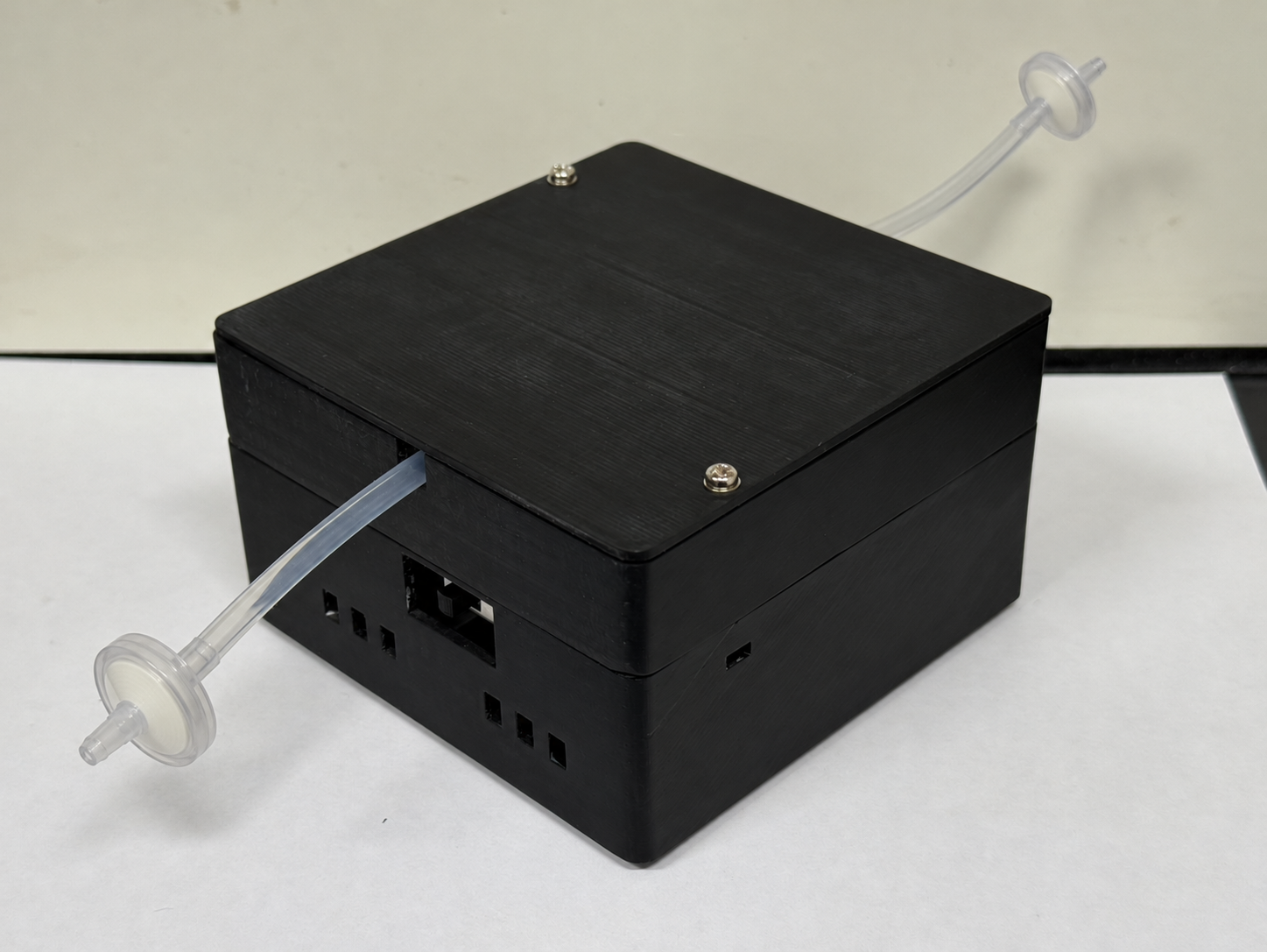
AeroSense is a portable, cartridge-based reader designed to expose engineered live-cell wells to sample headspace and read their fluorescence. The proposed product would return a disease-risk tier within a target of minutes. Ripeness forecasting and quality grading are prospective extensions.
User Flow
An operator loads a headspace gas sample into the inlet of a four-well cartridge matched to the target crop and disease, then starts a run from a phone interface. An ESP32 microcontroller drives four blue LEDs (about 468 nm) at distinct modulation frequencies (41, 67, 89 and 113 Hz), exciting HEK293 cells that express an olfactory receptor (OR/Orco) and a GCaMP6 calcium reporter. One shared photodiode, a transimpedance amplifier and a 16-bit ADC capture the fluorescence, and a digital lock-in separates the four channels from background noise. A recognition layer inspired by the fly mushroom body's PN–KC–MBON circuit then classifies the pattern. So far, that layer has been tested only on public metal-oxide sensor datasets, not on AeroSense cell signals.
Core Value
The aim is a decision-ready read-out rather than a raw signal: a risk tier and a recommended next step, such as setting a batch aside for laboratory confirmation. It is a screening layer, not a laboratory replacement and not a safety verdict. Because the cartridge is swappable, the same base device could in principle be redeployed to other targets by developing new cartridges and models. Banana is the first target, and other crops remain hypotheses.
Deliverables and Metrics
The intended output is a risk tier with a recommended action, reflecting the survey’s 73% priority on accuracy and avoiding false negatives. Development metrics include time-to-result, channel signal quality, and sensitivity and specificity against confirmed field outcomes. The provisional gas-transport target is 60 s to all wells; simulation gives a slowest-well t90 of 49.4 s at 3 mL/min. This is gas arrival beside the liquid surface, not total assay time.
Data and Safety
The cartridges use HEK293, a standard mammalian cell line, with insect olfactory receptors expressed in it, so no live insects are involved. The cells are held in sealed wells, and the biosafety requirements for partner sites will be confirmed with institutional guidance before any field deployment.
Scope and Limits
- Done: the hardware and firmware are designed, the first board is built, and 96 of 96 software checks pass.
- Measured reader evidence: the expanded study spans 0–20 µM sodium-fluorescein standards and four single-well loading conditions. All 12 held-out technical reads identified the filled well; a 10 µM standard was recovered as 9.25–10.83 µM. Hardware reports the channel-specific curves, cross-response matrix and calibration-transfer comparison.
- Next instrument steps: test calibration across independent reloadings, validate simultaneous multi-well recovery, and integrate the live-cell workflow. Assembly feedback and the revised manual are documented below.
Who It Serves
Exporters, packing houses, cooperatives and research institutes that need a fast, non-destructive screening step between harvest and shipment. We start with Taiwan's banana export chain. Mango follows, with data collection planned, and high-value tea processing comes in a second phase.
Success Criteria
(1) The staged hardware validation passes its defined acceptance criteria, starting with fluorescence detection by the full instrument.
(2) We complete field trials with agricultural institutions; so far we have completed interviews with the Taoyuan improvement station, farmers' associations, facility farms and the Taiwan Banana Research Institute.
(3) A measured end-to-end time-to-result meets our minutes-scale target on live samples.
(4) Early-adopter interest converts into paid pilots; we have no paying customer yet.
Manual review
The original manual records the participant’s assembly comments; the revised manual incorporates that feedback.
Business Model Canvas
Business Model Canvas
Nine connected hypothesesSelect a region for details.
Key partners
Our field validation is anchored by the Taoyuan District Agricultural Improvement Station's Plant Protection Lab, local farmers' associations, facility farms and the Taiwan Banana Research Institute. Their interviews narrowed our beachhead to banana disease detection.
Academic
AeroSense is advised by Prof. Chung-Chuan Lo (NTHU, Institute of Systems Neuroscience) and co-advised by Prof. Ching-Che Charng (China Medical University), who is also a co-author of the peer-reviewed paper behind our neuromorphic computation layer.
Industry advisers
We interviewed the Chief Science Officer of an established domestic electronic-nose company, an analytical-instrumentation professional, and food-safety biotechnology professionals at Challenge Bio. We also consulted a patent attorney.
Programs and mentors
NTHU Garage and FITI mentors provide go-to-market and fundraising guidance.
Key activities
Beachhead strategy
- Market: banana disease early detection in Taiwan's export supply chain.
- Application: on-site, non-destructive screening that flags suspicious samples for laboratory confirmation.
- Why banana: a single, quantifiable pain point (an estimated NT$3.51 billion per year in fungal-disease-related loss, a team estimate) and an accessible pilot channel through institutions.
- Goal: complete hardware validation, run pilots with institutions and exporters, and secure the first paid pilots.
Follow-on markets
- Mango: same device and platform, data collection planned. Ripeness forecasting is a hypothesis at this stage.
- Tea processing (second phase): turning a tea master's sensory judgment into a repeatable VOC fingerprint.
- Longer term: broader Asia-Pacific agriculture, food safety, cold chain, and industrial and environmental monitoring.
Go-to-market in three phases
- Pilot: improvement stations, research institutes, farmers' associations and large agribusinesses. Interviews are done; device pilots are planned.
- Export supply chain: banana and mango exporters, packing houses, cold chain and post-harvest processors, building the VOC dataset.
- Scale: associations, packing houses, cold storage and logistics centers, and tea enterprises.
Milestones
- Q4 2026 to H1 2027, Validate: finish staged hardware validation (Stage A to E), run a controlled end-to-end demo, write a workflow SOP, present at the iGEM Grand Jamboree, and close the NT$3.0 million starting-capital round.
- 2027, Pilot: pilots with exporters, packing houses and institutions. Exit gate: repeat use and a documented willingness to pay or a letter of intent.
- 2028 to 2029, Scale: multi-site banana deployment, then mango and tea, with unit economics checked against real invoices.
- 2030 onward: a diagnostics pathway only if the regulatory and clinical route is clear.
Key resources
Institutional and physical
- Backed by NTHU's Institute of Systems Neuroscience.
- Access to agricultural-institution field sites through completed interviews.
- Mentorship from NTHU Garage and NSTC-FITI.
Intellectual property, stated plainly
- In place: the peer-reviewed foundation of our neuromorphic layer (Cheng, Charng et al., Science Advances, 2025), co-authored by our advisors and open access (CC BY 4.0, DOI 10.1126/sciadv.adq9893), with code on Dryad and data on Zenodo.
- Open items: the patent attorney advised a prior-art search first and filing before publishing. Our team has decided to publish full technical detail in this project. We still need to settle which route (invention patent, utility model or none) fits what we publish, negotiate commercial licensing for the GCaMP6 reporter, and confirm university IP and technology-transfer terms with NTHU's office, which we have not yet engaged.
Value proposition
A fast, on-site, non-destructive screening layer that flags suspicious samples for laboratory confirmation, with low operator dependence.
- Designed to detect disease-related VOC shifts earlier than visual inspection. How much earlier is under test.
- The output is a risk tier with a recommended next step, not a safety verdict and not a laboratory replacement.
- A swappable cartridge lets one reader serve other targets over time. Banana comes first.
- A device plus a monthly cartridge subscription instead of a multi-million NT$ instrument. An interviewee put GC-MS and LC-MS at roughly NT$5 to 10 million, amortized over about 15 years.
Customer relationships
Pilot-first relationships anchored in field validation and mentor and industry review, rather than broad marketing. We engage improvement stations, research institutes and export-chain partners directly, iterate on their feedback, and move toward device and cartridge subscription support as trust is established.
Customer segments
- Primary: research institutes, improvement stations, farmers' associations and cooperatives as likely first payers and pilot partners. Banana exporters and packing houses are the end users in the beachhead.
- Secondary: tea processors (second phase), and mango exporters once data exist.
- Future: cold-chain and logistics operators, food-safety laboratories, and industrial and environmental monitoring users.
Channels
- Direct B2B outreach, starting with research institutes and improvement stations, then exporters and packing houses.
- Academic and mentor networks (iGEM, FITI, NTHU Garage).
- Credibility built through completed field interviews and transparently reported validation.
Cost structure
- Personnel, R&D and laboratory consumables, equipment access, administration, and IP and legal fees.
- Year-1 planned spend is NT$3.08 million in the expense forecast (a lean base for three salaried founders). The P&L base case shows NT$4.2 million, which assumes team expansion.
- Starting capital of NT$3.0 million provides approximately 12 months on the expense-forecast basis or 9 months on the P&L basis. The modeled rounds leave a roughly NT$4.3 million three-year financing gap.
Revenue streams
- Hardware sales: NT$120,000 per device, about NT$110,000 in mass production.
- Cartridge subscription: NT$4,000 per month, about NT$4,500 at scale.
- Model and dashboard subscription, and custom receptor development: from Year 2, estimated at about NT$1.2 million by Year 3.
Our base case projects revenue of NT$0.50 million, NT$2.46 million and NT$7.75 million in Years 1 to 3, with 3, 12 and 35 units sold. Year-1 cartridge revenue is likely overstated because it assumes every install pays for a full year.
Entry / Exit Barriers
Risks to test, not proven moatsSelect a region for details.
Low entry / low exit
A limited pilot is easy to start and stop, but offers little protection from competing solutions.
Application to AeroSense
For AeroSense, compare one crop workflow on actionable information, sampling time and recurring cost before committing to production.
Expand only when the operational benefit supports the commitment.
Responsible scalingLow entry / high exit
Easy market entry can still leave costly equipment, inventory or service obligations.
Application to AeroSense
Separate short trials from commitments to optical hardware, cell-cartridge supply and long-term support.
Agree on termination responsibilities and separate development costs from the cost of serving each customer.
Responsible scalingHigh entry / low exit
Sensing and calibration can be demanding while a bounded pilot remains reversible.
Application to AeroSense
AeroSense’s entry hurdle is reproducible performance across samples and operating conditions, not architecture complexity alone.
Prioritize transferable calibration, documented interfaces and traceable datasets.
Responsible scalingHigh entry / high exit
Difficult technical entry and costly exit combine development, supply and service risk.
Application to AeroSense
Expanding crop-specific cell supply, reader production and long-term support together would concentrate these obligations.
Stage commitments against technical acceptance criteria and budgets, with a clear policy for equipment, samples and data if work stops.
Responsible scalingEntry · Technical
Reproducible living-cell sensing and integrated reader performance are the technical entry hurdles.
Responsible scalingEntry · Commercial
Adoption depends on workflow fit, buyer trust, access to trial sites and financing.
Business modelExit · Operator
An operator exit policy must cover records export, cartridge disposal and return to the existing inspection process.
Read the evidence and limitations →Exit · Venture
A venture exit policy must allocate remaining equipment, costs, data responsibilities and service obligations.
Responsible scalingRead the four project-specific barrier reviews
These discussions remain separate from the unassigned scenario matrix.
Feasibility Analysis
SWOT Analysis
Internal × ExternalSelect a region for details.
Strengths · Internal
- A differentiated sensing approach: a living olfactory receptor layer, a custom optical readout and a fly-brain-inspired classifier. The classifier traces to peer-reviewed research (Science Advances, 2025) in which our advisors took part.
- A swappable cartridge that lets one reader target other crops and diseases over time.
- Field interviews with an improvement station, farmers' associations, facility farms and the Taiwan Banana Research Institute that informed our beachhead.
Weaknesses · Internal
- Development stage: four-channel fluorescence-standard measurements are complete; integrated live-cell and field VOC validation are the next milestones.
- Buyer validation is early: one exporter response challenged whether the problem was routine in its workflow; paid pilots remain a development goal.
- Limited funding: runway is about 9 to 12 months, and the modeled rounds leave a gap of roughly NT$4.3 million.
- A student-founder-led team that will need commercial and regulatory experience as it scales.
Opportunities · External
- A gap between visual inspection and slow, destructive laboratory assays in agricultural quality control.
- Industry interviews suggest current electronic-nose sensors lack selectivity and reproducibility, which leaves room for a programmable receptor approach (to be tested).
- Institutions such as research institutes and associations appear more willing to pay than individual farmers, and could be pilot entry points.
- A path from banana to mango and tea, and later to food safety and cold chain.
Threats · External
- Established electronic-nose makers (Alpha MOS, Aryballe, Sensigent) could move into agriculture.
- Industry skepticism toward a new AI-biotech platform until field data exist.
- Open publication of our work lowers the cost for others to copy it.
- An active patent landscape and the need to license the GCaMP6 reporter commercially before pilots scale.
Risk Analysis
Validate phase (Q4 2026 to H1 2027)
| Risk | Severity | Mitigation |
|---|---|---|
| Calibration transfer and live-cell integration. Standard-dye curves demonstrate reader response; channel mixing and performance with living sensing cells require the next validation stage. | High | Measure the channel-mixing matrix, test calibration across reloadings, and compare an integrated live-cell run with reference imaging under the staged validation protocol. |
| Weak or inconsistent receptor and cell signal (signal-to-noise). | High | Use higher-signal GCaMP variants, a redundant multi-receptor design and better imaging algorithms. |
| Limited funding and runway. NT$3.0M starting capital lasts about 12 months on the expense-forecast basis and about 9 months on the P&L base case. | High | Begin the next raise and grant applications well before Month 6, tie spending to validation milestones, and reconcile the two workbook sheets. |
| IP and disclosure. We have decided to publish technical detail openly, and our own disclosures can count as prior art. A prior-art search is not yet commissioned. | High | Consult the patent attorney (completed), commission the prior-art search, and decide which route, if any, fits what we publish. |
| GCaMP commercial licensing and university IP ownership are unresolved. | High | Negotiate a commercial license or design around with an alternative indicator, and engage NTHU's technology transfer office, which we have not yet formally approached. |
Pilot phase (2027)
| Risk | Severity | Mitigation |
|---|---|---|
| Demand not yet validated on the buyer side. The one exporter that replied said the problem is not routine in its process. | High | Hold follow-up conversations on how exporters inspect and grade, secure an institutional pilot partner, and concentrate resources on one scenario. Exit gate: repeat use and a documented willingness to pay or a letter of intent. |
| Early odor signal too faint, or confounded by orchard conditions. | High | Treat as a hypothesis. Measure days gained and interference in controlled sampling, and report readings against field hygiene. |
| VOC signatures fail to generalize across batches and seasons. | High | Collect field data across multiple harvest cycles, with external advisor review. |
| An over-trusted risk score that misses real risk (false negatives). | High | Report a risk tier with a confidence signal, recommend laboratory confirmation for high-risk samples, never show a silent "safe", and state that a VOC signal is not a safety verdict. |
| Wet-lab and cell-culture bottlenecks. | Medium | Standardized reagent protocols and backup cell stocks. |
| Biosafety: cartridges use genetically modified cells. | Medium | Assess biosafety-level and waste-disposal requirements before any field deployment. |
Scale phase (2028 to 2029)
| Risk | Severity | Mitigation |
|---|---|---|
| Lower adoption: detection alone may not reduce loss, and buyers may resist NT$120,000 plus NT$4,000 per month. | High | Pair each risk tier with a defined action (segregate, confirm in the lab), quantify avoided loss per shipment, target institutional buyers and study subsidy routes. |
| Manufacturing and unit cost. No manufacturing partner for the board and cartridge is identified, and unit costs are unknown. | High | Modular design, cost spread across cartridge consumables, and progressive process optimization. |
| Competitor response from established electronic-nose makers. | Medium | Aim to differentiate through the modular cartridge, biological receptor layer and neuromorphic classifier. This differentiation is not yet validated. |
| Revenue shortfall against projections. Year-3 base-case revenue is about 39% of our SOM estimate. | High | Stress-test against exporter-side evidence and diversify across hardware, consumables, software and custom-project fees (see Financial Analysis). |
Financial Analysis / Company Projection
All figures come from the team's financial workbook and are modeled assumptions to be calibrated against pilot quotes, not contracts.
SBA planning guidance connects financial projections with funding needs, cash flow and capital expenditure. This provides a framework for reconciling our expense forecast and revenue model as pilot evidence becomes available. [10]
Year 1 Cost Structure (expense forecast)
| Category | Annual Cost (NT$) | Notes |
|---|---|---|
| Setup costs | ~113,000 | Company registration, accounting setup, office basics, computers |
| Fixed costs | ~2,238,000 | Office rent, bookkeeping, registered address, and founder personnel costs (3 founders, with insurance and year-end bonus) |
| Variable costs | ~725,500 | R&D equipment access, reagents and cell-culture consumables, utilities, travel, IP and regulatory consulting |
| Total Year-1 spend | ~3,076,500 | Excludes founders' paid-in capital (NT$1,000,000) |
This is a lean cost base for three salaried founders. The P&L base case below assumes team expansion and shows Year-1 operating expenses of NT$4.2 million. Starting capital of NT$3,000,000 (founders' equity plus an angel round) gives a runway of about 12 months on the expense-forecast basis and about 9 months on the P&L basis, so we quote 9 to 12 months. Harmonizing the two sheets is an open modeling task.
3-Year Revenue Projection (base case)
| Metric | Year 1 | Year 2 | Year 3 |
|---|---|---|---|
| Devices sold (units) | 3 | 12 | 35 |
| Device price (NT$/unit) | 120,000 | 120,000 | 110,000 |
| Cumulative installed base (units) | 3 | 15 | 50 |
| Cartridge subscription (NT$/unit/month) | 4,000 | 4,000 | 4,500 |
| Software, data and custom-service revenue (NT$) | 0 | 300,000 | 1,200,000 |
| Total revenue (NT$) | 504,000 | 2,460,000 | 7,750,000 |
| Gross margin (assumed) | 45% | 55% | 60% |
| Total operating expenses (NT$) | 4,200,000 | 6,300,000 | 9,000,000 |
| Operating profit/(loss) (NT$) | (3,973,200) | (4,947,000) | (4,350,000) |
The cumulative three-year operating loss is about NT$13.3 million, against NT$9.0 million of cash in the modeled rounds. The roughly NT$4.3 million gap would have to come from grants, faster revenue, tighter costs or a further round. Operating loss is not cash flow, since working capital and capex are excluded. Year-1 cartridge revenue is likely overstated because it assumes every install pays for a full year. Reader and cartridge unit costs are not yet known, and purchase intent at these prices has not been tested.
Equity / Cap Table (modeled)
Three founders hold 100,000 founding shares. A 30,000-share technology pool is issued at incorporation, with 20% assumed to go to the host institution (to be confirmed with NTHU's technology transfer office, which we have not yet formally engaged) and 80% to the inventing team. A modeled angel round (40,000 shares at NT$50, about NT$2.0 million) and Round 1 (50,000 shares at NT$120, about NT$6.0 million) would value the company at roughly NT$8.5 million after the angel round and NT$26.4 million after Round 1. The founders would then hold a combined 56.4%. These are modeled rounds, not priced or committed transactions.
Exit Strategy
At this early stage, our long-term ambition is to grow AeroSense from a single agricultural beachhead into a broader VOC Intelligence Platform spanning food safety, cold chain, and industrial and environmental monitoring. Once the platform is validated across multiple crops, we would pursue either continued growth toward a future financing round or a strategic partnership or acquisition with an established sensing or agri-tech company.
Financial planning workbook · PDF preview
Read the workbook below or download the original spreadsheet to inspect its formulas and assumptions.
Development roadmap
Commercialization roadmap · 2026–2031
Select a milestone to read its purpose. Swipe horizontally on a small screen.
90-Day R&D SprintQ4 2026
Plasmid functional validation → mutant receptor library expression → real-time deep-learning loop with the portable device.
iGEM 2026 ParisQ4 2026
Brand exposure at the iGEM Grand Jamboree, Paris.
Seed Round — NT$3,000,000Q3–Q4 2026
Angel/seed fundraising in parallel with the FITI grant application, targeting NT$3.0 million in starting capital.
Taiwan Farm Pilots — 10 sites2027
Ten partner-farm pilot deployments in Taiwan, validating the agriculture beachhead scenario.
ISO/IEC 17025 accreditation2028
A planned laboratory-accreditation milestone to support industrial and food-safety expansion.
Industrial & Cold-Chain Rollout2028–2029
Target customers: semiconductor fab-boundary VOC monitoring and convenience-store cold-chain food safety.
Next Funding Round (Series A)Q3 2028–Q2 2029
Follow-on raise to fund the industrial and food-safety expansion.
FDA / TFDA Regulatory Pathway2030–2031
Assess the Taiwan and US regulatory routes for a future breath-VOC screening application before clinical deployment.
Hospital Pilots — Taiwan / US / Europe2030–2031
Planned clinical point-of-care pilots for breath screening with hospital sites in Taiwan, the US and Europe.
Strategic Fundraising / Exit2031
Evaluate strategic fundraising or an exit after successful clinical pilots.
Future Development
Potential Funding
- Seed Stage (current) — Target NT$3 million , to fund product validation (Year 0–1), agricultural-platform expansion into mango and tea (Year 1–3), and, longer term, expansion of the VOC Intelligence Platform into food, industrial, and environmental domains (Year 3–5).
- Entrepreneurship support — FITI provides commercialization training and review; NTHU Garage provides an incubation and mentoring environment. We will check each program’s current eligibility and funding terms rather than count these opportunities as secured finance. [11] [12]
- Strategic Partnerships — A prospective collaboration/visit with an established domestic electronic-nose company, currently being scheduled.
Skills, Capabilities & Stakeholders
Stakeholder landscape
Qualitative planning mapSelect a region for details.
● Academic● Regulatory / IP● Industry / mentors● Agricultural / buyers● Public / alternatives
Dashed outlines mark strategic categories rather than established relationships. Circle size and position are qualitative.
Academic advisors
Academic advisors support the biological and computational work.
Read the capability and stakeholder record →FITI / NTHU Garage mentors
FITI / NTHU Garage mentor input helped narrow the application and revise the business case.
Read the capability and stakeholder record →Technical reviewers
iST provided external engineering review for the reader design.
Read the capability and stakeholder record →NTHU TTO
Technology transfer is a planning category; no completed NTHU TTO engagement is recorded.
Read the capability and stakeholder record →Regulatory / biosafety review
Biosafety and regulatory review are distinct from product approval. No device-class determination is recorded.
Read the capability and stakeholder record →Investors
Investors are a planning category, not a record of committed funding.
Read the capability and stakeholder record →Agricultural interviewees
Agricultural station and association interviews informed the problem and use context.
Read the capability and stakeholder record →Exporters / packing houses
Exporters and packing houses are the proposed users and buyers. One exporter response questioned whether the problem was routine in its workflow; this feedback is shaping follow-up buyer interviews.
Read the capability and stakeholder record →Public survey
The public survey informed communication and risk perceptions, not B2B demand.
Read the capability and stakeholder record →Competing technologies
Competing technologies are an analytical category, not contacted partners.
Read the capability and stakeholder record →Team Capabilities
AeroSense integrates expertise across computational/systems neuroscience, hardware engineering, and wet-lab biology:
- CEO — Pin-Che Huang, M.S. student, Institute of Systems Neuroscience, NTHU — leads strategy and the biological sensing roadmap.
- COO — Yi-Chia Fang, senior, NTHU College undergraduate program — leads operations and business development.
- CTO / Dry Lab Lead — Chun-Ting Chou, M.S. student (3rd year), Institute of Systems Neuroscience, NTHU — leads the neuromorphic AI and computation layer.
- CTO / Wet Lab Lead — Yi-Jung Chen, M.S. student, Institute of Bioinformatics and Structural Biology, NTHU — leads the biological sensing layer (receptor engineering, cell culture).
The team is advised by Prof. Chung-Chuan Lo , Deputy Dean of NTHU's College of Life Science and Director of the Institute of Systems Neuroscience, and co-advised by Prof. Ching-Che Charng of China Medical University, who is also a co-author of the team's foundational Science Advances paper — giving AeroSense's algorithmic core a direct, published research lineage.
Interview Insights
Summaries of the feedback that shaped our business decisions.
Agricultural extension researcher
Taoyuan DARES · Plant Protection Lab
The interview clarified the disease-detection problem and the limits of visual inspection in the supply chain. It helped us narrow six candidate crops to a banana beachhead.
Farmers' association and facility farms
Sampling and post-harvest handling
Feedback on sampling and post-harvest handling informed the workflow and the shipment-loss examples used in our outreach materials.
Public survey respondents
General consumers and students
Respondents prioritized trustworthy, accurate results and clear next steps. This supported risk tiers with escalation guidance. The consumer sample indicates communication needs; it does not establish agricultural buyers’ willingness to pay.
Business-plan and pitch mentors
Written review and slide-level feedback
An 11-point business-plan review and a separate pitch-deck review prompted us to narrow the application, redesign the competitor comparison, and revise TAM, SAM and SOM. The resulting market choices remain hypotheses for buyer validation.
The next commercial milestones are to validate the workflow with exporters and institutions, complete the prior-art and commercial-licensing review, and establish repeatable live-cell and field measurements. Medical diagnostics remains a separate, longer-term pathway.
NSF I-Corps treats customer interviews, business-model development and minimum viable product testing as connected steps in commercialization. We use this as a methodological reference for the next buyer interviews, not as evidence that AeroSense participated in I-Corps. [9]
iST Group contributed circuit review, and a patent attorney was consulted on disclosure and intellectual-property planning.
Long-term Impacts
Positive impacts. AeroSense aims to reduce post-harvest agricultural loss and the economic and environmental cost of discarded produce. By pricing on a usage basis rather than a large capital outlay, the platform aims to give smaller exporters and cooperatives — not only large, well-resourced agribusinesses — access to a screening capability that today is effectively limited to buyers who can afford lab-grade testing. Over time, a growing multi-crop VOC dataset could help standardize quality grading across a currently inconsistent, judgment-based system, benefiting both producers (fairer, more transparent grading) and consumers (more reliable food-safety assurance).
Risks to manage. As with any automated risk-classification system, an over-trusted "risk score" could lead a partner to under-inspect a shipment the model misses (a false negative). This is precisely why the team designed the output as a risk tier with escalation guidance rather than a binary pass/fail — a decision informed directly by our public survey finding that false negatives are the least-tolerated failure mode among respondents. Broader deployment of an AI-driven agricultural sensing platform also carries a data-governance responsibility for the VOC and lot-level data collected from partner sites. Our current plan is to keep data project-scoped by default and to share only aggregated, anonymized data for model improvement with explicit partner opt-in — stated here as a policy plan , not yet a built and independently audited system.
As the platform moves from pilot to multi-partner deployment, the team plans to establish a lightweight, mentor-supported data-governance check-in, extending the same "closed feedback loop" discipline it has already applied to its own commercialization process (see Skills, Capabilities & Stakeholders ) to how it manages responsible use of an increasingly large agricultural dataset.
Appendix
Business Plan
AeroSense business plan · PDF preview
Value Proposition Canvas
Customer ↔ Proposed offerSelect a region for details.
Customer jobs
- Users (QC staff, station technicians): decide which batch or plant needs a closer look, without being an expert.
- Buyers and payers (exporters, packing houses, associations, institutes): catch disease-infected produce before it ships or mixes with healthy stock.
- Field-side institutes: detect rot in the corm, pseudostem and crown early enough to act.
- Validators (labs): receive a prioritized list of samples for confirmatory testing.
- Customer-value hypotheses for exporter evaluation: time export around ripeness, standardize quality grading, protect brand reputation and reduce claims.
Pains
- Visual inspection catches disease only once it is visible, and growers told us there is no monitoring beyond looking at the crop.
- Laboratory assays are accurate but destructive and slow, and they need trained personnel and lab infrastructure.
- There is no fast, non-destructive early screen across a full shipment.
- The early odor signal is faint, and heavy smells can simply reflect a dirty orchard.
- Individual farmers may have low willingness to pay and may resist having their own produce flagged.
- Survey respondents did not want a bare verdict: they ranked trustworthy results (76%), avoiding false negatives (73%) and clear next steps (68%) first.
Gains
- A same-day early warning that points to the batches worth a closer look (target).
- A screen that fits existing packing and station workflows (to be tested).
- A device plus monthly cartridge subscription instead of a multi-million NT$ instrument purchase (interviewee's figure for GC-MS/LC-MS: roughly NT$5–10M).
- A risk tier with a confidence signal and a recommended next step, which survey respondents asked for.
Products & services
- AeroSense reader.
- Swappable sensor cartridges (banana first; other crops are hypotheses).
- Analytics subscription: recognition model and dashboard.
- Custom receptor and model development for a partner's crop or process.
Pain relievers
- Non-destructive screening with a minutes-scale response target.
- Aims to detect VOC shifts earlier than visible symptoms; how much earlier is under test.
- Output is a risk tier and a recommendation to confirm in the lab, not a safety verdict.
- One reader can in principle serve other targets by swapping the cartridge.
Gain creators
- Turns judgment that depends on one experienced inspector into a repeatable, recorded reading (intended).
- A VOC dataset built from real batches can become a moat over time; today it is still thin.
- Usage-based cost may lower the barrier for cooperatives, institutes and smaller packing houses, but price acceptance is untested.
PEST Analysis
Context → consequence → evidenceSelect a region for details.
Political / regulatory
NTHU Garage and FITI support startup development through mentoring and incubation. Our patent-attorney consultation informed disclosure and intellectual-property planning.
Regulatory and biosafety planning follows the intended agricultural use; any future medical application would need a separate assessment.
Read the evidence and limitations →Economic
The team estimates annual output value of NT$10.445 billion for the banana export sector and NT$3.51 billion at fungal-disease risk. These planning estimates define the scale of the proposed beachhead.
Year-1 planned spend is NT$3.08 million in the expense forecast; the separate P&L base case uses NT$4.2 million in operating expenses. Buyer-side losses, confirmation costs and unit economics guide the adoption case.
Read the evidence and limitations →Social
In the public survey (n=300), 78% recognized that removing visible mold does not necessarily make food safe, while 58% recognized that normal appearance and smell cannot rule out risk.
Respondents prioritized trustworthy results (76%), avoiding false negatives (73%) and clear next steps (68%). These findings guide the risk-tier output and follow-up advice in our product concept.
Read the evidence and limitations →Technological
MCU-class lock-in processing and olfactory-circuit modeling support the proposed sensing architecture. Our reader integrates biology-facing optics, electronics and decoding, with four-channel fluorescence-standard measurements informing calibration.
Commercial electronic noses differ in price, portability and sensing method; compare the intended sampling workflow and target-specific performance rather than treating all instruments as laboratory-only systems.
Read the evidence and limitations →Guides
Entrepreneurship Guide · reuse the planning process
The guide presents eight steps drawn from our project: define customer pain and a first market, connect market sizing to losses, compare alternatives, identify who pays, examine rights and regulation, explain team capabilities, and repeat customer discovery and review. Its checklist helps another team record assumptions and follow-up work.
Social Responsibility & SDGs
Read the sustainability assessment →