
Introduction
"Everyone has the right to education." Universal Declaration of Human Rights, Article 26 [1]
Article 26 of the 1948 Universal Declaration of Human Rights affirms the right to education, free at least at elementary and fundamental levels, and directs it toward the full development of human personality and respect for human rights and fundamental freedoms [1]. The 2030 Agenda extends this commitment through SDG 4: inclusive, equitable quality education and lifelong learning for all. Target 4.7 connects learning to sustainable development [2].
Information alone does not ensure behavior change. Research challenges the "deficit model" that treats mistaken views as simply a lack of facts: knowledge and attitudes have a more complex relationship [3], and scientists' training and assumptions about audiences can sustain that model [4]. Pro-environmental research likewise identifies a gap between knowing and doing [5].
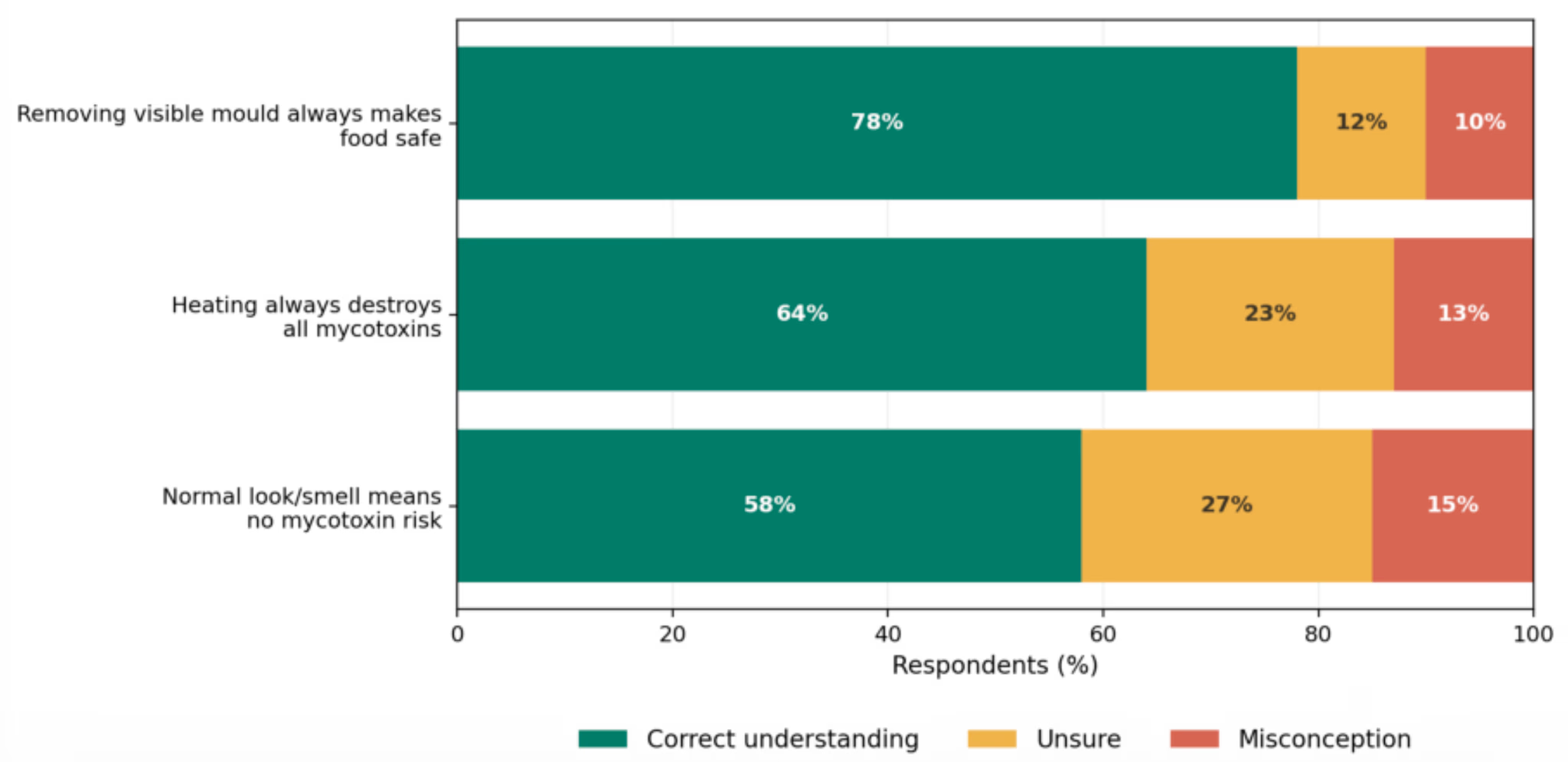
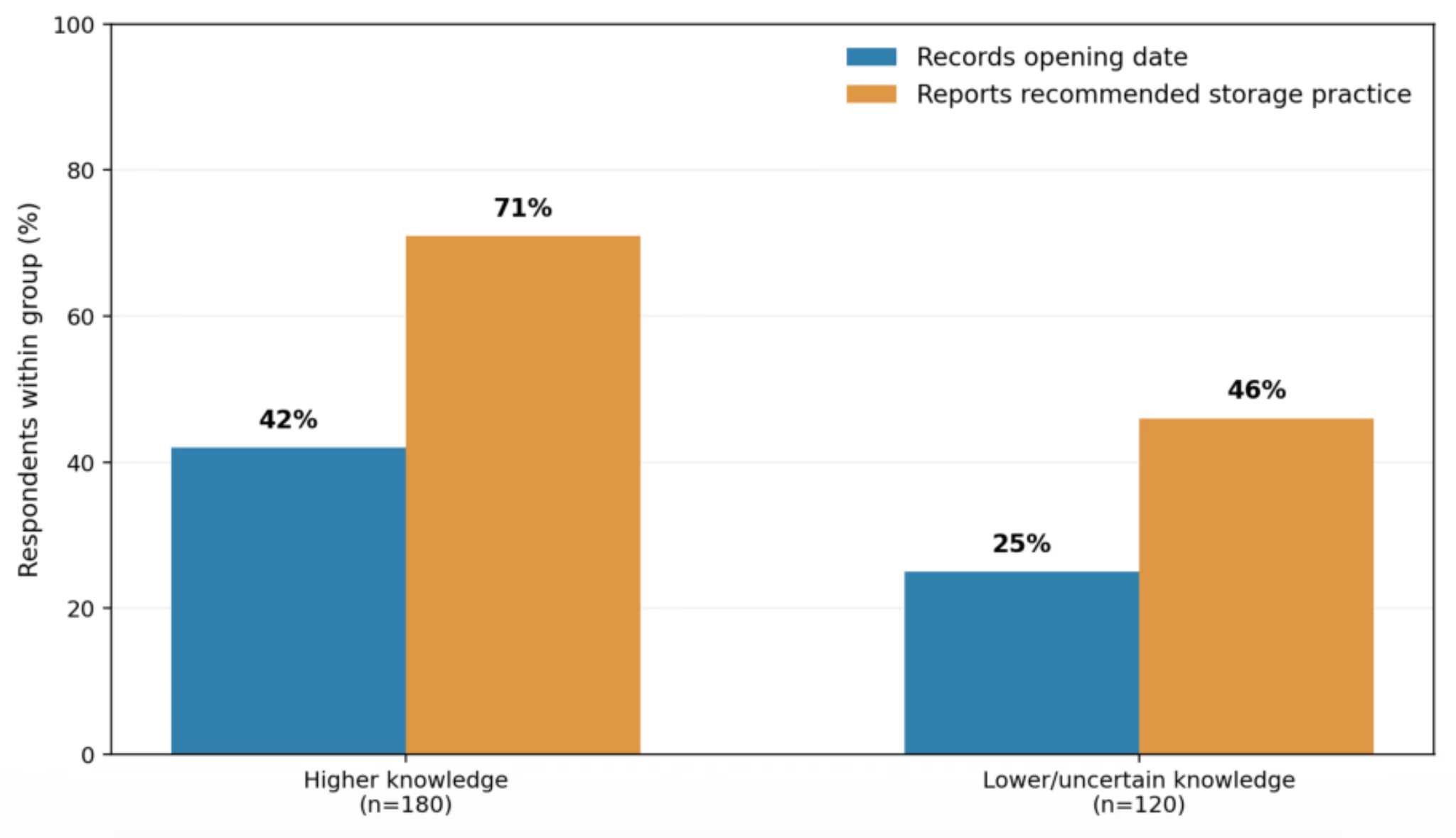
Our survey found a similar gap: only 58% understood that normal appearance and smell do not rule out risk, and higher knowledge did not consistently translate into action. We therefore looked to active learning. Across 225 science, engineering and mathematics studies, it improved exam performance by 0.47 standard deviations and reduced failure rates to 21.8%, compared with 33.8% [6]. A serious-games meta-analysis found benefits for learning (d = 0.29) and retention (d = 0.36), but not motivation [7]. These formal-course findings guide our design; our own activities still need evaluation with their intended audiences.
Synthetic biology also calls for dialogue. The Royal Academy of Engineering recommended ongoing public engagement on its benefits and concerns [8]. AeroSense combines a fly olfactory receptor in a cultured human cell line with a fly-inspired readout circuit. We wanted people to understand this approach and help question it.
Our Education Journey as The Fly Brain Map
Choose one brain region to explore its activities.
Antennal Lobe
Mushroom Body Calyx
Mushroom Body Lobes / MBON
Antennal Lobe: input (broadest reach)
Biological meaning
The antennal lobe is the fly's primary olfactory processing center — roughly 50 anatomically distinct glomeruli, each wired to a single receptor type, where signal from thousands of olfactory sensory neurons first converges. Nothing is interpreted yet here; it's simply where every receptor channel's raw reading arrives in parallel. It's the literal starting point of "a smell is a pattern across many channels" — the idea our whole sensing platform, and Module 1 (Discover) of our online Learning Lab, is built on.
Educational meaning
We treat the AL as our broadest-reach layer. None of the three projects here are trying to teach anyone anything in depth — they're trying to find out what the widest possible audience already believes (Public Survey), get them to make a decision and see its consequence in under fifteen minutes (Online Games), or keep the same corrective claim in front of them through feeds, short videos, and articles they already read (Social Media, Short Video & Articles). Like the AL itself, breadth comes before interpretation.
1. Public Survey
Why does it matter?
Before designing activities, we asked what people believed about mold and mycotoxin risk, and whether that knowledge shaped their storage habits. The survey let us test the knowledge gap rather than assume it.
Educational Impact from us.
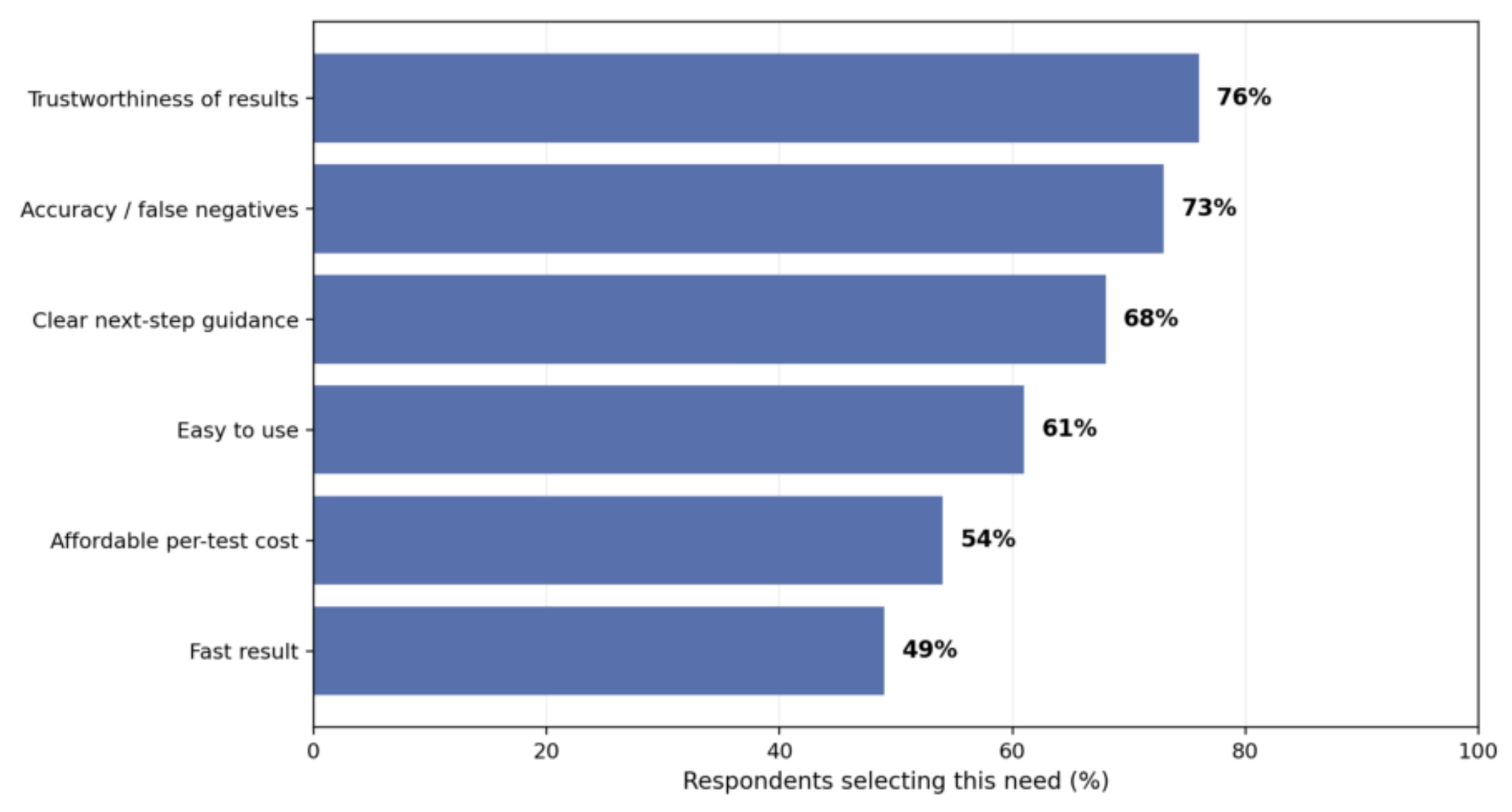
We ran a bilingual (Chinese and English) online questionnaire on mold and mycotoxin understanding, food-storage habits and what people want from a screening tool. It reached 300 respondents. Three findings shaped the rest of our education work:
Impact on us.
The survey shaped three design choices. Games and Learning Lab Module 2 focus on the limits of heat, appearance and smell, using the same statements as the survey for later comparison. Lessons and posts add practical habits such as recording opening dates. The Learning Lab also explains the limits of screening and what to do next, while our design prioritizes avoiding missed risk.
What it cannot tell us.
These are self-reported answers from people who chose to respond, so they show where to look, not how common each belief or habit is across Taiwan.
Try the decision questions
Diagnosis
What would you decide?
-
Claim 1
Cutting off the visible mold makes the rest safe to eat.
Scientific interpretation
Disagree. Removing a visible colony does not automatically make the rest of a food safe. In some firm foods, public guidance allows cutting away a margin; in soft, moist, or porous foods, mycelium and some mycotoxins can extend beyond what you see. “Always safe” is the over-claim.
-
Claim 2
Heating or roasting fully eliminates mycotoxins.
Scientific interpretation
Disagree. Heat may inactivate molds without eliminating heat-stable mycotoxins. Killing or reducing the organism is not the same as removing the metabolite. “Fully eliminates” is not a safe general rule for ordinary cooking.
-
Claim 3
If it looks and smells normal, it’s not risky.
Scientific interpretation
Disagree. Appearance and smell cannot establish mycotoxin status. Absence of an off-odor does not prove absence of toxin; presence of mold does not by itself quantify a toxin. Sensory inspection is not an assay.
2. Online Games — Odor Pixel Suite
Why does it matter?
Our survey showed that the gaps are not missing facts but untested trust: many people were unsure whether heat or a sniff test can tell them food is safe. Being told "a sniff test is not a safety test" twice does not change that trust. Learners need to experience why smell can mislead.
Smell works by pattern, not by a single signal. An odor activates several receptors at once, similar odors produce similar patterns, and mixtures overlap. This is why a nose, human or electronic, can be fooled, and it is also the principle AeroSense is built on. Odor Pixel Suite lets learners make the decisions themselves: recognize a pattern, follow a scent, separate a mixture, and see when they get it wrong. The games turn the reason behind our survey findings and the logic of our sensor into something learners can play.
Educational Impact from us.
Odor Pixel Suite is three short browser games. Each has three levels (Junior, Standard, Challenge), a Practice mode, a Daily Challenge mode and a Science page that explains the biology behind it.
01 · Recognise
Odor Pixel Lab
Match an odor to a pattern of receptor-like signals, including patterns with noise. The question is how identity survives imperfect measurements.
Play the pattern game ↗02 · Navigate
Odor Maze (Scentbound Maze)
Explore a maze and use scent information unlocked along the route. The activity makes a signal useful through the choice it helps a player make.
Enter the maze ↗03 · Decode
Odor Fingerprint Mixer
Explore overlapping patterns from odor mixtures. A mixed fingerprint is an interpretation problem, which connects the activity to AeroSense's decoding layer.
Explore the mixer ↗We built the suite through a five-stage design journey. At each stage we collected evidence and changed the games in response.
- Draft design
We started from three perspectives on scent: its encoding features, its identity and identification, and its composition ratio. We sketched one game for each: pattern recognition, a scent-guided labyrinth and a fingerprint mixer.
- Internal playtest & refinement
Our teammates played the first versions. One could not pass even the easiest level. Another said the instructions gave no idea where to start. A third said the games matched our design intent, but that our target audience might need to be redefined. We learned that what felt easy to the designers was not easy for anyone else.
- Public playtest & feedback
We tested the prototypes with 32 people. In Pattern Recognition, players said there were too many patterns to remember. In the Mixer, players reported that they never succeeded and found it too complex. In the Labyrinth, players said the controls were not smooth and did not understand what the E and Q keys did.
- Camp/workshop deployment
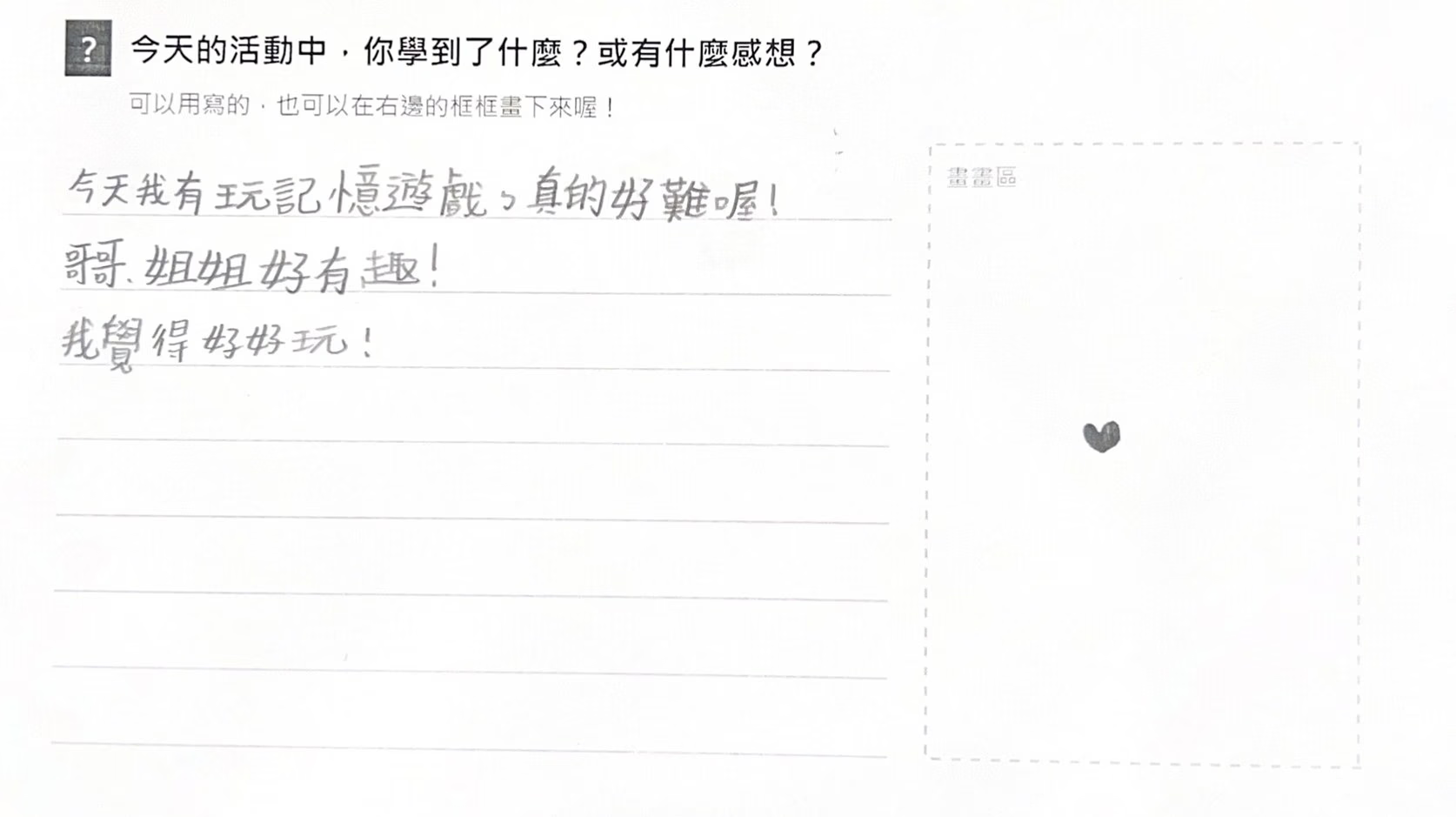
At the Shan-chi Elementary School science camp, we projected the game for the whole class. The pupils found it too difficult at first, so we adjusted the difficulty and created three levels, letting each group find a suitable option. One pupil wrote on a worksheet: "Today I played the memory game. It was really hard! I thought it was really fun!”
- Data + optional external release
The released version answers what we heard. Junior levels use smaller patterns and let players review before the quiz. The Junior Mixer starts with two scent cards and a simple mix. Challenge levels use closer lookalikes and hidden patterns for players who want more. For educators, workshops can switch on paired pre/post questions with anonymous data export, while everyday visitors are never quizzed. Progress is stored only in the player's own browser.
Impact on us.
The games taught us three things.
First, difficulty is a design decision, not a detail. Teammates, members of the public and primary-school pupils all hit the same wall at the start. Three levels now let each learner begin where they can succeed, and the same structure lets a teacher use one game from primary school to university.
Second, fun is not the same as learning. At the camp, many worksheets mentioned only that the game was fun. This is why each game now links to a Science page and why educators can add paired pre/post questions. These let us measure learning, not just enjoyment, in future workshops.
Third, players' struggles confirmed our own design. When players could not remember enough patterns, or could not separate overlapping fingerprints by eye, they experienced the exact problem AeroSense is built to solve. Humans are poor at decoding overlapping receptor patterns, which is why our sensor relies on computational decoding rather than on a person reading the signal.
Mushroom Body Calyx: integration (structured learning)
Biological meaning
The calyx is the dendritic input zone of the mushroom body — around 2,000 Kenyon cells receive sparse, combinatorial input here from antennal-lobe projection neurons, and this is where parallel receptor channels actually get bound together into one learnable, associative pattern. It's the integration step — the subject of Module 4 (Decode) of our curriculum — and biologically, it's where exposure becomes memory.
Educational meaning
The three projects here have a different job than the first part's: they're not trying to reach as many people as possible, they're trying to turn a shorter exposure into real, structured understanding, across the full age range our work touches — elementary schoolers, university life-science and medical students, and a self-paced option open to anyone.
1. Elementary School Science Camp
Why does it matter?
Shan-chi Elementary School is a rural school in Xinfeng Township, Hsinchu County. Bringing a hands-on science session to a school there is a small step toward the equal access to quality education that SDG 4 describes. The camp also lets us test our claim that the game can be understood by children, instead of assuming it.
Educational Impact from us.
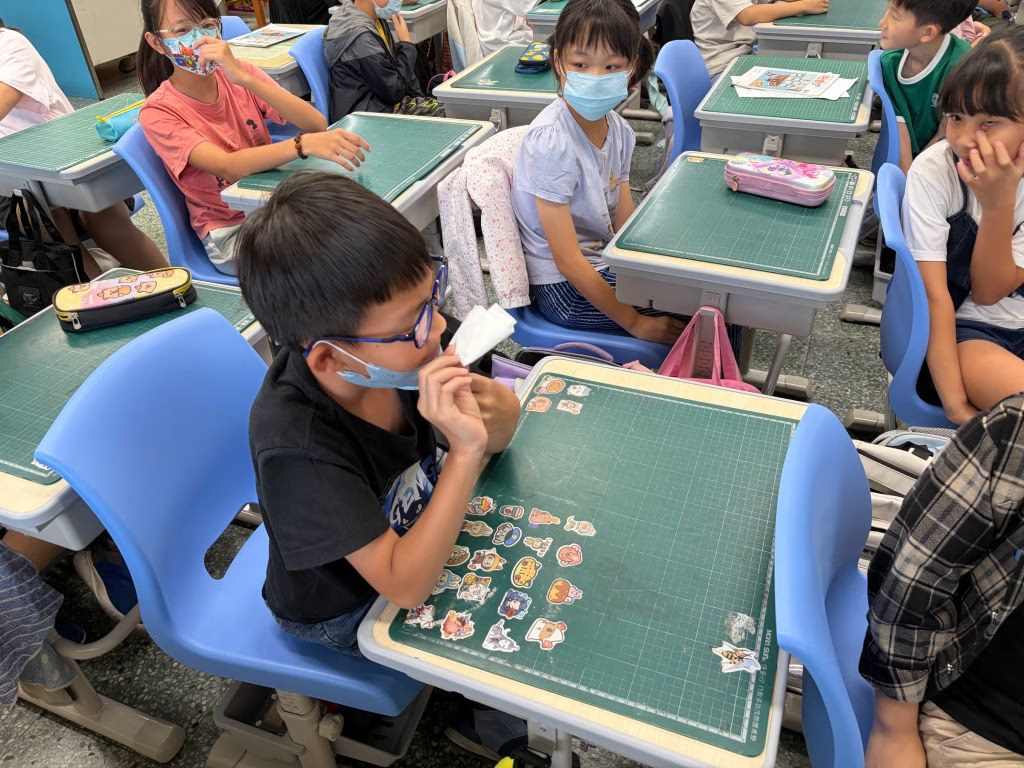
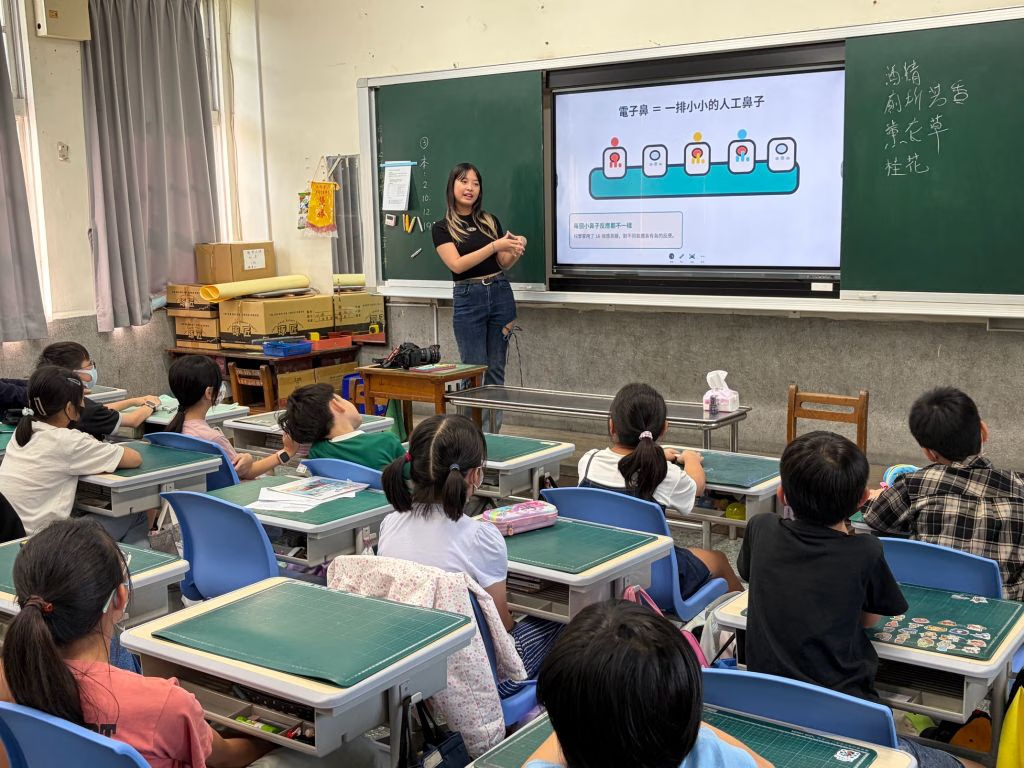
We ran a half-day science camp at the school for more than thirty upper-grade pupils (grades 5 and 6).
We started with a Science Mini-Class. In about ten minutes we asked three questions in a row: How does a nose smell? How does an electronic nose smell? And what does our lab do? Each answer built on the one before, so the children could follow a smell from their own nose, to a machine, to the sensor we are building.
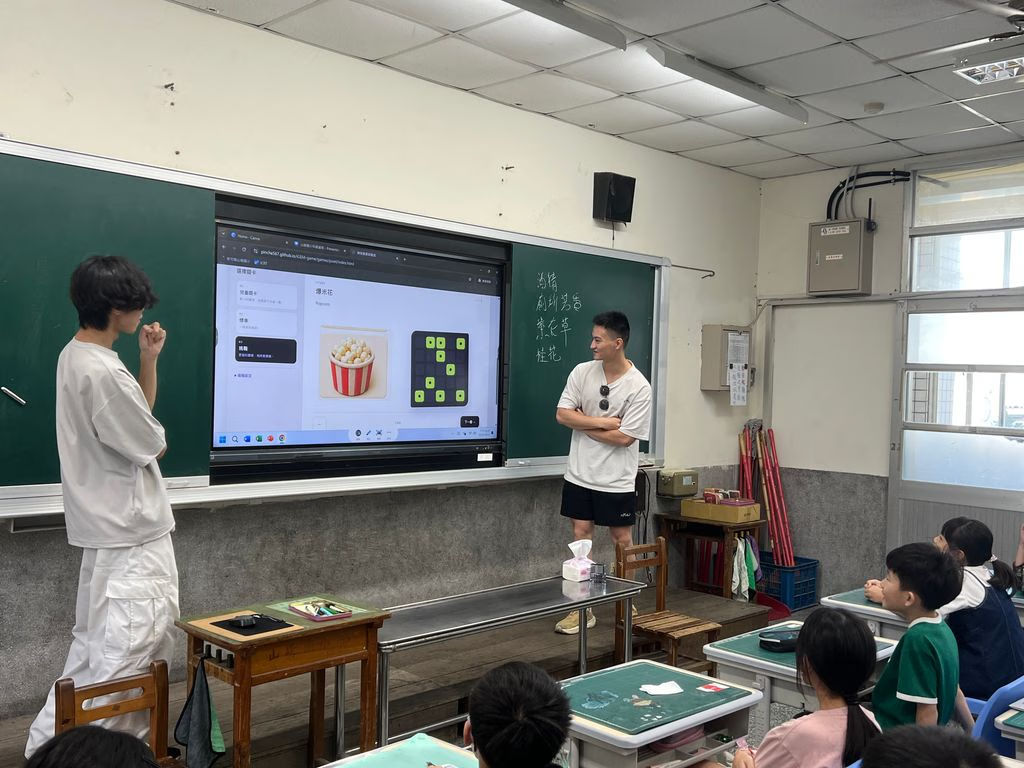
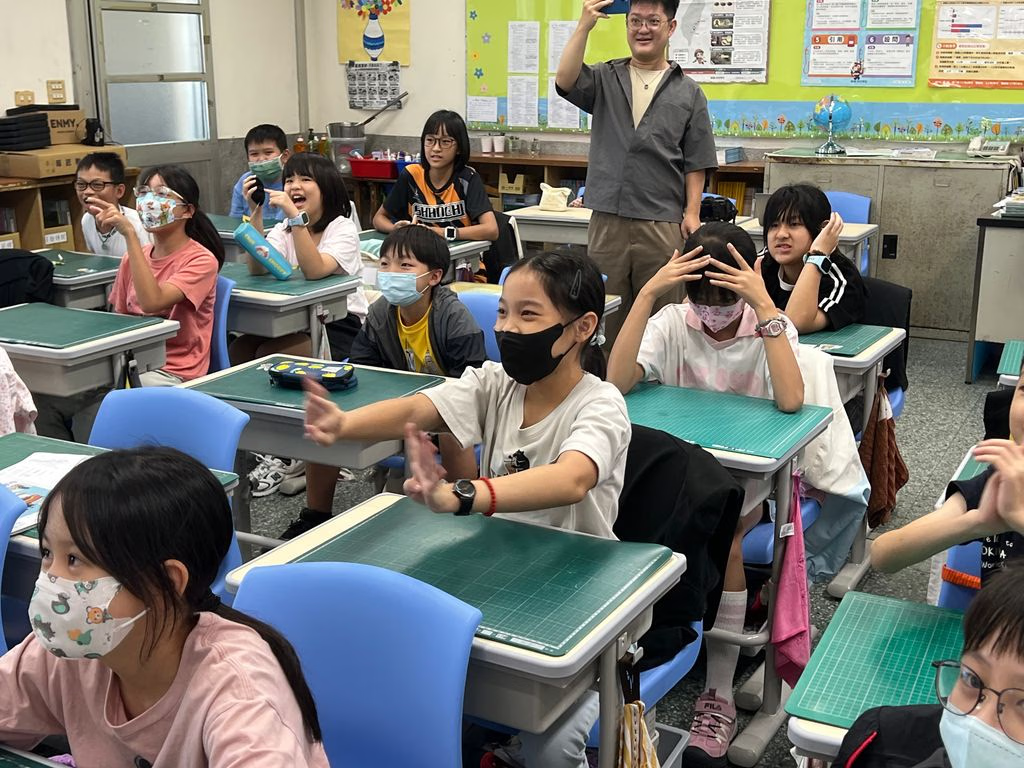
Next, the children played Odor Pixel Suite, the game we designed, as a challenge that lasted about ten minutes. We adapted it for a whole class. Instead of one child at one screen, the questions were projected on a screen, and each team answered at the same time by holding up one, two, or three fingers.
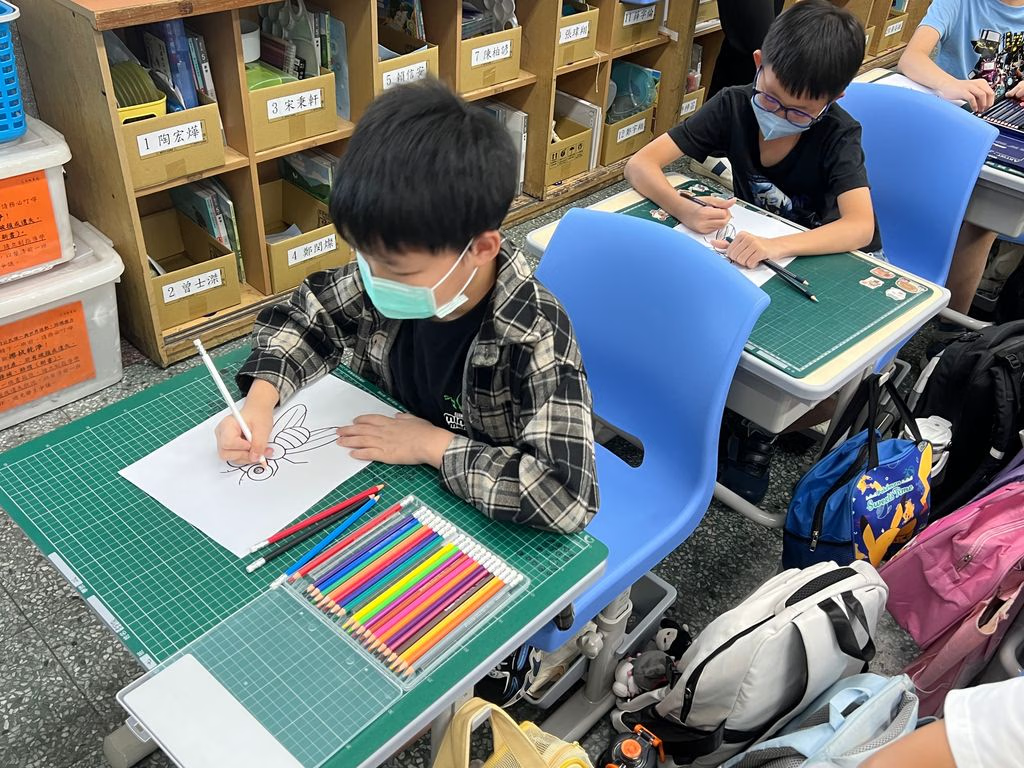
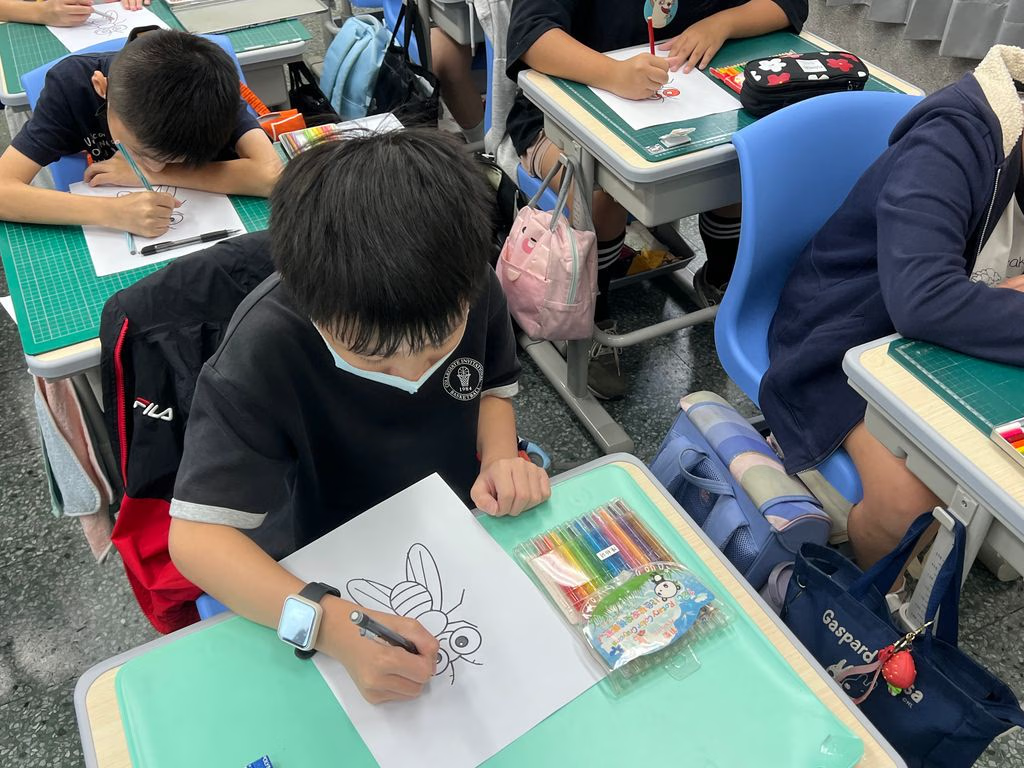
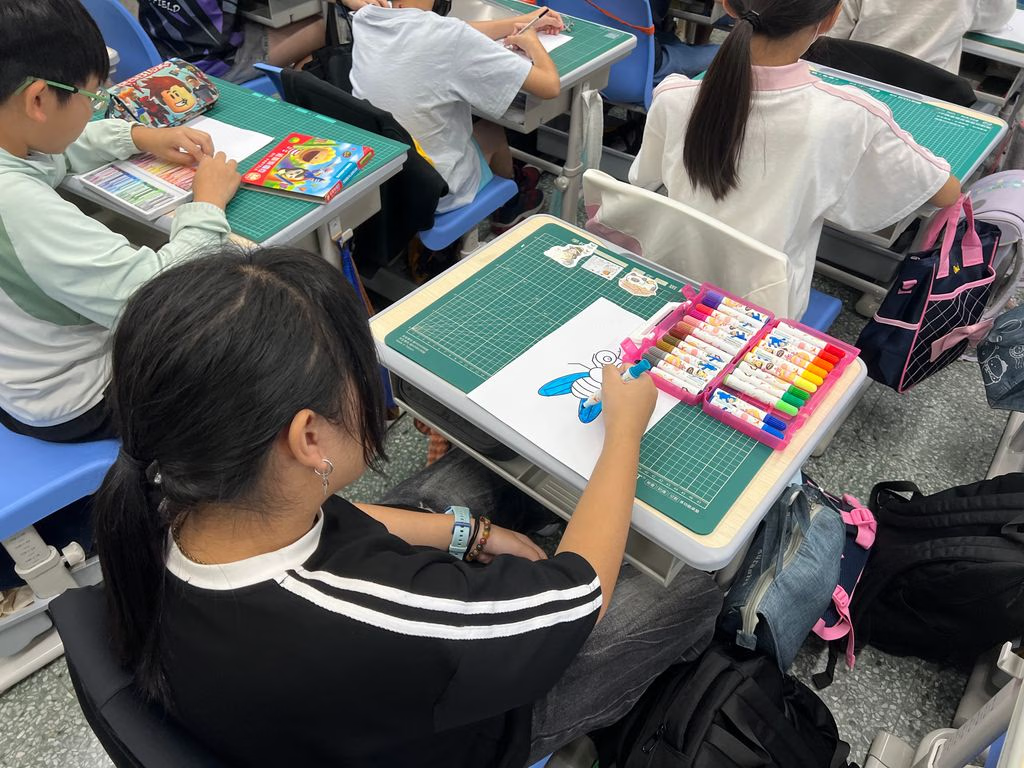
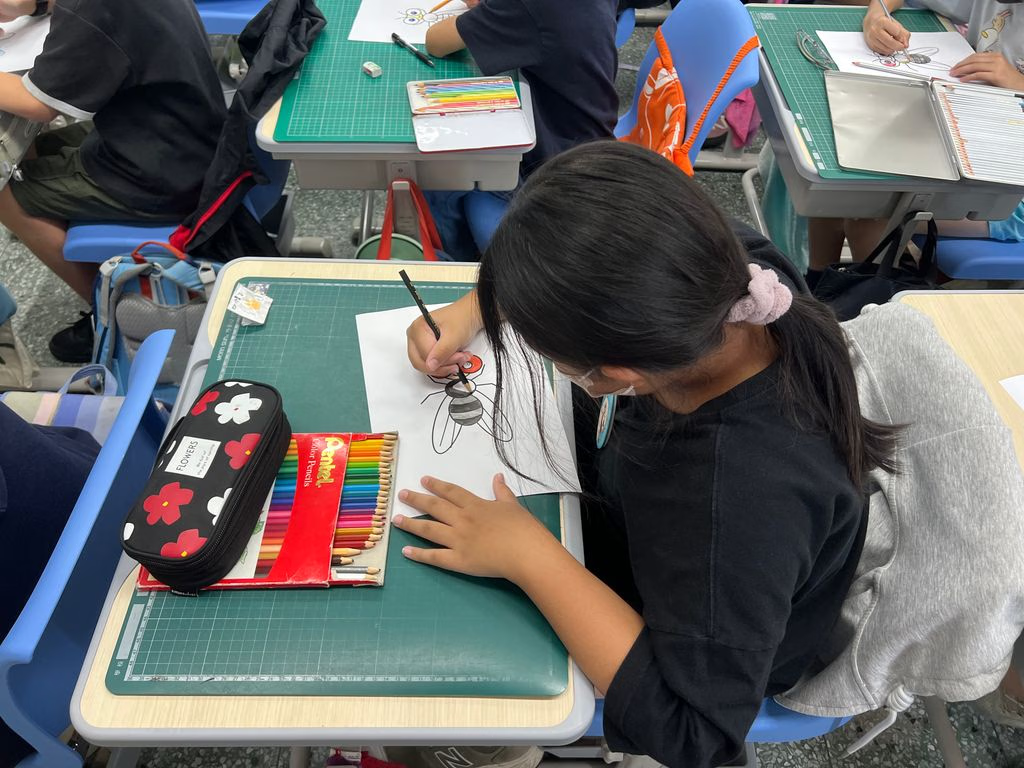
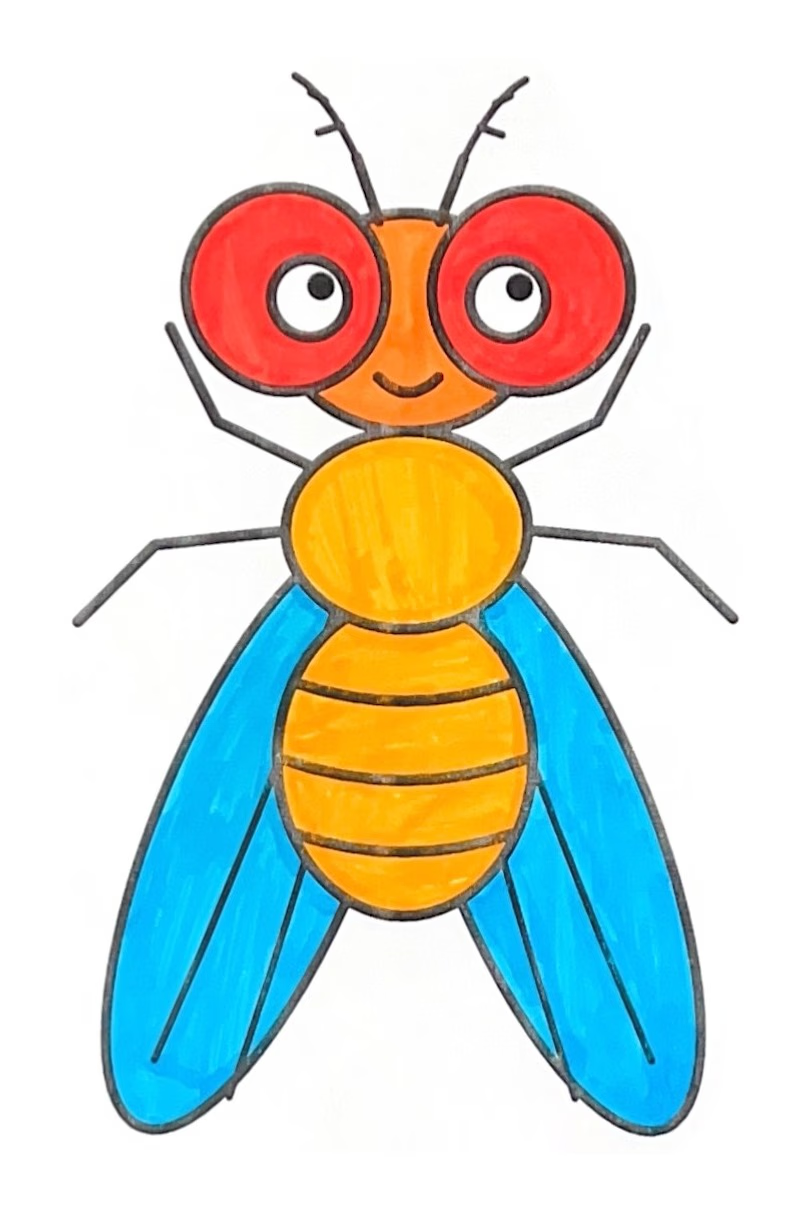
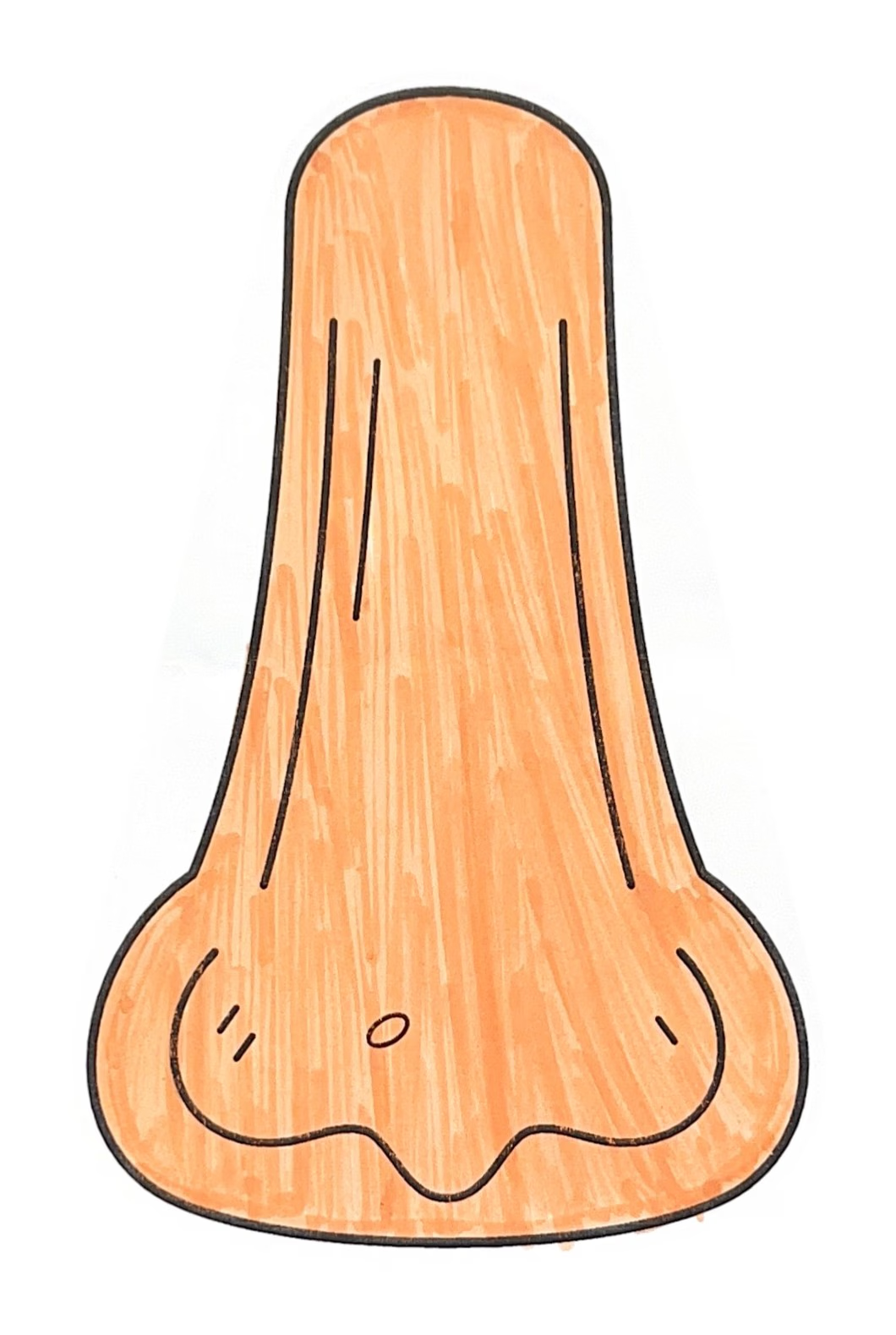
Then came a drawing and worksheet session of about fifteen minutes. The children drew a cartoon nose or a cartoon fruit fly, and completed a worksheet. The children's drawings are shown in the Art Exhibition section below.
Impact on us.
We collected 22 worksheets from the camp, each asking what the child learned or felt. Thirteen children named something they had learned, and nine wrote only that they had fun or liked the game. Five wrote about the electronic nose, and five mentioned the game. One wrote that the memory game was "really hard," and another noted that it had "a lot of questions."
Several children put the science in their own words. One wrote that everyday smells are made of many tiny molecules. Another wrote that different animals smell in different ways and that smelling uses the brain, not only the nose. A third wrote that we can use the brain in place of the nose. One wrote that technology is powerful and should be used to build the future, and one asked the school to hold the activity again.
This suggests that children could follow the path from nose to electronic nose and enjoyed the game, although the worksheets are short and self-reported, so they do not measure how much each child understood.
2. Olfactory Neuroscience Workshop (with Prof. Chung-Chuan Lo)
Why does it matter?
The workshop connected olfactory neuroscience to our sensor design: how a brain turns smell into a decision, and how that logic informs an electronic nose. It also gave us a first chance to assess the full sequence of talk, project and online activities with students approaching a field choice.
Educational Impact from us.
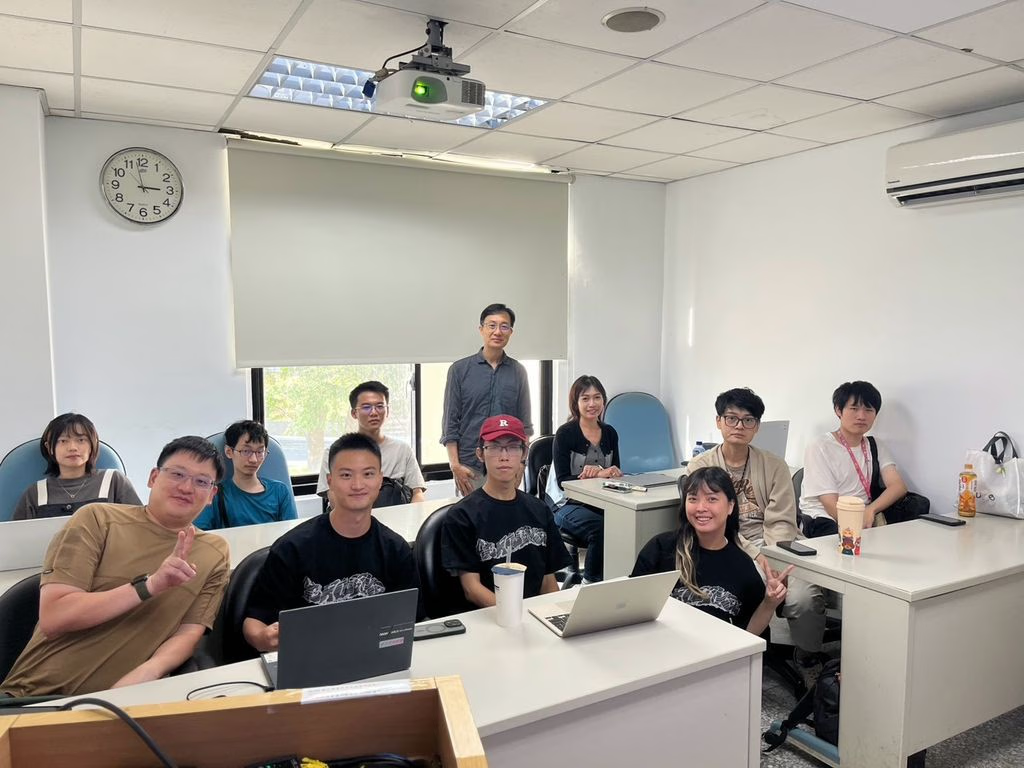
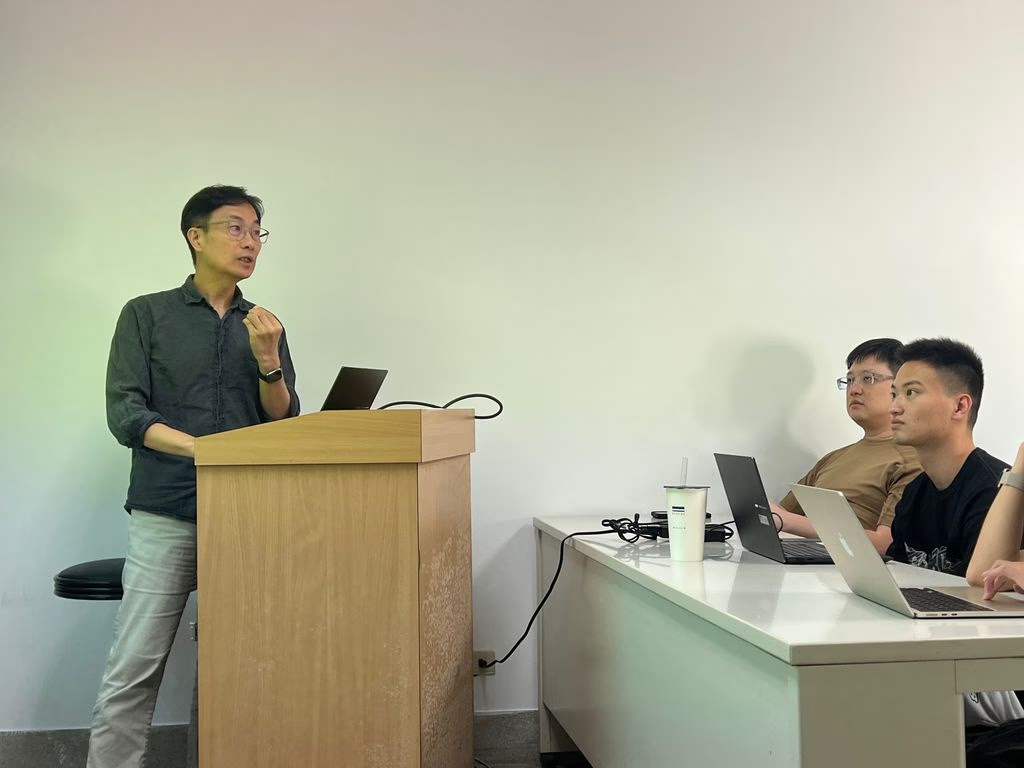
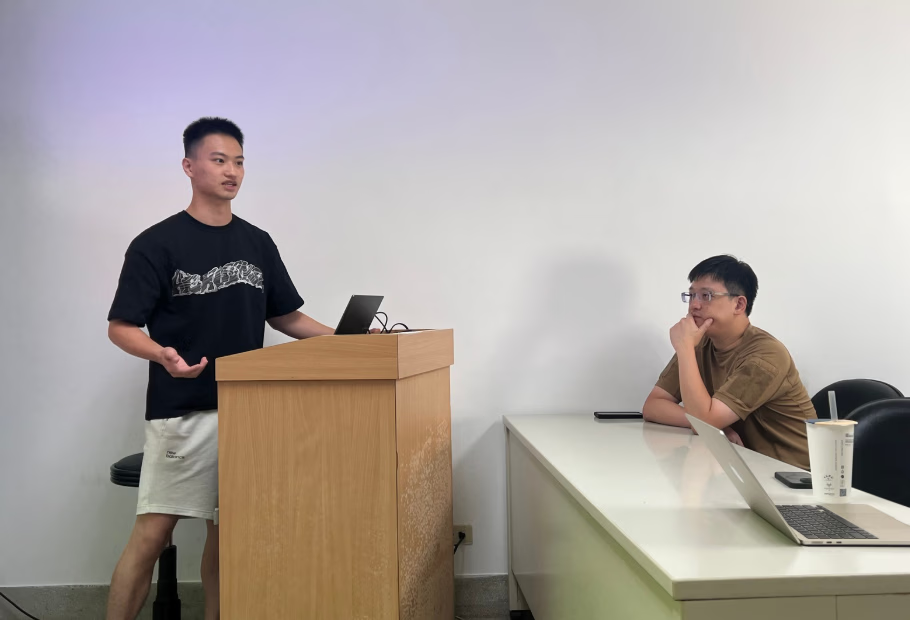
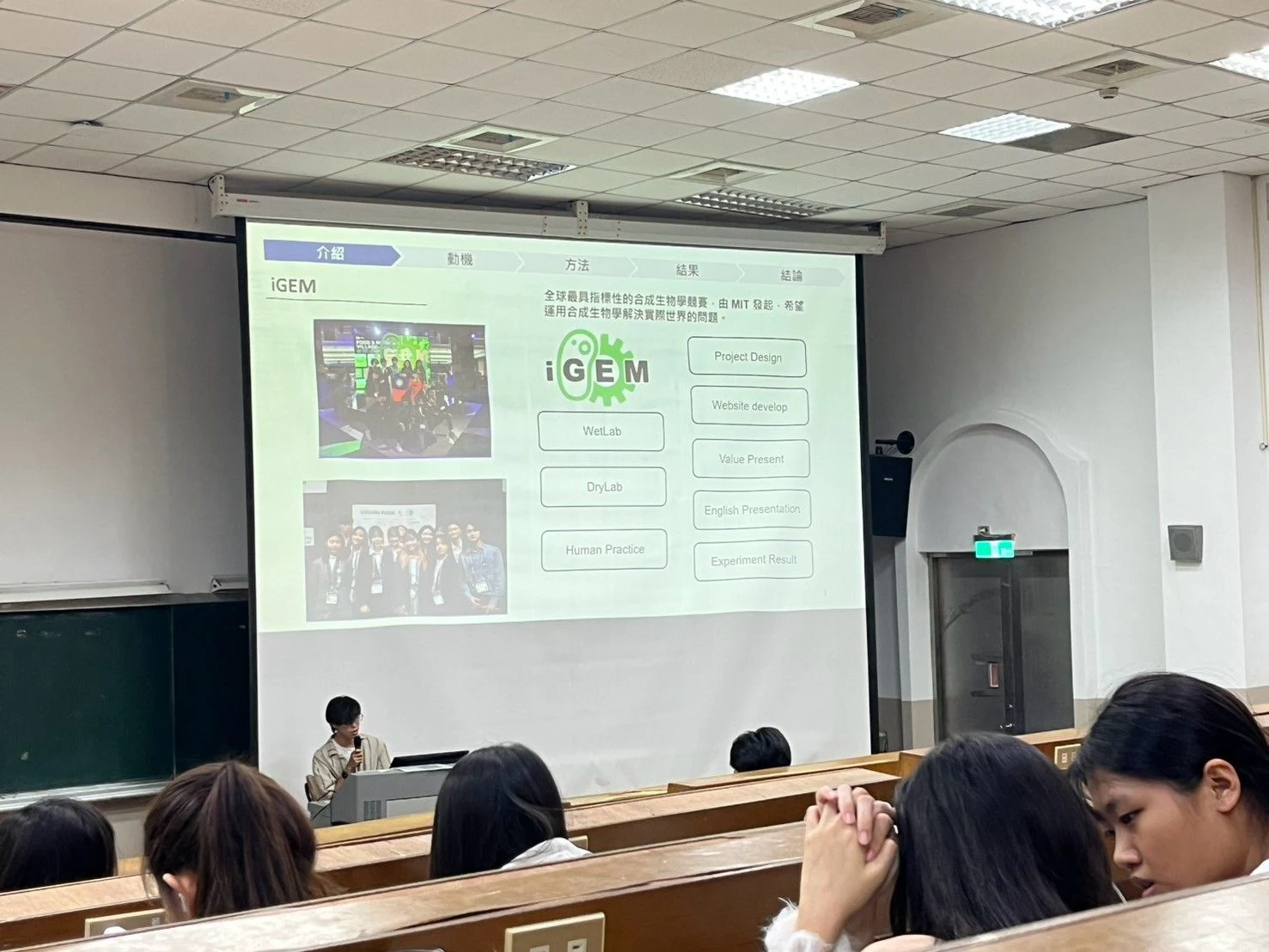
We ran "From the Brain to the Electronic Nose," a workshop for students of the NTHU College of Life Science and Medicine. Prof. Lo then spoke on the biological logic underneath olfaction: how receptors bind odor molecules, how a single smell is represented by a combination of receptors rather than one, and how the fly's antennal lobe and mushroom body turn that pattern into a decision. He also showed how this circuit-level understanding from computational neuroscience has inspired approaches to artificial intelligence.
We followed with introducing our project: why early detection of food mold and crop disease matters, how a living-cell sensor built from an olfactory receptor and a fluorescent reporter detects volatile compounds, and how a fly-brain-inspired classifier reads the resulting "odor fingerprint." We closed that part with the idea that how biology smells is how we design. Then everyone tried our online platform. We gave a short tour of the Learning Lab, running one module live so that students could see how its five modules fit together. The workshop ended with a feedback form.
Impact on us.
The workshop drew 15 participants, split evenly across doctoral, master's, and bachelor's students. Prof. Lo's talk received the highest satisfaction, and participants strongly agreed that they understood the olfactory mechanism and the electronic nose mechanism better after attending.
Their suggestions were specific. Some English technical terms were hard to follow, which made it difficult to understand the rest of the talk, remember where a term had appeared, and ask questions afterward. Participants wanted a take-home message that gives the overall picture of the project, and asked us to explain the neural network, the project goal, and the intended use more clearly.
Workshop slides: From the Brain to the Electronic Nose
3. AeroSense Learning Lab — the Online Curriculum
Why does it matter?
The Learning Lab extends access beyond a camp or workshop, so learning does not depend on living near a university. At their own pace from home, learners can follow how a fly smells, how a living cell becomes a sensor, and what a screening result can and cannot tell them about food safety.
Educational Impact from us.
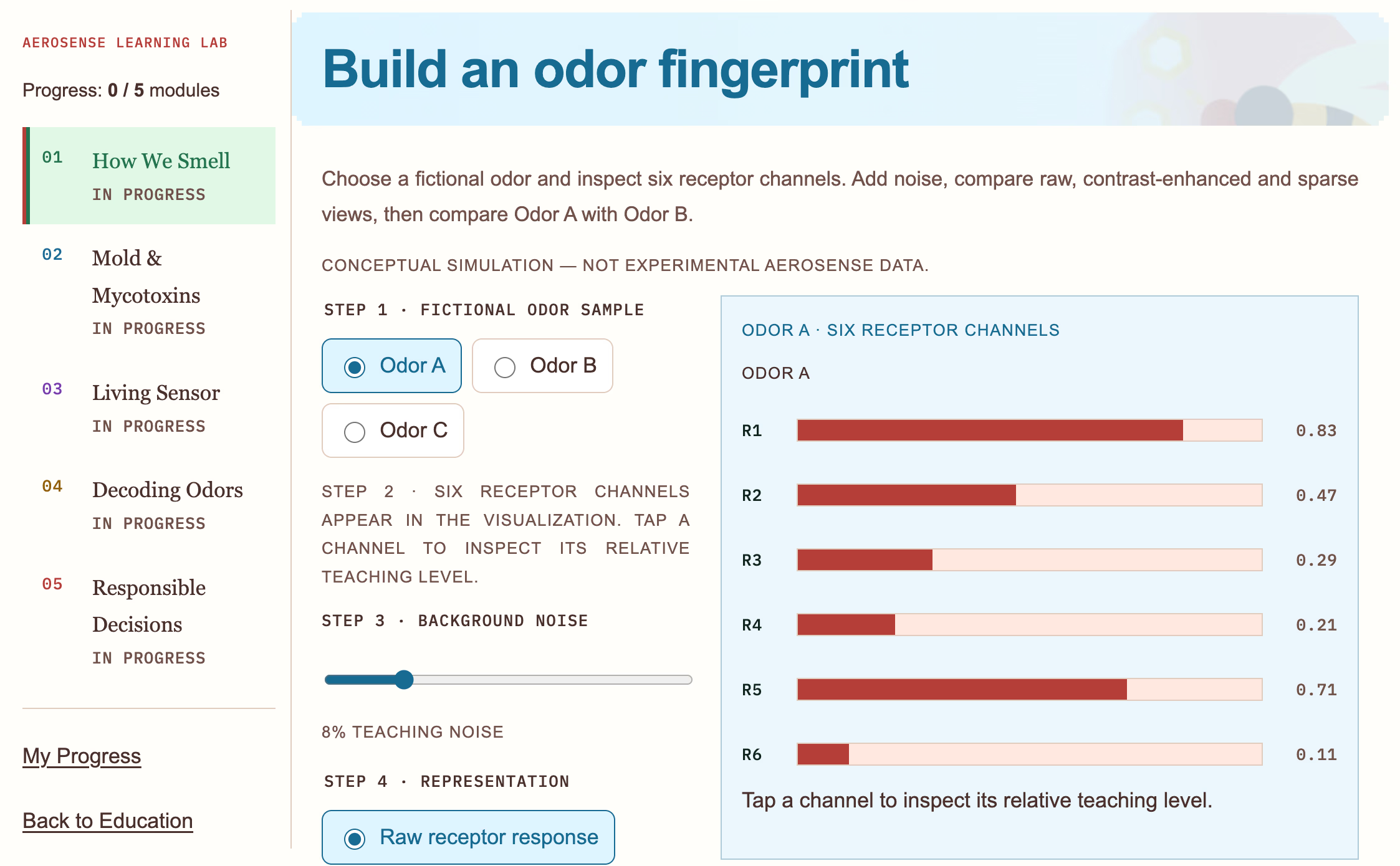
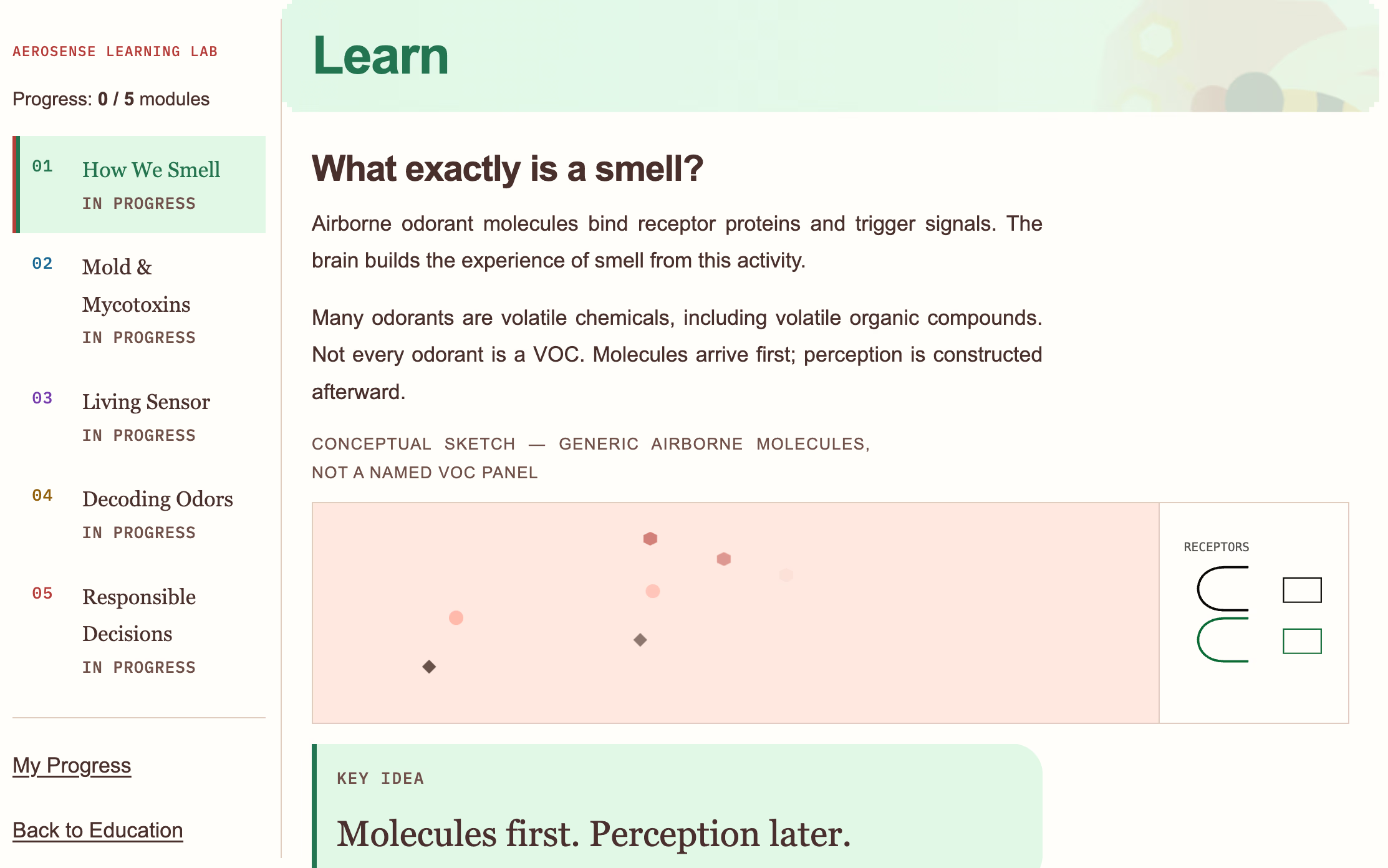
- Free to use online, with nothing to install
- Five modules of about 8 minutes each, around 40 minutes in total, organized as Biology, then Engineering, then Decision
- Module 2 uses the same statements as our public survey, so learners' answers can be compared with our survey baseline
- Printable discussion prompts for educators, and a teacher toolkit that other teams can build on
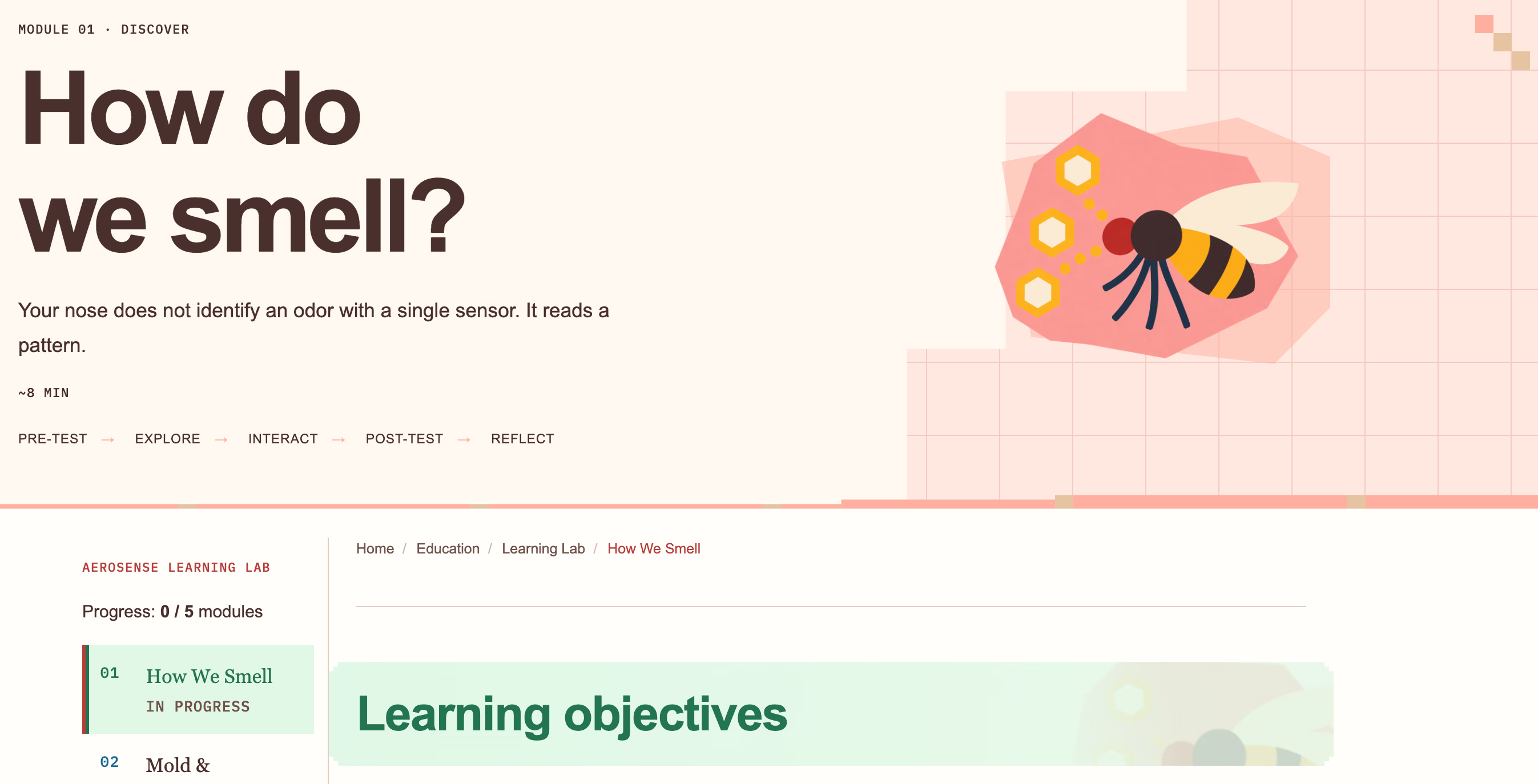
Open an individual module
From volatile molecules to receptor patterns.
02 · QuestionCan a smell answer a safety question?Practise the limits of heat, appearance and odor as evidence.
03 · BuildHow could a cell become a sensor?Connect receptor, reporter and measurement.
04 · DecodeWhat does the pattern mean?Use the fly circuit as an entry point into computational interpretation.
05 · DecideWhat should happen next?Use uncertainty, screening and confirmation to choose a responsible action.
Impact on us.
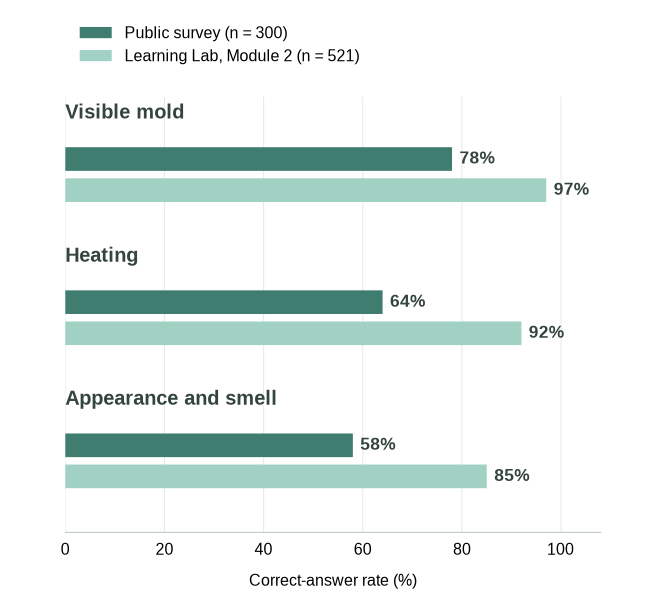
More than 500 people have gone through the Learning Lab. Because Module 2 reuses the survey's statements word for word, we can compare learners' answers with our public survey baseline. Learning Lab learners answered correctly 97% of the time on visible mold (survey: 78%), 92% on heating (survey: 64%) and 85% on appearance and smell (survey: 58%). The largest gaps were on the two misconceptions the public held most often.
Learners told us two things, and we changed the platform in response. First, the interface was unclear and the opening had too much text, so we cut the text and separated sections with color blocks. Second, the opening was too difficult. To make the platform accessible to more people, we lowered the difficulty of the opening and closing sections and added hands-on tasks, so that learners understand by doing.
The Learning Lab is not only a self-learning tool but also designed to be used by educators. Printable discussion prompts help turn individual reading into class discussion. We have already used it this way. In our Olfactory Neuroscience Workshop with Prof. Chung-Chuan Lo, we ran one module live alongside a lecture for university students. After our science camp, the Shan-chi Elementary School principal asked to keep using our approach, so we included Learning Lab instructions in the Teacher Toolkit.
Such an online platform allows children to access science knowledge in a correct and fun way. by a Director of Student Affairs in Elementary
We see the Learning Lab as a companion to biology, food-safety and neuroscience courses. Students can use Module 2 to check their own beliefs before and after a class, and Modules 3 and 4 to read up on how a living-cell sensor and pattern-based decoding work. Because each module is self-contained, future iGEM teams can add a module about their own project and extend the course for students and educators beyond Taiwan. The Learning Lab is freely available to iGEM teams, educators and anyone who wants to teach how biology can sense the world.
Mushroom Body Lobes / MBON: output (validation and handover)
Biological meaning
Kenyon cell axons run through the mushroom body lobes, where mushroom body output neurons (MBONs) read the learned pattern and convert it into an actual decision — approach or avoid. It's the output stage — the subject of Module 5 (Decide) of our online Learning Lab — and biologically, it's where internal learning becomes visible, external behavior.
Educational meaning
The projects here aren't about reach or depth — they're about what happens when our work gets read out to an outside expert audience and has to hold up: an industry conference, a peer iGEM team, and an academic lecture hall. It also holds the two ways our work leaves the room: a toolkit other teachers can run, and an exhibition of what participants made.
1. SynBioBeta 2026 — Next-Gen BioLeaders & Poster Session
Why does it matter?
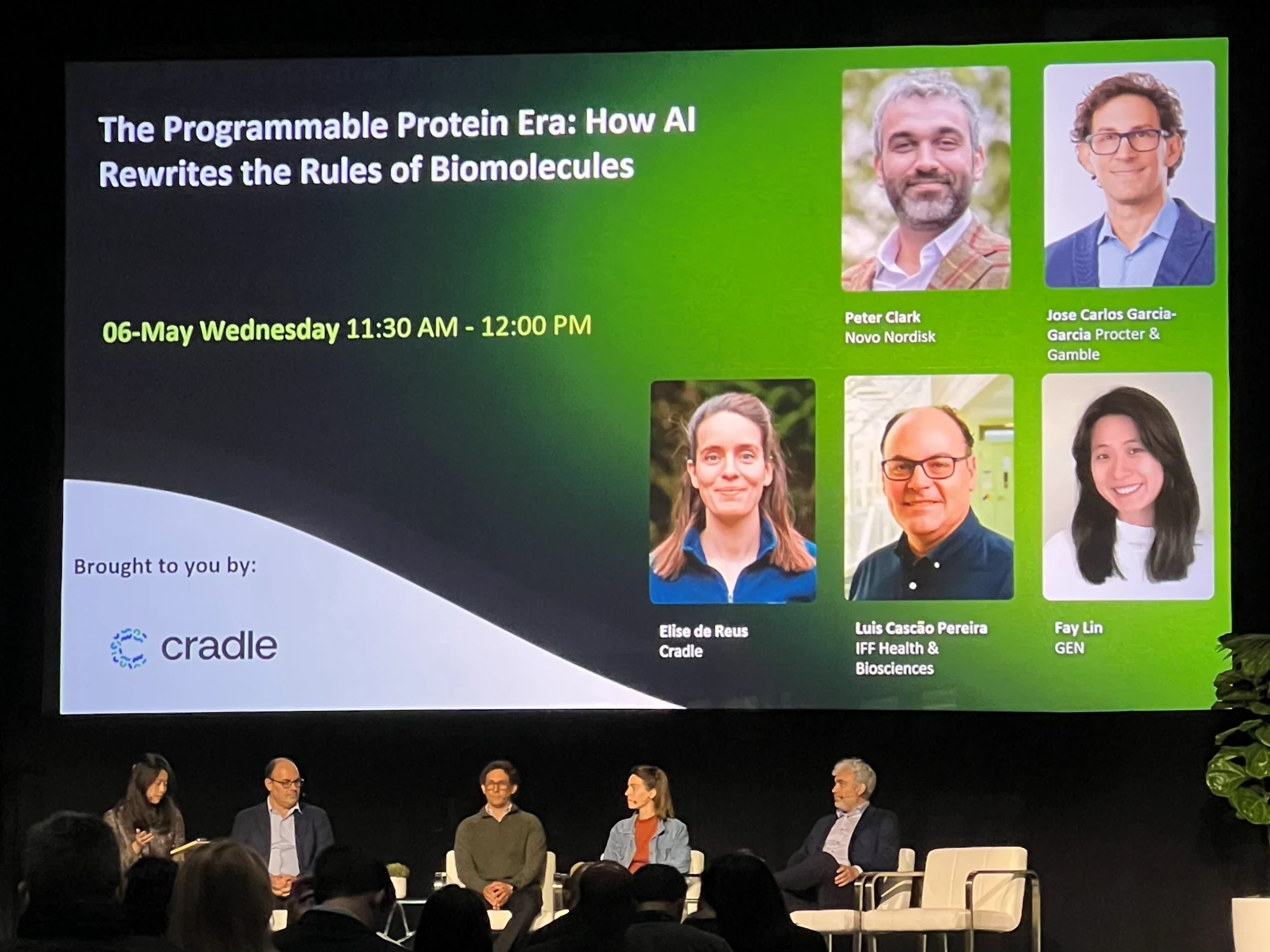
SynBioBeta let us learn from practicing synthetic biologists, founders and investors through the Next-Gen BioLeaders community. At the poster session, we tested whether a mixed, non-specialist audience could understand our central idea in a few minutes: a smell is a pattern read by a fly-inspired circuit.
Educational Impact from us.
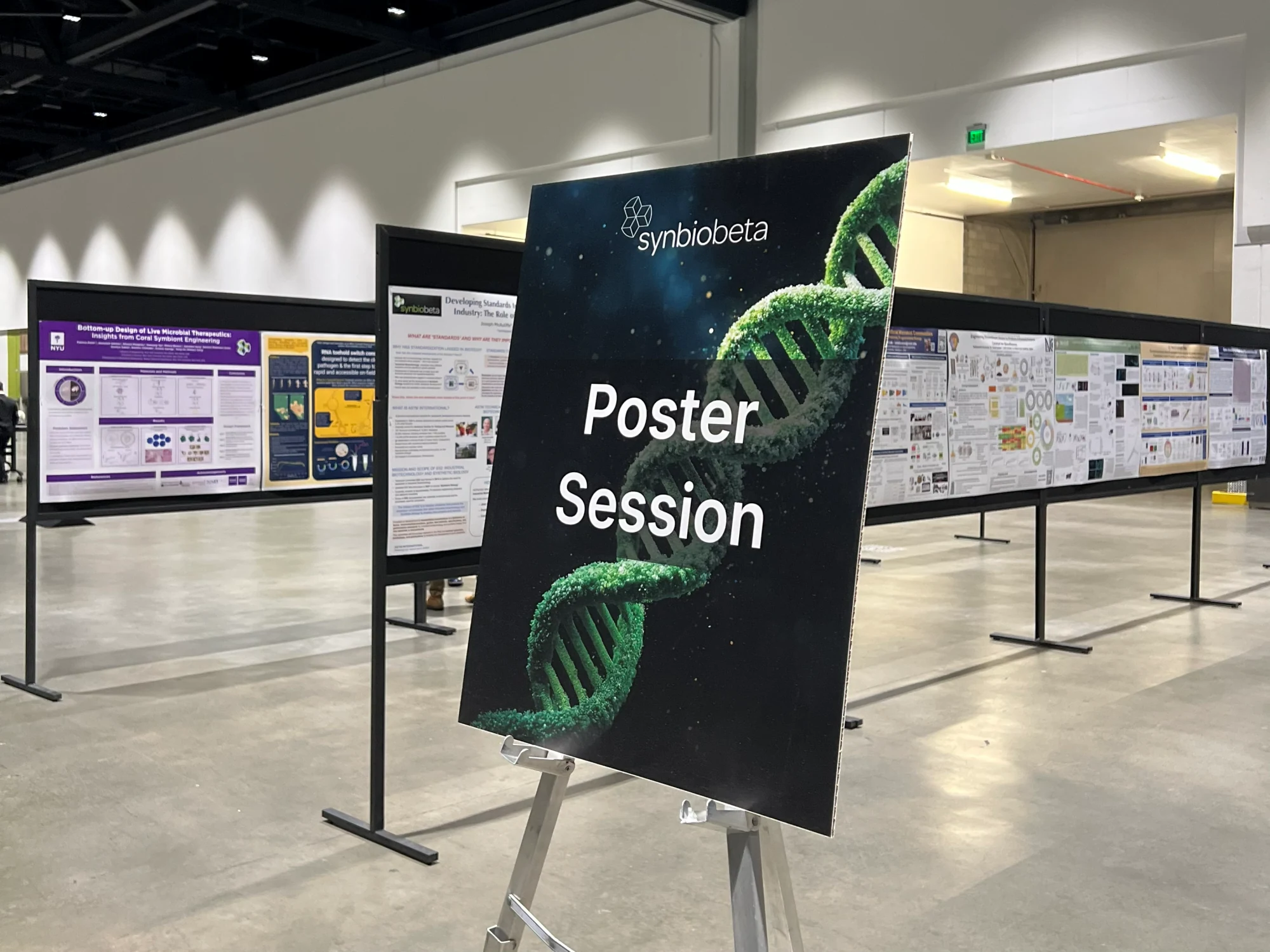
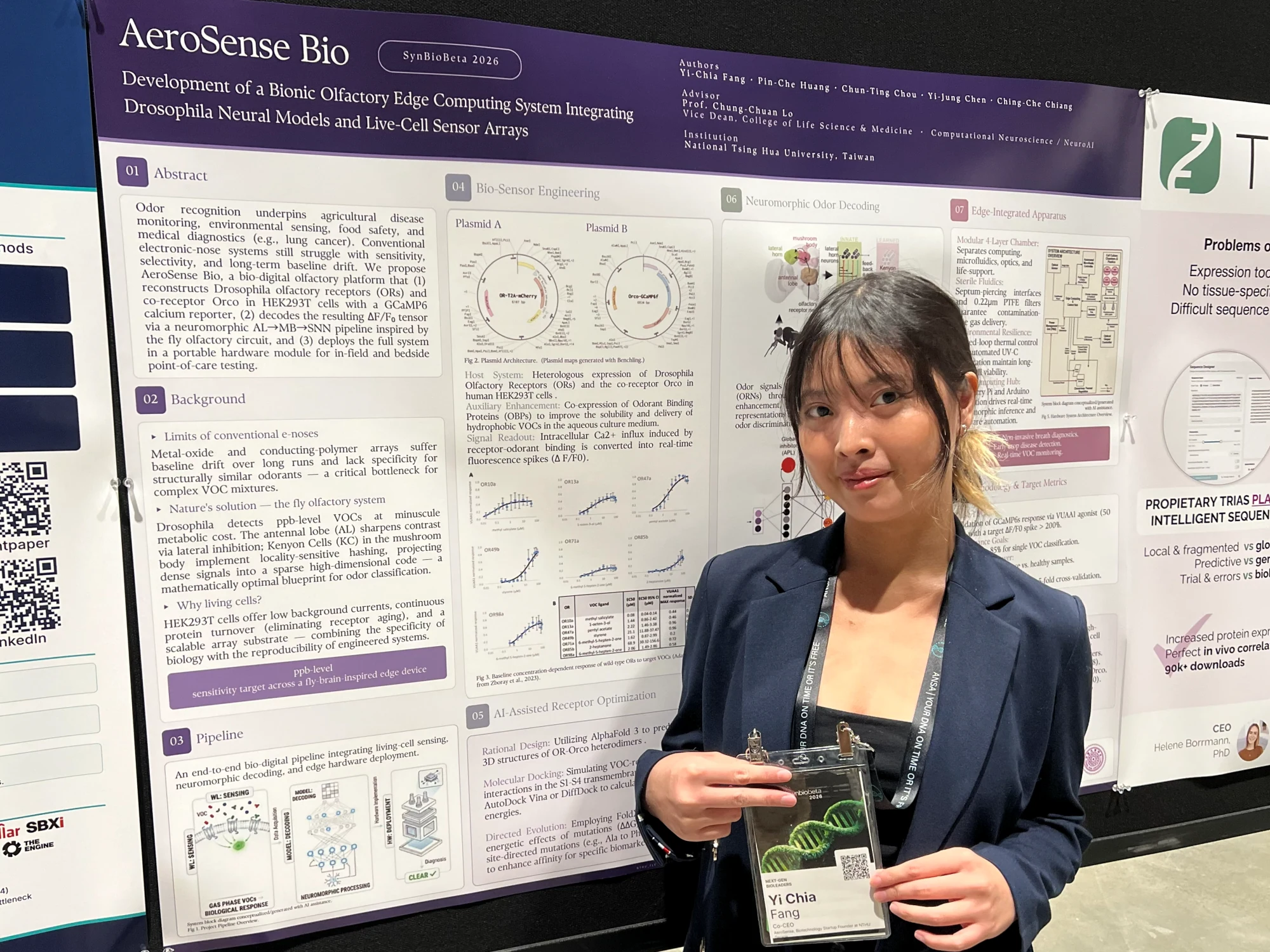
At SynBioBeta in San Jose, as one of the Next-Gen BioLeaders, with our poster accepted and presented in the Expo Hall. The poster, "Development of a Bionic Olfactory Edge Computing System Integrating Drosophila Neural Models and Live-Cell Sensor Arrays," fit the whole platform on one page for a mixed audience: why conventional electronic noses fall short, how the fly solves the problem, and why we use living cells.
The poster showed us where the explanation broke. A PhD student from UCLA, with a wet-lab background, told us he had not known how a live-cell sensor is actually built. That was the step we had explained least.
Impact on us.
The hardest question we were asked was whether our living-cell system can scale. Two more followed: how a medically positioned device would be regulated, and whether the hardware has enough margin. They came from people who evaluate companies, not student projects.
This early external review raised questions about the wet lab, model and hardware. They changed our plan and led us to add consultations.
The regulatory question led us to add regulatory consultation and to move our first application from medical diagnostics to agriculture, where the path to market is more accessible.
The poster's wording changed with the plan. The original poster lists medical point-of-care testing, including non-invasive breath diagnostics, alongside agriculture and environmental monitoring; our current materials present AeroSense as an agricultural and food-safety screening platform.
2. Mini Jamboree (with International iGEM Community)
Why does it matter?
Other iGEM teams could assess both our research and our education work. The cross-border meeting offered technical criticism from experienced peers and a chance to compare how teams teach.
Educational Impact from us.
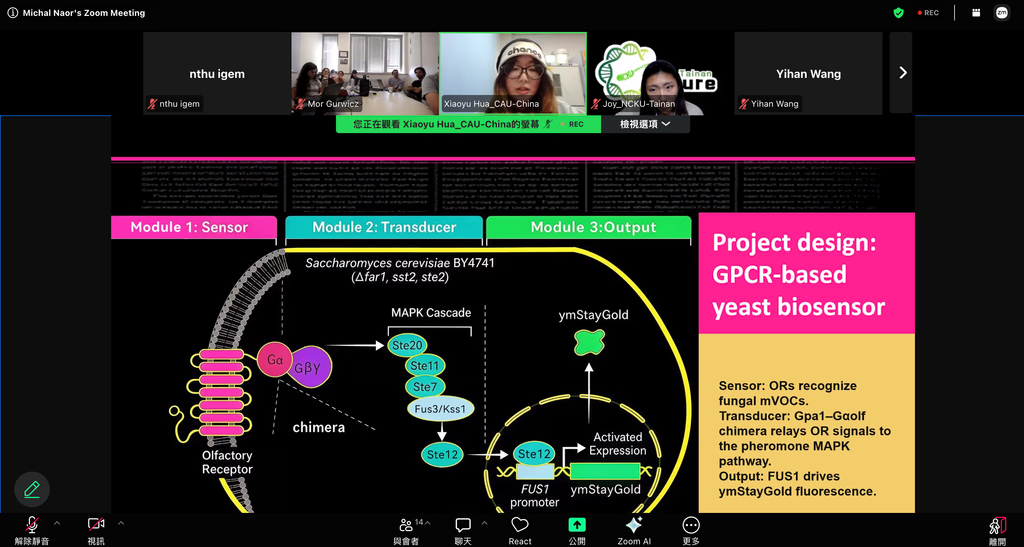
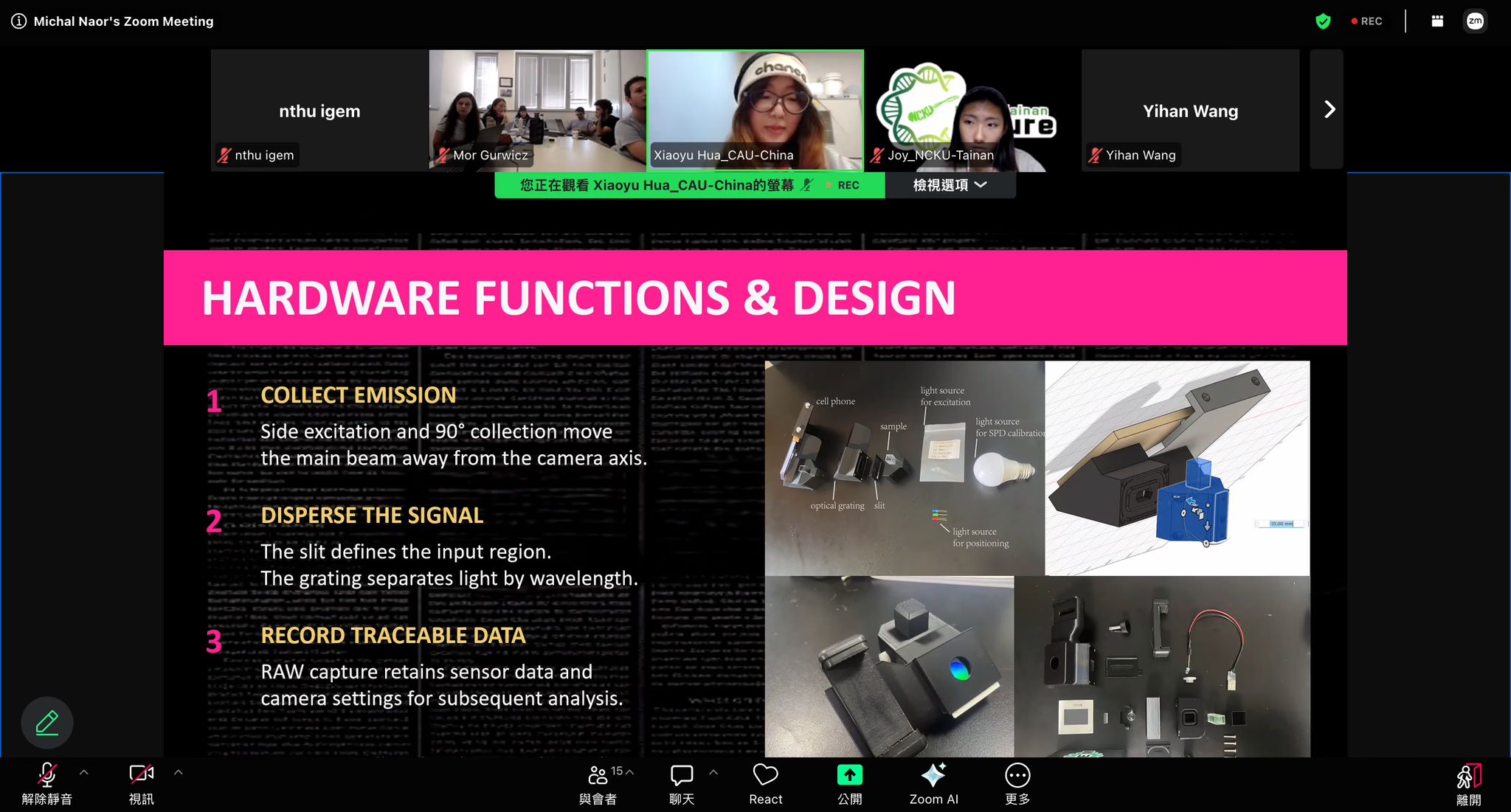
iGEM TAU-Israel hosted an online Mini Jamboree. Eight teams from six countries took part: NCKU-Tainan and NTHU from Taiwan, CAU-China and AIS-China from China, CERNAL from Israel, Cell Forge from India, iGEM-UA Alicante from Spain, and UFRGS-Brazil. Each team presented for about fifteen minutes, so every team heard seven other projects and every project was heard by teams in different regions with different regulations, farming and school systems. Besides our project, we also shared the education work described on this page, so that our activities could be compared with theirs.
Impact on us.
We received feedback on our model design from teams outside our own circle, and we exchanged education activities with them.
3. China Medical University Guest Lecture
Why does it matter?
The circuit our classifier is built on comes from research co-published by our advisor, Prof. Chung-Chuan Lo, and Prof. Ching-Che Charng of China Medical University (Cheng et al., Science Advances, 2025). Prof. Charng invited us to bring that shared research back to his university, to an audience that could judge how we had used it.
Educational Impact from us.
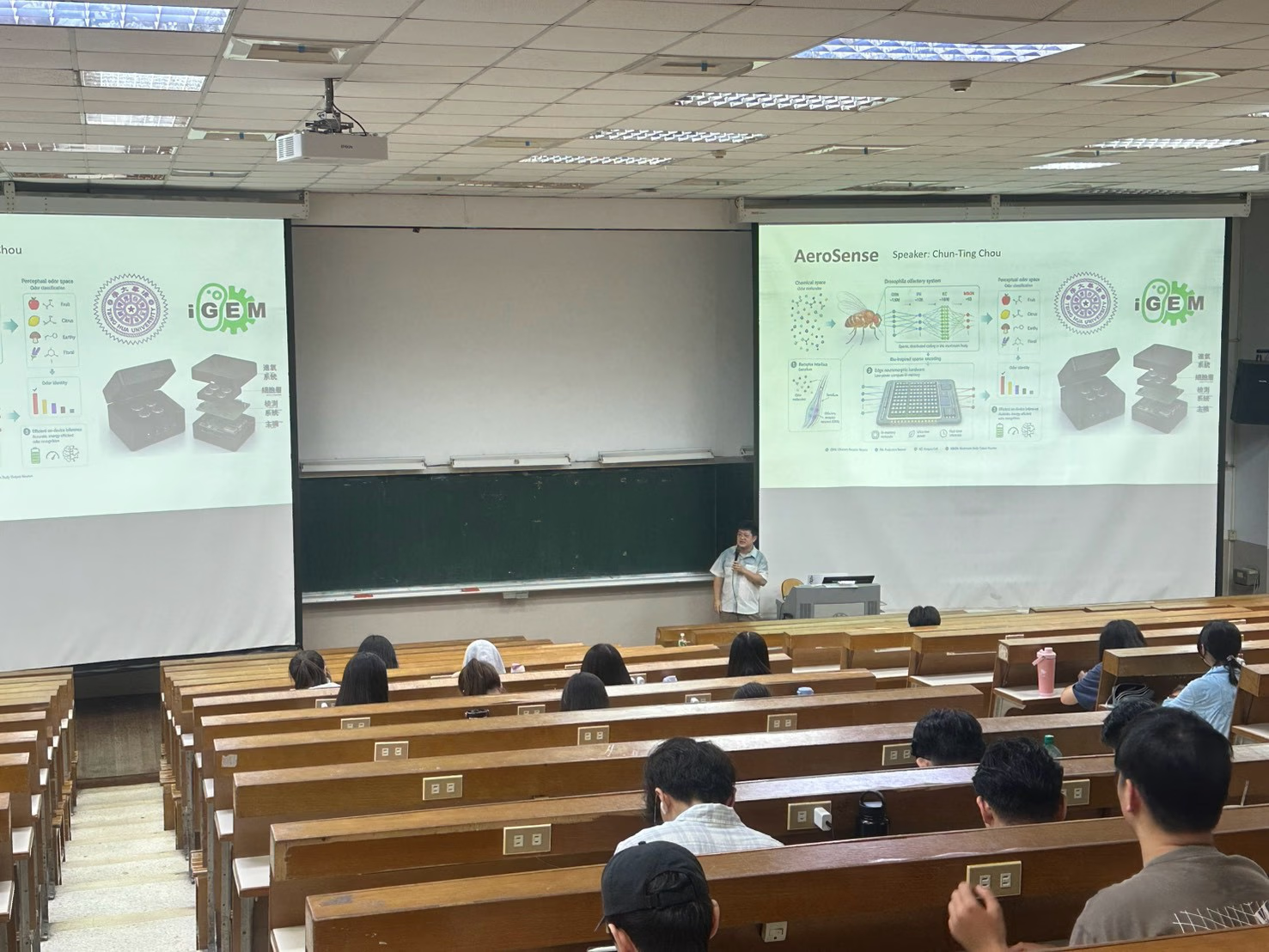
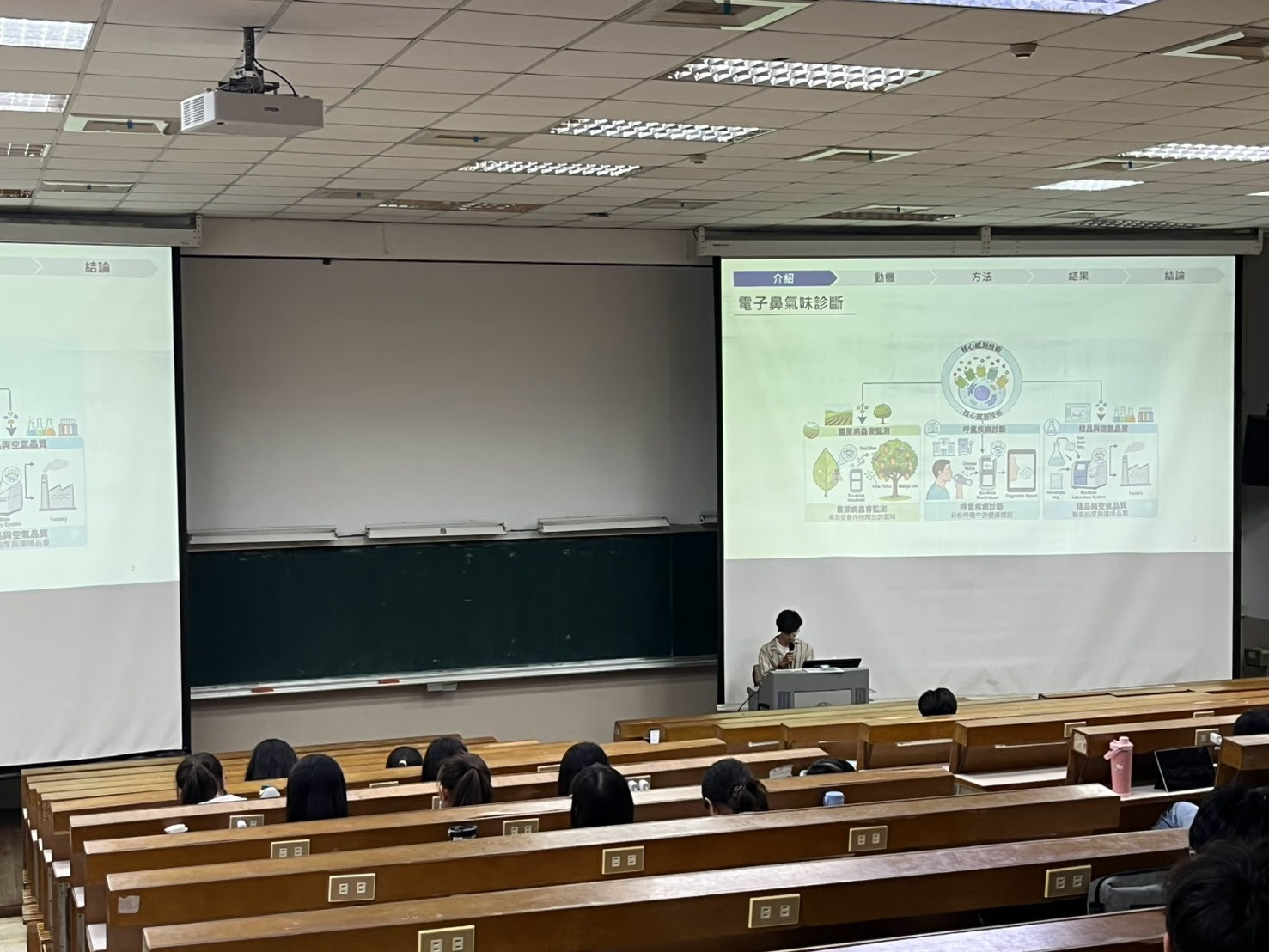
A member of our model team gave a research-sharing lecture on our electronic-nose work to more than thirty undergraduate and graduate students at China Medical University. The lecture followed one thread: why electronic noses drift and why recalibrating them is costly; how the insect olfactory system keeps its odor code stable; and how our spiking neural network borrows those ideas. We also presented the observed model behavior: the 14 sensors in our test dataset behave like only three types, adding more features did not help once the data had been compressed, and accuracy fell to about 75% when odors were presented continuously. We taught the evidence together with its limits so that listeners could judge the method themselves.
Impact on us.
Most of the audience's questions were about how the model processes an odor: how sensor readings become a pattern, and how that pattern becomes a decision. They showed us that this step needs a plainer explanation than we had given. We changed how we introduced the model in the olfactory neuroscience workshop that followed.
4. Teacher Toolkit & Education Guide (Open Resources)
Teacher Toolkit. When we met the principal of the elementary school where we ran our science camp, he told us he liked the way we teach and asked for a way to keep using it, since we cannot visit every year. We packaged the camp into a teacher toolkit: the lesson slides, the Odor Pixel Suite game, and instructions for using the Learning Lab, so that a teacher can run the same session without us. The school welcomed the approach, and the toolkit is free for any teacher to download.
Teacher toolkit instructions (PDF)
Bring the science into your classroomLesson slides, activities and teaching guidance, ready to explore and reuse.Open the Teacher Toolkit
Education Guide. The Education Guide is written for other teams, as a PDF on our Contribution page. It sets out the steps we followed: find out what your audience believes, choose one claim, match the format to the audience, measure the same way each time, and hand the work on, so that a team that has never met us can plan its own education work. Find the Education Guide on Contribution.
Game source and educator documentation are published in the official iGEM GitLab repository. The linked guides and playable activities remain available on this website.
5. Art Exhibition
We asked participants of the elementary school science camp, the olfactory neuroscience workshop and other activities to draw "the electronic nose and the fruit fly as you imagine them," and we treat their drawings as a creative output of our education work. What a learner draws shows what they took away in their own terms, which a quiz cannot show. The drawings are displayed on our Art Gallery below.
Closing
We began by assuming that the problem was a lack of knowledge about mold. Our survey tested that assumption and revealed a narrower need. Most respondents knew mold was dangerous, but many still trusted heat, appearance or smell to judge whether food was safe. Every activity on this page carries that one testable claim from first contact, through structured learning, to outside feedback and handover. Learning Lab learners answered the three misconception statements correctly far more often than the survey baseline did, with the largest gap, 28 percentage points, on heating. The comparison is between different groups, not a paired pre/post assessment.
In the fly brain, learning does not stop at the output. Dopaminergic neurons feed the outcome back into the mushroom body and change how the fly responds the next time. Our education worked the same way, and our audiences changed our project as much as we taught them:
- At SynBioBeta, questions about regulating a living-cell medical device moved our first application from medical diagnostics to agricultural and food-safety screening.
- Survey respondents ranked avoiding false negatives and clear next steps among their top needs. This reinforced our choice to screen and triage rather than certify, with no "SAFE" output.
- Students at China Medical University asked how the model turns readings into a decision, which changed how we taught the model at our next workshop.
- Learners, playtesters and pupils found our tools too text-heavy or too hard, so we simplified the Learning Lab and gave every game three levels.
- A principal asked to repeat the lesson without us, so we built the Teacher Toolkit.
Across all of these signals, our audiences mostly asked what a result means and what to do next. That is the question AeroSense is built to answer, and the one our education will keep asking.
References
[1] United Nations General Assembly. (1948). Universal Declaration of Human Rights, Article 26. https://www.un.org/en/about-us/universal-declaration-of-human-rights
[2] United Nations. (2015). Transforming our world: the 2030 Agenda for Sustainable Development, Goal 4 and Target 4.7. https://sdgs.un.org/goals/goal4
[3] Sturgis, P., & Allum, N. (2004). Science in society: re-evaluating the deficit model of public attitudes. Public Understanding of Science, 13(1), 55–74.
[4] Simis, M. J., Madden, H., Cacciatore, M. A., & Yeo, S. K. (2016). The lure of rationality: Why does the deficit model persist in science communication? Public Understanding of Science, 25(4), 400–414.
[5] Kollmuss, A., & Agyeman, J. (2002). Mind the gap: Why do people act environmentally and what are the barriers to pro-environmental behavior? Environmental Education Research, 8(3), 239–260.
[6] Freeman, S., Eddy, S. L., McDonough, M., et al. (2014). Active learning increases student performance in science, engineering, and mathematics. Proceedings of the National Academy of Sciences, 111(23), 8410–8415.
[7] Wouters, P., van Nimwegen, C., van Oostendorp, H., & van der Spek, E. D. (2013). A meta-analysis of the cognitive and motivational effects of serious games. Journal of Educational Psychology, 105(2), 249–265.
[8] Royal Academy of Engineering. (2009). Synthetic biology: public dialogue on synthetic biology. Report by People Science and Policy Ltd.
3. Social Media
Why does it matter?
The survey and the game both need someone to seek them out: fill in a questionnaire, or sit down and play. Social media reaches the person who will do neither. It puts the same ideas in a feed people are already scrolling, trading depth for reach.
Educational Impact from us.
We ran three series, each built for a different kind of reader.
Series 1: From fly nose to edge device.
Three posts that follow one smell through the AeroSense system, one post per layer: the living sensor, the decoding model, and the hardware. Each post is a short carousel written for readers with no biology or engineering background.
Post 1, Parts Design: "We put a fruit fly's nose inside a human cell." Explains how a fruit fly odor receptor and a calcium-sensitive glow protein, placed in human cells, turn a smell into light: an odor molecule binds the receptor, calcium flows in, and the cell lights up. The response becomes a measurable change in fluorescence.
Post 2, Model: "The cell lit up. Now what?" How a circuit modeled on the fruit fly brain turns the glow into a decision.
Post 3, Hardware: "Hearing a cell's faint glow in a noisy room." How the edge device picks a faint signal out of background noise.
Series 2: Sustainability Pop Quiz.
Four multiple-choice Instagram stories, each followed by an answer card. Every question ties one AeroSense design choice to a Sustainable Development Goal, so followers learn what the goals mean by guessing which one applies.
Flagging a batch of bananas or mangoes before disease symptoms are visible points to SDG 2, Zero Hunger. The goal of low-power, on-device odor interpretation points to SDG 9, Industry, Innovation and Infrastructure. A reusable, non-destructive sensing cartridge points to SDG 12, Responsible Consumption and Production. And the interviews with an e-nose company's chief scientist, several biotech companies, and an analytical-instrumentation professor point to SDG 17, Partnerships for the Goals.
Series 3: Blog Articles.
We publish long-form articles on Neuroinfo, a popular-science blog on computational neuroscience run by Prof. Chung-Chuan Lo's lab at National Tsing Hua University. Since 2017, the blog has published hundreds of articles in Traditional Chinese for general readers, giving our writing a home and an audience beyond our iGEM season.
Each article takes one recent study on fruit fly olfaction and explains it for non-specialists: the question it asks, how the experiment works, what it found, and what it still cannot tell us. A deep-tech tour then connects the finding to AeroSense, explaining which part of the fly's smell system inspired our design and where biology and engineering differ.
Impact on us.
We treat social media as a reach channel, not a measurement tool. Over the posting period, our feed posts reached more than 1,700 accounts, our stories more than 1,400, and our reels more than 500, with an average of about 50 likes per post. We gained more than 100 new followers, and more than 50 people answered the Sustainability Pop Quiz stories, getting about 75% correct on average. Our best-performing post was Post 1, “We put a fruit fly's nose inside a human cell.” Most of our audience was aged 20 to 30.
These numbers show interest, not learning. Saves, poll responses and comment questions do not establish understanding; the games and Learning Lab provide opportunities to assess it more directly. In comparable in-person outreach, including street booths and pub-quiz events, we observed that this content often attracted people already interested in science.