
Reuse the microscopy analysis
Microscopy and kinetic fluorescence
Inspect the endpoint analysis of 25 fluorescence fields across 12 conditions. Reusable scripts and machine-readable tables connect each image to its QC decisions, DAPI-object measurements, reporter thresholds and exclusions.
The readout is reporter-positive fraction among retained DAPI objects from one batch. Measurement defines its scope and statistical interpretation. Reuse terms: Website credits
Reuse the kinetic odor assays
The Test 1 source index links 32 original exports, 3,840 fluorescence readings and 96 well summaries from one HEK293 plate. It includes a standalone analysis script, QC exclusions, English figures and the executed method. The archive retains all raw readings, including the two rows excluded from the corrected comparison.
Trace each exploratory result to its original readings, correction components and single-well control comparisons. The accompanying assay discussion defines the interpretation and follow-up measurements.
Resources for your next project
Choose biology, hardware or the interfaces between them. Each resource includes design rationale, evidence and reuse guidance.
Choose an illustrated chapter to explore its design files, evidence and reuse guidance.
01 / Wet Lab Biological sensing toolkit OR/Orco construct maps, Registry records and a guide to adapting cellular sensing.
Adapting Drosophila OR/Orco sensing
Construct maps, Registry records and exploratory fluorescence assays connect the OR/Orco design to its experimental evidence.
Designs and exploratory measurements.
This package connects construct design, assay controls, metadata and diagnostic failure modes for insect-receptor biosensing.
The Parts collection provides Registry identifiers and construct records; Design explains the cassette architecture and Experiments records the assay workflow.
AeroSense adapts published OR/Orco sensing to its receptor panel, constructs, HEK293 workflow and downstream reader. VUAA1 supplies the functional-control logic; the comparison below separates these choices from the published components.
GCaMP6 established sensitive, genetically encoded calcium fluorescence. AeroSense uses this optical signal as the interface between receptor activity and electronics [7].
The biological design adapts the HEK293 Drosophila OR/Orco architecture with mCherry and GCaMP6 reported by Zboray et al. [1]
This comparison distinguishes published prior work from modifications introduced in AeroSense.
- Published precedent
- What the cited papers report. Citations jump to this page’s References.
- AeroSense implementation
- AeroSense construct choices documented in Parts and Design.
- How to interpret the map
- The table compares designs; experimental observations belong in Experiments and Results.
| Design element | Published precedent | AeroSense implementation |
|---|---|---|
| Cellular platform AeroSense host | HEK293 stable cell lines [1] | HEK293 See the host and transfection design |
| Tuning receptor Differs | Drosophila OR | selected AeroSense receptor panel |
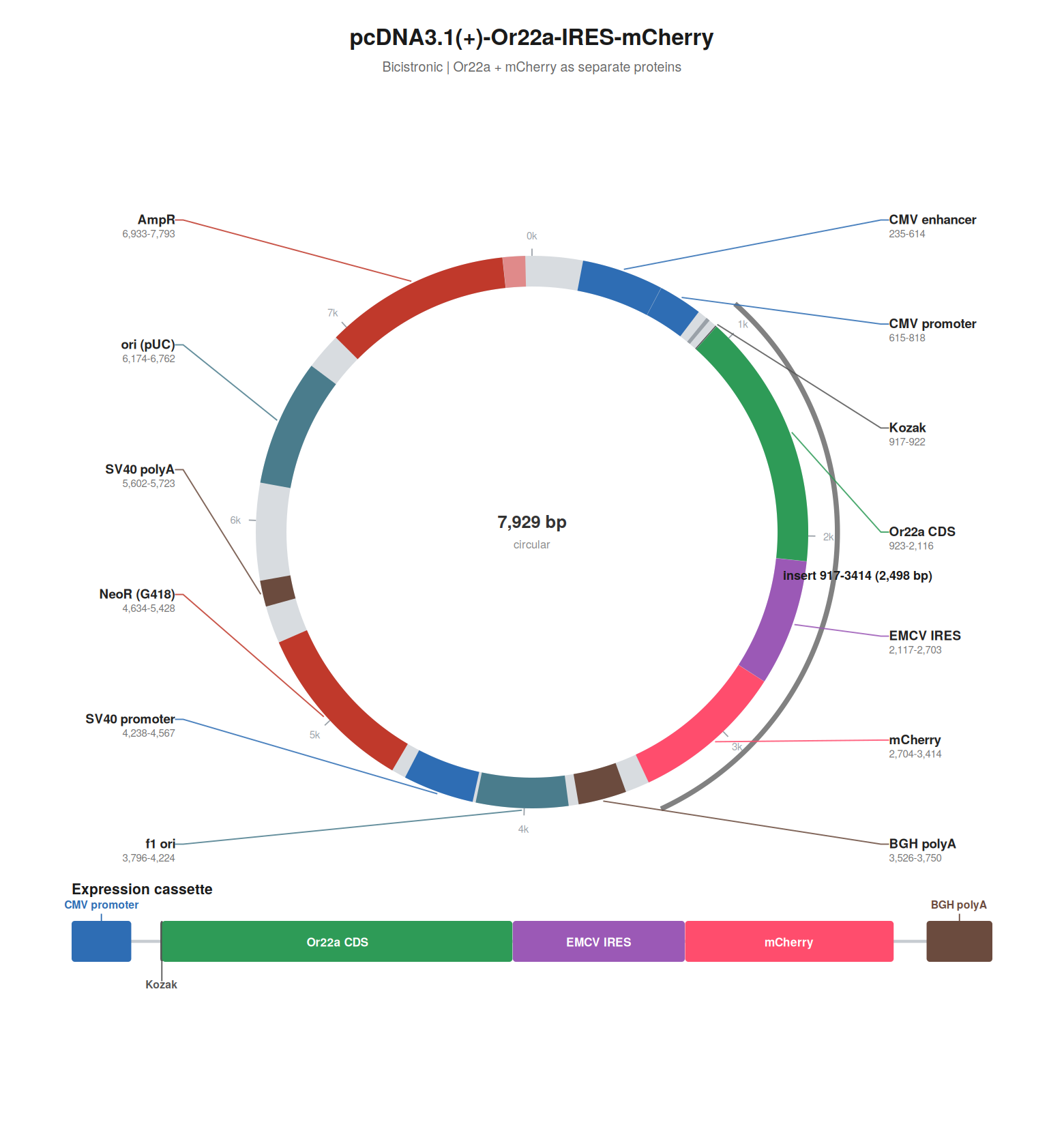
| Expression reporter Separate expression marker | OR–IRES–mCherry [1] | OR–IRES–mCherry |
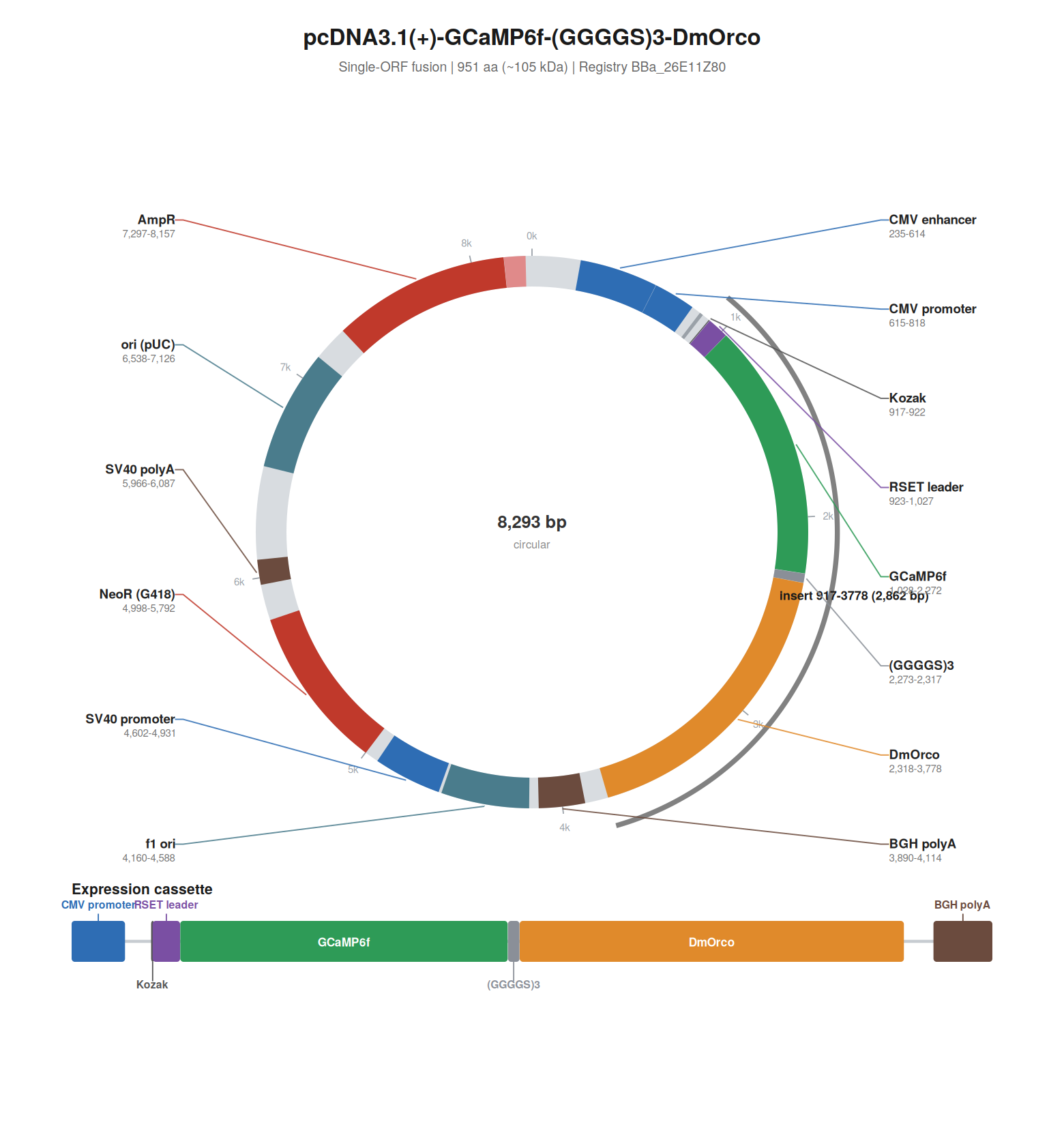
| Calcium readout Fusion reporter design | GCaMP6–linker–Orco [1] | GCaMP6f–(GGGGS)3–Orco; see the Registry record |
| Functional control Orco agonist reference | VUAA1 [1] [2] Jones et al., 2011 — full entry in References. | VUAA1 positive-control workflow |
| Application Differs | plant-associated VOC profiling | food/agricultural fungal-risk sensing |
Use the adaptation map to distinguish published precedent from AeroSense-specific choices. The Parts page lists assigned identifiers and sequence status; Experiments separates executed steps from proposed assays.
Resources
-
Annotated construct maps
Maps of the receptor-expression cassette and the GCaMP6f–Orco reporter.
Registry identifiers and construct records
The Parts collection lists 27 entries: 25 new parts and two reused parts. Sequence records, Registry documentation and functional characterization remain distinct.
-
Biological control plan
Ionomycin × VUAA1 diagnostic logic connects reporter performance to Orco agonist response in the engineering record.
-
HEK293 microscopy analysis package
Endpoint-image QC, DAPI-object measurements, blank-derived reporter thresholds and sensitivity analysis across 25 fields, with source hashes, scripts and CSV tables. The retained-object denominator and analysis limits are documented in Measurement.
Microscopy analysis code — GitLab · Data availability · Methods and limitations · Original images and data
-
Reporter architecture and troubleshooting notes
Engineering records the earlier IRES-driven reporter investigation and the rationale for the GCaMP6f–Orco fusion.
02 / Hardware Weak-fluorescence reader Optical readout, fluorescent-standard tests and reusable calibration records.
Building a reproducible reader
A documented four-channel reader with fluorescent-standard measurements, calibration analysis and measured cross-talk correction.
Built and tested with standards.
Teams can trace layout, guarding, reference quality and optical leakage to the measurement budget, then adapt the documented circuit to their own components.
Hardware reports 58 fluorescein acquisitions, calibration coefficients and a measured channel-mixing matrix. Engineering · Hardware traces the corresponding circuit and enclosure decisions. The Reusable resources and Hardware · design report connect those measurements to the build files and analysis.
The early photodiode → high-gain TIA → ADC → ESP32 chain exposed limits beyond nominal gain: leakage, PCB contamination, guarding, feedback-component placement, supply coupling, SAR ADC kickback, reference stability and optical leakage. Schematic and layout review made these measurement constraints explicit.
An ESP32 handles acquisition, modulation, embedded processing and wireless communication in the current reader; higher-level inference remains off-board. Engineering retains the earlier Raspberry Pi comparison and the rationale for consolidating these functions.
Frequency-tagged fluorescence excitation can be separated from one detection stream, while synchronous lock-in detection recovers weak periodic optical signals. These established principles underpin our custom multichannel biological reader: photodiode, LMP7721 TIA, ADS8866 ADC and ESP32 acquisition, with an embedded implementation and a documented calibration workflow. [3] [4]
The design record explains the ESP32-only architecture and preserves initial-to-current files. Failed assumptions and resulting revisions: Transferable design lessons
Resources
Manuals, firmware and simulation resources: Hardware code and documents — GitLab · Data availability.
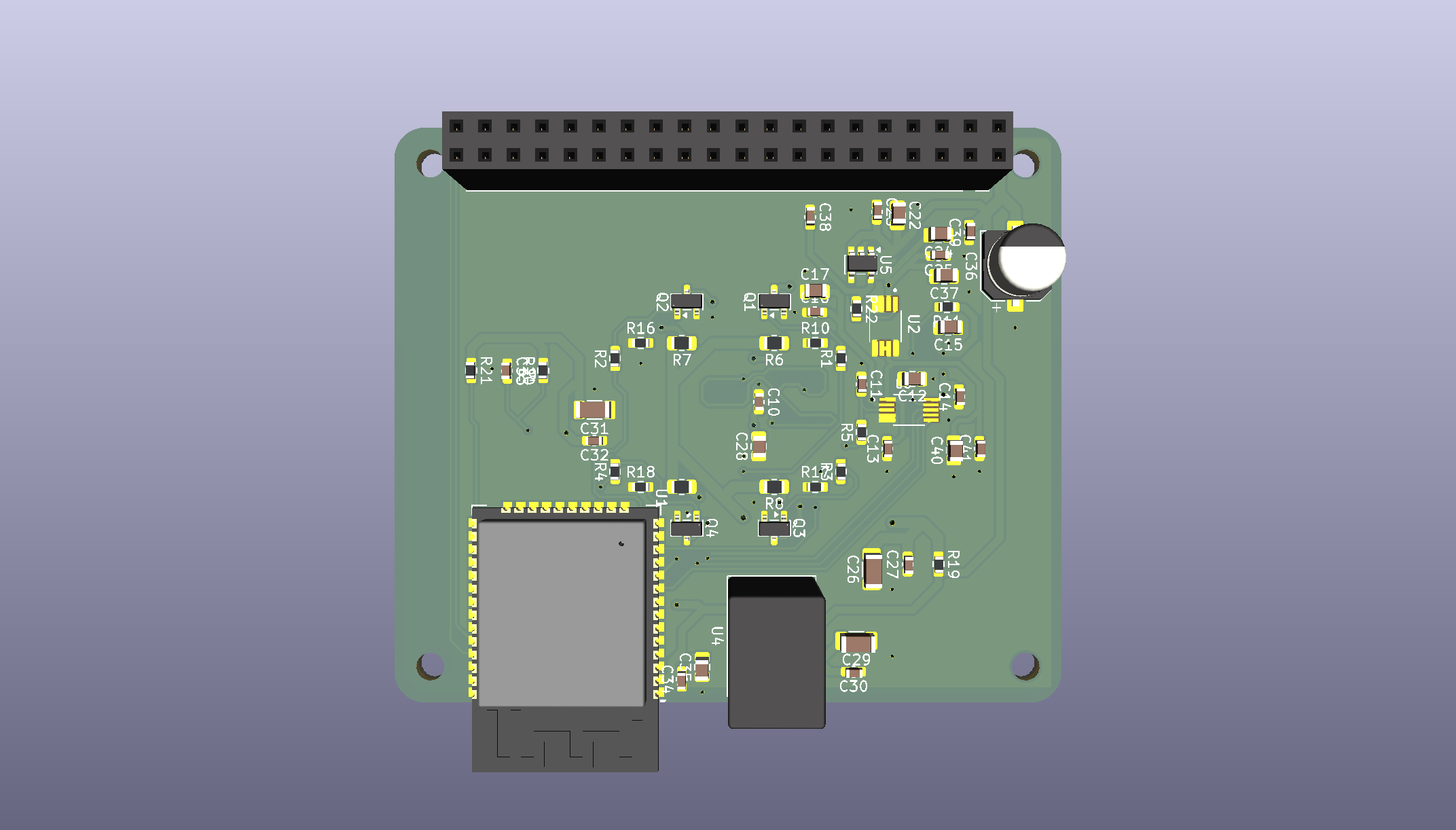
Text-based design sources are available on GitLab; model files are listed under archive availability. The CAD preview images are available below. Read the hardware design report for calculations, simulation results and assembly guidance.
-
initial design schematic PDF
KiCad PDF export of the earlier-design archive (not fabricated).
-
initial design KiCad PCB
Editable initial design layout source.
-
initial design bill of materials
Parts list from the earlier-design archive.
-
initial design DRC / ERC reports
Stop-before-fabrication design review.
Initial DRC report · PDF · Initial ERC report · PDF · Engineering figure
-
current design schematic PDF
Current redesign schematic export.
-
current design BOM
current design parts list (DOCX).
-
PCB layout
View-locked board record for inspection of the retained layout.
-
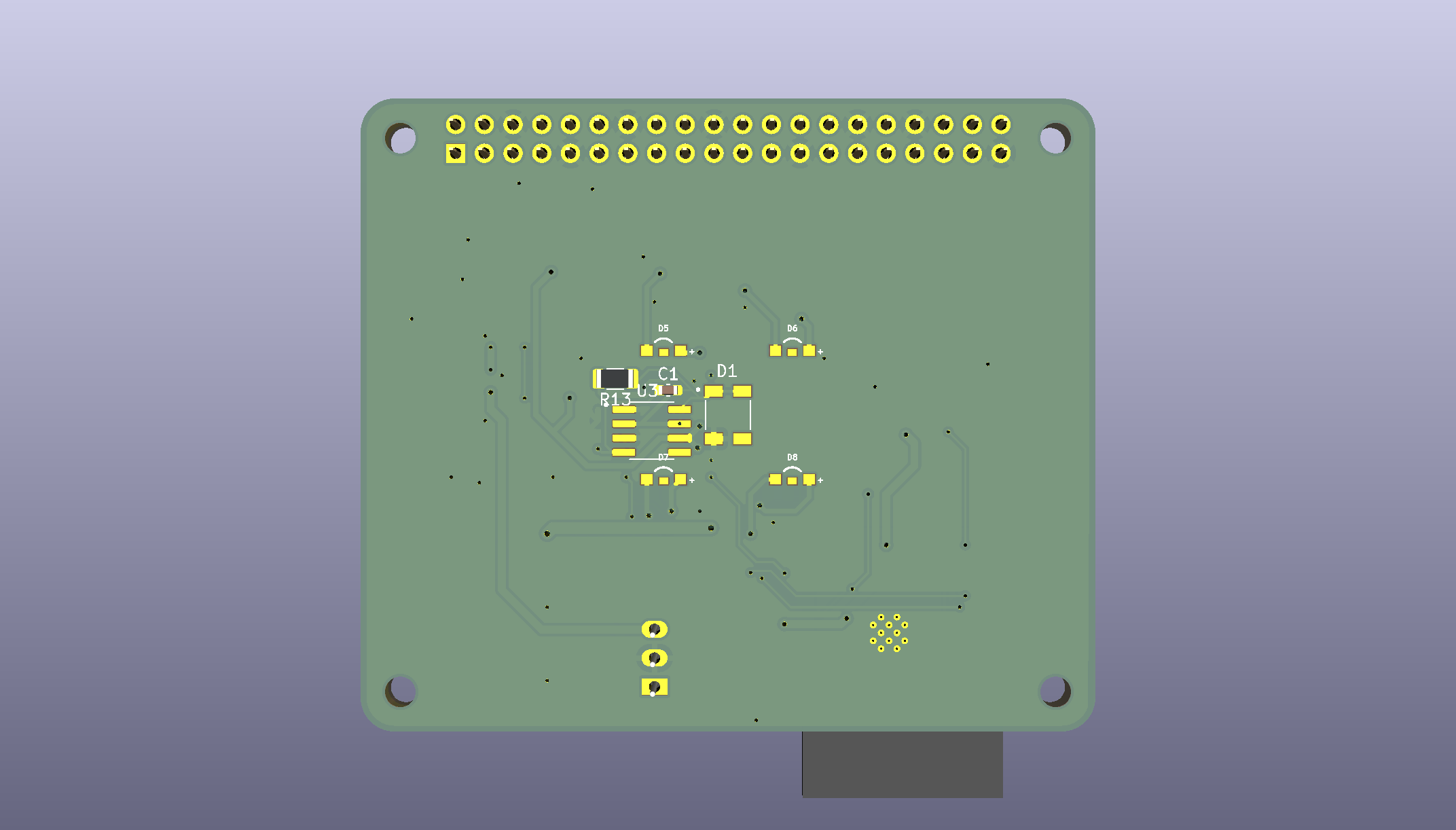
current design KiCad 3D renders
Top/bottom CAD renders — not fab photos.
Design lessons to reuse
Ten design lessons connect a failed assumption to the resulting engineering choice. engineering record
Measurement
Protect the weak signal.
Protect high-impedance measurements
- Principle
- Nominal feedback resistance does not determine usable sensitivity. Contamination, humidity, flux residue, and incomplete guarding can rival the photocurrent.
- Why it mattered
- A 100 MΩ-class front end is limited by leakage path length and cleanliness, not by the resistor value printed on the schematic.
- What another team should do
- Shorten the photodiode–TIA path, implement guarding, and budget leakage as a first-class noise source before chasing more gain. Read Hardware · TIA and high-impedance PCB.
Look beyond ADC resolution
- Principle
- Analogue noise and reference quality can dominate long before quantization does.
- Why it mattered
- A higher-resolution converter does not by itself make a weak fluorescence signal usable.
- What another team should do
- Specify a dedicated reference and decoupling, then measure a noise floor on hardware — do not declare sensitivity from the ADC datasheet. Read Hardware · Digitization.
Budget for optical leakage
- Principle
- Excitation light that reaches the detector spends the same dynamic range as fluorescence.
- Why it mattered
- A photodiode that can see the LED will swamp the biological signal regardless of TIA gain.
- What another team should do
- Design geometry, filtering, and a blank-sample leakage test as part of the analog chain, not as enclosure cosmetics. Read Hardware · Optical design.
Preserve channel identity
- Principle
- If several excitation sources share one detector, identity must be recoverable after optical mixing.
- Why it mattered
- Overlapping LED channels cannot be separated by wiring labels once they hit a single photodiode.
- What another team should do
- Plan frequency tagging and synchronous demodulation (or an equivalent identity method) before layout freeze. Read Hardware · Multiplexing. The measured mixing matrix and correction analysis are available with the calibration records.
Calibrate the complete instrument
- Principle
- Bring-up, dark noise, leakage, and a fluorescence standard are measurement quality gates, not optional extras.
- Why it mattered
- Biological numbers inherited from an uncalibrated reader cannot be interpreted as sensor performance.
- What another team should do
- Write the validation ladder before first layout so test points exist. Sequence: dark → leakage → standard fluorescence → multiplex recovery. Read Hardware · Validation.
Implementation
Make each component count.
Check critical CAD against the datasheet
- Principle
- Library convenience is not pin-out truth.
- Why it mattered
- A non-device-specific ADC symbol survived into a complete layout package until review.
- What another team should do
- Verify every high-risk symbol and footprint against the datasheet before detailed routing. Engineering cycle record: Hardware Cycle 1.
Give each processor a distinct purpose
- Principle
- Function-map the controller before stacking compute. Overlap is weight, power, and failure surface.
- Why it mattered
- ESP32 already covered GPIO, SPI, UART, wireless, and onboard processing for acquisition. A companion computer added no unique measurement function.
- What another team should do
- List required I/O and compute jobs first; keep heavy analysis off-board if the MCU already closes the measurement loop. Engineering cycle record: Hardware Cycle 2.
Interpretation
Test what the response means.
Compare models across multiple seeds
- Principle
- A lucky split is not a ranking. Across-seed statistics come before “better.”
- Why it mattered
- A ~0.90 single-seed F1 looked strong until multi-seed means (~0.85) were required.
- What another team should do
- Report mean ± spread across seeds (and, where possible, folds) before replacing a baseline. Engineering cycle record: Model Cycle 1.
Align quantization and simulation clocks
- Principle
- A scheduling bug invalidates the conclusion, not only the line of code.
- Why it mattered
- State quantization ran on a 1 ms host step while the simulator integrated at 0.1 ms, so most substeps used un-quantized values.
- What another team should do
- Assert that bit-constraint updates fire on the same clock as the dynamics. Flag prior precision claims until the gated rerun exists. Engineering cycle record: Model Cycle 2.
Distinguish receptor and reporter bottlenecks
- Principle
- A weak agonist response can be low reporter abundance or distance from the Ca²⁺ source, not only receptor failure.
- Why it mattered
- The earlier reporter investigation motivated a GCaMP6f–Orco fusion to bring the calcium reporter closer to the channel; Engineering preserves the observations and redesign rationale.
- What another team should do
- Separate receptor vs reporter failure with independent controls (for example ionomycin × agonist) before redesigning the sensing cassette. Engineering cycle record: Wet Lab Cycle 2 · diagnostic logic.
03 / Data Measurement data contract A shared record of sample identity, calibration and signal quality across the sensing pipeline.
Measurement and data contract
A common interface so Wet Lab and Dry Lab (Hardware | Model) do not silently use different assumptions about sample identity, calibration and signal quality.
Record formats documented.
The data contract defines a stable interface across receptor, electronics and model versions.
The blank CSV and JSON Schema specify sample identity, units, controls, source hashes and signal-quality fields.
AeroSense defines a shared data interface across the three layers. The lists below define the record format.
Biological metadata fields:
Reader metadata fields:
Processed-data fields:
Resources
04 / Model Neuromorphic decoder Fly-inspired odor representations, with simpler baselines for meaningful comparison.
Odor decoding package
A documented fly-inspired decoder architecture, evaluated with external sensor benchmarks and simpler comparison models.
Architecture and external-data benchmarks.
Baseline comparisons let other teams judge whether the biologically inspired model’s added complexity is useful.
Decoder comparisons use external metal-oxide sensor data. Optical, airflow and transport simulations include source code and data. The analysis and reproduction record: Model
Sparse Kenyon-cell representations and computational accounts of expansion and sparsification motivate the decoder architecture. [5] [6]
AeroSense applies this computational analogy to a decoder intended for receptor-response patterns. Current evaluations use the external sensor datasets identified on Model, providing benchmarks for the proposed receptor-pattern decoder.
The comparison ladder records the evaluation design. Supplied results, split definitions and analysis limits: Model
Raw features
     ↓
Simple baseline classifier

vs.

Raw → AL-inspired processing → classifier

vs.

Raw → MB-inspired sparse coding → classifier

vs.

Raw → AL → MB / SNN → output
Resources
05 / Human Practices Linking feedback to design A traceable link from stakeholder conversations to design decisions and re-evaluation.
05 Engineering / HP
Linking feedback to design
Linking feedback to design
A six-step record connects stakeholder feedback to a design change and the evidence needed to re-evaluate it.
Current status: Method and record format documented
Purpose
The important output of Human Practices is what changed because we learned this, not how many people we interviewed.
Evidence
The method and illustrative mappings are shown below. Activity records are linked in Human Practices evidence record
Contribution
Instead of recording Human Practices as a list of interviews, we record one chain for each conversation:
Text equivalent of the method: Stakeholder, then Observation, then Insight, then Design decision, then Evidence needed, then Re-evaluation.
-
01
Stakeholder
-
02
Observation
-
03
Insight
-
04
Design decision
-
05
Evidence needed
-
06
Re-evaluation
Full context: Integrated Human Practices, Insight → decision → change → evidence, How HP changed the technical project.
Reuse
This lets another team see not only who we spoke to, but what changed because we learned this. Examples from AeroSense:
-
-
Input
“A broad agricultural sensor does not define the buyer or decision.”
-
Engineering / product consequence
Narrow the initial use case to high-value storage and incoming quality control.
-
-
-
Input
Raw sensor output does not directly support action.
-
Engineering / product consequence
Add quality control, confidence, and follow-up information.
-
-
-
Input
Cost and switching behavior remain uncertain.
-
Engineering / product consequence
Separate technical feasibility from commercial feasibility, and validate through end-user interviews.
-
-
-
Input
False negatives and false positives have different consequences.
-
Engineering / product consequence
Include a threshold and a confirmation workflow in the system requirements.
-
These examples illustrate the method. They are not dated interview files or closed stakeholder → change → evidence loops.
Resources
Blank stakeholder-to-design record — GitLab. It links feedback, evidence, a design change and follow-up without inventing participant data. Read the template instructions — GitLab.
Stakeholder-to-design template
Status: Blank template available
Reuse the six-step chain to record feedback, interpretation, a design change and a planned follow-up.
06 / GuidesPractical guidesAdaptable steps for teaching, stakeholder conversations and real-world needs.
Guides
Our team has written three practical guides for other iGEM teams, covering the three ways we worked with people outside the lab: teaching, stakeholder conversations, and testing a real-world need. Each guide is a short step-by-step checklist that a team can adapt to its own project. We also share a record format that shows what changed in our design because of each conversation.
Education GuideFor teams planning public education and outreach.
- Find out what people already believe.
- Choose one claim and match the format to the audience.
- Measure the claim consistently and make participation accessible.
- Work with people who know the audience; protect participants.
- Document the work and hand it on.
Integrated Human Practices GuideFor teams who want their Human Practices to change the project, not only decorate it.
- Write assumptions first and choose people by the question.
- Start early and ask questions that could change the plan.
- Record what people said in their own words.
- Connect what we heard, what it taught us and what we changed.
- Report what remains open; protect and credit participants.
Entrepreneurship GuideFor teams who want to check whether their idea solves a real problem.
- Start with customer pain and choose one initial market.
- Size the opportunity from customer losses and identify who pays.
- Define a defensible advantage and check regulation and rights early.
- Show the capabilities needed to deliver the project.
- Test the problem with real customers and use reviewer feedback.
Each guide draws on the AeroSense project and provides a checklist for adaptation, documentation and local evaluation.
Find a resource to reuse
Start with what you want to do. Each row links a resource; expand its contents and scope before adapting it.
| Use it to | Resource and format | Get the resource |
|---|---|---|
| Adapt a sensing construct | OR/Orco construct mapsImagesContents and scopeFusion reporter and OR–IRES–mCherry cassette maps. Published maps; functional validation is separate. | Biology resources |
| Plan or repeat an assay | Assay and transfection protocolsHTMLContents and scopeExecuted-method records and assay specifications. Executed procedures are distinguished from planned assays. | Experiments |
| Inspect the reader circuit | Reader schematicPDFContents and scopeCurrent ESP32-standalone reader schematic. The schematic PDF is available from the link above. | Open schematic ↗ |
| Check components before building | Bill of materialsDOCXContents and scopeParts list for the current reader board. Published file; confirm parts and footprints before fabrication. | Current design BOM · PDF |
| Run acquisition and the interface | FirmwareC++ / HTML / JavaScriptContents and scopeReader acquisition and device-interface source. Source published on GitLab. | Hardware |
| Inspect channel separation | FDM / DLIA implementationPython / C++Contents and scopeDigital lock-in analysis and channel-processing source. Includes measured channel mixing and cross-talk correction records. | Hardware |
| Plan calibration measurements | Calibration workflowPDF / CSVContents and scopeFluorescein measurements, calibration coefficients and reproducible cross-talk analysis. Measurement conditions and fitted ranges accompany the results. | Hardware |
| Keep measurement records consistent | Measurement schemaCSV / JSONContents and scopeBlank measurement CSV, JSON Schema and field definitions. Blank formats with units, QC and provenance fields. | Data contract |
| Inspect the decoder design | Neuromorphic modelHTMLContents and scopeDecoder architecture, assumptions and external-sensor benchmark results. Discussion identifies the scope of the available implementation and reproducibility record. | Model |
| Compare processing approaches | Baseline comparisonsHTML / tablesContents and scopeComparison design and available evaluation results. Reported comparisons retain their split and reproducibility limits. | Model |
| Trace feedback to a design change | Stakeholder-to-design recordCSV / HTMLContents and scopeSix-step traceability method and blank record template. Illustrative mappings; no invented interview or completed follow-up. | Feedback-to-design method |
Scope and evidence for reuse
The resources preserve the connection between design, measurements and interpretation.
Release index
- Endpoint-image inputs, analysis scripts, hashes and output tables
- Acquired odor-assay time courses and diagnostic analysis
- Circuit, CAD, firmware, software and simulation source files
- Metadata contracts, control-comparison resources and recording templates
The following scope accompanies reuse of the cellular, reader and model evidence.
The cassette map specifies OR–IRES–mCherry as the expression marker and GCaMP6f–Orco as the calcium reporter. The earlier IRES-driven calcium-reporter observations belong to the redesign record. Microscopy and the two single-well kinetic assays support exploratory characterization; they do not establish stable cell lines or receptor-specific activation. The ionomycin × VUAA1 diagnostic matrix remains a planned control framework.
Fluorescein measurements establish reader behavior under the documented standard-solution conditions. Calibration and cross-talk correction retain their fitted ranges and matrix assumptions. Living-cell integration is exploratory; these records do not establish receptor-specific odor detection or field performance.
The measurement CSV and schema are blank record formats. They are not a matched raw/processed example of a reader run, and an SNR field does not itself provide a measured detection limit.
The four-feature NumPy MLP and the PN–KC–MBON decoder are separate implementations. The decoder benchmarks use external metal-oxide sensors; the matching training engine, fitted preprocessing, fold tables and seeds are not all released. These results therefore do not demonstrate classification of AeroSense cell responses.
The clock-schedule audit invalidated the quantization sweep; the seed-100 weight-search observation remains a separate result. Correction record: the limitation and rerun gate
A completed record should link the original observation, the design change and its follow-up evidence.
Reuse permissions follow the individual file and source terms recorded in Website credits.
Conclusion
AeroSense provides reusable biological designs, weak-signal measurement methods and structured odor-decoding resources. Teams can adopt one layer and trace its inputs, analysis and evidence independently.
Data availability
Research archive: Zenodo · DOI: 10.5281/zenodo.23469212. Public release pending.
Published code and documents
- Wet-lab analysis code and methods — GitLab
- Hardware code, CAD and simulation methods — GitLab
- Parts documentation — GitLab
Protocols and reusable record formats
Standalone protocol record · PDF. The general protocol identifies executed and proposed procedures. The separately acquired Test 1 executed methods · PDF documents the executed VUAA1/VOC pilot; the broader 384-well specification is retained as a proposed assay.
Blank measurement CSV · JSON Schema — GitLab · Instructions — GitLab. These are record formats, not acquired instrument data. The schema makes units, QC, biological replicate IDs and source hashes explicit.
Blank stakeholder-to-design record — CSV
Experimental data and reproducible analysis
- Microscopy and both odor assays: data and analysis
- Fluorescent standards, calibration and channel-mixing records
- Model tables, methods and source code
Raw and complete data
Archive availability: Research archive availability.
- Microscopy: original TIFF fields, segmentation outputs and control-comparison input/output tables.
- Test 1: original plate-reader exports and complete kinetic-analysis outputs.
- Hardware models: complete optics, airflow and membrane simulation datasets.
The control-comparison package contains aggregate inputs, executable analysis, source hashes and output tables. The protocol record distinguishes executed procedures from assay specifications.