Engagement · Human Practices
Human Practices
We investigated to what degree our project would be good for the world
Meet Our Interviewees
Throughout our project, we spoke with experts across biotechnology, aerospace engineering, venture capital, and industry to make sure our solution was grounded in real-world needs and constraints. Below is who we talked to, and what we learned from each conversation.
Davy Hsu

Davy Hsu
Co-Founder & Business Development, Trade Wind Bio · CEO, Spark Ark Bio
Davy Hsu is the Co-Founder and Business Development of Trade Wind Bio, a biotech company in Taiwan. He also serves as the CEO of Spark Ark Bio, a tech startup on circular food systems and fermentation. Previously, Davy also worked as an equity research analyst at HSBC.
What We Learned: Davy taught us what technoeconomic analysis is: combining the engineering process of a model with its economic viability. He also emphasized the importance of experimental data, as it is one of the sole drivers for investors' decisions to invest in a project or idea.
Paul Lin
Paul Lin
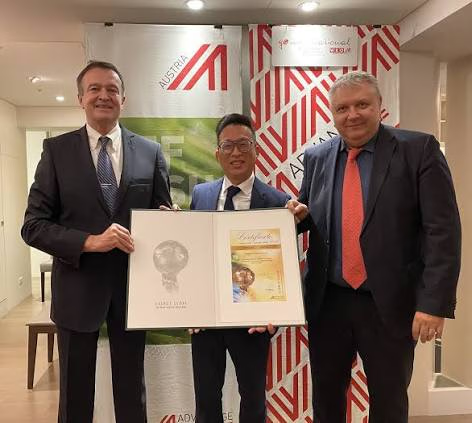
Chairman & President, Poseidon Industries Corp
Paul is the Chairman and President of Poseidon Industries Corp, which is a Taiwanese company that specializes in recycling plastics.
What We Learned: Paul gave us suggestions for recycling, indicating that transportation issues and costs are the main challenges for recycling. He emphasized the commercialization of our product and helped us understand that recycling in space is vastly different from recycling on Earth.
Poseidon Industries Visit 5/31
Our iGEM team went to a recycling factory in Taoyuan called Poseidon Industries, exchanged different presentations about each other, and received a tour of the whole recycling facility. The facility recycled different types of PET plastics, the type of plastics that we are targeting to recycle in our solution plan.
Main Takeaways
From the owner of Poseidon Industries, Paul, we learned the main challenges were transportation costs and commercialization. So, our main value proposition focuses on cutting costs for space missions, and we are mainly going to commercialize our product/idea through massive government organizations like NASA or private companies like SpaceX.
Questions and Answers
What are some of the biggest challenges your company has faced when managing or recycling plastics? Do you think we will face similar challenges or even harder ones recycling in space?
Regulations, policy mandating, lots of licensing and permits in the recycling field. Different licenses and permits for different chemical manufacturing recycling. The 2nd biggest challenge is collecting plastic waste from everywhere. In Taiwan, it's much more feasible and smaller.
Recycling plastic waste is much more challenging, because it costs a lot to go to space, additional cost to launch rockets and also bring it back to earth. Very different plastics, sustain space environments, all those have to be considered. Needs to add lots of different elements to make sure the plastic and product is viable to sustain in space.
Which types of plastic waste are the hardest for your company to recycle, and what makes them difficult? Will this be the same in space?
Plastic that is used in the tech industry, for example, computer parts, plastic used in tech servers; they use lots of tech plastics. Lots of components like the shell of a computer are plastic; same for phones, etc. Adds a lot of substance: ABS plastic type, which is by far the hardest plastic waste to recycle. (Can be found on computers, phones, TVs, screens, etc., to sustain high temperatures for running CPUs)
What final advice or suggestions would you give our team to make this project more practical and impactful for real-world use?
Very good approach; the biology breakdown and addition of enzymes is a very unique approach, but a big question is: Is it feasible? Down the road, is it able to be commercialized or scaled? At the moment, we hardly see any bioplastics in the market; before, there was a time they promoted PLA plastic, made out of cornstarch. Those are specifically bioplastics, but they are never on the market for long or a lot. Make sure to come up with a plan for bioplastics to be kept on the market, and also research WHY bioplastics have not been used or popular on the market so far.
If we start using plastics, how do we change the market like bioplastics? Is it more one-sided?
It works both ways because, currently, society still depends heavily on fossil resources. Fossil fuels are used to produce crude oil, which can then be refined into products such as naphtha, an important material used in fuels and petrochemical production, including aviation-related industries.
This is essentially the system we rely on today:
Plastic waste collection → recycling system → recycled naphtha production → industrial processing → petrochemical companies → manufacturing brand-new plastic pellets/products
This creates a circular economy, where plastic waste is collected and reused rather than discarded.
- reduce dependence on fossil resources
- decrease crude oil and naphtha production
- better utilize existing plastic waste
The interviewee suggested that although recycling may seem like only one part of the process, it actually helps close another loop in the industrial chain through chemical recycling, making the system more sustainable overall.
Today, more sustainable packaging options are becoming available. However, many products use mixed materials, such as paper, plastic, and aluminum. Since these materials are often combined in one package, recycling becomes more difficult.
The interviewee suggested that industries should try to design packaging using clearer material pathways, such as only paper, only plastic, or only aluminum, so each material can be recycled more effectively.
Plastic recycling is expected to remain in high demand, especially as industries aim to reduce fossil fuel use and reuse existing plastic waste.
Final Words of Advice
Over the next 20–30 years, society will need to address major issues such as pollution, carbon dioxide emissions, and sustainability. This makes green industries increasingly important. The plastic and petrochemical industries involve many different fields: not only chemistry and engineering, but also marketing, accounting, management, product design, and sales.
Different plastics also serve different purposes in daily life:
- PET / Polyester → bottles, textiles
- → plastic bags, food packaging
- PP → microwaveable food containers (such as convenience store meals)
The interviewee emphasized that plastics are deeply integrated into everyday life, meaning sustainability efforts will require collaboration from many different industries and professions.
Nils Averesch

Nils Averesch
Assistant Professor, University of Florida · Former Synthetic Biology Task Lead, NASA Ames Research Center
Dr. Nils Averesch is an Assistant Professor at the University of Florida, and he was formerly a research engineer at Stanford University, as well as the synthetic biology task lead at the NASA Ames Research Center.
What We Learned: Future space missions will need to produce materials on the Moon or Mars to reduce the amount of supplies transported from Earth. Engineered microbes could recycle plastic waste into useful materials, helping create a circular system and reduce the need for resupply, making space missions more self-sufficient while also providing more sustainable recycling solutions on Earth.
Meeting Summary & What We Learned
In-Situ Manufacturing and Resource Availability
From Dr. Averesch's presentation, we learned that one of the biggest challenges of space exploration is reducing the amount of materials that need to be launched from Earth. Since launch costs increase significantly with distance, future missions will need to rely more on in-situ manufacturing, which means producing materials and products directly on the Moon or Mars instead of transporting everything from Earth.
We also learned that the resources available depend on the destination. For example, Mars has access to carbon and nitrogen, while the Moon provides water and regolith (space soil). These differences directly affect how biological systems are designed and what materials can realistically be produced in each environment.
Microbes and the Circular Space Economy
Another important takeaway was the role of microbes in creating a circular economy for space missions. Instead of treating plastic waste as trash, engineered microbes can break it down into smaller molecules and convert those materials into useful products such as new plastics, fibers, or biomass. This approach helps reduce waste while making better use of the limited resources available during long-duration missions.
Finally, we learned that the technologies being developed for space also have major benefits on Earth. Biological recycling offers a more sustainable alternative to traditional plastic production, which depends heavily on fossil fuels. Overall, the presentation showed that microbial engineering can help make future space missions more self-sufficient while also contributing to more sustainable manufacturing practices here on Earth.
Q&A and Engineering Constraints
During our discussion with Dr. Averesch, we asked about the challenges of developing biological systems for space and how enzymatic plastic recycling could fit into future missions. He explained that space systems are designed based on Equivalent System Mass (ESM) rather than traditional financial cost, meaning lightweight and compact technologies are often far more valuable than cheaper, heavier ones.
He also emphasized that the biggest technical hurdle is the fundamental engineering of the microbes themselves, since modifying microbial genomes and maintaining consistent performance takes significant time and effort. We learned that spacecraft size, strict containment requirements for genetically modified organisms (GMOs), and precise temperature control have a major influence on final system design.
Finally, Dr. Averesch explained that biological recycling systems could become vital for long-duration missions because they would allow astronauts to reuse plastic waste and produce useful materials, such as feedstock for 3D printing, drastically reducing the need for constant resupply from Earth.
RaviTeja Duggineni

RaviTeja Duggineni
Founder, ResearchSat
RaviTeja Duggineni is the founder of ResearchSat, a company that develops research platforms enabling scientists to run experiments in microgravity aboard space missions.
What We Learned: Microgravity opens up experiments in biotechnology, life sciences, and materials research that are impossible on Earth, but hardware and software for space need much higher reliability, since cosmic radiation can interfere with electronics and convection-based cooling doesn't work in a vacuum. Technologies like enzymatic plastic recycling must be carefully redesigned for microgravity, since liquids behave very differently in space.
Meeting Summary & What We Learned
Space Research and Microgravity
Dr. Raviteja gave a presentation about the work of ResearchSat and the challenges of developing technology for space research. He explained that one of the biggest differences between Earth and space is microgravity, where objects float instead of falling. This unique environment allows scientists to perform experiments that cannot be carried out on Earth, especially in areas such as biotechnology, life sciences, and materials research.
ResearchSat focuses on making these kinds of experiments possible by developing reliable research platforms for space. He also explained that designing hardware and software for space requires much higher reliability because cosmic radiation can interfere with electronic systems. To reduce the risk of failures, engineers use redundant systems and additional software protections to ensure spacecraft continue operating correctly in the harsh space environment.
Engineering Challenges in Space Technology
Another key topic of the presentation was the engineering challenges that still exist in space technology. Dr. Raviteja explained that one of the biggest unsolved problems is heat management. While heat on Earth can be transferred through conduction, convection, and radiation, convection is not possible in the vacuum of space, making it much harder to cool electronic components such as microchips.
He also discussed how technologies such as enzymatic plastic recycling and other biological systems must be redesigned for use in microgravity because liquids like water and oil behave very differently in space. Overall, we learned that although many technologies are first tested on Earth, they must be carefully adapted to function in space, and companies like ResearchSat are helping advance scientific research by overcoming these unique engineering challenges.
Lindsey Yee

Lindsey Yee
Founding Team, Starbridge Venture Capital · Former NASA Ames Research Center · Interview conducted 09 August 2026
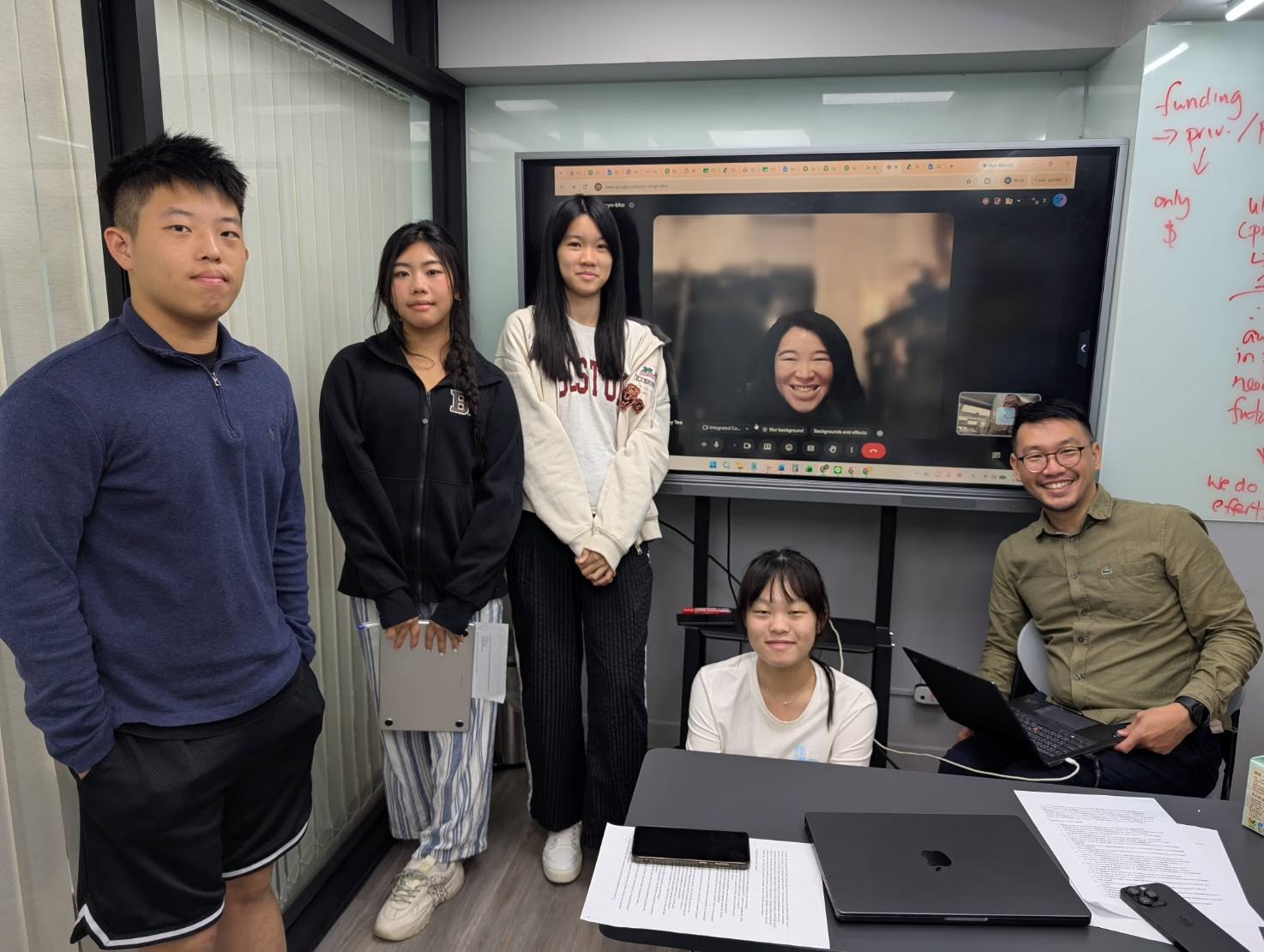
Lindsey is on the founding team of Starbridge Venture Capital, focusing on funding startups in the space sector. She previously worked at NASA Ames Research Center in the Intelligent Systems Division and is active in the Space Generation Advisory Council (SGAC), which promotes students' and young professionals' visions for international space policy at the United Nations Office of Outer Space Affairs (UNOOSA) and in industry.
What We Learned: Using enzymes to recycle plastic offers a novel, high-potential solution for long-term sustainability and resource self-sufficiency on the Moon and Mars. To become flight-ready, our development must focus on strict biological containment and advancing through NASA's Technology Readiness Levels; with falling launch costs, our project's value lies in mission autonomy and waste reduction.
Background
Lindsey has experience in the space industry, including previous work at NASA Ames Research Center in the Intelligent Systems Division. She is also active in the Space Generation Advisory Council (SGAC) and is currently involved in venture capital investing in California, with a focus on companies related to the space industry.
Her Opinion on Our Current Solution Idea
This solution has been attempted in the past, but not using biology and enzymes to break down plastics. Every new element brought into space has its own individual complications in the process.
Key Findings
1. Growing Need for Sustainable Space Waste Management
Lindsey explained that as space missions expand toward the Moon and eventually Mars, waste management will become increasingly important. Current missions largely add to the waste and pollution problem because disposal and resupply are still relatively inexpensive. However, developing sustainable waste-management systems will require organizations (particularly governments and agencies such as NASA) to be willing to invest in recycling and sustainability. She noted that small startups and traditional venture capital investors are generally less likely to fund recycling technologies unless there is a clear financial return.
2. Potential of Enzymatic Plastic Recycling
Lindsey indicated that plastic recycling has been considered previously, but using biological systems and enzymes to break down plastics presents a relatively different approach. She believes enzymatic recycling could become particularly useful once long-term facilities or colonies are established on Mars. The technology could reduce the need to continuously transport replacement materials from Earth and could contribute to greater sustainability for long-duration missions. However, astronaut safety is a major concern: a key question is whether bacteria or enzymes could accidentally escape the recycling system and damage spacecraft equipment, electrical systems, or other mission-critical components.
3. Technology Readiness Is Critical
For a technology to be considered for an actual NASA mission, Lindsey emphasized the importance of NASA's Technology Readiness Level (TRL) framework. Technologies must progress through the nine TRL stages, demonstrating increasing levels of technical maturity before they can be considered suitable for spaceflight. For the team's project, this means moving beyond demonstrating that enzymes can break down PET in a laboratory. Future research should demonstrate reliability, containment, safety, operation under relevant space conditions, and eventually performance in a realistic mission environment.
Always go by NASA's Technology Readiness Level; you can search online about it, nine different steps that need to be achieved in order for something to be considered space-ready.
Lindsey Yee, Starbridge Venture Capital
4. Partnerships and Industry Connections
Lindsey strongly recommended building direct relationships with people in the space and government sectors. Industry events, particularly the International Astronautical Congress (IAC), could provide opportunities to present the project and connect with potential supporters, stakeholders, researchers, and government organizations. She also noted that the space industry is currently relatively open to new ideas, making networking and early engagement important for developing the project.
5. Regulatory and Biological Considerations
For a synthetic-biology-based recycling system, NASA's biological research and regulatory resources should be examined early. Lindsey recommended using NASA's existing biology divisions and publicly available resources to understand the requirements for biological technologies intended for space missions. Safety and containment will likely be major considerations because introducing biological systems into spacecraft creates additional risks that conventional mechanical recycling systems may not have.
6. Economics and the Impact of Starship
One major risk to the team's business case is the rapidly decreasing cost of launching materials into space. Lindsey explained that SpaceX's Starship could significantly increase payload capacity and potentially reduce the cost of transporting materials. Current launch costs have already fallen substantially, with costs discussed in the interview being below approximately $2,000 per kilogram. If launch costs continue to decrease, the economic advantage of recycling materials in space may become less obvious. Therefore, the proposal should not rely solely on the argument that recycling is cheaper than sending replacement materials from Earth. Instead, the project should emphasize additional benefits such as reducing waste, increasing mission autonomy, reducing dependence on resupply, and supporting long-duration missions where transportation from Earth becomes difficult or impractical.
7. Funding and Business Model
Lindsey described venture capital funding as primarily driven by financial returns. Private investors generally want to understand how an investment could produce significant returns, potentially around 5×–10× their original investment. Government funding operates differently: government agencies such as NASA may support technologies when they contribute to national interests, scientific objectives, technological development, or mission capabilities. Therefore, the project may need a mixed funding strategy, combining government or research funding during the development stage with private investment if a commercially viable market can eventually be demonstrated.
8. Current Space Infrastructure and Future Demand
Lindsey noted that current space-station infrastructure is limited, with the International Space Station and China's Tiangong station being major examples. Developing additional private or commercial space stations faces significant challenges involving money, resources, and regulations. Future stations, lunar facilities, and eventually Martian settlements could create new demand for systems that reduce waste and improve resource efficiency.
Implications for Our Project
The interview suggests that enzymatic PET recycling has potential as a long-term sustainability technology for space missions, particularly for future lunar and Martian facilities. However, several challenges must be addressed before it can become mission-ready:
- Demonstrate technical feasibility beyond laboratory-scale PET degradation.
- Progress through NASA's TRL framework and establish clear milestones toward space readiness.
- Prove biological containment and astronaut safety.
- Test the system under relevant spacecraft or space-environment conditions.
- Develop relationships with NASA, government agencies, researchers, and space companies.
- Build a stronger economic case that remains compelling even as launch costs decline.
- Identify potential government applications and national-interest benefits to support public funding.
- Develop a long-term business model that can provide sufficient returns for private investors.
Conclusion
The interview provided strong support for the relevance of sustainable waste management in the future of space exploration, while also highlighting important technical and economic risks. Lindsey's perspective suggests that enzymatic PET recycling may be most valuable for future long-duration missions and established lunar or Martian facilities rather than near-term missions.
The project's next priority should therefore be to demonstrate that the technology can operate safely and reliably in a space environment while simultaneously developing partnerships with NASA, government organizations, researchers, and the broader space industry. Establishing a clear path through NASA's Technology Readiness Levels and developing a compelling economic and mission-based justification will be essential for turning the research concept into a viable space technology.
Questions and Answers
As space missions expand, such as missions to Mars, how do you think waste management will need to evolve?
Currently it's just adding to the pollution problem, which doesn't cost a lot, but you need to find people actually willing to spend money towards recycling and sustainability (government, NASA, etc.), because small startups, private companies, and VCs aren't going to spend money on recycling.
What kinds of partnerships would a team like ours need to move from a research project to a real deal?
Get contacts directly in the space and government industry, aligned with your topic of recycling in space. With all these resources and people, events like the International Astronautical Congress let you pitch your idea and get supporters and stakeholders. Currently the space industry is pretty open to new ideas like this.
If NASA were evaluating a PET recycling system, what factors would determine whether it could actually be used on a mission?
Always go by NASA's Technology Readiness Level; you can search online about it, nine different steps that need to be achieved in order for something to be considered space-ready.
How should we approach the regulatory framework for synthetic biology tools intended for long-term space missions?
NASA has an entire division dedicated to just biology; go to the NASA website as a resource. You can find a lot of info and regulations there.
How interested are startups and companies in space recycling?
Small startups like Astrobotic work on trying to clean up space debris; someone who works there is Carolyn.
Our solution is a safer and cheaper alternative to sending extra rockets up to ship in resources. Is there something we haven't considered that puts our proposal at risk? Is it viable?
Currently the space industry is waiting for the SpaceX Starship to launch, because once it launches, the payload capacity is so large they think they can bring anything and everything wherever they want in space. However, the payload capacity is so large they don't know if they have enough customers to use up all that space. Currently it would just be a one-way trip to Mars because they don't have enough fuel to get back to Earth. Priority for them is water, because it's essential for survival. Once Starship starts flying, everything else would be way cheaper to fly in space, but the actual cost from SpaceX is unknown and depends on the customer (currently less than $2k per kg), so SpaceX has already cut the price down substantially.
In your experience, what kinds of technologies are most urgently needed for future space missions?
It varies and differs based on a mission's goals and distance. For missions to the Moon or Mars, astronauts currently go up and down to the International Space Station; after that, the goal is the Moon. For Mars, we haven't made it that far yet, but there's interest in flying Starships around Mars, relying on the gravity of other planets to push the spacecraft without wasting fuel, since current spacecraft don't have enough fuel to make it back to Earth from Mars. Once we actually reach Mars, enzymatic recycling would definitely help sustainability; NASA has done some initial research into it. Once a colony or station is established on Mars, a sustainable solution like this can be put into play.
What are the biggest constraints for introducing new systems into spacecraft?
Astronaut safety and health: whether the enzymatic bacteria could leak and damage the electrical parts of the International Space Station or other spacecraft.
What would you say is the pain point for private space stations right now?
Currently there is only the International Space Station and China's Tiangong space station. NASA is always looking at different projects and testing college ideas and student projects, and is trying to get another station like the ISS up into space. Money, resources, and regulations are the main pain points for launching a new space station; ultimately it depends on whether it satisfies government contracts, since that determines who can actually pay enough to build and launch these stations.
You mentioned that money is an important issue, solved by raising funding. In cases where you were successful raising funds, what backgrounds do the people or organizations providing funding have, and what are they expecting (margin of return, ROI, etc.)?
On the venture capital side, it's purely capitalistic: investment decisions are based on how much return investors get themselves. There's a lot of hype currently around the SpaceX IPO.
Would it be a safe conclusion that any space proposal needs some plan for how to break even or when funders get an ROI?
For venture capital specifically, they want to know how many times they'll get back in return, like 5x or 10x their investment. Non-diluted government-type funding works differently.
Would you say most of the capital that's been raised is private, or is some of it public?
A mix of both, depending on the company. A lot of companies do satellite work, using satellites and radar technology to see what's happening on the ground, which could be used for government surveillance and spying.
Would it be accurate to conclude that private capital is looking for 10x returns, while public/government funding would need to serve the country's national interest?
Yes. Ultimately, private investors would need something like 10x ROI, and for public support from governments or organizations like NASA, there has to be some component where they benefit based on national interest.
Would you say space companies are prioritizing other issues, and our project would only be a further-down focus?
The major priority right now is getting another space station launched, because the ISS is estimated to come down within just a few years. That is the more immediate, big priority across the space industry for corporations, companies, and governments; if there is no ISS, every other space achievement would likely be unachievable and pointless.
Arvin Chen

Arvin Chen
Technology Development Manager, Tradewind
Arvin Chen is the technology development manager at Tradewind, where he leads research and development initiatives, optimizes biotechnology workflows, oversees project pipelines, and drives the commercialization of the company's technical innovations.
Relationship to Our iGEM Project
The company visit provided valuable insight into the industrial processes that directly support our iGEM project, which focuses on engineering bacteria capable of degrading PET plastic in space. Observing industrial fermentation systems allowed us to better understand how bacterial cultures are maintained under carefully controlled conditions, including precise regulation of temperature, oxygen availability, and nutrient distribution. We also learned how enzyme production is integrated into large-scale biotechnology applications, reinforcing the importance of optimizing bacterial growth for efficient PETase production. These experiences strengthened our understanding of the practical challenges involved in scaling synthetic biology from laboratory research to real-world applications, making the visit highly relevant to the development of our project.
Project Goal
Our iGEM project aims to address the growing challenge of plastic waste during long-duration space missions by developing a sustainable biological recycling system. We seek to engineer bacteria that produce PET-degrading enzymes capable of breaking down plastic waste into reusable monomers. These recycled materials can then be converted into useful products through technologies such as 3D printing, creating a circular resource system within spacecraft or future space stations. By recycling materials on-site, our project has the potential to reduce dependence on Earth-based resupply missions while improving sustainability during future space exploration.
Project Mindset
Throughout this project, our team has adopted a mindset centered on innovation, scientific curiosity, and interdisciplinary learning. We strive to apply biotechnology to solve real-world environmental challenges by designing engineered bacteria and expanding our understanding of DNA, proteins, amino acids, and enzyme function. In addition to conducting experiments, we continuously learn from previous iGEM projects, collaborate effectively as a team, and communicate scientific concepts clearly. Hands-on laboratory experience further strengthens our technical skills while encouraging us to ask meaningful scientific questions and explore future applications of synthetic biology that could benefit both Earth and space.
Current Technology
During the laboratory training, we gained practical exposure to several fundamental molecular biology techniques used in modern synthetic biology. Students learned the principles of PCR primer design, DNA amplification, DNA purification, colony PCR, DNA ligation, DNA sequencing, and enzyme activity analysis. We also explored the historical development of DNA sequencing technologies, including Sanger sequencing and the Human Genome Project, and discussed how these techniques continue to support genetic engineering today. Looking toward the future, the company introduced the long-term vision of deploying engineered bacteria aboard future space stations, with potential applications anticipated around 2028. These technologies provide the essential foundation for constructing, verifying, and optimizing engineered microorganisms for our iGEM project.
Key Takeaways
The company visit and laboratory training provided a comprehensive introduction to both industrial biotechnology and molecular biology techniques that are directly applicable to synthetic biology research. We learned that successful fermentation depends on maintaining strict environmental conditions, particularly temperature control, mixing, and oxygen availability, all of which significantly influence bacterial growth and enzyme production. In the laboratory, we developed a deeper understanding of PCR, primer design, DNA polymerase, ligation, sequencing, and experimental controls, recognizing how each technique contributes to constructing and verifying engineered organisms. We also learned that enzyme activity can be quantitatively measured using analytical instruments, providing valuable information for evaluating biological performance. Overall, the experience demonstrated how biology, chemistry, and engineering work together to develop sustainable biotechnological solutions, reinforcing the scientific foundation and practical relevance of our iGEM project.
Michael Thompson

Michael Thompson
Payload Operations Director, NASA Marshall Space Flight Center
Michael is the Payload Operations Director for NASA's Marshall Space Flight Center. He manages the weight calculations and payloads for NASA's space missions to the International Space Station (ISS), the Moon, Mars, and other missions.
What We Learned: Crew safety, vehicle safety, and mission success are the top priorities for space missions, while limited storage and waste make recycling especially important. An enzymatic scaffolding system for breaking down PET plastics in space could help reduce waste and dependence on resupply missions. He also guided our design toward safe containment, reliable operation, and Earth-based testing under simulated space conditions before potential use in space.
Summary
Our interview with Michael, a NASA contractor and Payload Operations Director, provided valuable insight into the practical requirements and challenges of operating biological systems in space. He explained that all ISS operations are guided by three priorities: crew safety, vehicle safety, and mission success. He also highlighted the importance of reducing resupply missions, particularly because limited storage space creates major challenges with food, spare parts, and waste disposal. For our project, he emphasized that any biological system must demonstrate strong safety, reliability, and feasibility before being considered for spaceflight. He also described how previous bacterial experiments were tested using Earth-based incubators and freezers before being operated in space, providing a potential model for how we could validate our system.
Takeaways
Coming directly from NASA, Michael validated the fact that NASA actually does need a solution to making resupplying in space less costly and more sustainable. In addition, he emphasizes the 3 main rules of NASA space travel (crew safety, vehicle safety, mission success). This led our team to propose a metal tank and separate room that our enzymatic bacteria will be housed in, ensuring both the crew and vehicles safety. However, in an event where contamination does happen, the separated room that our product is in gives time for the crew to safely evacuate.
Connections to Project
- Helped us identify safety and containment as essential design considerations for our enzymatic scaffolding system.
- Guided us toward testing our system under space-simulated conditions before considering actual space deployment.
- Strengthened our justification for PET recycling by connecting it to the real problem of limited storage and increasing waste during long-duration missions.
- Provided a realistic pathway for future development: Earth-based testing → simulated space conditions → controlled space experiment → larger-scale implementation.
Questions and Answers
What factors are considered when deciding which equipment or spare parts should be sent to the ISS?
Three rules that guide everything we do when operating a station. Crew safety, vehicle safety, mission success. Can we get the crew to be safe, keeping the ships/vehicles up there in space, and finally our mission's success. These three rules drive any of our missions and launches (Absolutely need to have this system for any mission). On Orbit Replacement Units (ORUs)
How often do astronauts encounter situations where they need a replacement tool or component that is not immediately available onboard?
Often and also not. Sometimes they may be a spare on board, but if we are focusing on reduction and redundancy. Other times you have some minor things, you don't have the right wrench or tools, and may need to fly it up there (resupplying). The biggest one is the payload that went into one of the racks, a rectangular computer that slides into a server rack. On Earth it fit, but in space, one of the tools to fit wasn’t on board and didn’t have the proper wrench. Ended up having to send another ship to supply this wrench.
What are the biggest logistical challenges in reducing dependence on cargo resupply missions for long duration space missions?
The biggest problem is food, and secondly is trash disposal. Space is so limited, they need to come down to clear the ships. Ships store bags full of trash and there's only so much space to hold those trash.
How do you think in-space resources can help reduce the amount of water and supplies that need to be sent from Earth?
Resource for in-space production, but we are doing how do you keep drinkable water and resources to fuel and supply the crew/astronauts. In space, no system is 100% efficient, but the more you can reuse and recycle the less you have to send.
How do you evaluate the feasibility of sending biotech solutions to the ISS?
At the very beginning, through a few big sponsors, periodically send proposals to send to the ISS. A primary investigator responds to the proposal, and people need to demonstrate feasibility of the proposal to the investigator. This is a selection process, and the sponsoring organization will also review your proposal, select it, provide the funding and resources you need for launch to the ISS, and then get the science/data back to Earth. You have to prove it has merit, feasibility, and potential for the sponsors and investigator.
What constraints would limit sending a biological system designed to break down plastic in space?
Mass isn’t one of the biggest constraints, by the time you are evaluated by sponsors it can be solved. The biggest problem is still the three rules I stated. They will focus more on what if the crew, ship, and mission are vulnerable to exposure to your product (Bacteria, enzymes, etc.) and how that will impact the safety of both the crew and ship. If it has a high enough risk of injuring crew or damaging a ship, it will definitely not be validated to fly. For example, a gallon of water could be a potential risk and damage to the crew’s safety. Crew safety, and vehicle safety is paramount and the main drivers of sponsors and if your proposal is validated or not.
How do you balance sending crew essential supplies vs experimental sustainability tech?
If it helps crew safety, it trumps everything else in priority. Crew time is also important, if it decreases crews time to work on it, it will be important too.
Are there current or planned missions that focus on in-situ resource utilization or waste reduction technologies on the ISS?
Tech demos for human exploration (missions to the moon or Mars). And also space manufacturing, medicine, semiconductors, etc. We are attempting to 3D print organs and tissue on orbit. These are where most of the issues currently lie.
Safety is an important factor, what are some basic safety regulations and how do we know if it's safe in space for crew?
It's not really safe, and that's why safety is such a driving factor. Space is an extremely hostile environment for humans. We have managed to do it safely for the past 2 decades, and part of that is on how we approach things and the precautions we take before each launch and mission. There are always exceptions, like the external cooling machine, there is a failure mechanism. That was possible before we launched, but it is practiced constantly in the simulation. So the crew and ground site crew knows how to react if something catastrophic happens because of that. We train crews to know the systems and how to react if things go south.
Previously, have there been bacteria sent up to space?
Yes, gloveboxes, the MSV. Through this we built a bigger better glovebox. We brought bacteria, medicine, and multiple experiments inside the glovebox.
How did those experiments and testing work on Earth before launching in space?
Freezers and incubators, versions of these payloads that fly inside the ships and are powered. You can maintain the sample temperatures to keep these bacteria or things alive. You initiate it up in space, start growing things, and see how it is reacting to the microgravity environment in space.
Carolyn Belle

Carolyn Belle
Former Director, Astroscale · Aurica Space Strategy Consulting
Carolyn Belle is a former director at Astroscale, and currently works for Aurica Space Strategy Consulting.
Summary
The interview with Astroscale focused on the challenges of managing space debris and developing more sustainable ways to use space. One of the most important points was that bringing space debris back to Earth is very expensive. The cost depends on factors such as the size and location of the object, its shape, and whether it is controlled or spinning. Smaller, closer, and more controlled objects are generally more affordable to remove. This makes finding ways to process and reuse materials in space especially important because transporting large amounts of waste back to Earth may not be economically practical. The interview also described several projects Astroscale is currently working on, including refueling satellites, extending satellite lifetimes, removing debris in low Earth orbit, and capturing end-of-life satellites. These projects demonstrate that the future of space sustainability may involve servicing and reusing spacecraft rather than simply allowing them to become waste. The interview also explained that debris removal is mainly prioritized according to risk, particularly the possibility of collisions with active satellites or other debris. Overall, the interview shows that space debris is both an environmental and economic challenge and that new technologies will be needed to manage and reuse materials in space.
Connections and Key Takeaways
The interview strongly connects to our project because the high cost of bringing space debris back to Earth provides an important reason to develop recycling systems that can operate in space. If plastics from old satellites could be processed using enzymes and bacteria directly in orbit, it could reduce the need to transport plastic materials back to Earth. This could make space-debris management more sustainable and potentially more cost-effective. The interview's discussion of Astroscale's projects is also especially relevant because their work demonstrates how spacecraft can be serviced, extended, captured, and removed at the end of their lives. Our project could potentially become another part of this future system: after a satellite is captured or serviced, its plastic components could be separated and processed using biological recycling instead of simply being discarded or burned up during atmospheric reentry. This suggests a possible future process in which robots capture and disassemble old satellites, while enzymes and bacteria recycle their plastic materials. The interview also highlights the importance of designing future satellites for easier disassembly and recycling. Therefore, our project should consider not only whether enzymes and bacteria can break down plastics in space, but also how those plastics would be collected and separated. Most importantly, Question #4 shows why in-space recycling could be economically valuable, while Question #1 shows how our technology could fit into existing efforts to make satellite operations and space-debris management more sustainable.
Questions and Answers
Satellites are pretty complicated, so were they disassembled in space? Was the work primarily done by human crews or is our robot technology good enough to take on this task?
We have not done this yet, it is very complicated! It may require that satellites are redesigned specifically so they can be more easily disassembled. It would be most economical for this to be done by robots, but we are not advanced enough to do this yet.
How much does it cost to bring space debris down? Are certain items more expensive to bring down, for example, satellites?
Easy answer: a lot. The cost depends on how big the object is, how easy it is to grab onto (its shape and also whether it is controlled or uncontrolled/spinning), and where the object is. The closer, the smaller, and the more controlled the object it is usually more affordable.
Is there any priority to what gets brought back down? What is it based on? Materials? Age? Cost?
There are several ways that someone might determine priority, generally it is about risk – it makes sense to bring down those objects that carry the most risk of impacting active satellites or other debris. What we want to avoid through debris removal is the potential for a collision in orbit. The cost and complexity of the removal mission are always considered as well. The cost of the original satellite, materials in it, or age are not specific factors we make a decision on but they do come into consideration during the risk assessment (like rocket bodies with remaining propellant or charge in batteries may be more likely to explode, so they carry a higher risk).
What were some of the projects Astroscale was or is currently working on?
- Refueling satellites in geostationary orbit – essentially adding more “gas” (propellant) to their tank
- Life extension for satellites in geostationary orbit – acting as a sort of jet pack to grab on and keep them in the right location in space pointed to the right spot on Earth
- Debris Removal in LEO – capture an old Japanese rocket that is uncontrolled in space and lower its altitude so that it burns up in the atmosphere
- End of life Servicing in LEO – capture dead satellites and lower their altitude so that they burn up in the atmosphere (the difference between this one and the one before is that for the rockets they don’t have a specific place designed for Astroscale to grab on, but for these satellites there is a special magnetic plate that is used for the Servicer satellite to attach to the Client satellite)