CERNAL turns our computational framework into a practical platform for designing biological logic circuits. By connecting its individual algorithms within a unified workflow, the software supports the design process from biological inputs to candidate circuit designs. A guided graphical interface makes this workflow accessible to researchers with limited programming experience, while a configurable API provides detailed control over algorithm parameters and enables integration into larger computational pipelines. Together, these interfaces support different research needs, from interactive exploration to programmatic use. This page presents CERNAL’s software architecture and implementation, explaining how its components work together to make biological circuit design accessible, configurable, and practical.
Ballot questions at a glance
CERNAL uses familiar biological file formats throughout its workflow: RNA sequences and differential-expression tables as inputs, GenBank files for custom backbones, and FASTA, annotated GenBank, SBOL 3 and CSV outputs. We wanted researchers to be able to carry their designs into the tools they already use.
For synthetic-biology standards, our SBOL 3 export preserves sequence features, part roles and provenance, while RFC10 and RFC1000 restriction-site checks support the selected assembly standard. We also build on established libraries: ViennaRNA for RNA folding and thermodynamic interactions, and Biopython for GenBank handling.
Responsible use matters to us, too. We implemented an integration with IBBIS Common Mechanism that checks final switch and assembled-construct sequences and holds sequence export when screening evidence is unavailable or unresolved. The screening software, databases and release policy require a configured deployment, as explained in the same implementation record.
On this page Existing Standards → Input Formats → Output Files →
Validation has been part of development throughout. CERNAL implements the stages described on our Model page, with software checks for the individual stages, API and complete workflow. For gene selection, we used published expression data in our PFOA analysis and, separately, endometriosis analysis with healthy-tissue context.
We also asked how the predictions compare with measurements. Our RNA-accessibility analysis compares predictions with published in-cell SHAPE measurements, and our toehold benchmark compares computational scores with Green et al.'s measured ON/OFF ratios. The Model evidence table identifies the original switch datasets and earlier prediction research behind these comparisons.
At the bench, we designed dozens of toehold candidates and selected designs for bacterial testing, then used the measurements to guide the next engineering cycle. Our bacterial NOT-gate results, yeast guide-RNA experiments and human-cell input-expression studies provide different pieces of experimental evidence. Testing is ongoing; the remaining gate-validation work is described alongside the completed results.
On this page Documented Run → Software Checks → Scientific Comparisons →
We built CERNAL with other projects in mind. The aim is to let researchers connect a chosen RNA signal to a biological output using a modular design pipeline. Users can supply their own sequences or expression tables and choose among supported hosts, gate families and outputs. This makes the framework adaptable to new biological questions, while each new host and application still needs its own experimental validation.
We see potential uses in biosensing, cell engineering, diagnostics and therapeutic research. These are also the applications that interested teams in our Mini-Jamboree survey. Among its seven respondents, 71.4% said they would use a tool like CERNAL in their iGEM project, and 85.7% expressed interest in using it afterward. That small survey encouraged us to keep building for reuse.
Other groups can also take just the part they need: the trigger-selection, gate-design and scoring interfaces are documented separately. Our conversations with Neta Agmon about practical inputs and outputs and AIS-China about the user workflow helped us focus that effort.
On this page Who Can Use It → Reuse → Reusable Interfaces →
Our pipeline comprises reusable components, so another group can use the scientific engine and its individual stages without adopting the entire web application. The implementation is available in our iGEM GitLab repository, with a documented contract between the engine and application.
We also developed a configurable HTTP API with OpenAPI documentation for submitting designs and retrieving results. We provide Python, R and MATLAB client source, together with curl examples; curl is a command-line way to call the same API. Researchers can set design constraints and scoring parameters from their own scripts. The client verification record distinguishes completed Python/R checks from MATLAB's pending runtime verification.
On this page API Endpoints → Python, R, MATLAB, curl → Reusable Interfaces →
We offer three ways to work with CERNAL. The guided web interface walks users through biological inputs, logic, output and vector choices. The API gives computationally oriented researchers control from their own workflows. For a conversational starting point, our optional LLM chatbot helps users select a reference gene and prepare a first design run; it is available when the deployment has a configured provider.
Users can follow the step-by-step video walkthrough, consult the in-app FAQ (sign-in required; public FAQ source), or start from the README and installation guide. We wanted a new user to have somewhere to turn at each step.
We also put the interface in front of another iGEM team. AIS-China's feedback identified three practical improvements: clearer placement of downloads, a more prominent New Circuit entry point, and meaningful run names. Their comments gave us concrete priorities for making the workflow easier to follow.
On this page Video Walkthrough → Guided Workflow → Results and Exports →
We wanted future teams to be able to understand the code and build on it. Our public documentation index brings together the architecture and diagrams, scientific-engine module map, API reference and development instructions. The README and execution script provide installation and run commands.
Within the code, typed contracts and docstrings describe the data passed between components, and comments document scientific conventions such as folding parameters and coordinates. The engine-boundary check and test map explain the checks contributors should preserve. We also discuss how the components fit together on this Software page, with the Model page providing the scientific reasoning behind the design.
On this page Architecture → Module Map → Install →
Read the Best Software judging criteria. Each answer links directly to its implementation, measurements or feedback records.
See the software in action
How to use CERNAL
From your target RNA to a candidate design, in five short clips. Follow the actions as the tour plays automatically, or choose a step to explore.
Before you start: Sign in or choose Continue as a reviewer, then open New Circuit.
Recorded from the local app · 11 October 2026 Direct-sequence example
Tell CERNAL what to detect and what to produce
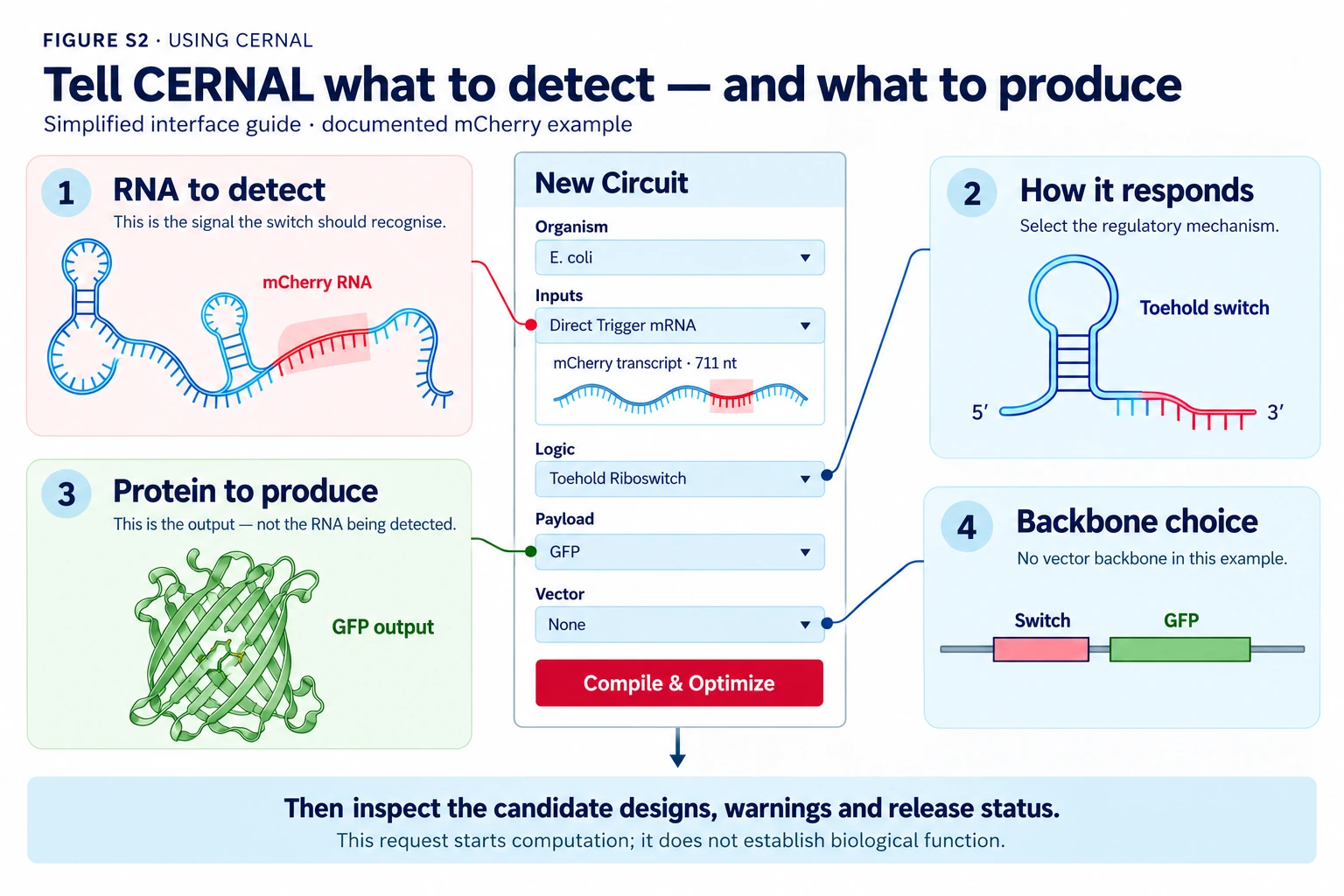
Watch the original five-step interface recording

Step 01 / 05 · Inputs · 6.5 s clip
Start with the RNA you want to detect
Choose E. coli as the organism for this example.
Sign in or choose Continue as a reviewer, then open New Circuit. Choose E. coli, select Direct Trigger mRNA and paste your target transcript. This example uses the 711-nucleotide mCherry transcript; the nucleotide counter confirms the input.
You should see: Your target RNA and organism are ready for the next step.
The silent clips play in order. Pause shows a still image; Play restarts the current clip.
Read the five steps
- Inputs: Start with the RNA you want to detect
Sign in or choose Continue as a reviewer, then open New Circuit. Choose E. coli, select Direct Trigger mRNA and paste your target transcript. This example uses the 711-nucleotide mCherry transcript; the nucleotide counter confirms the input.
You should see: Your target RNA and organism are ready for the next step.
- Logic: Choose how the switch responds
Scroll to Logic and select Toehold Riboswitch. Advanced Options are optional: open them to review the leakage limit, gate stability and maximum gates per circuit. This recording keeps the displayed defaults.
You should see: The mechanism and design settings are selected.
- Payload: Choose the output protein
In Payload, keep GFP selected for this example. A selected output has a check mark. Use Other when supplying your own coding sequence.
You should see: GFP is selected as the output, separate from the RNA being detected.
- Vector & submit: Review the vector, then start the run
Select None for this example, check that the form is ready, then click Compile & Optimize. You can also choose a catalogue vector or upload a custom GenBank backbone. The run page shows progress after submission.
You should see: A new run records the input and settings you chose.
- Review results: Inspect a candidate before choosing it
Select a candidate in the results list and inspect its metrics, construct view and warnings. Check the Downloads panel for available files; sequence exports depend on release status. Compare candidates before deciding what to investigate.
You should see: You can trace a candidate to its predicted properties and release status.
Results are computational predictions; a candidate's ranking score is not its probability of working. Review the warnings and export status alongside each score. Set up CERNAL locally or explore the documented engine run below.
01 · A tool for RNA design
Design switches from RNA data
Capabilities and their evidence
What can you do with CERNAL?
- Supply RNA sequences or analyzed differential-expression results for the supported workflows.
- Compare candidate switches, scores and warnings, keeping rejected candidates and release status visible.
- Prepare annotated sequence records when screening permits release, or reuse the engine interfaces in another workflow.
A real run, including its stopping point
The recorded 711-nt mCherry input yielded 21 ranked designs. Ranking succeeded, but FASTA, GenBank and SBOL release was held because the screening service was unavailable. The example shows what a user receives and what still blocks experimental use; ranked output is not biological validation.
Inspect the recorded example Install the reviewed source Open the API referenceHow RNA-responsive design complements existing tools
Start with the state you want to detect.
Designing a genetic response involves two decisions: identifying a molecular signal that represents the state of interest, and building a circuit that responds to that signal in the chosen host. Existing circuit-design tools can automate important parts of this process, but their predictions depend on the sensors, regulatory parts and operating conditions available to them. CERNAL connects transcriptomic input selection with RNA recognition-site analysis and candidate switch design, so a measured expression difference can guide what a circuit should sense.
Our goal is a reusable route from biological-state data to testable RNA-sensing designs. The current implementation produces computational candidates within supported workflows; reliable function still requires host-specific experiments.
This complements established work: Cello 2.0 maps circuit specifications to characterized parts; Asimov Kernel provides construct design, simulation and workflow tools; and programmable toehold switches already demonstrate RNA-responsive regulation. These sources support the design context, not an absolute claim that no competing route exists.
Three decisions behind one RNA design
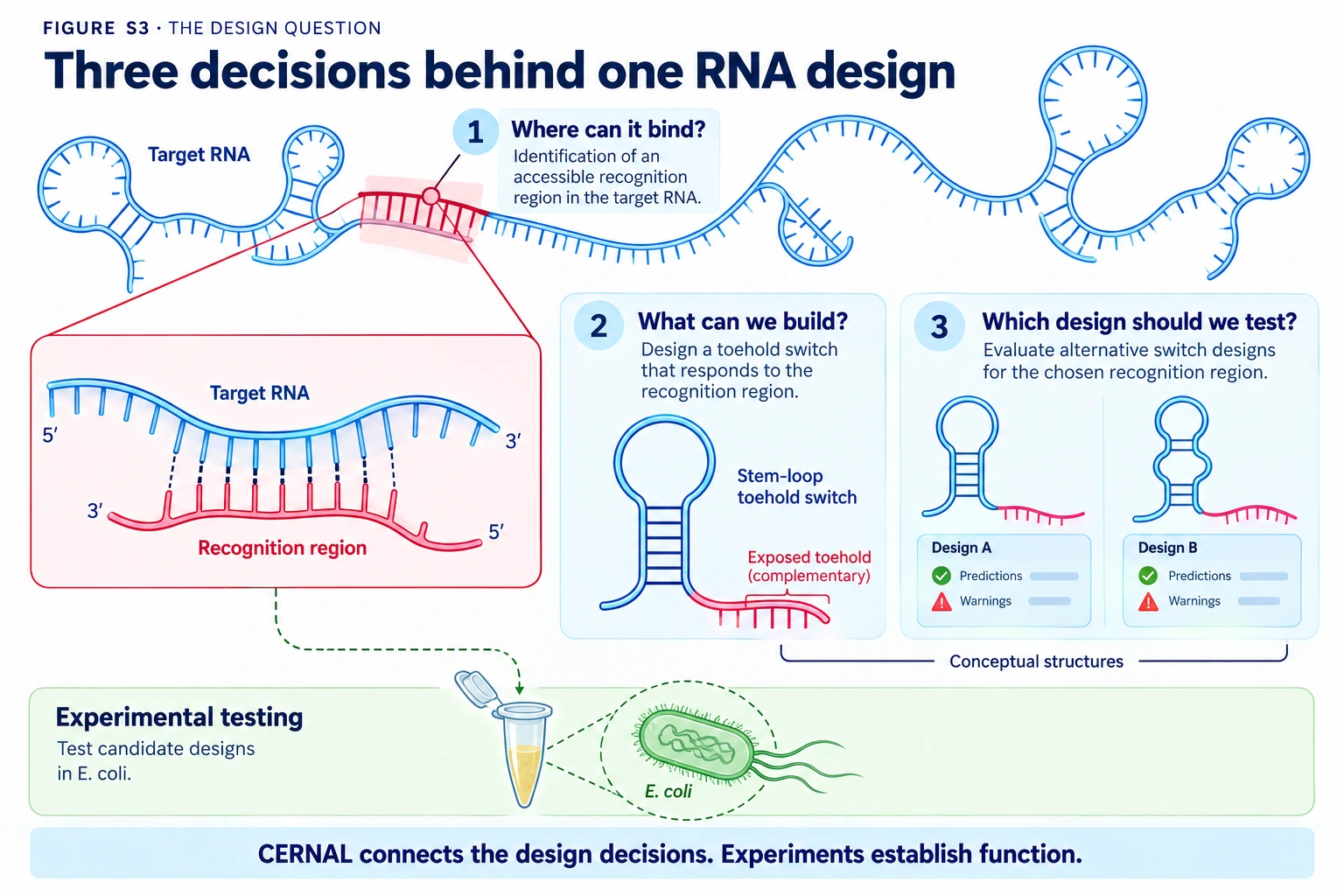
Recognition-site selection, compatible switch design and comparison form a connected design record; host experiments establish function.
Read the details & evidence
CERNAL connects design decisions; host experiments establish function.
- Choose an RNA input
- Known transcript or analyzed expression contrast
- Find recognition sites
- Inspect accessible, constructible windows
- Compare switch designs
- Retain predictions and rejected alternatives
- Review the record
- Teams, researchers and developers inspect the same evidence
- Test in the host
- Computational ranking does not establish biological function
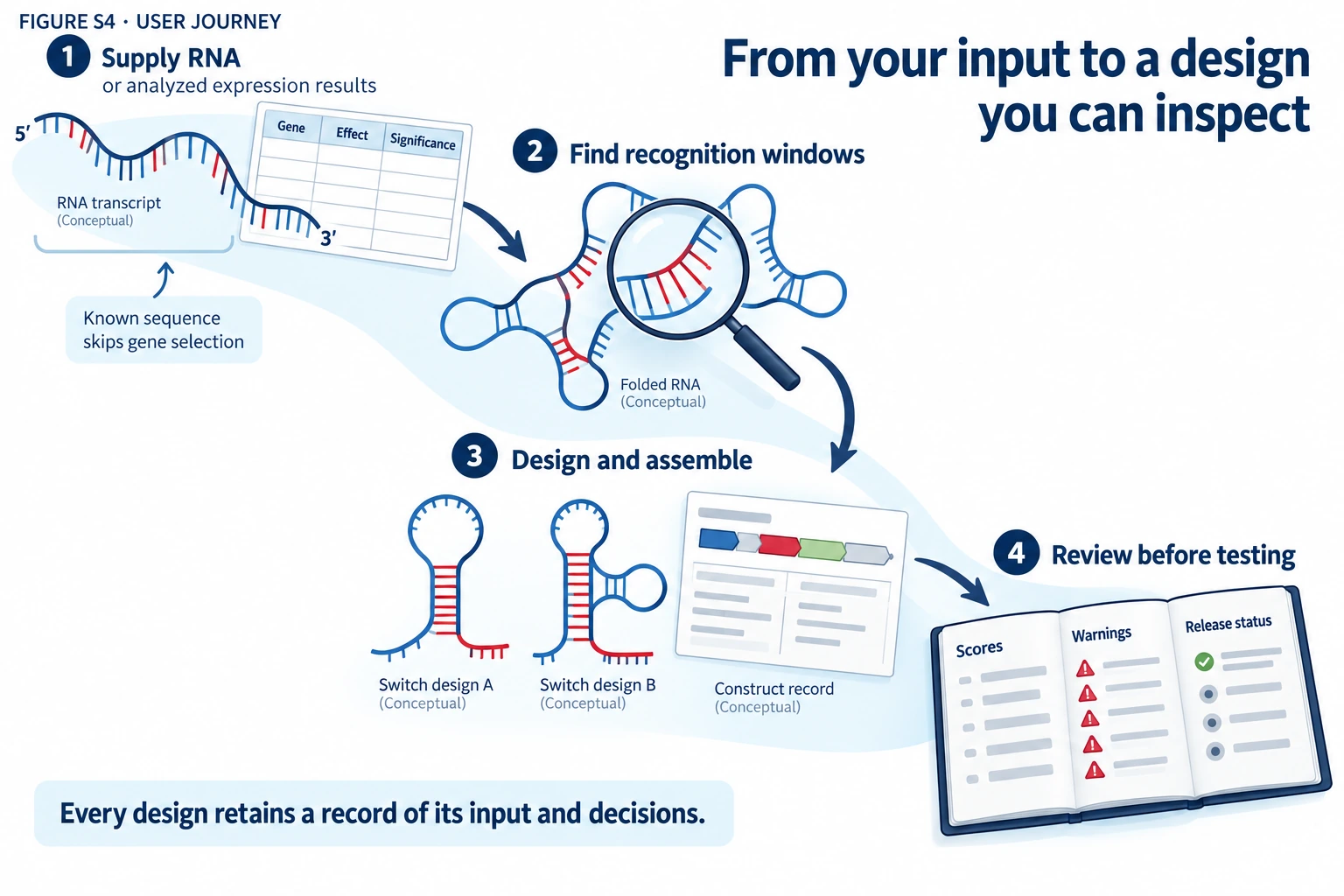
You have an RNA transcript you want to detect. Which part should a switch recognize, and which design is worth investigating? CERNAL brings those decisions into one workflow, with a record of the inputs, predictions and rejected alternatives.
A trigger is the short region of the target RNA that a switch recognizes. A toehold switch is an RNA regulator designed to turn protein production on when that trigger binds. CERNAL searches for usable triggers, constructs candidate switches, compares their predicted properties and assembles sequence records for review.
I know my target RNA
Paste its sequence. CERNAL scans a long transcript for trigger windows; a suitable short trigger can enter switch design directly.
I need to find a target
Supply a differential-expression table. CERNAL first selects genes that differ between your two states, then searches their transcripts.
This starts from analyzed expression results, rather than raw sequencing reads or counts.
From your input to a design you can inspect
66a6d265.
This includes the selectable AND path in PR 81. The archived examples and their source
revision remain fixed for reproduction. A source merge does not establish deployment,
activation of IBBIS screening or experimental validation. The merged PR's verification record
also reports Python and R client checks at 0d16304; the archived client walkthrough below retains its original evidence boundary.
Quantitative barrier results remain withheld pending corrected
CSV data, the axes_c8 record and provenance, as recorded in
PR 82. No earlier unsupported numerical barrier
claims are carried forward here. NucSyn remains an offline CSV research input, as described
in the research interface.
The decisions CERNAL connects
CERNAL stands for Compiler-like Engine for RNA Logic. The compiler analogy describes a chain of inspectable transformations: a biological intention enters as data, intermediate candidates are checked, and the system returns designs with diagnostics. It does not imply that a designed construct has been tested or can automatically be ordered.
The workflow connects six decisions that otherwise tend to live in separate scripts: which transcript distinguishes states, which region is accessible and constructible, which chemistry fits the host/input, which sequence or structural problems disqualify a design, how unlike measurements are compared, and how selected components become a traceable construct record. Checksums, frozen configuration, versioned scores and retained rejection reasons keep those decisions connected.
What a result establishes
CERNAL validates input, selects genes/windows, generates compatible switches, predicts selected properties, ranks under a declared profile and assembles records where parts exist. Results remain available through both browser and API. These are computational design capabilities; they do not establish experimental sensitivity, specificity, leakage, dynamic range, clinical performance or wet-lab function. The full capability matrix distinguishes implemented, conditional and incomplete features.
Who can use it
| Audience | Practical use |
|---|---|
| iGEM and synthetic-biology teams | Compare candidate RNA switches, inspect rejected alternatives and review construct records and release status. |
| Transcriptomics researchers | Bring a results table or public comparison and obtain candidate windows for a supported host. |
| RNA-tool developers | Reuse or extend the engine contract, domain model, family registry, scoring machinery and tests. |
| Software integrators | Submit jobs and retrieve results through HTTP or Python, R and MATLAB client source. |
| Judges and reviewers | Trace an example from input through code/configuration to measurements and artifacts. |
02 · A documented example
Follow one transcript through CERNAL
What happened in the mCherry run?
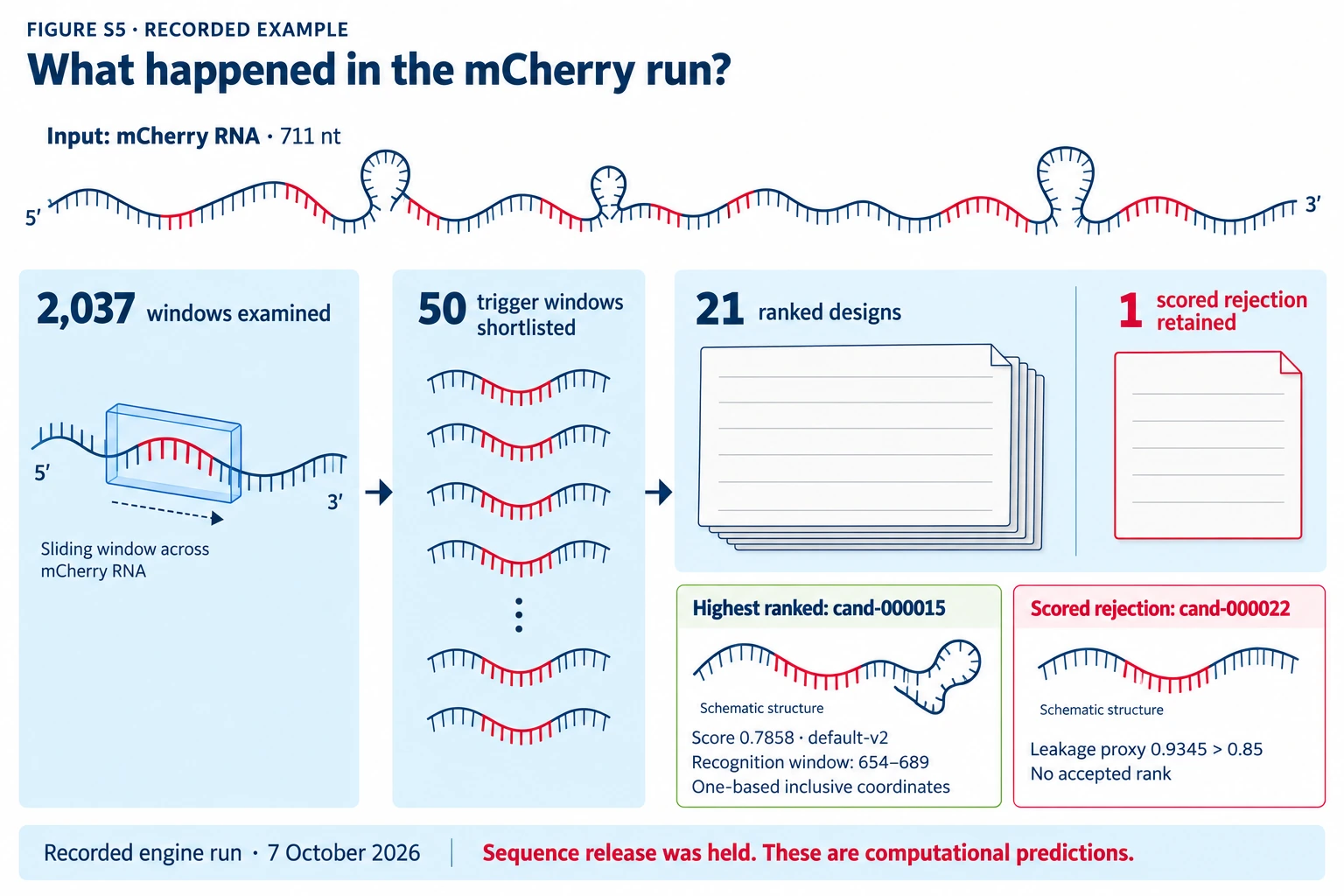
The recorded run produced 21 ranked designs and one scored rejection. cand-000015 scored 0.7858; cand-000022 had leakage proxy 0.9345 above 0.85. Sequence release was held.
Read the details & evidence
Accepted candidates are computational results; sequence release was held.
- 711 nt mCherry RNA
- Detected input; GFP is the output protein
- 2,037 windows
- 30, 33 and 36 nucleotide footprints examined
- 50 shortlisted triggers
- Windows enter switch generation and evaluation
- 21 accepted designs
- Top score 0.7858 under default-v2
- 1 scored rejection
- Reason retained; no accepted rank
We ran the scientific engine on a 711-nucleotide mCherry transcript on 7 October 2026. Here mCherry is the RNA to recognize; GFP is the output protein. The question is which region of that transcript can support a candidate toehold switch.
This run used E. coli, the toehold family, seed 7 and the engine's default parameters, at source revision 9a5ca657 with ViennaRNA 2.7.2. The cards below summarize the recorded engine output; they are not application screenshots or experimental measurements.
The full transcript enters the direct-sequence path.
Windows of 30, 33 and 36 nt are screened and compared.
Selected windows are passed to switch design and evaluation.
One further scored candidate is retained as rejected, with its reason.
Windows and final designs are different objects: a shortlisted window does not guarantee an accepted switch. The recorded run took 2.537 seconds in the local verification environment. This is one engine execution, not a benchmark of browser latency or other inputs.
The metrics download preserves the recorded ranks, predictions and rejection reasons. Generated sequence fields are omitted because sequence release was held.
The selected design and the rejected alternative
The highest-ranked candidate in this run was cand-000015. It recognizes
nucleotides 654–689 of the input transcript, using one-based inclusive
coordinates. Its score was 0.7858 under default-v2.
Accepted · rank 1
cand-000015
A 36 nt trigger, an 89 nt switch and a 973 bp assembled sequence record containing promoter, switch, GFP and terminator. This request included no backbone.
Rejected · no rank
cand-000022
Its leakage proxy was 0.9345, above the allowed ceiling of 0.85. The result keeps the rejection reason; the candidate receives no overall score or rank.
A score of 0.7858 does not mean a 78.58% chance of working. It combines predicted properties under a chosen scoring profile. Inspect the individual measurements, missing values and warnings before selecting candidates for further work. This direct run has no measured state-separation or orthogonality value. The Model page explains the metrics, weights and missing-value rules.
A useful review starts with three checks: does the candidate target the intended transcript region, what caused it to outrank the alternatives, and which evidence is still missing? For example, a direct-sequence result can compare switches against that RNA, but cannot show whether the RNA distinguishes diseased and healthy cells. That question requires appropriate biological data and experimental validation.
Compare the scored designs
// Explore the recorded result
Choose a candidate to inspect its target window and predicted properties. The bars show its
default-v2 ranking score; they are not measured success rates.
The complete candidate table is available as CSV.
Loading the recorded candidates…
Its ranking score is 0.7858. Select a row to compare windows and metrics.
HOLD_SYSTEM.
This is a release-status decision, separate from a candidate's scientific score.
Read the export audit.
The software contains serializers for switch FASTA, annotated GenBank and SBOL 3 constructs. These files are emitted only when the release check permits them. A construct assembled without a backbone is not a complete cloning vector; available parts and the chosen assembly method still need review.
For the reasoning behind window selection in this same transcript, continue to the Model walkthrough.
To repeat the recorded computation, use the reviewed source snapshot and the reproduction script with the supplied transcript. The request file records the input and settings; the provenance file records the source revision, sequence checksum and library version. Compare the resulting candidate table before comparing execution times.
Download and install the source snapshot. Save reproduce.py and mcherry.fasta in its top-level directory. From that directory, run:
PYTHONPATH=src .venv/bin/python reproduce.py ./mcherry-repeatThe destination must be new. This runs the scientific engine directly, so the web server and worker are unnecessary for this check. The script verifies the input checksum and preserves the export-release checks. Compare candidate records and scores; timestamps and runtime can differ. A separate replay from an isolated source snapshot reproduced all 22 candidate records from our recorded run.
03 · Prepare a run
Choose the input that matches your question
Do you already know the RNA target?
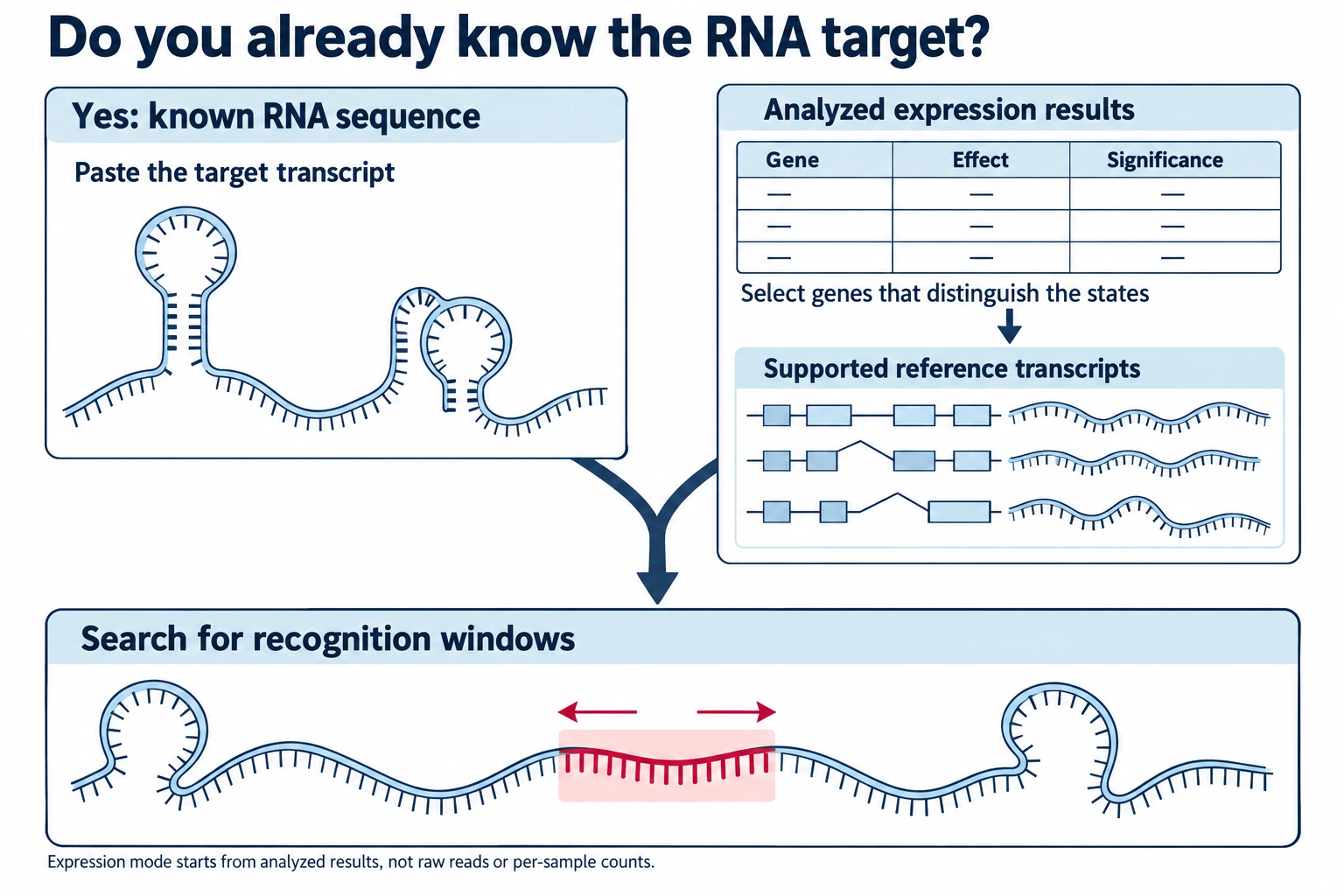
Known RNA proceeds to window search. Analyzed expression results first select genes and retrieve supported transcripts. Raw reads and per-sample counts are not this input.
Read the details & evidence
Bring analyzed expression results, not raw reads or per-sample counts.
- Known RNA sequence
- Normalize DNA or RNA; preserve original coordinates
- Expression results table
- Select genes that distinguish the supplied states
- Public comparison
- An owned immutable table, prepared offline
- Candidate trigger windows
- Scan long transcripts or use a compatible short trigger
- Evidence stays distinct
- A direct sequence cannot establish state separation
Both input paths eventually produce trigger records, so the downstream switch-design workflow is shared. The evidence available to that workflow is different: an expression comparison supplies information about two biological states, while a pasted sequence supplies information about one RNA. This distinction determines what the resulting score can mean.
Differential expression, direct sequence and public data
Differential expression is the discovery path. Supply a table comparing a control state with an experimental state. You can upload a CSV, TSV, TXT or XLSX file, reuse an owned dataset, select a bundled example or public comparison, or send inline CSV through the API. CERNAL parses the table into typed records, selects genes, loads their transcripts from the bundled host reference, then scans their possible trigger windows.
The product receives an analyzed results table, not raw reads or per-sample counts. Count-dependent input quality control, expression-vector redundancy and measured confusion matrices therefore have no input in the present workflow. XLSX has a further boundary: the web platform accepts and previews spreadsheets, but the scientific engine's parser reads CSV/TSV text. Use a text export for the documented LocalEngine path.
Direct sequence is the known-target path. Paste RNA or DNA; whitespace is removed,
letters are normalized, and DNA T becomes RNA U. A sequence that already
fits a supported trigger footprint can enter design directly. A longer transcript uses the same
scanner as expression-based discovery. The maximum pasted length is 10,000 nt. Empty inputs,
invalid alphabets and lengths outside the pipeline's bounds receive an input error. There is
a narrower compatibility boundary too: a 20–29 nt sequence can pass initial length validation
but supply no compatible toehold design, whose smallest footprint is 30 nt.
This scanning behavior addresses a concrete earlier failure: a long paste was effectively reduced to its final 36 nt. The historical mCherry regression in the development record reports a change from zero to 41 candidates after that fix. That is a historical result from earlier code, distinct from the 21 accepted candidates in the current run. Window offsets now preserve which part of the original transcript each design recognizes.
A direct run has no selected-gene fold changes and cannot establish whether the transcript
separates the two cell states you care about. In default-v2, missing
state_separation and orthogonality are excluded from the weighted mean.
Scores from runs with different available evidence should not be read as directly interchangeable.
The public catalog is another way to supply a DE table. It contains fifteen curated comparisons, five each for human, yeast and E. coli, browsed as organism → experiment → comparison. Choosing one creates an owned, checksummed, immutable dataset. The card shows the provider, accession, conditions, gene/significance counts, retrieval date, analysis method and DOI where present before the dataset is selected.
Provider adapters run in an offline management command. The application does not fetch from a provider during a design job, so a slow or unavailable provider does not interrupt that run. Catalog presence does not imply engine support: human comparisons are browseable even though the current engine has no human reference transcriptome. Catalog files also differ in evidence completeness: the recorded files lack adjusted p-values, and the E. coli comparisons lack p-values altogether. Gene selection uses the available significance tier and records its warning.
Specific gene is an informational route. Choosing an organism, identifier and
optional symbol stores params.target_gene, then moves the user to direct input to
paste its sequence. It does not perform a gene-to-sequence lookup.
What upload validation checks
A readable file is only the first check
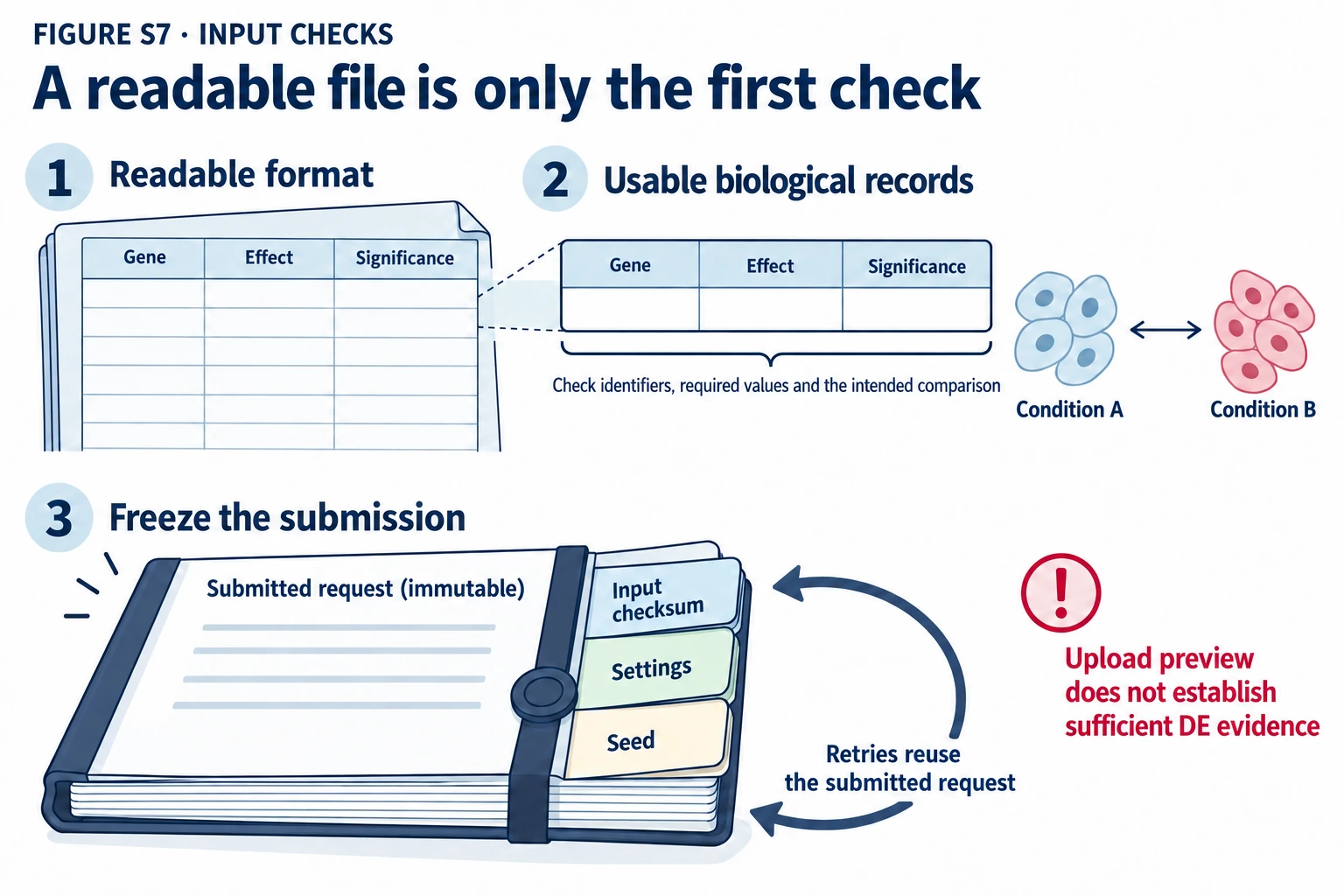
Readable formatting, usable biological records and an immutable submitted request are different checks. Retries reuse the submitted request.
Read the details & evidence
Passing upload preview does not guarantee sufficient evidence for DE selection.
- Readable upload
- Header, identifiers, numeric fields and size limits
- Usable engine records
- DE selection needs usable identifiers and fold changes
- Frozen request
- Input checksum, host, constraints, profile and seed
- Same submission on retry
- Idempotency prevents duplicate calculations
- Check contrast direction
- Valid formatting cannot establish the intended biological comparison
The first validation pass is synchronous, so a researcher learns whether a file is interpretable before queuing a costly computation. It checks a non-empty readable table, a header, a recognized gene-identifier column, at least one fold-change or expression column, and numeric values in recognized measurement columns. The development upload limit is 100 MB; tables are limited to 200,000 rows, with the first 5,000 sampled in detail and duplicate genes reported as warnings.
| Field | Examples |
|---|---|
| Gene identifier | gene, geneid, id, target_id, ensembl_id, locus_tag |
| Display symbol | symbol, gene_name, hgnc_symbol |
| Log2 fold change | log2FoldChange, logFC, fold_change, FC |
| Expression | baseMean, control_mean, target_mean, treatment |
| Significance | padj, FDR, qvalue, pvalue, pval |
Column matching ignores case, spaces, punctuation and underscores. Matching a name does not
convert its scientific units: a column called FC must still contain the log2
fold-change quantity expected by the engine. Gene IDs remain separate from display symbols,
which are not stable unique identifiers across annotation builds.
The engine's parse_dge_table is its single raw-table entry point. It accepts UTF-8
text, including a byte-order mark, selects comma/tab separation from the filename, maps fields
and converts missing or unparseable optional values to None. Rows without a usable
identifier or fold change are dropped. Later stages receive frozen records rather than paths
or untyped strings. An expression-only sheet can therefore preview successfully but still lack
the fold-change data required for DE selection. The dataset retains its owner, checksum, byte size, schema version,
validation status and report; the engine verifies its checksum when reading it.
Which organisms and parts are supported
The organism changes the design requirements
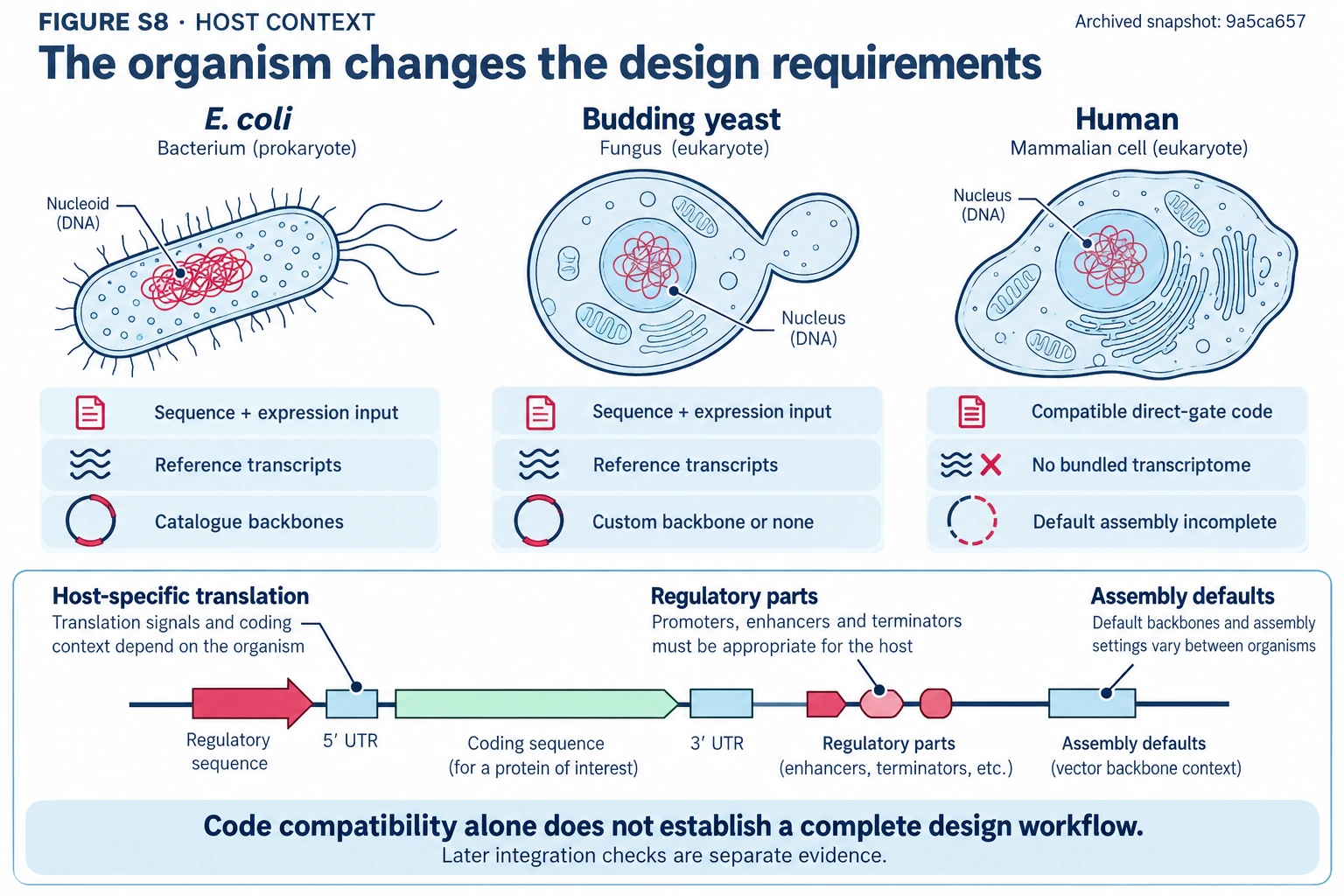
Archived snapshot 9a5ca657 distinguishes E. coli, yeast and incomplete human assembly support. The construct drawing is a conceptual illustration of context, not a functional sequence.
Read the details & evidence
This diagram describes archived 9a5ca657. Later four-host integration checks are separate evidence, not proof of full assembly or biological function.
- E. coli
- Direct and DE paths; references and catalogue backbones
- Yeast
- Direct and DE; custom backbone or no backbone
- Human
- Compatible direct-gate code; no complete default assembly workflow
- Host-specific context
- Translation context, reference transcripts, regulatory parts and assembly
The host selects the translation context, compatible gate families, folding/translation-tool configuration, reference transcripts, regulatory parts and assembly defaults.
| Host | Input paths | Reference and assembly scope |
|---|---|---|
| E. coli | Direct and DE | RefSeq K-12 MG1655 reference with 4,308 coding sequences; regulatory parts and ten catalog backbones. |
| Yeast | Direct and DE | RefSeq S288C reference with 6,027 coding sequences across sixteen nuclear chromosomes and the mitochondrion; Registry-verified regulatory parts. Supply a custom GenBank backbone or select none. |
| Human | Compatible direct-gate code exists; DE unsupported | No bundled human transcriptome or mammalian promoter/terminator defaults. Structural gate compatibility does not establish a complete assembled-design workflow. |
Adding human support requires more than another sequence file. A spliced transcriptome needs transcript records and an isoform policy, while mammalian expression requires an explicit choice of parts and assembly protocol. The BioBrick restriction-site conventions used for existing defaults do not establish a mammalian assembly standard.
The configuration stored with every run
Submission freezes the input mode, dataset/checksum or normalized sequence, organism, gate
families, scoring profile and overrides, constraints, payload outputs, optional catalog/custom
backbone, seed, idempotency key, notes and any informational target-gene selection. The database
distinguishes a DE run with a dataset from a direct run without one. The fast API requires
exactly one of trigger_sequence, dataset_id or dge_csv.
Constraints include maximum genes and triggers, minimum/maximum separation, adjusted-p threshold, baseline-expression bounds, trigger lengths and GC range, direction balancing, maximum switch length, forbidden motifs, assembly standard and maximum circuit gates. The circuit-size default is two. These are engine settings; the strict fast API currently accepts a smaller constraint vocabulary, listed in the integration chapter. An idempotency key makes a retry return the existing submission instead of starting a duplicate calculation. Changes to a design assumption belong in a new run, preserving the old record for comparison.
The four-step browser workflow
Four choices describe one biological request
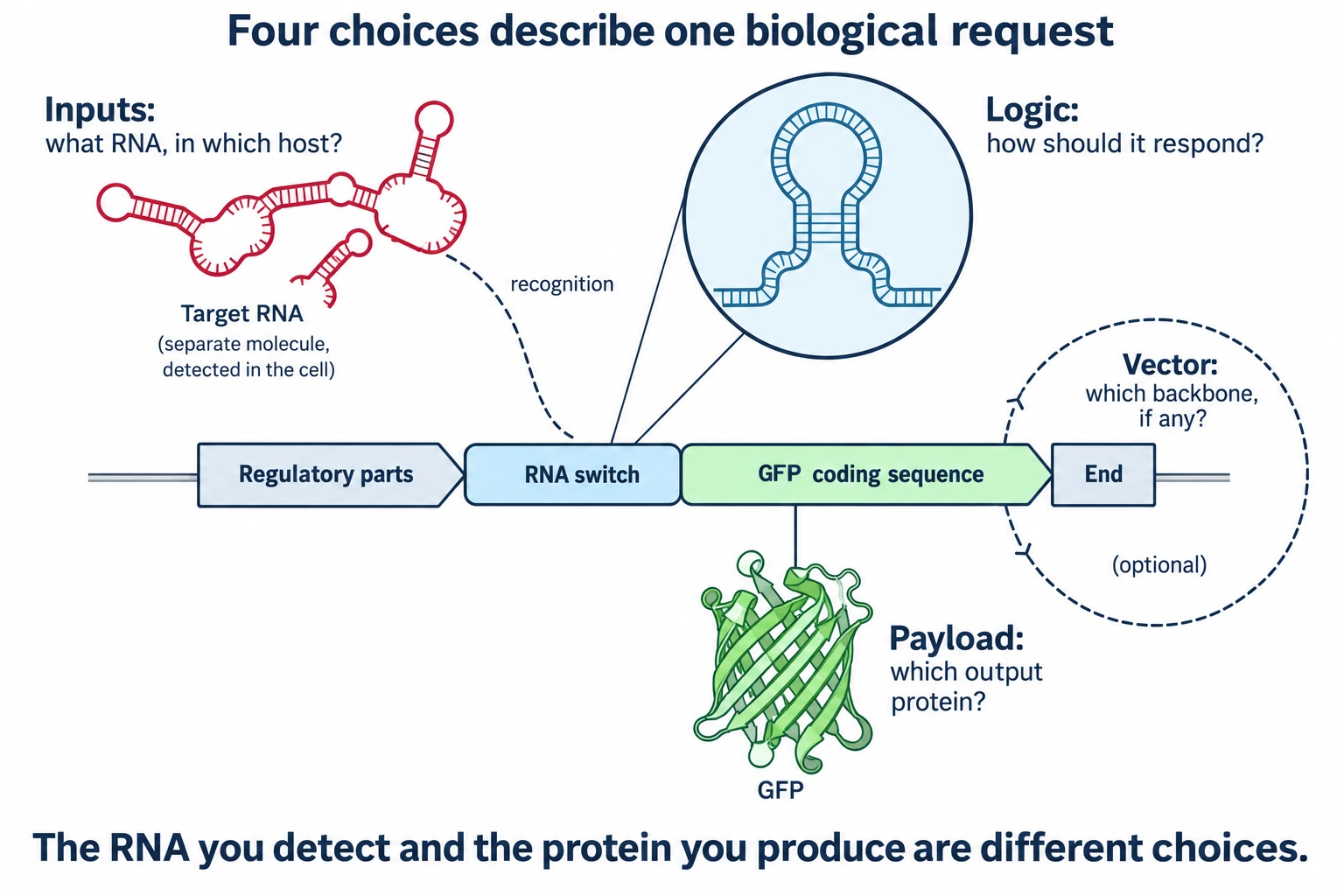
The detected RNA, response mechanism, output coding sequence and optional backbone describe different aspects of a request. Sequence drawings are conceptual and not to scale.
Read the details & evidence
Early blocking explanations help users resolve missing choices before computation.
- 1 · Inputs
- Choose the organism and RNA data source
- 2 · Logic
- Select an available mechanism and circuit-size limit
- 3 · Payload
- GFP or a supported custom coding sequence
- 4 · Vector
- Catalogue backbone, custom GenBank or none
- Track and review
- Inspect progress, warnings, candidates and release status
The wizard shows a blocking explanation before submission for missing data, an underspecified sequence, an unavailable mechanism, no selected output, a missing custom CDS or insufficient custom GenBank content. Its four steps connect biological choices to concrete settings:
Choose the organism and source: uploaded/existing table, public comparison, pasted sequence or informational gene choice. Inspect the expression preview, including its volcano plot and searchable, sortable table.
Choose a mechanism and maximum circuit size. The form uses the engine's capability report. Availability labels help show unsupported choices, but the pipeline also checks family compatibility and records skipped mechanisms.
Choose downstream outputs or paste a custom coding sequence. GFP is built in; other named outputs require actual sequence support or a validated custom CDS.
Select a supported catalog backbone, upload a GenBank vector or choose no backbone. Submit once; the idempotency key prevents a network retry from creating duplicate work.
The browser's presets are not the same as every engine request. In the recorded mCherry case, mCherry supplied the detected RNA, GFP supplied the payload, and no backbone was requested. The downloadable request is the authority for that particular result.
During execution, the run page polls every three seconds, displays the named stage and percentage, and offers cooperative cancellation. Failed and canceled runs have different terminal states, readable messages and a route back. The results view includes output and precision filters, rejected-candidate visibility, metric decomposition, trigger/design details, per-candidate annotations and decision tags. Its plasmid ring uses actual segment lengths; the logic view displays the stored graph rather than assuming a fixed number of inputs.
| Route | Purpose |
|---|---|
/login · /register | Session sign-in, registration and account-approval status. |
/dashboard | Recent runs and the starting point for a new design; the root route redirects here. |
/compile | The four-step wizard. |
/runs/:runId | Progress, cancellation, candidate exploration, annotations and downloads. |
/settings | Create, reveal once, regenerate or revoke API keys; inspect scopes and expiry. |
/use-cases · /guide · /faq | Workflow selection, practical help and troubleshooting. |
/api-docs · /about | Human-readable API/client/scoring reference and project/engine information. |
Accessibility practices: the interface uses semantic headings and forms, field labels and required states, live alerts/status regions, descriptive controls, keyboard-capable primitives, logo alternatives, disabled-state labels and responsive layouts. These implementation practices do not constitute a completed screen-reader, contrast, keyboard-only or mobile-device audit. Independent usability and accessibility evaluation remain work to complete.
04 · Inside the scientific workflow
How an input becomes candidate designs
A construct proposal keeps its design history
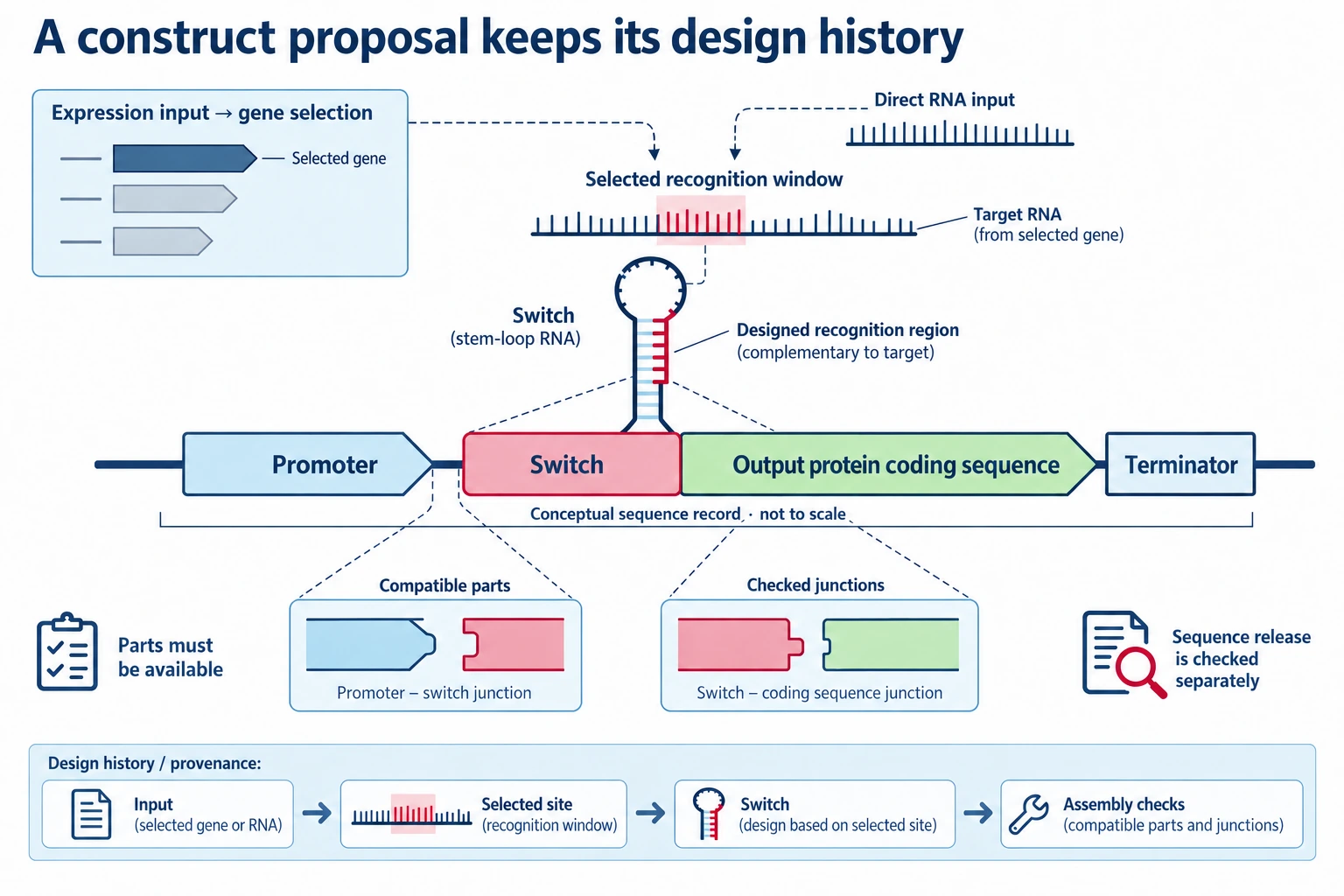
A conceptual construct record links the chosen recognition site, switch, available parts and assembly checks. Sequence release remains separate.
Read the details & evidence
Assembly is conditional on parts; report generators remain incomplete and release is separate.
- Resolve the request
- Host, constraints, scoring profile and scientific tools
- Select genes in DE mode
- Significance, separation and available transcripts
- Rank trigger windows
- Coordinates, seed and opening evidence remain attached
- Generate compatible switches
- Record violations, raw properties and conjunction proposals
- Assemble available parts
- Check junctions, circular motifs and reading-frame continuity
The simple workflow at the top of this page hides several distinct scientific decisions. This chapter follows those decisions in execution order. The Model page develops the assumptions, equations and evidence behind them.
The stages and their implementation boundaries
| Stage | What happens | Current boundary |
|---|---|---|
| 0 · Request and tools | Resolve host, constraints and scoring profile; construct shared scientific tools. | Product input is a results table or sequence. Raw-count quality checks have no input here. |
| 1 · Gene selection | Deduplicate genes, evaluate significance and expression separation, check transcripts and shortlist candidates. | DE mode only. Missing significance/count evidence stays explicit. |
| 2 · Trigger selection | Profile each transcript once and rank exact 30/33/36 nt windows using gate-aware structural evidence. | DE and long direct sequences use this scanner; a short direct trigger follows a simpler path. |
| 3 · Switch design | Check trigger-set compatibility, generate switches, collect violations and compute raw properties. | Single-input toehold families are operational; other registered families have explicit limitations. |
| 4 · Circuit proposals | Combine available gene switches into conjunctions, including terms oriented by up/down regulation, and penalize complexity. | Multiple-gene proposals are implemented. General OR/nested logic and measured sample classification are not. |
| 5 · Assembly | Join promoter, switch, payload, terminator and optional backbone; check circular motifs and reading-frame continuity. | Available parts limit assembly. File release is a separate check. |
| 6 · Reports and figures | Declared interfaces for scientific structure/circuit illustrations and a PDF report. | Generators remain incomplete. Existing UI views and CSV output do not establish PDF-report support. |
Gene selection can use adjusted p-values directly or perform Benjamini–Hochberg correction on raw p-values when the input is suitable. It applies effect-size floors and ceilings, directional abundance checks, transcript availability and a fast constructibility/yield screen. An optional direction-balanced shortlist prevents up-regulated genes from crowding out all down-regulated inputs. Count-vector redundancy is available only when count information exists.
Trigger selection records the window's original coordinates, RNAplfold settings/version, selected nucleation seed and opening evidence. Length classes are ranked separately and joined round-robin. The pipeline then builds activator/repressor trigger sets and asks each gate family whether the set is compatible before generating sequences. Incompatible sets and invalid designs have different causes; recording those causes makes a run with few survivors interpretable.
Current circuit generation selects available member designs and combines eligible gene inputs up to the configured gate limit. Multi-gene scoring uses each metric's weakest member, plus a circuit-complexity cost. A pasted transcript still represents one biological input even if it yields many windows. The engine does not turn those windows into independent genes. No per-sample count matrix enters the product, so circuit proposals have no measured confusion matrix, sensitivity or specificity.
What a toehold switch is designed to do
Trigger binding is intended to open the switch
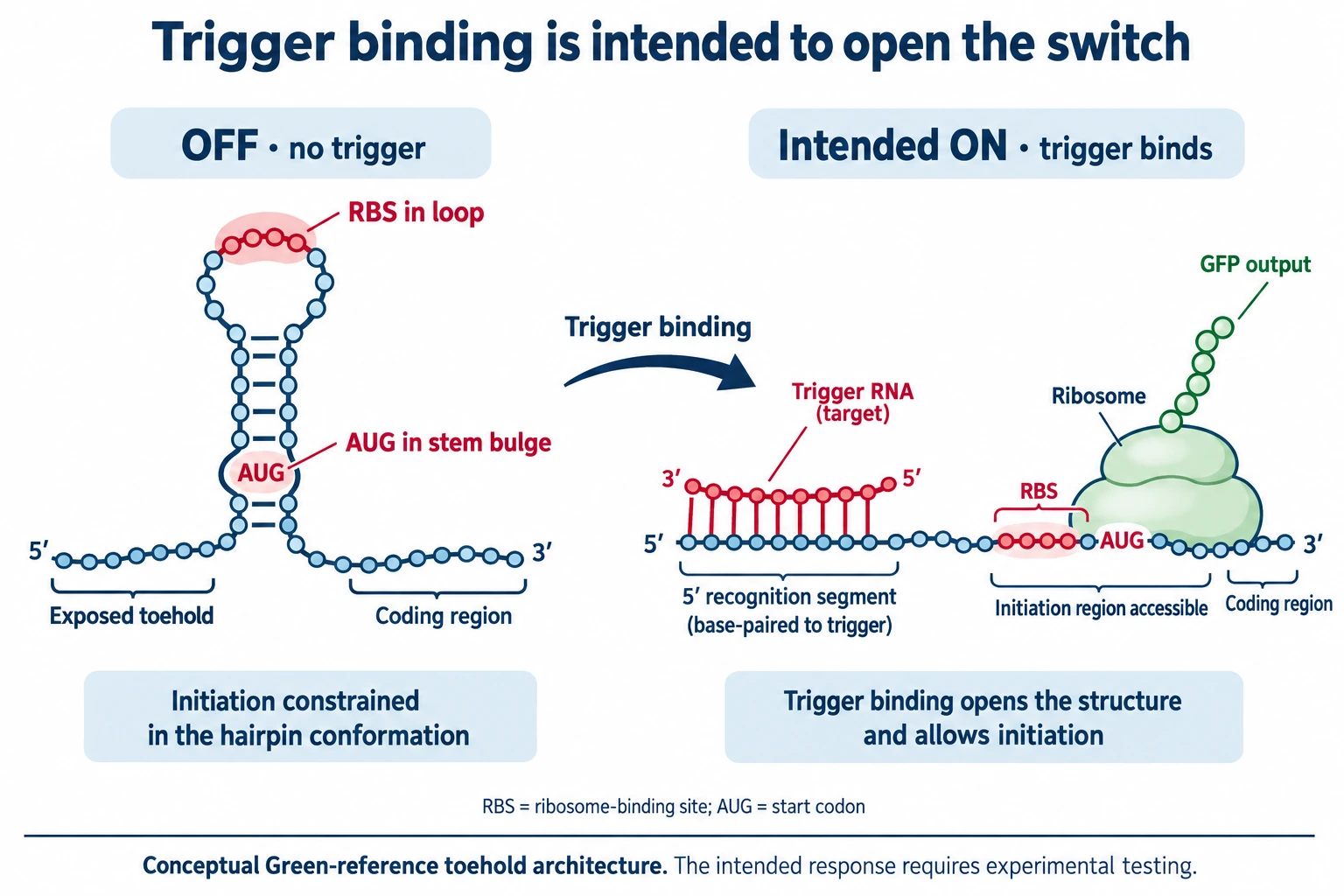
Conceptual Green-reference toehold: RBS in the loop, AUG in a stem bulge, and antiparallel trigger recognition. The intended ON response requires experimental testing.
Read the details & evidence
Green-reference architecture: AUG lies in a stem bulge; initiation remains constrained. Activation requires testing.
- OFF design
- Green reference: AUG in stem bulge; RBS in loop
- Trigger RNA binds
- A separate strand recognizes the exposed toehold
- Branch migration opens stem
- Translation-initiation region becomes accessible
- Intended ON response
- Ribosome translates the downstream payload
- Check the assembled sequence
- Motifs, reading frame, structure and junctions
OFF · without trigger
The RNA forms a hairpin around the translation-initiation region. In the illustrated prokaryotic design, the ribosome-binding site is in the loop while the AUG start codon is paired in the stem. The structure is intended to suppress payload translation.
ON · trigger bound
The trigger pairs with the exposed toehold and opens the stem through branch migration. Exposing the initiation region is intended to permit translation of the downstream payload.
The design trade-off is between a sufficiently closed OFF state and favourable trigger-induced opening. A predicted stable hairpin alone is not proof of low leakage or successful activation. Eukaryotic variants use a Kozak translation context; compatibility with that context does not remove the host-specific limitations described above. The original toehold-switch work is cited in reference 1.
How the engine constructs and checks a switch
The generator uses 12, 15 or 18 nt toeholds where the trigger footprint permits them. A scanned 30/33/36 nt footprint maps to the corresponding 12/15/18 nt design; a manually supplied short trigger retains generation of the fitting variants. Construction joins a leader, the reverse-complement binding sequence, designed stem, bulge/loop, host translation context, AUG and an in-frame linker to the payload. Recorded architecture boundaries locate these components without requiring later code to infer them from the sequence.
Validation collects sequence, length, AUG/stop, forbidden-motif, restriction-site and homopolymer violations along with implemented structural checks. Some intended ensemble and translation checks remain incomplete. Circular assembly checks include the origin join, which would be invisible to a linear scan; junction checks also catch motifs created by joining individually acceptable parts. Violations are recorded rather than repaired without explanation.
Gate evaluation returns raw values: folding energy, leakage and dynamic-range proxies, trigger accessibility, GC content and the implemented success proxy. Translation/codon and some ensemble-related measures remain unavailable. ON-state folding treats switch and trigger as two strands through the shared folding adapter; concatenating them into one strand would represent a different physical system. The same adapter isolates direct ViennaRNA access.
Registered families and usable pipeline paths
A mechanism name does not guarantee a complete workflow
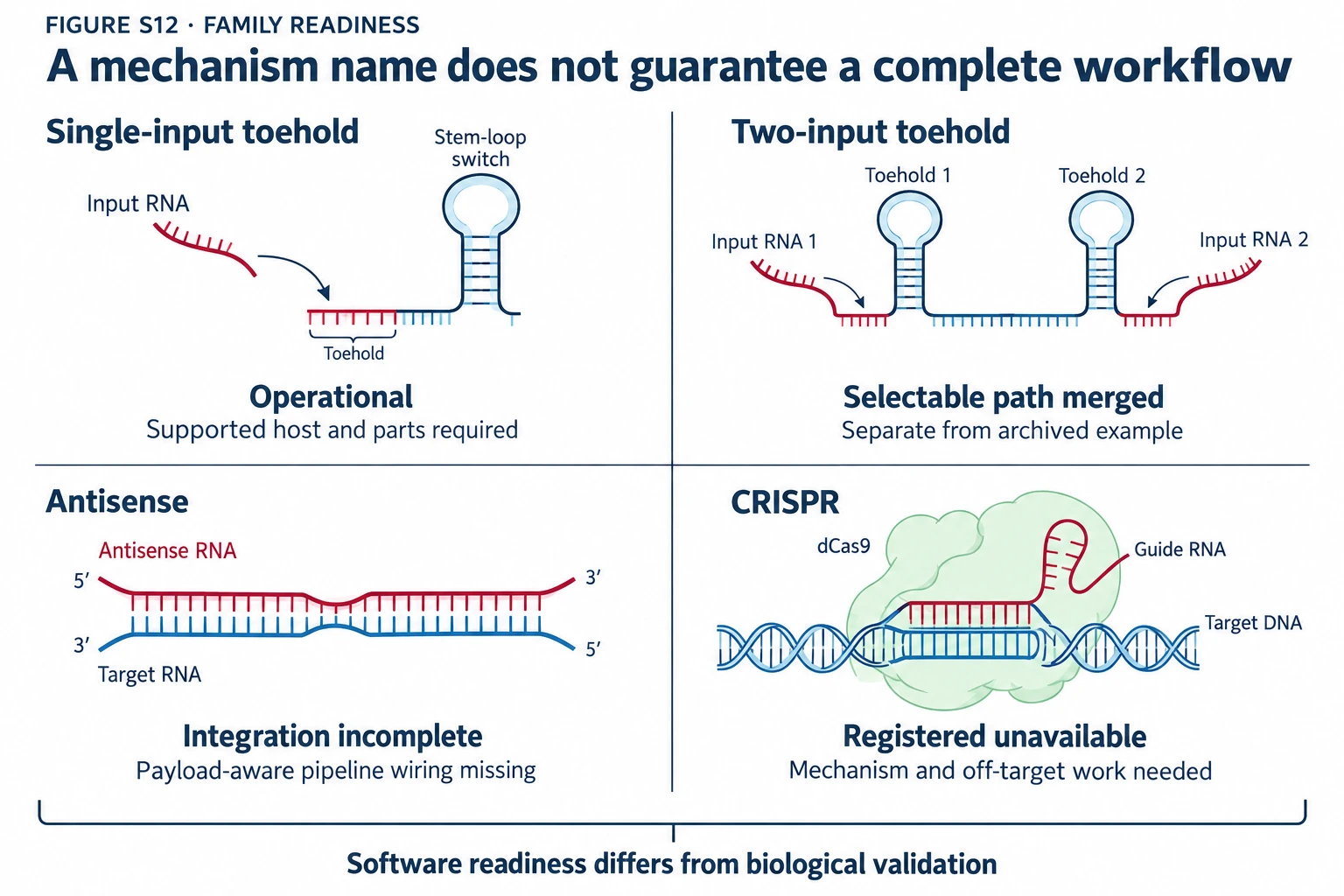
Single-input toehold support, the newer two-input path, incomplete antisense integration and unavailable CRISPR registration have different readiness. Molecular sketches do not establish biological function.
Read the details & evidence
Gate names and leakage labels must be interpreted with their mechanisms.
- Single-input toehold
- Operational within supported host and part constraints
- Two-input toehold
- Selectable path merged; archived run did not use it
- Antisense
- Family code exists; payload-aware pipeline integration remains missing
- CRISPR
- Registered unavailable; mechanism and off-target implementation needed
- A usable pipeline needs
- Compatibility, payload wiring, generation, scoring, assembly and tests
| Family | Input and action | Operational status |
|---|---|---|
toehold | One input; translation activation | Implemented, including generic and prokaryotic/eukaryotic variants, within supported host/part constraints. |
toehold_and | Two inputs; translation activation | Skipped in the archived 7 October pipeline. The selectable AND path is now merged in PR 81; see the 16 October source update for its evidence boundary. |
antisense | One repressor input; translation inhibition | Family code and tests exist. Payload-aware integration is missing from normal runs, so the pipeline skips it. |
crispr | Transcriptional control; declared eukaryotic scope | Registered unavailable. Requires mechanism-specific implementation and a genomic off-target model. |
The isolated antisense family sweeps UTR-arm lengths, spacers and trigger offsets, then evaluates initiation-region accessibility, hybridization energy and a success proxy. That is useful extension work, but it is not an operational browser workflow. Its default expression state is also different: a toehold aims to be OFF without trigger, whereas antisense inhibition leaves the payload ON when repression fails. A leakage label must therefore be interpreted together with the gate's mechanism, trigger state and payload. For a toehold it describes residual expression without the activating trigger; for antisense it describes residual expression with the repressor present. The same metric name refers to opposite trigger states.
Family declarations feed the API and interface, while pipeline guards enforce what can actually run. Adding a class and registration entry is the extension mechanism, not sufficient evidence to claim a newly usable chemistry. Host compatibility, payload wiring, generation, scoring, assembly and tests all need to work together.
05 · Interpret and retain the result
Understand the ranking and the files
A ranking score starts a review
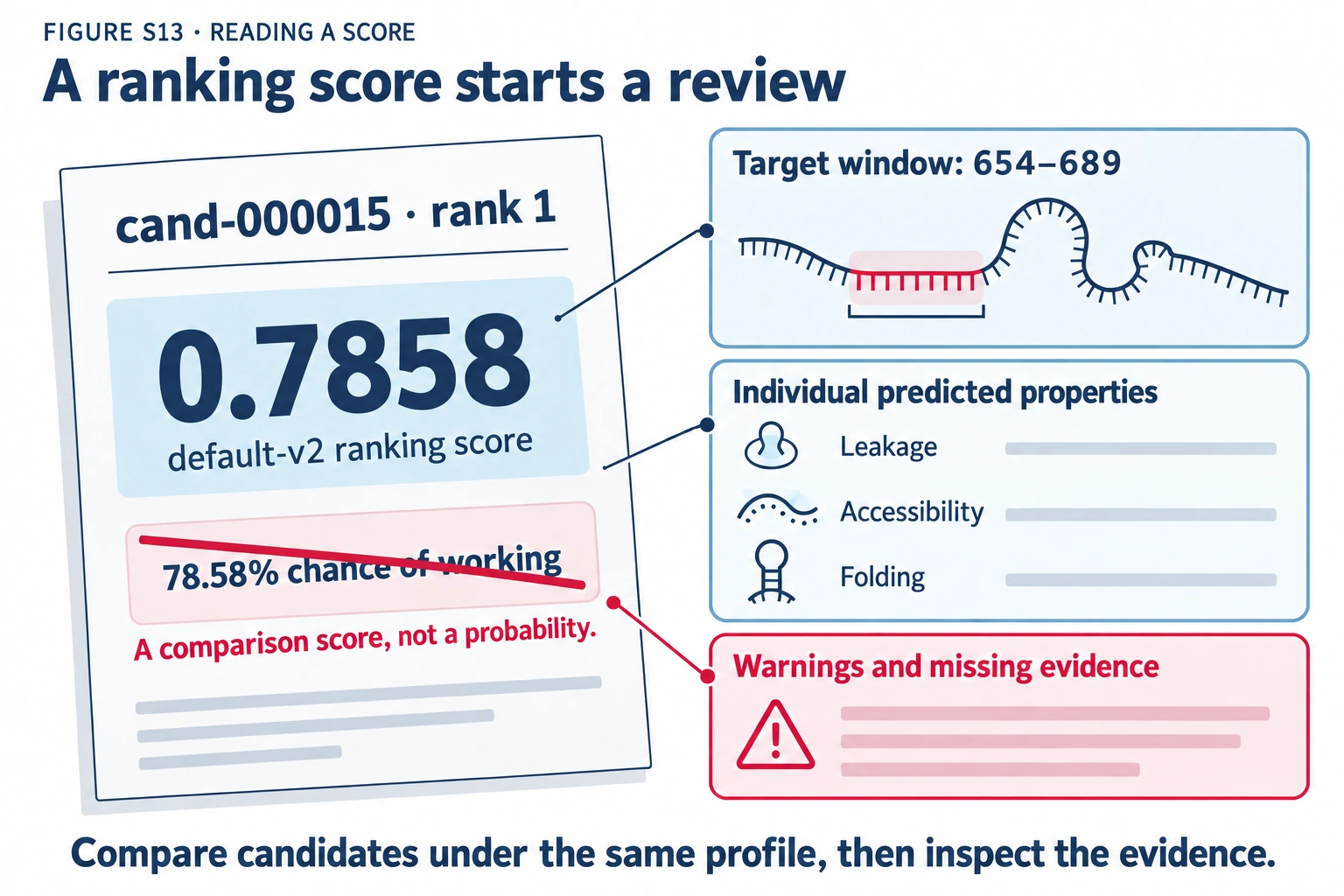
A profile-dependent score such as 0.7858 combines predictions; review components, missing measurements and warnings before choosing an experiment.
Read the details & evidence
0.7858 is a profile-dependent score, not a 78.58% success probability.
- Raw evidence
- Measurements, missing values, trigger location and tool provenance
- Versioned scoring profile
- Directions, normalization, weights and missing-value policy
- Hard filters
- Threshold breaches remain visible with rejection reasons
- Accepted candidate record
- Rank, metric decomposition, construct, warnings and user annotations
- Rejected candidate record
- Retained reason; no accepted rank
CERNAL returns the information needed to inspect a decision: accepted candidates with their ordering, scored rejections with reasons, component measurements, sequence/construct records, warnings and an artifact manifest. A rank, a biological prediction and permission to release a sequence file are separate statements, as the mCherry example demonstrates.
What the score means to a user
Gate families return raw measurements only. A shared, versioned scoring layer performs
normalization, weighting, hard filters and ranking. This prevents each chemistry from defining
its own incomparable meaning of “good.” The recorded example uses default-v2.
Its result of 0.7858 is a weighted computational score, not a 78.58% probability of experimental
success.
The interface retains each metric's raw value, normalized value, weight and better direction. Values are clamped to declared ranges and scaled so larger normalized values are better; energy, leakage and complexity use the appropriate reversed direction. The vocabulary includes state separation, trigger accessibility, gate folding energy, predicted leakage, orthogonality, GC content, dynamic range, predicted success rate and circuit complexity. Their units and provisional ranges/weights are fully listed in the Model scoring reference.
A missing raw value stays None. Under default-v2, missing state
separation and orthogonality are skipped in both numerator and denominator; other missing
metrics contribute the worst score at their declared weight. This replaces the earlier blanket
missing-value penalty described in historical documentation. Preserving the missing value is
essential: substituting zero for an unavailable lower-is-better metric could give an unmeasured
design the best possible score.
Hard filters and rejected candidates
The default hard filters reject predicted leakage above 0.85 and state separation below 0.5
when that separation value exists. An absent value does not independently fail a hard filter.
This is why the sample's cand-000022 can pass trigger shortlisting and still fail
the later leakage check. It remains in the result with a non-empty reason and no rank.
Database constraints preserve the distinction between accepted and rejected candidates. Rejected candidates can be requested in the browser or API, allowing a user to distinguish an empty search from a search whose scored designs breached a threshold. Earlier-stage windows that never produced scored designs are not the same set as the final rejected-candidate list.
API callers can request different metric weights, hard filters and tie-breakers. Metric directions and declared ranges are fixed by the profile rather than caller preferences. A derived profile gets a deterministic label so identical overrides can be identified. Compare scores only after checking the profile, input mode and available measurements; a score without that context is insufficient for choosing a design. Tie-breaker preferences are recorded in the derived profile, but this snapshot orders equal final scores by candidate reference; the requested metric tie-breakers are not applied to that final ranking.
What a candidate record contains
| Group | Recorded information |
|---|---|
| Identity and decision | Engine reference, platform database identifier, gate family, logic type, selected output, rank/overall score when accepted, rejection flag and reason. |
| Trigger evidence | Input feature, transcript window offset, sequence, orientation, accessibility evidence, selected seed and structural-tool provenance where available. |
| Switch and construct | Switch sequence and structure, toehold length, trigger offset, component boundaries, plasmid segments and total length. |
| Interpretation | Logic graph, complete metric decomposition, summary and warnings. User annotations and decision tags live alongside the result. |
The results explorer supports output filters for runs requesting multiple payloads, precision filters, candidate selection and rejected-candidate visibility. A proportional plasmid ring helps inspect assembly order and lengths; a logic view helps inspect the proposed condition. These are views of stored computational records. They do not add biological evidence to those records.
Files, release status and protected downloads
Ranking and sequence release are separate decisions
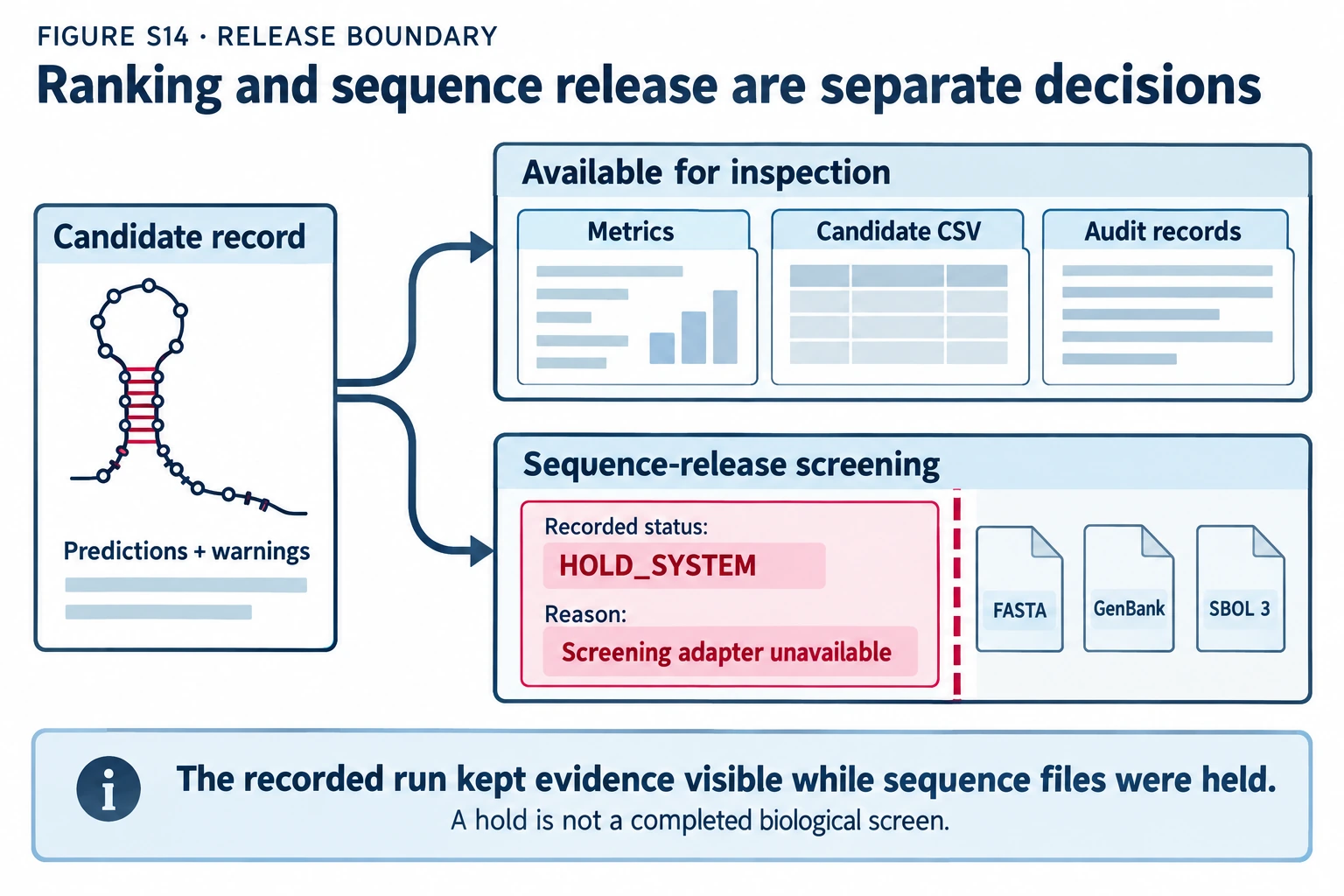
Metrics and audit evidence may remain visible while sequence files are held. The recorded example was HOLD_SYSTEM because the screening adapter was unavailable.
Read the details & evidence
File-format support and assembly checks do not certify biological suitability.
- Candidate result
- Accepted ranks and scored rejections remain inspectable
- Metrics and audit records
- CSV, checksums, warnings and release decisions
- Sequence release check
- Available screening adapter and allowed release required
- FASTA · GenBank · SBOL 3
- Sequence-bearing serializers; owner-checked downloads
- Example: HOLD_SYSTEM
- Screening adapter unavailable; sequence files held
| Output | Contents and conditions |
|---|---|
candidates.csv | Candidate identity, rank, family, logic type, score and rejection status/reason. Accepted and scored rejected candidates are retained; the platform export expands metric columns. |
| Screening audit JSON | Release decision, reasons, adapter/database provenance and sequence/result checksums. The mCherry run contains 42 switch/plasmid audit records. |
| FASTA | Serializer for an accepted switch with candidate metadata. Sequence-bearing files are emitted only after the release check allows them. |
| GenBank | Serializer for an annotated circular construct, with component features and CERNAL metadata. Release remains conditional; assembly without a backbone is not a complete cloning vector. |
| SBOL 3 | Native serialization from the plasmid record: component, sequence, subcomponents with ranges and part roles/provenance. Subject to the same release check. |
| ZIP | The platform can bundle available artifacts by file, category, selected IDs or whole run. |
summary.csv and manifest.json | Platform-derived files written at result import. These are distinct from the native engine result used in the worked example. |
| Scientific figures and PDF report | Artifact kinds and interfaces exist, but stage 6 generators are incomplete. Browser-rendered views do not mean downloadable reports have been produced. |
The example's sequence files were held with HOLD_SYSTEM because its local screening
adapter was unavailable. Neither an accepted score nor a SYNTHESIZE annotation
overrides that release decision. The published metrics download omits generated sequence fields
and is labeled accordingly. The recorded export audit explains
the actual outcome rather than implying files that the run never emitted.
Each engine artifact has a kind, relative path, media type, SHA-256 checksum and optional candidate reference. The platform verifies referenced files and checksums, associates artifacts with known candidates, records byte sizes and stores files behind owner-checked download views. Storage locations are not exposed as download URLs; MIME-sniffing protection accompanies file responses.
How CERNAL uses existing standards
| Standard | Use in CERNAL |
|---|---|
| DESeq2 / edgeR / limma exports | Recognized input aliases preserve established analysis workflows. Raw-p adjustment requires a suitable untruncated table; a pre-filtered subset cannot support the same false-discovery calculation. |
| GenBank | Reads custom backbones and implements annotated construct export with a feature for each segment. |
| SBOL 3 | Builds a component and sequence, subcomponents with positional ranges, Sequence Ontology roles and Registry accessions where applicable. Serialization is deterministic. |
| BioBrick RFC10 / RFC1000 | The selected restriction-site set is applied across the assembled sequence, including inter-part junctions and the circular origin. |
| iGEM Registry | Fifteen bundled parts have recorded Registry verification. Tests compare bundled data with the recorded reference, including sequence lengths; an offline test does not re-query the live Registry on every run. |
| FASTA / CSV | Sequence serialization and flat candidate/metric data support downstream tools that do not use GenBank or SBOL. |
| OpenAPI | The typed HTTP layer generates machine-readable documentation and interactive API documentation for clients. |
Serialization support and standards-oriented screening describe software behavior. They do not certify biological suitability or release eligibility. The actual example therefore exposes its held-export status beside its successful candidate ranking.
What is needed to reproduce a result
A seed is only one part of a reproducible run
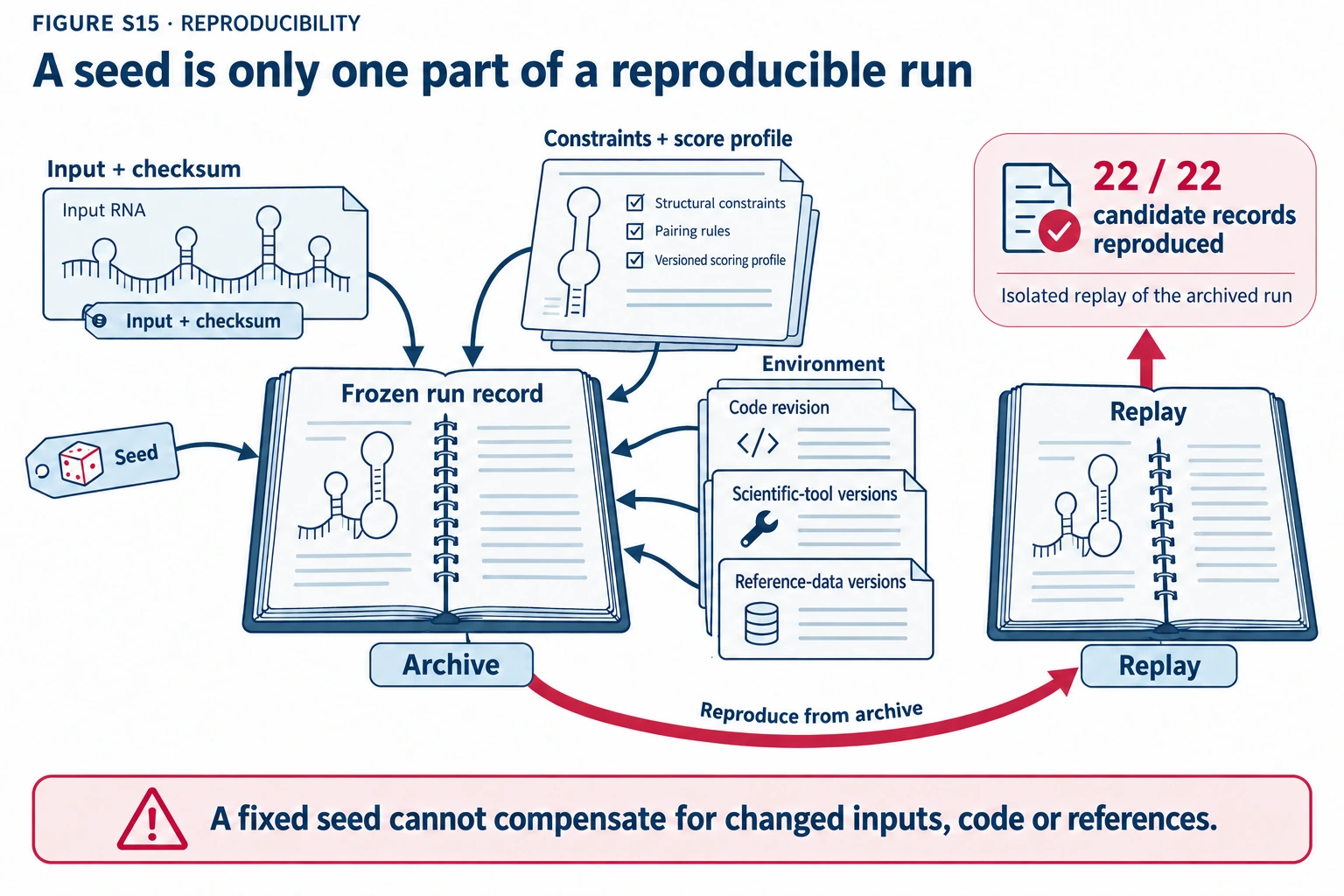
Reproduction requires input checksums, settings, seed, code, scientific tools and reference versions. The isolated replay reproduced all 22 candidate records.
Read the details & evidence
A fixed seed cannot compensate for changed code, temperature or references.
- Input identity
- Checksummed sequences, tables and uploaded biological parts
- Complete request
- Constraints, normalized input, scoring profile and seed
- Scientific environment
- Source, schemas, dependencies and reference revisions
- Replay and compare
- All 22 recorded candidate records reproduced in isolated replay
Keep the input checksum, complete normalized request, engine/schema versions, scoring profile, seed, ViennaRNA/Biopython versions, transcriptome/catalog revisions and any uploaded biological parts. Stable identifiers and ordering support deterministic processing, but a seed cannot compensate for changed science code, temperatures or reference sequences.
The example includes a fixed source archive and replay script, and an isolated replay reproduced all 22 candidate records. Runtime and audit timestamps can change between executions. Historical MockEngine output used idempotency keys and seeds for deterministic simulated fixtures; it should not be confused with the current LocalEngine computation or experimental measurements.
Source references: input parsing, pipeline and release checks, assembly and serialization, scoring profiles.
06 · Software design
How the web product and scientific engine fit together
The platform manages work; the engine designs candidates
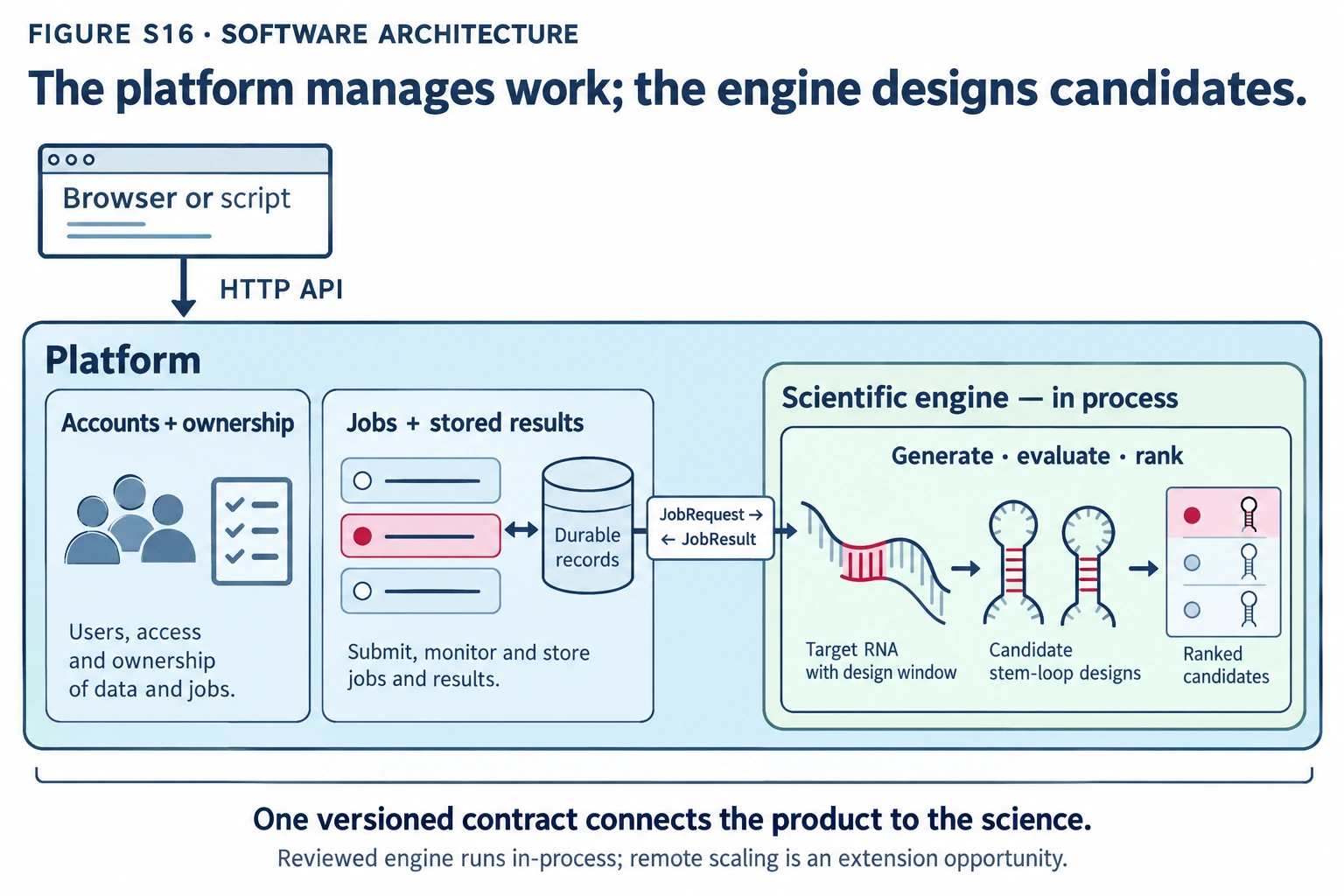
The platform manages accounts, ownership, jobs and stored results. The reviewed scientific engine runs in process through a request/result contract.
Read the details & evidence
The reviewed engine runs in-process; remote scaling is an extension opportunity.
- Browser + scripts
- One API, shared account ownership and results.
- Platform
- Accounts, uploads, queue, database and durable results.
- Request / result
- Frozen records cross the enforced interface boundary.
- Scientific engine
- Stages, gate families, scoring and shared scientific tools.
- Import checks
- AST rules prevent engine imports from the web platform.
One repository contains two main systems. The platform handles people, permissions, uploads, jobs and durable results. The scientific engine receives a versioned request and returns candidates and an artifact manifest. Both the browser and automation clients use the same API, accounts and results; there is no separate scientific data model for scripted work.
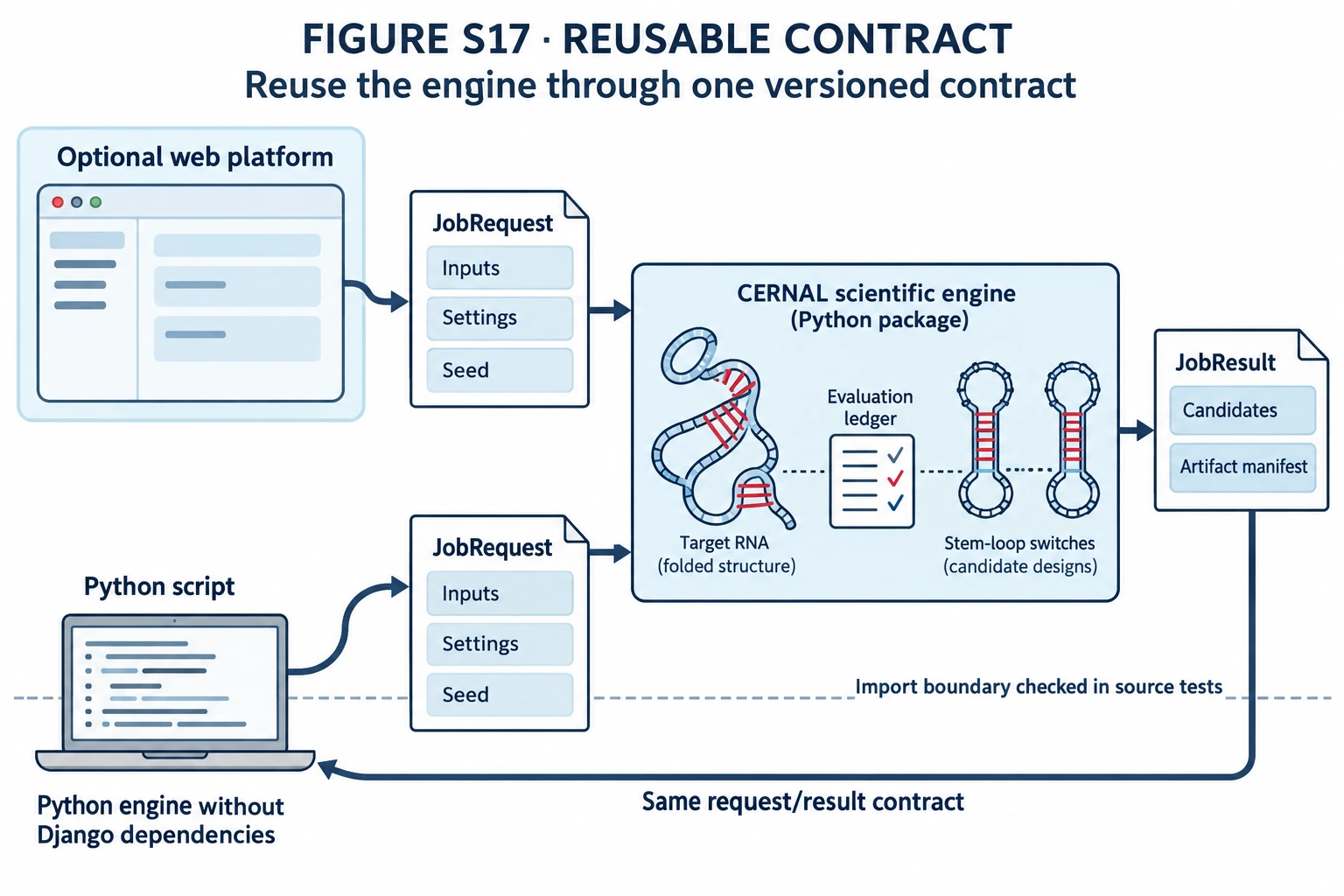
Reuse the engine through one versioned contract
An offline interface to NucSyn research exports
NucSyn connects through an offline research handoff
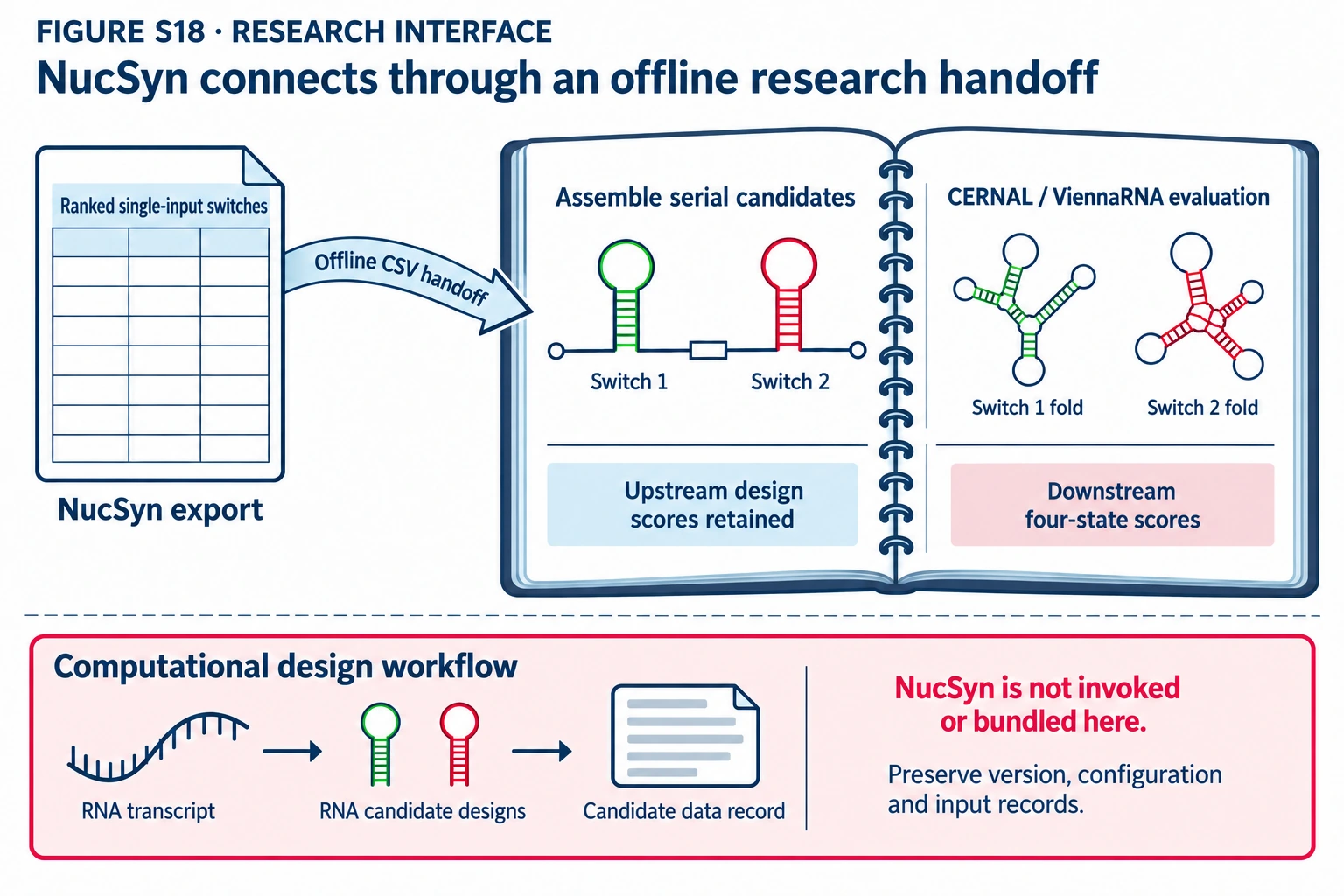
NucSyn single-input switch CSVs are read by a research notebook, which evaluates serial constructs through CERNAL/ViennaRNA. This is offline, outside the production engine.
Read the details & evidence
NucSyn is neither invoked nor bundled by CERNAL's production engine.
- NucSyn exports
- Ranked single-input switch CSVs retain upstream design scores.
- Research notebook
- Domain boundaries guide serial candidate assembly.
- CERNAL folding
- ViennaRNA evaluates downstream construct states.
- Preserve provenance
- Keep producing version, configuration, inputs and upstream credit.
The eukaryotic AND research notebook reads ranked single-input switch CSVs exported from NucSyn Platform. It retains the upstream scores, assembles serial candidates using sequence-domain boundaries and evaluates the constructs through CERNAL's ViennaRNA folding adapter. NucSyn is not invoked or bundled by CERNAL's production engine: the connection is an offline data interface. This supplementary description follows the notebook at revision c1bb92c, separately from the dated production snapshot discussed on this page.
Upstream design scores and CERNAL's downstream four-state scores remain distinct. Reproducing an export also requires its producing software version, configuration and inputs; a link to today's release cannot supply missing historical provenance. The Model explanation describes the computational boundary, and the credit below identifies the upstream authors and citation.
An enforced interface between platform and engine
The engine does not import Django, API routers or application modules, access the database, or
read Django settings. Configuration arrives through frozen request records. Platform code may
import engine.contract and engine.client, not the scientific internals.
An abstract-syntax-tree test catches ordinary, conditional and function-local imports that break
these rules; it does not rely on executing every import path.
This lets the engine run and be tested without a web server, database or network. It also keeps future isolation possible: a remote process could implement the same request/result interface without redesigning the browser or database. The current snapshot runs the engine in-process; an interface that permits a remote engine is not evidence that independent remote scaling has been deployed. Inside the engine, dependencies point downward from orchestration through stages and gate families to tools and domain records.
Runtime components and shared tools
The browser is a React 19 static single-page application with TanStack Router and React Query for server state, polling and mutations. Django Ninja provides typed HTTP routes and a shared error envelope. Application services own business operations; Django ORM models hold persistent state; a thin django-q2 task dispatches work through the engine interface.
The v1 runtime uses SQLite with write-ahead logging, foreign keys and a busy timeout, plus one ORM-backed queue worker. The queue is a database table, so no separate broker is required. The worker timeout is one hour, the retry interval exceeds that timeout, and maximum attempts is one to avoid silently repeating an expensive calculation. Shared rate-limit state uses a database cache instead of separate counters per web process.
Scientific tools are built once per run and passed down: the folding adapter, accessibility profiler, motif screener, codon/translation tools, assembly tools and selected families. Sharing one folding instance preserves its cache and configuration, including temperature. Otherwise two candidates could be folded under different assumptions and then compared on the same score axis. Rule tests check construction discipline. The removed off-target scanner is not silently replaced with a zero-valued measurement.
ViennaRNA supplies secondary-structure calculations; Biopython handles GenBank parsing and serialization in the assembly layer. Those adapters make tool-specific details replaceable. A registered tool method can still be incomplete, so constructing a tool does not establish that every planned scientific measurement is available.
Run states, cancellation and failure handling
Every job needs an explicit outcome
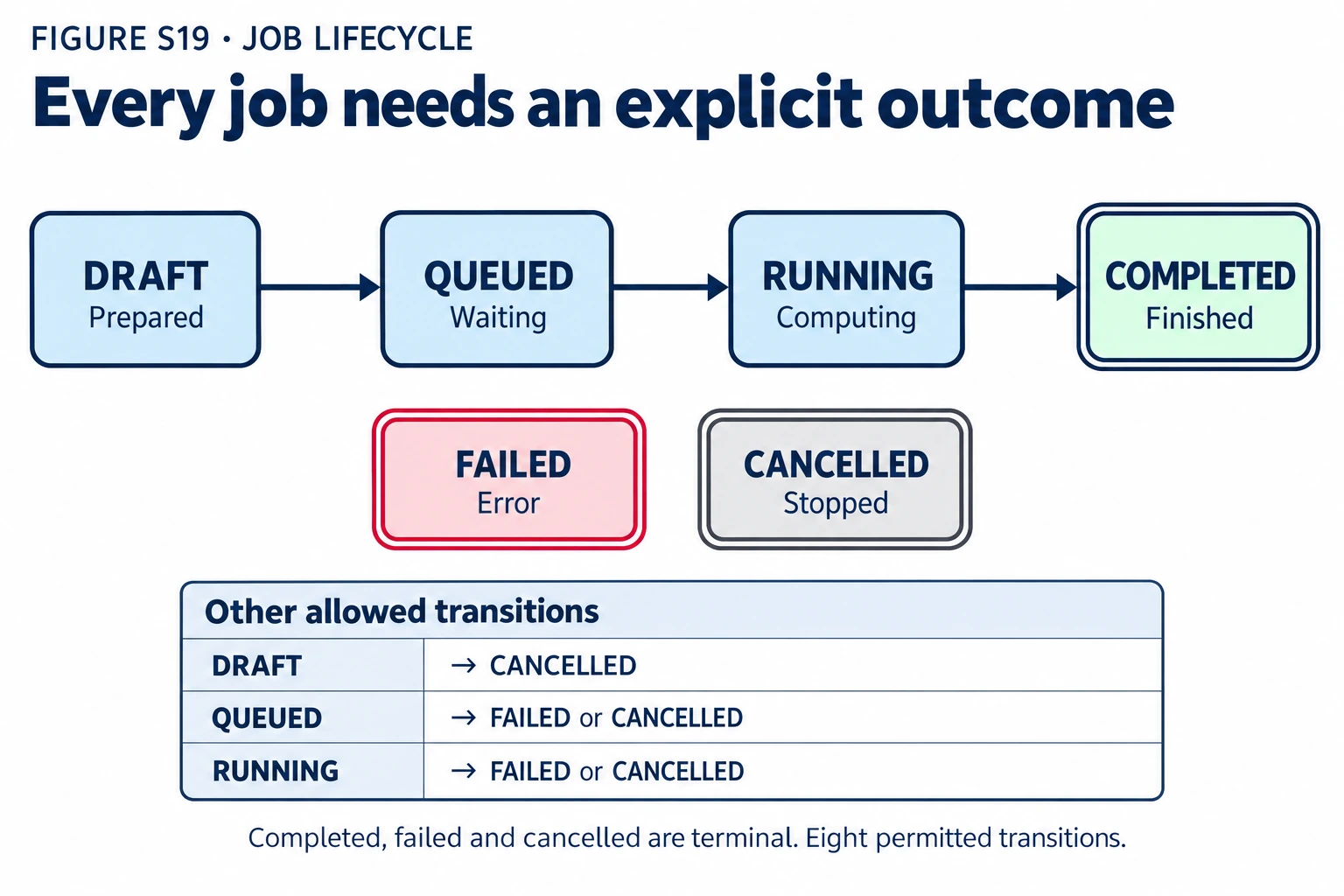
Six states have eight permitted transitions. COMPLETED, FAILED and CANCELLED are terminal; draft may queue/cancel, queued may run/fail/cancel, running may complete/fail/cancel.
Read the details & evidence
Six separate states; only the eight declared transitions are permitted. Completed, failed and cancelled are terminal.
- DRAFT
- May queue or cancel
- QUEUED
- May run, fail or cancel
- RUNNING
- May complete, fail or cancel
- COMPLETED
- Terminal
- FAILED
- Terminal
- CANCELLED
- Terminal
Runs use six states: DRAFT, QUEUED, RUNNING,
COMPLETED, FAILED and CANCELLED. The last three are
terminal. A draft can be queued or canceled; a queued run can begin, fail or be canceled;
a running job can complete, fail or be canceled. Legal transitions are declared with the model
and applied centrally by the analysis service.
Cancellation sets a request flag. The engine checks its callback between stages and batches,
rather than being killed during a folding call. Scientific input or compatibility failures
become safe terminal messages a researcher can read. Unexpected programming errors are logged
with the run identifier for diagnosis; the user-facing response contains neither a traceback
nor a filesystem path. Task exception handling must reach a terminal state instead of leaving
the interface polling RUNNING indefinitely.
Result import verifies the submitted input identity when available, referenced artifacts and checksums. Candidate and metric rows are created in one database transaction, and a second import into the same populated run is rejected. File writes are outside the database transaction: a rollback can leave orphan bytes in artifact storage, but these have no successful result record pointing to them. Such a run is not marked complete. This distinguishes atomic database import from a stronger, unsupported claim that every filesystem write rolls back.
Where the code and data live
| Location | Responsibility |
|---|---|
src/api/ | Authentication, schemas, routers, ownership checks and error responses. |
src/apps/ | Accounts and keys, datasets/catalogue, run orchestration, result import, artifacts and annotations. |
src/engine/contract.py, client.py | Versioned cross-boundary records and the EngineClient/LocalEngine interface. |
src/engine/domain.py | Immutable records for genes, triggers, gates, circuits, folds, constraints and assembled parts. |
src/engine/pipeline.py | Orchestration, tool construction, stage wiring and artifact release. |
src/engine/stages/, gates/, scoring/ | Scientific stages, registered chemistries/tools, profiles, filters, normalization and ranking. |
frontend/src/ | Routes, wizard, results explorer, help, API client and query hooks. |
clients/ | Python, R and MATLAB packages plus shared conformance fixtures. |
tests/, tools/ | Unit/API/workflow checks, architecture rules, generated API reference and reference-data utilities. |
var/ | Mutable database, uploads, generated artifacts and logs; excluded from source control. |
The platform stores datasets, immutable submissions, candidates, individual candidate metrics,
artifacts and user annotations. Ownership follows the submitting account. The engine vocabulary
includes DgeRow/DgeTable, SelectedGene,
TriggerCandidate/TriggerSet, GateDesign,
BooleanExpression/CircuitCandidate, Segment/Plasmid,
and the contract's JobRequest, CandidateResult, ArtifactRef
and JobResult. Frozen dataclasses make the crossing between stages explicit.
Candidate decision tags include none, pinned, shortlisted, rejected and synthesize. These are
user annotations and do not change a computational validation or release result.
Engine coordinates are zero-based with an inclusive start and exclusive end. RNA is uppercase
ACGU; DNA conversion is explicit. Energies use kcal/mol, GC uses percent 0–100,
most accessibility quantities use fractions 0–1, state separation uses log2 fold and dynamic
range uses linear fold. The worked example also provides one-based inclusive coordinates for
human reading. Those conventions must remain attached to exported values.
Algorithms, scientific models and AI-assisted development
Scientific computation and software development are different
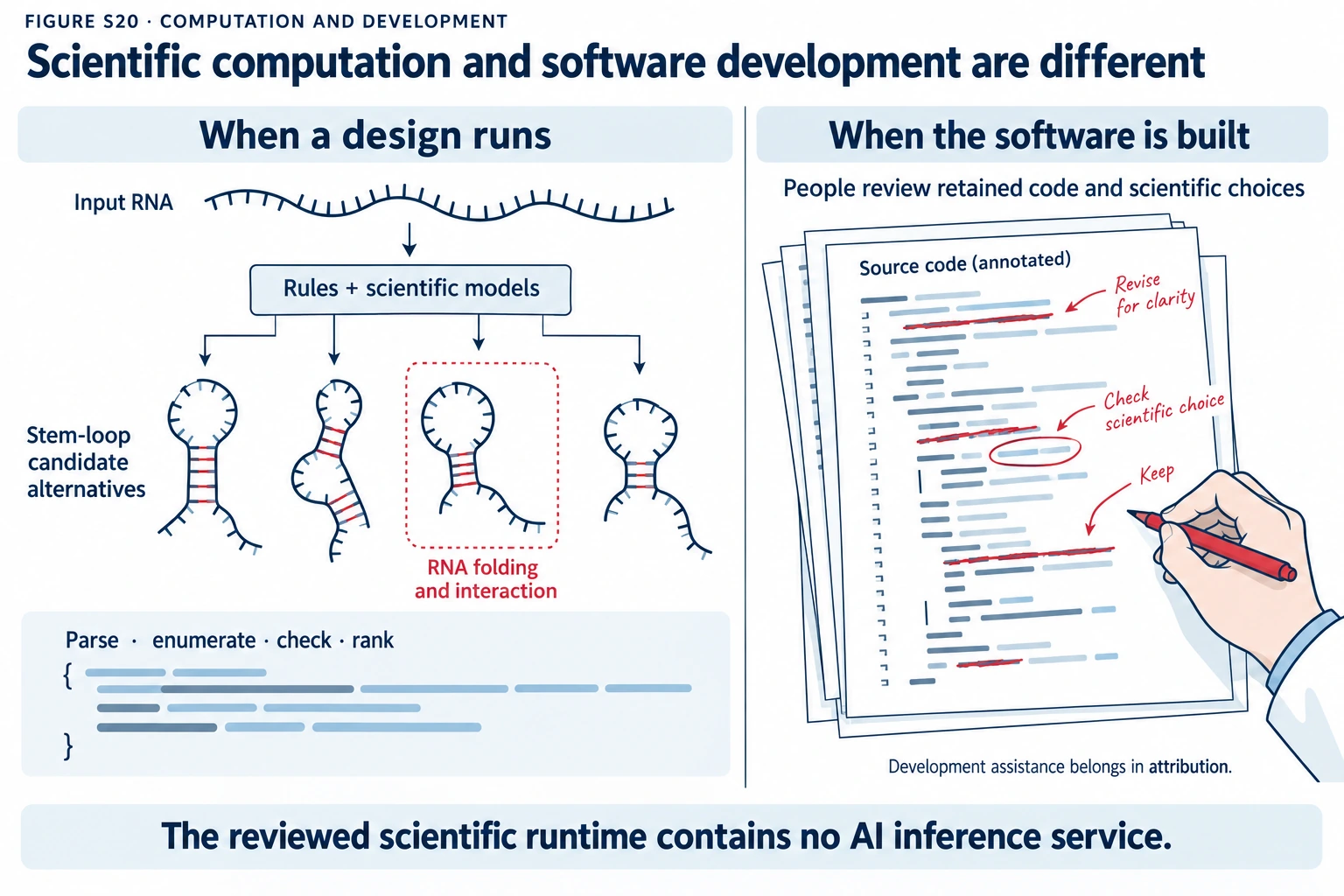
Reviewed scientific runtime uses rules and scientific models, without an AI inference service. Development assistance and human review belong to provenance and attribution.
Read the details & evidence
The reviewed runtime contains no AI inference service; reproducibility is not biological validation.
- Deterministic rules
- Parse inputs, enumerate windows, check motifs and rank candidates.
- Scientific models
- Thermodynamics predicts structures and probabilities, not measured cellular performance.
- Development tools
- AI assistance belongs in attribution, outside scientific runtime.
- Team review
- People verify retained code, scientific choices and claims.
The reviewed runtime contains no generative AI, large language model, neural network, trained classifier or remote inference service. Its Python and JavaScript manifests include no AI inference SDK, and design runs send no biological data to an AI provider.
Deterministic computation
Column normalization, significance adjustment, gene rules, sliding-window enumeration, motif screens, gate templates, reverse complements, weighted ranking, sequence concatenation and the authentication/queue/persistence layers.
Scientific models
ViennaRNA thermodynamics, partition functions, minimum-free-energy structures and base-pair probabilities. Derived leakage, dynamic-range and success values are model-based proxies, not measured cell behavior.
Development provenance
AI assistance in interface design, coding or documentation is recorded separately from runtime behavior. Historical MockEngine data is simulated test material, not a scientific model.
This separation matters when assessing a result: deterministic execution can be reproducible while its biological model remains uncertain. AI assistance used to build the software does not supply scientific validation. The human/third-party attribution record is described in the final chapter.
07 · Run and integrate
Use the application or automate a workflow
The browser and language clients reach one HTTP surface. The browser uses a same-origin session
cookie with CSRF-protected writes; a script sends an X-API-Key header. Both apply
the same ownership rules. A design submitted by a script therefore appears in the same account's
browser history, with the same results and artifacts.
Install the reviewed source snapshot
The web process and worker must run together
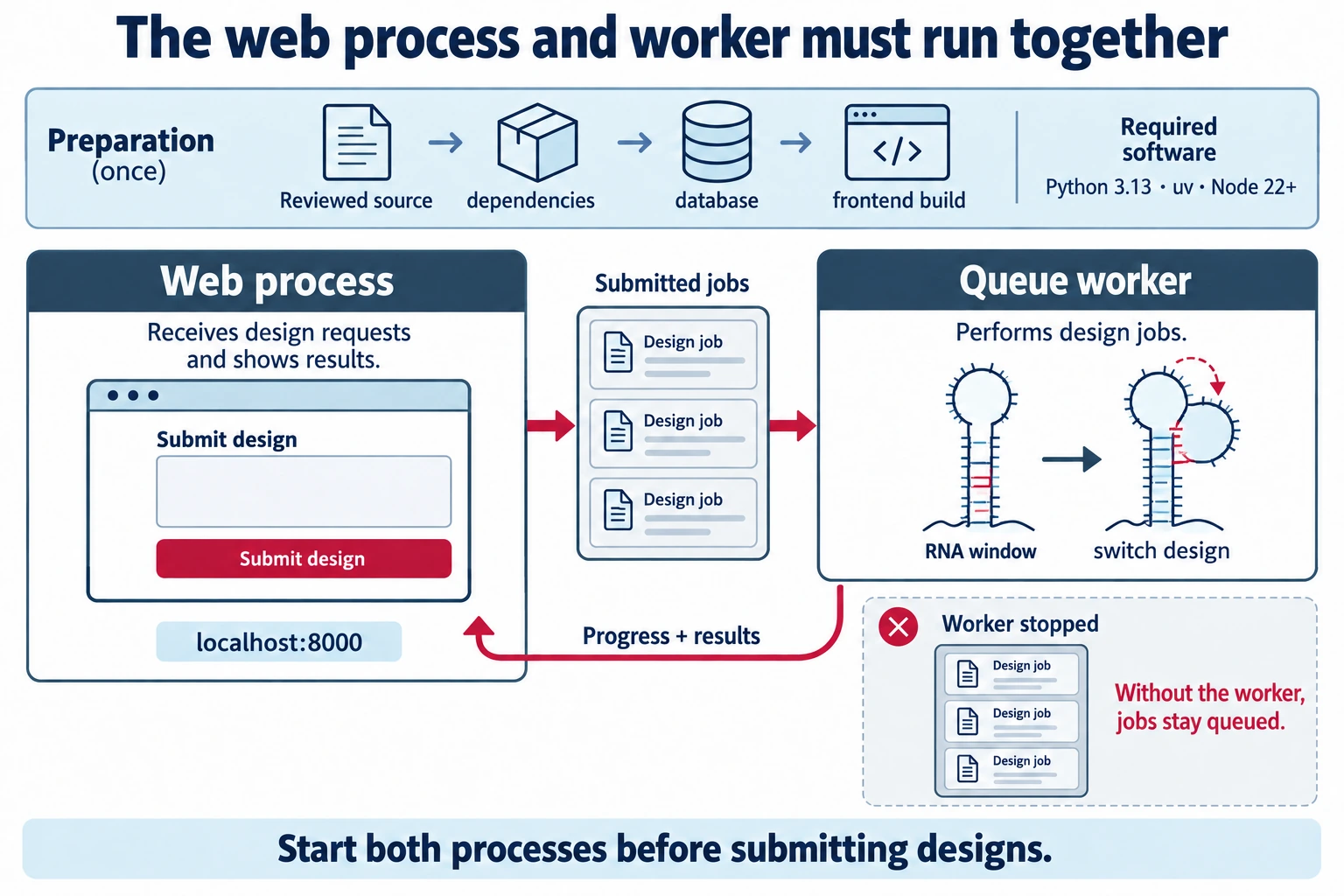
Local setup requires the web process and queue worker together. Without a worker, submitted jobs remain queued. Source environment requirements are retained in the text.
Read the details & evidence
Reviewed setup requires Python 3.13, uv and Node 22+ for the frontend build.
- Reviewed source
- Use the fixed archive and its checksum manifest.
- Set up
- Install dependencies, migrate, create administrator and build frontend.
- Web process
- Serve the local application at localhost:8000.
- Queue worker
- Run LocalEngine jobs; without it, submissions remain queued.
- Deployment review
- TLS, supervision, backups and monitoring remain separate operating work.
Requirements are Python 3.13, uv, Node 22 or newer for the frontend build, and a
worker alongside the web process. Python 3.14 is excluded by this project's dependency
specification. ViennaRNA and Biopython are installed through the Python environment; current
scientific runs use LocalEngine.
Download the complete source snapshot (7.1 MiB)
used for this page. Revision 9a5ca657 was not on the public repository when checked;
this archive contains its tracked files. The
source manifest records its checksum and provenance.
The public repository may contain a different revision, so it is not substituted for this
reproducible snapshot.
Human reference-data availability. A verified, versioned download link and checksums for the separate human reference files human.fasta.gz and human.json are pending. The source archive and manifest above document the reviewed snapshot.
tar -xzf cernal-source-9a5ca657.tar.gz
cd cernal-source-9a5ca657
./do install
./do migrate
./do superuser
./do build-frontend
CERNAL_ENGINE=engine.client.LocalEngine ./do devCERNAL_ENGINE=engine.client.LocalEngine ./do workerOpen http://localhost:8000 and sign in with the administrator account created during
setup. Without the worker, submissions remain queued. The production frontend is built into
Django's static assets; Node is needed to build it, not to run a second production frontend
server. ./do frontend provides the Vite development server for interface work;
./do help lists the task runner's commands.
The example can also be rerun directly through the engine without either server process using the replay instructions. Neither path provisions the screening adapter needed for sequence-file release. Historical documentation describing MockEngine as the default predates this snapshot and should not guide engine selection.
The five endpoints used by clients
Submit once, then follow the job handle
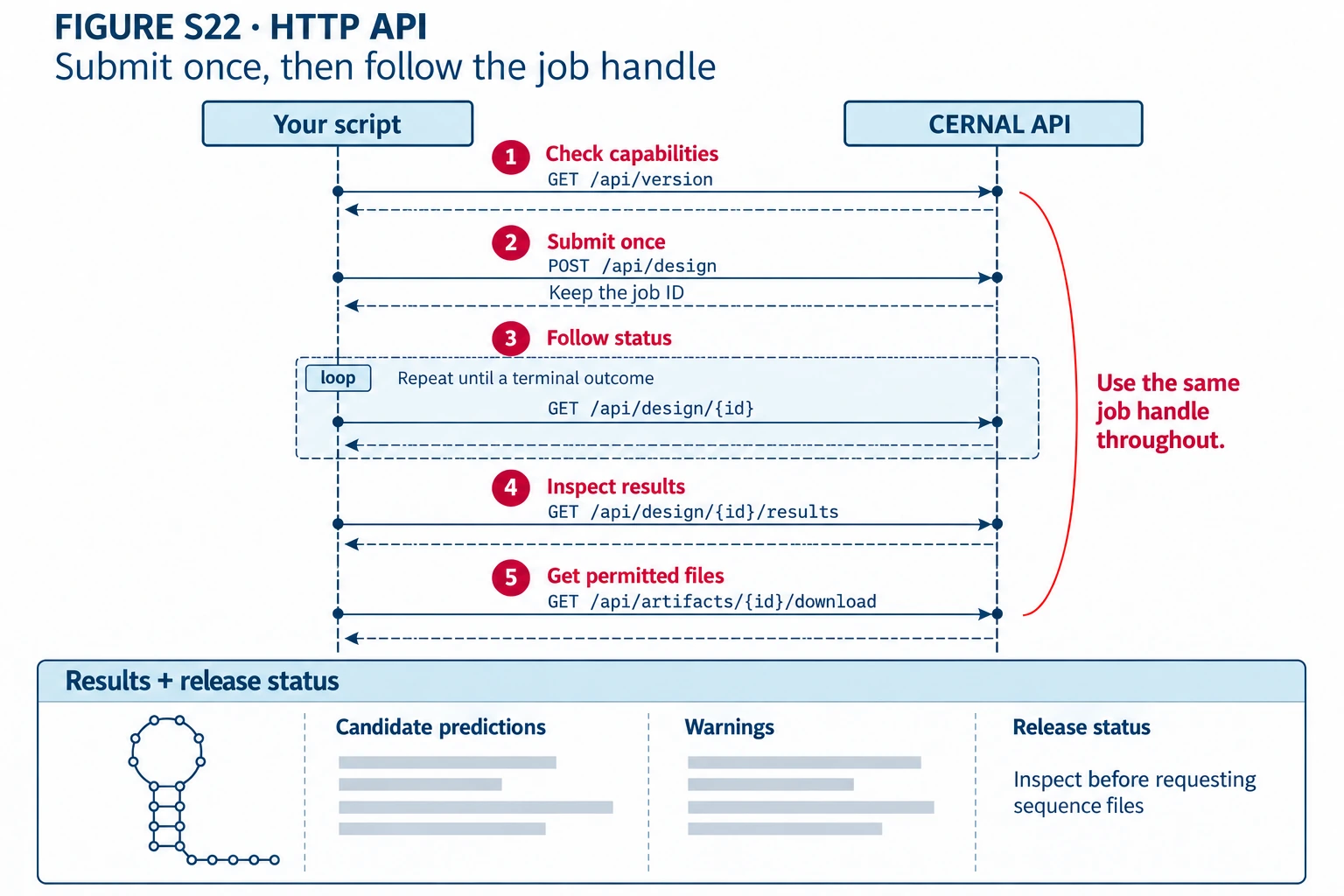
Use the version endpoint, submit a design once, retain its job ID, poll status, inspect results and request permitted files.
Read the details & evidence
Optional waiting keeps the same job handle; dry-run budget estimates are not enforced limits.
- Capabilities
- GET /api/version declares versions, profiles and available options.
- Submit
- POST /api/design returns a job handle.
- Poll status
- GET /api/design/{id} until a terminal outcome.
- Inspect results
- GET /api/design/{id}/results returns candidates and metric decomposition.
- Download artifact
- GET /api/artifacts/{id}/download checks ownership and available artifacts.
| Endpoint | Purpose |
|---|---|
GET /api/version | Application/API/engine versions, family metadata, scoring profiles, metric vocabulary/units, hard filters and available backbones. |
POST /api/design | Resolve one scientific input and submit through the same service as the wizard. Returns a job handle or, with optional waiting, a completed response. |
GET /api/design/{id} | Cheap status polling without retransmitting the full result. |
GET /api/design/{id}/results | Ranked candidates and metric decomposition; ?format=csv returns a flat table. |
GET /api/artifacts/{id}/download | Ownership-checked download of a stored artifact. The URL is an API route, not a storage path. |
The wider API covers datasets, the public catalog, runs, candidates, annotations, archives and
exports. The running application serves interactive documentation at /api/docs and
its generated specification at /api/openapi.json. The
API reference records field semantics and
the versioning contract.
Submission options: ?wait=60 allows a request to
wait up to sixty seconds; the hard ceiling is 300 seconds. If work remains, the client retains
a job handle and can continue polling. ?dry_run=true estimates the search without
creating a run. top_n limits returned candidates, and artifact selectors control
which artifact metadata is included. Submitted budget values support rough
estimates, but the scientific pipeline does not enforce those budgets as resource limits.
Its current dry-run budget_ok response is always true and must not be treated as
a verified resource-budget check.
The strict /api/design constraint block accepts max_triggers,
min_separation, max_p_adj, trigger_lengths,
max_switch_length, forbidden_motifs and standard.
Broader engine settings such as gene-count or abundance/GC bounds are not automatically accepted
by this endpoint. Custom hard filters must include a non-empty reason.
Strict submission rejects misspelled keys inside constraint, scoring, payload and budget
blocks with a structured 422 response and suggestions. This avoids silently using a
default when a caller meant to change a parameter. Error responses consistently carry a code,
message and structured detail; the frontend's typed ApiError also retains HTTP
status. An object owned by another account returns 404 rather than confirming its existence
with a permission-denied response.
Custom backbone parameters belong to the run-submission workflow, not the fast design endpoint's request schema. Strict nested-key checking should not be interpreted as a promise that every unknown top-level field is rejected.
React Query uses separate resource keys for the session, capabilities, datasets/catalogue, runs, candidates, artifacts, annotations and API keys. Polling stops at a terminal state; mutations can refresh the affected data without recreating a second source of scientific state.
Within a declared API schema version, the documented compatibility promise is additive changes: do not remove or rename fields or change their types/units, and let clients ignore unknown response fields. The engine's public surface is generated into a committed reference, with a freshness test that detects documentation/source drift. The run records its engine and schema versions so changes can be traced after the fact.
API keys, scopes and compute quotas
Keys use the recognizable cern_live_ prefix. Only a SHA-256 digest and short display
prefix are stored; the full secret is shown once at creation. Keys can expire, be regenerated
or be revoked. The two scopes are read and design, with design implying
read. Key-based clients cannot create/manage keys or delete datasets; those operations require
the user's browser session.
The default key settings are sixty requests per minute and two concurrent active runs. The active-run check counts the owner's queued/running work against the requesting key's configured ceiling. Concurrency matters because a fast submission loop can otherwise fill a one-worker queue even while staying within a request-rate limit. Limits use shared database-backed counters and 429 responses with retry information; browser sessions do not use these key quotas.
For the examples below, create a design-capable key in Settings and make its value available to
the client process as CERNAL_API_KEY. Start the local application and worker first.
Run from the extracted source directory and save the provided mcherry.fasta there.
These are client recipes, not claims that their API presets reproduce the exact native-engine
request above.
Python, R, MATLAB and curl
One API, different client evidence
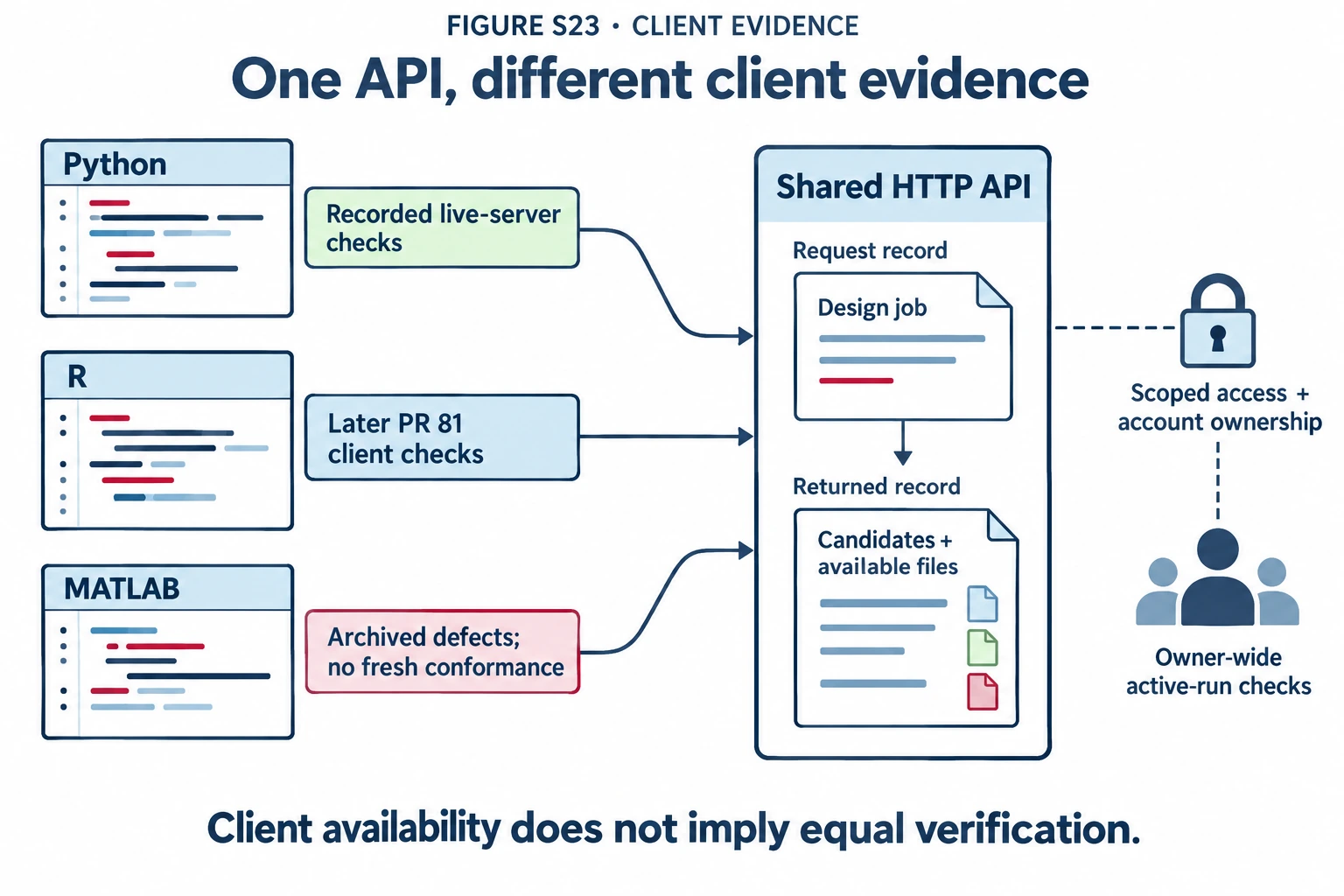
Python, R and MATLAB use the same authenticated API but have different recorded verification. Shared access does not establish equal client conformance.
Read the details & evidence
Client availability does not imply equal verification across language runtimes.
- Python
- Source package has recorded live-server CI conformance.
- R
- Later PR 81 reports client checks beyond the archived walkthrough.
- MATLAB
- Archived wrapper defects; no fresh conformance claimed.
- Shared HTTP API
- Browser sessions or scoped X-API-Key access preserve ownership.
- Key controls
- Hashed, scoped, expiring and revocable keys have compute quotas.
All clients wrap the same five operations. Python exposes Client.design,
status, results, artifact and capabilities.
Its returned job supports wait, best, to_dicts, optional
to_dataframe and artifact download. Waiting uses polling with backoff rather than
submitting another job.
Python uses requests, with pandas optional. R uses httr2 and tibble without a Bioconductor
dependency and returns candidate rows suitable for dplyr/ggplot2; its S3 error classes distinguish
authentication, validation, rate limits and failed runs. The MATLAB wrapper is designed around base
webwrite/webread, snake_case name-value parameters and tables, without
requiring the Bioinformatics Toolbox. Its known snapshot defects and a direct HTTP alternative
are documented in the MATLAB recipe below.
uv pip install ./clients/pythonimport os
from pathlib import Path
from cernal import Client
sequence = "".join(
line.strip() for line in Path("mcherry.fasta").read_text().splitlines()
if not line.startswith(">")
)
client = Client(
api_key=os.environ["CERNAL_API_KEY"],
base_url="http://localhost:8000",
)
job = client.design(
trigger_sequence=sequence,
organism="ecoli",
gate_families=["toehold"],
seed=7,
)
print(job.estimate)
rows = job.wait().to_dicts()
print(rows[:3])Execute the script with the source environment's Python. Install pandas to use
to_dataframe(). Download an artifact only after checking that its kind is present;
the example's sequence files are held. Use Client(dry_run=True, ...) to obtain
an estimate without submitting, and do not call wait() on a dry run.
install.packages(c("httr2", "tibble"))
install.packages("clients/r", repos = NULL, type = "source")
library(cernal)

lines <- readLines("mcherry.fasta")
sequence <- paste(lines[!startsWith(lines, ">")], collapse = "")
client <- cernal_client(
  Sys.getenv("CERNAL_API_KEY"), base_url = "http://localhost:8000"
)
job <- cernal_design(client, trigger_sequence = sequence,
                     organism = "ecoli", gate_families = list("toehold"), seed = 7L)
result <- cernal_results(cernal_wait(job))
print(head(result))
To continue an existing DESeq2 workflow, export its results with an explicit gene-identifier
column and pass the resulting text as dge_csv. The package does not run DESeq2
itself. This source recipe has not been independently executed with an R runtime in the
evidence presented here.
The archived wrapper exposes cernal.Client, design,
Job.wait and table results, but source review found two defects: authenticated
headers are concatenated into the wrong matrix shape, and asynchronous polling replaces the
response containing job_id with a status object that uses id.
It should not be presented as a verified working client in this revision.
The following alternative calls the same API with MATLAB's built-in HTTP functions, keeps the original job ID and uses a two-column header matrix. It was checked against the API source and MATLAB's weboptions documentation, but has not been executed in a MATLAB runtime.
baseURL = 'http://localhost:8000';
apiKey = getenv('CERNAL_API_KEY');
assert(~isempty(apiKey), 'Set CERNAL_API_KEY before starting MATLAB.');
headers = {'Accept', 'application/json'; 'X-API-Key', apiKey};
postOptions = weboptions('HeaderFields', headers, 'Timeout', 30, ...
    'MediaType', 'application/json', 'ContentType', 'json');
getOptions = weboptions('HeaderFields', headers, 'Timeout', 30, ...
    'ContentType', 'json');
lines = readlines('mcherry.fasta');
sequence = char(join(lines(~startsWith(lines, '>')), ''));
body = struct();
body.trigger_sequence = sequence;
body.organism = 'ecoli';
body.gate_families = {'toehold'};
body.seed = 7;
response = webwrite([baseURL '/api/design'], body, postOptions);
jobId = char(response.job_id);
started = tic;
while ~ismember(char(response.status), {'COMPLETED','FAILED','CANCELLED'})
    if toc(started) > 300
        error('Polling timed out; the existing job ID is %s.', jobId);
    end
    pause(2);
    response = webread([baseURL '/api/design/' jobId], getOptions);
end
if ~strcmp(response.status, 'COMPLETED')
    error('Run %s ended %s.', jobId, response.status);
end
result = webread([baseURL '/api/design/' jobId '/results'], getOptions);
disp(result.candidates);
For wrapper development, inspect clients/matlab/+cernal/private/request.m and
clients/matlab/+cernal/Job.m in the source archive. Because Job is a value class,
a repaired wrapper's wait call must retain the returned object:
job = job.wait(); T = job.results();.
curl -sS 'http://localhost:8000/api/design?wait=60' \
  -H "X-API-Key: $CERNAL_API_KEY" \
  -H 'Content-Type: application/json' \
  --data @clients/fixtures/design_request.json
This fixture is a separate client-conformance input, not the 711 nt mCherry request.
Use ?dry_run=true instead of the wait query to request an estimate without
creating work. The native engine's downloadable request.json is not the same
schema as the HTTP request fixture.
The Python client has a live-server conformance job in CI. R and MATLAB ship suites against shared request/column fixtures, but those runtimes were not independently verified in the recorded evidence; the MATLAB wrapper also has the two source-identified defects above. The included Jupyter quickstart demonstrates intended scoring overrides, estimates, plotting and downloads; it contains deployment/key placeholders and is a template, not an executed benchmark. Client packages are available from the source archive; package-index publication is not required by the local installation recipes.
Development setup and deployment are different deliverables
The reviewed archive's deploy/ contains only a placeholder. It does not provide a
verified Dockerfile, systemd service, reverse-proxy configuration or deployment automation.
The deployment document describes a proposed application/compute separation and runbook.
There is no verified public service demonstrated by this page.
Production settings require an explicit secret key and allowed hosts. Operators also need to configure trusted CSRF origins as appropriate, database/media paths, upload limits and logging; collect static assets; supervise the web process and worker; and test the reverse proxy, TLS, backups, monitoring and upgrades. Secrets belong in the deployment environment, not the source archive. SQLite with one worker is the implemented v1 arrangement. Other databases/brokers and independently scaled workers are extension work, not a demonstrated deployment capability.
08 · Evidence and remaining work
What has been tested, and what remains uncertain
Follow each claim to something you can inspect
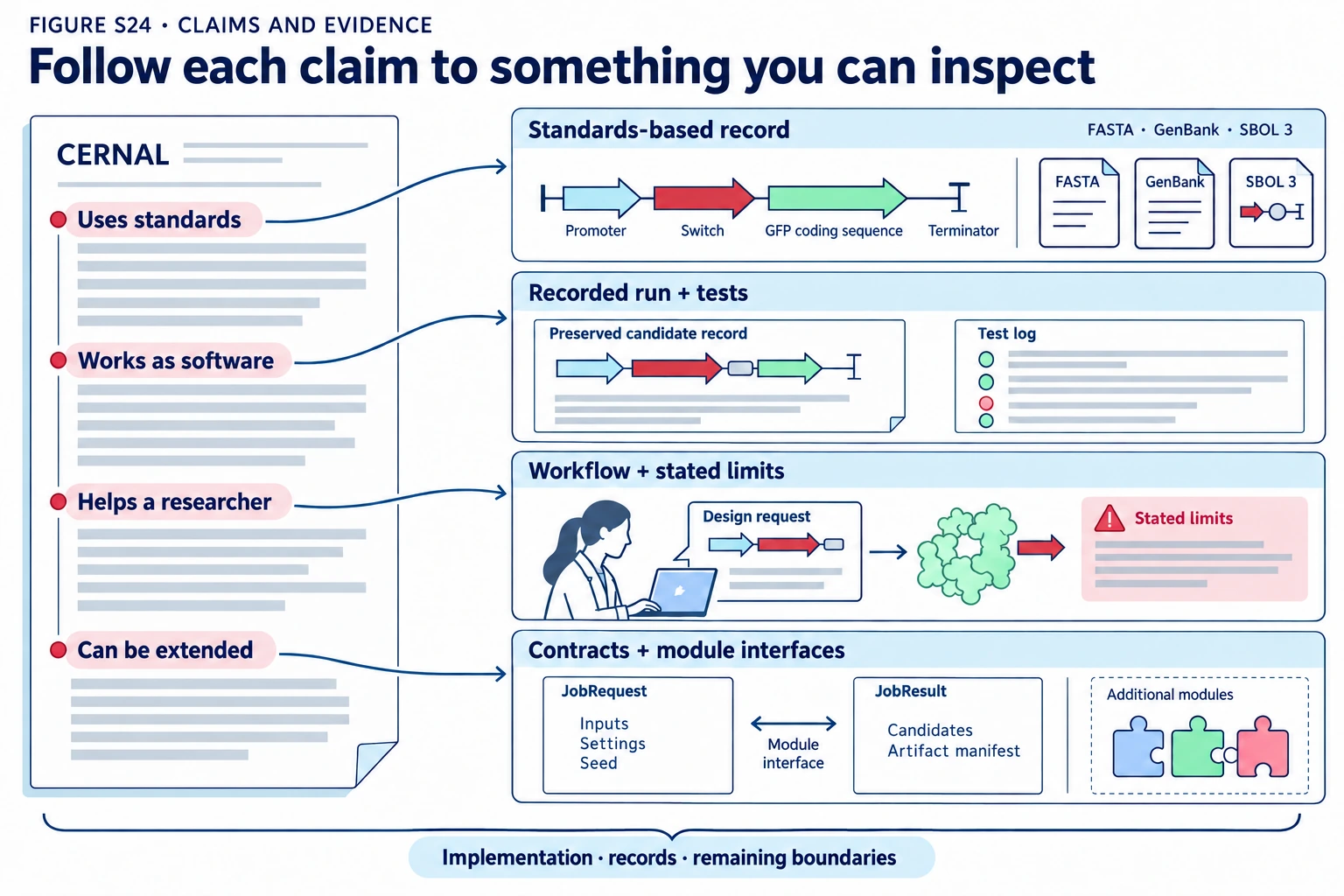
Standards, recorded runs, workflow and interfaces lead to separate source evidence. Scientific claims remain linked in the page text.
Read the details & evidence
Every claim links to a concrete implementation, record or remaining boundary.
- Standards and integration
- Input formats, sequence records and versioned HTTP API
- Validation
- Recorded run, test map and scientific comparisons
- Usefulness and usability
- Supported workflows, four-step browser and explicit limitations
- Extension and documentation
- Engine boundary, module map, install guide and reusable interfaces
Four kinds of evidence answer different questions
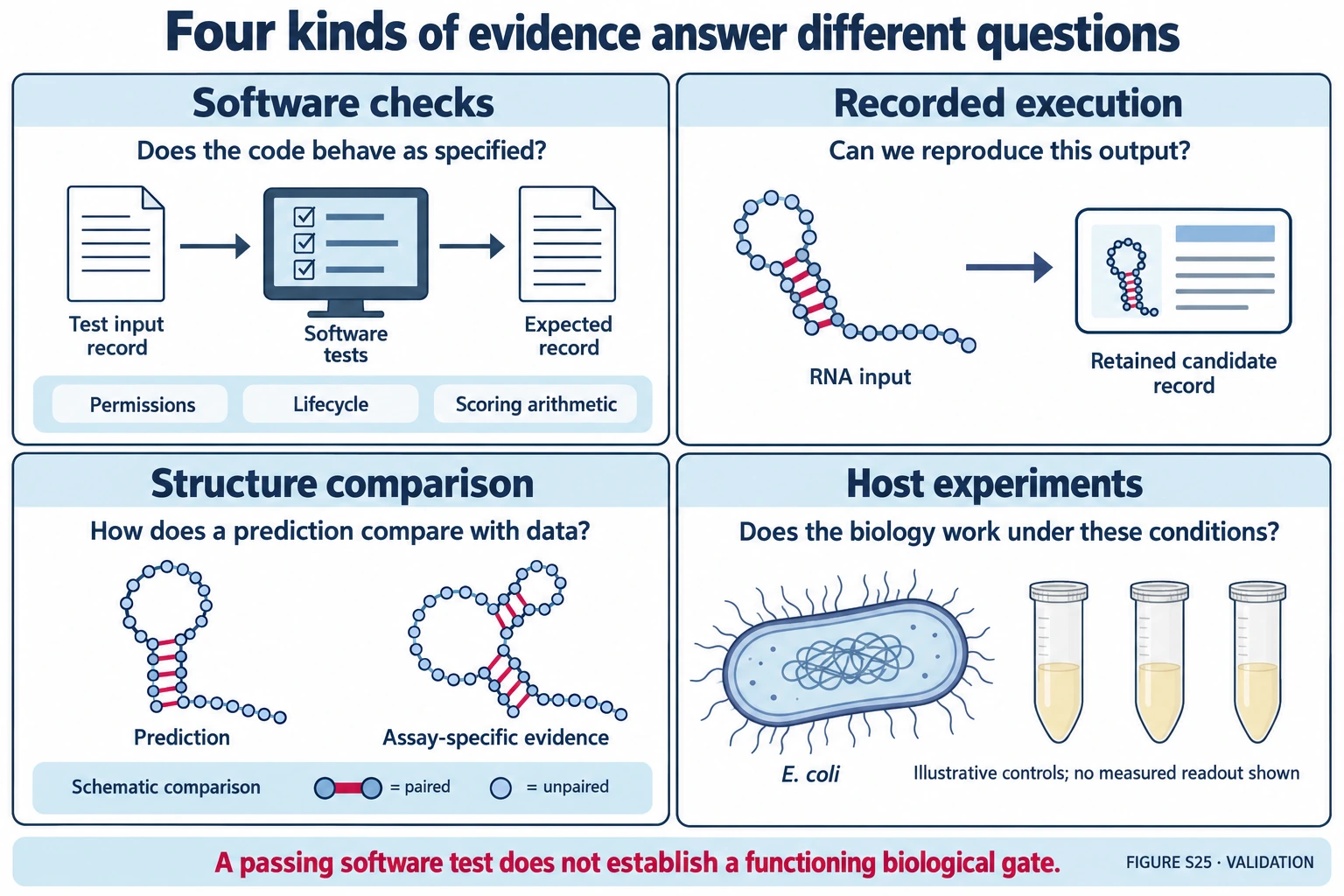
Software checks, recorded execution, structure comparisons and host experiments answer different questions. One kind does not substitute for another.
Read the details & evidence
A passing software check or successful ranking does not establish a functioning gate.
- Software checks
- Exercise parsing, permissions, lifecycle, scoring arithmetic and interfaces.
- Recorded run
- Exposes candidate ranking, rejected alternatives and an export hold.
- Structure comparison
- Challenges a prediction against assay-specific experimental structure data.
- Host experiments
- Test biological questions with host-specific controls and limitations.
The recorded run shows that the current scientific engine processes one real transcript and returns a reproducible candidate ranking, including one scored rejection and an explicit export hold. Automated checks address broader software behavior. Experiments are needed to establish whether those designs function in cells; neither a successful run nor a large test count answers that question.
Dated verification snapshot
The preserved check dated 29 September 2026 used the locked Python environment and Node 22.23.3. It reported the following results. These are historical recorded checks, not newly rerun totals for the 7 October source snapshot.
| Check | Recorded outcome |
|---|---|
pytest -q | 1,148 tests passed in 61.54 seconds. |
| Ruff lint/format | Lint passed; 206 files already formatted. |
| Django system checks | Passed after frontend assets were generated. |
| Frontend checks/build | TypeScript and ESLint passed; seven logic-diagram render cases passed; Vite transformed 2,533 modules and produced the application bundle. |
| Documentation checks | Clean whitespace diff, balanced code fences, required sections and all 67 relative Markdown links resolved in that document. |
The original verification record
preserves its context. Formatting/file/module counts describe the check, not biological
performance. The reviewed CI workflow
runs on pull requests and pushes to main, rather than every feature-branch push.
It installs the scientific stack and tests LocalEngine; the older description of mock-only
CI no longer applies.
What each test suite establishes
| Suite or check | What it exercises |
|---|---|
tests/engine/ | Domain records, parsing, gene/trigger selection, folding/tools, gate families, switch checks, assembly, scoring, pipeline, candidate storage and references. |
tests/api/ | Authentication, registration, keys/scopes/quotas, datasets/catalogue, input modes, submission/status, candidate/artifact access, CSV/ZIP and annotations. |
| Top-level backend checks | Models, lifecycle/cancellation, result import, expression services/providers, administration and architecture conventions. |
tests/e2e/test_full_workflow.py | The researcher workflow and failed-run presentation through backend/API layers; this is not a browser-device audit. |
frontend/e2e/render-logic.mjs | Server-rendered diagrams with different activator/repressor counts and empty graphs. |
frontend/e2e/smoke.mjs | A browser-flow script exists, but the snapshot includes obsolete project routes. It needs maintenance before being cited as current live-browser evidence. |
| Client conformance | Python against a live server, including capabilities, submission, authentication errors and typo suggestions. R/MATLAB source suites require their runtimes. |
test_boundary.py | Engine/platform import separation by source-level AST inspection. |
test_house_rules.py | Shared-tool construction, metric vocabulary, raw-value rules and forbidden imports/conventions. |
test_api_surface_is_fresh.py | The generated engine reference still matches the source. |
These checks substantiate transformations, validation, permissions, state transitions, response shapes, checksums, scoring arithmetic and selected scientific computations against fixtures. They do not establish wet-lab function, calibration across organisms, off-target specificity, clinical safety, production reliability or independent accessibility/security certification.
Crowdcast-inspired exploratory documentation review
A simulated review can suggest improvements
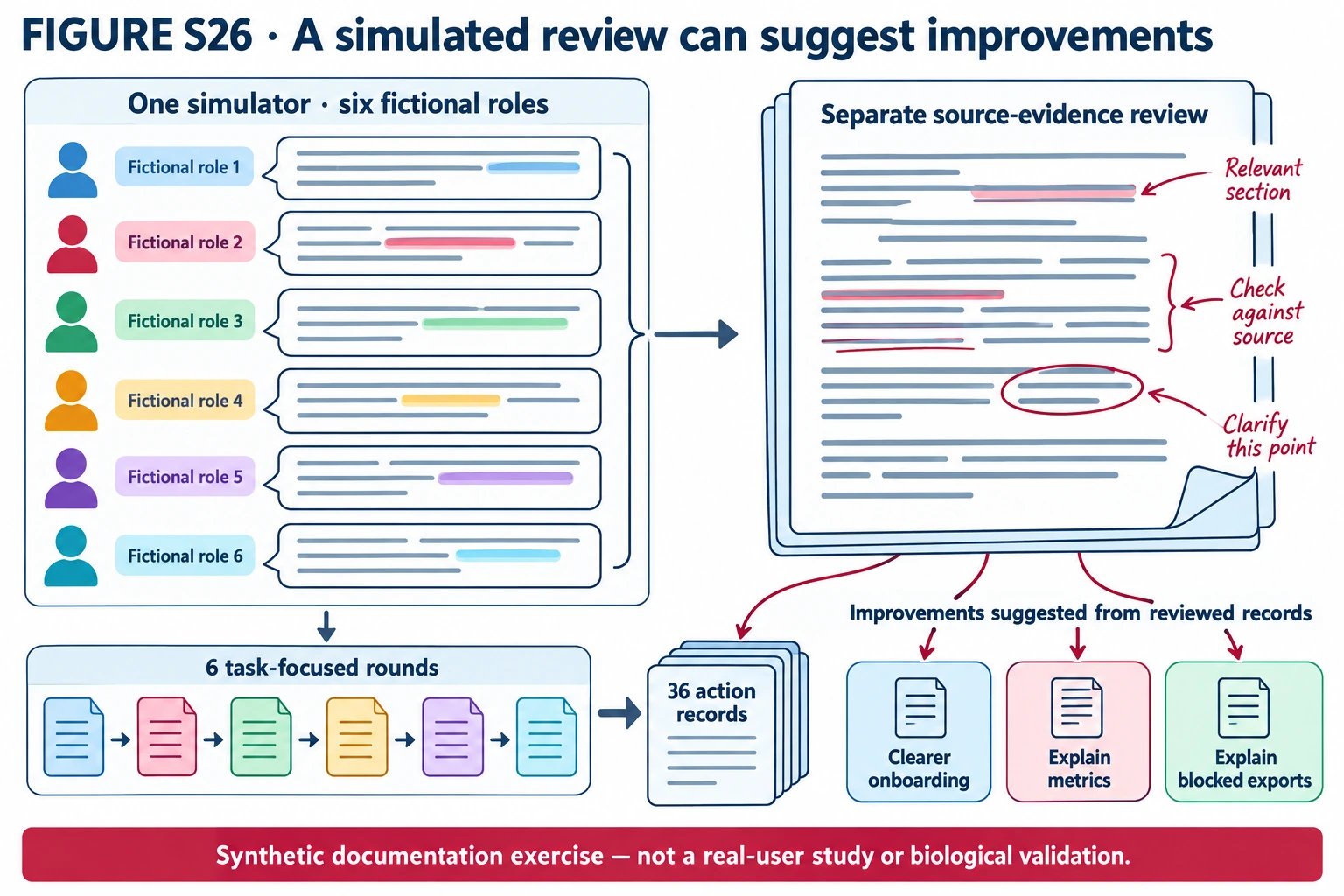
One simulator explored six fictional stakeholder roles over six rounds, producing 36 action records checked against sources. This is not a real-user study.
Read the details & evidence
This synthetic documentation exercise is not a real-user study or scientific validation.
- Source analysis
- Preserve revisions and prepare fictional stakeholder roles.
- Simulated discussion
- One simulator explores task-focused rounds with six fictional roles.
- Claim review
- A separate review checks recorded actions against source evidence.
- Candidate improvements
- Improve onboarding, metric interpretation and blocked-export next steps.
We used an AI-assisted workflow inspired by Crowdcast to explore CERNAL documentation through six fictional stakeholder roles across six sequential task-focused rounds. The workflow separated source analysis, persona preparation, recorded discussion and review of every action. One simulator modeled the six roles; a separate review checked source claims. Source revisions, persona definitions and all 36 action records were retained for inspection.
The exercise produced candidate improvements concerning onboarding, differential-expression input preparation, metric interpretation, evidence boundaries and withheld sequence release. The recommendations were to name an accountable next step for blocked exports, keep the meaning of uncalibrated metrics visible, consolidate differential-expression preflight checks, distinguish hosted and local setup paths, and provide a compact claim/evidence ledger. Existing documentation already contains many of the relevant caveats. These recommendations concern how readers find and act on them.
This was a synthetic documentation exercise, not a real-user study, browser usability test or scientific validation. Proposed changes remain proposals until separately implemented and verified. The separate AIS-China exchange records real peer feedback on downloads, navigation and run naming.
What the scientific comparisons found
The current RNA-availability comparison uses E. coli structure-probing data. Across matched seed-probability bins, marginal accessibility exceeded the benchmark composite's Pearson correlation in 15 of 20 bins. Mean correlation was 0.33708 for marginal accessibility and 0.30115 for the composite. These are associations with a probing signal, not probabilities that a switch will work.
The benchmark composite is distinct from CERNAL's final weighted candidate score. Overlapping windows and shared model assumptions limit independence; this comparison does not establish trigger binding, gate activation or cross-host performance. The Results accessibility chapter retains cohort accounting, source data and ablations. The Model validation chapter explains the resulting design decision and its limits.
Scientific limitations that affect interpretation
Read the condition beside the capability
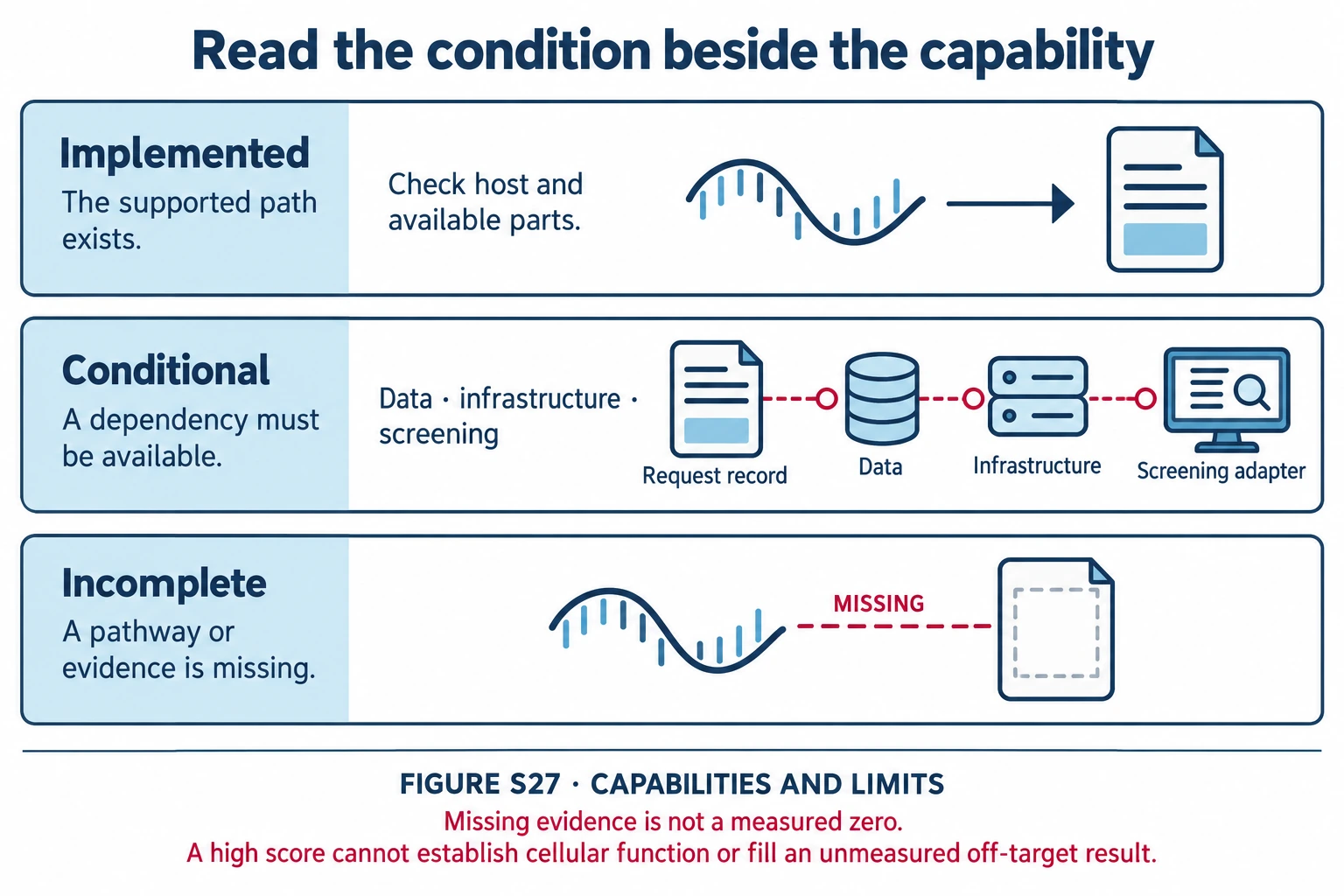
Implemented, conditional and incomplete are support categories. Missing evidence is not a numerical zero, and a high score cannot fill it.
Read the details & evidence
A high score cannot resolve missing off-target measurements or establish cellular function.
- Implemented
- Code supports the declared input, host and available parts.
- Conditional
- Execution or release depends on infrastructure, data or screening.
- Incomplete
- Missing pathways or measurements remain visible, never scored as zero.
- Next verification
- Test deployment, clients and host-specific function; calibrate scientific proxies.
- The host experiments provide preliminary bacterial reporter evidence, partial yeast suppression and HEK expression/FACS measurements. They do not calibrate the software's ranking or establish a generally validated design pipeline. Structural proxies and scoring choices remain provisional.
- Transcriptome off-target matching is not implemented; the former scanner/placeholder fields were removed. Missing orthogonality does not mean verified specificity.
- Current multi-gene conjunction proposals are computational combinations of available switches. They are not a complete Boolean compiler or evidence that a physical combined circuit implements the displayed truth condition.
- The product does not ingest per-sample counts; confusion matrices, sensitivity and specificity are therefore not measured from its current inputs.
- The selectable two-input path is merged in the source update, but unavailable in the archived example; deployment and experimental performance remain unestablished. Operational antisense integration and CRISPR remain unavailable pipeline paths; human discovery/default assembly is unsupported.
- GFP is the built-in payload. Other outputs need supported parts or a custom validated coding sequence. No codon optimization is performed; supplied payload sequences are retained.
- Input contrast direction cannot be verified from the results table alone. A valid file can still represent the opposite biological comparison.
- A high score does not resolve missing measurements, uncertain kinetics/context or incomplete screening. The evidence and scoring profile must travel with the number.
Assembly checks, screening and human review
Different safety checks have different jobs
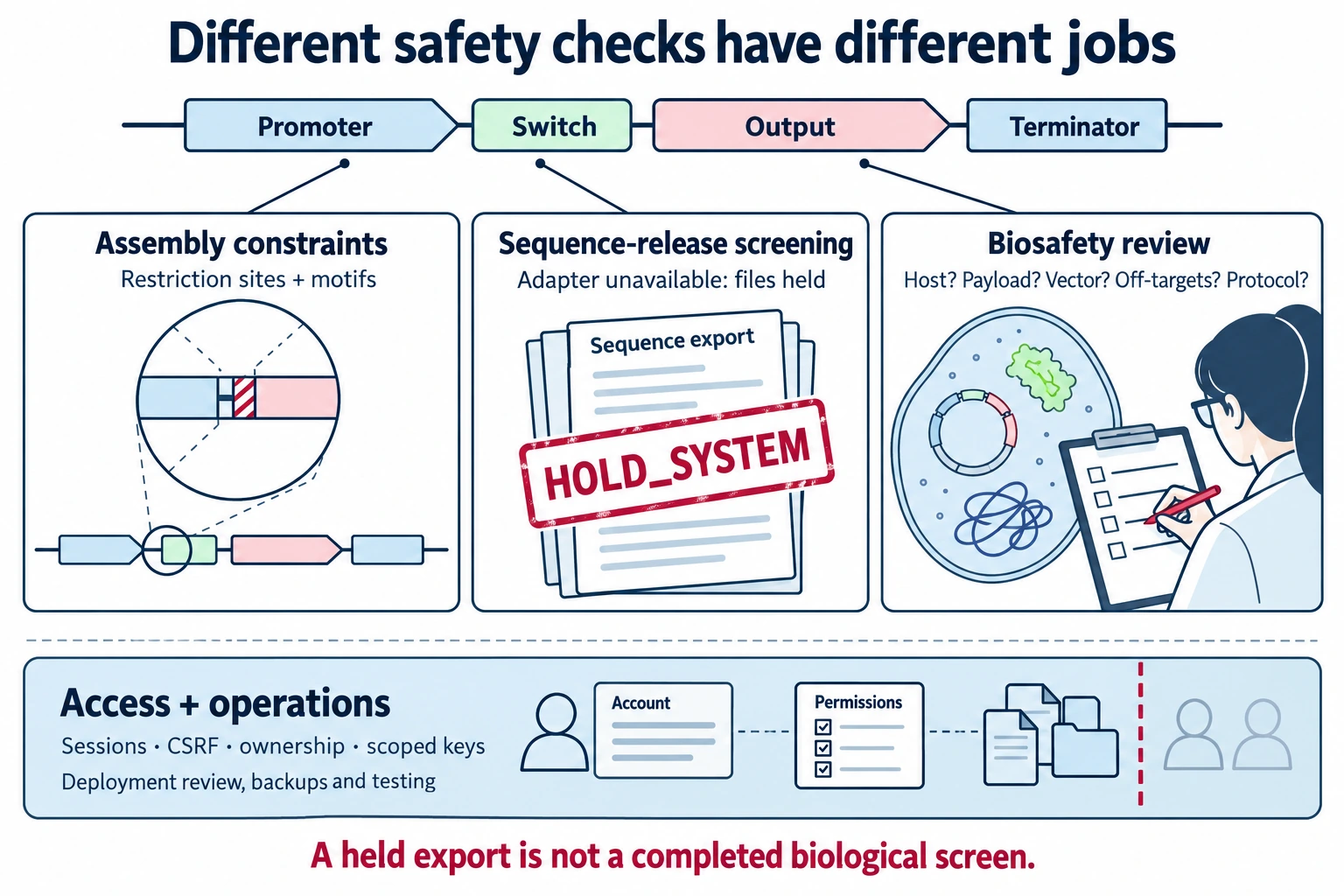
Assembly constraints, sequence-release screening, biosafety review and access/operations checks serve different purposes. A hold is not a completed screen.
Read the details & evidence
A held export is not a completed biological screen; a user tag is not approval.
- Assembly checks
- Restriction sites and motifs test sequence constraints.
- Release gate
- Unavailable screening adapter holds sequence-file release.
- Biosafety review
- Review host, payload, vector, off-targets and experimental protocol.
- Access controls
- Sessions, CSRF, ownership checks and scoped keys restrict access.
- Operational review
- Threat modelling, backups and penetration testing remain deployment work.
A restriction-site or motif screen tests sequence/assembly constraints. It does not establish absence of hazards, organism-specific off-target effects or appropriate containment. The current release gate refuses sequence files when its screening adapter is unavailable, as shown by the example's audit; that refusal must not be described as a completed biological screen.
Before laboratory use, review the host, payload, vector, selectable marker, promoter and
terminator; unintended reading frames/regulatory elements; relevant off-targets; and the
assembly method and experimental protocol under the team's institutional and competition
biosafety process. The software does not provide a validated pathogen/toxin database or
containment assessment. A SYNTHESIZE decision tag is an annotation by a user,
not an automated approval or proof that a construct is ready for synthesis.
Implemented security controls and operational gaps
The platform uses same-origin HttpOnly sessions and CSRF protection rather than browser-stored bearer tokens. Registration is inactive by default pending staff approval. Queries and artifact downloads are scoped to owners; API keys are hashed, scoped, expiring/revocable and subject to request/concurrency limits. Upload size/row checks, sanitized storage paths and safe error envelopes reduce accidental exposure through files and diagnostics.
Production settings include secure cookies, HTTPS redirect, HSTS, frame denial, MIME-sniffing protection and a same-origin referrer policy. Expensive worker tasks are not silently retried. These controls still need a real deployment to be reviewed: threat modeling, dependency scanning/update policy, backup/restore drills, log/privacy policy, an incident contact and independent penetration testing remain operational work, not completed certifications.
Capability matrix
“Implemented” below means code exists for the stated scope, with its conditions preserved. “Conditional” means execution or verification depends on infrastructure/data/runtime that is not established by the example. “Incomplete” identifies a scientific or product gap.
| Capability | State | Conditions or remaining work |
|---|---|---|
| Browser product | Implemented | Account approval, running web/worker processes and usable inputs; current live-browser/accessibility evidence still needed. |
| Local direct path | Implemented | Compatible host/family and real parts. Current mCherry result is provided. |
| Local DE path | Implemented for E. coli/yeast | Bundled references and accepted results table. Human and count-based evidence remain absent. |
| Single-input toeholds | Implemented | Generic/host-specific variants; experimental calibration remains. |
| Multi-gene circuit proposals | Implemented within scope | Conjunctions from available switches with a complexity cost. General logic and measured cellular behavior are not established. |
| Plasmid assembly | Implemented for available parts | GFP/custom payload; no backbone, catalog or custom GenBank. Host/protocol expansion remains. |
| Sequence-file export | Conditional; held in example | FASTA/GenBank/SBOL serializers exist; release requires an available screening adapter and approval from the release check. |
| API and keys | Implemented | Sessions/keys, ownership, scopes and quotas. |
| Python client | Implemented; CI conformance | Installable from source; public package-index publication is not established here. |
| R/MATLAB clients | Archived limitations; later R CI reported | The archived walkthrough does not verify R runtime behavior; the later source update reports R client checks. MATLAB authentication-header and asynchronous-ID defects are identified in the archived wrapper; a direct HTTP recipe is provided. No fresh MATLAB conformance is claimed. |
| Deployment | Conditional | Local setup documented; production infrastructure and its operational verification remain. |
| Two-input toehold | Selectable path merged; 16 October update | Unavailable in the archived example; PR 81 is merged. Deployment and experimental performance are not established here. |
| Antisense / CRISPR | Incomplete as pipeline paths | Payload integration or mechanism/off-target work, depending on the family. |
| PDF/scientific figure generation | Incomplete | Declared interfaces need implementations. |
| Wet-lab validation | Host-specific preliminary evidence | Reporter, suppression and expression measurements test different questions. Pipeline-wide calibration and functional human NOT/AND validation remain incomplete. |
| MockEngine | Historical test fixture | Removed from the current runtime; simulated legacy outputs are not scientific results. |
Priorities for the next iteration
- Provision and validate sequence screening and biological off-target analysis with reference provenance, keeping release decisions distinct from structural ranking.
- Add per-sample evidence and the confusion evaluator, then extend beyond conjunctions to broader circuit logic with explicit biological implementation assumptions.
- Verify the merged selectable AND path in its operating environment and test its predicted four-state behavior experimentally.
- Integrate payload-aware antisense while preserving its inverted default-state/leakage meaning.
- Define and implement a CRISPR mechanism with an appropriate genomic off-target model.
- Calibrate proxy metrics, weights and thresholds against experimental measurements.
- Expand verified host parts, payloads, transcriptomes and assembly protocols.
- Implement scientific figures, reports and per-stage snapshots.
- Execute R/MATLAB conformance checks and maintain the browser smoke flow, then assess usability and accessibility with users.
- Supply deployment artifacts and verify supervision, monitoring, backups and upgrades before making production-service reliability claims.
09 · Reuse and attribution
Build on CERNAL's components
Reuse the component your project needs
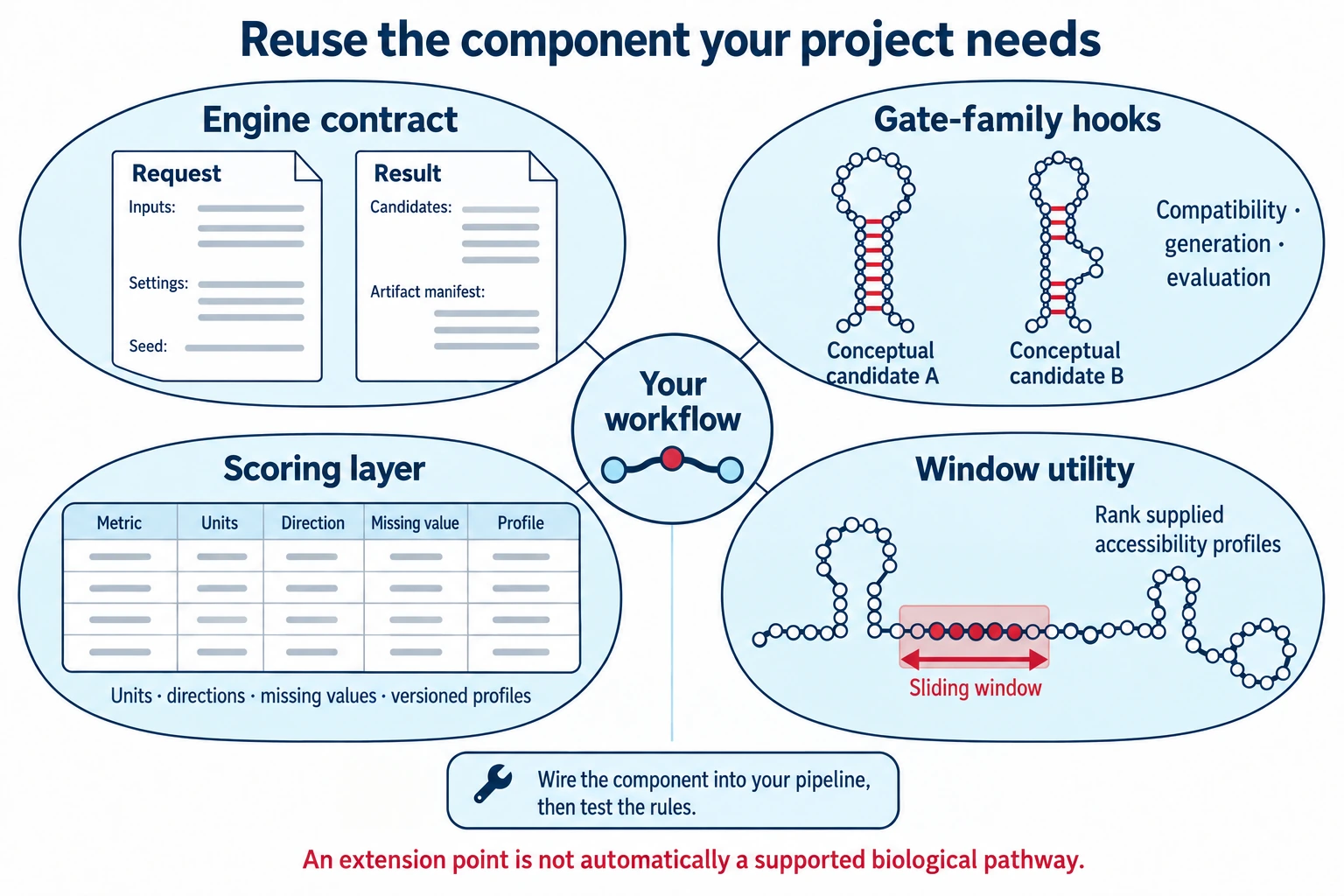
The engine contract, gate-family hooks, scoring layer and window utility are independent reuse points; new behavior still requires integration and tests.
Read the details & evidence
A new module is an extension point, not automatically a supported biological pathway.
- Engine contract
- Frozen requests and results work without the web platform.
- Gate-family hooks
- Declare compatibility, generation, evaluation, sequence and artifact behavior.
- Scoring layer
- Keep units, directions, missing values and versioned profiles.
- Window utility
- Rank supplied accessibility profiles with deterministic output and provenance.
- Wire and test
- Complete pipeline integration and rule checks before enabling new behavior.
Another team can adopt the full application, call its API or use the engine without the web product. The most reusable pieces have small interfaces and explicit inputs, making it possible to keep a useful part even when the scientific mechanism or interface changes.
Interfaces worth reusing
| Component | How another team can use it |
|---|---|
| Gate-family interface | Add a module and registration entry, declare its scope, and implement compatibility, generation, evaluation, sequence and artifact hooks. Complete pipeline wiring and tests before enabling it for users. |
| Scoring layer | Reuse metric declarations, directions, units, missing-value policy, normalization, weighted scores and filters for comparing heterogeneous designs. |
| Engine contract | Use frozen request/result records to run scientific work without Django, accounts or a database, or implement another execution backend. |
| Boundary and rule tests | Adapt AST-based checks so architecture and scientific conventions remain enforceable across handovers. |
| Trigger-window utility | Rank supplied accessibility profiles offline with deterministic output and provenance. The preserved default is nucleation-first lexicographic ranking; a balanced geometric-mean mode is an explicit sensitivity alternative. |
Preserve the engine/platform boundary, raw measurements and missing values. Version a scoring profile or gate rule whenever output can change, and test it before advertising availability. This is particularly important when replacing folding libraries or introducing a chemistry whose leakage semantics differ from existing families.
Begin with the architecture guide,
gate-family interface,
scoring profiles and
standalone ranking guide.
Numbered architecture decision records in the archive explain choices with maintenance costs.
Use ./do lint and ./do test when modifying behavior.
Licensing and dependency notices
Keep licences and provenance attached
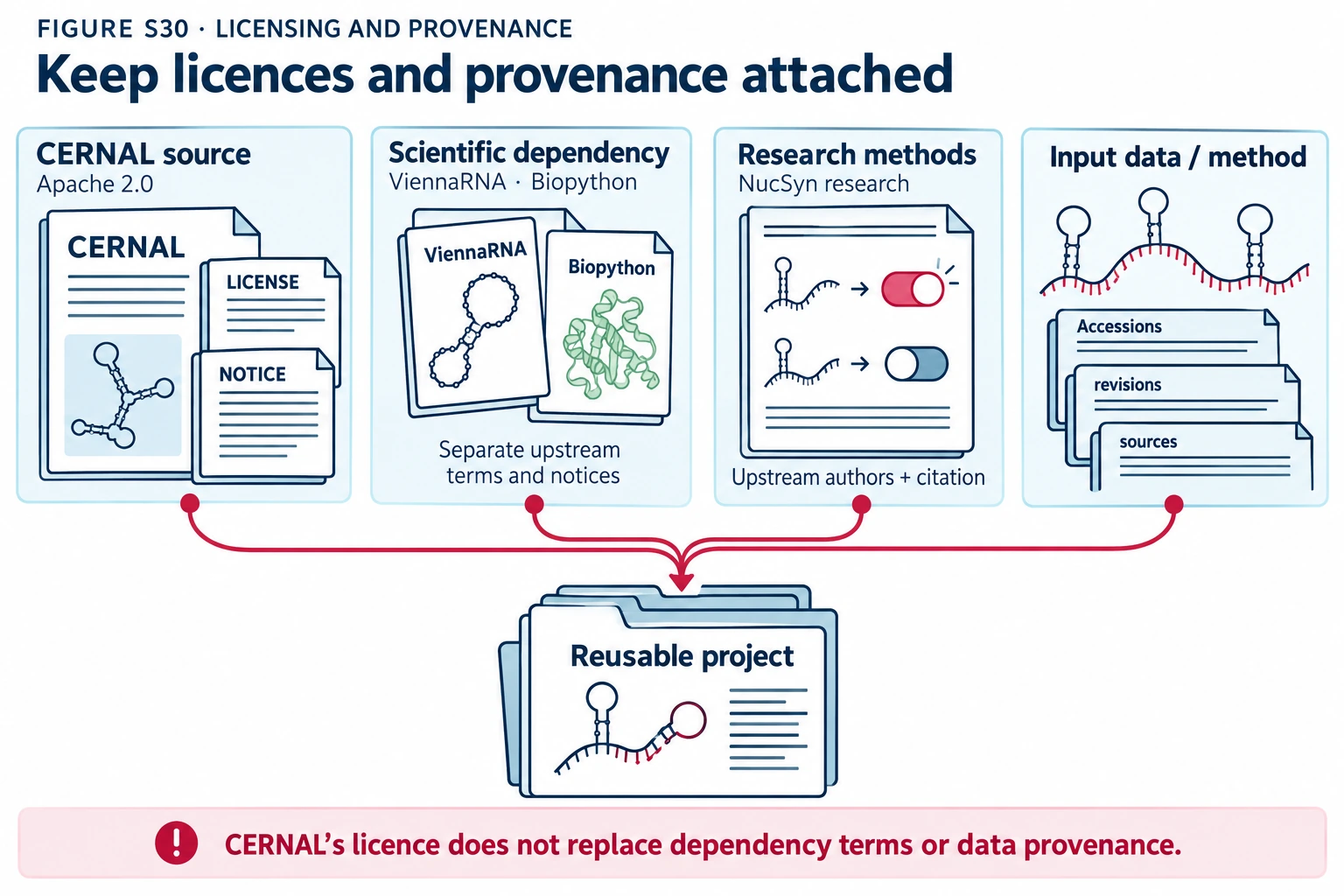
CERNAL source terms, dependency terms, NucSyn attribution and data/method provenance must remain distinct. The page retains the applicable source records.
Read the details & evidence
CERNAL's own licence does not replace scientific dependency terms or data provenance.
- CERNAL source
- Apache 2.0; preserve LICENSE and NOTICE.
- ViennaRNA
- Separate custom licence and redistribution terms require review.
- Biopython
- Preserve upstream and applicable file-specific licence notices.
- NucSyn research
- Credit upstream authors, citation and separately licensed software.
- Supporting records
- Retain contributors, dataset accessions, source revisions and method citations.
CERNAL's source is under the Apache License 2.0; preserve its LICENSE and NOTICE. Major platform dependencies use BSD, MIT and other permissive licences, but that does not make every scientific dependency interchangeable under one licence label.
ViennaRNA uses a custom licence allowing research, educational and commercial use while restricting redistribution for a fee beyond media costs and requiring attribution. CERNAL's source distribution does not vendor it; users install it as a dependency. Its terms need separate consideration when redistributing an environment or container, and the dependency must not be silently described as ordinary MIT/BSD code. See the ViennaRNA licence.
Biopython uses the Biopython License Agreement, with some files explicitly dual-licensed under BSD 3-Clause. Retain the relevant upstream notices and file-specific terms; describing the entire dependency as simply MIT is inaccurate. The Biopython source/licensing page explains that distinction. Neither dependency changes the licence of CERNAL's own code.
NucSyn authorship and citation
We credit Yehuda Landau and coauthors for NucSyn Platform and the upstream switch-design work used by the eukaryotic AND research workflow. NucSyn Platform v0.1.2 is distributed as a Linux x86_64 OCI container under its separate upstream licence. CERNAL does not redistribute that container. This release reference identifies the available software; it does not identify the version that generated every historical CSV.
Landau Y, Arbel M, Benarroch D, Klein JY, Moree E, Tuller T. Computational design of toehold switches in eukaryotes and prokaryotes for efficient post-transcriptional control. bioRxiv, 2025 (preprint). doi:10.1101/2025.01.15.633215. The upstream citation record provides the bibliographic attribution.
People, development tools and data provenance
CERNAL was built by the Tel Aviv University iGEM team. The repository records AI-assisted development and documentation separately from scientific runtime behavior. The frontend began with a Lovable design export and was substantially adapted into a static React application; the original export and a decision record preserve that origin.
// Work-In-Progress
The attribution record identifies third-party components and includes fields still requiring team confirmation, including named contributors and the scope of coding-assistant use. Those fields should be completed by the team rather than inferred from generated prose. The team remains responsible for understanding and verifying retained code, scientific choices and claims; development tools are reported as tools, not people who performed experiments.
Catalog comparisons carry provider/accession provenance, and the worked example supplies its input and computation records. Historical simulated fixtures or design-export screenshots must stay labeled as demonstrations rather than experimental outcomes. A source file's older description of a mock default or unfinished feature does not override the fixed snapshot and evidence presented on this page.
References and supporting records
[1] Green, A. A., Silver, P. A., Collins, J. J., & Yin, P. (2014). Toehold switches: de-novo-designed regulators of gene expression. Cell, 159(4), 925–939. Original toehold-switch study.
[2] Lorenz, R., et al. (2011). ViennaRNA Package 2.0. Algorithms for Molecular Biology, 6, 26. ViennaRNA methods.
[3] Love, M. I., Huber, W., & Anders, S. (2014). Moderated estimation of fold change and dispersion for RNA-seq data with DESeq2. Genome Biology, 15, 550. DESeq2 methods.
[4] Benjamini, Y., & Hochberg, Y. (1995). Controlling the false discovery rate: a practical and powerful approach to multiple testing. Journal of the Royal Statistical Society: Series B, 57(1), 289–300. False-discovery-rate procedure.
[5] Cock, P. J. A., et al. (2009). Biopython: freely available Python tools for computational molecular biology and bioinformatics. Bioinformatics, 25(11), 1422–1423. Biopython methods.