Our Approach to Safety
The CERNAL compiles circuits - those are meant to act in one cellular state to introduce programmability and control. This presents us with multiple layers of safety questions, from the biosecurity of such a platform, through biosafety of its development and validation in the lab, and bioethical concerns.
Biosafety · The bench
Where we worked
All wet-lab work was carried out at Tel Aviv University, under the university's institutional biosafety rules [1] and under the supervision of our PI and instructor - Prof. Tamir Tuller, Dr. Daniel Dovrat.
We utilized cross-faculty centers for certain specialized equipment such as flow cytometry, plate-readers or sequencing machines, and worked across two Biosafety Level 2 laboratories, supported by the PIs of our graduate students, with each lab specialized for their most common type of work:
- Mammalian laboratory - HEK293T culture, transfection and the dual-reporter readout. Every step in a biological safety cabinet, at BSL-2 practices.
- Microbiology laboratory - cloning, E. coli and yeast. The space is BSL-2 certified, but our work in it is Risk Group 1, so we adhered to BSL-1 practices: open bench, standard microbiological technique, PPE throughout.
Before any team member was allowed to work in the lab they completed the yearly TAU safety training courses, for chemical, biological and emergency safety, and worked alongside an experienced lab member or instructor.
Organisms we used
Organisms are classified by risk groups, with lab space classified by the biosafety level of the work and containment standards within it [2]. Both of our laboratories are BSL-2 certified, and work followed the organism requirements for safety: the three Risk Group 1 strains were handled at BSL-1 practices on the open bench, and the human cell line at BSL-2 in a biological safety cabinet. We deliberately kept the organism list short and manageable - all organisms that are already used commonly in the lab space we had, with minimal new standards to learn. Nothing we worked with is beyond iGEM's whitelist and thus doesn't require additional check-in forms [3].
// organisms
-
E. coli DH5αrisk group 1 [4] → plasmid maintenance and cloning
recombination- and endonuclease-deficient, so a construct comes back out the way it went in. This also leaves it very sensitive and as a poor survivor anywhere but a flask. -
E. coli BL21risk group 1 [2] → toehold switch experiments
Protease-deficient, which is why it is commonly used for expression - we used reporter genes such as; GFP, mCherry. -
S. cerevisiae W303-1Arisk group 1 → CRISPRa gate line
MATa, obtained from the host laboratory rather than a repository.
Carries auxotrophic mutations for Histidine, Leucine, Tryptophan and Uracil. These auxotrophies allow the selection system, with SC dropout media. -
HEK293Trisk group 2 → endometriosis proof of concept
Obtained from ATCCCRL-3216. The only human-derived line in the project, classified Risk Group 2 and handled at BSL-2 in line with institutional standards (see below).
The three microbial strains are Risk Group 1: non-pathogenic, well characterized, and posing minimal risk to laboratory personnel. All work with them was under common safety protocols and procedures:
- Annual safety training - completing the yearly university safety training.
- Personal Protective Equipment (PPE) - lab coats and gloves, at all times at the bench.
- Lab-specific training - best practices, handling, disposal, emergency responses, and equipment operation.
HEK293T (CRL-3216) is an immortalized human embryonic kidney line obtained from
ATCC [5], an established, authenticated repository line with a documented
provenance and certificate of analysis. Thus, gaining their status as spot iGEM's white list and not requiring a
check-in form [3].
Although these cells are tested and verified – All human-derived material is handled under universal precautions and assumed to be potentially infectious regardless of test status. This is the standard ATCC itself recommends for all human cell lines, and which CDC/NIH BMBL applies to human cells irrespective of testing [6]. The presumption runs that way by regulation too: human cell lines fall inside the OSHA Bloodborne Pathogens Standard unless a line has been characterized free of recognized bloodborne pathogens [7], and iGEM itself places human cell lines at Risk Group 2 [8]. In practice:
- BSL-2 containment - all culture work in a biological safety cabinet, never on the open bench.
- Universal precautions - the line is treated as potentially infectious human material whatever its certification says.
- Separation - dedicated media, pipettes and waste, kept apart from the microbial work.
- Mycoplasma testing - on thaw and periodically thereafter. A positive culture invalidates every reporter measurement taken from it, so this is a data-integrity control as much as a safety one.
- Defined passage window - roughly P5–P25 for transfection work, with a fresh vial thawed rather than an overgrown culture rescued.
Hazards at the bench
Non-Biological hazards are also common in the lab, and we encounter them on a daily basis. In the Experiments page each protocol carries information about how each hazard - chemical, physical or else - is handled in that specific experiment; here we include highlights. iGEM asks teams to account for non-biological hazards - physical and chemical - alongside biological ones; corrosives, mutagens and extreme cold among them [8].
Chemical
- Ethidium Bromide - Added to the molten agarose to detect DNA in the gel. As a mutagen, all handling of it was done in the chemical fume hood, gloved, and gels leave the hood only once set. It is the single most hazardous substance in the project and the one with the tightest containment around it.
- Sodium hydroxide, 20 mM - The yeast lysis buffer for genotyping. Dilute, but it is boiled at 95 °C for ten minutes in a closed tube, which is the one step in the project combining a corrosive with pressure. Tubes are opened facing away and allowed to cool before handling.
- Selection antibiotics - Ampicillin and G418, both at 10 mg/ml. G418 is the one to respect: an aminoglycoside, harmful if inhaled, so stocks are made up as liquid by our instructor, to avoid airborne powder.
- Poly-L-lysine, 0.01 % - Used to coat 96-well plates before seeding. Residual PLL is cytotoxic, which is why coated wells are washed twice and dried completely before cells go in - a cell-health control that doubles as a handling one.
- Trypsin-EDTA, 0.25 % - For detaching HEK293T. An irritant to skin and eyes, and handled in the cabinet as part of the human-cell workflow.
- Cell-culture reagents - DMEM, fetal bovine serum, penicillin-streptomycin and Opti-MEM. Low-hazard individually; they matter here because they are animal-derived or contain antibiotics, and because everything they touch is human-cell waste.
- Kit and assay reagents - The Roche High Pure lysis/binding buffer, DNase I and SYBR Green master mix used for transcript quantification. Handled per their datasheets, gloved, with the lysis buffer treated as the one to keep off skin.
Thermal
- Molten Agarose - For casting gel electrophoresis, TAE with agarose are heated in a microwave in short bursts with a loose plug to allow pressure release. The flask is swirled between bursts and allowed to cool to roughly 35-40 °C before anything is added to it. Superheating is the real risk, not the boil.
- Heat blocks - 42 °C for the E. coli heat shock and the 40-minute yeast transformation, 95 °C for the lysate boil. they have a plastic cover to prevent accidental touches and potential burns.
- −80 °C freezers - Glycerol stocks are held in two separate freezers so one failure cannot cost us a construct. Insulated gloves for retrieval; cold contact injury is the hazard, and it is easy to underestimate.
Physical
- Centrifuges - can run upper of 20,000g. Balanced in pairs every time, with dummy tube when necessary. The lid is latched, until the rotor stops.
- UV Gel Imaging - Gel imaging box is equipped with a uv light source. The machine is built and located in a way to minimize accidental exposure, it's maintained turned off when not in use, and cleaned with ethanol after each use.
- Flow cytometry - Both the yeast line and the HEK293T dual-reporter readout are read at single-cell resolution. We use the instrument for analysis only, never for sorting, so no droplet stream and none of the aerosol containment a live sorter would require. The machine is usually operated for us by a trained specialist from the cross-faculty unit that runs it, or Yael from our team that received special training for it.
- CO₂ incubators - Mammalian culture runs at 37 °C in 5 % CO₂. The cylinders are the hazard rather than the incubator: secured, and in a room with the ventilation to handle a leak.
- Autoclaving - Sterilizing media and decontaminating cultured material before disposal. An autoclave is a pressure vessel holding saturated steam well above boiling, so the hazards are scalding on opening, superheated liquids that boil over once the pressure drops, and the vessel itself. Every autoclave run was carried out exclusively by our instructor - no team member operated it. Restricting the machine to one trained, authorized operator is the control, rather than training everyone on the equipment with the highest consequence of misuse.
Our project is inherently low-risk
Setting out the hazards one by one is important for visibility and understanding how everyday actions also carry a risk. But, Our project is designed to be as simple and safe as possible. We avoided high-risk components, procedures and focused on basic molecular biology to build robust and reliable systems:
- No pathogens. Three Risk Group 1 microbial strains and one certified human cell line. Nothing on the iGEM Red List, nothing requiring a check-in.
- No toxins. Every construct we characterized expressed a fluorescent reporter -
EGFP and mCherry from the
pDD-HTP4backbone on the mammalian line, and fluorescence on the yeast line. The therapeutic payload described in the project description is a design target, not something we built. The Experiments page lists every construct, which makes this checkable rather than a claim. - No release. Nothing engineered left containment at any point. Our environmental-sensing work is designed as a lab-on-a-chip assay rather than a deployed sensor - samples come to us, not the other way round - so it raises no deliberate-release question. At the time of writing that assay had not been run.
- No novel hazard. Every technique here is routine molecular biology running in a lab that runs it daily, under supervision from people who run it daily.
The residual risks are the ordinary ones of any molecular biology bench - one mutagen, a few hot surfaces, a corrosive at low concentration - and they are managed by the ordinary controls. Throughout, our work followed the iGEM Safety Policies [9] and Tel Aviv University's institutional biosafety rules [1].
Biosecurity · The CERNAL
Source reviewed on 19 October 2026 against CERNAL revision 35fcbf1. The sections below distinguish implemented behavior, isolated test evidence, and live deployment.
CERNAL includes a sequence-screening checkpoint before generated designs can be released. This checkpoint uses commec, the Common Mechanism screening software developed by the International Biosecurity and Biosafety Initiative for Science (IBBIS). It examines the final sequences produced by the design workflow and holds outputs when screening is incomplete or leaves an unresolved concern.
Screening is one part of responsible sequence design. A result without an unresolved finding does not establish that a sequence is harmless, suitable for an experiment, or approved for synthesis. Biological context and appropriate expert oversight remain essential.
Implementation boundary. The reviewed backend enforces release checks and retains provenance. The optional frontend screening panel is not fully connected, and live deployment has not been verified. Backend schema · Frontend panel.
What IBBIS and Common Mechanism provide
IBBIS is a Swiss nonprofit foundation that develops tools and practices to reduce biological risks. The Common Mechanism is one of its initiatives; commec is the software CERNAL integrates. Calling this “IBBIS screening” is convenient shorthand, but the software, its reference databases, and CERNAL’s own release policy each have a distinct role. IBBIS background · Common Mechanism overview
The software can run on local infrastructure, allowing sequence data and reports to remain within the operator’s environment. This capability should not be confused with a verified claim about the hosting or privacy configuration of any particular CERNAL deployment. Common Mechanism overview
How screening works
Common Mechanism combines three kinds of sequence evidence:
- Biorisk evidence. A profile-based search uses hidden Markov models to look for relationships to curated families of established sequences of concern.
- Best-match evidence. Protein and nucleotide similarity searches provide information about related sequences and their associated control-list annotations.
- Low-concern evidence. Matches to common or conserved biological sequences help interpret earlier findings, including findings that the tool can resolve as cleared.
These stages support a screening decision. They do not experimentally measure the biological activity of a proposed design. Official commec repository
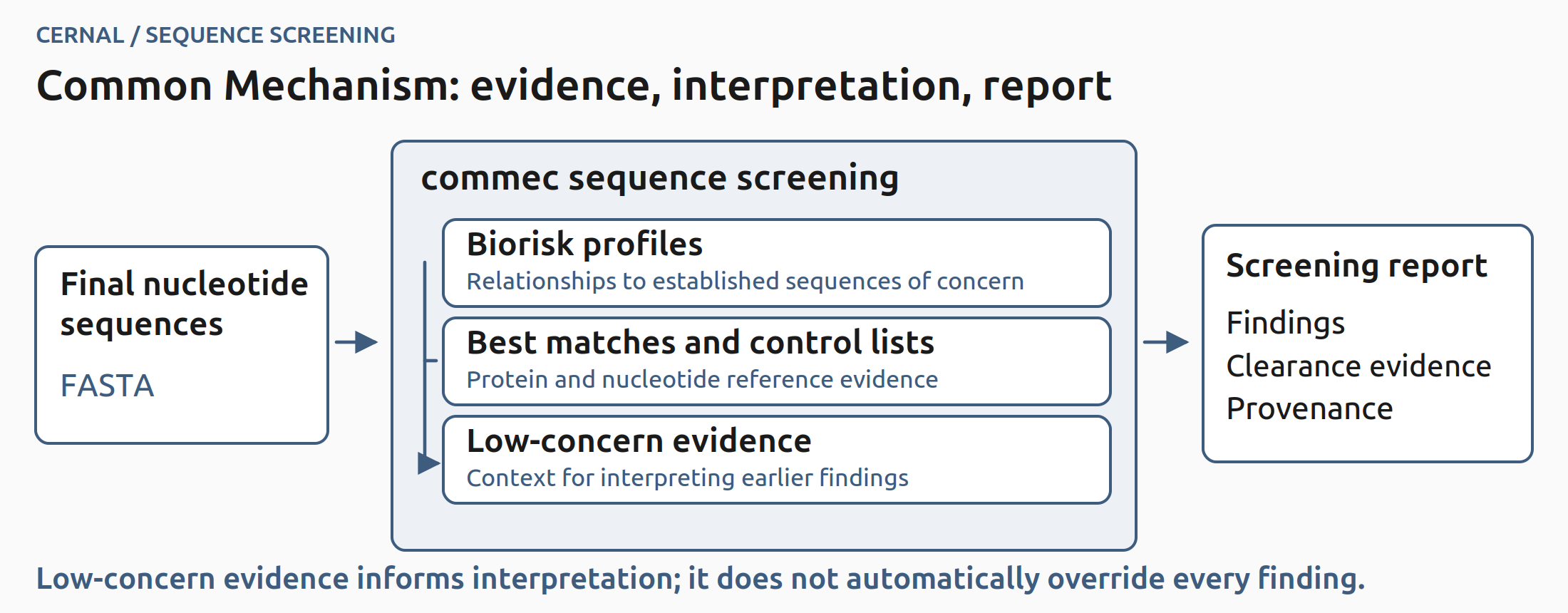
- Final nucleotide sequences enter commec as FASTA.
- Biorisk profiles and best matches with control-list information provide evidence.
- Low-concern evidence helps interpret earlier findings; it does not automatically override them.
- The report retains findings, clearance evidence and provenance.
More detail on the screening mechanism
For nucleotide input, the current documentation describes a protein search against custom-filtered UniRef clusters and a nucleotide search against curated viral reference genomes. Input is supplied in FASTA format; multiple records can be screened together. Control-list interpretation depends on the configured regional scope. Command-line documentation
CERNAL’s reviewed integration targets commec 2.1.0, native JSON schema 0.6, and the CERNAL policy commec-resolved-findings-v2. This version belongs to the v2 database architecture. Older descriptions of Common Mechanism may refer to different databases, output layouts, and supported inputs, so they should not be combined indiscriminately with this implementation. CERNAL adapter contract · Official 2.1.0 release
Where screening fits in CERNAL
The reviewed backend places screening after optimization, when the sequences intended for output are available. For every accepted candidate, it screens both the complete switch sequence and the assembled construct. This matters because an assessment of an earlier input or a partial component would not describe everything that the final design contains. Final-output screening integration
The screening step runs within the existing background analysis workflow. The adapter submits linear nucleotide FASTA records with all available regional control lists selected. RNA is represented as DNA for the command-line screening input, while the retained evidence remains bound to the original sequence. Adapter execution
Both final sequences require valid release evidence before FASTA, GenBank, or SBOL exports are generated. Server-side checks also apply when sequences are disclosed or downloaded, including sequence identity, evidence expiry, and the active screening manifest. These checks revalidate eligibility; they do not rerun the biological screen at every download. Export checkpoint · Release revalidation
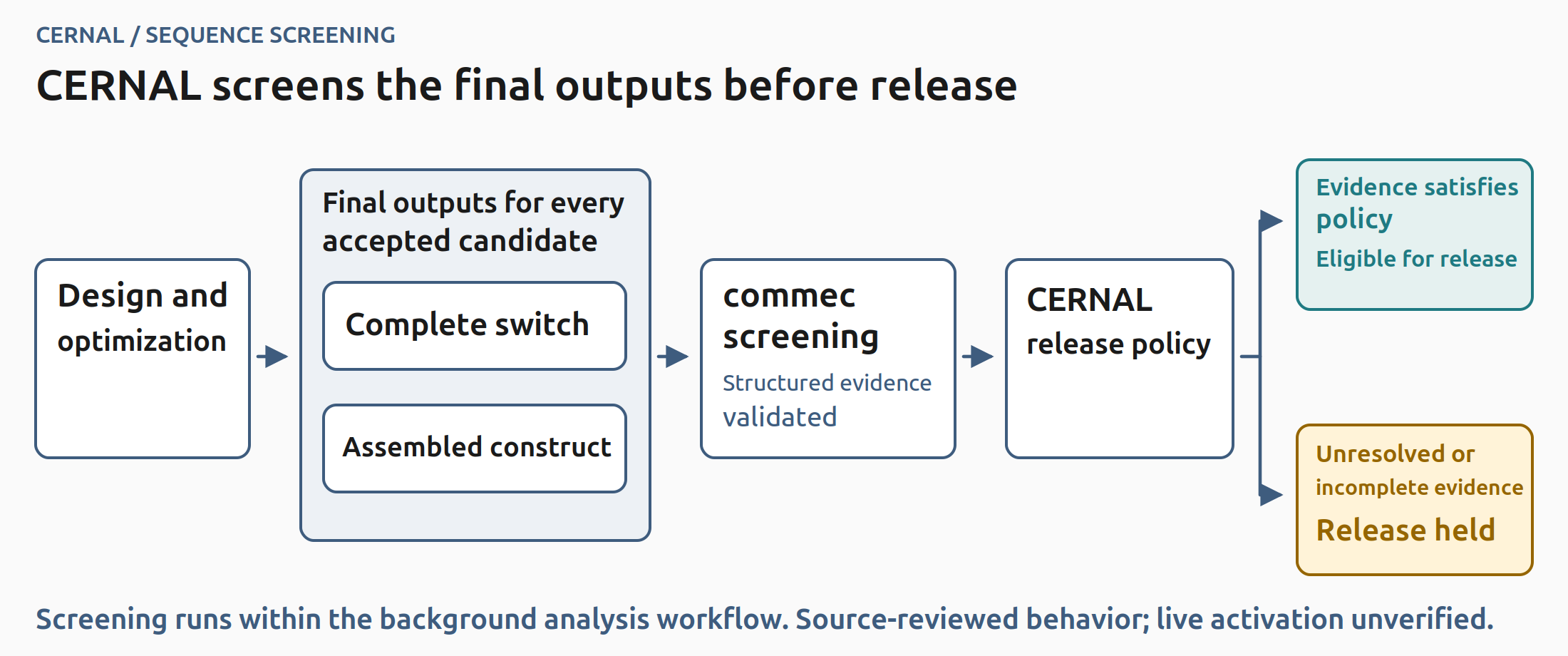
- After design and optimization, both the complete switch and assembled construct are screened for every accepted candidate.
- commec runs inside the existing background analysis job; structured evidence is validated.
- CERNAL policy permits eligibility only when the final sequences have consistent evidence.
- Unresolved concerns or incomplete evidence hold release.
How to interpret a result
Common Mechanism provides a human-readable HTML report and structured JSON evidence. The reports retain findings and the information used to interpret them. CERNAL then applies its own release policy to that evidence; the policy is separate from the screening algorithm. Output documentation
A cleared finding can remain visible
The reviewed policy accepts consistent native results of Pass, Warning (Cleared), and Flag (Cleared). Clearance requires supporting low-concern evidence and consistent stage results; the biorisk stage must remain Pass. A cleared result can therefore retain a warning or flag annotation while being eligible under CERNAL’s policy. The annotation is preserved rather than silently erased. Native-result interpretation
Unresolved warnings and flags block release. Missing, malformed, stale, or inconsistent evidence produces a system hold, as do timeouts and process errors. Empty search results alone are insufficient. Release decisions
“Eligible for release” describes the outcome of this software policy. It is not a claim of universal biological safety, a regulatory authorization, or a replacement for a synthesis provider’s assessment.
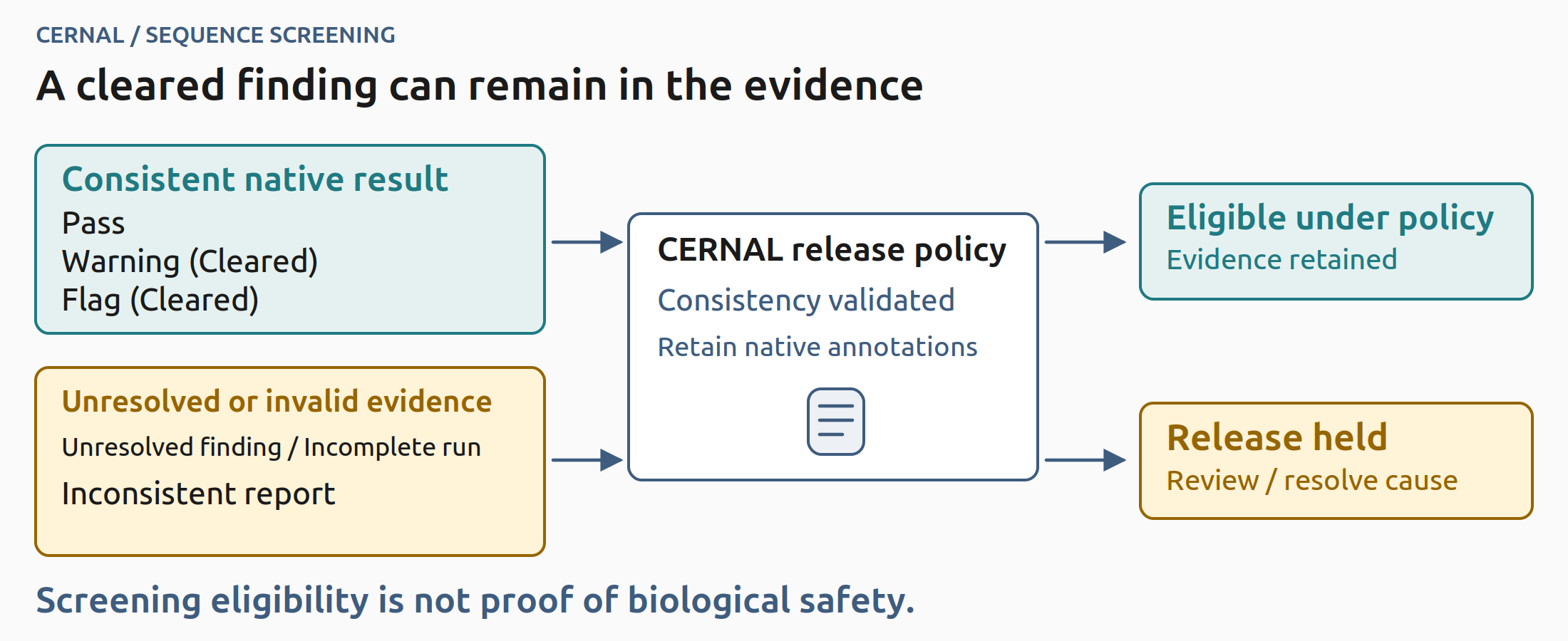
- Consistent Pass, Warning (Cleared) or Flag (Cleared) results can be eligible under policy.
- Cleared findings require supporting evidence and consistent stages; the biorisk stage must remain Pass.
- Unresolved findings, incomplete runs and inconsistent reports hold release.
- Native annotations are retained. Eligibility is not proof of biological safety.
Evidence and reproducibility
Reference databases and control lists change as knowledge and guidance develop. Screening results are therefore tied to the software version, database revisions, input sequence, and configuration used at the time. The v2 tools support recovering the database revisions associated with an earlier output, helping make results reproducible. Version 2 transition guide
CERNAL checks its declared software and database inventories before and after screening. It also validates the report’s sequence identities, database revisions, and effective configuration. Audits retain sequence and result digests, provenance, decisions, reasons, and the validity window. Integrity checks · Audit fields
What has been demonstrated
A recorded isolated benchmark on 18 October 2026 exercised real Common Mechanism screening in an MG1655/mCherry design run. It screened an 83-base switch and a 958-base linear expression cassette without a vector backbone. The switch received native Pass and the cassette Flag (Cleared); both satisfied CERNAL’s release policy. Export verification confirmed that the FASTA and GenBank sequences matched the screened identities. Benchmark acceptance record
The complete generation, screening, and export run took 271.06 seconds on resource-limited laptop WSL using two screening threads. This is one measured run, not a general runtime guarantee or a sensitivity and specificity benchmark. Its database revisions were biorisk 1.2, best_match 1.0, low_concern 1.1, and control_lists 1.1. An earlier missing-tool-path failure held release rather than authorizing export. Benchmark acceptance record
The benchmark used a one-hour, benchmark-only manifest and was not installed into a production service. It predates the final parser tightening; subsequent regression tests revalidated the recorded native result. It must not be presented as a fresh full-tool run on the reviewed revision or proof of live deployment. Benchmark evidence
What screening cannot establish
Screening depends on the reference information available and the searches performed. Unknown or insufficiently represented functions may not be recognized, and findings can require contextual interpretation. A match does not establish harmful intent; the absence of an unresolved match does not prove safety.
Sequence screening also does not verify the identity or legitimacy of a user, determine the intended experiment, or replace institutional biosafety review. IBBIS provides separate customer-screening resources because these are distinct questions. IBBIS FAQ
These limits are why CERNAL treats screening as an additional release safeguard and preserves the evidence behind the decision.
References
[1] Safety Unit, Tel Aviv University. Safety areas. Retrieved 15 September 2026, from https://en-safety.tau.ac.il/about-safety-unit-english-lobby
[2] World Health Organization. (2020). Laboratory biosafety manual (4th ed.). https://www.who.int/publications/i/item/9789240011311
[3] iGEM Foundation. White List. https://responsibility.igem.org/guidance/white-list
[4] National Institutes of Health. NIH Guidelines for Research Involving Recombinant or Synthetic Nucleic Acid Molecules, Section III-F-8 and Appendix C-II (exempt Escherichia coli K-12 host-vector systems). https://osp.od.nih.gov/policies/biosafety-and-biosecurity-policy/
[5] American Type Culture Collection. 293T (ATCC CRL-3216). https://www.atcc.org/products/crl-3216
[6] Centers for Disease Control and Prevention & National Institutes of Health. Biosafety in Microbiological and Biomedical Laboratories (6th ed.). https://www.cdc.gov/labs/bmbl/index.html
[7] Occupational Safety and Health Administration. (1994, June 21). Applicability of 1910.1030 to established human cell lines (standard interpretation). https://www.osha.gov/laws-regs/standardinterpretations/1994-06-21
[8] iGEM Foundation. Working Safely. https://responsibility.igem.org/guidance/working-safely
[9] iGEM Foundation. Safety Policies. https://responsibility.igem.org/safety-policies