
EngagementContribution
Contribution
A homemade PCR buffer for proofreading polymerases
Cheaper than commercial buffers, and optionally pre-colored so PCR products can go straight onto a gel.
Background
In an iGEM project, teams usually work on short deadlines and tight budgets. Because of this the most valuable resources for an iGEM team are working time and funds. It is essential to find ways to improve the speed of your workflows and to try to minimize costs. One of the biggest cost factors in molecular biology are the enzymes used and their respective reaction buffers. A great way to save costs is to express and purify your enzymes yourself and look for homemade alternatives for their reaction buffers. During our project, we started expressing and purifying enzymes ourselves and experimented with self-made buffer alternatives. One of our main focuses has been the proofreading polymerases, commonly used for polymerase chain reactions (PCRs) in any work involving molecular cloning, and we were especially focused on their reaction buffers. We established a homemade buffer alternative in our lab and also experimented with pre-colored buffer alternatives, like the commonly used pre-colored reaction buffers for Taq DNA polymerase, saving time on our PCRs by eliminating the need to add loading dye to each PCR sample. This solution is a cost-effective alternative to commercially available premixed buffers and saves time, especially when conducting large-scale PCR assays. As our contribution to the iGEM community, we would like to share our findings after almost a full year of optimizing our buffer recipe so future iGEM teams can also save money and time when conducting their PCRs.
Protocol for preparing the buffer
For preparation of the buffer (Table 1), mix TAPS, potassium chloride and magnesium chloride in a reaction tube. Optionally add Ficoll 400 and cresol red for a precolored reaction buffer. Add approximately 80 % of the final volume of deionized water and dissolve the reagents. Once dissolved, adjust pH to 9.3 using potassium hydroxide. After the pH is adjusted, add the 2-mercaptoethanol and fill with deionized water to the final volume. Finally, sterile-filter through a filter with a pore diameter of 0.22 µm to avoid contamination.
Table 1: Contents of the PCR reaction buffer as well as their concentrations in the 5x concentrated reaction buffer and in the final PCR reaction. Ficoll 400 and cresol red can optionally be added for a precolored buffer, which can be directly loaded for gel electrophoresis. TAPS = Tris(hydroxymethyl)methylaminopropanesulfonic acid
| Reagent | Concentration in the reaction buffer (5x) | Concentration in PCR reaction (1x) |
|---|---|---|
| TAPS | 125 mmol/l | 25 mmol/l |
| Potassium chloride | 250 mmol/l | 50 mmol/l |
| Magnesium chloride | 10 mmol/l | 2 mmol/l |
| 2-mercaptoethanol | 5 mmol/l | 1 mmol/l |
| Ficoll 400 | 5 % | 1 % |
| Cresol red | 0.1 % | 0.02 % |
Documentation
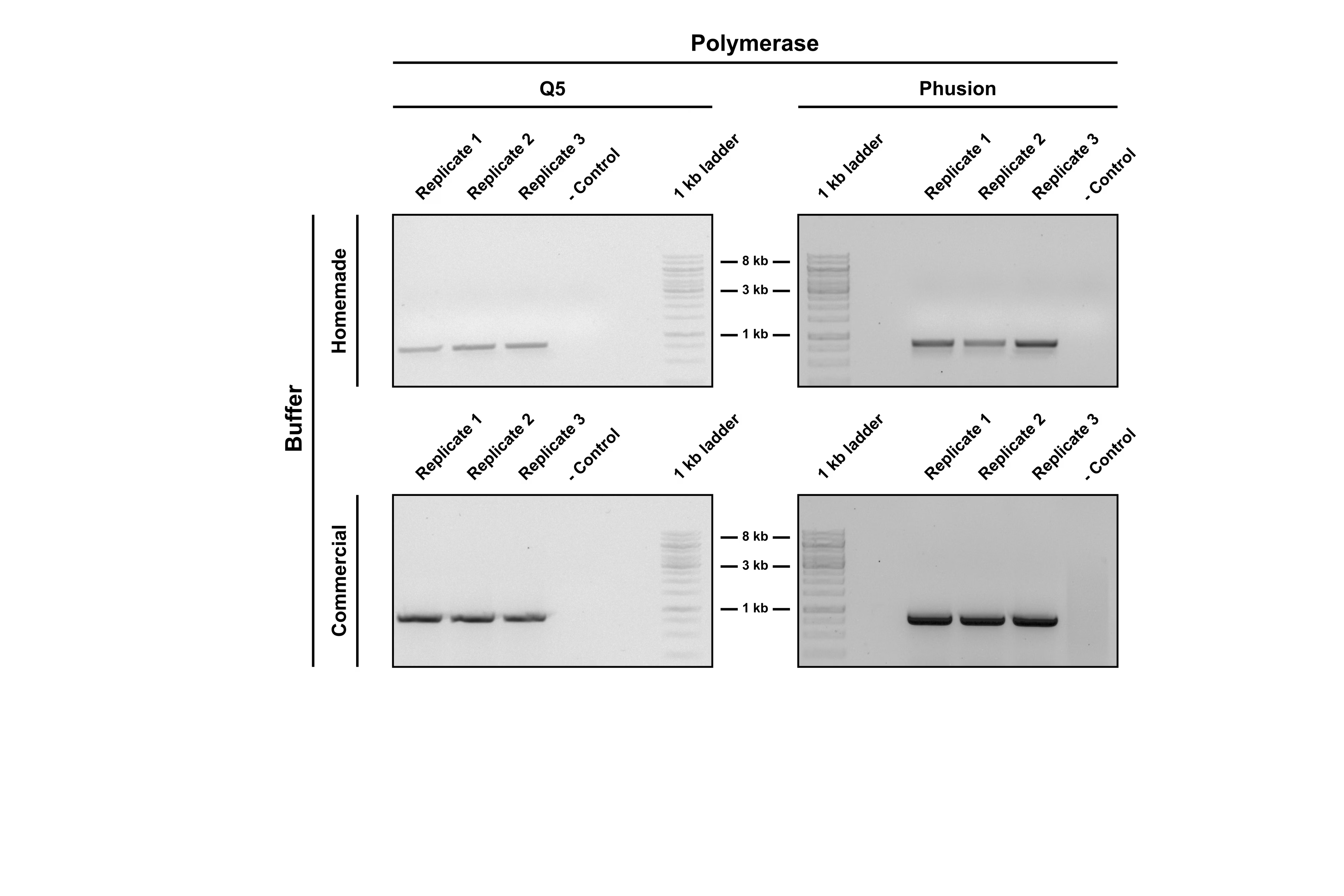
The buffer’s performance was tested using Q5 DNA polymerase (NEB) and Phusion DNA polymerase (Thermo Fisher Scientific) and compared against the performance of the buffer supplied by the company from which the polymerase originated. The PCR was performed using the primers 5’-ACTGCATAATTCTCTTACTGTCATGCCA-3’ and 5’-GAATGGCGCCTGATGCG-3’ on 5 pg of pUC19 plasmid as template, resulting in an expected amplicon size of 800 bp (Table 2 & Table 3). The results of multiple test runs are shown in Figure 1.
Table 2: Reagents and their concentrations in the PCR mix used for verification of buffer function. dNTPs = deoxynucleoside triphosphates; Primer fwd = 5’-ACTGCATAATTCTCTTACTGTCATGCCA-3’; Primer rev = 5’-GAATGGCGCCTGATGCG-3’
| Reagent | Amount [µl] |
|---|---|
| 5x reaction buffer | 5 |
| dNTPs [5 µmol/l each] | 1 |
| Primer fwd [10 nmol/l] | 1 |
| Primer rev [10 nmol/l] | 1 |
| Polymerase | 0.2 |
| Deionized water | 15.8 |
| Template [5 pg/µl] | 1 |
Table 3: Standard PCR program used for verification of buffer function with the primers 5’-ACTGCATAATTCTCTTACTGTCATGCCA-3’ and 5’-GAATGGCGCCTGATGCG-3’.
| Step | Temperature [°C] | Duration [mm:ss] | Cycles |
|---|---|---|---|
| Denaturation (initial) | 98 | 02:00 | |
| Denaturation | 98 | 00:15 | 35x |
| Annealing | 68 | 00:30 | |
| Elongation | 72 | 00:30 | |
| Elongation (final) | 72 | 02:00 |
Cost Accounting
Cost accounting was performed to validate the claim that the homemade buffer is much cheaper than commercial alternatives.
The buffers are compared against the 5x Q5 reaction buffer (6 €/ml) and the 5x Phusion HF buffer (5.20 €/ml) sold by New England Biolabs.
It is assumed that all Chemicals needed are acquired at CarlRoth and in the smallest ordering volume (the smaller volumes are less cost-effective).
The cost accounting is performed for the non coloured buffer option, as the commercial variants are also colourless.
All numbers are rounded up to the fourth decimal to favour the commercial option.
TAPS can be acquired for 17.50 € per 10 grams; 0.0305 grams are needed for 1 ml of 5x concentrated PCR buffer, costing 0.0534 €.
Potassium chloride ≥99,5 %, p.a., ACS, ISO can be acquired for 9.90 € per 10 grams; 0.0187 grams are needed, costing 0.0186€.
Magnesium chloride hexahydrate ≥99 %, p.a., ACS can be acquired for 19.90 € per 250 grams; 0.0021 grams are needed, costing 0.0001 €
2-Mercaptoethanol can be acquired for 18.90 € per 100 ml; 0.0005 ml are needed, costing 0.0001 €.
The final cost of the homemade buffer is 0.0722€ per ml; the commercial alternative for Q5 buffer at 6€ per ml is 83.1025x more expensive and the commercial alternative for Phusion buffer at 5.20€ per ml is 72.0222x more expensive.